On 13 February 2024, UN High Commissioner for Human Rights Volker Türk urged EU leaders to approve a ground-breaking agreement on business and human rights, amid reports that support for the measure may now be in question in the European Council.
“The adoption of the Corporate Sustainability Due Diligence Directive would show historic leadership by the EU at a time when global leadership in support of human rights is needed more than ever,” said Türk.
“For the past four years, work on the Directive has seen unprecedented involvement by many stakeholders, including business and my Office, as well as political commitment from EU institutions and Member States to push it forward. This process has truly raised hopes of ensuring more effective management of human rights risks by large companies.”
“For the Directive to fail now would be a massive blow,” he said.
The EU-wide Directive would require certain large EU and non-EU companies to take reasonable steps to identify and address adverse human rights risks.
“Human rights due diligence is feasible and supports sustainable business processes that deliver long-term value to society at large. And for those reasons it also makes eminent business sense,” said Türk.
Many of the companies that would fall within the Directive’s scope have backed its adoption. It would create a level playing field by harmonizing disparate rules across jurisdictions.
“The agreement on the Directive is reported to be substantially aligned with the UN Guiding Principles on Business and Human Rights and other relevant international human rights standards. I am convinced the Directive can make a positive contribution to respect for human rights, and its adoption would send an important message of solidarity to those at risk from business activities,” the UN Human Rights Chief said.
A vote on the Directive is possibly due later this week.
Haroon Siddique in the Guardian of 15 February 2024 relates the story of lawyer Adil Meléndez Márquez who received a call from his bodyguards 20 minutes after receiving the Sir Henry Brooke award from the Alliance for Lawyers at Risk. Meléndez is no stranger to death threats, but things have just got a lot scarier. With bitter irony, 20 minutes after receiving the Sir Henry Brooke award from the Alliance for Lawyers at Risk, his bodyguards called him to say that they had been stood down from, leaving him without protection.
In an interview with the Guardian in London, Meléndez said he is a human rights lawyer who hails from among those he represents. He is Afro Colombian and works predominately on cases for Afro Colombians and Indigenous communities, often in areas under the control of paramilitaries rather than the government. He was kidnapped when he was 12 so has first-hand experience of the violence which blights the country and has received threats since becoming involved with Movice (movement of victims of state crimes) in 2006. See also: https://humanrightsdefenders.blog/2014/02/12/death-threats-in-colombia-on-the-rise-again/
After receiving threats Meléndez took a case to the Inter-American Commission on Human Rights – an organ of the Organization of American States – which, in 2009, ordered Colombia to provide him with protection. For the first eight years this amounted to three personal bodyguards and a bulletproof car, then the bulletproof car was removed and later one of the bodyguards, leaving him with two until last week, he says.
Meléndez describes his work as taking on “politicians, business interests, cattle ranchers, the armed forces and paramilitary groups”.
He expands: “Rampant corruption and violence is taken advantage of by [foreign] companies. They operate in such a way that it denies the rights of communities because all they’re interested in is the exploitation of natural resources. It means that they don’t have to provide compensation or justice for the communities because the rule of law, the writ of law doesn’t apply.”
One of the projects Meléndez has been helping to resist is the upgrading of the 115km Canal del Dique in Colombia’s Caribbean region, which he helped to get temporarily suspended. He believes that proper consultation was not carried out prior to the project, as is required by law and it involves “the privatisation of rivers which are the source of life of the Afro-descendent communities”. He said that as a result of the suspension he was called an “enemy of development” by a Colombian minister, words he claims were echoed by the the paramilitary group and notorious drug cartel, Autodefensas Gaitanistas de Colombia (AGC), also known as the Gulf Clan.
While he counts Colombia’s president, Gustavo Petro, the country’s first leftist head of state, as a friend and acknowledges his lack of control over swathes of the country, at the same time he says disapprovingly: “President Petro speaks in international fora about the protection of the environment but in his own country his government is awarding contracts to a project that is damaging to the environment.”
Meléndez does not blame Petro for the removal of his bodyguards, believing it was the work of someone lower down the food chain, but he believes it is for the president to ensure they are reinstated. Not doing so would put the government in breach of the Inter-American Commission on Human Rights, he says. “I have had to stop all my activities at the moment and it’s possible even that I will have to make the decision not to return to Colombia,” says Meléndez.
However, he hopes that the prize he was presented with in London, which he calls a reward for “the rebellious and those in resistance”, might offer a degree of protection. “This prize raises my profile,” he said. “It provides evidence that I’ve got support from the international community. The organised criminal actors or others who are against me, they calculate the consequences of their actions and so the calculation now includes a much higher level of risk for them if they make a decision to act against me.”
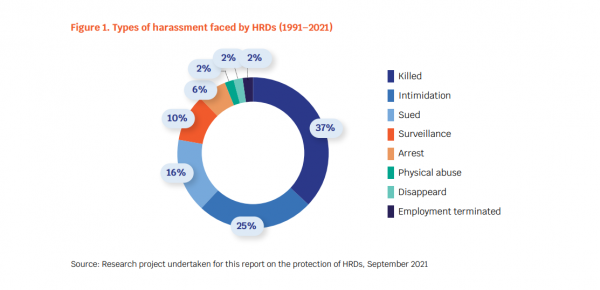
A new UN report claims that, between 2001 and 2021, 30% of outspoken Thai activists experienced violence resulting in a loss of life, by the businesses against which they had campaigned. Released by the United Nations Development Programme (UNDP), on 11 February 2024, the report says that businesses have used legal action, intimidation and violence to silence human rights defenders.
The categories of abuse faced by human rights defenders, per the report.
Activists, affected villagers and attorneys are among the groups considered to be human rights defenders in the report. Over the last 25 years, businesses filed 109 lawsuits against human rights defenders. 68.9% of these were by those with stakes in the mining, livestock and energy industries.
One anonymous interviewee said the lawsuits are used as strategic roadblocks and that they found themselves “going to court approximately once a month, incurring expenses and losing time.” Outside of the judicial system, human rights defenders were reportedly spied upon, or threatened with violence and job loss.
“After making a turn in my car, someone fired shots at me,” claims another anonymous interviewee, adding “I was in the orchard, a single home in the orchard. It was dark. Five shots were fired. I did not report the case, thinking it was an act of intimidation.”
4% of human rights defenders have died or been forcibly disappeared in the 25 years covered by the report, published on February 12th, the International Day for the Prevention of Violent Extremism.
In 2015, Thailand pledged to work towards the fulfilment of the UN’s 17 Sustainable Development Goals (SDGs), alongside other members of the organisation. SDG 16, one of the goals, asks countries to “uphold peace, justice and strong institutions,” and another, SDG 10, aims for “reduced inequalities”.
The report recommends that government and relevant agencies recognize the status and importance of human rights defenders and develop measures that protect them from violence and harassment.
On 15 February 2024 AP carried the story that Venezuela’s government has ordered the local UN office on human rights to suspend operations, giving its staff 72 hours to leave, after accusing the office of promoting opposition to the South American country. The UN office was established in Caracas in September 2019.
The foreign affairs minister, Yván Gil, announced the decision at a news conference in Caracas on Thursday. Gil’s announcement came on the heels of the detention of the human rights attorney Rocío San Miguel, which set off a wave of criticism inside and outside Venezuela.
The South American country’s government said it had made a decision “to suspend the activities of the technical advisory office of the UN high commissioner for human rights and carry out a holistic revision of the technical cooperation terms”.
The government said the UN human rights office must rectify its “colonialist, abusive and violating attitude”, accusing it of playing an “inappropriate role” in the country and supporting impunity for people involved in attempts at assassination, coups, conspiracies and other plots.
The Venezuelan government regularly accuses members of the political opposition of plotting takeovers or the assassination of President Nicolas Maduro, all accusations vehemently denied by opposing parties and their members.
“We regret this announcement and are evaluating the next steps. We continue to engage with the authorities and other stakeholders,” said UN human rights office spokesperson Ravina Shamdasani. “Our guiding principle has been and remains the promotion and protection of the human rights of the people of Venezuela.”
Venezuelan state television on Wednesday harshly criticized comments by the UN’s special rapporteur on the right to food, Michael Fakhri, who just concluded a visit to Venezuela. Fakhri had said in a statement the government food program does not tackle the root causes of hunger and is susceptible to political influences.
San Miguel was taken into custody on Friday at the airport near Caracas while she and her daughter awaited a flight to Miami. Authorities did not acknowledge her detention until Sunday, and as of Wednesday her attorney had not been allowed to meet with her.
San Miguel’s daughter, ex-husband, two brothers and former partner were also detained following her arrest. Of them, only her former partner remains in custody.
On 5 February 2024, the Swedish Government adopted a new five-year strategy for development cooperation for human rights and freedoms, democracy and the rule of law. This strategy is an important part of the implementation of the Government’s new reform agenda for development assistance and contributes to free and inclusive democratic societies built on respect for human rights and freedoms.
Democracy, human rights and freedoms, and the rule of law are essential for freedom, security and the continued development of society. At the same time, we see storm clouds gathering. Democracy is in decline for the seventeenth consecutive year, which gives rise to increased oppression and conflicts. Russia’s full-scale invasion of Ukraine is a clear example of this.
Another is the way authoritarian states are undermining fundamental human rights and freedoms and using new digital technology for oppression and to spread disinformation.
“With this strategy, the Government is placing greater emphasis on the individuals around the world who fight for their freedom every day. We want to help those living under oppressive systems. Unfortunately, we see that democracy is headed in the wrong direction. That’s why Sweden has to do its part. We will do what we can to support the positive forces that exist,” says Minister for International Development Cooperation and Foreign Trade Johan Forssell.
The strategy outlines the Swedish Government’s increased focus on supporting defenders of human rights and democracy, free elections and independent journalism, in comparison with the previous strategy. The allocated budget for the strategy in 2024 is SEK 900 million. This budget is set out by the Government each year.
The Gulf Centre for Human Rights (GCHR) is working with journalists in the Middle East and Northern Africa to investigate various violations affecting the safety of journalists and their ability to do their work.
Shutterstock
“I find myself wishing there was more protection [for investigative journalists], a sense of safety and even simply just hope. I watch in awe as they investigate crimes that they unfortunately know they could well be victims of in the future, or in some cases already have been.“ Zaynab Al-Khawaja, GCHR’s Journalists Protection Coordinator, working with journalists conducting the investigations
With a strong gender focus, the GCHR ensures that the majority of the investigations are carried out by women, empowering them and shedding light on cases involving women.
One investigation highlights the story of an anonymous woman journalist who quit her job and relocated due to sexual harassment. She writes:
A large proportion of society is aware of widespread harassment in the streets, resulting from an exacerbated hypermasculinity. However, statements by several Iraqi women journalists confirm that this phenomenon did not spare women in press and media outlets, forcing a considerable number of them to quit journalism for good.
The investigation also reported that 41% of women journalists in Iraq have been victims of harassment, forcing 15% to leave their jobs and 5% to quit their profession for good.
This data aligns with UNESCO’s Chilling report, revealing increasing offline and online attacks against women journalists, including stigmatization, sexist hate speech, trolling, physical assault, rape and murder.
Another investigation looked into the imprisonment and silencing of journalists, some facing fabricated allegations of sexual harassment. GCHR collaborates with the NGO Vigilance and 40 partners on a joint appeal to end the persecution and detention of journalists and human rights defenders exercising their right to freedom of expression. GCHR also supported a journalist in the Middle East investigating the case of a disappeared journalist in Syria.
Since 2022, GCHR and UNESCO have joined forces to support investigative journalism, reducing impunity for crimes against journalists and enhancing their safety through the Global Media Defence Fund. Established in 2019, this fund has supported over 120 projects globally, directly benefiting over 5,000 journalists, 1,200 lawyers and 200 non-governmental organizations.
In 2022, UNESCO published recommendations on addressing violence against women journalists, based on The Chilling, a global research project by UNESCO and the International Center for Journalists (ICFJ). All reports related to this project are available here on UNESCO’s website.
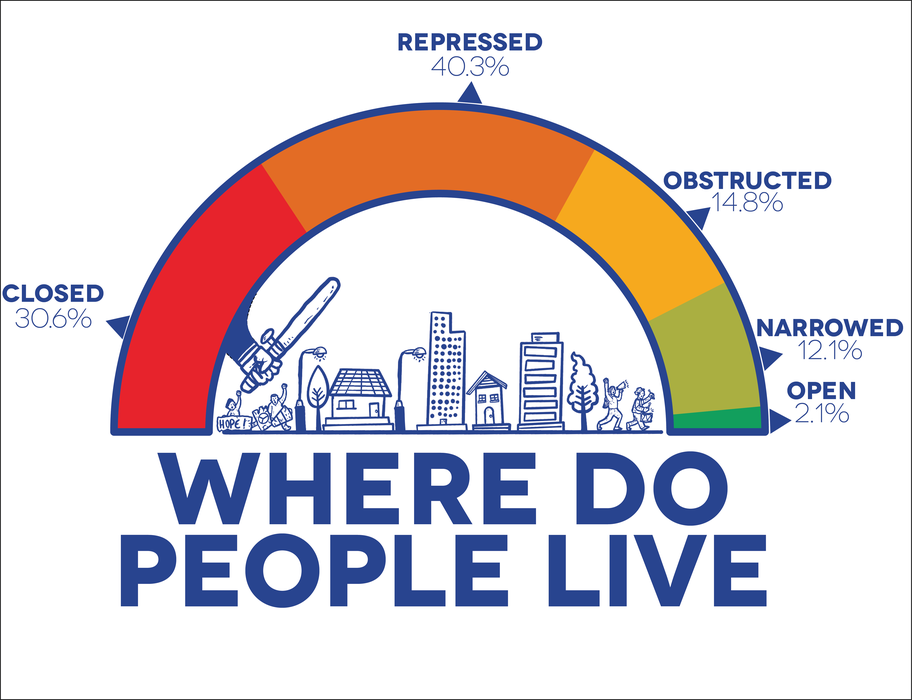
Almost a third of the world’s population now lives in countries with closed civic space. This is the highest percentage since 2018, when CIVICUS began systematically tracking civic space conditions around the world. This startling decline – from 26 per cent living in closed countries in 2018 to 30.6 per cent today – points to a major civic space crisis that requires immediate, global efforts to reverse. This year we also recorded the lowest percentage of humanity living in open countries, where civic space is both free and protected. Today, just two per cent of the world’s population enjoys the freedom to associate, demonstrate and express dissent without significant constraints, down from almost four per cent just five years ago.
Since the previous edition of this report, which covered 2022, civic space ratings have changed for 12 countries over the last year, worsening in seven countries and improving in five.
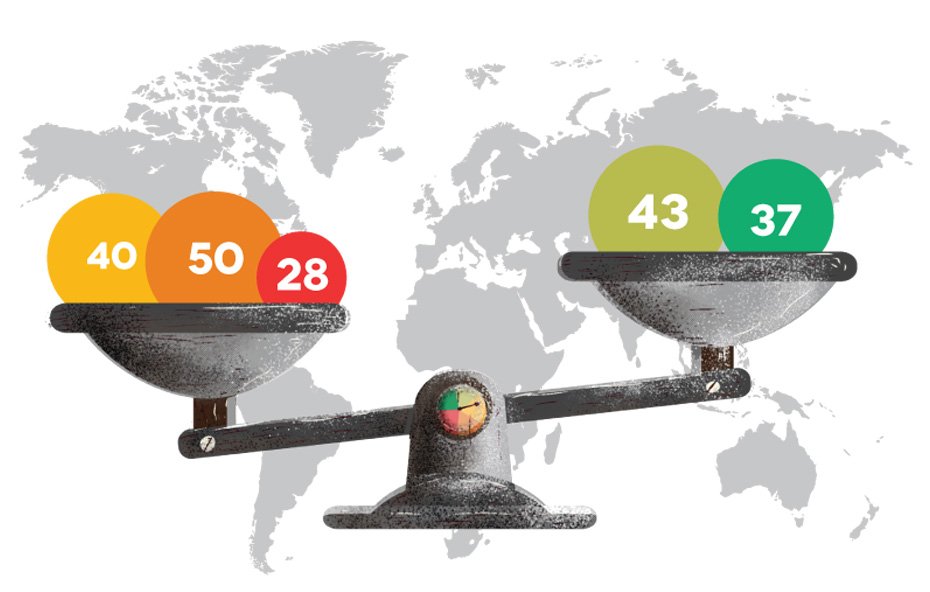
The latest CIVICUS Monitor country ratings update in December 2023 indicates that civil society faces an increasingly hostile environment. There are now 28 countries or territories with closed civic space, 50 with repressed civic space and 40 with obstructed civic space, meaning that 118 of 198 countries and territories are experiencing severe restrictions in fundamental freedoms. In comparison, 43 countries have narrowed civic space and just 37 have an open rating.
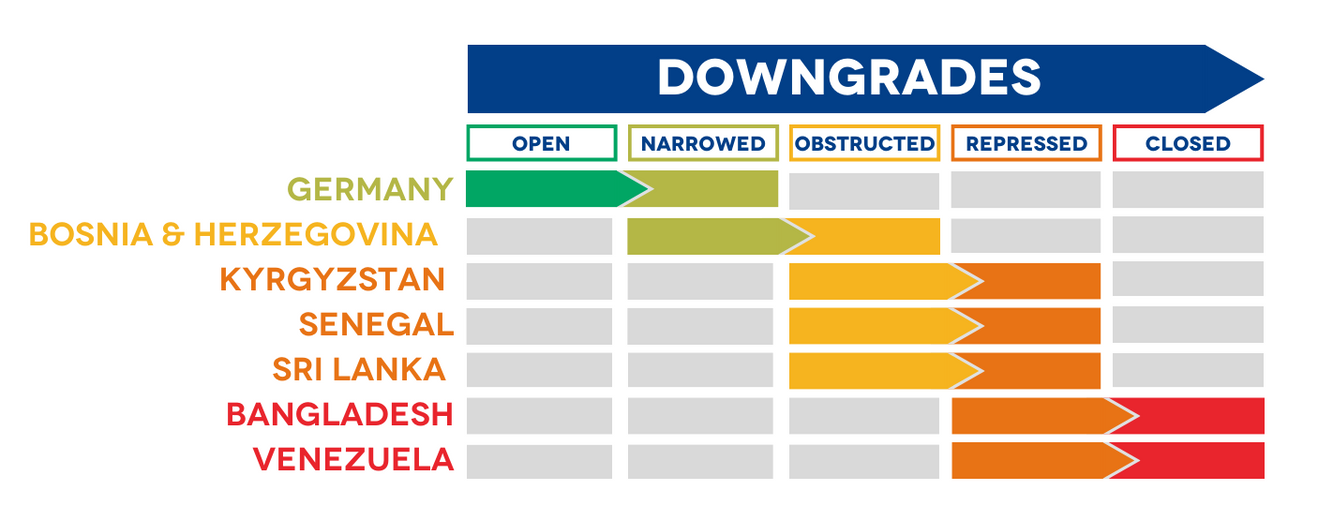
The severity of the civic space deterioration is exemplified by the number of countries moving to the repressed or closed category. Of the seven countries being downgraded, five moved to the two worst categories. Bangladesh and Venezuela are now rated as closed and Kyrgyzstan, Senegal and Sri Lanka are downgraded to the repressed rating as conditions for civil society continue to worsen.
Europe continues to add to the list of downgraded countries, with Bosnia and Herzegovina now placed in the obstructed category and Germany moving from an open to a narrowed rating. Over the past six years, 12 European countries have seen their ratings downgraded due to deteriorating civic space conditions.
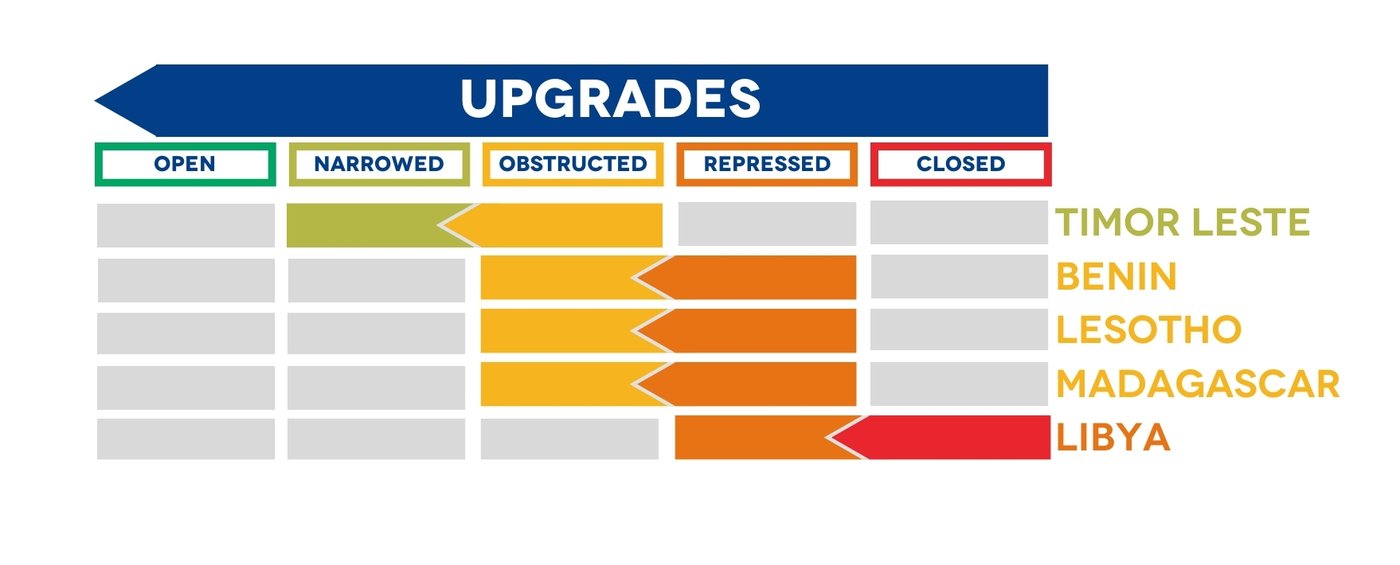
Five countries have upgraded ratings in 2023, although, as in previous years, the situation for civil society in these countries continues to be challenging. Libya moved from the closed to the repressed category. Benin, Lesotho and Madagascar have moved from the repressed to the obstructed category. Notably, Timor-Leste has joined the narrowed category. Regional sections describe the conditions that led to ratings changes.
Justice & Peace Netherlands is launching its new call for applications for human rights defenders at risk to participate in Shelter City Netherlands. The deadline for applications is 28 February 2024 . Shelter City is a global movement of cities, organizations and people who stand side by side with human rights defenders at risk. Shelter City provides temporary safe and inspiring spaces for human rights defenders at risk where they re-energize, receive tailor-made support and engage with allies. The term ‘human rights defender’ is intended to refer to the broad range of activists, journalists and independent media professionals, scholars, writers, artists, lawyers, civil and political rights defenders, civil society members, and others working to advance human rights and democracy around the world in a peaceful manner. From June and September 2024 onwards, several cities in the Netherlands will receive human rights defenders for a period of three months. At the end of their stay in the Netherlands, participants are expected to return with new tools and energy to carry out their work at home.
Application forms must be submitted by 28 February 2024. An independent commission will select the participants. Note that selected human rights defenders will not automatically participate in Shelter City as Justice & Peace is not in control of issuing the required visas to enter the Netherlands. For more information, please contact us at info[@]sheltercity.org.
Naw Hser Hser and Maggi Quadrini wrote in the Diplomat of 31 January 2024 how 3 years after the Myanmar coup, women Human Rights Defenders remain at the forefront
Three years have passed since the military coup in Myanmar. Since then, the resistance movement has flourished into an inspired example of people’s power and the defiance of authoritarian forces. In the eyes of the military, the hijacking of the 2020 general election and subsequent coup attempt was an easy conquest. They thought that violence and their long-practiced orders of “shoot to kill” would silence the civil unrest that immediately followed. It soon became clear that the generals gravely underestimated the will of the country’s people, who refused to inherit another era of military rule. The people’s rejection of the junta has been widespread and notable for the prominent role played by women in the revolution against military rule.
While the political, social, and armed aspects of the revolution have shifted, what has remained constant is the unwavering participation and leadership of women who have defied patriarchal systems, including gender stereotypes, and set an unquestionable new standard of what is possible for women and girls in Myanmar.
Women human rights defenders are resisting the military dictatorship in different ways despite the many challenges they face. They remain resilient and unwavering in their quest to see the fall of the junta. During these difficult times, women and girls, especially those from ethnic areas, including the Rohingya as well as those who identify as LGBTQ, have faced more forms of violence, including domestic assaults, sexual violence, rape, being coerced into sex work, and human trafficking.
No reliable justice mechanisms exist in Myanmar that can bring perpetrators to court and ensure accountability. Facing a myriad of barriers that prevent and undermine women’s participation, women human rights activists have defied the patriarchal systems promoted by the Myanmar military, which have been used to influence a culture that does not see women as equals.
Rather than submit to the military junta and its patriarchal dictates, women have increased their participation in various facets of the pro-democracy movement. The women’s rights movement has also become more intersectional than ever. Women from urban and rural backgrounds, different ages, ethnic groups, and religions have united in their shared goal of defeating the Myanmar armed forces, quashing the patriarchy, and ensuring gender equality.
In the immediate aftermath of the coup, many women human rights defenders were forced into exile. Many fled to border areas, their names rapidly reaching the top of the lists of those wanted by the junta. This also put a target on their family members. The threat of unlawful arrest and the possibility of torture and death has taken an immense strain on women fighting the military. Yet they have continued to resist the junta’s tactics of intimidation and terror in pursuit of a gender-equal future for Myanmar that is free from military rule.
Women human rights defenders have refused to adhere to Myanmar’s patriarchal status quo in many ways. This was evident through their strong participation in the Civil Disobedience Movement (CDM), where many female majority professions, including garment workers, health care providers, teachers, engineers, police, and even those in the military, quit their jobs following the attempted coup and refused to work for the junta. The Gender Equality Network has estimated that women comprise over 60 percent of frontline protest leaders and roughly 70 to 80 percent of the CDM’s leaders…
Women have been actively involved in resolving the many struggles of this revolution, including in the political, social, and armed arenas. However, there is still a lack of funding support and a lack of recognition within the resistance of women’s roles. There is also a lack of women’s participation in decision-making.
Findings from a new report called “Triple Resistance,” released this month by the Women’s League of Burma (WLB), a community-based organization working on the rights of the country’s women, revealed that despite the risks facing women human rights defenders, including threats to their physical and digital security, they have not been discouraged. On the contrary, they remain committed to seeing an end to military rule – something that is only possible through the participation of women. Of the women interviewed for WLB’s report, nearly 100 percent are involved in humanitarian work, and 50 percent have taken on new roles in the political arena, particularly as federalism becomes more established.
Women-led organizations are driving relief efforts on the ground, particularly in conflict-affected areas of Myanmar. These organizations provide services for victims of gender-based violence, counseling, food kits, and dignity kits, including menstrual care items and materials for expectant or new mothers. In Karenni State, where the capital city is being attacked relentlessly, the Karenni National Women’s Organization is continuing its operations to ensure displaced and vulnerable communities receive urgently needed humanitarian assistance and access to safe houses as gender-based violence rises.
Similarly, in Karen State, the Karen Women’s Organization works with its networks to ensure the swift and secure delivery of aid through cross-border channels effectively and efficiently to meet the needs of displaced groups, the majority of whom are women and children.
In addition, as local leadership across ethnic states and regions in Myanmar adopt federal bodies and institutions, women have participated in leadership capacities and have been central to forming a new federal Myanmar. For example, in Karenni State, women occupy several positions in the Karenni State Consultative Council, the Ta’ang Political Consultative Council, and other locally-driven bodies, as well as in People’s Administration Teams and village administrations.
Women leaders bring decades of experience working with armed actors and rights groups to provide security and protection for their communities. Their leadership must be recognized, encouraged, and accelerated. Without women, there is no sustainable development and consideration of gender perspectives during operations, service provision, or other political developments.
At an international level, governments and donors must understand that knowledge and expertise on locally-led challenges and solutions come from lived experiences and trust, which women and ethnic people can speak to. Global actors must recognize the efforts of women human rights defenders who continue to defy the status quo to ensure that the fall of the military junta will also lead to substantial improvements in gender equality. To do so, they must reinforce their commitment to amplify civil society organizations, including women-led initiatives. This new political space must be supported in order to hold the military junta accountable, at the International Criminal Court, if not in Myanmar itself.
In short, support of gendered programs, and for women’s participation more generally, is an integral part of the struggle against the military junta. Whether on the frontline, in political positions, or the classroom, women make up the substance of the revolution and are gradually carving out a new, progressive Myanmar. They deserve the world’s support.
On 31 January 2024 several NGOs – including HRW and AI -came out in support of a bill in the US Senate. Senator Ben Cardin introduced the Human Rights Defenders Protection Act of 2024, which aims to protect individuals abroad “who face reprisals for defending human rights and democracy.” The law, if enacted, would strengthen the US government’s ability to “prevent, mitigate, and respond” to such cases.
Senator Cardin said this legislation “will help elevate, guide, and enhance US efforts to support these courageous individuals globally at a time when their efforts are more important than ever.”
HRW said: The bill would integrate support for rights defenders into various US policies and programs and encourage engagement with the private sector. It aims to improve assistance for rights defenders living in exile from their home countries and strengthen US tools to hold perpetrators of rights abuses accountable.Human Rights Watch has long documented the risks, threats, and attacks that rights defenders across the globe face. In Rwanda, for example, the government for many years has targeted with impunity rights defenders at home and extended its repression beyond its borders to silence Rwandan critics living abroad. Last December, the Emirati government brought new charges under its counterterrorism law against 87 activists and dissidents, including imprisoned rights defender Ahmed Mansoor.
The proposed legislation would create a new US visa for rights defenders who face a “credible fear of an urgent threat,” allowing those who qualify to reach safety before they are detained or harmed. It would also increase the number of US government personnel dedicated to democracy and human rights issues in the federal government and at embassies in countries with a high risk of rights abuses.
Andrew Fandino, Advocacy Director for the Individuals at Risk Program at Amnesty International USA. stated: “The Human Rights Defenders Protection Act of 2024 is a critical piece of legislation that will help strengthen and improve the U.S. government’s ability to support human rights defenders around the world,” ..“With over 401 human rights defenders killed globally in 2022 alone, now more than ever, human rights defenders need this additional support and protection.”
If passed, the legislation would require the US government to establish a “Global Strategy for Human Rights Defenders.” The strategy would survey current tools and resources to support human rights, identify how the government would prioritize and bolster protections for rights defenders, and establish specific goals for implementing the legislation’s policy objectives. This would link to the existing EU Guidelines on Human Rights Defenders (2008), and the OSCE Guidelines on the Protection of Human Rights Defenders (2014) and those of a small group of European countries.