Posts Tagged ‘Human Rights Defenders’

Luon Sovath speaks out on Radio Free Asia

November 10, 2012

On 7 November the activist monk Luon Sovath, MEA Laureate of 2012, spoke to Radio Free Asia about his work.

As the interview is quite interesting I copied here in in full:

Fresh from receiving the “Nobel Prize for Human Rights,” Cambodia’s technology-savvy activist monk Loun Sovath has called on authorities in his country to end the use of violence in land eviction cases, vowing to continue his struggle to protect victims of land grabs. He also said he would not be cowed by government harassment and called on his fellow monks, often respected as figures of moral authority in Cambodia, to join in the struggle to defend villagers who have become victims of forced evictions. Loun Sovath was the first Southeast Asian to be presented with the 2012 Martin Ennals Award for Human Rights Defenders as he was selected for documenting the struggle of land rights activists and ordinary citizens evicted from their homes in his impoverished country. The monk collected the award—viewed by many as the Nobel Prize for Human Rights—in Geneva last month.

“The Buddha advised people to do good deeds both physically and mentally,” he told RFA’s Khmer service during an interview in Washington on Wednesday. “Respecting human rights is a good deed which will lead to peace and prosperity for this world and in the next. So for monks to become rights defenders is nothing against Buddhism, but can lead to enlightenment and peace.” “Monks play a vital role in society. I appeal to monks to rise up to follow in the Buddha’s footsteps,” he said. Loun Sovath  said the Cambodian people must also rise up to demand their rights, highlighting land disputes as the one of the biggest issues facing the public in the country.

“The authorities must stop using violence against innocent villagers who are the victims of land grabbing,” he said. Research by Cambodian rights group LICADHO shows that some 2.1 million hectares of land has been given to private companies in the form of land concessions over the last two decades. The massive transfer has led to countless forced evictions and affected over 400,000 people in the 12 provinces that LICADHO monitors since 2003 alone, the group said.

Sovath is currently touring the U.S., meeting with the Cambodian community and addressing various nongovernmental organizations on the human rights situation in his country. He began his nearly two-month visit last week in New York, traveled to Washington, and arrived in Chicago Thursday. Sovath said he was honored to receive the Martin Ennals Award.

“I was given the award because I have worked as a rights defender and a protector of social justice involved with land issues, forced evictions, and the protection of natural resources and wildlife,” he said. In June 2011, the New York-based Human Rights Watch awarded Loun Sovath with the Hellman/Hammett grant for his work supporting communities facing forced evictions and land-grabbing in Cambodia.
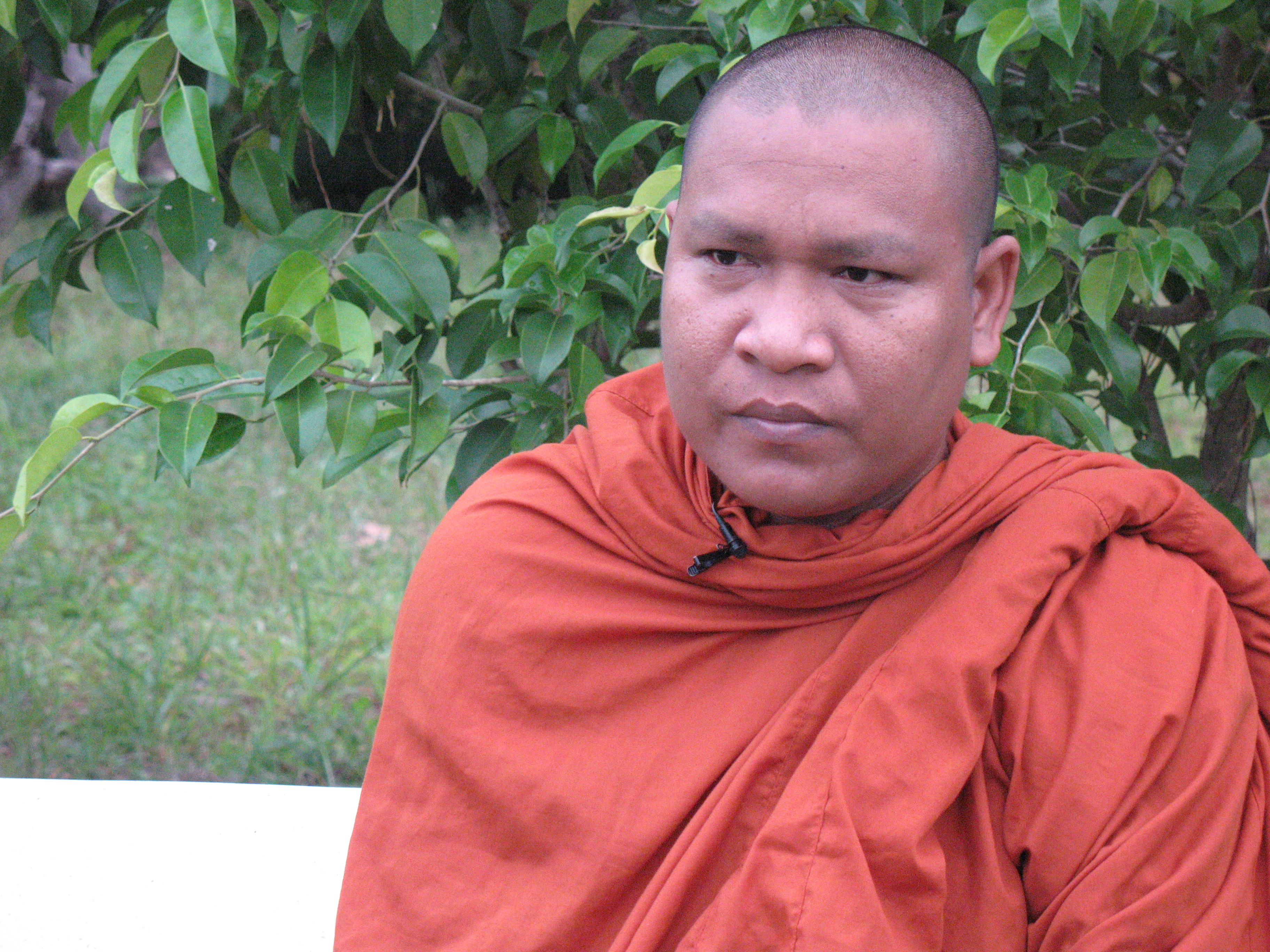
Luon Sovath by Dovana

Years of activism Sovath first became involved in human rights work in 2009, when members of his family were injured during a police shootout at unarmed villagers in a land eviction case. The monk’s brother and nephew were wounded in the standoff, which he documented in a video. He is known for his extensive use of video to inform the world about his confrontations with authorities, earning him the nickname “multimedia monk.” The monk is rarely seen without a mobile phone or tablet. He also uses songs and art to spread his non-violent message of defending human rights. Loun Sovath said he strove to protect human rights in the interest of his country. “I have a desire to help build Cambodia,” he said. In June, Loun Sovath was briefly detained by Cambodian authorities and accused of “causing instability” after he joined protests against the jailing of 13 women over a long-running forced land eviction case in the capital Phnom Penh. Municipal monk officials threatened to have him defrocked as a monk, but released him after he put his thumbprint on a statement assuring that he will not join future protests. Loun Sovath had been banned in April from entering pagodas in Phnom Penh after he participated in land protests.

Sovath, who has since participated in various protests, said he would not stop his activism even though he was concerned about his personal safety. “The authorities have tried to prevent me from doing good things and from helping the country and [the Buddhist] religion,” Sovath said. “I can’t accept this because I have done nothing wrong,” he said. “As long as human rights violations continue to exist in Cambodia, I will continue to do my work.”

Reported by Samean Yun for RFA’s Khmer service. Translated by Samean Yun. Written in English by Joshua Lipes.

Copyright © 1998-2011 Radio Free Asia. All rights reserved.

“Carrying the Ideal” film on women HRDs in Nepal

November 8, 2012

Women human rights defenders in Dhanusha, a district in Nepal’s southern Terai region, are often subjected to threats and attacks due to their work. In the summer of 2010, Peace Brigades International, a non-governental organization working for the protection of Nepalese human rights defenders since 2006, visited Dhanusha to profile their struggles, as well as to bring to light the special needs of women human rights defenders across Nepal.
“Carrying the Ideal: Women Human Rights Defenders” documents the courageous and often dangerous work of women defenders carried out in a climate of impunity and injustice and in a social strata supportive of caste and gender discrimination.

via “Carrying the Ideal” English on Vimeo.

South Sudan: UN Condemns Expulsion of Its Human Rights Investigator

November 6, 2012

On 4 November, All Africa reports that the United Nations Mission in South Sudan (UNMISS) condemns the expulsion of its human rights officer who carried out investigations into human rights situations in the young nation. The Head of the UN office in Juba described it as a “breach of legal obligations” of the country.   (The expelled official, identified as Sandra Beidas, was reportedly given 48 hours by South Sudan’s Ministry of Foreign Affairs and International Cooperation to leave the country.) Her expulsion is probably linked to a UN report of August, which accused South Sudan army (SPLA) of incidents of torture, rape, killings and abducting civilians during the civilian disarmament campaign in South Sudan’s Jonglei State.

….

In recent months, similar reports from Amnesty International and locally-based civil human rights group in the country have accused South Sudan’s security forces of human rights violations in the country, allegations the government has repeatedly denied. However, already in August last year the former head of the United Nations human rights division in South Sudan, Benedict Sannoh, was badly beaten and taken from his hotel room by 10 South Sudanese police officers. The police left the UN official at a hospital after he was beaten, kicked and punched him while he was “in a sustained fashion while he was in a fetal position on the floor” the UN said at the time.

allAfrica.com: South Sudan: UN Condemns Expulsion of Its Human Rights Investigator Page 1 of 2.

Fars News Agency: Javad Larijani Blasts Double-Standard Policies on Human Rights in Iran

November 1, 2012


Official Blasts West’s Double-Standard Policies on Human Rights in Iran

TEHRAN (FNA)- Secretary of Iran’s Human Rights Council Mohammad Javad Larijani rapped the West’s double-standard policies and stances on human rights issues, saying that western states shelter terrorist groups like the anti-Iran terrorist Mojahedin-e Khalq Organization (MKO) and award them in the name of defending human rights.

Our people are familiar with the West’s discriminatory and hostile attitude towards the Islamic Republic of Iran,” Larijani said in a meeting with Head of Iran-Germany Parliamentary Friendship Group Bijan Jirsarayee in Tehran on Wednesday. 

Larijani rapped the double-standard polices and behavior of the western states towards the human rights issues in Iran. 

On one hand, the western states shelter and support terrorist groups like the MKO … and cooperate with the US in imposing unilateral sanctions against Iran which have inflicted great losses on the Iranian people and is a blatant violation of human rights, and on the other hand, they suddenly emerge as advocates of human rights and grant awards to culprits in Iran as if they are defenders of human rights, he added. 

The European Parliament announced that this year’s winners of the Sakharov Prize for Freedom of Thought are two Iranian culprits (!ed), lawyer Nasrin Sotoudeh and film director Jafar Panahi. Sotoudeh is now imprisoned in Iran for security crimes and Panahi is a fugitive living outside Iran.

The rest of the article is one long rambling statement against the MKO and the support it gets from the West (read for yourself if you want to) but with the marvelously inconsistent quotation of …Human Rights Watch, one of the NGO regularly denounced as a stooge of the same West..

A May 2005 Human Rights Watch report accused the MKO of running prison camps in Iraq and committing human rights violations. According to the Human Rights Watch report, the outlawed group puts defectors under torture and jail terms.”

Fars News Agency :: Official Blasts Wests Double-Standard Policies on Human Rights in Iran.

Photo exhibit on HRDs hits Stockholm – Speak Truth to Power

November 1, 2012

A exhibition at a Stockholm museum features portraits of human rights activists from around the world. The “Speak Truth To Power” exhibition, which recently opened at the Fotografiska Museum in Stockholm, features portraits by the late Pulitzer Prize-winning American photographer Eddie Adams.  “When you see the photo exhibition you suddenly understand that human rights are not abstract,” Gabor Gombos of the UN Disability Rights Committee tells The Local. “It is very concrete in terms of activities and in terms of human rights defenders,” he adds. Gombos is one of several activists featured in the exhibit, which will remain at the museum until late November.

CTRL/CLICK HERE FOR A COLLECTION OF PHOTOS FROM THE EXHIBITION

The exhibition, which also features portraits of more well-known activists such as the Dalai Lama and Desmond Tutu, advocates for “courage without borders” in an effort to raise awareness about the power of human rights.
“‘Speak Truth To Power’ combines the power of arts and education to bring attention to continuing human rights abuses and to demonstrate the capacity of an individual to create change.” The exhibition is based on a book by Kerry Kennedy, daughter of late US attorney general Robert Kennedy, called “Speak Truth to Power” which contains a set of interviews with human rights activists from around the globe.

Sanne Schim van der Loeff

Human rights photo exhibit hits Stockholm – The Local.

Threats against women’s rights advocate Denis Mukwege in DRC mobilize medical community

October 30, 2012

I am referring to this blog post by Dr Jocalyn Clark because it is so good to see that the medical community comes out to support a Human Rights Defender in DRC and considers the attack on him as “another wake-up call for us all”.

Last Thursday evening, as many of you will have seen via media reports, a true hero of women and human rights Dr Denis Mukwege narrowly escaped death during an assassination attempt on his life that killed his security guard. Amnesty International is now rightly calling for a full investigation and asking whether his recent criticisms of the Congolese government played a role. Attacks against human rights defenders and humanitarian workers are said to be increasing in DRC, where conflict has raged for years. Denis Mukwege, winner of many international accolades including the UN Human Rights Award, has long championed the rights of women and highlighted to the world the extent and the brutality of systemic rape against women in the conflict zones of DRC…”

Threats against women’s rights advocate Denis Mukwege are another wake-up call for us all | Speaking of Medicine.

Defamation campaign and threats against human rights defender Tolekan Ismailova

October 26, 2012

On 14 October 2012, TV channel LTR broadcast a program in which human rights defender Ms Tolekan Ismailova was depicted as spreading propaganda for homosexuality in Kyrgyzstan and being destructive to Kyrgyz values. Similar accusations were published in several Kyrgyz-language newspapers. Ms Tolekan Ismailova is the director of Human Rights Centre ‘Citizens Against Corruption’. These accusations refer to the documentary ‘I Am Gay and Muslim’, which was part of the human rights film festival Bir Duyno – Kyrgyzstan (One World  Kyrgyzstan), organised annually in Bishkek. The documentary was scheduled to be shown on 28 September 2012 in Bishkek. The film explores the problematic issue of gay rights in the Islamic world, taking the example of Moroccan young men who speak about their sexual and religious identity.

On 26 September 2012, the organisers of the festival had received phone calls and text messages threatening them with physical harm while the director of the cinema was threatened that the building would be set on fire unless the film’s screening was cancelled. Dublin-based Front Line Defenders condemns the smear campaign and threats against Ms Tolekan Ismailova and the other organisers of the human rights festival, and is concerned for their physical and psychological integrity and security.

For actions see: https://www.frontlinedefenders.org/node/20249/action


This information was received through the International Secretariat of Women Human Rights Defenders International Coalition. 

Are Political Islamists in the UAE Human Rights Defenders?

October 26, 2012
An Arab blogger, Sultan Sooud Al-Qassemi, posted on 25 October a relevant article in AL-Monitor. It poses the always tricky question of the ‘definition’ of a Human Rights Defender, but even more the valid question of human rights policy. Why would the international community put priority or energy into defending those whose human rights credentials are below par? Not speaking Arabic myself, I cannot refute the many examples given by the author. Anybody who can is welcome to enlighten us. In the meantime it is not more than fair to put on record the detailed accusations in the long article, including writings and tweets by Hassan Al Diqqi. Why the author does not give similar examples from other islamists is a good question.  Also there is the weakness that the article does not give examples of those activists in the UAE that the author would consider real human Rights defenders, which makes the article look like a apology for the UAE’s govenrment. I just have to mention the cases of  Ahmed Mansoor, blogger and member of  ANHRI’s (Arab Network for Human Rights Information); Nasser bin Ghaith, an economist, university lecturer and advocate of political reform; and three online activists Fahad Salim Dalk, Ahmed Abdul Khaleq and Hassan Ali al-Khamis, which featured in my blog on 18 July. 

The article itself has some strong language:

For almost two years, the UAE’s political Islamists have been referred to in the West as human rights activists. No doubt, they are indeed activists with an agenda but there is also no doubt that they are not our version of Nelson Mandela, nor is their vision for the country that of the Magna Carta. I have been following their rhetoric — in Arabic — over the past few months on social media with great concern. I have found it to be xenophobic; anti-Semitic; sectarian; exclusionary; racist toward Asians, Africans and other Arabs and overall repugnant.

 ………………………

Nothing exposes the ignorance of non-Arabic-speaking writers than when they comment on the current events in the UAE without taking the time to read what is written. Referring to the political Islamists as “human rights defenders” is an insult to human rights activists all over the world and the equivalent of calling Greece’s Golden Dawn, Holland’s Freedom Party led by Geert Wilders or Hungary’s Jobbik Party as human rights platforms. If outsiders want to champion the UAE’s political Islamists, they should at the very least refer to them as they truly are: right-wing, exclusionary political movements. Vote for Geert Wilders if you like, just don’t call him a human rights defender.

see full piece: UAE Political Islamists Are Not Human Rights Defenders – Al-Monitor: the Pulse of the Middle East.


CIVICUS Letter to the Special Rapporteur on HRDs in Pakistan

October 26, 2012

CIVICUS (a worldwide civil society alliance) wrote on 17 October 2012 a letter to the UN Special Rapporteur on Human Rights Defenders, Mrs. Margaret Sekaggya. Triggered by the recent shooting of the girl Malala Yousafzai, the letter details other such attacks on women HRDs in Pakistan.

for the full text go to:

CIVICUS Letter to the Special Rapporteur on Human Rights Defenders.

“Only washed wounds will heal”: HRDs from 39 countries discuss Transitional Justice in Latin America

October 24, 2012

Event at the Resistance Memorial, the site where political prisoners were held and tortured during the dictatorship. It was the stage of a debate attended by almost 100 activists and academics from around the world on October 18, 2012

More than 60 human rights defenders from 39 countries gathered at the Resistance Memorial, in São Paulo, to discuss issues related to “Transitional Justice” – in reference to the processes of transition from dictatorship to democracy. The debate was part of the 12th International Human Rights Colloquium, organized by Conectas and being held in São Paulo since Monday.

Two specialists on the subject – Paulo Vanucchi, former Brazilian Human Rights Minister under the Lula da Silva administration, and Gáston Chillier, of the Argentine organization CELS (Center for Legal and Social Studies), presented an overview of how Argentina and Brazil reached the stage of Transitional Justice.

…….Vanucchi defended punishing the military, while pointing out that punishment does not necessarily mean a prison sentence. Vannuchi ended with an expression borrowed from the Chilean President Michelle Bachelet: “Only washed wounds will heal”.

Argentines, Brazilians and human rights defenders from another 39 countries discuss Transitional Justice » Conectas – Human Rights.