Posts Tagged ‘Human rights defender’
January 31, 2013
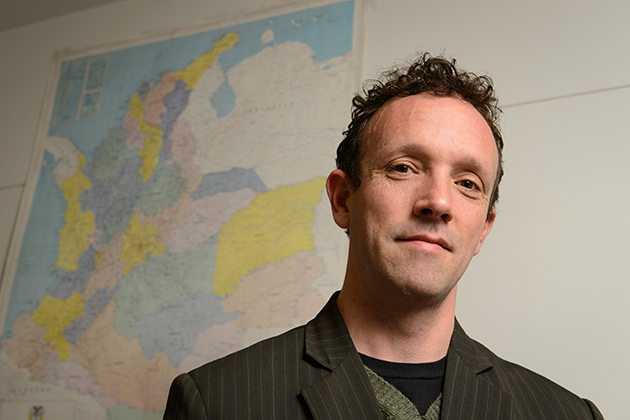
When writing about individual Human Rights Defenders the tendency is to give attention to those in the front line who are in immediate trouble. This time I want to refer to a HRD teaching at the University of Connecticut based on a blog post by Kenneth Best of 30 January 2013. It concerns Luis van Isschot, an assistant professor of history, who specializes in the study of human rights in Latin America ( photo by Peter Morenus/UConn Photo).

Conversation around the dinner table in the van Isschot home in Montreal was a bit different than in most Canadian homes. Growing up with a Spanish, Peruvian, and Dutch family heritage, Luis van Isschot listened to discussions about Latin American history and politics led by his father, a physician who treated families in a clinic based in Montreal’s Latino community…….
…His path to a doctoral degree developed from his volunteer work in Guatemala and later in Colombia, where he served as a human rights observer. It was during his time in Colombia that a friend who was a university professor and a historian told him that one of the most important books of Colombian history was written by a professor from his hometown of Montreal, Catherine Le Grand at McGill University, and that he should look her up. He did, and it led to his enrollment in the doctoral program. “She made it seem that you could be a wonderful teacher, a cutting-edge scholar, and have a balanced life of engagement in your community, and that the Ph.D. was a way of doing that,” van Isschot says. “The university is central to the community, not apart from it. That makes sense to me.”
He later became involved with MEA Laureate 2001 Peace Brigades International, a nonpartisan organization that sends international volunteers to areas of conflict to provide protective accompaniment to human rights defenders threatened by political violence in 11 nations, including in Asia, Africa, and Latin America. In addition to serving as a human rights observer in Colombia, he also traveled to the Great Lakes Region of Africa, doing research in the Democratic Republic of Congo, Rwanda, and Burundi.
“It was a really important experience for me to go somewhere where the language of human rights and social justice and the understanding of history really enriched my own understanding of what I was working on in Latin America,” he says. His experience in Colombia led him to focus his doctoral studies on human rights activities in that nation’s oil capital, Barrancabermeja, where he lived for a year. The city was the center of a major urban war between Colombian paramilitary groups and leftist guerillas. Between 1998 and 2002, in a city of 300,000 there were about 2,000 violent murders. “It was a devastating period. The relationships I made with Colombian human rights activists, teachers, and scholars convinced me that I needed to find some place to explore the issues,” he says.
His book, The Social Origins of Human Rights: Protesting Political Violence in Columbia’s Oil Capital, 1919-2010, is near completion, and scheduled to be published in early 2014. His new research project is titled “When the Courts Make History: the Impact of the Inter American Court of Human Rights in Latin America’s Conflict Zones,” and examines the historical changes set in motion by the pursuit of justice across borders.
http://today.uconn.edu/blog/2013/01/focusing-on-human-rights-with-a-latin-american-perspective/
Posted in human rights, Human Rights Defenders | Leave a Comment »
Tags: Africa, Canada, Colombia, Democratic Republic of Congo, Human rights defender, human rights education, human rights teaching, Latin America, Luis van Isschot, McGill University, PBI, Peace Brigades International, research, University of Connecticut, USA
January 29, 2013
On 28 January 2013, a number of Brazilian civil society organisations and social movements addressed an open letter to the Coordinator of the National Programme for the Protection of Human Rights Defenders (NPPHRD) and the Presidency regarding the security situation for human rights defender Alexandre Anderson de Souza.
Alexandre Anderson de Souza is head of the Associação dos Homens do Mar – AHOMAR (Association of Seamen), an organisation set up to defend the rights of the fisherfolk working in Rio de Janeiro, and particularly those affected by the construction of a gas pipeline for Petrobras. AHOMAR argues that there are reports of environmental permit irregularities in the construction of the pipeline and it will have a negative impact on local flora and fauna as well as on the livelihood of those who fish in those waters in the Guanabara Bay.
Alexandre Anderson de Souza has suffered a number of threats to his life and has been under the NPPHRD since 2009, but the federal government has delegated the responsibility to authorities in the state of Rio de Janeiro, where he and his family live. However, the human rights defender and a number of Brazilian civil society organisations and social movements that support him, have been repeatedly expressing their discontent with the protection offered by the state programme and the conditions in which Alexandre Anderson de Souza, his wife Ms Daize Menezes and their children have been forced to live. As the situation has worsened the human rights defender and his family have had to relocate to different hotels in the city of Rio de Janeiro but the locations were highly insecure. The buildings did not have 24-hour reception personnel and the rooms they were accommodated in had no telephone. The protection programme has been unable to ensure Alexandre and his family’s return to their residence in Magé, and as a result the human rights defender remains unable to resume his work at AHOMAR. Four members of AHOMAR have been killed to date.
Another point of discontent with the state protection programme has been the unsatisfactory level of legal support provided to the human rights defender by the non-governmental organisation (NGO) Projeto Legal (Legal Project). Projeto Legal has signed an agreement with the government of the state of Rio de Janeiro, in the context of the state protection programme, to provide legal support and advice to the human rights defenders included in the programme. After repeated complaints about the NGO’s inaction in several instances, Alexandre Anderson de Souza received information from a reliable source that one of Projeto Legal’s main funders is Petrobras, the same oil company whose actions the human rights defender and his organisation AHOMAR have been trying to hold accountable for environmental damages. The information was confirmed on the websites of both Petrobras and the NGO, but neither they, nor the government of the state of Rio de Janeiro, have clarified the terms of the agreement, raising doubts over the impartiality of the organisation and a conflict of interests.
The open letter signed by several civil society organisation addressed the main concerns of Alexandre Anderson de Souza and other NGOs working with human rights defenders in the country. While welcoming the formal establishment of the state of Rio de Janeiro’s protection programme for human rights defenders through the Decree 44.038 signed on 18 January 2013, the letter asks for Alexandre and his wife Daize, as well as other human rights defenders who are currently under the protection of the state, to have their security ensured by the National Protection Programme until the state protection programme is fully operating and able to fully ensure the safety of human rights defenders in the territory of the state of Rio de Janeiro.
Front Line Defenders is gravely concerned following reports of the vulnerable security situation of human rights defender Alexandre Anderson de Souza and his family, and of other human rights defenders under the protection of the state of Rio de Janeiro. 
http://racismoambiental.net.br/2013/01/carta-aberta-ao-coordenador-nacional-do-programa-de-protecao-aos-defensores-de-direitos-humanos-sr-igo-martini/#more-85964
Posted in Front Line, human rights, Human Rights Defenders | 2 Comments »
Tags: Alexandre Anderson de Souza, Brasil, environmental issues, Front Line, Front Line Defenders, human rights, Human rights defender, Non-governmental organization, Petrobras, protection, threats
January 28, 2013
On 24 January 2013, human rights defender Martha Díaz was targeted again with a death threat.
On 24 January, a package in a manila envelope was delivered to the residence of Martha Díaz, which contained a mass card and note with letters cut from a newspaper. The letters stated: “You are dead, you are a collaborator of the guerilla, we are not joking, one of you is going to die”[translated from Spanish]. On 22 January, the human rights defender had already received a pamphlet sent by a group who identified themselves as “Los Rastrojos”.
Martha Díaz is Director of AFUSODO, an organisation of relatives of victims of extrajudicial executions and a member organisation of MOVICE (National Movement of the Victims of State Crimes). Since its creation, AFUSADO has received some 27 threats. Front Line Defenders issued an urgent appeal https://www.frontlinedefenders.org/node/20842 on death threats received by Martha Díaz on 14 November 2012, and has issued previous appeals on threats against human rights organisations in the Cauca and Valle del Cauca departments.
Posted in Front Line, Human Rights Defenders | Leave a Comment »
Tags: Colombia, Death threat, death threats, Front Line, human rights, Human rights defender, impunity, Martha Diaz, MOVICE
January 26, 2013
The Human Rights House Foundation (HRHF) was informed today by its partners that prominent human rights defenders were arrested in Baku, Azerbaijan, in connection with a protest held on Saturday 26 January 2013:
Hundreds of people have demonstrated in Azerbaijan’s capital to express solidarity with recent protests in the central town of Ismayilli.More than 40 participants to the peaceful protests were detained, including prominent blogger Emin Milli, Rafto Prize winner 2009 Malahat Nasibova, human rights lawyer Intigam Alieyev, as well as investigative journalist Khadija Ismayilova.The arrests happen to come two days after the Parliamentary Assembly of the Council of Europe (PACE) adopted a resolution on the human rights situation in Azerbaijan and called upon the authorities to stop attacks and harassment against human rights defenders. The Azerbaijani human rights defenders present in Strasbourg held a joint press conference in the Council of Europe buildings on Wednesday 23 January 2013.
“By arresting within a crowd of protesters also these prominent human rights defenders, Azerbaijan authorities show that they use detention as a tool to punish critical voices, few days after those critical voices expressed their opinions at the Council of Europe” says HRHF.
Posted in human rights | 2 Comments »
Tags: Azerbaijan, Baku, Council of Europe, Emin Milli, freedom of assembly, freedom of expression, harassment, human rights, Human rights defender, Human Rights Defenders, Human Rights House Foundation, Intigam Alieyev, Malahat Nasibova, Parliamentary Assembly of the Council of Europe
January 25, 2013
Front Line Defenders launched today its 2013 Annual Report on human rights defenders, which rather confusingly in fact covers 2012. It highlights developments in the
situation of human rights defenders in 2012 and analyses the situation in each region of the world. It concludes: “The sad reality is that while governments
proclaim their support for human rights and their respect for the work of human rights defenders in international fora, in practice, human rights defenders face a daily struggle for survival.”
In 2012, Front Line Defenders issued 287 urgent appeals on 460 human rights defenders at risk in 69 countries; it provided 267 security grants and trained 358 human rights defenders.
The Report, currently in English, will shortly be available in French, Spanish, Russian, Arabic and Farsi.The Report is available at
http://www.frontlinedefenders.org/node/21376 <http://www.frontlinedefenders.org//node/21376>
Posted in Front Line, Human Rights Defenders | Leave a Comment »
Tags: 2013, annual report 2012, Front Line Defenders, human rights, Human Rights and Liberties, Human rights defender, Human Rights Defenders
January 25, 2013
In January 2013, detained human rights defenders and Twerwaneho Listeners Club (TLC) members Messrs Gerald Kankya, Simon Amanyire and Gilbert Kayondo were released on bail following a decision by the Public Prosecutor that no evidence existed of defamatory statements made by the individuals against Uganda’s First Family. However, the human rights defenders immediately faced new charges and are scheduled to report to the Fort Portal Police Station on 30 January 2013 for interrogation. The charges include inciting violence, disseminating harmful propaganda, while other charges relate to funding and the operation of programmes of the organisation. TLC is a non-governmental organisation based in Fort Portal that carries out human rights advocacy and monitoring work, including through radio programmes, with a view to holding public leaders more accountable.
On the afternoon of 22 January 2013, police conducted searches of the offices of TLC and of the residences of Gerald Kankya and Simon Amanyire. Two computers were confiscated from the TLC offices, while during the search of Gerald Kankya’s residence, police barricaded the gate of the residence with their vehicle, blocking Gerald Kankya’s wife from gaining access to her home. While searching Simon Amanyire’s residence, police confiscated a number of documents.
For more information on this case, see Front Line Defenders’ appeal http://www.frontlinedefenders.org/node/21363 issued on 23 January 2013, as well as previous urgent appeals and updates documenting instances of harassment of TLC members.
Posted in human rights | Leave a Comment »
Tags: corruption, Fort Portal, freedom of expression, Front Line, Front Line Defenders, harassment, human rights, Human Rights and Liberties, Human rights defender, Human Rights Defenders, impunity, Non-governmental organization, TLC, Uganda
January 24, 2013
The Observatory for the Protection of Human Rights Defenders, a joint programme of the FIDH and OMCT, received information from the local group “Voix des sans-voix pour les droits de l’Homme ” about serious threats against the HRD Philomène Muamba, President of ADDEF ( l’Association pour la défense des droits des enfants et femmes opprimés), based in Kasaï-Occidental. It seems that on 17 January at 03h00 in the morning 3 policemen and 2 military came to the house of Ms Philomène Muamba, in Tshikapa, without any written order. As she was not home, they expressed threats against her little sister. Philomène Muamba then lodged a complaint against X with both the military and civilian prosecutors in Tshikapa.
Since 2011 Philomène Muamba has received several death threats on the telephone along the lines that “you had us arrested and thought we were going to die in jail but …we will bury you”. In 2011 et 2012, she was indeed at the basis of a trial that had led to the conviction of persons who had been accused of several cases of rape. And one should note that on 17 January 2013 around 20h00 several detainees – including men mentioned above – had escaped from the central prison in Tshikapa.
The original report is only in French: http://www.omct.org/fr/human-rights-defenders/urgent-interventions/congo-dem-republic/2013/01/d22133/
Posted in FIDH, human rights, Human Rights Defenders, OMCT | Leave a Comment »
Tags: death threats, FIDH, Human rights defender, impunity, International Federation for Human Rights, Observatory, OMCT, Philomène Muamba, Protection of Human Rights Defenders, rape, Tshikapa, women human rights defenders, World Organisation Against Torture
January 22, 2013
In the framework of its Sponsorship project ‘Defend the defenders‘, OMCT released in January 2013 a portrait of Stanislav Dmitrievsky, prominent Russian human rights defender and Chairman of the Russian Chechen Friendship Society. Mr. Dmitrievsky, who is sponsored by the Swiss Clown Dimitri, is once again facing judicial harassment. As the court summons him for co-authoring the book “International Tribunal for Chechnya”, it is feared that Stanislav Dmitrievsky will have to face criminal charges if the publication is recognized as “extremist material”. Stanislav Dmitrievsky is sponsored by Swiss clown Dimitri in the framework of the OMCT Project Defend the defenders.
Stanislav is a Russian human rights activist, a writer and an editor. He has devoted his life to actively fight against injustice in Russia and North Caucasus. Former Editor-in-chief of the newspaper Pravozaschita (“Human Rights Defense”), he has then been involved in human rights non-profit organisations. He is also involved in the civil society movement against the reportedly unlawful de-listing and demolition of buildings of cultural significance in Russia. He his currently the chairman of the Russian-Chechen Friendship Society (RCFS), a Finland-based NGO. The mandate of the RCFS is to monitor the human rights respect in North Caucasus and especially Chechnya. Regrettably, Mr. Dmitrievsky had to move the originally Russia-based RCFS headquarters to Finland when the Court of Justice of Nizhnii Novgorod shut down the NGO in 2006.
Mr. Dmitrievsky is also a consultant for the Nizhny Novgorod Foundation to Support Tolerance, directed by Ms. Oksana Chelysheva. This Foundation has taken over the work of the RCFS after its closure in Russia, and is now one of the three organisations composing the reconstituted RCFS in Finland. Their collaboration led to the publication of “International Tribunal for Chechnya”, the book currently subjected to investigation about its alleged “terrorist” content.
Posted in human rights | 1 Comment »
Tags: chechen friendship society, Chechnya, Dmitrievsky, Finland, human rights, human rights activist, Human rights defender, North Caucasus, OMCT, OMCT Project Defend the defenders, Russia, Russian Chechen Friendship Society
January 22, 2013
On 12 January 2013 the family of imprisoned human rights defender Gao Zhisheng were permitted a visit to see him ten months after an initial visit on 24 March 2012. A report of this second visit reached Front Line only on 18 January 2013. Gao Zhisheng’s wife, Ms Geng He who is US-based, told Radio Free Asia that her father and brother-in-law saw Gao Zhisheng for 30 minutes on 12 January but were forbidden from asking any “sensitive” questions, including what conditions in prison were like. Gao Zhisheng is being held in China’s remote northwestern Xinjiang Uighur Autonomous Region. Previous attempts by his family for a second visit had been denied by the authorities. According to Geng He, Gao Zhisheng appeared to be ‘relatively well’ and did not need assistance walking. Gao Zhisheng is a human rights defender and self-taught lawyer, and was named one of China’s top ten lawyers by the Ministry of Justice in 2001. He regularly took on cases involving persecution of religious minorities, including Falun Gong practitioners and those associated with the unofficial ‘house church’ movement.

While Front Line Defenders welcomes this recent visit by the family of Gao Zhisheng, it reiterates its continued call on the Chinese authorities to immediately and unconditionally release Gao Zhisheng as it believes he is being detained solely as a result of his legitimate and peaceful human rights activities.
For more information on Gao Zhisheng’s case, see http://www.frontlinedefenders.org/node/17876
Posted in Front Line, human rights | 1 Comment »
Tags: China, Falun Gong, family visit, Front Line Defenders, Gao Zhisheng, Human rights defender, prison, Radio Free Asia, Xinjiang
January 21, 2013
Sudanese teacher and activist Jalila Khamis Koko, who was arrested by the National Security Service in March 2012, was released from detention after a court hearing on 20 January reports Amnesty International.
Jalila was acquitted of all charges except those related to “spreading false news”, a vague provision of the criminal code often used by the government to silence dissent. It is punishable by six months in prison, but the court released her since she had already spent nine months in pre-trial detention. “Jalila’s release is victory for justice but the nine months that she has spent in detention simply for expressing her opinions cannot be ignored,” said Audrey Gaughran, Amnesty International’s Africa program director. “The government must also ensure that she is able to return to her teaching job from which she was unfairly dismissed during the course of her detention.”
Posted in human rights | Leave a Comment »
Tags: Africa, Amnesty International, Audrey Gaughran, Human rights defender, Jalila, Jalila Khamis Koko, National Security Service, Sudan, teacher, woman human rights defender