Posts Tagged ‘Human rights defender’
February 14, 2013

reports that a new hearing on the case of human rights defender Bahtyar Mamedov is scheduled to start on 14 February 2013 at the Court of Grave Crimes in Baku. The human rights defender has been detained since 30 December 2011 on charges of “swindle” and “extortion accompanied by violence”. The trial under the charges of swindle has been ongoing since April 2012, despite a reported lack of evidence to support the case.
Bahtyar Mamedov is a defender of property rights and the legal representative of Baku inhabitants whose houses have been demolished. Bahtyar Mamedov subsequently discovered fraud with money due to be paid as compensation, allegedly involving a military unit commander, Shahin Sultanov. Bahtyar Mamedov was then accused himself of an alleged attempt on his part to extort money from Shahin Sultanov, which he strongly denies. During the initial three-month period ordered by the Court of Grave Crimes to investigate the charges of “extortion accompanied by violence”, no evidence was found to support the charges, yet the case was not closed. The prosecution subsequently opened a second case against Bahtyar Mamedov on charges of fraud. Until 5 November 2012, Shahin Sultanov, the alleged victim of the fraud, had not been questioned by the investigative team and did not respond to the summons to appear before the court. On 15 October 2012, he sent a declaration stating that he did not know Bahtyar Mamedov and that he had lodged a complaint against him according to information received from third persons, and that he has nothing against Bahtyar Mamedov.
Front Line Defenders issued an urgent appeal and an update on the continued judicial harassment faced by Bahtyar Mamedov on 26 October 2012 <http://www.frontlinedefenders.org/node/20381> and 12 November 2012 <https://www.frontlinedefenders.org/node/20745> respectively.
Posted in Front Line, Human Rights Defenders | Leave a Comment »
Tags: Azerbaijan, Bahtyar Mamedov, Baku, Extortion, Front Line, Human right, Human rights defender, Independence of Lawyers, judicial harasment, judicial harassment, legal profession, Property, Shahin Sultanov
February 9, 2013
The Asian Human Rights Commission (regional NGO) reports that two prominent lawyers have been assassinated in targeted killings on 2 February 2013.
 Mr. Malik Jarrar 47, a Supreme Court lawyer, was shot dead in Peshawar, the capital of Khyber Paktoonkha province by unknown persons, riding a motorcycle. He was on his way to pick up his two sons from school. Mr. Jarrar was the former vice chairperson of the Human Rights Commission of Pakistan. Another prominent lawyer, Mr. Mian Muhammad Tariq 55, was also shot dead in similar manner in Karachi, the capital of Sindh province. He was shot dead by unknown assailants when he was parking his car inside his apartment building.
Mr Malik’s was probably a sectarian killing as he was from the Shia sect, the second largest sect of Islam which is under attack by the Taliban and other fundamentalist Sunnis who had declared them as Kafir (infidel) and liable to be killed. In the recent days four prominent Shia were assassinated by unknown persons in Peshawar.
The legal fraternity of the whole country organised a two-day boycott of courts in protest of killings. The lawyers see in the killings of their colleagues the total failure of the government to for maintaining the rule of law in the country.
In the last week four workers of one NGO, HANDS, working to provide health facilities and food rations to poor fisherfolk, were abducted by unknown persons but the government has failed to recover them. Persons who work in favour of human rights, which is deemed contrary to the interests of radical Islamist groups face considerable threat, as may be noted in the killings in 2011 of the Governor of Punjab, Salman Taseer, and the Federal Minister of Minority Affairs, Shabaz Bhatti, who were targeted for their efforts to protect minorities, and their opposition to Pakistan’s draconian blasphemy laws.
So far 87 journalists had been killed in Pakistan since 2000. In the year 2012, eight journalists were killed while performing their official duty.
The irresponsible attitude of the government towards the security and protection of the human rights defenders and the appeasement policy towards the Muslim fundamentalists groups can be judged by the government’s refusal to allow the UN Special Rapporteur on human rights defenders to visit the country. The government, after ratifying the UN ICCPR has accepted a recommendation to do so.
source: http://www.humanrights.asia/news/ahrc-news/AHRC-STM-039-2013
Posted in human rights | 1 Comment »
Tags: Asian Human Rights Commission, human rights, Human rights defender, Human Rights Defenders, lawyers, legal profession, Malik Jarrar, Mian Muhammad Tariq, Non-governmental organization, Pakistan, Pakistan Human Rights Commission, Peshawar, sectarian violence, Shia, Sindh
February 8, 2013
In the aftermath of the killings at Sandy Hook Elementary School in Newtown, Connecticut, at the end of last year, I came across a post that used the word ‘human rights defenders’ to describe those who publicly countered attempts to blame the victims or to scold the teachers for not being religious enough or being too soft. I decided to sit on it for a while as the shock and emotions run too high and is seemed all very political. Now, on reflection I have decided to share it here as it certainly clarifies the climate in which liberal groups (such as People For the American Way) have to operate in parts of the USA. The qualification Human Rights Defenders in the end seems about right to me. The article reads in part:
“..grief stricken and appalled Human Rights Defenders throughout the nation called on citizens Tuesday to reject extremist hate messages American leaders and groups have relayed, as the nation mourns the tragic and horrific loss of 20 children and six adults“, such as “God caused the shooting” and singing “praise to God for the glory of his work in executing his judgment.” [Only hours after the tragedy Shirley Phelps-Roper of the Westboro Baptist Church group’s tweeted: “Westboro will picket Sandy Hook Elementary School to sing praise to God for the glory of his work in executing his judgment.”]
Mike Huckabee and Bryan Fischer (of the American Family Association) both implied that the school shooting occurred on public schools for adhering to the separation of church and state — saying God let the massacre happen because we’ve moved away from things like compulsory prayer (1). Echoing Jerry Falwell and Pat Robertson in the wake of 9/11 (who also, in part, blamed that tragedy on People For the American Way), Focus on the Family’s James Dobson said God has ‘allowed judgment to fall upon us’ because the nation has turned its back on him by accepting things like abortion and gay marriage.”(2). The Tea Party Nation has called the teachers “radicals in the classrooms,” accusing them of being part of a liberal plot to “destroy the family” and create a society that “coddled” the shooter (3).
- http://www.rightwingwatch.org/content/fischer-god-didnt-stop-ct-school-shooting-because-hes-gentleman-who-doesnt-go-where-he-not-w
- http://www.rightwingwatch.org/content/dobson-connecticut-shooting-was-god-allowing-judgment-fall-upon-us-turning-our-back-him
- http://www.rightwingwatch.org/content/tea-party-nation-attacks-teachers-over-ct-school-shooting
The references above provide links to the statements mentioned in the article of 19 December 2012 which can be found in full on : http://www.examiner.com/article/god-did-not-cause-it-human-rights-defenders-say-1
Posted in human rights, Human Rights Defenders | 1 Comment »
Tags: Bryan Fischer, God, gun debate, human rights, Human rights defender, Jerry Falwell, liberal, Newtown, Pat Robertson, People For the American Way, politics, radicals, religion, religious extremism, right-wing, Sandy Hook Elementary School, Shirley Phelps-Roper, Tea Party Nation, United States, USA, Westboro Baptist Church
February 7, 2013
A draft law to criminalise “homosexual propaganda”, currently being considered by the Russian parliament, flagrantly violates international human rights laws and standards, says the International Service for Human Rights (ISHR). The ISHR is particularly concerned that the law will be used to target, intimidate or harass human rights defenders and those who speak out on the rights of lesbian, gay, bisexual, transgender and intersex people. “States have an obligation not only to respect and protect human rights, but also to respect and protect those who stand up and speak out for human rights. Russia’s draft law is manifestly incompatible with this obligation,” said Ms Collister of the ISHR.
ISHR’s statement comes as three United Nations Independent human rights experts have also called on Russian parliament to scrap the draft Bill. In a joint statement issued by the Special Rapporteur on freedom of opinion and expression, the Special Rapporteur on human rights defenders and the Special Rapporteur on the right to health, the experts state, “The draft legislation could further contribute to the already difficult environment in which these defenders operate, stigmatizing their work and making them the target of acts of intimidation and violence, as has recently happened in Moscow.”
For further comment, contact Heather Collister, International Service for Human Rights, on + 41 79 920 3805 or h.collister@ishr.ch.
Posted in human rights | Leave a Comment »
Tags: draft law, freedom of expression, Freedom of speech, health, homoph, human rights, Human Rights and Liberties, Human rights defender, Human Rights Defenders, International Service for Human Rights, legislation, LGBT rights, Moscow, Russia, Special Rapporteur, Special Rapporteur on the situation of human rights defenders, UN Rapporteurs, United Nations
February 5, 2013
On 25 January 2013, the Investigatory Committee of the Republic of Karelia, Russian Federation, resumed the investigation of the criminal case against human rights defender Maxim Efimov. He is charged with “actions aimed at the incitement of national, racial, or religious enmity, abasement of human dignity, and also propaganda of the exceptionality, superiority, or inferiority of individuals by reason of their attitude to religion, national, or racial affiliation, if these acts have been committed in public or with the use of mass media”, under Part 1 of Article 282 of the Criminal Code of the Russian Federation.

Maxim Efimov is Director of the Karelian regional branch of the inter-regional Youth Human Rights Group (YHRG). He is also Chief Editor of the human rights newspaper Chas nol (Hour zero). The above mentioned charges were brought following the publication by Maxim Efimov of an article in early 2012 regarding the Russian Orthodox Church, in which he criticised state sponsorship of the Church.
On 25 January 2013, investigator A A Voronin decided to reopen the investigation against Maxim Efimov and to seek a sixth expert opinion [SIC] on whether the article published by Maxim Efimov contained any illegal statement. The additional expert opinion was ordered on the basis of the alleged insufficient clarify of five previous expert opinions, which all found that the article did not contain any illegal statement. On 1 February 2013, Maxim Efimov sent a letter to the Director of the Investigatory Committee of Russian Federation, A Bastrykin, protesting the reopening of the investigation.
Front Line Defenders reiterates its concern at the risk of criminal prosecution facing Maxim Efimov, and calls on the authorities to immediately and unconditionally drop all charges against him. Front Line Defenders believes that the charges and criminal case brought against Maxim Efimov are solely motivated by his legitimate and peaceful human rights work in the Russian Federation, as is evident by the investigator’s failure to accept the unanimous decision by five previous expert opinions declaring that the article published by Maxim Efimov did not contain any illegal statement.
In May 2012 Human Rights First and other NGOs had already reported on sinister efforts – reminiscent of old Soviet practices – to force activist Maxim Efimov to undergo a psychiatric evaluation in a mental hospital. Ironically, while churchgoers were routinely hospitalized for ‘insanity,” this time it was Efimov’s criticism of the Orthodox Church that triggered his prosecution. Regional human rights group AGORA, whose lawyers represent Efimov, promised to conduct an independent psychiatric evaluation for their client, reminding the government that “the European Court has a clear and unequivocal position in relation to the grounds on which people can be placed in psychiatric hospitals,” which are hardly applicable in this case”. AGORA is preparing to take this case to the Supreme Court of Karelia. http://www.humanrightsfirst.org/2012/05/15/russian-court-to-activist-youre-crazy/
Meanwhile, state pressure on Efimov kept mounting. Two days after an arson attack on the Saint Catherine Cathedral in Petrozavodsk, Efimov was summoned for another round of questioning, and the investigator alleged that the attack was carried out by his supporters—another effort by the government to interfere with his work. Efimov had condemned the attack on the cathedral and sent condolences to congregants and denied any involvement, claiming that his being at the center of this arson investigation is baseless and is yet another example of interference in his daily work as a human rights defender in Karelia.
Posted in Front Line, human rights, Human Rights Defenders | Leave a Comment »
Tags: Efimov, freedom from religion, freedom of expression, Front Line (NGO), Human right, Human rights defender, Human Rights First, intolerance, judicial harassment, Karelia, Maxim Efimov, Non-governmental organization, psychiatric abuse, Russia, Russian Orthodox Church, separation of church and state
February 5, 2013
Having just today reported on the new human rights defenders network created in the Arab world, I would be amiss not to draw attention to the developments of an already existing network in Africa. On 4 February 2013 the Pan-African Human Rights Defenders Network (PAHRD-Net) officially launched from Kampala, Uganda, a 3-year programme totalling 1.8 million Euros to promote a safe legal and working environment for human rights defenders (HRDs) across Africa.
“The tireless and innovative work done at the sub-regional level to protect human rights defenders will now have a dedicated venue at the Pan-African level for mutual support and reinforcement,” said Hassan Shire Sheikh, Chairperson of PAHRD-Net and Executive Director of the East and Horn of Africa Human Rights Defenders Project (EHAHRDP). Today’s launch is the result of a process started in 1998 in Johannesburg (All-Africa Human Rights Defenders Conference) and renewed in 2009 at the follow-up meeting in Kampala.
PAHRD-Net brings together the five sub-regional human rights defenders networks in Africa (the Central African HRD Network, the East and Horn of Africa HRD Network, the North Africa HRD Network represented through the Cairo Institute for Human Rights Studies, the Southern Africa HRD Network hosted by the International Commission for Jurists, and the West African HRD Network) to meet the protection needs of human rights defenders and especially to address the needs of the five groups of most-at-risk: journalists fighting to end impunity and corruption, women human rights defenders, defenders working on issues of sexual orientation and gender identity, HRDs working under oppressive regimes or in armed/post-conflict areas, and HRDs engaging with the resource extraction industries.
Human rights defenders are individuals working alone or through organizations under the goal of promoting respect for universal human rights norms. Frequently HRDs come into conflict with the entrenched local power structures of state and non-state actors through their activism. This conflict can put in jeopardy the security of the HRD and their work and family networks. HRDs are often the victims of harassment, threats, assault, injury, and death across Africa, and many are forced into exile, a move which may effectively end their advocacy for human rights. The consolidation and growth of protection mechanisms within the sub-regions will improve the responses available to mitigate these threats and develop HRDs’ ability to manage their own security effectively.
The European Commission supports the new programme under its global fund for Democracy and Human Rights, which is to underpin the implementation of the European Union Guidelines on Human Rights Defenders
For further information please contact:
Hassan Shire Sheikh – Chairperson, Pan African Human Rights Defenders Network executive@defenddefenders.org
Joseph Bikanda – Coordinator, Pan African Human Rights Defenders Network: Tel +256-312-202133, +256-312-265825, or panafrica@defenddefenders.org
Rachel Nicholson – Advocacy Officer, East and Horn of Africa Human Rights Defenders Project: Tel +256-312-265-824, +256-778-921274, or advocacy@defenddefenders.org
Posted in human rights | 2 Comments »
Tags: Africa, EU Guidelines on Human Rights Defenders, European Commission, Hassan Shire Sheikh, Human right, human rights, Human Rights and Liberties, Human rights defender, Human Rights Defenders, impunity, Johannesburg, journalists, Kampala, PAHRD-Net, Pan-African Human Rights Defenders Network, protection, resource extraction, women human rights defenders
February 5, 2013

The goal of the
International Centre for supporting Rights and Freedoms (ICSRF) is “
the provision of legal assistance to human rights activists in all countries of the world and its commitment to establish a new generation of cadres working in the field of defense of human rights“, although strangely its website
http://www.icsrf.org/ is at the moment only in Arabic and the scope of its activities seems to be restricted to the Arab-speaking world.
The creation of the new network was announced at the conclusion of a regional training course entitled “supporting skills of the defenders of human rights in the Arab countries”, held from 24 to 25 January 2013 in Kuwait with the participation of 32 participants from Kuwait, the UAE, Saudi Arabia, Bahrain and Oman including human rights organizations, human rights defenders and activists monitoring and documenting human rights violations.
The ‘Freedom – Network of Human Rights Defenders’ is established under the management of the International Centre for supporting Rights and Freedoms (ICSRF) and the members of the network will be selected from the participants who attended one of the training courses of the ICSRF or from those who work closely with the ICSRF. They will be trained on how to use international law and communication skills with media – both at the theoretical and practical level – in addition to the role of each member in monitoring and documenting violations. The ICSRF aims to create “a new generation of human rights defenders who are able to practice human rights work in a professional manner in line with the international law and the latest international developments as well as to establish a network of human rights defenders.”
Although everything points more to a regional than an international network, one can only wish them success as the Middle East is a region where Human Rights Defenders require support and freedom.
Posted in human rights | Leave a Comment »
Tags: Advocacy Organizations, Bahrain, freedom, human rights, human rights activists, Human Rights and Liberties, Human rights defender, Human Rights Defenders, human rights organizations, human rights violations, information technology, International Centre for supporting Rights and Freedoms, Kuwait, legal assistance, media, Middle East, network, Oman, protection, Saudi Arabia
February 4, 2013
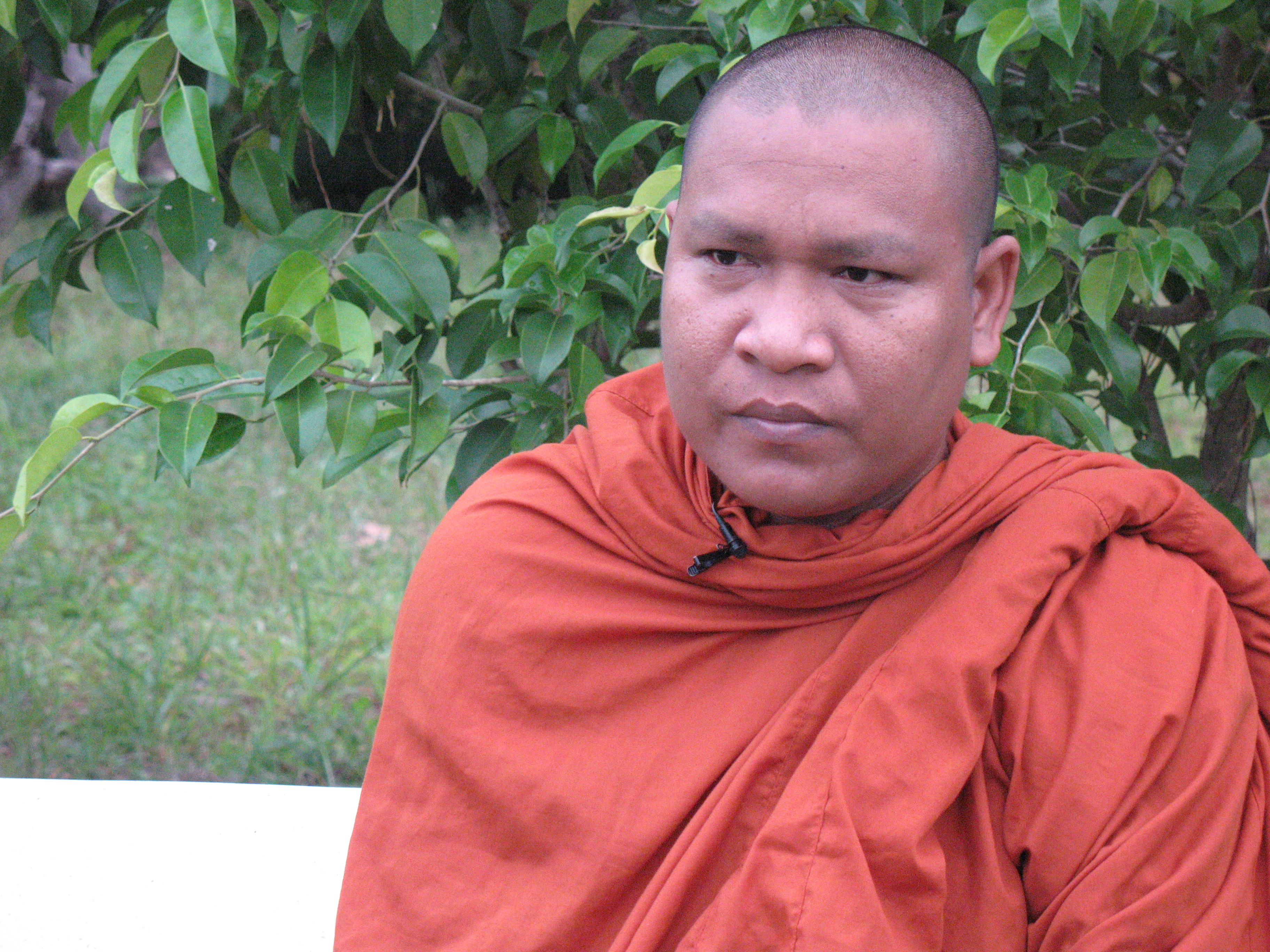
Ever since the monk Luon Sovath became the Laureate of the Martin Ennals Award 2012, I have following events in Cambodia with more than usual interest. And it is clear that the struggle for land rights there is continuing.
Luon Sovath by Dovona
Two Cambodian women human rights defenders were convicted on baseless charges in separate trials on 26/27 December 2012. Yorm Bopha was sentenced to three years in prison. Tim Sakmony from Borei Keila received a six-month sentence, partially suspended, and has been released.
Both women have been prominent in protesting against the forced eviction of their communities. Yorm Bopha was outspoken during the detention of 13 other women activists from Phnom Penh’s Boeung Kak Lake community, who were sentenced for up to two-and-a-half years’ imprisonment in May 2012. Tim Sakmony is one of the representatives of 106 families now living in tents next to the demolished site of the Borei Keila community, also in Phnom Penh. The two women are believed to have been targeted because of their leading roles in peacefully advocating for the right to adequate housing for their communities.
Further information: http://amnesty.org/en/library/info/ASA23/020/2012/en
In this context I want to draw attention to the film maker Chris Kelly and his colleagues. They have been filming in Cambodia for more than three and a half years, following the lives of three extraordinary individuals(including the Venerable Luon Sovath) caught up in the chaos and turmoil of Cambodia’s economic development. Now they are finished filming and starting the editing phase. They have launched a crowdfunding campaign to help raise funds towards the completion of the documentary.Please visit this link to see what they need to raise. If you cannot afford to donate, please help spread the word using your social media platforms, blogs, word of mouth or any other means that you can think of. http://www.blog.thecauseofprogress.com
Posted in human rights | Leave a Comment »
Tags: AI, Borei Keila, Cambodia, Chris Kelly, documentary, Human rights defender, Khmer Rouge, Land Law, Loun Sovath, Luon Sovath, Martin Ennals Award for Human Rights Defenders, MEA 2012, Phnom Penh, The Cause of Progress, Tim Sakmony, women human rights defenders, Yorm Bopha
February 3, 2013
 Human rights defenders from Iran, Cambodia, Kenya, Uzbekistan, Colombia and Mauritania are finalists for the 2013 Front Line Award for Human Rights Defenders at Risk. The jury is made up of members of the Irish and the European Parliament as well as Front Line Defenders board member Noeline Blackwell.
The winner of the 2013 Front Line Award for Human Rights Defenders will be announced at a ceremony in Dublin later in the year.
Finalists for Front Line Award for Human Rights Defenders at Risk 2013 are:
 Mam Sonando – Cambodia – has devoted his life to helping the poor and disenfranchised of Cambodia, fighting for their rights while also following the non-violent precepts of his Buddhist faith. He is a journalist and the Director of one of only three independent radio stations in Cambodia where the state has almost complete monopoly over the media, and crackdowns on free speech have led to widespread self-censorship. He is also founder and president of a national organisation called the Association of Democrats, which actively promotes democracy and human rights. He was arrested In early July 2012 and despite there being absolutely no evidence to link him with the so-called secessionist movement, he was found guilty on 1 October 2012 of instigating insurrection and incitement to take up arms against the state and sentenced to 20 years imprisonment.
 Mansoureh Behkish – Iran – is a women’s rights activist and co-founder of Mothers of Khavaran and Mothers of Laleh Park. As a supporter of non-violent resistance and a HRD she has spent the past three decades empowering survivors and victims of human rights abuses. In particular she seeks to help the mothers, sisters and wives of the thousands imprisoned or executed by the Islamic Republic authorities, to seek justice through legal and humanitarian channels.As a result of her work as a HRD, she herself has faced continuous harassment, confiscation of her passport and violation of her right to travel and three terms of imprisonment.
 David Rabelo Crespo – Colombia – has worked for 35 years in the defence of human rights. In the early years, he worked mainly in defence of social, economic and cultural rights, and later worked for worker’s rights, promoting social and union mobilisation. In more recent years, he has worked to defend the lives of others although in doing so he has put his own life at risk. Between 1998 and 2004 he was director of the Municipal Peace Council, a body devised to protect the lives of the local people who, with the arrival of the paramilitaries were at risk from the upsurge in assassinations of social and community leaders, and a series of massacres carried out with impunity. David Rabelo Crespo has devoted his life to promoting respect for human rights and international humanitarian standards in the Magdalena Medio region of Colombia, and even though he is now imprisoned he continues to work to protect the rights of political prisoners in Colombian prisons.
 Bahtiyor Hamraev – Uzbekistan – has been a dedicated campaigner for human rights in Uzbekistan for the last 15 years. He has been head of the Djizak regional branch of the Human Rights Society of Uzbekistan (HRSU) and has documented human rights violations in this region. In recent years he has become the main contact with families of imprisoned human rights defenders, helping to spread the information about their conditions in detention, the torture and ill-treatment and helping to provide the families with legal aid and financial assistance. The price he has had to pay has sometimes been far too high, but despite all of these difficulties, he has continued to work, refused to leave the country and tried to make a difference in one of the worst human rights situations in the region. Sadly, Hamraev is suffering from terminal cancer, yet he continues to send information about human rights violations and to assist families of imprisoned human rights defenders.
 Biram Dah Ould Abeid – Mauritania – has been threatened, defamed and harassed because of his work for human rights and against slavery in Mauritania. He has been arrested and ill-treated on several occasions and in April 2012 he was “disappeared” for several weeks into a secret, high-security government facility, without being able to contact to his family and without any legal assistance. It is believed he would have been killed but for the international outcry. He was released in September 2012 but has chosen to continue his work inside Mauritania.
 Ruth Mumbi – Kenya – is a passionate community mobiliser, and is the founder and current National Coordinator of Bunge la Wamama, a women’s chapter of Bunge la Mwananchi a movement that conducts strong advocacy and campaigning on issues of social justice and accountability in different parts of Kenya. She was born and still lives in Kiamaiko, a Nairobi slum and she began her involvement in community mobilisation initiatives in the late 1990s, when she was barely 16 years of age.
For further information please contact Jim Loughran, Head of Communications, Front Line Defenders
Tel +353 (0)1 212 37 50
Mobile +353 (0)87 9377586
Email: jimloughran@frontlinedefenders.org
Posted in Front Line, Human Rights Defenders | Leave a Comment »
Tags: awards, Cambodia, Colombia, Front Line, Human right, Human rights defender, Human Rights Defenders, Iran, Kenya, Mauritania, nominees 2013, Uzbekistan
February 2, 2013
Radhia Nasraoui, human rights defender and lawyer, is awarded the 2012 Olof Palme Prize, for her untiring work against torture and impunity for more than three decades. As a concerned and patriotic citizen, she has under severe pressure defended human rights in Tunisia and challenged authorities under the motto “We must use our voices. Not saying anything makes us accomplices of the oppression”.
Waleed Sami Abu al-Khair receives the 2012 Olof Palme Prize for his strong, self-sacrificing and sustained struggle to promote respect for human and civil rights for both men and women in Saudi Arabia. Together with like-minded citizens and colleagues, Waleed Sam Abu AlKhair does so with the noble goal of contributing to a just and modern society in his country and region.
THE OLOF PALME PRIZE, the Swedish labor movement’s most prestigious award since 1987 when the Olof Palme Fund’s Board decided to establish an annual prize for a particularly significant achievement in the spirit of Olof Palme. The prize consists of USD 75 000.
Posted in Human Rights Defenders | 1 Comment »
Tags: Advocacy Organizations, Human right, human rights advocates, Human Rights and Liberties, Human rights defender, labour movement, Middle East, Olof Palme, Radhia Nasraoui, Saudi Arabia, Sweden, Tunisia, Waleed Sami Abu al-Khair