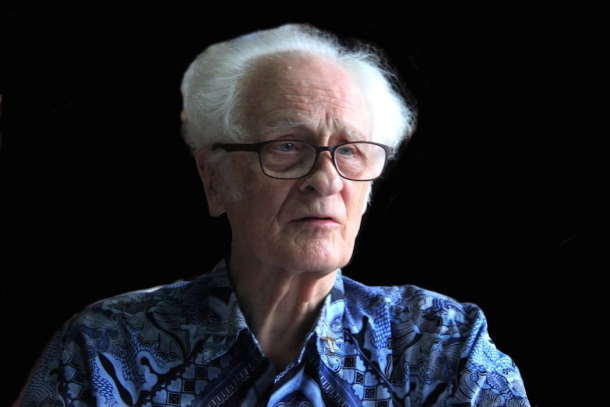
German-born Jesuit Father Franz Magnis Suseno has become an Indonesian citizen and an outspoken champion of democracy and interfaith dialogue in Indonesia. (Photo by Siktus Harson/ucanews.com)
Ryan Dagur painted on 15 April 2019 (in UCA News) a portrait of a remarkable man, the Jesuit priest Franz Magnis Suseno,doesn’t mince his words when promoting democracy and dialogue in Indonesia. “An adopted son’s passion for Indonesian pluralism”
Not so long ago, Jesuit priest Father Franz Magnis Suseno ..ruffled a few feathers by.. calling people who are threatening to boycott the polls fools, parasites, and psycho freaks.His scathing comments came in an article about the upcoming Indonesian presidential and legislative elections published by Kompas, the country’s bestselling newspaper.Many criticized him for the remarks, some even sent him letters of protest, but many also supported him. The German-born priest, a professor at the Driyarkara School of Philosophy, has apologized for his choice of words but argued the article was a call for all citizens to care for democracy and prevent the worst individuals from being elected to office.
…..The 82-year-old, born into a noble family and who was once called Count von Magnis, is now widely known as a philosopher, human rights defender, and culturalist, with his main area of expertise being Javanese culture. He has written 41 books on philosophy, political ethics, and Christianity, as well as made countless television appearances.During his time in the country, Father Magnis has witnessed a major shift in Indonesia’s political climate from a 32-year dictatorship under Suharto to the reform era that began in 1998 when the tap of democracy was opened.“It’s my moral obligation to speak up when democracy is threatened,” he said.He says he is optimistic that Indonesia will remain a leading democracy in Southeast Asia, but admitted various threats do concern him, especially what he calls the politicization of religion by hard-line Muslims. “Indonesia will only fall to another authoritarian regime if people continue to use religion in politics,” he said. He said it is dangerous because, for many people, religion is more important than democracy.
…. Father Magnis has built close friendships with several respected Muslim leaders, including the late Abdurahman Wahid, a highly respected figure, and Indonesia’s fourth president, as well as Nurcholish Majid, an avid defender of pluralism in Indonesia. Holding dialogue with extreme elements is also important, he said, especially when conflict occurs.He has met the now exiled Islamic Defenders Front chief, Muhammad Rizieq Shihab, several times when his organization sought to impose its own ban on worshiping activities in a number of churches in Jakarta. In 2011, Father Magnis met Shihab, to discuss the issue of an American pastor burning a Quran in Florida, which angered Muslims all over the world. Following the discussions, Shihab told his angry followers not to take out their anger on Indonesian Christians. In building a relationship with believers of other faiths, it is important for Christians to be humble and sensible and to avoid belittling acts or gestures. “It’s better to be low profile, rather than something fancy,” he said, adding that this philosophy should be especially applied in poor areas. This was why he called the erection of a 46-meter-high Marian statue in Ambarawa, Central Java in 2015, “inappropriate.” ..
Father Magnis is also critical of Christians who measure the success of their work by the number of people they attract to Christianity because it leads to aggressive Christianization. “Our mission is to bring the goodness of Christ into our society and let people decide whether to join us,” he said.He said Indonesia will remain an Islamic country, and what Christians can do is to help them build a better democratic system, where freedom of religion is upheld and interfaith relations are well established. Father Antonius Benny Sustyo, an outspoken activist priest, said Father Magnis’ openness and willingness to communicate with others are among his finest characteristics. “..Achmad Nurcholish, a Muslim activist said Father Magnis had contributed a lot to the progress of humanity in Indonesia, especially through his writings that have an enriched perspective.
Father Magnis’ endeavors have been duly recognized and have earned him a number of awards.In 2015, he received an award from Indonesian President Joko Widodo for his dedication to education and culture. A year later, in 2016, he won the Matteo Ricci International Prize for his commitment to promoting interreligious dialogue from the Catholic University of the Sacred Heart in Milan. However, the one that gives him the most pleasure is a so-called “Mud Award”, bestowed on him by communities in East Java whose land and homes were buried by mud caused by the activities of a company belonging to Aburizal Bakrie, a businessman cum politician. It was given in 2007 after the priest refused to accept a Bakrie Award — handed out by Aburizal Bakrie’s family — to show solidarity with people affected by the mud disaster. “I was very happy with that award. I’ll always treasure it,” he said.
Israel must fully honour and implement the rights and obligations contained in the UN’s Declaration on human rights defenders, and in particular end the use of criminal, legal and security tools to obstruct the legitimate work of human rights defenders, say two UN rapporteurs: Michael Lynk, the special rapporteur on the situation of human rights in the Palestinian Territory and Michel Forst, the special rapporteur on the situation of human rights defenders .
Their comments come on 11 April 2019 after the latest hearing on 7 April in the case of Issa Amro, a human rights defender and founder of Youth Against Settlements, a Hebron-based group which seeks to end settlement expansion through non-violent civil resistance. “Israel must provide for the protection of human rights defenders in the context of their work and ensure that, if charged with any offence, their right to a fair trial is respected,” said the Rapporteurs “The case of Issa Amro is emblematic of the sophisticated array of obstacles faced by Palestinian human rights defenders who engage in non-violent activities.”
“Cracking down on individuals whose work is essential to denouncing violations and creating safe and peaceful societies, sends a troubling message that the Israeli authorities make little effort to abide by international human rights standards, including the right to a fair trial.
“We are very concerned that in January 2019 Israel did not renew the mandate of the Temporary International Presence in Hebron (TIPH), an international observer force that was instrumental in efforts to avoid violence – a decision which led to a group of human rights defenders, including Issa Amro, deciding to accompany children to school.”
The UN experts also expressed deep concern about the repressive working environment faced by Palestinian human rights organisations in recent years.
On 27 March 2019, 21 international and Burundian human rights organisations condemn new irregularities in the case of Germain Rukukiin a Joint statement:
Almost four months after his appeal hearing at the Bujumbura Court of Appeal on 26 November 2018, the judicial case file of Burundian human rights defender, Germain Rukuki, has gone missing. In December 2018, the Government of Burundi decided to divide the Bujumbura Court of Appeal into three separate appeal courts, and the file apparently went missing during the reorganization.
Germain is appealing against his wrongful conviction by the Ntahangwa High Court and 32-year prison sentence, the longest prison sentence imposed on a human rights defender in Burundi. He is still awaiting the Court’s decision, which was initially expected within 30-days of the appeal hearing.
The loss of his case file further violates Germain Rukuki’s right to a fair trial, in addition to the multiple irregularities and undue delays that have characterized the legal proceedings since his arrest in July 2017.
We, the undersigned non-governmental organisations, strongly condemn this blatant miscarriage of justice and insist that Germain’s conviction is unlawful and part of a pattern of systematic attacks against human rights defenders and dissent voices since 2015, as echoed by the international human rights community, international and national civil society, as well as the United Nations and the Commission of Inquiry on Burundi in its reportreleased in September 2018.
We, the undersigned organisations, call on Burundian authorities to:
Release Germain Rukuki immediately and unconditionally, and quash his conviction and sentence;
Comply with international and regional human rights standards, notably the rights to freedom of expression, association and peaceful assembly, and the right to a fair trial;
Until he is released, ensure Germain Rukuki and his lawyer have timely and adequate access to his case file;
Launch an immediate, effective, impartial and transparent investigation into the circumstances of and responsibility for the loss of Germain Rukuki’s file;
Recognise the legitimacy of human rights work in Burundi and ensure a safe and enabling environment in which it is possible to defend and promote human rights without fear of punishment, reprisal or intimidation…..
For details about the arrest, please see the link below to HRW
AnEU spokesperson on 19 March stated:
“We believe that the sentencing of Oyub Titiev is directly connected to his human rights work for Memorial, an organisation that has been the subject of ongoing intimidation and harassment in the North Caucasus and beyond. We also believe that Mr Titiev has not received a fair trial. His sentencing continues a trend of arrests, attacks and discrediting of human rights defenders and journalists who work in that region of the Russian Federation. Mr Titiev’s predecessor as head of Memorial in Chechnya, Ms Natalia Estemirova, was killed in 2009 and, almost ten years later, not a single person has yet been brought to justice for this crime,”.
“The European Union expects Mr Titiev to be released immediately and unconditionally. The Russian Federation freely entered into commitments, first in Helsinki in 1975 and later in Copenhagen in 1990, to ensure “the right of everyone, individually or in association with others, to seek, receive and impart freely views and information on human rights and fundamental freedoms, including the rights to disseminate and publish such views and information.” We expect these commitments to be upheld”.
AFP reported on 16 March 2019 that Alfredo Okenve, a leading human rights defender in Equatorial Guinea was arrested in the capital Malabo after travelling there to receive an award for his work, his NGO and a police source said Saturday. Okenve had arrived in Malabo on Thursday, a day ahead of a ceremony at the French Institute where he was to receive the Franco-German Prize for Human Rights and the Rule of Law from French and German ambassadors. He was arrested at Malabo airport on Friday night when he was about to board a flight to Madrid after the cancellation of the awards ceremony earlier in the day.
A leading figure in the country’s civil society movement, Okenve is one of the leaders of the Center for Studies and Initiatives for the Development of Equatorial Guinea (CEID-GE), which said he had been flown back home to the port city of Bata and placed under house arrest. The authorities “prevented him from flying to Spain,” said Mariano Nkogo, who is also a senior figure within the NGO. He said a military plane had been chartered to fly Okenve back to Bata.
His arrest was also confirmed by a police officer at the airport and by the opposition Convergence for Social Democracy (CPDS) whose members have been previously targeted in a crackdown by President Teodoro Obiang Nguema, who has ruled the West African state for 39 years.
Friday afternoon’s award ceremony was cancelled after the Guinean government sent a formal note to the envoys’ representatives saying it did not recognise the award, a regional diplomatic source said. “Due to the lack of transparency in the awarding of this prize, the government of Equatorial Guinea cannot recognise its validity,” said the note, a copy of which was seen by AFP. The French and German embassies then postponed the ceremony. [for more on this award – authorities take note! – see: http://www.trueheroesfilms.org/thedigest/awards/franco-german-prize-for-human-rights-and-the-rule-of-law]
In late October, Okenve was seized and beaten by unidentified men who left him in a remote area of Bata. He then went to Madrid to seek medical care, only returning home in mid-February.
Gacheke Gachihi, coordinator of Mathare Social Justice Centre and member of the Social Justice Centre Working Group, celebrates the life of a fellow activist, Caroline Mwatha Ochiengwho was a tireless campaigner against police brutality and illegal arrests in Kenya, and was involved in documenting these cases. Through the documentation of these systematic injustices, Caroline, a founding member of Dandora Social Justice Centre and member of the Social Justice Centre Working Group (the collective voice of social justice centers in the informal settlements in Nairobi), was exposed to police harassment and threats, but she never gave up and continued to fight for social justice. Earlier this month, she was murdered. Her disappearance and murder sends a terrifying message to human rights defenders and social justice activists who are fighting against systematic extrajudicial killings and police brutality in Kenya.
I recall a recent event that illustrates Caroline’s tireless commitment. On December 13, 2018, at 9 p.m., I received a distress call from an activist who had been illegally arrested and detained at the Kwa Mbao Administrative Police (AP) camp — an informal settlement where the Dandora community Social Justice Centre was monitoring human rights violations. Carol Mwatha was our team leader at the notorious Kwa Mbao AP camp, which is under the jurisdiction of the Dandora Social Justice Centre. She was responsible for monitoring and documenting cases of human rights violations and extrajudicial killings by security agencies.
Under the leadership of Carol Mwatha, we spoke to the officer in charge of the AP camp, who was supervising those who had been arrested in the raid that evening. We demanded the unconditional release of our comrades. They were being detained illegally for refusing to bribe a police officer, something that exposes many youth in these areas to extrajudicial killing. As a result of Carol Mwatha’s intervention, our comrades were released unconditionally.
……
The struggle against social injustice and deplorable living conditions exposed Carol Mwatha to dangers that eventually led to her disappearance on February 6 and her subsequent murder. Caroline’s body was dumped in the city mortuary under a different name on Tuesday, February 12, and the police reported a story of a botched abortion to cover up her murder.
Caroline Mwatha Ochieng was a tireless campaigner against police brutality and illegal arrests, and she was involved in documenting these cases and referring them to the independent Police Oversight Authority and other organizations that have been mandated to seek accountability and redress against human rights violations in Kenya. Through the documentation of these cases, Carol was exposed to serious police harassment and threats, but she never gave up and continued to fight for social justice.
In a rather bizarre twist, it turns out that the Catholic Church on Thursday refused to hold a requiem Mass for Caroline Mwatha on the grounds that postmortem results showed that she died as a result of excessive bleeding caused by possible abortion. Kenya Conference of Catholic Bishops General Secretary Father Daniel Rono on Friday told the Star that life begins at conception and that abortion is wrong. Similar sentiments were shared by National Council of Churches of Kenya Deputy General Secretary Reverend Nelson Makanda. “The sanctity of the foetus must be protected and that starts from conception. Once fertilisation occurs that is a human being and the child must be protected to its natural death. Anyone who aborts is a murderer,” he said.
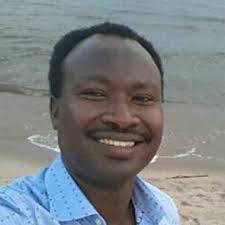
Yared Hailemariam is the Executive Director of the Association for Human Rights in Ethiopia (AHRE), a non-governmental and non-partisan organisation based in Brussels and Geneva, founded by activists that fled the country and other members of the Ethiopian diaspora. He served as a lead investigator at the Ethiopia Human Rights Council (HRCO) for seven years before being forced into exile in the aftermath of the heavily contested 2005 election in the country.
The post-2005 period saw a massive crackdown on civil society through the enactment of draconian legislation, and the implementation of two states of emergency that allowed for the brutal repression of thousands of demonstrators, journalists, and HRDs. During this time, AHRE, based in exile, focused on advocacy, protection and capacity-building for Ethiopian HRDs, and producing research highlighting the deteriorating situation in Ethiopia.
However, when the reformist agenda of the new Ethiopian Prime Minister Dr. Abiy Ahmed began to manifest itself in 2018, Hailemariam decided it was safe to head home after more than 13 years in exile. In January 2019, he helped organise a civil society meeting and workshop in Addis Ababa which brought together national and international civil society organisations (CSOs) to forge a path forward after years of restrictions and repression. [see also: https://humanrightsdefenders.blog/2016/09/09/un-human-rights-council-urged-to-address-situation-in-ethiopia/]
“This is a huge chance for civil society. Because of bad laws and the previous government, our work was totally crippled and paralysed, but there are many good signs that our presence is welcome like it wasn’t before. It’s a bright future for civil society as a result of these changes.”
Hailemariam hopes to help rebuild civil society in Ethiopia by bringing together HRDs returning from exile with the few CSOs that were able to remain in the country and weather the storm. He says that while the new reforms are positive, these changes must trickle down to institutions and the general citizenry for them to be real and long lasting.
“The head is moving, but the legs are not. Civic reforms don’t affect the real day to day situations like unemployment or access to healthcare, so the government needs to act quickly to make real institutional reforms. Unless the whole body starts moving together, it will seriously affect the political reform.”
He acknowledges that the real struggle will be to rebuild the capacity of a civil society sector decimated by brain drain and financial insecurity. However, he hopes that with a bit of tenacity and good networking, HRDs in the country can come together before the planned 2020 elections and engage in civic education to prepare Ethiopia for a brighter, more democratic future.
Turkey‘s anti-democratic mentality has not changed since its foundation, but it has never been as oppressive as today, said Turkish human rights defender Eren Keskin. Over the years, Keskin played a vital role in strengthening civil society awareness in Turkey. She became involved with the Human Rights Association (IHD) three years after its 1986 founding and headed its Istanbul branch for years. She has been arrested and imprisoned numerous times, accused of terrorist ties for defending Kurdish rights, and won several awards including the Aachen Peace Award, the Theodore Haecker Prize, the 2018 Helsinki Civil Society Award, the 2018 Anna Lindh Prize, and the 2017 Hrant Dink Award. A new travel ban is likely to stop her from coming to the Martin Ennals Award ceremony on 13 February 2019.
“Turkey’s undemocratic mentality has not changed since its foundation,” said Keskin. “There is no change in the mind or understanding of the state. I have been part of the struggle for human rights for nearly 30 years. I have not experienced a period in which freedom of thought and freedom of expression have been contravened this much. Turkey is more oppressive today than ever.
Keskin said she had been brought before the courts more than 100 times and convicted on numerous occasions.
“I see the struggle for the defence of human rights as respect for those who have died. It is out of respect for them that I am part of the struggle for human rights,” she said. “We experienced a lot of pressure, but our friends were killed. They were killed fighting for human dignity. I am lucky to be alive…I was assaulted twice with firearms, imprisoned and threatened with death, but never gave up.”
…Keskin became the editor-in-chief of the Kurdish Özgür Gündem newspaper from 2013 to 2016 as part of a solidarity campaign after Turkish authorities arrested its journalists. She was prosecuted for a number of articles that appeared in the newspaper as, under Turkish law, editors-in-chief can be indicted when the authors cannot be held to account. Keskin said 143 criminal cases had been brought against her for her time working at Özgür Gündem. “I have already been sentenced to 12-and-a-half years in prison, a 450,000 lira ($85,000) fine and travel ban,” she said. A court in October lifted the ban on Keskin travelling abroad, but last week she realised she had been given another one when authorities refused to issue her a passport. She had been nominated for the Martin Ennals Award for Human Rights Defenders and was planning to attend the award ceremony in Switzerland. [see: https://humanrightsdefenders.blog/2018/10/24/breaking-news-ennals-award-announces-its-3-finalists-for-2019/]
“People ask, ‘How do you live? How do you endure it?’” Keskin said. “For me, the job we do is a way of life and I have never regretted it.”
On 28 January, 2019, the Unrepresented Nations and Peoples Organization (UNPO), the World Uyghur Congress (WUC) and Norwegian Uyghur Committee (NUK) announced that they have nominated the Chinese human rights defender Ilham Tohti for the Rafto Prize. With the completion of five years of his arrest, the organisations believe his peaceful trajectory in defense of the freedom and fully enjoyment of human rights by the Uyghur population in China is deserving of this prestigious prize. See also: https://humanrightsdefenders.blog/2018/01/15/today-ilham-tohti-completes-his-fourth-year-in-chinese-detention/.
[Ilham Tohti served as a professor of economics at Minzu University in Beijing where he specialized in research focused on Uyghur-Han relations, China’s ethnic policies and East Turkistan. Alongside his scholarship and teaching, Ilham is revered for establishing and maintaining Uyghur Online, a website dedicated to promoting Uyghur human rights and improved relations between Uyghur and Han Chinese people. Professor Tohti criticised oppressive policies against Uyghurs and wrote extensively on constructive approaches to overcome unequal treatment between ethnic groups. Notably, he called for dialogue and reconciliation, using his web platform as the primary vehicle. For his efforts, he was arrested by Chinese authorities on January 15, 2014. Despite the UN Working Group on Arbitrary Detention finding his detention to be arbitrary in March 2014, Tohti was sentenced to life in prison in September of that year on charges of “separatism” after just a two-day trial. The legal process involving Tohti was met with significant issues throughout. His lawyers were unable to meet him for six months following the initial arrest, his defense team was not provided with complete evidence by the prosecutor, nor were their requested witnesses allowed to testify during the trial. Ilham has been serving his life sentence since December 2014 at Urumqi’s No. 1 Prison. Since then, he has been allowed very few visits from his family. Complicating this has been his continued detention in Urumqi, despite his family living in Beijing – a likely punitive move from Beijing. ChinaChange has noted that Tohti has been held in solitary confinement until at least early 2016 and has been denied the right to communicate with family and friends aside from minimal visits. The WUC gathered 132 scholars and 19 civil society organisations in an open letter to urge the Chinese government to release Ilham Tohti from his arbitrary detention of the five-year anniversary of his arrest in January 2019.]
The WUC,the UNPO and the NUK encourage scholars and organisations to join in nominating Ilham Tohti. The deadline for nominations is Friday, February 1st. As the situation in East Turkistan continues to deteriorate, with more than one million innocent Uyghurs arbitrarily detained in internment camps and the Uyghur people facing unparalleled repression, Ilham Tohti’s life and work stands as an inspiration to continue the peaceful struggle for peace, understanding
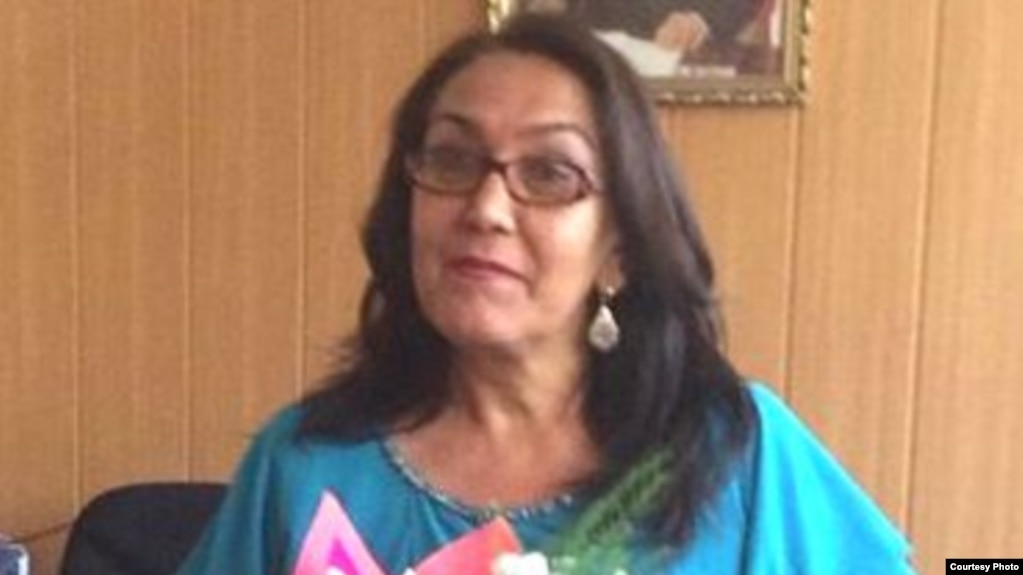
Radio Free Europe (RFE) announced on 4 January 2019 that Faiziniso Vohidova, a Tajik lawyer who defended dissidents for decades, died at the age of 55.
Faiziniso Vohidova in 2016
Faiziniso Vohidovawas a graduate of Moscow State University and started her career as a lawyer in 1995. She was one of the last lawyers in Tajikistan who provided legal assistance to opposition figures, journalists, and victims of torture. Steve Swerdlow, researcher with Human Rights Watch, called Vohidova’s death “a huge loss for Tajikistan” and described her as a brave “lawyers’ lawyer.”
“[Vohidova] was an amazing combination of fierce intellect, sharp wit [and] principle. [For] duration of Tajikistan’s independence she has been part of that small group of activists and lawyers who have sought to make it live up to the democratic pronouncements written in its Constitution,” Swerdlow wrote on Twitter, adding that she was “unafraid to take on the toughest battles, fight for justice till the end, no matter what the odds.”
Rajabi Mirz, an independent journalist and rights defender in Tajikistan, told RFE/RL that Vohidova was “the last pillar” of those challenging the authorities in Tajikistan. “She was one of the few who cared about Tajikistan’s future,” Mirzo said.


 Yared Hailemariam

 Hans Thoolen on Human Rights Defenders and their awards