On 27 May 2019, the Jury of the 24th Ludovic-Trarieux International Human Rights Prize chose the Colombian lawyer Rommel Durán Castellanos, President of the Equipo Jurídico Pueblos (EJP), as the recipient of the 2019 Prize. The Prize will be officially presented to Mr. Durán Castellanos on 8 November 8 at 5 p.m. at the Salle D of the European Convention Center Luxembourg – ECCL. For further information please contact: uiacentre@uianet.org.
Rommel Durán Castellanos, 33 years old, is a human rights lawyer and a the president of the ‘Pueblos’ Legal Team (Equipo Juridico Pueblos) and a volunteer with the Committee for Solidarity with Political Prisoners (CSPP), in Bucaramanga, in the northern Cesar Department, as well as a member of the Santander branch of the Committee for Solidarity with Political Prisoners. Since 2007, Rommel Durán has been defending marginalized communities and victims of human rights abuses and carrying out grassroots training workshops on human rights and protection mechanisms. In particular, he provides legal assistance to victims of violations in rural areas, where forcibly displaced small-scale producers are attempting to return to their lands, and victims of such crimes as enforced disappearance, torture and killings, perpetrated by State agents and paramilitary groups.
Rommel Durán faces very serious threats to his life due to his work as a lawyer and has first-hand experience of the violence that he seeks to challenge through his work. He is subject to harassment, including to a campaign of threats, attacks and stigmatization because of his work accompanying small-scale farming communities who are claiming the restitution of their lands under the Colombian Victims and Land Restitution Law.
In his work as a member of the ‘Pueblos’ Legal Team, Rommel Durán supports members of the Pitalito community who maintain that they have been forced, at gunpoint, to sell their land at unfairly low prices. Alongside the Directing Committee of the National Movement of Victims of State Crimes (MOVICE), Rommel Durán accompanied those members of the community who have returned to their lands and has provided them with legal advice and protection during the difficulties they have encountered since their return.
Apart from being stigmatized and falsely (criminally) accused, assumedly by those who have ‘purchased’ the land, the returning members of the community and their (legal) supporters, including Rommel Durán, have also been shot at by armed men during an incident in December 2013 while attempting to verify the state of the community’s crops.
On 9 August 2014, Rommel Durán was arrested in the village Curumaní and detained in poor conditions. The only information given by these policemen at the time was that there was a warrant for alleged conspiracy. However they did not state which judicial office issued the order. His cell phone was snatched from him; he was filmed and photographed illegally and was prevented from calling his own lawyer. He was released after being detained for 20 hours on 10 August. The issue of this certificate suggests that there is no intention holding to account those responsible for Rommel Durán’s arbitrary detention.
The fourth Aurora Prize for Awakening Humanity was awarded on 19 October 2019 to Mirza Dinnayi, Co-Founder and Director of Luftbrücke Irak (Air Bridge Iraq). [see also: https://humanrightsdefenders.blog/2019/05/01/nominees-for-the-2019-aurora-prize-are/] Driven by his passion to save lives, the Yazidi activist has found a way to overcome numerous bureaucratic and logistic obstacles to help the most vulnerable members of the Yazidi community during numerous conflicts in Syria and Iraq. “The recognition of genocide is the first step in order to satisfy the victims,” he told the Thomson Reuters Foundation in a phone interview. The Aurora Forum took place in Yerevan. For more on the million dollar Aurora Prize see: http://www.trueheroesfilms.org/thedigest/awards/aurora-prize-for-awakening-humanity.
Tom Catena, Aurora Humanitarian Initiative Chair and 2017 Aurora Prize Laureate, praised Mirza Dinnayi by saying: “What makes Mirza Dinnayi an outstanding human being is the fact he couldn’t live in good conscience knowing that good people are left behind, that the innocent are suffering. Trying to help others while facing an unspeakable evil can be challenging and frustrating, but he never wavered. I am delighted to congratulate Mirza Dinnayi with being awarded with the Prize and welcome him to the Aurora family.”
Mirza Dinnayi will receive a $1,000,000 grant for support to organizations that have inspired his work. He has chosen to donate the funds to three organizations that provide medical care and rehabilitation to victims of ISIS terror:
Air Bridge Iraq;
SEED Foundation;
Shai Fund.
Working on behalf of the Yazidi community, Mirza Dinnayi has dedicated his whole life to saving the victims of the Iraq war, evacuating women and children from territories controlled by ISIS and providing those tortured and violated with rehabilitation and support. It was Dinnayi who brought to Germany the future Sakharov Prize Laureate Lamya Haji Bashar. Today, she is a renowned human rights activist and has one of Aurora’s scholarships named after her.Previous Aurora Prize Laureates include:
The Aurora Humanitarian Initiative also honored the contributions of the other two 2019 Aurora Humanitarians who received a $50,000 grant each: Zannah Bukar Mustapha, Director and Founder of Future Prowess Islamic Foundation in Nigeria, and Huda Al-Sarari, Yemeni lawyer and human rights defender.
“We say this is zero hour to act on the climate crisis because we don’t have any time left. We have only a sliver of time left,” Nadia Nazar, the co-founder of the youth climate group Zero Hour, told an eager crowd at the Carnegie Institute in Washington, DC. “And that is our hope, and we must take that hope to act now in order to save the planet for everybody.”
The urgency of our climate crisis, and its web of impacts, was one of the themes at the Letelier-Moffitt Human Rights Awards, an annual event hosted by the Institute for Policy Studies. Zero Hour, along with the Honduran Comité Municipal en Defensa de Bienes Comunes y Naturales del Municipio de Tocoa, were honored for their work on the frontlines of environmental justice. The Comité has been organizing the communities along the Guapinol River against pollution from mining companies like Los Pinares – owned by one of the wealthiest families in Honduras. When those extractive industries threatened their drinking water, the community erected the “Camp in Defense of Water and Life” to block access to the mine. Since then, members have faced detention, as well as the death of one of their own.
Like the Comité, Zero Hour organizers are well aware of the need for rapid shifts to deal with the looming effects of climate change. The youth organizers of Zero Hour were awarded for their work and focus on the disproportionate effect of the climate crisis on low income communities, people of color and other marginalized groups. Founded in 2017 by 16-year-old Jamie Margolin and her friends, Zero Hour is led by young people of color. The group advocates for climate justice, and leads discussions on the impact of climate change on young people while delving into the underlying roots of systematic oppression sustained under the climate crisis.
“The youth are breaking the walls of these systems and we are demanding everybody is uplifted in our solutions, not just certain people. We can’t keep perpetuating the same systems within our solutions and our conversations around the climate crisis,” Nazar said. “We believe that the energy and the love of young people are vital towards bringing down the destruction and hate of the fossil fuel industry and the corporations all around the world.”
Elsa Mengistu, former Operations Director for Zero Hour told Inequality.org “It’s cool to have kids strike from school and disciplinary action happen. There’s media frenzy, people pay attention, but real action comes from when we’re hit where pockets are,”. “I want to build on it by having adults come and strike with us and I want them to put a pass on the economic cycle and make people realize what is going on. I don’t want it to just be a school strike but a strike for everybody.”
[In 2008, Sergei Magnitsky, a young Russian lawyer who uncovered massive tax fraud perpetrated by Russian officials, was charged with the very offenses he had uncovered. In an effort to cover up the crimes he had exposed, Magnitsky was sent to prison where he later died from abuse, neglect, and mistreatment. Bill Browder, for whom Magnitsky had worked, vowed to dedicate himself to seeking justice for Sergei and this crusade has made him a global human rights leader. First passed by the US Congress in 2012, the Global Magnitsky Human Rights Accountability Act authorized sanctions of government officials implicated in serious human rights abuses. ..Since its enactment, the US Government has sanctioned more than 70 officials in over a dozen different countries. Most recently, Magnitsky sanctions were enacted to penalize those Saudi Arabian officials implicated in the murder of journalist Jamal Khashoggi.]
Bill Browder’s campaign for justice and accountability did not stop in the United States. Since 2012, similar Magnitsky laws have been enacted in Canada, Estonia, the United Kingdom, Latvia, and Lithuania. Despite fervent opposition from Russia and other lawless regimes that prefer to have their human rights abuses go unnoticed and unpunished, the European Union, Australia, France, Germany, Ireland, Denmark, Italy, and other EU member countries are considering the passage of their own Magnitsky laws.
Saudi human rights lawyer Waleed Abu al-Khair, who was convicted on anti-terrorism charges and sentenced to 15 years in prison, is the winner of the 2019 ABA International Human Rights Award. For more on this and other awards for human rights lawyers see: http://www.trueheroesfilms.org/thedigest/awards/aba-international-human-rights-award
The ABA Journal states that Abu al-Khair founded Monitor for Human Rights, one of the only human rights organizations in Saudi Arabia, in 2008. He dedicated his legal career to defending human rights and the right to freedom of expression, and pushed for an elected parliament, independent judiciary, constitutional monarchy and other reforms in his country. Abu al-Khair’s 2014 arrest and conviction largely stemmed from comments he made to the media and on social media that criticized Saudi Arabia’s human rights record, discussions of human rights in his home and his defense of activists who were punished for criticizing the government, according to Human Rights Watch and Amnesty International. The human rights organizations say the specific charges against him included disobeying the ruler and seeking to remove his legitimacy; insulting the judiciary and questioning the integrity of judges; setting up an unlicensed organization; harming the reputation of the state by communicating with international organizations; and preparing, storing and sending information that harms public order.
His full 15-year sentence was upheld by a Saudi appeals court in 2015 after he refused to apologize for the alleged offenses. He is currently in the Dhahban Central Prison in Jeddah, Saudi Arabia. The United Nations Human Rights Council’s Working Group on Arbitrary Detention has twice reviewed the legitimacy of Abu al-Khair’s detention, and in 2018, declared that Saudi Arabia lacked legal basis and grounds for restricting his freedoms of expression and opinion, the ABA press release says.
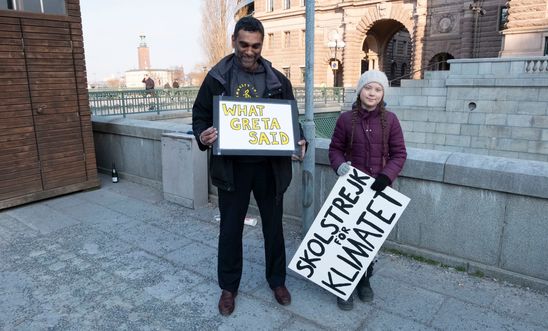
The Fridays for Future movement was started by Greta Thunberg, a teenager from Sweden who last August began protesting outside the Swedish parliament – skipping school every Friday demanding the Swedish government take more serious action to tackle the climate crisis. Her efforts have inspired a global movement, with the most recent Fridays for Future schools strikes seeing more than one million young people from all over the world take part, with demonstrations in more than 100 countries.
Greta Thunberg, said: “It is a huge honour to receive Amnesty International’s Ambassador of Conscience award on behalf of Fridays for Future. This is not my award, this is everyone’s award. It is amazing to see the recognition we are getting and know that we are fighting for something that is having an impact. To act on your conscience means that you fight for what you think is right. I think all those who are part of this movement are doing that, because we have a duty to try and improve the world. The blatant injustice we all need to fight against is that people in the global south are the ones who are and will be most affected by climate change while they are the least responsible for causing it.”
Kumi Naidoo, Amnesty International’s Secretary General, said: “The Ambassador of Conscience award celebrates people who have shown unique leadership and courage in standing up for human rights. I can think of no better recipients this year than Greta Thunberg and the Fridays for Future climate strike movement.
Greta Thunberg, said: “Human rights and the climate crisis go hand in hand. We can’t solve one without solving the other. Climate change means people won’t be able to grow food, their homes will come under threat and their health will be compromised. Governments have a duty to protect us, so why are they doing nothing to stop climate change from devastating our lives?”
Kananura Irene, a Fridays for Future activist from Kampala, Uganda, said: “Sometimes I feel really sad because some of the people I try to talk to won’t listen. Some people insult us, others think we are politicians, and others ignore us entirely, they tell us maybe we won’t finish what we’ve started. But I can assure everyone that we are really determined to finish what we have started, because our futures are on the line.”
[Around the world, attacks against ordinary people who stand up for freedom, justice and equality are surging. Authorities around the world are misusing their power to crack down on human rights defenders – imprisoning, torturing and even killing them for speaking up. In 2018, 321 defenders in 27 countries were targeted and killed for their work – the highest number ever on record. Amnesty is calling on the UK Government to show the world that protecting human rights defenders is a priority.]
Corrected version: Last week I announced the 3 laureates of the Václav Havel Prize for Creative Dissent [see: https://humanrightsdefenders.blog/2019/05/15/2019-laureates-of-the-vaclac-havel-prize-for-creative-dissent-announced/] and one of them is Rap Against Dictatorship, which was threatened with legal action for their 2018 hit ‘My Country’s Got’, a viral rap video lambasting Thailand’s junta and justice system. Rap Against Dictatorship said two of its rappers are flying to Norway to attend the award ceremony, which will be held at the Oslo Freedom Forum – the same event which invited junta critic and Khaosod English writer Pravit Rojanaphruk to speak in 2015. “Liberate P and Jacoboi are our representatives to receive the prize. Please keep supporting us,” the group said.
“My country preaches morals but has a crime rate higher than the Eiffel Tower. My country’s parliament house is a soldiers’ playground. My country points a gun at your throat,” read some of the lyrics.
Police officials considered filing sedition charges against the rappers, to much ridicule on social media, but no legal action was taken.
On 23 May 2019, L4L will be presenting the 2019 Lawyers for Lawyers Award to Selçuk Kozağaçlı, a human rights lawyer from Turkey. Selçuk Kozağaçlı is a lawyer, human rights defender and member of the People’s Law Office. He is well known for working on the “Soma Mine” disaster, the worst mine disaster in Turkey’s history, in which 301 miners were killed. He is also the chair of the Progressive Lawyers’ Association (ÇHD), an association which focuses on the right to life and advocates for the prevention of all types of attack on fundamental rights and human dignity. The Progressive Lawyers’ Association was closed on 22 November 2016 by Statutory Decree No. 677 issued under the State of Emergency.
The Award Ceremony will take place in Amsterdam. Prior to this ceremony an interesting seminar will be held in collaboration with the Amsterdam Bar Association and the Justitia Commission of the Young Lawyers Association Amsterdam. The main topic of the seminar will concern the developments surrounding the proposed European Convention on the Profession of Lawyers. Two panel discussions will be organized around this topic. Speakers include François Moyse (Vice-Chair of the CCBE European Convention Working Group), Mikolaj Pietrzak (president of the Warsaw Bar Association) and former Award winners and lawyers Sirikan ‘June’ Charoensiri (Thailand), Magamed Abubakarov (the Russian Federation) and Alec Muchadehama (Zimbabwe).
From 2:30 PM until 5:00 PM CEST L4L will livestream PART I with the seminar ‘Lawyers at risk! Do we need a European Convention?’ It will continue the broadcast with PART II from 5:00 PM until 5:30 PM CEST with the Award Ceremony. To watch online, please click on the following link:https://www.youtube.com/user/LawyersforLawyersL4L/live
Nominations are open for the 2020 Aurora Prize for Awakening Humanity. For more information on this and other awards see: http://www.trueheroesfilms.org/thedigest/awards/aurora-prize-for-awakening-humanity. Every year the Aurora Humanitarian Initiative grants a US $1,000,000award to the Laureate who receives a unique opportunity to continue the cycle of giving by supporting the organizations that have inspired their humanitarian work. Read the rest of this entry »



 Hans Thoolen on Human Rights Defenders and their awards