Posts Tagged ‘Honduras’
March 16, 2016
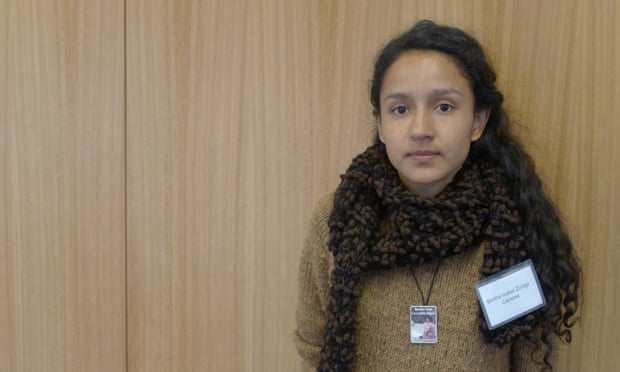
Bertha Cáceres, daughter of murdered Honduran environmental activist Berta Cáceres. Photograph: Liz Ford for the Guardian
This week, Bertha, who is studying for a masters degree in Latin American studies in Mexico, was in New York to speak at side events during the annual Commission on the Status of Women. Here she said “… I will talk about the situation in Honduras. This is not the first assassination, but one of a series of assassinations of human rights defenders … I don’t want another human rights defender to be assassinated”. Even while she spoke with the Guardian journalist a call came through from COPINH’s lawyer (the NGO her mother worked for) to say another member of the organisation had been shot dead ….
According to a statement by Front Line Defenders today, this human rights defender, Nelson Garcia, was returning home following a violent eviction conducted by the Public Order Military Police and the Cobras Special Force in the municipality of Río Lindo when he was intercepted by unidentified men who shot him in the face four times. Read the rest of this entry »
Posted in Front Line, Human Rights Defenders | Leave a Comment »
Tags: Agua Zarca, assassination, Berta Cáceres, COPINH, Development Cooperation, environmental issues, FMO, Front Line (NGO), Honduras, killing, land rights defender, Ministry of Foreign Affairs Netherlands, Nelson Garcia, the Guardian
March 16, 2016
Posted in human rights, Human Rights Defenders | 1 Comment »
Tags: Agua Zarca, Berta Cáceres, dam, environmental issues, Finland, Guatemala, Honduras, Indigenous People, killings, land rights defender, Ministry of Foreign Affairs Netherlands, Panama, Peter Bosshard, UN Guiding Principles on Business and Human Rights, woman human rights defender
March 7, 2016
A group of over 50 international organizations has written to the President of Honduras to express their shock over the recent killing of Berta Cáceres [https://thoolen.wordpress.com/2016/03/03/berta-caceres-human-rights-defender-assassinated-today-in-honduras/], to demand an international investigation and the immediate protection of Gustavo Castro Soto, a Mexican activist, who witnessed her assassination. Here is the letter and signatories in full: Read the rest of this entry »
Posted in Human Rights Defenders | 8 Comments »
Tags: assassination, Berta Cáceres, Civil society, environmental activists, Gustavo Castro Soto, Honduras, indigenous groups, investigation, Juan Orlando Hernández, killing, land rights defender, Lenca Indigenous People, NGOs, woman human rights defender
March 3, 2016
A sad day for Honduras and all human rights defenders: today, 3 March 2016, Berta Cáceres was murdered by as yet unknown assailants who broke into her home in the city of La Esperanza in the early hours of the morning. One week prior to her assassination, the defender had denounced the killing of 4 leaders of her community as well as threats against her and other human rights defenders, at a press conference.

Berta Cáceres was one of the most prominent human rights defenders in Honduras and a Lenca indigenous woman who, for the past 20 years, had been defending the territory and rights of the Lenca people. In 1993, she co-founded the Consejo Civico de Organizaciones Populares e Indígenas de Honduras – COPINH (http://www.copinh.org/) (Civic Council of Popular and Indigenous Organisations of Honduras), which led fierce campaigns against illegal logging and mega-projects for their detrimental effects on the rights of indigenous peoples in the country. She faced off – and often won – against illegal loggers, plantation owners, multinational corporations, and dam projects that would cut off food and water supplies to indigenous communities. (e.g. https://thoolen.wordpress.com/2014/01/28/berta-caceres-in-honduras-continues-to-be-harassed-in-spite-of-court-order).
The human rights defender was a finalist for the 2014 Front Line Defenders Award [https://www.frontlinedefenders.org/es/programme/fld-award] and in 2015 she received the Goldman Environmental Prize. She had been a beneficiary of precautionary measures granted by the Inter-American Commission on Human Rights (IACHR) since 2009. Her harassment was followed closely by Front Line and others.
Other human rights defenders (including members of COPINH) have been targeted in the past. The killing of human rights defenders and impunity for the perpetrators have been documented by many organizations. In this blog alone:
https://thoolen.wordpress.com/2016/01/29/assassination-of-human-rights-defenders-proceed-in-honduras-venezuela-peru-colombia-and-the-philippines/
https://thoolen.wordpress.com/2016/02/27/alarming-criminalisation-of-human-rights-defenders-in-latin-america/
“the most dangerous place to be an environmental activist was actually Honduras, according to Global Witness” [https://thoolen.wordpress.com/2015/04/24/killings-of-environmental-human-rights-defenders-up-again-compared-to-last-year/]
Honduras: Berta Caceres, human rights defender & indigenous leader who opposed Agua Zarca dam, assassinated | Business & Human Rights Resource Centre
Posted in awards, Front Line, human rights, Human Rights Defenders | 3 Comments »
Tags: assassination, Berta Cáceres, COPINH, Front Line (NGO), Global Witness, Goldman Environmental Prize, Honduras, indigenous groups, judicial harassment, killing, land rights defender, woman human rights defender
February 27, 2016
The criminalization of human rights defenders in the context of the extraction of natural resources and megaprojects is becoming a very worrisome phenomenon in Latin America, denounces the Observatory in a report published today in Mexico. Entitled “The criminalization of human rights defenders in the context of industrial projects: a regional phenomenon in Latin America”, this document points to the role of businesses, civil servants, public prosecutors, judges, and the State. The report issued by OMCT and FIDH (in the context of their Observatory for Human Rights Defenders) on 25 February 2016 describes the specific cases of human rights defenders criminalized in eight Latin American countries (Brazil, Colombia, Ecuador, Guatemala, Honduras, Mexico, Nicaragua and Peru).
The report especially stresses two core issues common to all the countries studied: Read the rest of this entry »
Posted in books, FIDH, human rights, Human Rights Defenders, Observatory for the Protection of Human Rights Defenders, OMCT | 4 Comments »
Tags: Brazil, Colombia, criminalisation, criminalization, Ecuador, environmental issues, FIDH, Honduras, Human Rights Defenders, independence of the judiciary, Latin America, Mexico, Nicaragua, Observatory for the Protection of Human Rights Defenders, OMCT, Peru, regional NGOs, resource extraction
January 29, 2016
On 30 November I referred to the systematic killing of human rights defenders in 2015 [https://thoolen.wordpress.com/2015/11/30/closing-civil-society-space-a-euphemism-for-killing-human-rights-defenders/] and mentioned the annual report by Front Line for 2015 listing Latin America and the Philippines as the most dangerous places [https://thoolen.wordpress.com/2016/01/06/latin-america-philippines-most-dangerous-places-for-human-rights-defenders/]. If further illustration is needed, here some short summaries of cases of killing human rights defenders as reported by Front Line over the last few months:
Honduras: Killing of LGTBI rights defender Paola Barraza. On 24 January 2016, human rights defender Ms Paola Barraza was assassinated by unknown attackers in front of her house in the neighbourhood of Lempira, in Comayaguela. Paola Barraza, a trans woman, was a member of the board of directors of Asociación LGTB Arcoíris (LGTB Rainbow Association). The human rights defender was at home when unknown persons knocked at her door and called her outside. When Paola Barraza answered the door she was fired upon five times. She died at the scene as a result of her wounds. Paola Barraza was previously attacked in connection with her LGTBI rights work on 15 August 2015 [https://www.frontlinedefenders.org/node/29495] Between 23 June 2015 and 31 August 2015, three other LGTBI rights defenders working in country were killed https://www.frontlinedefenders.org/node/29495.
Read the rest of this entry »
Posted in Front Line, human rights, Human Rights Defenders | 1 Comment »
Tags: Angis Precioso, assassination, Cesar Estrada, Colombia, Daniel Abril, Emerito Samarca, environmental issues, Front Line (NGO), Genesis Ambason, Héctor Sánchez Losada, Hitler Ananias Gonzales Rojas, Honduras, Human Rights Defenders, indigenous groups, killings, LGTBI rights, Lito Abion, Paola Barraza, Peru, Philippines, Venezuela
December 21, 2015
Two cases of women human rights defenders in Central America as reported by Front Line Defenders.
El Salvador Read the rest of this entry »
Posted in Front Line, human rights, Human Rights Defenders | Leave a Comment »
Tags: Asociación para una Ciudadanía Participativa (Honduras), AWID, Bertha de Leon, break-ins, COFADEH, Dina Meza, El Salvador, Front Line (NGO), harassment, Honduras, Study Foundation for the Application of the Law (Salvador), Teresa Naves, threats, women human rights defenders
October 7, 2015
The 2015 Rafto Prize has been awarded to the Honduran priest, radio activist and human rights defender Ismael Moreno Coto, better known as Padre Melo. The Prize is awarded in recognition of his use of the media in defense of freedom of expression and fundamental rights in Honduras, a country plagued by extreme violence.
Activities around this important Norwegian prize are:
- the 2015 Rafto Conference on Saturday 31 October 10 am at Radisson Blu Hotel Norge (the banquet hall) in Bergen [free of charge, but registration here before 28 October].
- the 2015 Rafto Prize Award Ceremony on Sunday 1 November 6 pm at Den Nationale Scene, Bergen in honour of Laureate Padre Melo, with artistic contributions from Norwegian artists.
For more on this award: http://www.brandsaviors.com/thedigest/award/rafto-prize
For any inquiries, please contact Project Coordinator Liv Unni Stuhaug: livunni.stuhaug@rafto.no
Read more about this year’s Rafto Prize Laureate here.
Posted in awards, human rights, Human Rights Defenders | Leave a Comment »
Tags: Bergen, cleric, digest of human rights awards, freedom of expression, Honduras, human rights award, Human Rights Defenders, Ismael Moreno Coto, Norway, Padre Melo, Rafto award
June 5, 2015
On 25 May 2015 the inaugural PEN Canada/Honduras Award for investigative journalism, ‘Escribir sin Miedo’, was presented in Tegucigalpa, Honduras, to the journalist and documentary filmmaker Fred Alvarado for his essay “HONDURAS: the Process of American Remilitarization and the Failure of the War on Drugs”.
Escribir sin Miedo was organized and launched by the newly established PEN Honduras centre, in partnership with PEN Canada, with funding from the British embassy in Guatemala. “Investigative journalism has never been more important in this country,” said Dina Meza, president of PEN Honduras, “and awards like this recognize the importance of creating a culture in which writers and human rights defenders can address sensitive issues without fearing for their lives.”
And the problems are grave:
– At least 30 journalists have been killed since the country’s 2010 Universal Periodic Review at the United Nations, and at least 48 since 2003. Several were killed even after receiving protection measures, including “precautionary measures” granted by the Inter-American Commission on Human Rights (IACHR). To date the government has obtained convictions in just four of these cases, with the remaining 44 unresolved – an impunity rate of over 90 per cent.
– Frontline reports that Honduran human rights defender, Ms Gladys Lanza Ochoa, continues to face intimidation and harassment following her sentencing to 18-months imprisonment on 26 March 2015. An appeal against the sentencing has been lodged before the Supreme Court of Honduras. [Gladys Lanza Ochoa is Coordinator of the Movimiento de Mujeres por la Paz Visitación Padilla (Honduran Women’s Committee for Peace “Visitación Padilla”), a collective of women human rights defenders from across Honduras who work on issues such as gender violence and women’s participation in public life, in addition to advocating for democracy and human rights in Honduras. Over the last years, Gladys Lanza Ochoa, as well as other members of Visitación Padilla have been regularly victims of threats, intimidation and surveillance in connection with their human rights work (https://www.frontlinedefenders.org/node/19743) Most recently, on 14 May 2015, the human rights defender was followed by unidentified persons riding motorcycles and driving a car that did not bear registration plates. This intimidation occurs right after Gladys Lanza Ochoa’s lawyer launched her appeal before the Supreme Court against her sentence to 18 months in prison https://www.frontlinedefenders.org/node/28385.
– On 25 May 2015 Telesur published a lengthy “Analysis From Reagan to Obama: Forced Disappearances in Honduras” which provides many details on 30 years of horror: “Hondurans today suffer not just from the terror of death squads but from the ravages of three decades of the implementation of neoliberal policy made possible by death squads, which makes them that much more vulnerable.”
– Bertha Oliva, director of COFADEH and winner of the Tulip award, lost her husband Tomas Nativi to forced disappearance by Battalion 316. Nativi was taken from their home by masked agents in 1981 and has never been seen again. Over the years after Nativi’s disappearance, Oliva came to realize that she was not alone, and others had similar experiences of family members being disappeared. In 1982, 12 of these families came together to form COFADEH with the objective of bringing back alive family members who had been disappeared. In the majority of cases throughout the 1980s while Battalion 316 was operating, COFADEH did not succeed in their goal. After the 1980s, COFADEH broadened its scope as an organization not only committed to seeking justice for the families of the disappeared and truth for Honduran society, but also representing and defending victims of human rights abuses, documenting cases, and providing training to raise awareness about human rights. The creation of COFADEH was, in its own words, a “concrete action” in the face of the inactivity of the state to ensure “the right of victims to live and to have due process, among other rights that have been violated.” COFADEH has continued to play a key role in documenting and denouncing human rights abuses and demanding justice, particularly once again in the years since the coup.
for more on Honduras: https://thoolen.wordpress.com/tag/honduras/
http://www.telesurtv.net/english/analysis/From-Reagan-to-Obama-Forced-Disappearances-in-Honduras-20150522-0027.html
Posted in awards, Front Line, human rights, Human Rights Defenders, UN | 2 Comments »
Tags: award, Bertha Oliva, Canada, COFADEH, death threats, disappearances, Fred Alvarado, Front Line (NGO), Honduras, Human Rights Defenders, journalists, Lanza Ochoa, PEN, Telesur, UPR, USA
April 24, 2015
Jeremy Hance – writing in Mongabay on 20 April, under the title “Killings of environmental activists jumped by 20 percent last year“ confirms again the terrible truth that it is in the countryside, away from monitors, and in disputes over land issues that the most gruesome repression takes place and the leader is..Brazil! [for last year’s report see: https://thoolen.wordpress.com/2014/04/16/environment-deadly-for-human-rights-defenders-says-global-witness/]

Soy field in the Brazilian Amazon. Photo by: Rhett A. Butler.
The assassination, murder, and extrajudicial killing of environmental activists rose by 20 percent last year, according to a new grim report by Global Witness. The organization documented 116 killings in 2014 across 17 countries with the highest number in Brazil, which saw 29 environmental and land defenders killed. Still, the report is a major understatement of the problem as data across much of Africa, China, the Middle East, and Central Asia remains scarce to non-existent.
“Across the world environmental defenders are being shot dead in broad daylight, kidnapped, threatened, or tried as terrorists for standing in the way of so-called ‘development’,” said Billy Kyte, a campaigner with Global Witness. “The true authors of these crimes—a powerful nexus of corporate and state interests—are escaping unpunished. Urgent action is needed to protect citizens and bring perpetrators to justice.”
Most of the deaths last year—116 of them—were related to disputes over land. But mining was linked to 25 deaths, and hydroelectric dams and agribusiness to 14 each. Indigenous people also remain among the most targeted.
“In 2014, 47 indigenous people were killed defending their natural resources, 40 percent of the total deaths of environmental and land defenders,” reads Global Witness’s new report, entitled How Many More?. This year’s report follows a landmark document last year that tracked environmental activist killing—all 908 of them—over a dozen years.

Environmental activist killings by sector. Image courtesy of Global Witness.
Human rights defenders are stigmatized (as ‘anti-development’) and criminalized in order to silence their opposition.
While Brazil had the highest number of environmental activist murders in 2014, the most dangerous place to be an environmental activist was actually Honduras, according to Global Witness. During the last five years (2010-2014), Honduras lost 101 activists, giving it the highest rate of environmental activist killings per capita.
“A UN Human Rights Council resolution addressing the heightened risk posed to environmental and land defenders would be a start,” Kyte said. “But, in the end, governments themselves have to take responsibility and ensure impartial, exhaustive investigations into killings of these activists. And they have to bring perpetrators to account. Many targeted assassinations of activists are being passed off as ‘common’ murders and are going unnoticed.”

Environmental activist killings by country. Those in red were indigenous people. Image courtesy of Global Witness.
Read more: http://news.mongabay.com/2015/0420-hance-activist-murder-rise.html#ixzz3XxWqLdTV
Killings of environmental activists jumped by 20 percent last year.
Posted in human rights, Human Rights Defenders | 2 Comments »
Tags: annual report, Billy Kyte, Brazil, environmental activists, extrajudicial killings, Global Witness, Honduras, How Many More?, Human Rights Defenders, impunity, indigenous minorities, indigenous peoples, Jeremy Hance, land rights, Mongabay, statistics, stigmatization
 Hans Thoolen on Human Rights Defenders and their awards