The five undersigned human rights organisations, strongly condemn the prosecution of Singaporean human rights defender Jolovan Wham. After convicting Wham in January 2019 of “organising a public assembly without a permit,” the State Court sentenced him, on 21 February, to a fine of S$3,200 (US$2,367), or by default, 16 days in prison. [see: https://humanrightsdefenders.blog/2018/01/05/international-commission-of-jurists-joins-criticism-of-singapore-for-harassment-of-human-rights-defender-jolovan-wham/]
Posts Tagged ‘harassment’
Indian Government accused of harassment of Amnesty and Greenpeace India
February 22, 2019Shemin Joy, for DH News Service, New Delhi, reported on 21 February 2019 that a letter addressed by 3 UN Rapporteurs to the Indian government has now been made public as no reply was received. The letter will now be part of the report to be discussed in UN Human Rights Council as India has not responded to the charges. In the letter, the Special Rapporteurs referred to the raids and searches conducted at the offices of Amnesty International India and Greenpeace India as well as the blocking of foreign funding to these NGOs. ….concern is expressed at the alleged smear campaign against Amnesty International India, in what seems to be an attempt to tarnish the organization’s reputation in the absence of formal charges
“We reaffirm our position that the ability to access foreign funding is an integral part of the right to freedom of association, and reiterate our concerns at the highly detrimental impact of the FCRA, which has been increasingly used to obstruct Indi.reiterate our concerns at the highly detrimental impact of the FCRA, which has been increasingly used to obstruct Indian civil society’s access to international funding,” they said. [see also: https://humanrightsdefenders.blog/2013/11/05/india-should-end-funding-restraints-on-human-rights-defenders-says-hrw/]
The seven-page letter was written by Special Rapporteurs David Kaye (promotion and protection of the right to freedom of opinion and expression), Clement Nyaletsossi Voule (rights to freedom of peaceful assembly and of association) and Michel Forst (situation of human rights defenders) on December 20 last year and had said that they would make public the letter after two months with or without the government’s response.
Read more at: https://www.deccanherald.com/national/smear-campaign-against-amnesty-719547.html
Amnesty launches report on Laws designed to silence human rights defenders
February 21, 2019
The report lists 50 countries worldwide where anti-NGO laws have been implemented or are in the pipeline
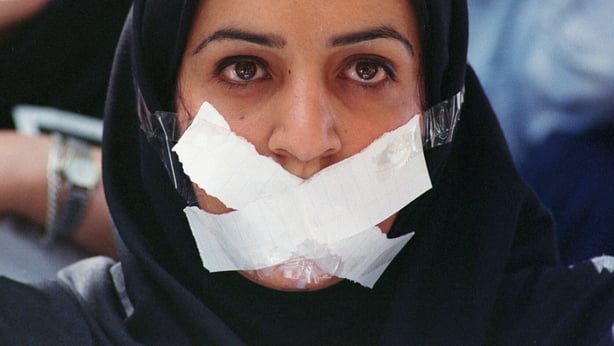
Governments around the world are stepping-up their attacks on civil society organisations and human rights defenders, according to a new Amnesty International report. On 21 February 2019 RTE Ireland summarizes it as follows: It says governments are creating laws that subject non-governmental organisations and their staff to surveillance, bureaucratic hurdles and the threat of imprisonment. The international human rights group says the global assault on NGOs has reached a crisis point as new laws curb vital human rights work. The report, Laws Designed to Silence: The Global Crackdown on Civil Society Organisations, lists 50 countries worldwide where anti-NGO laws have been implemented or are in the pipeline.
https://www.rte.ie/news/2019/0221/1031852-amnesty_assault_on_ngos/
Michel Forst: “Empowering defenders on the move is crucial to the prevention of further tragedy”
February 20, 2018The ISHR in a piece of 16 February 2018 draws attention to tow complementary reports on the situation of human rights defenders in a migration context. They fit admirably with the outcry of 250 NGOs concerning Hungary referred to in my earlier post of today [https://humanrightsdefenders.blog/2018/02/20/250-ngos-address-letter-to-hungarian-parliament-regarding-restriction-on-the-work-of-human-rights-defenders/].
The first is the report, by UN Special Rapporteur Michel Forst, which examines the many ways in which human rights defenders are impacted by the current environment related to migrant and refugee flows. For example, defenders may become migrants or refugees as a result of the harassment and violence they face in their own communities or countries. ‘Empowering defenders on the move is crucial to the prevention of further tragedy‘.
The second is the OHCHR Principles and Practical Guidance for the protection of the Human Rights of Migrants in Vulnerable Situations, especially Principle 18 which states that ‘States must respect and support the activities of human rights defenders who promote and protect the human rights of migrants’.
Both document will be considered at the upcoming session of the UN Human Rights Council.
‘The two documents are fully complementary’, Sarah Brooks of the ISHR says. ‘The recommendations of the OHCHR and the UN expert have no daylight between them – their message is quite simple. In order for lives to be saved, States must ensure that human rights defenders and civil society can operate safely and without hindrance.’

Migrants – including migrant workers – who seek to stand up for their rights and those of others face unique threats, including deportation. The case of Sujana Rana and Rose Limu Jee, two migrant domestic workers from Nepal who were detained and deported after advocating for freedom of association in Lebanon, is a prime example. And defenders in countries of destination – whether the Gulf, the United States, or many Member States of the European Union (e.g. Hungary) – find that their own governments may rollback protections or even funding for civil society and defenders when migration-related issues are the focus, or in the worst cases criminalise assistance to migrants and refugees.
Main challenges
- Limits on access to migrant and refugee populations. This can appear as overt limits on physical presence in border areas or due to the remote nature of some areas where populations on the move are concentrated. This includes securitised border zones and offshore facilities. In both cases, the real impact is to increase physical and financial barriers to access, preventing people on the move from accessing independent services and much-needed legal counsel.
- Criminalisation. Some defenders struggle against risks of criminal prosecution both nationally and as a result of local bylaws, particularly registration requirements (based on geographic areas of work, for example). The overzealous application of existing law has also been sued to accuse people of harbouring or smuggling, when in reality the individual was engaged in humanitarian activity. This threat of criminal charges has a chilling effect, as does the decrease in funding for organisations working in this area (both anti-racism work and traditional legal aid centres).
- The growing role of non-state actors. Especially in some parts of Latin America, organised crime poses significant threats to defenders, as well as to States should they try to protect them. Businesses are also implicated, as the report notes particular types of private employment contracts which ‘gag’ service providers and impose outsized fines or criminal penalties for discussing the situation. Finally, in cases where governments have outsourced certain services, tools like access to information requests (normally directed at public authorities) are no longer available.
http://www.ishr.ch/news/hrc37-global-community-must-recognise-defenders-people-move-says-un-expert
Click to access 201802_ohchr_principles_and_practical_guidance.pdf
ProtectDefenders.eu held its annual meeting 2017
December 28, 2017The Newsletter of December 2017 of ProtectDefenders.eu contains a report of the 2017 Annual Meeting. The highlights:
On the 8th of November, ProtectDefenders.eu held its second annual meeting, under the motto “Champions of change – Human rights defenders at the forefront of development and democracy“. More than 30 human rights defenders at risk from all regions of the world who have benefited from the project gathered in Brussels with representatives of international NGOs and European institutions. This unique meeting has successfully brought together grassroots activists working on the frontlines for change and leading experts on the protection of human rights defenders, universal and regional protection mechanisms, and representatives of various EU institutions implicated in the protection of human rights defenders and current development agenda.

The meeting highlighted the crucial role and impact of human rights defenders around the world as promoters of a sustainable development and engaged development actors in how to integrate the protection of human rights defenders as part of an effective development and protection agenda. The widespread attempts to de-legitimise human rights’ discourse and human rights defenders’ work worldwide were addressed, by promoting a positive narrative grounded on the universality and indivisibility of human rights and its contribution to more advanced and developed societies. Human rights defenders and high-level speakers shared strategies to enhance the protection of those who strive to defend human rights, and to develop a positive narrative on the human rights’ work, legitimising their work at the local level and taking back the human rights discourse to the centre of the international agenda.

To conclude the meeting, the twelve partner organisations of ProtectDefenders.eu have issued a public statement urging all national authorities to “publicly recognise the crucial role played by human rights defenders and protect them in all circumstances from any form of judicial harassment“. As stressed by Antoine Madelin, FIDH Director for International Advocacy and Chair of the Board of ProtectDefenders.eu, “Human Rights Defenders are the pillars of democracy and of the rule of law but are too often subjected to unfair criminal prosecution, in an effort to undermine their work in the defence of human rights.”
Malta’s Aditus foundation urges Government to improve relationship with human rights defenders
December 11, 2017In commemoration of International Human Rights Day, the Aditus foundation (a non-governmental organisation established in 2011 by a group of young lawyers who monitor, report and act on access to human rights by individuals and groups; the focus is primarily Malta, but also covers the regional & international dimensions of human rights in Malta) noted the precarious situation of Malta’s human rights defenders and called for a broader respect for their central role in promoting and contributing towards Malta’s overall well-being. [see also: https://humanrightsdefenders.blog/2017/12/04/the-new-normal-rising-attacks-on-human-rights-defenders/]
In a statement released to the media, the foundation said that Malta’s human rights defenders are …are present where State interventions are either absent or insufficient, where the risk of human rights violations is high. It continued to say that without human rights defenders, Malta would probably not be able to boast today’s’ levels of social wellbeing. As activists dedicated to ensuring human rights enjoyment for all persons, most of us push for stronger legal and policy standards, support the training of public officials, provide public information, support victims of violations and strive to hold the State accountable and responsible for its failures. “In return, many of us are bullied, harassed, insulted, threatened and stigmatised. Many of us are denied access to important dialogue with State entities, or exploited by the State as we provide those public services the State refuses or is unable to provide. As the community of Malta’s human rights defenders is still mourning the brutal assassination of Daphne Caruana Galizia, we are uncertain of the security of our working environment and are concerned for the physical and psychological safety of our staff and volunteers.”
“We are not satisfied that our concerns are being taken seriously by the competent authorities, especially in view of the fact that we are often victims of hatred perpetuated by those entities responsible for our protection.”
“Understanding the importance of human rights defenders is fundamental for the fostering of a society that is geared towards respecting, protecting and fulfilling everyone’s human rights.”
“By tolerating this on-going abuse of its human rights defenders, Malta is not only offending the principles human rights embody – equality, non-discrimination, individual and social empowerment – but it is also further marginalising those communities and themes human rights defenders so vehemently stand up for.”
“On International Human Rights Day, we therefore urge Malta to rethink its relationship with human rights defenders. This means to not merely refrain from activities that instil fear and insecurity, but to take steps towards actively supporting human rights defenders.”
UN Rapporteurs urge ASEAN summit to address regional human rights concerns
November 11, 2017Four UN human rights experts*(including Michel Forst, the Rapporteur on Human Rights Defenders) have called on states to address pressing human rights issues during the 31st ASEAN Summit being held from 10-14 November in the Philippines. Recognising the important work of the many active civil society organisations across the region, the experts expressed concern about “a worrying deterioration in the environment in which they operate.”
“Human rights defenders, social activists, lawyers, journalists, independent media and even parliamentarians trying to speak out and protect the rights of others, increasingly face a multitude of risks ranging from judicial harassment and prosecution to threats, disappearances and killings,” said the experts. They observed rising numbers of cases of serious human rights violations affecting among others, people working on women’s rights, environmental and land issues and lawyers dealing with drug cases.
The experts called on the 10 ASEAN Member States to amend or repeal existing legislation and to reconsider draft laws that are being or could be applied to criminalize or restrict the vital work of civil society. “We condemn the public vilification, harassment, arrests and killings of members of civil society, and call on Member States to rigorously uphold their duty to ensure the freedom and protection of those exercising their fundamental rights to freedom of expression, association and peaceful assembly,” the experts said. “Independent media, members of civil society and human rights defenders should be viewed as partners and as an essential element of democracy.”
“This summit should be seen as an opportunity to make real progress on these issues and to show the world that the Member States of ASEAN are fully committed to securing the human rights of all in the region,” the group said.
(*) The UN experts are: Ms. Annalisa Ciampi, the Special Rapporteur on the rights to freedom of peaceful assembly and of association; Ms. Agnes Callamard, Special Rapporteur on extrajudicial, summary or arbitrary executions; Mr. Michel Forst, Special Rapporteur on the situation of human rights defenders; Ms. Yanghee Lee, Special Rapporteur on the situation of human rights in Myanmar
http://www.ohchr.org/EN/NewsEvents/Pages/DisplayNews.aspx?NewsID=22380&LangID=E
Even Maina Kiai cannot escape harassment in Kenya
August 22, 2017There are certainly worse violations to which human rights defenders are submitted than a short detention at the airport, but this case concerns Maina Kiai, who is former UN Special Rapporteur on the rights to freedom of peaceful assembly. Kiai, also Kenya Human Rights Commission (KHRC) board member. On 20 August 2017 he was stopped from catching his flight at Jomo Kenyatta International Airport to the US. This was after immigration officers demanded that he gets travel clearance before they could stamp his passport. He was held for about two hours before but was allowed to travel after Director of Immigration Major-General Gordon Kihalangwa (Rtd) intervened. Kihalangwa told the Star that Kiai was not detained but was taken through routine security checks that every traveler is subjected to. “Kiai was not restricted. It was a normal security check and not meant to demean him or anyone.”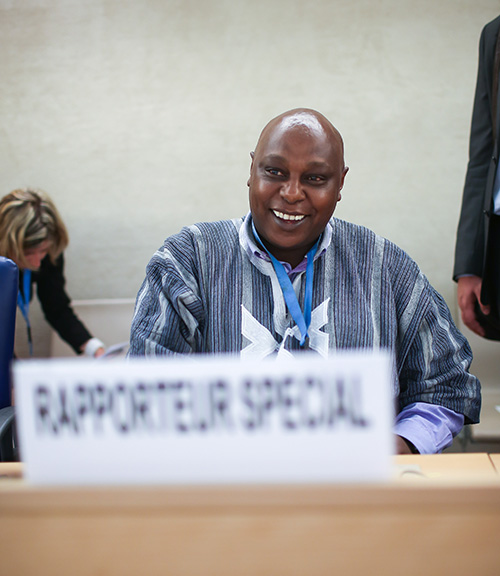
That notoriety has protective value can be seen from what he added: “Kiai is a renown personality. He is even known to me. I spoke to him personally before he traveled“. [for more on Maina Kiai: https://humanrightsdefenders.blog/tag/maina-kiai/]
Still, human rights defenders such as Njonjo Mue termed the incident “disturbing and an attempt by the state to manage its citizens with a fist”. “We are dealing with a regime determined to silence all independent voices, its dictatorship and we back to 1990s”. Khelef Khalifa of Muslims for Human Rights (MUHURI) said it was not a coincidence but a deliberate attempt to silence all those voices that speak to power.
Last week, there were attempts by the state to shut down the NGOs KHRC and AfriCOG in what government termed as failure to comply with statutory obligations. The events climaxed by failed raid on AfriCOG offices. On 16 August 2017 this is what Front Line Defenders had to say about this:
Kenya Revenue Authority officials attempted to raid the African Centre for Open Governance’s offices. On 14 and 15 August 2017, the Executive Director of the NGO Co-Ordination Board notified the Kenya Human Rights Commission- KHRC and the African Centre for Open Governance- AfriCOG that the Board would be cancelling their registration. The NGO Co-Ordination Board also called for the freezing of their accounts and the arrest of the Board of Directors and members of AfriCOG ……
On 16 August 2017, Kenya Revenue Authority officials attempted to raid the AfriCOG offices, however, the search was called off in order to investigate complaints by the organisation. On 15 August 2017, the Executive Director of the NGO Co-Ordination Board sent a letter to the Director of Criminal Investigations stating that AfriCOG will be shut down and calling for the arrests of its directors and members. The NGO Co-Ordination Board has alleged that AfriCOG is not a registered organisation under the NGO Co-Ordination Act 1990 as required by law. The letter, in which AfriCOG and the Central Bank of Kenya were copied, also called for the freezing of accounts in the name of AfriCOG.
On 14 August 2017, the Kenya Human Rights Commission received a letter from the NGO Co-Ordination Board de-registering the NGO. In the letter, the Executive Director of the NGO Co-Ordination Board also asked the Central Bank of Kenya, who was copied in the correspondence, to freeze any accounts in the name of KHRC. The allegations by the Board include that the NGO has illegal bank accounts, that it illegally employs expatriates and that it is concealing illegal remuneration of board members.
These allegations are similar to those made by the NGO Co-Ordination Board about the KHRC in 2015 when the Board issued a press statement announcing that it had initiated the de-registration process for a number of NGOs, including the KHRC. In Kenya Human Rights Commission v Non-Governmental Organisations Co-Ordination Board [2016] eKLR, Judge Onguto found that the NGO Co-Ordination Board had violated Article 37 of the Constitution by not giving the KHRC a hearing before deciding to cancel its registration certificate and freeze its bank accounts.
Source: Rights defenders condemn Maina Kiai detention, urges him to sue | The Star, Kenya
Malaysian Home Minister: Human rights defenders are “wolves in sheep’s clothing”
August 21, 2017
The Home Minister in Malaysia has resorted to an old but persistent ‘canard’ often leveled at lawyers in general, namely that human rights defenders are siding with criminals in court. On Tuesday 15 August, 2017 themalaymailonline.com/ reported that Datuk Seri Ahmad Zahid Hamidi alleged that critics of the law often masquerade as human rights defenders.
Home Minister Datuk Seri Ahmad Zahid Hamidi has criticised human rights defenders today, accusing them of defending criminals instead. While launching his book on the Prevention of Crime Act (POCA) 1959 today, the deputy prime minister reportedly alleged critics of the law often masquerade as human rights defenders. “They defend crime syndicates. They are wolves in sheep’s clothing,” he was quoted saying by news portal Malaysiakini. “They claim to defend human rights, but in court, they defend criminals accused by the authorities.”
The Human Rights Commission of Malaysia (Suhakam) has put forth a definition of human rights defenders, two days after the deputy prime minister called them “wolves in sheep’s clothing who protect criminals”. Suhakam chairman Razali Ismail said such individuals were people who work towards the realisation of rights and freedoms contained in the Federal Constitution, the Universal Declaration of Human Rights and other human rights instruments through non-violent means. “The efforts of human rights defenders contribute to positive societal change and play an important role in the establishment of the rule of law. “They certainly cannot be said to be defending crime syndicates and criminals,” he said in a statement today.
Source: Home Minister: Human rights defenders siding with criminals in court | Malaysia | Malay Mail Online
Trans defender’s Karla Avelar’s life is under constant threat
May 16, 2017Brian Dooley of Human Rights First, wrote the following piece “Karla Avelar’s Life Of Constant Threats” in the Huffington Post of 13 May 2017 (in full below). Karla (El Salvador) is one of the three finalists of the Martin Ennals Award for Human Rights Defenders [https://humanrightsdefenders.blog/2017/04/26/breaking-news-three-human-rights-defenders-selected-as-finalists-for-the-2017-martin-ennals-award/]. An rise in deadly violence against transgender women in El Salvador prompted the United Nations on Friday to call for an investigation into crimes against sexual minorities in the conservative Central American country. So far this year, seven transgender women have been killed in El Salvador, according to the Office of the U.N. High Commissioner for Human Rights [http://www.reuters.com/article/us-elsalvador-violence-lgbt-idUSKBN189018]

CARLOS CRUZ, COMCAVIS TRANS
Six times in two years. Human rights activist Karla Avelar has been forced to move home six times in the last two years after being physically threatened by individuals she believes are gang members and for her work as a human rights defender in El Salvador.
She’s a leading advocate for the human rights of LGBT people, founder and head of COMCAVIS TRANS, an organization known for its work for transgender people for nearly a decade. It’s dangerous, unpopular work, and Avelar is regularly targeted and threatened.
A couple of weeks ago she was forced to move home when people tried to extort from her possible prize money for the Martin Ennals Human Rights Defender Award, for which she is a finalist. The award’s winner will be decided and announced in October, but news of her nomination has prompted these latest threats.
It hasn’t been an easy life. She was shot in two separate incidents, spent five traumatic years in jail and has been a constant target of abuse for being a transgender woman. Avelar told my colleague Mariel Perez-Santiago at her office in San Salvador last year how she had been raped by more than a hundred men on her first day in prison, and that the attacks continued with the complicity of prison staff.
She became a formidable advocate for the rights of trans people in and out of prison, helping to win important reforms in the prison where she used to be an inmate. Thanks to her campaigning, transgender women are now separated from men in different wards, and human rights organizations are allowed access to the prisoners to educate them about their rights. She also represented El Salvador’s LGBT civil society at the country’s 2014 Universal Periodic Review at the United Nations in Geneva.
Her advocacy has led to international recognition including becoming a finalist for this year’s Martin Ennals Award. “Transgender persons, and the wider LGBT community, face widespread hostility and social rejection in El Salvador,” said the Martin Ennals organization in a statement. “Crimes against them are almost never brought to justice, which results in a climate of impunity. Sadly, this treatment of transgender people can be seen well beyond El Salvador. We aim to highlight Ms. Avelar’s bravery in continuing her work. We are encouraged that the authorities contacted her after the media coverage of the latest threats. This needs to be followed up with judicial proceedings against those responsible and, most importantly, effective protection for Karla Avelar.”
Her profile has meant that the threats against her are receiving attention, and the Attorney General’s office has been in touch with her to discuss issues of her safety. But for Avelar and others in El Salvador’s LGBT community the risks are daily and grave. She estimates around 600 cases of unsolved murders of LGBT people in the country over the last 25 years.
“Sadly, these most recent threats against me are not surprising and are part of a broader and systematic pattern of persecution of members of the LGBT community in El Salvador,” said Avelar. “I will not be silenced by these threats, but the Salvadoran government must guarantee my safety and that of all human rights defenders and activists, who work tirelessly to monitor and urge respect for the human rights of the most vulnerable.”
Forced to leave her home again and again, she’s asking for protection as well as international visibility. Making her more famous won’t guarantee her safety but we can try to help by sharing her story with whoever we know, by showing that we’re watching, and by saying that she should be protected and never be forced to move again.
 Hans Thoolen on Human Rights Defenders and their awards