On International Human Rights Day, the Open Society Foundations reaffirmed their vision for a shared humanity where everyone can thrive, continuing the philanthropy’s role as the world’s largest private funder promoting rights, equity, and justice.
Under the leadership of Chair Alex Soros, the philanthropy is streamlining its programming to support new voices and approaches that align with today’s emerging forms of organizing and leadership. The Foundations will pursue targeted time-bound efforts, provide long-term institutional support, and retain the flexibility to respond to crises through rapid response funds.
Binaifer Nowrojee, president of the Open Society Foundations, said:
Across the world, we are seeing inspiring and powerful movements working to shape a future framed by human rights. Standing with them as allies, we will deepen, broaden, reimagine, and catalyze efforts to advance a new vision of human rights that is not bounded by historic double standards, exclusions, and inequities.
We are crafting and implementing thoughtful, future-focused strategies for change that will leverage gains made through key openings and convert them into wins. Our investments will aim to work with groups to build on and sustain these wins over time. We are committed to listening and to being informed by the needs of allies leading the fights for rights, equity, and justice.
The commitments include multiyear investments across a broad range of issues and geographies, including:
Rights protection: Supporting human rights advocacy as well as protection of rights defenders at risk, particularly environmental and women’s groups
Inclusion: Ensuring marginalized and vulnerable groups can fully exercise their rights without fear of violence or discrimination
Public safety: Promoting communities-centered approaches to tackling repressive or militarized responses to violence and public safety
Accountability: Supporting human rights–based litigation in national, regional, and international courts
Political participation: Supporting new champions and nonpartisan movements of inclusive and accountable democratic practice in specific countries and globally
Economic rights: Developing and promoting new state-led economic models for a green transformation to advance economic and social rights
In 2025, Open Society will be approving further programming to promote rights, equity, and justice.
Open Society has also approved funding across other areas, including ideas, impact investing, advocacy, and higher education.
Philip Oltermann on 19 August 2023 reports that ΗRDs fear the billionaire’s legacy will be lost as his Open Society Foundations curbs its activities across the EU
Soros survived the Nazi occupation of his native Hungary, made a fortune on Wall Street and became one of the most steadfast backers of democracy and human rights in the eastern bloc. But human rights activists and independent media fear the legacy of billionaire philanthropist George Soros, 93, could be about to be undone in his homelands, as his donor network announced it will curb its activities across the EU from 2024.
Several beneficiaries of Soros’s Open Society Foundations (OSF), chaired since the start of this year by his son Alex, told the Observer they would struggle without its support amid an authoritarian rollback.
“When the Open Society Foundations left Budapest under severe political pressure in 2018, they said they would lose their physical presence but not their focus on the region,” said Márta Pardavi, co-chair of the Hungarian Helsinki Committee, a Budapest human rights NGO supported by the foundations. But she added: “Has there really been such a positive shift in Europe over the last five years that that promise has become less relevant?”
In a July email to staff, the OSF management announced a “radical redesign to help us deliver more effectively on our mission”. “Ultimately, the new approved strategic direction provides for withdrawal and termination of large parts of our current work within the European Union, shifting our focus and allocation of resources to other parts of the world,” it said.
While 40% of the charity’s global staff will be laid off, cuts will be severest in Europe, with the 180 headcount at its Berlin headquarters cut by 80%. Staff remaining in the German capital will mainly administer the foundation’s funds in Switzerland.
Its Brussels offices will be downsized, while a branch in Barcelona will be closed by the end of the year. Of an erstwhile seven branches in the post-Soviet area only three remain in Kyrgyzstan, Ukraine and Moldova.
Many European NGOs, think tanks and research groups working on issues ranging from media freedom and migrants’ rights to state surveillance and digital regulation rely on the foundations, which spent $1.5bn on philanthropic causes in 2021.
As traditional European media outlets have struggled to live up to their role amid a drop in advertising revenue, OSF has stepped in to support independent news projects including the Organized Crime and Corruption Reporting Project (OCCRP), London-based Bureau of Investigative Journalism and Forbidden Stories, an encrypted online platform that allows threatened journalists to securely upload their work and be continued by others.
Alex Soros, who grew up and was educated in the US, said: “The Open Society Foundations is changing the way we work, but my family and OSF have long supported, and remain steadfastly committed to the European project.”
The foundations say they will continue support for European Roma communities. Even critical employees expressed confidence the foundations could commit more to longer-term projects, just fewer of them.
Yet while a profound change to the structure of the organisation has long been signalled by Soros senior, the decision to achieve this via drastically reducing its headcount seems to have only emerged has been a priority under its new board of directors. Once jokingly referred to by employees as Soros’s “reading group”, the board has been slimmed down to a tighter unit dominated by family members since the baton was passed to Soros junior.
“The OSF is one of the few bodies that hand out unrestricted core funding,” said one grantee, who asked to remain anonymous amid uncertainty over the foundation’s future strategy. “It’s what keeps the light on for human rights defenders in Europe.”
Berlin has been the hub of the foundations’ European operations after the 2018 closure of the Budapest branch under pressure from the government of strongman Viktor Orbán, once a recipient of Soros’s support.
Last week the Hungarian prime minister’s political director Balázs Orbán (no relation) posted a message on social network X, formerly known as Twitter, in which he called the Open Society Foundation “the Soros empire”. “We only truly believe that the occupying troops are leaving the continent when the last Soros soldier has left Europe and Hungary,” he said.
“If you invest in democracy, you can never expect it to yield quick returns,” Márta Pardavi said. “The need for democracy-building never really goes away. And I think George Soros knew that.”
On July 21, 2021, Project Syndicate 2020 published his piece called” The Fight for Open Societies Begins Again”:
Democracy is back on policymakers’ minds. US President Joe Biden plans to host a summit on the theme, and invitations to a host of events on democracy and human rights fill my inbox.
This renewed focus is not good news. Rather, it reflects the erosion of both democracy and respect for human rights in recent years.
Freedom House reports that less than 20% of the world’s population now live in what it categorizes as fully free societies, the lowest share in more than a quarter-century. Many countries are drifting steadily toward authoritarianism.
Freedom is in trouble for well-known reasons. In many countries, increasing inequality and marginalization of different groups has fueled an embrace of right-wing (and in some cases left-wing) authoritarianism.
As the world grapples with rapid technological change and economic restructuring, many are far from convinced that democracies have the edge in terms of adaptation and forward-looking policymaking. The pandemic – which many democracies mishandled – deepened these doubts.
These are difficult times for those of us who profoundly believe that the absolute, non-negotiable basis of good government is a free, democratically empowered citizenry protected equally under law.
In 1980s Eastern Europe, the problem was sclerotic, aging communist governments that could no longer deliver for their people. Today’s situation is more complicated.
I am president of the largest private philanthropy in this domain. If we are honest with ourselves, we know that our traditional models of advancing democratic values and institutions are struggling.
The Open Society Foundations (OSF) was founded in the 1980s on the assumption that there was an urgent global public demand for freedom, and that a growing number of governments around the world were embracing its rules and norms.
That allowed us (in partnership with local activists) to use a mixture of shaming and encouragement to persuade governments to adopt and respect human-rights laws and democratic procedures.
Whether our work concerned the Roma in Central and Eastern Europe, LGBTQI communities in Africa, ethnic minorities in South and East Asia, women’s rights in Latin America, or worldwide migrant and refugee protection, it seemed that we were pursuing a historic mission. And one day, that pursuit might lead to all individuals enjoying full and equal rights and opportunities.
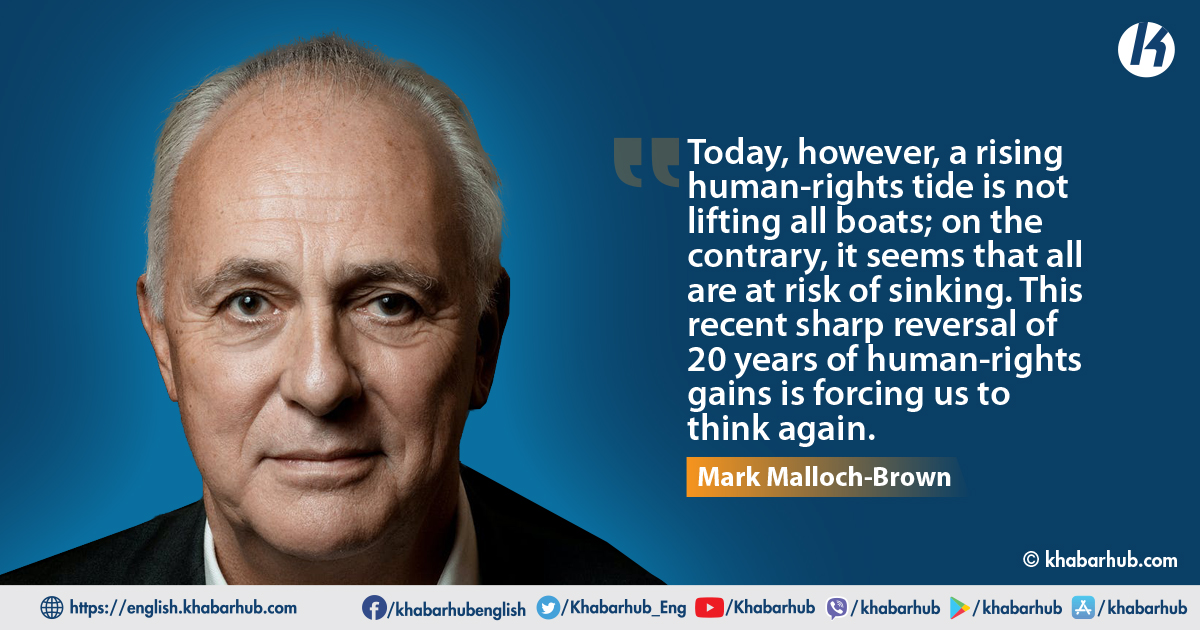
Today, however, a rising human-rights tide is not lifting all boats; on the contrary, it seems that all are at risk of sinking. This recent sharp reversal of 20 years of human-rights gains is forcing us to think again.
As a foundation chaired to this day by its founder, George Soros – a survivor of Nazism and a refugee from communism in his native Hungary – we will not move on to less challenging issues.
After all, Soros started the foundation when prospects for human-rights advances looked as difficult as they do today.
Presidents stole additional terms, official corruption surged, and agreements between states brushed aside people’s rights. Nowadays, human-rights defenders and those who support them are not welcome in much of the world.
So, the mission is non-negotiable. But we must revisit our approach. We must ask how to recover public support for democratic and human-rights norms, while also identifying more clearly the enemies of open societies and what will lead them, even grudgingly, to respect their obligations again.
In 1980s Eastern Europe, the problem was sclerotic, aging communist governments that could no longer deliver for their people. Today’s situation is more complicated.
True, a bipolar world again threatens freedom. Biden’s forthcoming Summit for Democracy is in part an effort to rally like-minded governments but also the wider world against Chinese President Xi Jinping’s authoritarianism. That may mean democracies have some uncomfortable bedfellows as pragmatism risks trumping values.
A dense web of trade, investment, education, and technology links mean China is tied to the West, and vice versa, in ways that the Soviet Union never was.
A relationship that is more economic than military gives democracies an array of options – from governmental and consumer boycotts to a more coherent international containment and engagement strategy – for pressing Xi’s regime to accept norms of good behavior at home and abroad.
Leaders on both sides will frame this contest primarily in terms of economics, but human rights can also be a big winner – or a big loser.
Soros has always called OSF’s work “political philanthropy.” What he means is that we need to engage with the wider dynamics of change and find entry points to champion our issues.
Whereas strong states were the sole or leading human-rights violators during the Cold War, today’s world is one of multidimensional human-rights menaces. Inequalities exacerbated by unregulated transnational financial and corporate power, together with dramatic shifts in individual states’ fortunes, are creating an ever more challenging landscape. The world is becoming more unequal – and angrier.
Many view the renewed attention to deep-seated institutional racism in the United States and around the world – and the recognition that marginalization based on race, gender, religion, and class is often mutually reinforcing – as exposing the limits of a human-rights agenda.
That anger is amplified (and fueled) by social-media platforms where polarization, abuse, and lies undermine trust in institutions. A technology that many saw just a few years ago as an enabler of citizens’ rights has become in many cases a tool for manipulating minds and closing societies.
The insidious copycat behavior that Donald Trump’s four-year presidency allowed and encouraged in regimes around the world accelerated a crisis of respect for the rule of law and human rights.
Presidents stole additional terms, official corruption surged, and agreements between states brushed aside people’s rights. Nowadays, human-rights defenders and those who support them are not welcome in much of the world.
Yet malign governments and globalization, with its unintended financial and corporate consequences, are only half the problem.
Many view the renewed attention to deep-seated institutional racism in the United States and around the world – and the recognition that marginalization based on race, gender, religion, and class is often mutually reinforcing – as exposing the limits of a human-rights agenda. Human-rights remedies, victims argue, have scratched the surface, not reached the roots.
Human-rights work needs to become more political: tougher and smarter in its attacks on oppressors, and clearer about being on the side of the oppressed.
We need to address the challenges people actually face, looking beyond narrow political rights to address the deeper causes of economic and social exclusion.
On 9 May 2018, Hungary’s (remaining) civil society issued the Professors Solidarity Call below, signed by 77 professor until now and asking for more signatories. It concerns the so-called “Stop Soros” bill, to be voted by the Hungarian parliament very soon, which will have a devastating impact on both Hungarian civil society and the asylum seekers and refugees that are already in a dire state. That Victor Orban is behind an ‘anti-Soros bill’ is the more remarkable as he himself was the beneficiary of a Soros scholarship [in 1988 a dissident Hungarian university graduate wrote a letter to George Soros, a billionaire philanthropist, asking for help obtaining a scholarship to Oxford University. In the letter, which has recently resurfaced, the young Viktor Orban said he wanted to study the “rebirth of civil society”. He got the scholarship.– the Economist 7 April 2018].
PROFESSORS’ SOLIDARITY DECLARATION AND CALL FOR ACTION IN DEFENCE OF THE HUNGARIAN HELSINKI COMMITTEE AND THE HUNGARIAN CIVIL SOCIETY
We, 77 university professors and academics from 28 countries around the world, express our solidarity with the Hungarian Helsinki Committee and the independent Hungarian civil society, which currently faces an imminent existential threat.
The so-called “Stop Soros” bill, to be voted by the Hungarian Parliament in mid-May 2018, will have a devastating impact on both Hungarian civil society and those vulnerable human beings that cannot count on anyone else’s support. The new legislation will allow the government to simply ban the activities of organizations assisting refugees and migrants in a fast and arbitrary process. Activities such as legal aid to asylum-seekers, reporting to the UN or the EU, holding university lectures about refugee law or recruiting volunteers will be rendered illegal, if these are performed by civil society actors who dare to criticise government practices. Practices, which are equally condemned by the EU and the international community.
The Hungarian Helsinki Committee (HHC) is an outstanding human rights organization, well-known and respected for its professionalism around the world, not only by civil society, but by academia, state authorities and the judiciary as well. The HHC has massively contributed to the promotion of refugee law education and legal clinics on various continents. We all personally know and highly respect their work. States should be proud of such NGOs, instead of aiming to silence them.
Strong and independent civil society organisations are as indispensable for democracy and the rule of law as strong and independent universities. If NGOs such as the Hungarian Helsinki Committee are threatened, democracy is threatened. If a prestigious organization, winner of various international human rights awards, can simply be banned from providing legal aid to refugees, if a globally reputed voice of human rights can be silenced with an administrative measure in an EU member state, then further dramatic anti-democracy measures are likely to follow. There is a real risk that the Hungarian example will be increasingly copied elsewhere, and soon it may be too late to stop the domino effect.
We call on our governments to express, without delay, their vivid discontent with Hungary’s legislation aiming at annihilating independent civil society. We call on universities around the world to do the same and actively demonstrate their solidarity with the Hungarian Helsinki Committee and the entire threatened Hungarian civil sector. We call on the European Union to prove to the world its credibility as a guardian and global promoter of fundamental rights, and immediately take action to prevent this flagrant human rights violation from happening on its own territory.
Signatures (in alphabetical order) at the end of the document: https://www.helsinki.hu/wp-content/uploads/Professors-solidarity-call-HHC-HU-NGOs-2018.pdf
This is the second item addressing the world of human right defenders in 2017. I do this with an ‘old piece’ by Chris Stone, President of the Open Society Foundations, dating back to 21 December 2015 saying that across the globe, governments are shutting down spaces for civic engagement. Something that indeed has become evident.
It starts with the short video clip above in which George Soros, Binaifer Nowrojee, Mburu Gitu, and other experts discuss why this is happening—and how civil society can unite to prevent it.
All around the world, active citizenship is under attack and the space for civic engagement is closing—not just in countries that have struggled under repressive or autocratic governments, but also in democracies with longstanding traditions of supporting freedom of expression. There are many different reasons for this shrinking of the public space.
In some countries, especially newer democracies or countries undergoing political transitions, those in power are fearful of civic activism. Seeing its power, officials in governments with no previous experience regulating political protests or public debates have come down with a heavy hand, erring on the side of preventing change rather than encouraging it.
In other countries, including France and the United States—partly in response to the fear of terrorism—well-established civil liberties have been suspended or cast aside in the name of security. Such measures, from mass surveillance to martial law, reduce the space for civic life, the space where citizens do the work of improving our communities and societies.
Civil society is enormous in its size and diversity. We are members of the media, for-profit businesses, volunteer associations, political parties, trade unions, faith communities, private foundations, and nonprofit organizations. If we are united at all, we are united by our work outside of government and the state to advance the common good—even though we have different ideas of what that looks like.
Because the space we need for this work is closing, we must come together, understand our mutual dependence and interrelatedness, and support each other in this work. We must forge a new solidarity.
In 2010 businessman and philanthropist George Soros gave $100 million to Human Rights Watch (if the same sum was matched in private contributions). This time a more modest but still considerable sum goes Connecticut. Georges Soros and Gary GladsteinRead the rest of this entry »

 Hans Thoolen on Human Rights Defenders and their awards