Posts Tagged ‘genocide’

Calls for protection of Gaza human rights defenders and access for investigators

October 8, 2025
At Human Rights Council: Euro-Med Monitor calls for protection of Gaza human rights defenders and access for investigators

In a statement delivered before the United Nations Human Rights Council on 2 October 2025 , Euro-Med Human Rights Monitor called to protect human rights defenders in Gaza and to grant international investigators unrestricted access to examine violations committed amid Israel’s ongoing war on the Gaza Strip.

The statement was delivered remotely from Gaza by Maha Hussaini, Head of Media at Euro-Med Monitor, during the Council’s 60th session under Item 8. Hussaini stressed that the continued silence of states and civil society representatives severely undermines international law and enables further violations.

Addressing the Council, Hussaini said: “I speak to you from my last refuge after I was forcibly expelled from my home in Gaza City under relentless Israeli bombardment, though I do not know if by the time you hear these words I will still be alive or buried beneath the rubble.”

She continued: “Gaza is under unprecedented Israeli attacks, and I have been forcibly displaced along with my colleagues at Euro-Med Human Rights Monitor several times now. I’m meant to present this statement as a human rights defender, to document and to advocate. But today I can no longer count the Israeli crimes I witness, because they surround me in every breath and every hour.”

Hussaini further noted: “It is a shame that I had to tear up my business card identifying me as a human rights worker at some point during this genocide to avoid being killed or detained by the Israeli military.”

She concluded: “We demand, not plead, we demand protection for those documenting genocide in Gaza, we demand unhindered access for international investigators, and we demand that perpetrators face justice. Every silence from you, representatives of states and civil society, is another strike of the hammer driving the coffin of international law.”

On 4 October 2025, in its response to a call for input by UN Special Rapporteur on human rights defenders, Mary Lawlor, Al-Haq drew urgent attention to the escalating and systematic efforts to silence Palestinian voices and dismantle the infrastructure of Palestinian civil society. The submission highlights how Israel’s settler-colonial apartheid regime has intensified its campaign to suppress resistance, criminalise advocacy and quash any pursuit of accountability as it pursues Palestinian erasure.
https://euromedmonitor.org/en/article/6871/At-Human-Rights-Council:-Euro-Med-Monitor-calls-for-protection-of-Gaza-human-rights-defenders-and-access-for-investigators

https://www.alhaq.org/advocacy/26700.html

https://www.omct.org/en/resources/statements/israel-palestine-the-observatory-condemns-the-arbitrary-detention-and-ill-treatment-of-activists-aboard-the-global-sumud-flotilla-in-israeli-prisons

Nobel Peace Prize: choice between Trump and Albanese?

July 24, 2025

No-one will have missed the recent media hype surrounding the opposite candidacies of US President Trump and UN rapporteur Francesca Albanese for this year’s Nobel Peace Prize. This blog with its focus on human rights defenders and their awards would be amiss in not taking note, even if the Nobel Prize is foremost a peace prize not necessarly a human rights award. [see also my piece of 2012 https://global.comminit.com/content/nobel-prize-peace-not-necessarily-human-rights]

So, it is not excluded that the ‘making peace at any cost’ considerations will prevail, but my bet is that the Peace Prize Committee will be careful in ignoring the massive support from the world’s human rights community who have massively come out against the Trump administration’s sanctions against Albanese. Human rights should trump ‘peace’ on this occasion.

Nominations for a Nobel Peace Prize for Francesca Albanese are gathering steam. See the links below:

https://www.frontlinedefenders.org/en/statement-report/united-states-america-sanctions-united-nations-special-rapporteur-assault-human

https://www.scmp.com/news/us/diplomacy/article/3318822/trump-says-he-deserves-nobel-peace-prize-not-everyone-agrees

https://english.pnn.ps/news/47558

https://www.business-humanrights.org/en/latest-news/un-experts-condemn-us-sanctions-on-special-rapporteur-francesca-albanese-amid-report-on-corporate-complicity-in-israels-occupation-genocide/

https://www.thearabweekly.com/eu-gingerly-criticises-washingtons-unprecedented-sanctions-un-rapporteur

https://www.ynetnews.com/article/bku2skjbgl

https://www.hrw.org/news/2025/07/10/us-imposes-sanctions-on-un-special-rapporteur

https://eu.fayobserver.com/story/opinion/2025/08/22/trump-wants-nobel-peace-prize-but-cut-food-abuses-immigrants-has-not-resolved-gaza-or-ukraine/85765058007/

https://www.ynetnews.com/article/sk429uepgg

https://economictimes.indiatimes.com/news/international/global-trends/donalds-dream-dumped-trump-overlooked-for-2025-nobel-peace-prize-but-why/articleshow/124450001.cms?from=mdr#google_vignette

Rwanda: Human Rights Watch’ Archives March 1993 – December 1994 digitized and public

April 4, 2024

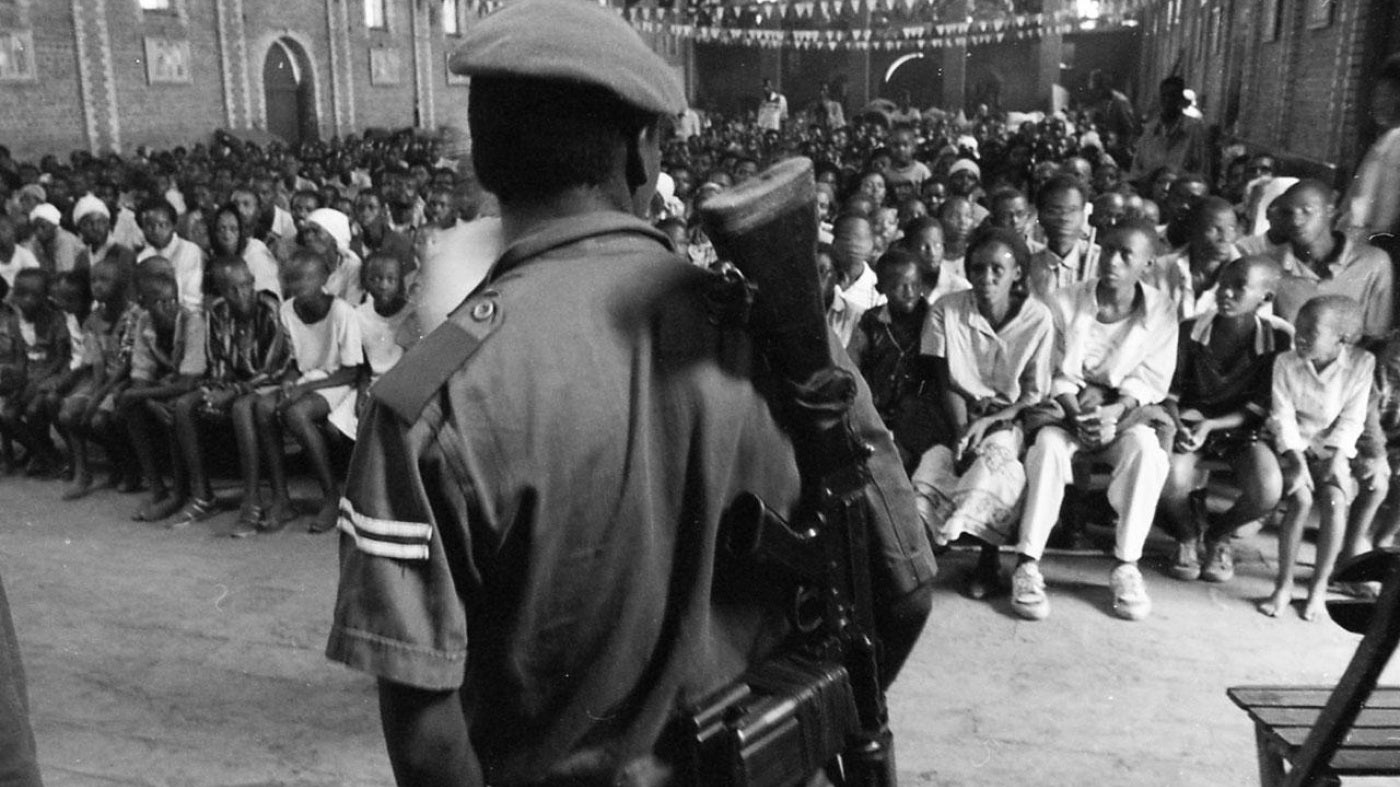
A crowd of mostly Tutsi civilians, seeking protection against Hutu militiamen, sit in the Sainte Famille Catholic church in the then-government controlled part of Kigali, listening to a member of the security services address them. Over several months, ma

On 2 April, 2024 Human Rights Watch made part of its Rwanda Archives public in digital form.

Human Rights Watch has been documenting and exposing human rights violations in Rwanda since the early 1990s. Its senior adviser in the Africa division, Alison Des Forges, one of the world’s foremost experts on Rwanda, dedicated her career to the struggle for human rights in the Great Lakes region of Africa, and to Rwanda in particular. In the period leading up to the 1994 genocide, she worked tirelessly to alert world powers to the impending crisis in Rwanda. Few would listen. By the time the genocidal forces had unleashed their sinister program and the world had awakened to the full horror that was unfolding in Rwanda, it was too late. The killings in Rwanda increased as a civil war in Burundi waged on. The violence in Burundi, also based on ethnic divisions between Hutu and Tutsi ethnic groups, lasted from 1993 until 2005.

Des Forges’s efforts did not stop when the genocide ended. She continued to painstakingly gather information on the killings, rapes, and other horrific crimes, which she compiled into what has become one of the main reference books on the Rwandan genocide: “Leave None to Tell the Story: Genocide in Rwanda”, a 500-page account of the genocide published jointly by Human Rights Watch and the International Federation of Human Rights (FIDH) in 1999. 

Des Forges testified as an expert witness in 11 trials at the United Nations International Criminal Tribunal for Rwanda (ICTR) in Arusha, Tanzania, as well as in domestic court proceedings involving Rwandan genocide suspects in several countries.

Des Forges campaigned vigorously for justice for the genocide until her tragic death in a plane crash in the US on February 12, 2009. She also documented human rights abuses by the new government of Rwanda after the genocide and advocated for accountability for all abuses, past and present.

Thirty years after the genocide, Human Rights Watch has begun the process of digitizing and making available some of Des Forges’s archives. The documents summarized below are some of those that remained in Human Rights Watch possession after Des Forges’s death and help shed light on efforts by Des Forges and others to warn about, and then attempt to stop, the genocide. These are just a selection of the many documents in the archives; others will not be published at this time for a variety of reasons. The private exchanges, letters, statements, and reports below do not purport to be a comprehensive account of the work of Human Rights Watch and others at the time, as it is likely documents are missing from the archive.

See also: https://www.trueheroesfilms.org/thedigest/awards/F42005AB-6691-4C7F-BA0D-1999D2279EA2

https://www.hrw.org/news/2024/04/02/human-rights-watch-rwanda-archives

International Day of Commemoration in Memory of the Victims of the Holocaust

January 28, 2021

More must be done to thwart neo-Nazis and white supremacists who are using the COVID-19 pandemic to target minorities, increase their ranks and re-write history, the UN Secretary-General has said.  António Guterres made the appeal in a video message for the International Day of Commemoration in Memory of the Victims of the Holocaust, observed on Wednesday 27 January, which honours the six million Jews and millions of others murdered by the Nazis during the Second World War.  

As this year’s anniversary is taking place under the shadow of the pandemic, he noted that the crisis has exposed longstanding injustices and contributed to a renewed rise in antisemitism and xenophobia.  

“Today, white supremacists and neo-Nazis are resurgent, organizing and recruiting across borders, intensifying their efforts to deny, distort and rewrite history including the Holocaust”, the UN chief said.    

The UN High Commissioner for Human Rights, Michelle Bachelet, has also voiced concern over the “frightening” increase in hate crimes, and “sharp rise” in antisemitism online, over the past year. 

 “With renewed vigour, conspiracy theorists increasingly link extreme political ideologies and antisemitic delusions – weaving elaborate lies and falsehoods that lay responsibility for every kind of government failing on individual Jews or the Jewish community as a whole”, she said.  “We need to push back against lies. We need to ensure that public discourse is based on facts, which objectively reflect truth – including the fundamental truth of our equal rights and dignity as human beings”, she said.  

Global church leaders such as Pope Francis and the head of the World Council of Churches have joined international leaders on World Holocaust Remembrance Day, calling for decisive action against antisemitism and warning of its danger to morph into other hate. “Remembering is an expression of humanity. Remembering is a sign of civilization,” said Francis. “Remembering is a condition for a better future of peace and fraternity.”

On this 27th January (and beyond!), please join us in commemorating the Holocaust and committing to combatting antisemitism says Elizabeth Arif-Fear in https://voiceofsalam.com/2021/01/28/this-holocaust-memorial-day-we-need-to-stand-together-against-antisemitism/:

  • Join us and light a candle: Share a message of solidarity with the Jewish community by tweeting a photo of your candle with the hashtags #LightTheDarkness #WeRemember and #MuslimsAgainstAntisemitism
  • Learn more: Find out more about the Holocaust and educate others around you
  • Stand up: Speak out when you hear/see antisemitic tropes and conspiracy theories
  • Join us: Get involved with MAAS and volunteer to help us in the fight against antisemitism!

Let’s all light a candle this Holocaust Memorial Day – let’s all stand up against antisemitism. Note that this blog was first published by Muslims Against Antisemitism (27/01/2021).

https://www.ecumenicalnews.com/article/dont-repeat-what-world-holocaust-remembrance-day-remembers-world-urged/60824.htm

https://news.un.org/en/story/2021/01/1083052

Profile of Widad Akreyi, Iraqi human rights defender

November 5, 2019
Dr. Widad Akreyi at the award ceremony for the 2018 International Woman Harmony Award, Cortona, Italy, Nov. 23, 2018.

Azeem Ibrahim wins the 2019 Engaged Scholar Prize for his writing on Rohingya

August 20, 2019
web-Dr.-Azeem-Ibrahim--GLOBAL-SCHOLAR-PRIZE

File photo of Dr Azeem Ibrahim Courtesy

The International Association of Genocide Scholars (IAGS) has awarded academic Dr Azeem Ibrahim its 2019 Engaged Scholar Prize. Founded in 1994, the IAGS is a global, interdisciplinary, non-partisan organization that seeks to further research and teaching about the nature, causes, and consequences of genocide, and advance policy studies on genocide prevention.

Glasgow born Ibrahim has been recognized principally for his work on the genocide committed by the Myanmar state against the country’s Rohingya minority in his book “Rohingyas: Inside Myanmar’s Genocide (Hurst: 2016).”  Ibrahim has also researched and written extensively on the impact of displaced populations including the Syrians, Uyghur Muslims and others. His publications have appeared in prominent media outlets like New York Times, the Washington Post, Newsweek, Foreign Policy, CNN, Daily Telegraph, Yale Global, Dhaka Tribune and many others.

Dr Ibrahim is currently a Director at the Centre for Global Policy in Washington DC and is working on creating the Rohingya Genocide Archives which aims to investigate and document the crimes committed against the Rohingyas by Myanmar and create a databank that can then be used by scholars, historians, researchers and any possible future tribunals. Dr Ibrahim was one of a handful of scholars to foresee and warn of the impending genocide of the Rohingya Muslims in Myanmar in 2016, when the Myanmar military undertook a policy of ethnically cleansing over 700,000 Rohingyas, forcing them into Bangladesh which now houses the largest refugee camp in the world.

IAGS has since its formation presented awards to honor both innovations in and the engaged practice of genocide scholarship. In 2017, these awards were consolidated into four categories: the Emerging Scholar Prize; the Engaged Scholar Prize; the Prize for the Arts; and the IAGS Lifetime Achievement Award. These awards are presented at the IAGS biennial conference and celebrate individuals who make exemplary contributions to the field of genocide studies.

https://www.dhakatribune.com/bangladesh/2019/08/19/bangladeshi-academic-wins-prestigious-global-scholar-prize

About Us

“On Her Shoulders” tells the story of human rights defender Nadia Murad, 2018 Nobel Peace Prize

October 21, 2018
Nadia Murad, a 23-year-old Yazidi, survived genocide and sexual slavery committed by ISIS. Repeating her story to the world, this ordinary girl finds herself thrust onto the international stage as the voice of her people. The film “On Her Shoulders” tells the story of Nadia Murad, 2018 Nobel Peace Prize winner, human rights activist, and Yazidi survivor of genocide and human trafficking. [see also: https://humanrightsdefenders.blog/2018/10/05/breaking-news-see-which-other-awards-the-2018-nobel-peace-prize-laureates-won-already/]

ON HER SHOULDERS Trailer (2018) Nadia Murad Documentary © 2018 – Oscilloscope

Last straw?: U.N. Human Rights Rapporteur Barred By Myanmar

December 21, 2017

 Yanghee Lee, U.N. human rights special rapporteur to Myanmar, talks to journalists during a news briefing in Yangon, Myanmar, in July 2017.

Yanghee Lee, the U.N. special rapporteur on Myanmar, says she has been told that the Myanmar government will neither cooperate with her nor grant her access to the country for the remainder of her tenure. Lee was scheduled to visit Myanmar in January to assess human rights in the country, particularly in western Rakhine state, where the Rohingya are concentrated.

I am puzzled and disappointed by this decision by the Myanmar Government,she said in a statement.This declaration of non-cooperation with my mandate can only be viewed as a strong indication that there must be something terribly awful happening in Rakhine, as well as in the rest of the country.” “Only two weeks ago, Myanmar’s Permanent Representative informed the Human Rights Council of its continuing cooperation with the UN, referencing the relationship with my role as Special Rapporteur,” Lee said. Amnesty International called Myanmar’s decision to bar Ms Lee “outrageous”. James Gomez, the group’s director for Asia and the Pacific, said: “It is a further indication that authorities will do anything they can to avoid international scrutiny of their human rights record.”  [see also: https://humanrightsdefenders.blog/2017/02/01/murder-of-human-rights-defender-ko-ni-in-myanmar/]

The U.N. says more than 630,000 Rohingya have fled Myanmar since ongoing military attacks that began in August. Doctors Without Borders estimates that 6,700 Rohingya were killed in the first month of the crackdown. Refugees streaming into neighboring Bangladesh have brought with them tales of rape and murder at the hands of Myanmar’s soldiers.

U.N. High Commissioner for Human Rights Zeid Ra’ad Al Hussain told the BBC this week that Myanmar’s nominal leader, Aung San Suu Kyi, and the head of the country’s armed forces could potentially face charges of genocide for their role in the crackdown. “Given the scale of the military operation, clearly these would have to be decisions taken at a high enough level,” he told the BBC. “And then there’s the crime of omission. That if it came to your knowledge that this was being committed, and you did nothing to stop it, then you could be culpable as well for that.” [see also: https://humanrightsdefenders.blog/2017/09/03/myanmar-time-for-aung-san-suu-kyi-to-return-at-least-some-of-her-many-human-rights-awards/]

Myanmar’s refusal to cooperate with the U.N. comes as the country set up a joint working committee for the return of Rohingya refugees with Bangladesh — where hundreds of thousands are housed in squalid border camps. Under an agreement signed last month in Dhaka, a 30-member working group is to be set up for the voluntary repatriation of Rohingya.

The authorities last week arrested Wa Lone and Kyaw Soe Oo, Reuters journalists who have been covering the Rohingya crisis, and the men are being held incommunicado at an undisclosed location. They were arrested after being invited to dine with police officers on the outskirts of Yangon, the commercial capital.  After the arrests, the ministry of information released a picture of the men in handcuffs and alleged they had “illegally acquired information with the intention to share it with foreign media”.

https://www.npr.org/sections/thetwo-way/2017/12/20/572197324/u-n-human-rights-investigator-barred-by-myanmar

https://www.ft.com/content/6f0674ec-e57d-11e7-97e2-916d4fbac0da

Patrick Desbois, French priest who uncovered Nazi killings, awarded Lantos prize

November 10, 2017

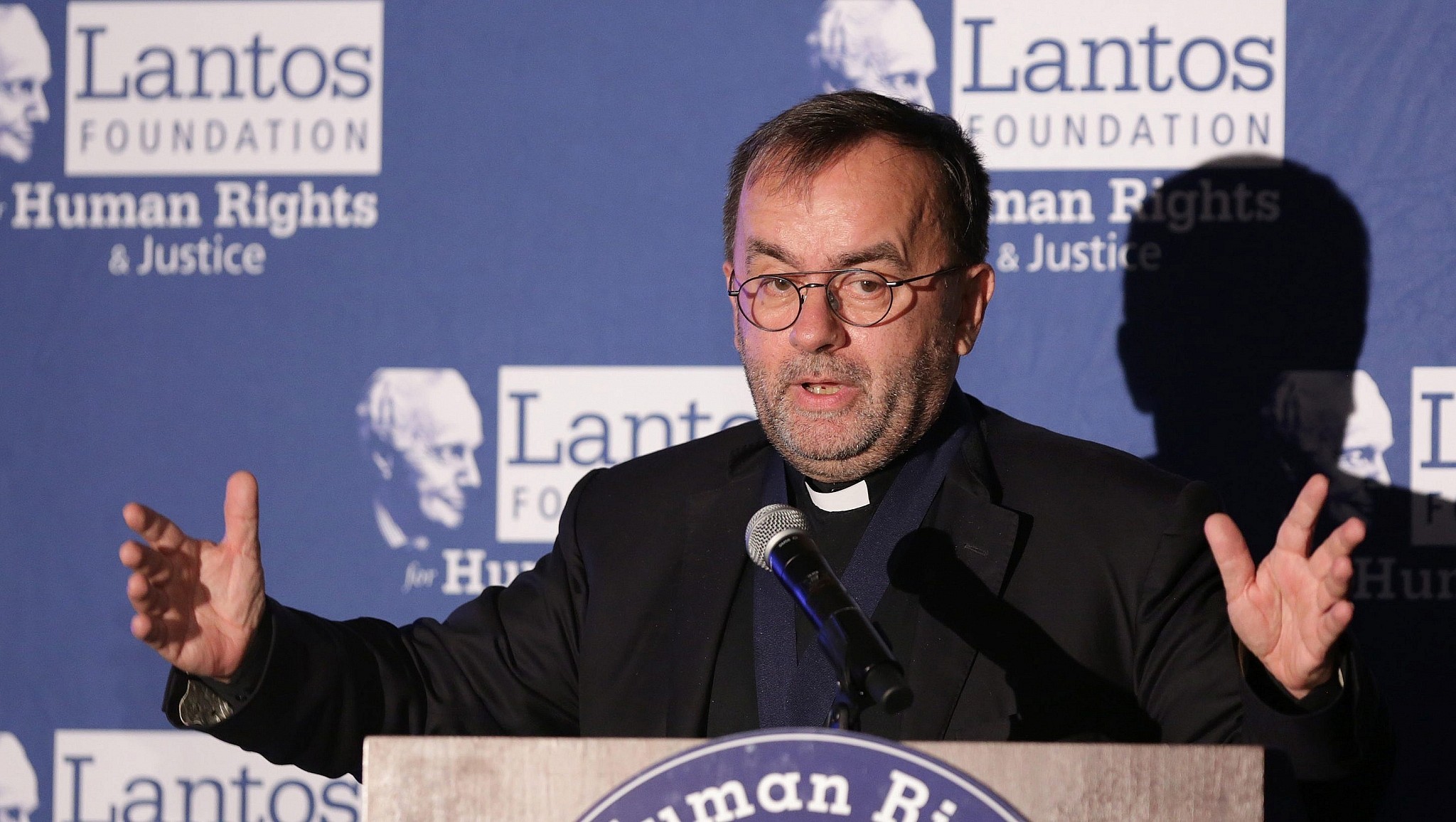
Father Patrick Desbois speaks after being awarded the Lantos Human Rights Prize on Capitol Hill in Washington, DC, on October 26, 2017. (Chris Kleponis)

Father Patrick Desbois speaks after being awarded the Lantos Human Rights Prize on Capitol Hill in Washington, DC, on October 26, 2017. (Chris Kleponis)

Father Patrick Desbois, a Roman Catholic clergyman, whose work has uncovered millions of previously unknown victims of the Nazi genocide was awarded the Lantos Foundation’s Human Rights Prize. The Lantos Human Rights Prize is an annual award given by the Lantos Foundation for Human Rights and Justice, an organization founded by Tom and Annette Lantos, who were both Holocaust survivors. For more on the award see: http://trueheroesfilms.org/thedigest/awards/lantos-human-rights-prize.

Father Patrick Desbois, who teaches at Georgetown University’s Program for Jewish Civilization, was recognized during a reception on Capitol Hill as a “vital voice standing up for the values of decency, dignity, freedom, and justice.” His scholarly reportage on the Holocaust has focused on the Jews who were killed by mass shootings by Nazi units in Russia, Ukraine, Belarus, Poland, Moldova and Romania between 1941 and 1944. In 2004, Desbois founded Yahad-In Unum, a French organization whose sole mission was to locate the mass graves of Jewish victims from Nazi paramilitary death squads. These regiments were responsible for the mass killings of Jews, often by shooting and primarily in the former Soviet Union.

His first book, “Holocaust by Bullets: A Priest’s Journey to Uncover the Truth behind the Murder of 1.5 Million Jews,” was based on that work and the culmination of its discoveries. Desbois has another book — a memoir on his life as an anti-genocide activist and Holocaust scholar — due for publication in 2018.

Other than uncovering unknown truths about the Nazi’s killing operation, Desbois has also been working on collecting evidence of the Islamic State’s massacre of the Yazidi people in parts of Iraq and Syria. [see also: https://humanrightsdefenders.blog/2017/02/09/collecting-human-rights-prize-yazidi-lawmaker-calls-trumps-travel-ban-unfair/]

Source: French priest who uncovered Nazi killing sites awarded Lantos rights prize | The Times of Israel

Cataloger of Khmer Rouge Atrocities wins Judith Lee Stronach Award

April 8, 2017
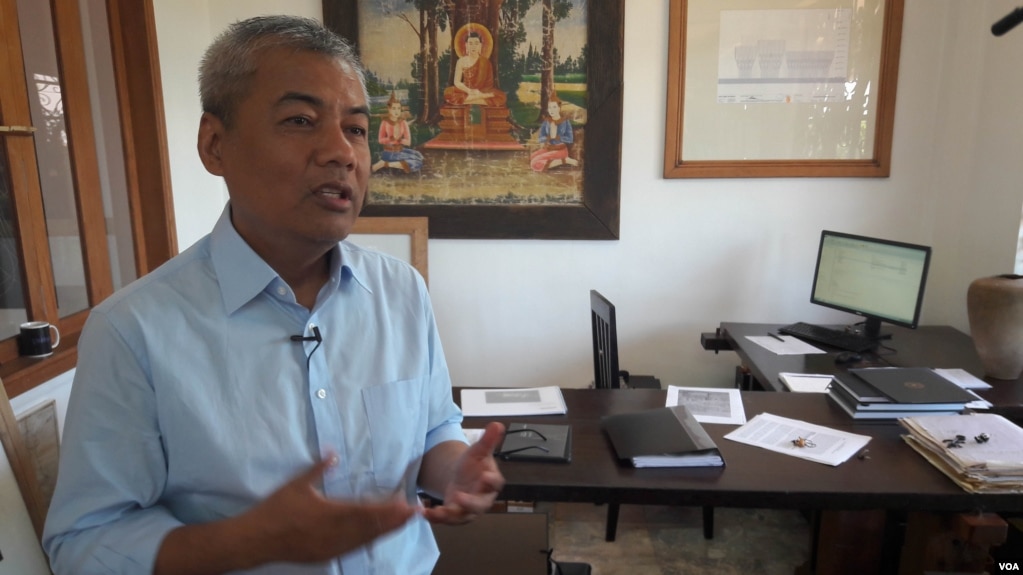
Chang Youk, director of DC-Cam, talks to VOA Khmer about national reconciliation at his office in Phnom Penh, Cambodia, August 08th, 2016. (Neou Vannarin/VOA Khmer)
Chhang Youk, director of DC-Cam, talks to VOA Khmer about national reconciliation at his office in Phnom Penh, Cambodia, August 08th, 2016. (Neou Vannarin/VOA Khmer)

Chhang was a survivor of the Khmer Rouge regime. He fled to the United States as a refugee, but memories of the suffering he endured brought him back to his homeland in the early 1990s. He founded DC-Cam and has led the organization since 1995, creating a national genocide education program. Nushin Sarkarati, a senior attorney at CJA, said that without Chhang’s dedication there would be little justice for the victims and survivors.

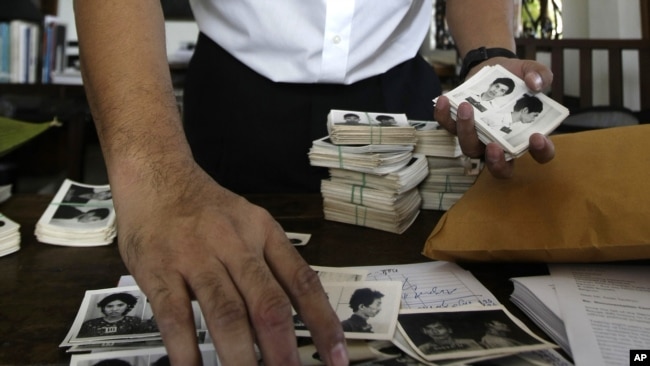
In this photo taken on Aug. 20, 2012, Director of Documentation Center of Cambodia, Youk Chhang arranges photos, a part of about a thousand of newly-discovered photo collection of detainees at the former Khmer Rouge main prison S-21, in his office in Phnom Penh, Cambodia.

In this photo taken on Aug. 20, 2012, Director of Documentation Center of Cambodia, Youk Chhang arranges photos, a part of about a thousand of newly-discovered photo collection of detainees at the former Khmer Rouge main prison S-21, in his office in Phnom Penh, Cambodia.

Beth Van Schaack, a Stanford law professor who advises DC-Cam, said the group’s orientation towards victims made Chhang a natural choice for the award. “What CJA really admires about DC-Cam is it also has a very victim centered approach, working-hard to help Cambodian victims, experience justice before the ECCC [Extraordinary Chambers in the Courts of Cambodia] and DC-Cam has become in many ways a model for other documentation centers around the world that are collecting information that can be submitted to justice processes where human rights are concerned,” she said.

Nate Thayer, a journalist who has reported on Cambodia for some three decades, said without Chhang’s work, the Khmer Rouge perpetrators would have gotten away with their crimes. “Youk Chhang was a one-man army fighting for justice for those who suffered in Cambodia and his personal passion and devotion bringing those who responsible for mass murder to justice, to face the music, to answer for their crime.

Peter Maguire, a law professor and an author of “Facing Death in Cambodia,” called Chhang a “Cambodian national treasure” whose efforts bring more truth and reconciliation to the Cambodian people than the combined efforts of the United Nations and ECCC.

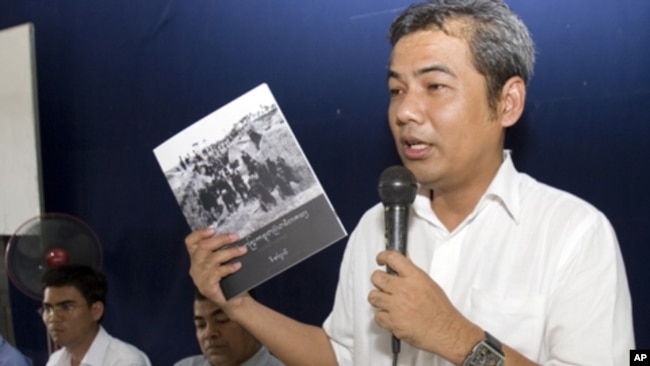
Youk Chhang, a leading Cambodian genocide researcher, shows a copy of the Cambodian version of a Khmer Rouge history textbook to teachers in Takeo province, July 3, 2012.

Youk Chhang, a leading Cambodian genocide researcher, shows a copy of the Cambodian version of a Khmer Rouge history textbook to teachers in Takeo province, July 3, 2012.

Neth Pheaktra, ECCC spokesman, told VOA Khmer that DC-Cam deserved the award as it had uncovered valuable evidence that could be used at the court. “The work that DC-Cam has done helps the ECCC save time in finding evidence by ourselves, and it shows us the way, brings us information as well as some historical documents we needed for the trials.”

Chhang is currently working on developing the Sleuk Rith Institute, a permanent hub for genocide studies in Asia based in Phnom Penh.

Source: Cataloger of Khmer Rouge Crimes Wins Prestigious Human Rights Award