In the Monitor of the ISHR of 30 September 2013, Ambassadors András Dékány and Istvan Lakatos of Hungary expresses an important opinion regarding the issue of reprisals against human rights defenders. As it is short here is the full text:
Posts Tagged ‘Geneva’
UN Human Rights Council should not be a bystander on reprisals, say two Hungarian Ambassadors
October 1, 2013Controversy surrounding the death of LGBT activist Eric Ohena Lembembe; Cameroon blames the victims and continues persecution
September 25, 2013
On 23 September Amy Bergquist of the Advocates for Human Rights writes in her blog: The International Justice Program doesn’t get to travel to Geneva very often, but thanks to the United Nations’ live webcasts, we can usually see and hear all the U.N.’s human rights action as it happens. On Friday morning, I was eager to watch the U.N. Human Rights Council’s consideration of the Universal Periodic Review of Cameroon. I was especially moved when one of our colleagues from the Cameroonian Foundation for AIDS (CAMFAIDS) took the floor to speak on behalf of the International Lesbian, Gay, Bisexual, Trans, and Intersex Association and recounted his July 15 discovery of his tortured and murdered colleague, Eric Ohena Lembembe, Read the rest of this entry »
UN High Commissioner hits back in Sri Lankan disinformation campaign – and rightly so
September 22, 2013
The UN High Commissioner for Human Rights, Navi Pillay, in a statement which some claim unusual for a top UN official to direct at a UN-member country, took aim at Defence Secretary Gotabhaya Rajapaksa, and other government officials, just after her visit last month to Sri Lanka. During the visit at least three government ministers “joined in an extraordinary array of distortion and abuse” which is continuing now, Pillay’s spokesman, Rupert Colville, told reporters in Geneva: “We consider it deeply regrettable that government officials and other commentators continue what appears to be a coordinated campaign of disinformation in an attempt to discredit the high commissioner or to distract from the core messages of her visit.” Pillay’s office sent a formal complaint to the government demanding that it immediately retract and publicly correct “misinformation”.
In the statement Pillay complained that the defence secretary made widely reported but false claims that she had asked President Rajapaksa during their private meeting to remove a statue of Sri Lanka’s first prime minister from Colombo’s Independence Square. “Firstly, we categorically deny that the high commissioner ever uttered a single word about the statue of Prime Minister D.S. Senanayake at any point during her visit to Sri Lanka, let alone asked the president to remove it. This claim is without a shred of truth,” Colville said. “Secondly, there has been a further distortion concerning comments the high commissioner made to the president concerning a flag in Independence Square.” Pillay asked the president why the flag of one religious community was flying next to the national flag in such a symbolic location, Colville said.
UN rights Chief hits out at senior officials and Gota for waging misinformation campaign.
The full statement is made available on the OCHR website
Related articles
- U.N. High Commissioner says Sri Lanka increasingly authoritarian (thoolen.wordpress.com)
Protecting Human Rights Defenders from Reprisals: crucial issue with timely article and side event on 24 September
September 20, 2013Philip Alston, John Norton Pomeroy Professor of Law at New York University School of Law, and former UN Special Rapporteur on Extrajudicial, Summary or Arbitrary Executions wrote a piece on one of the most crucial topics facing human rights defenders at the moment and which has figured regularly in this blog: the issue of retaliation or reprisals against those HRDs who cooperate with the Un and their Rapporteurs. Read the rest of this entry »
Whistle-blowers and HRDs serve democratic principles says U.N. expert
September 19, 2013On 11 September, 2013 UPI in Geneva carried an interesting but surprisingly-little-noticed item under the title “U.N. expert says whistle-blowers serve democratic principles“: Human rights defenders and whistle-blowers need protection in order to ensure democratic and international order, a rights envoy said from Geneva. Alfred de Zayas, U.N. special envoy in equitable order, told the U.N. Human Rights Council access to “truthful and reliable” information from diverse sources is essential for people to play an effective role in public affairs. German protesters gathered last weekend for an event dubbed “Freedom Not Fear.” Tens of thousands of demonstrators turned out in Berlin to rally against the U.S. National Security Agency and Britains signals intelligence program gathering of databases of peoples email, online chat and Internet browsing histories without prior court authorization. “I am dismayed that notwithstanding lip service to democracy, too many governments seem to forget that in a democracy, it is the people who are sovereign,” de Zayas said in his prepared remarks Wednesday. NSA contractor Edward Snowden was granted temporary asylum in Moscow. He faces charges in the United States, including two espionage-related counts, for leaking information about a surveillance program dubbed Prism. De Zayas said human rights defenders and whistle-blowers deserve “specific protection” from prosecution. “[They] have in some contexts been accused of being unpatriotic, whereas they perform, in reality, a democratic service to their countries and to the enjoyment of human rights of their compatriots,” he said.
via U.N. expert says whistle-blowers serve democratic principles – UPI.com.
As asked in another blog : Are whistle blowers heroes or villains? : “Private Chelsea nee Bradley Manning, Julian Assange. Edward Snowden. They have all claimed that their actions are for the public good. The Establishment says that they are all a risk to national security. That brings up the thorny issue of Free speech v security. Were lives put at risk because of the leaks? If so, is that a price worth paying? Are they moral crusaders? Or are they recklessly endangering national security? Should we even conflate whistle blowing with security? Was national security ever really at risk? Or is that a cop-out from our leaders because they are embarrassed about what is being leaked? Then we have to ask the question – is there a difference between a corporate whistle-blower and one that works for the government? If so, why? Whistle blowers. Good or Bad? Heroes or Villains?”
Related articles
- Walking on eggshells | Are whistle-blowers heroes or heels? (tribune-democrat.com)
- Whistle-blowers need protection, U.N envoy says (upi.com)
China Detains Activists trying to reach UN
September 19, 2013While Iran has started to free some of its political prisoners, China does the opposite by detaining two prominent rights activists who were en route to Geneva ahead of a U.N. review of Beijing’s rights record. Beijing-based activist Cao Shunli was stopped at Beijing’s airport on 14 September and questioned by state security police, the overseas-based China Human Rights Defenders [CHRD] said in an emailed statement. On the same day, Guangdong rights activist Chen Jianfang was also intercepted at Guangzhou’s International Airport.The activists, who have been incommunicado since, had been en-route to Geneva to attend a training course at the invitation of a Geneva-based rights group ahead of the U.N. Human Rights Council’s Universal Periodic Review of China on 22 October. Chen, a farmer-turned-petitioner who has been repeatedly detained in illegal “black jails” and who served a 15-month term in labor camp in March 2010, said she was threatened with violence by airport police, who also tore up her plane ticket. Both women had been active in transparency campaigns around the U.N. review process, sending information requests, suing the foreign ministry, and staging demonstrations outside its gates in a bid to be included in China’s submission to the U.N. “In recent weeks, police in several Chinese cities have interrogated other activists and lawyers about the same training program and warned them about serious consequences,” CHRD said.
(Reported by Wei Ling for RFA’s Cantonese Service, and by Xin Yu for the Mandarin Service. Translated and written in English by Luisetta Mudie).
via RFA’s China Detains Activists Over UN Campaign.
Related articles
- China continues harsh line on dissent but one jailed HRD smuggles out video (thoolen.wordpress.com)
Congolese nun today announced as winner Nansen Refugee Award 2013
September 17, 2013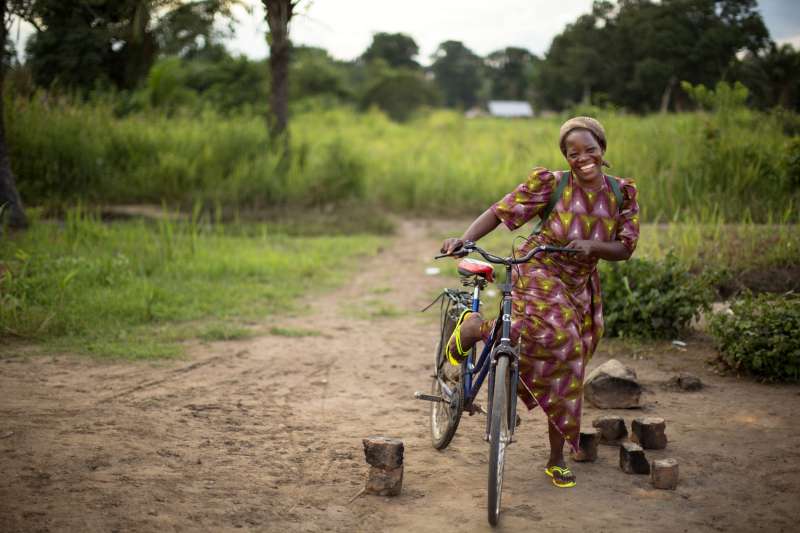
(Sister Angélique Namaika on her bicycle to visit the girls she helps in Dungu © UNHCR/ B. Sokol)
UNHCR announced today – 17 September – that the Nansen Refugee Award 2013 goes to Sister Angélique Namaika, who works in a remote north-east region of Democratic Republic of the Congo (DRC) with survivors of displacement and abuse by the Lord’s Resistance Army (LRA). Read the rest of this entry »
Southeast Asian Voices of HRDs being stifled
September 12, 2013As concerns grow in Southeast Asia over the use of national security, anti-terrorist and defamation laws to limit freedom of expression on the Internet, a coalition of international and local NGOs and activists from Vietnam, Thailand and Cambodia urged governments to stop using vague legislation based on ill-defined concepts such as “national security”, “sovereignty” or “lèse-majesté” to intimidate, harass and imprison independent voices. Speaking at an event in Geneva, which coincides with the 24th session of the UN Human Rights Council, FIDH, IFEX, Article 19 and PEN International united to call for the urgent revision of these laws to bring them into line with international human rights standards. Independent and dissenting voices, including bloggers and netizens, journalists, activists and human rights defenders, have increasingly been subjected to repression in Southeast Asia.
A lot more detail in Human Rights Council : Stifled Southeast Asian Voices: NGOs Unite … – FIDH.
More controversy surrounding the issue of retaliation against HRDs in Sri Lanka
September 10, 2013
On 9 September 2013, UN High Commissioner for Human Rights, Navi Pillay, told the Human Rights Council in Geneva that she had an immediate concern for the protection of human rights defenders, journalists and communities that she met during her recent visit to Sri Lanka. Read the rest of this entry »
Report available on GHR Expert Seminar 20 years Vienna
September 9, 2013On the occasion of the 20th Anniversary of the World Conference on Human Rights several commemorative meetings took place. I just came across the one organised by Geneva for Human Rights – Global Training (GHR) which held an Expert Seminar in Geneva on 6 June 2013 under the theme: ‘After Vienna: all rights for all !’.
It was sponsored by the Dutch Permanent Delegation and chaired by Professor Bertrand Ramcharan, former High Commissioner for Human Rights. Fifty-seven persons attended, including 17 experts. The aim of the Expert Seminar was to sensitize those attending the sessions of the current Human Rights Council decisions contained in the Vienna Declaration and Programme of Action (VDPA). The Seminar discussed the VDPA; shared experience and assessed the realization of its main provisions, in particular their implementation at the national level. Further, the seminar discussed the remaining protection gaps in the field of human rights and recommendations for future action. The report in PDF contains summaries of the experts presentations and a reference to the (intriguingly called) session: ‘brainstorming dinner”.
There seems to be no website for GHR but its address is:
Geneva for Human Rights – Global Training, 14, Avenue du Mail CH-1205 Geneva, Switzerland, Tel. +41 22 320-27-27
and emails are:
acz.hr@bluewin.ch
info@gdh-ghr.org

