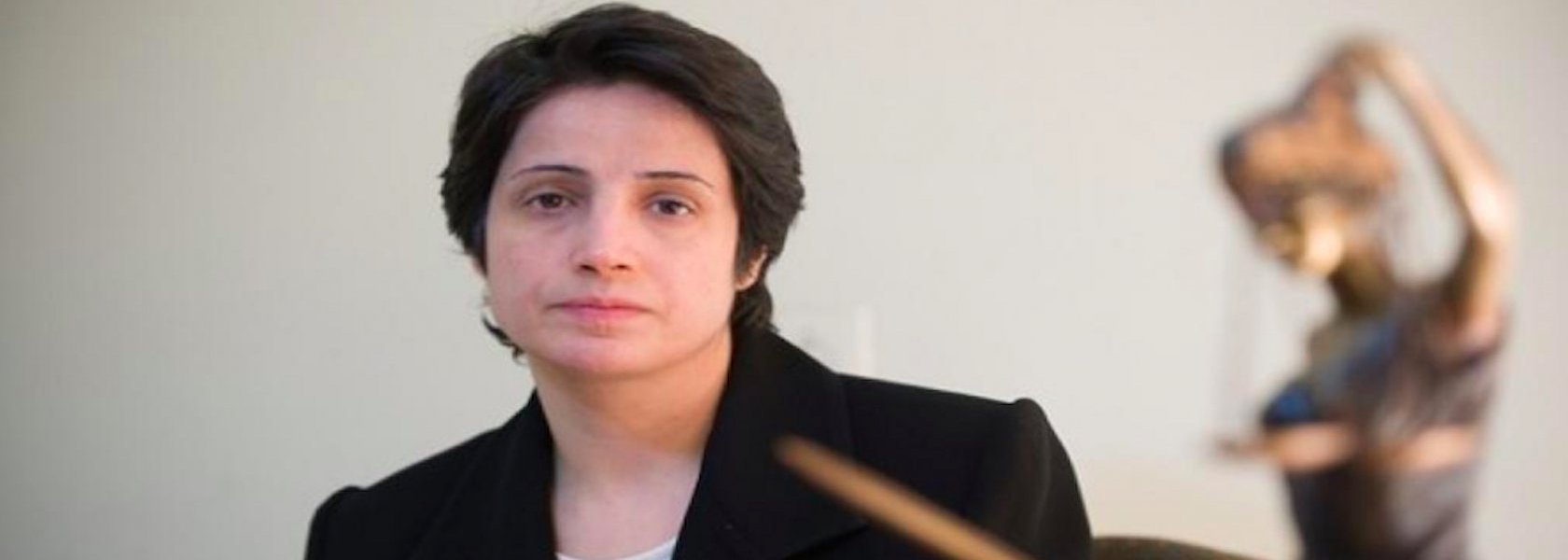
Following up on my post from yesterday [https://humanrightsdefenders.blog/2020/11/25/loujain-al-hathloul-to-stand-trial-in-saudi-arabia-today/] Amnesty International reported on 25 November 2020 that a Saudi Arabian judge has decided to transfer human rights defender Loujain al-Hathloul’s case to Saudi Arabia’s Specialized Criminal Court (SCC), an institution used to silence dissent and notorious for issuing lengthy prison sentences following seriously flawed trials
Posts Tagged ‘fair trial’
Loujain al-Hathloul to stand trial in Saudi Arabia today
November 25, 2020As I have been following the case of Loujain al-Hathloul regularly [see https://humanrightsdefenders.blog/tag/loujain-al-hathloul/] I think it is important to report that she will appear in a Saudi court today Wednesday 25 November 2020, more than two years after she was first detained in a crackdown on human rights defenders.
Lina al-Hathloul, whose sister Loujain is being held by Saudi authorities, speaks at the 10th Anniversary Women In The World Summit at David H. Koch Theater at Lincoln Center on April 10, 2019, in New York City. Photo by Photo by Mike Coppola/Getty Images.
“We were just announced that @LoujainHathloul has a trial tomorrow,” her sister, Lina al-Hathloul, tweeted Tuesday.
The conservative Gulf kingdom insists that Hathloul and the others are detained over national security concerns. Saudi Minister of State for Foreign Affairs Adel Jubeir told CNN last week that Hathloul’s fate “was up to the courts.”
“The idea that she and her friends were detained because they advocated women’s driving is preposterous,” said Jubeir.
Hathloul’s court date was scheduled for March but was postponed indefinitely amid what Saudi officials said were coronavirus concerns. On Oct. 26, she began a hunger strike to protest her treatment in prison and lack of regular contact with her parents.
Amnesty International urged Riyadh to allow diplomats and journalists to attend the trial. The rights group also called for Hathloul to be given access to her parents, and to a lawyer so she can prepare an adequate defense.
“In light of the women rights activists reporting having been tortured or otherwise ill-treated in detention, we also have concerns about the admissibility of any ‘evidence’ that might be submitted in court tomorrow,” Lynn Maalouf, Amnesty’s deputy Middle East and North Africa director, said in a statement.
“The only just outcome for this trial would be the immediate and unconditional release of Loujain al-Hathloul,” Maalouf said.
On Tuesday, a group of 29 organizations issued a letter to the president of Saudi Arabia’s Human Rights Commission, Awwad Al-Awwad, expressing their concern over the “continued arbitrary detention of women’s rights defenders.”
Hathloul’s expected court appearance comes days after Saudi Arabia wrapped up its hosting duties for this year’s Group of 20 summit, of which women’s empowerment was a theme. Ahead of the virtual gathering, a coalition of human rights organizations sought to draw attention to what they say is an increase in repression under Crown Prince Mohammed bin Salman.
UN expresses deep concern over Egypt using special terror courts to silence human rights defenders
October 9, 2020Cairo accused of ‘gravely endangering’ activists and infringing on their fundamental rights by imprisoning them during pandemic

Egypt has jailed more than 60,000 dissidents (AFP/File photo) By MEE staff
The Middle East Eye of 8 October 2020 reported that the UN Human Rights Council said in a statement on Friday that Cairo was treating free speech as terrorism.
“Terrorism charges and exceptional courts are being used to target legitimate human rights activities, and have a profound chilling effect on civil society as a whole,” according to 10 international specialists, including the UN rapporteurs on counter-terrorism and extrajudicial killings.
“The use of terrorism courts to target and harass civil society is inconsistent with the rule of law.“
The statement came days after Egypt executed 15 political prisoners who had been in detention since 2014.
The UN experts slammed the terrorism courts, saying that they undermine defendants’ basic legal rights, including the presumption of innocence. The special courts were created in 2013 after a Sisi-led coup overthrew the elected government of then-president Mohamed Morsi.
“Defendants do not enjoy the right to confer safely and confidentially with their lawyer,” said the experts.
“In addition, when the accused are put on trial from behind glass or inside metal cages, sometimes cut off from proceedings at the discretion of the presiding judge, they cannot effectively use their right to be present at their own trial.”
Egypt has embarked on a brutal crackdown on dissent since 2013, jailing more than 60,000 activists and imposing strict censorship measures on public discourse.
Sisi has consistently denied that there are political prisoners in Egypt, framing the crackdown as part of the fight against terrorism. After coming to power, he outlawed Morsi’s Muslim Brotherhood and blacklisted it as a terror group.
On Thursday, the UN advocates cited the case of Bahey El-Din Hassan, director and co-founder of the Cairo Institute for Human Rights Studies, who was sentenced to 15 years in absentia in August over his criticism of the government. See: https://humanrightsdefenders.blog/2020/08/27/egypt-15-year-term-for-human-rights-defender-bahey-el-din-hassan/
“It is an act of reprisal, seemingly punishing [him] for his cooperation with the United Nations,” the statement said.
“The exercise of free speech and human rights work are being treated as terrorism, and it appears that the Terrorism Circuit Court is being used to retaliate against human rights activity protected by international law.”
—–
https://www.middleeasteye.net/news/egypt-terrorism-courts-jail-activists-un-experts
German Judges give their human rights award to Iranian human rights lawyer Nasrin Sotoudeh
September 6, 2020Radio Farda reported that the German Judges Association (DRB) has awarded its Human Rights Prize to the Iranian human rights lawyer Nasrin Sotoudeh who is currently on a hunger strike in an Iranian prison in protest to the conditions of political prisoners. For more information on this and other awards see: http://www.trueheroesfilms.org/thedigest/awards/german-association-of-judges-human-rights-award
“Nasrin Sotoudeh has become a symbol of the Iranian civil rights movement through her courage and tireless commitment to human rights and the rule of law,” the presidents of the German Judges Association said on Wednesday. Barbara Stockinger and Joachim Lüblinghoff stated that now more than ever, Ms. Sotoudeh needs wide international support, and that they wanted to honor her “highly impressive commitment in Iran and to bring her fate to the public attention”.
The 57-year-old lawyer and rights activist began a hunger strike at Tehran’s notorious Evin Prison on August 11 to protest the “unfair” and “illegal” conditions of political prisoners in Iran. She has demanded the release of political prisoners to protect them from the spread of coronavirus in prisons.
See also: https://humanrightsdefenders.blog/2020/06/24/list-of-lawyers-imprisoned-in-iran-for-defending-human-rights/. Iranian authorities have freed tens of thousands of prisoners since the breakout of the coronavirus pandemic in the country, but have refused to grant furlough to political prisoners and other prisoners of conscience, including Sotoudeh.
Sotoudeh, an international award-winning lawyer and rights activist, was been sentenced to a total of 33 years in prison and 148 lashes on several charges, including conspiracy against national security, spreading lies and disturbing public opinion.
Earlier this year, Sotoudeh went on a hunger strike to protest the maltreatment of political prisoners vulnerable to the coronavirus pandemic. She previously staged a 49-day hunger strike in prison in 2012 while she was serving another sentence for her human rights work. On Wednesday, Swedish Foreign Minister Ann Linde expressed deep concern about Sotoudeh’s health and said she wanted to reiterate the EU’s call for her sentence to be reviewed. In a statement on August 28, the American PEN association called for the immediate release of Sotoudeh and other political prisoners, as well as an end to judicial and legal harassment of her and her family.
Human rights defender Ebru Timtik dies in Istanbul hospital after 238 days hungerstrike
August 29, 2020Timtik started the hunger strike in February to protest alleged unfair proceedings during the trial, along with another colleague, Aytac Unsal, who is reported to be in a critical condition. [see https://humanrightsdefenders.blog/2020/08/06/online-conference-for-ebru-timtik-and-aytac-unsal-on-11-august-2020/]
On Friday, police tried to prevent a crowd of her supporters from gathering outside the Istanbul Bar Association for a memorial, the Evrensel newspaper reported. Later, riot police used tear gas and rubber bullets to block a protest march. At least one lawyer was detained, the paper said. “Ebru Timtik is immortal” and “Aytac Unsal is our honor,” some of the mourners chanted, according to Evrensel.
European Commission spokesman Peter Stano said: “Ebru Timtik’s hunger strike for a fair trial and its tragic outcome painfully illustrate the urgent need for the Turkish authorities to credibly address the human rights situation in the country and the serious shortcomings observed in the Turkish judiciary,” Stano said.
“Ms. Timtik’s death is a tragic illustration of the human suffering caused by a judicial system in Turkey that has turned into a tool to silence lawyers, human rights defenders and journalists,” said Dunja Mijatovic, the Council of Europe’s human rights commissioner.
Hunger strikers in Turkey traditionally refuse food but consume liquids and take vitamins that prolong their protests. Timtik’s death comes months after two members of a left-wing popular folk group that is banned in Turkey also died of a hunger strike. They had also been accused of links to the DHKP/C.
https://www.startribune.com/turkish-lawyer-dies-on-hunger-strike-demanding-fair-trial/572249512/
Online conference for Ebru Timtik and Aytaç Ünsal on 11 August 2020
August 6, 2020Lawyers for Lawyers (L4L) will organise an online press conference on
11 August 2020 at 4.00 – 4.45 pm (CEST) to inform about the situation of human rights lawyers Ebru Timtik and Aytaç Ünsal from Turkey, who are serving long prison sentences and have been on hunger strike since February 2020.
Speakers are : Irma van den Berg (Lawyers for Lawyers), Tony Fisher (London), Mehmet Durakoğlu (the president of İstanbul Bar Association) and other speakers who will be confirmed later.
From 4.30 – 4.45 pm there will a Q&A, only for journalists.
Background information:
Since 4 August Ebru Timtik is on 215th day of her hunger strike (death fast)
and Aytaç Ünsal is on 184th day of his. They have been under pre-trial detention for almost 3 years. Their lawyers, recently, submitted a request to Istanbul 37th Assize Court before which they have been tried which demanded their release on the basis that their health had deteriorated to such an extent that it was not appropriate that they remain in prison. Upon receipt of this request the Court transferred Ebru and Aytaç to the Istanbul Forensic Medicine Institute and asked the experts to examine them. The experts at the Institute reported that Ebru and Aytaç’s physical condition made it inappropriate for them to remain in detention. The Court, instead of releasing them pending the outcome of their appeal, ordered their transfer to a hospital following this report. They are currently
held as pre-trial detainees in a special ward of a hospital that is a Covid-19 Pandemic Hospital with no access to the outside world and similar limitations imposed on them as they would have been subject to had they remained in prison.
Ebru and Aytaç have passed several critical stages since the beginning of their protest against their conviction of terrorist offences, together with 16 other progressive lawyers, based on allegations of anonymous witnesses, evidence to which they did not have access and, more generally, the systemic violation of fair trial rights in Turkey in the present day (a full summary of the proceedings against them and against other colleagues is enclosed). The physical condition they are in now is extremely
worrisome, especially for Ebru who is seen as being in a near death situation.
Ebru and Aytaç are two of over 1,500 lawyers arrested and prosecuted for alleged terrorist offences in Turkey since the attempted coup in July 2016. Many Turkish and European bar associations, lawyers’ organisations and NGO’s reported on the serious flaws in the case against them, the
situation of the lawyers in Turkey and the violations which they have suffered.
Technical details:
The event will be held at Zoom. The link and the technical details will be shared with the confirmed participants the same day of the event. Simultaneous translation will be available between Turkish and English.
Please write an email including your full name, profession and the organisation or media outlet you represent (if there is any) by 10 August 2020 at serifecerenuysal@gmail.com, info@lawyersforlawyers.nl or aysebingol@hotmail.com if you are willing to join.

Kyrgyzstan: Activist Askarov dies in prison after decade battling tainted conviction
July 26, 2020Jul 25, 2020
Rights activist Azimjan Askarov, seen here holding one of his self-portraits in his basement prison cell in February 2012. (Photo: Nate Schenkkan)
EURasia.net of 25 July 2020 gives the sad new that Azimjan Askarov, a celebrated ethnic Uzbek humn rights defender, husband to Hadidja Askarova, has died in prison at the age of 69.
The news of his death on July 25 was confirmed by his longtime friend, supporter and fellow activist Tolekan Ismailova and his lawyer, Valeryan Vakhitov. He had suffered from poor health for much of his 10 years in prison, but his condition worsened significantly in the past two weeks. Vakhitov, who visited Askarov in prison only a few days before his death, said his client had lost his appetite, that his skin “looked yellowish in color,” and that he was unable to move unaided.
On July 24, prison officials dismissed those concerns and the reports of Askarov’s ill-health as “inaccurate information.” [https://www.rferl.org/a/jailed-rights-activist-askarov-transferred-to-different-kyrgyz-prison-amid-reports-of-poor-health/30745718.html]
Although the likelihood of Askarov’s imminent death had been widely anticipated, the actual event has stunned his longtime colleagues and the rights community.
“I am devastated. When we saw one another for the last time, they brought him to me in their arms. I told him: ‘Please hang on, we love you,’ and he began crying. He seemed to feel something,” Vakhitov told Kloop news website.
Askarov was arrested on June 15, 2010, in the immediate aftermath of a deadly whirlwind of ethnic unrest in southern Kyrgyzstan that killed hundreds, mostly ethnic Uzbeks.
In the days, weeks and months that followed that bloodshed, security services mainly targeted ethnic Uzbeks for investigations, arrests and systematic harassment. Askarov was among the first to be singled out for this treatment.
He was charged with purported involvement in the killing of a police officer on June 13, 2010, in the southern town of Bazar-Korgon. Immediately after his arrest, Askarov was beaten, subjected to abuse and denied access to his lawyer. He spoke about some of that mistreatment in an interview with Eurasianet in 2012, two years into his life sentence.
“They nearly killed me,” he said, referring to local police. “They held my arms behind my back, and took a weight filled with water, and hit me with it [in the stomach]. They hit me over the head with it so that huge lumps rose up.” He also said he saw witnesses beaten bloody to force them to testify against him….
In 2016, the Office of the United Nations High Commissioner for Human Rights found that Kyrgyzstan had in its treatment of Askarov violated multiple articles of the International Covenant on Civil and Political Rights.
Askarov’s initial criminal trial, as well as subsequent appeals, have been decried by legal experts as miscarriages of justice. Many supposed witnesses were intimidated into giving testimonies and people who would have spoken in his defense were denied that opportunity. Perhaps most ominously, hearings were routinely attended by relatives of the alleged murder victim, who openly threatened Askarov and his legal team with death. This pattern repeated over many years.
But as Philip Shishkin, a journalist, noted in his 2013 book Restless Valley, “of the many interesting things about the case, one detail stands out: the verdict relies heavily on the testimony of a half dozen policemen who had reasons to dislike Askarov even before his alleged participation in the murder of their colleague.”
Much of his 15 years of activism was focused on highlighting and documenting allegations of police abuse in his native Bazar-Korgon, including by some of the officers that then pursued his case…
In one typical rebuttal of criticism from 2015, the Foreign Ministry asserted that “the decision of the court was taken on the basis of undeniable evidence, Askarov’s guilt has been proven in all instances.”
“The Kyrgyz Republic stands for the supremacy of the law. The justice system is an independent branch of power,” the ministry said at the time.
There is strong reason to believe, however, that the government allowed itself to be taken hostage by the same kind of combustible, deeply violence-prone nationalist elements that lay behind the ethnic bloodshed of June 2010. Many notorious criminals have been allowed to walk free from prison in Kyrgyzstan over the decades, but as officials saw it, affording that same treatment to Askarov would have threatened to spark another cycle of unrest, immaterial of the legal particulars.
This reading was all but confirmed in an interview given to Eurasianet in 2018 by Roza Otunbayeva, who was interim president at the time of the ethnic unrest and Askarov’s arrest. Asked about the Askarov case, she evinced regret, but concluded that “it was a decision of our court. And this court’s decision was [upheld].” She did, however, have the authority to issue a pardon, which she declined to do.
“It was a decision that [would] again [have broken] the country,” she told Eurasianet. “I mean, the stability of the country, political consensus within the country was very much bound to such a touchy issue. And it was a very high price.”
Istanbul court jails four human rights defenders on terror charges; seven acquitted
July 6, 2020Having announced the trial last Friday [https://humanrightsdefenders.blog/2020/07/03/will-long-running-saga-of-trial-against-the-istanbul-10-end-on-friday-3-july/] I need to report also on the outcome although it was widley reported in the media.

A Turkish court on Friday convicted Taner Kilic, former chairman of Amnesty International, of membership in a terror organisation and sentenced him to over six years in prison. (AP)
Arab News on 4 July 2020 reported that human rights activists, including a former head of Amnesty International’s Turkish branch, have been jailed by an Istanbul court on terror-related charges in a decision condemned as an “outrage” by fellow campaigners. Amnesty International Turkey’s honorary chair Taner Kilic was sentenced to six years and three months in prison for “terror organization membership. Gunal Kursun from the Human Rights Agenda Association; Idil Eser, former executive director of Amnesty International Turkey; and Ozlem Dalkiran, former head of Amnesty International’s communications department, were each handed jail terms of one year and 13 months for “aiding a terror organization.”
The prosecution claimed that the hotel gathering was a “secret meeting to organize an uprising,” in order to trigger a “chaos environment” in the country – a claim categorically denied by the defendants.
Amnesty International has described the case as a travesty of justice. The defendants are now expected to appeal the verdict in the case dubbed the ‘Buyukada trial.”
Other human rights activists, including Nalan Erkem, lknur Ustun, Ali Gharavi, Peter Steudtner, Veli Acu, Nejat Tastan and Seyhmus Ozbekli, were acquitted.
“Another disappointing court verdict against civil rights and civil society in Turkey. Not how we put our relations on a positive track. My thoughts are with imprisoned and families. Solidarity with democratic forces in Turkey!” tweeted Sergey Lagodinsky, chair of the EU-Turkey delegation at the European Parliament. Dunja Mijatovic, the Council of Europe’s commissioner for human rights, voiced concerns that Turkey is targeting and silencing human rights defenders.
Andrew Gardner, Amnesty International’s Turkey researcher, who observed the hearing, said the verdict is an outrage based on absurd allegations without any evidence and is supported by a pro-government media smear campaign.
https://www.arabnews.com/node/1700036/middle-east
https://ahvalnews.com/buyukada-case/four-human-rights-activists-given-prison-sentences-buyukada-case