Posts Tagged ‘fair trial’

Detainees in the Emirates held in prison even after completing their sentence

April 13, 2023

On 12 April 2023 Human Rights Watch reported that United Arab Emirates are continuing to incarcerate at least 51 Emirati prisoners who completed their sentences between one month and nearly four years ago.

The prisoners are all part of the grossly unfair “UAE94” mass trial of 69 critics of the government, whose convictions violated their rights to free expression, association, and assembly. UAE authorities are using baseless counterterrorism justifications for continuing to hold them past their completed sentences.

Prisoners in the UAE94 case have already suffered tremendously after years in prison following a grossly unfair trail,” said Joey Shea, United Arab Emirates researcher at Human Rights Watch. “Emirati authorities should free them immediately and finally put an end to this decade-long ordeal. Prominent UAE partners, including the United States and COP28 organizers, should press UAE authorities for their immediate release.”

The prisoners were among 94 people detained beginning in March 2012 in a wave of arbitrary arrests amid an unprecedented crackdown on dissent. The case had a chilling effect on freedom of expression, assembly, and association.

In July 2013, Abu Dhabi’s Federal Supreme Court convicted 69 of the defendants, sentencing 5 to 7 years in prison, 56 to 10 years, and 8 in absentia to 15 years, with 25 acquitted. The verdict could not be appealed, in violation of international law, because it was issued by the UAE’s highest court. As of March 2023, 51 had completed their sentences but remain imprisoned with no clear legal basis, according to Emirati activists and court documents. Some prisoners completed their sentences as early as July 2019.

At least four of the 51 received a Public Prosecution letter saying that they were on Munasaha during what was supposed to be their last three months in detention, activists and family members told Human Rights Watch. After three months, these detainees were taken in front of a judge, who determined they still held “terrorist thoughts” and ruled that they needed further “rehabilitation.”

Under article 48 of the counterterrorism law, the public prosecutor may place someone convicted of a terrorist offense in a counselling or Munasaha program in the prison where they were serving their sentence, under counselling center supervision.

The counterterrorism law sets no time limit for continued incarceration and instead requires the state security public prosecution to report to the court every three months. The court may order a person’s release if it finds that “his or her condition so allows.” It is not clear if the defendant has any right to attend the hearing or see or challenge the evidence used to justify their detention.

The decade of unjust imprisonment has had devastating consequences for the prisoners’ families. A family member said that the young child of one of the prisoners still does not understand why her father was in prison. “She asks me, we love our country and our leaders, why are they are doing this to my father?” the family member said.

Many prisoners are being held in the notorious al-Razeen prison, and many are alleged to be in solitary confinement. A family member said, “All the prisoners are suffering there, they don’t have their rights and it is very hard to visit them.” Another family member said: “Throughout the years, the conditions are getting worse.”

Visits are irregular and difficult to procure, the family members said. Families often drive for hours to the prison in the middle of the desert, only to be denied a visit with no explanation. Family members also said that phone conversations are often cut off mid-call with no explanation. Some prisoners have not been able to speak with their family members by phone for years.

Other family members said there have been months-long periods in which a prisoner, as one family member said, “totally disappeared” with “no calls, no nothing,” leading the family to believe that “maybe he is dead.” Prisoners are also often denied books and pictures.

The International Covenant on Civil and Political Rights (ICCPR) in article 15 prohibits retroactive criminal punishment. The United Nations Human Rights Committee, in its general comment on article 9 of the ICCPR, said, “if, under the most exceptional circumstances, a present, direct and imperative threat is invoked to justify the detention of persons considered to present such a threat, the burden of proof lies on States parties to show that the individual poses such a threat and that it cannot be addressed by alternative measures, and that burden increases with the length of the detention.”

“By arbitrarily extending the unjust sentences of peaceful critics using bogus counterterrorism justifications without due process, the UAE again shows its total disregard for the rule of law,” Shea said.

https://www.hrw.org/news/2023/04/12/uae-detainees-held-beyond-sentences

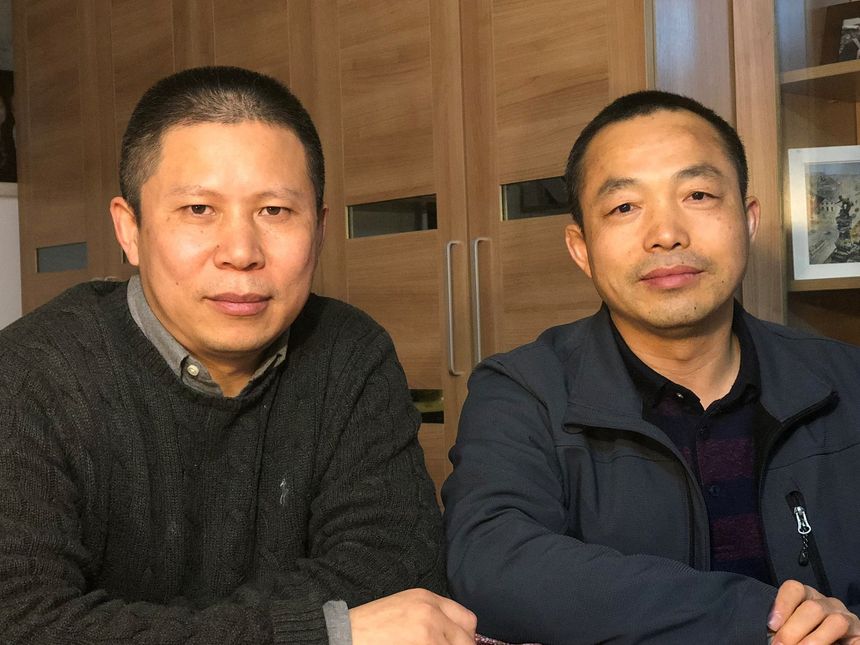
Xu Zhiyong and Ding Jiaxi, two human rights defenders in China, sentenced

April 11, 2023

The Network of Chinese Human Rights Defenders, on 10 April 2023 condemned the Chinese government’s sentencing of Ding Jiaxi and Xu Zhiyong, two of China’s most notable human rights defenders. “Their sentencing once again demonstrates the Chinese government’s hostility to peaceful advocacy of democracy and human rights, and marks a new low in the Chinese government’s human rights record,” said Ramona Li, Senior Researcher and Advocate for the group.

On April 10, the Linshu County Court sentenced Ding Jiaxi to 12 years imprisonment and 3 years deprivation of political rights, and Xu Zhiyong to 14 years imprisonment. The court, located in Shandong province, found both guilty of the crime of subverting state authority following closed-door trials.

The government consistently violated their rights under international and Chinese law throughout their detention and trial. Both Ding Jiaxi and Xu Zhiyong had been held in prolonged pre-trial detention for over three years, including periods in a form of incommunicado detention referred to as “residential surveillance in a designated location” where both were subjected to torture. Ding Jiaxi’s lawyers attempted multiple times to have the court dismiss his “confessions” as illegally obtained evidence because of they had been extracted under torture; the court rejected these motions.

Ding Jiaxi and Xu Zhiyong were refused access to lawyers for the first thirteen months of their detention, and their attorneys were refused copies of the files containing the information on which the charges were based. Witnesses cited by the prosecution, Wang Jiangsong and Dai Zhenya, publicly refuted testimony that the prosecution alleged they had provided. Family members said that authorities charged the two in Linshu county, far away from Beijing, to avoid public scrutiny of the case.

Ding Jiaxi and Xu Zhiyong were active in the New Citizens Movement, which promoted a form of civic engagement through grassroots advocacy for the implementation of the civil and human rights based on China’s laws and constitution. They were both detained amid a crackdown on human rights activists and lawyers following an informal gathering in southern Fujian province in December 2019.

Ding Jiaxi is also a Beijing lawyer who has provided support to many of the most marginalized and underprivileged groups in China, including education rights for the children of migrant workers and grassroots petitioners appealing to central government officials as a last resort to address wrongdoing by local officials. Xu Zhiyong was also a prominent lawyer who was an instrumental figure in pushing through legal reforms defending the rights of China’s internal migrant population. [see also: https://humanrightsdefenders.blog/2020/03/24/un-experts-alarmed-over-chinas-missing-human-rights-lawyers-victims-of-rsdl/]

In a pre-written statement released before his sentencing, Ding Jiaxiconnected his work to his belief in the possibility of China’s “peaceful, rational, and non-violent” transition from an authoritarian state. He wrote: “No matter the many who have doubted me or the difficulties and setbacks I’ve encountered, including physical torture that I’ve suffered, I will not part from my steadfast convictions.”

In his own statement, Xu Zhiyong described his hopes for a liberal democratic China with free elections, equal access to education and job opportunities, and social support for even the poorest to have “enough to live a dignified life.” He said he had simply “called on Chinese people to become real citizens,” and explained the urgency of doing so, saying “we cannot saddle the next generation with this duty.” [see also: https://humanrightsdefenders.blog/2014/01/24/xu-zhiyongs-closing-statement-to-the-court-a-remarkable-document/]

Both Ding Jiaxi and Xu Zhiyong should be immediately and unconditionally released per the recommendation of UN human rights experts, who have found that the two have been arbitrarily detained in violation of international law. UN human rights experts have further characterized the crime of “subversion of state authority” as being so broadly worded that charges under the crime fail to provide adequate due process to the extent that they are in violation of the Universal Declaration of Human Rights.

“The heavy sentencing of Ding Jiaxi and Xu Zhiyong is a travesty of justice. At every step, Chinese authorities have taken the wrong turn: from detaining them in secret, torturing them, falsifying witness testimony, putting them on trial in secret, and now this heavy sentence,” said William Nee, Research and Advocacy Coordinator for CHRD.

“Democracies and international organizations around the world must stop paying only lip service to human rights. They must take concrete and credible measures to gain the release of Xu Zhiyong and Ding Jiaxi, as well as the thousands of prisoners of conscience in China, in the Tibetan and Xinjiang regions and Hong Kong,” said Renee Xia, CHRD executive director.

https://www.nchrd.org/

https://www.theguardian.com/world/2023/apr/10/china-jails-two-leading-human-rights-lawyers-after-closed-door-trial

Vietnam should drop charges against Human Rights Defender Truong Van Dung

March 29, 2023
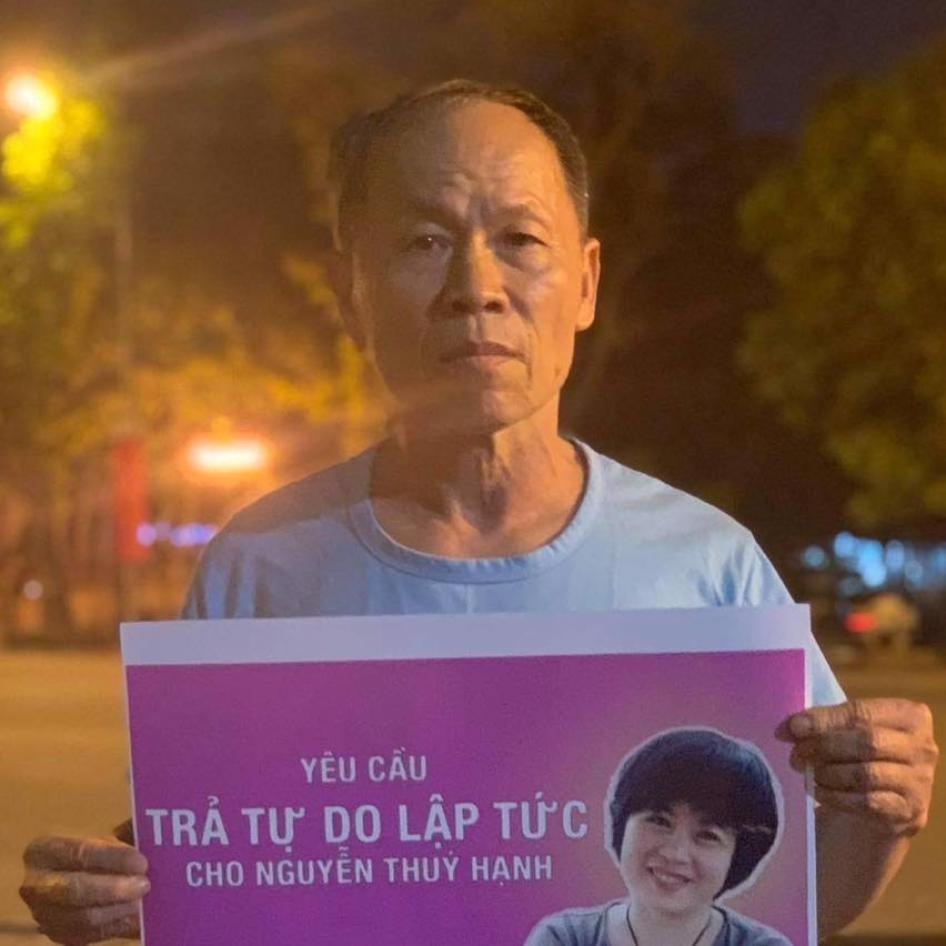
Truong Van Dung hold a sign that says, Request the Immediate Release of Nguyen Thuy Hanh. 

On 27 March 2023 7:00 Human Rights Watch said that the Vietnamese authorities should immediately release land rights activist Truong Van Dung and drop all charges against him. Police in Hanoi arrested Truong Van Dung in May 2022 on charges of “conducting propaganda against the state.” A Hanoi court on March 28, 2023 sentenced him to six years in prison.

Vietnamese authorities have convicted at least 163 people since 2018 for exercising their rights to freedom of expression or association under vague or over broad laws that criminalize protesting or criticizing the government. At least 18 others have been charged and are awaiting trial. The authorities have brought many of these cases using the propaganda charge, criminalized under articles 88 and 117 of Vietnam’s penal code.

“Truong Van Dung is the latest in a long line of human rights defenders silenced by the Vietnamese government for protesting against human rights violations and advocating for reforms,” said Phil Robertson, deputy Asia director at Human Rights Watch. “Democratic governments forging closer ties with Vietnam need to speak out publicly and forcefully in his support and call on Vietnam to release all political prisoners and take genuine steps toward reform.”

Truong Van Dung, 65, first became active in land rights advocacy in the 2000s, campaigning against forced confiscation of his own house. In the early 2010s, he joined other activists and began to advocate for basic rights, including freedom of expression, association, and assembly. Between 2011 and 2018, he also participated in numerous anti-China and pro-environment protests. He joined a protest opposing Vietnam’s problematic 2018 law on cybersecurity and publicly boycotted Vietnam’s national “elections,” a process controlled by the Vietnam Communist Party which is neither free nor fair.

He also publicly voiced support for numerous political prisoners and detainees, including Nguyen Thuy Hanh [see also: https://humanrightsdefenders.blog/2021/04/09/viet-nam-profile-of-human-rights-defender-nguyen-thuy-hanh-arrested-and-charged/], Pham Doan Trang, [see also: https://www.liv.ngo/content/files/2022/04/Pham-Doan-Trang_-UN-experts-call-for-release-of-Vietnamese-human-rights-defender-_-Hans-Thoolen-on-Human-Rights-Defenders-and-their-awards.pdf] Can Thi Theu, Nguyen Thi Tam, Trinh Ba Tu, Trinh Ba Phuong, Le Dinh Luong, Hoang Duc Binh, Nguyen Tuong Thuy, Pham Chi Dung, Le Huu Minh Tuan, Do Nam Trung, and members of Hoi Anh em Dan chu (Brotherhood for Democracy).

In December 2013, Truong Van Dung and other activists founded a humanitarian group, Hoi Bau bi Tuong Than (Association of Gourd and Squash Mutual Assistance), to provide financial and spiritual support for political prisoners, land rights petitioners, and their families.

After his arrest in May 2022, Truong Van Dung was held incommunicado for more than nine months. He was allowed to meet with his lawyer for the first time in March. His family has not been allowed to see him. Vietnam’s courts, controlled by the ruling Communist Party of Vietnam, are not independent and hearings and trials do not meet international standards. “How can Truong Van Dung get a fair trial when Vietnam’s legal system isn’t independent and the laws under which he is charged violate basic international human rights standards – and what he has been accused of shouldn’t even be crimes,” Robertson said.

https://www.hrw.org/news/2023/03/27/vietnam-drop-charges-against-human-rights-activist

Cambodia: Quash Convictions of ‘ADHOC 5’

June 22, 2022
201808asia_cambodia_adhoc
© 2018 ADHOC

The Cambodian authorities should quash the baseless criminal convictions of four members and one former member of the Cambodian Human Rights and Development Association (ADHOC), Human Rights Watch said on 22 June 2022. On June 21, 2022, four of the defendants, Yi Soksan, Lim Mony, Ny Sokha, and Ny Chakrya appealed a May 23 appeals court ruling upholding their convictions to the Cambodian Supreme Court.

From the very beginning, the Cambodian authorities have sought to unjustly punish the ADHOC 5 as a way to intimidate all civil society activists from criticizing Prime Minister Hun Sen’s government,” said Phil Robertson, deputy Asia director at Human Rights Watch. “Foreign governments, the United Nations country team, and international donor agencies should urge the authorities to drop these cases and end all repression of human rights defenders.” See also: https://humanrightsdefenders.blog/2017/03/11/even-landmark-un-decision-does-not-change-cambodias-treatment-of-human-rights-defenders/

In April 2016 the government’s Anti-Corruption Unit arrested ADHOC members Ny Sokha, Nay Vanda, Yi Soksan, and Lim Mony, along with the former ADHOC member Ny Chakrya, who was then deputy secretary-general of the National Election Committee, and accused them of making false statements regarding a criminal case against the then-opposition leader Kem Sokha.

The five activists spent 14 months in pretrial detention. During their criminal trial, the prosecution failed to present any of the witnesses mentioned in the case or provide any credible evidence to substantiate the charges.

On September 26, 2018, the Phnom Penh municipal court convicted Vanda, Sokha, Soksan, and Mony of “bribery of a witness” (article 548 of Cambodia’s criminal code) and Chakrya of being an accomplice (articles 28 and 548). All five received suspended five-year prison terms, minus 14 months of time served.

On October 24, 2018, the defendants appealed the guilty verdicts to the Court of Appeal. The prosecutor’s office also filed an appeal, seeking to have the defendants serve the remainder of their suspended sentence in prison. The Court of Appeal denied both appeals on May 23, 2022.

The ADHOC 5 case arose during a broader government crackdown on civil society and the political opposition, specifically on the Cambodia National Rescue Party (CNRP), which the government-dominated Supreme Court later dissolved in a politically motivated ruling.

The former CNRP leader, Kem Sokha, continues to face unsubstantiated, politically motivated treason charges brought in September 2017. While he is no longer detained, his trial only recommenced in January, after being suspended for two years ostensibly because of the Covid-19 pandemic and the government deemed his case to not be a “priority”. The allegations against Sokha are based on the government’s groundless claim that the CNRP fomented a “color revolution” to overthrow the government.

Human Rights Watch has documented the situations of more than 50 current political prisoners in Cambodia, including both those in pretrial detention and those serving prison sentences following politically motivated convictions. They include political opposition members, human rights defenders, land and environmental rights activists, and journalists.

“The Cambodian authorities should recognize that every day the ADHOC 5 case persists, the greater this travesty of justice inflicts harm to the government’s reputation,” Robertson said. “The only way for justice to be served is for the prosecutor to quash the convictions and provide the defendants with an appropriate remedy for the years of hardship the case caused them.”

see also: https://www.martinennalsaward.org/hrd/the-khmer-5/

https://www.hrw.org/news/2022/06/22/cambodia-quash-convictions-adhoc-5

Ola Bini, a Swedish internet activist and human rights defender, will be in a Quito court. A trial to watch.

May 10, 2022

Jason Kelley and Veridiana Alimonti in EFF of 9 May 2022 report on the continuing saga of Ola Bini:

In preparation for what may be the final days of the trial of Ola Bini, an open source and free software developer arrested shortly after Julian Assange’s ejection from Ecuador’s London Embassy, civil society organizations observing the case have issued a report citing due process violations, technical weaknesses, political pressures, and risks that this criminal prosecution entails for the protection of digital rights. Bini was initially detained three years ago and previous stages of his prosecution had significant delays that were criticized by the Office of the Inter-American Commission on Human Rights (IACHR) Special Rapporteur for Freedom of Expression. An online press conference is scheduled for May 11th, with EFF and other organizations set to speak on the violations in Bini’s prosecution  and the danger this case represents. The trial hearing is set for May 16-20, and will most likely conclude next week. If convicted, Bini’s defense can still appeal the decision.

What’s Happened So Far

The first part of the trial against Ola Bini took place in January. In this first stage of testimony and expert evidence, the court repeatedly called attention to various irregularities and violations to due process by the prosecutor in charge. Human rights groups observing the hearing emphasized the flimsy evidence provided against Bini and serious flaws in how the seizure of his devices took place. Bini’s defense stressed that the raid happened without him present, and that seized encrypted devices were examined without following procedural rules and safeguards.

These are not the only problems with the case. Over two years ago, EFF visited Ecuador on a fact-finding mission after Bini’s initial arrest and detention. What we found was a case deeply intertwined with the political effects of its outcome, fraught with due process violations. EFF’s conclusions from our Ecuador mission were that political actors, including the prosecution, have recklessly tied their reputations to a case with controversial or no real evidence. 

Ola Bini is known globally as someone who builds secure tools and contributes to free software projects. Bini’s team at ThoughtWorks contributed to Certbot, the EFF-managed tool that has provided strong encryption for millions of websites around the world, and most recently, Bini co-founded a non-profit organization devoted to creating user-friendly security tools.

What  Bini is not known for, however, is conducting the kind of security research that could be mistaken for an “assault on the integrity of computer systems,” the crime for which he was initially investigated, or “unauthorized access to a computer system,” the crime for which he is being accused now (after prosecutors changed the charges). In 2019, Bini’s lawyers counted 65 violations of due process, and journalists told us at the time that no one was able to provide them with concrete descriptions of what he had done. Bini’s initial imprisonment was ended after a decision considered his detention illegal, but the investigation continued. The judge was later “separated” from the case in a ruling that admitted the wrongdoing of successive pre-trial suspensions and the violation of due process.

Though a judge decided in last year’s pre-trial hearing to proceed with the criminal prosecution against Bini, observers indicated a lack of solid motivation in the judge’s decision.

A New Persecution

A so-called piece of evidence against Bini was a photo of a screenshot, supposedly taken by Bini himself and sent to a colleague, showing the telnet login screen of a router. The image is consistent with someone who connects to an open telnet service, receives a warning not to log on without authorization, and does not proceed—respecting the warning. As for the portion of a message exchange attributed to Bini and a colleague, leaked with the photo, it shows their concern with the router being insecurely open to telnet access on the wider Internet, with no firewall.

Between the trial hearing in January and its resumption in May, Ecuador’s Prosecutor’s Office revived an investigation against Fabián Hurtado, the technical expert called by Ola Bini’s defense to refute the image of the telnet session and who is expected to testify at the trial hearing.

On January 10, 2022, the Prosecutor’s Office filed charges for procedural fraud against Hurtado. There was a conspicuous gap between this charge and the last investigative proceeding by prosecutors in the case against Hurtado, when police raided his home almost 20 months before, claiming that he had “incorporated misleading information in his résumé”. This raid was violent and irregular, and considered by Amnesty International as an attempt to intimidate Ola Bini’s defense. One of the pieces of evidence against Hurtado is the document by which Bini’s lawyer, Dr. Carlos Soria, included Hurtado’s technical report in Bini’s case file.

Hurtado’s indictment hearing was held on February 9, 2022. The judge opened a 90-day period of investigation which is about to end. As part of this investigation, the prosecutor’s office and the police raided the offices of Ola Bini’s non-profit organization in a new episode of due process violations, according to media reports.

Civil Society Report and Recommendations

Today’s report, by organizations gathered in the Observation Mission of Bini’s case, is critical for all participating and to others concerned about digital rights around the world. There is still time for the court to recognize and correct the irregularities and technical weaknesses in the case. It points out key points that should be taken into consideration by the judicial authorities in charge of examining the case.

In particular, the report notes, the accusations have failed to demonstrate a consistent case against Ola Bini. Irregularities in court procedures and police action have affected both the speed of the procedure and due process of law in general. In addition, accusations against Bini show little technical knowledge, and could lead to the criminalization of people carrying out legitimate activities protected by international human rights standards. This case may lead to the further persecution of the so-called “infosec community” in Latin America, which is made up primarily of security activists who find vulnerabilities in computer systems, carrying out work that has a positive impact on society in general. The attempt to criminalize Ola Bini already shows a hostile scenario for these activists and, consequently, for the safeguard of our rights in the digital environment.

Moreover, these activists must be guaranteed the right to use the tools necessary for their work—for example, the importance of online anonymity must be respected as a premise for the exercise of several human rights, such as privacy and freedom of expression. This right is protected by international Human Rights standards, which recognize the use of encryption (including tools such as Tor) as fundamental for the exercise of these rights.

These researchers and activists protect the computer systems on which we all depend, and protect the people who have incorporated electronic devices into their daily lives, such as human rights defenders, journalists and activists, among many other key actors for democratic vitality. Ola Bini, and others who work in the field, must be protected—not persecuted.

See also: https://humanrightsdefenders.blog/tag/technologists/

but in the end an Ecuadorian court has found Ola Bini innocent: https://www.article19.org/resources/ecuador-ola-bini-innocent-verdict-must-lead-to-stronger-digital-rights/

However: https://mronline.org/2024/04/11/activist-ola-bini-sentenced-to-one-year-in-prison-after-ecuadorian-court-overturns-acquittal/

https://www.hrw.org/news/2021/11/10/when-digital-rights-and-cybercrime-collide#

https://www.eff.org/deeplinks/2022/05/eff-and-other-civil-society-organizations-issue-report-danger-digital-rights-what

20 Years later, Guantanamo’s legacy still there

March 16, 2022

On the 20th anniversary of Guantanamo Bay Kasmira Jefford of Geneva Solutions looks at the legacy of the so-called “war on terror”. She does so in conversation with UN special rapporteur Fionnuala Ní Aoláin on the promotion and protection of human rights and fundamental freedoms while countering terrorism. From camps in north-eastern Syria, where thousands are detained without legal processes, to China where detention camps are posing under the guise of “education facilities” – secret detentions and enforced disappearances are still happening every day under the banner countering terrorism. Here some lengthy extracts:

In 2010, UN experts from four different working groups and special procedures joined forces to produce one of the most comprehensive studies to date on widespread systematic torture, enforced disappearances, arbitrary detention and secret detentions taking place across the world and condemning the wide range of human rights violations committed by countries.

In a follow-up report presented on Wednesday at the Human Rights Council 49th session, the special rapporteur said 10 years on, these practices are still rife and deplored the “abject failure” by states to implement the recommendations of the 2010 study.

GS News: In 2010, UN experts published a milestone study on secret detentions. What does your follow-up report show?

Fionnuala Ni Aolain: The 2010 report was unusual because it involved… four special procedure mechanisms coming together and identifying each in their collective way the scale of the problem of systematic torture and rendition of persons across borders, and systematic disappearances, arbitrary detention, and secret detentions. The [follow-up] report we’ve just published does a stock-taking and assesses whether or not the recommendations of the special experts were implemented. And possibly the single most depressing thing about that review is that the annex lists every single person who was named in the 2010 report – hundreds of names who were rendered, tortured, or both – and not a single individual received an adequate remedy [for the violation of human rights they experiend]. There was no accountability, no person was ever charged with crime for any of those acts.

The second part of the follow up report focuses on what that culture of impunity enabled. And what I find is that the culture of impunity, fostered and enabled by the “war on terror” as it was called essentially has created and enabled the conditions in which other places of mass detention have emerged. The report focuses on two of them : Xinjiang, China, and the situation in [in detention camps] in northeast Syria.

One of the observations you make is that ‘secret’ detention has evolved in the past two decades to encompass more complex forms of “formally lawful” or legalised transfer. Can you explain?

In the evolution that we’ve seen…dark-of-night arrivals into places like Poland and Lithuania and other countries that were accepting these rendition flights stopped because the global heat, if you want, on that kind of rendition was simply too high. It just became intolerable and unacceptable for states who were cooperating in enabling torture and rendition to continue to do it. But there’s been this transition into this ‘lawful transfer’. These are diplomatic assurances, [for example], where one state offers an assurance to another state that they will not torture the person who’s transferred into their custody.

But as the report makes clear, if you have to provide an assurance that you’re not going to do that, it tells you that there’s something fundamentally dysfunctional about the legal system that’s producing the assurance  – and there’s a fundamental question about the trustworthiness of the assurance if it happens. And what we know in practice is that so many of those assurances are not worth the paper they are written on. People have had the worst kinds of practices meted out to them under the cover of diplomatic assurance. And there have been no consequences for states in breaking those assurances.

One of the issues you raise in the report is the lack of a globally agreed definition on terrorism or acts of terrorism. Why has it been so complex to agree upon a definition?

Part of what happened is that 9/11 spawned this culture where everybody agree that terrorism was a bad thing but nobody ever defined it. …What we see in practice is the systemic abuse of counterterrorism across the globe. We see it in multiple countries. Over 67 per cent of all the communications the mandate has sent since 2005 have involved the use of a counterterrorism measure against a civil society actor. So this tells you that actually, they’re doing really bad counterterrorism.

We have to understand that, in fact, there’s a structural endemic problem. And in many countries, states’ security is governed by counterterrorism. The example I often use is the Kingdom of Saudi Arabia, when women’s rights activist Loujain al-Hathloul was jailed on terrorism charges and processed through a Special Criminal Court. So this shows terrorism being everything and nothing.

…….

In your annual report presented to the General Assembly in October last year, you said that efforts to improve counter terrorism measures are in fact damaging human rights. Would you say that counterterrorism is incompatible with the respect of human rights?

Security is a human right. It’s found in the Universal Declaration on Human Rights. Our most fundamental right that enables us to have other rights is the right to be secure. So I don’t think they’re incompatible and I don’t think the drafters of the Universal Declaration thought they were incompatible. I grew up in Northern Ireland in a society which was, in many ways, defined for decades by counterterrorism law. The problem is that expansive counterterrorism law, which is what we have, is imprecise – and vague counterterrorism law is fundamentally incompatible with the rule of law.

The fundamental idea contained in the rule of law is that if you are to be charged with an offence by the state, that you know precisely what acts you engaged in that are likely to make you subject to the course of power of the state. And the fundamental problem with terrorism is that it really, in so many countries, kind of injures that the concept of the rule of law, because it’s not precise. A reasonable individual could not know what kind of actions they would engage in would implicate the use of a state or measure against them. So I don’t think it’s incompatible but unfortunately, we have very few examples of good practice.

One of the key examples you highlight in your report are the camps in northeast Syria where thousands of people – the majority women and children – are being detained. You describe this as “a human rights black hole”. What can or should be done immediately for these people who are living in desperate situations?

You have thousands, almost over 60,000 men and  women being held in detention centres, prisons, who have never been through any legal process; the idea that we would hold people in these conditions is simply abhorrent. And then we turn to look at the conditions in those camps. The special rapporteur on torture and I have found that the conditions in the camps reach the threshold of torture, inhumane, and degrading treatment under international law. So the fact that they are there is also unacceptable. But the bottom line is that we have states, mostly western states, who simply will not take back their nationals including children, who refuse.

So, there’s a large-scale political solution that’s required to fix the challenge in northeast Syria, which involves all of the significant parties to the conflict. However, in the short run, the only international law compliance solution to the situation in these camps is the return of women and children to their countries of nationality. We have some states who have made active and ongoing efforts to do so and some who have made no effort.

https://genevasolutions.news/global-news/twenty-years-after-guantanamo-mass-detention-a-worrying-legacy-of-war-on-terror

Naty Castro, human rights defender in the Philippines arbitrarily detained

March 10, 2022

On 8 March 2022 the Observatory for the Protection of Human Rights Defenders, a partnership of the World Organisation Against Torture (OMCT) and the International Federation for Human Rights (FIDH), requests an urgent intervention in the Philippines.

The Observatory has been informed by Karapatan Alliance Philippines (Karapatan) about the arbitrary detention and judicial harassment of Dr. Maria Natividad Marian “Naty” Castro, a public health practitioner and human rights defender. Ms. Castro has worked in the poorest and most marginalised areas in the Philippines as a community-based health worker. She has also worked for the defence of community rights of the indigenous Lumad and is a former National Council member of Karapatan.

In February 18, 2022, officials of the Philippine National Police (PNP) and the Philippine Army (PA) arbitrarily arrested Ms. Castro at her residence in San Juan City, Manila. The members of the PNP and PA presented an arrest warrant issued by the Regional Trial Court Branch 7 of Bayugan City, Agusan del Sur, in January 2020, on charges of “kidnapping” and “serious illegal detention” (Criminal Case No. 6527), filed by public prosecutor Genesis Efren in March 2019. Ms. Castro, together with 540 other individuals, is being accused of kidnapping and detaining an unknown individual in Barangay Kolambungan, Sibagat, Agusan del Sur Province, on December 29, 2018.

Following her arrest, Ms. Castro was taken to the San Juan City Police Station and then moved to the Quirino Memorial Medical Center in Quezon City to undergo medical examination. She was subsequently brought to the PNP’s headquarters in Camp Crame. However, neither her family members nor legal counsels were allowed to have contact with her, and their requests to bring her medicine for hypertension and diabetes were dismissed.

On the same day in the afternoon, Ms. Castro was flown to the island of Mindanao without her family or legal representatives being informed. On February 19, 2022, the authorities held Ms. Castro incommunicado. Only after multiple calls from her family and legal representatives, the PNP disclosed that Ms. Castro was being held at the Bayugan City Police Station in Agusan del Sur Province.

On the afternoon of February 20, 2022, Ms. Castro’s family and legal counsel were able to visit her and bring her medicines. On February 22, 2022, the Regional Trial Court Branch 7 of Bayugan City ordered her transfer to the Agusan del Sur Provincial Jail, where she was still being detained pending trial at the time of publication of this Urgent Appeal.

Ms. Castro’s lawyers filed a petition for bail and a motion to dismiss the charges against her. Both requests were pending before the court at the time of publication of this Urgent Appeal.

The Observatory for the Protection of Human Rights Defenders notes that since November of 2020, Ms. Castro has been a victim of red-tagging. Her name and picture have been circulated on social media platforms in Lianga, Surigao del Sur Province, falsely accusing her of being a “communist”, a “terrorist”, and a member of the New People’s Army (NPA).

Human rights defenders in the Philippines have been subjected to trumped-up charges and lengthy pre-trial arbitrary detention. Karapatan members have been subject to frequent harassment, criminalisation, and attacks, including the killing of Ms. Zara Alvarez and the arbitrary detention of Teresita Naul, Alexander Philip Abinguna, Nimfa Lanzas, and Renayn Tejero. Ms. Naul was released on October 28, 2021, after 18 months of arbitrary detention. Mr. Abinguna and Mses. Lanzas and Tejero remain detained. See also: https://humanrightsdefenders.blog/2021/05/27/william-zabel-human-rights-award-2021-to-philippines-ngo-karapatan/

https://www.fidh.org/en/issues/human-rights-defenders/philippines-arbitrary-detention-of-rights-defender-and-health

Prosecution of human rights defender Öztürk Türkdoğan in Turkey should be dropped

February 23, 2022

All charges against Öztürk Türkdoğan, the co-chair of Turkey’s most prominent human rights organisation and a respected lawyer, should be immediately dropped, Amnesty International said ahead of the start of his trial. Öztürk Türkdoğan, the co-chair of the Human Rights Association (IHD), faces baseless charges of “membership of a terrorist organization”, “insulting a public official” and “insulting the Turkish nation and the Turkish state” for public statements he made in relation to his association’s human rights work.
See also: https://humanrightsdefenders.blog/2021/03/22/turkey-arrests-and-backsliding-on-femicide/.


The prosecution of Öztürk Türkdoğan is an undisguised attack on this one human rights defender and also on all those who speak out for human rights in Turkey,” said Julia Hall, Amnesty International’s Deputy Director for Research for Europe. “With these spurious charges against the co-chair of Turkey’s longest-standing human rights organisation, the prosecuting authorities send a chilling message that increases the climate of intense fear among Turkey’s already beleaguered human rights community.

According to IHD’s records, over 200 separate criminal investigations and prosecutions of IHD members and elected representatives of the organization are ongoing across Turkey.

The criminalization of human rights defenders and of the Human Rights Association are the true insults here. The authorities’ unrelenting attack on Öztürk Türkdoğan and Turkey’s civil society movement has to end,” said Julia Hall. “Turkey must immediately drop all charges against Öztürk Türkdoğan and create an enabling, protective environment for civil society in line with its obligations under international human rights law.”

In December 2021, the Turkish authorities initiated three separate prosecutions against Öztürk Türkdoğan. He was tried under Article 125 of the Turkish Penal Code allegedly for “insulting” a public official in a statement published on the IHD website on 29 June 2018. The first hearing of this prosecution, in which the Minister of Interior is the alleged victim, was held on 18 February 2022. The next hearing will be held on 11 May.

He was also charged with “membership of a terrorist organization” under Article 314/2 of the penal code after the authorities detained him and searched his home on 19 March 2021. During the search, his phone and laptop were confiscated. The first hearing for this case will take place on 22 February 2022.

https://www.amnesty.org/en/latest/news/2022/02/turkey-baseless-prosecution-of-ozturk-turkdogan-an-attack-on-all-those-who-speak-out-for-human-rights/

https://www.arabnews.com/node/2029361/middle-east


Lawlor calls on Kyrgyzstan to stop harassment of human rights defender Kamilzhan Ruziev

November 12, 2021

Kyrgyzstan must investigate death threats against human rights defender Kamilzhan Ruziev instead of harassing him for making complaints against the police, said Mary Lawlor, the UN Special Rapporteur on the situation of human rights defenders “It is extremely disturbing that authorities began laying criminal charges against Mr. Ruziev after he exposed police torture and ineffectiveness, when they should actually be investigating the death threats made against him,”

As director of the non-governmental human rights organisation Ventus, Ruziev defends victims of torture, domestic violence, and discrimination. In 2019, a police investigator, whom Ruziev exposed for committing torture, reportedly threatened to kill him. When the State Committee for National Security and the Prosecutor’s Office failed to investigate the threats, Ruziev took them to court, only to find himself facing seven criminal charges.

“Kyrgyz authorities must give Mr. Ruziev a fair trial and effectively investigate all allegations of threats and ill-treatment against him and other human rights defenders,” she said. The next hearing on Mr. Ruziev’s case will be on 11 November 2021.

Lawlor said she was also disturbed by reports that Mr. Ruziev was ill-treated while held in detention for 48 hours in May 2020, and denied access to his lawyer.

“Now I hear that his health is deteriorating, and complaints to the authorities about violations committed against him continue to fall on deaf ears,” she added.

In a report to the Human Rights Council earlier this year on threats and killings of human rights defenders, Lawlor warned: “when a human rights defender receives death threats, swift action must be taken to prevent the threats from escalating. Impunity fuels more murders.”

Lawlor is in contact with the authorities of Kyrgyzstan on this issue, and stressed that “Kyrgyzstan must do better to safeguard the environment for human rights defenders to carry out their work.”

Her call was endorsed by: Ms. Tlaleng Mofokeng, Special Rapporteur on the right to physical and mental health.

https://www.miragenews.com/investigate-death-threats-against-human-rights-664761/

Mubarak Bala wins Humanist International 2021 Freedom of Thought Award

August 27, 2021

In recognition of his efforts and contributions to promote humanist values in Nigeria, the General Assembly of Humanists International awarded Mubarak Bala with the 2021 Freedom of Thought Award during its General Assembly. See also: https://humanrightsdefenders.blog/2021/04/29/un-experts-demand-release-of-nigerian-atheist-from-one-year-detention/

Born in Kano state, northern Nigeria, in 1984 and a chemical engineer by training, Mubarak Bala is a prominent member of the Humanist movement. As President of the Humanist Association of Nigeria, he has played a vital role in the Humanist community in Nigeria.

Bala has been working to promote freedom of religion or belief in Nigeria and has been an outspoken religious critic in the conservative northern region, where open religious opposition is unusual. He has campaigned for the decriminalization of apostasy and blasphemy laws in states that implement Sharia in northern Nigeria. In addition he has engaged in human rights education and raised awareness on the importance of freedom of thought and conscience to peace, progress and stability in the region. He has organized meetings and conferences to enlighten the local populace especially those inclined to religious extremism and radical Islam due to indoctrination, lack of understanding or misinformation about freedom of religion or belief.

Bala has been held in detention since his arrest on 28 April 2020. Held for 15 months without any charge, Bala now faces charges of public disturbance in connection with Facebook posts deemed “blasphemous” he is alleged to have published in April 2020. In addition to being arbitrarily detained for 15 months, there have been several other violations of his rights to a fair trial, which include denying Bala access to his legal counsel until October 2020, failing to comply with a Federal High Court order to release Bala on bail, and consistent attempts to obstruct Bala’s legal team.

Andrew Copson, President of Humanists International, commented: “Mubarak Bala is an honorable humanist who has experienced great hardship and persecution in his realization of a life lived true to his values. Today he is a prisoner of conscience, whose thoughts are freer than he himself.”

The award was accepted on his behalf by his wife Amina Ahmed during the General Assembly of Humanists International on 15 August, commenting the award with these words:

On behalf of my husband Mubarak Bala, I really want to thank humanists all over the world for this wonderful honour. This award has really shown that the world still cares for Mubarak, and that Mubarak has not been forgotten. This is to show that humanity is above all regardless of religion and belief. I thank Humanists International for your utmost support and care for Mubarak’s family. We don’t know how to thank you enough, all I can say is thanks a zillion! And I know this is indeed a phase which will come to pass soon. I also want to thank the Humanists Association of Nigeria who has struggled these past months for Mubarak’s release. You have all really shown so much love and care for Mubarak and we really appreciate it.

https://www.theguardian.com/world/2022/apr/05/nigerian-humanist-mubarak-bala-receives-24-year-jail-sentence