Posts Tagged ‘Egyptian Initiative for Personal Rights (EIPR)’

UN experts call on Egypt to lift restrictions on released human rights defenders

January 18, 2026

Independent human rights experts on 14 January 2026 expressed concern over restrictions faced by human rights defenders in Egypt following their release from detention.

We recently raised concerns about the continued detention of human rights defenders on renewed and similar charges,” the experts said. “Even those who have been released continue to face restrictions that severely limit their ability to return to normal life.”

Many human rights defenders charged under Egypt’s counterterrorism law have faced a travel ban, had their assets frozen, or ended up back on the country’s terrorism watchlist after being released.

“Such restrictions have severe consequences for the affected individuals and their families and their ability to enjoy economic and social rights,” the experts said.

Gasser Abdel Razek, Karim Ennarah and Mohamed Bashir, three members of the Egyptian Initiative for Personal Rights (EIPR), were arrested in November 2020. They were released following an international outcry, but were immediately placed under an asset freeze and a travel ban. [see https://humanrightsdefenders.blog/2020/12/04/pressure-works-egypt-releases-human-rights-defenders/]

“This is deeply concerning, particularly given that Egyptian law guarantees the right to appeal asset freeze decisions, which the three individuals have done, but to no avail,” the experts said.

Human rights lawyer Mohamed El-Baqer was detained in connection with several cases involving similar charges. During his incarceration in late 2020, his name was added to Egypt’s terrorism watchlist for a period of five years, leading to a travel ban, withdrawal of his passport, and freezing of his bank account and other assets. El-Baqer received a presidential pardon in 2023, but he has remained on the terrorism watchlist.

“What makes it all the more shocking is that, just one day before the end of the five-year period, El-Baqer was added to the terrorist list for another five years, despite no evidence being provided,” the experts said.

Human rights defender Ahmed Samir Abdel-Hai’ was arrested in early 2021 after returning from university in Vienna where his studies focused on Egypt’s anti-abortion laws. He was sentenced to three years in prison but was freed by a presidential pardon in summer 2022.

Since then, Abdel-Hai has been banned from travelling, with the official reason given being that he was a “threat to national security.”

The experts asked how Abdel-Hai could still be regarded as a threat to the country after he received a presidential pardon.

“These human rights defenders were criminalised under vague counterterrorism laws. They have either served their sentences or been granted presidential pardons. They should not continue to face restrictions,” they said.

The experts urged authorities in Egypt to put an end to these restrictions in line with international human rights standards.

*The experts:

https://www.ohchr.org/en/press-releases/2026/01/un-experts-egypt-must-lift-restrictions-released-human-rights-defenders

https://www.miragenews.com/un-calls-on-egypt-to-lift-curbs-on-freed-rights-1601914/

Egyptian NGOs demand apology after closure of 13-year case over lack of evidence

April 1, 2024

Hossam Bahgat is demanding an apology and remedy after a travel ban and freeze on his assets was reversed on 20 March 2024 (AFP/Mada Masr/file photo)

On 22 March 2024 MEE reported on a very interesting development in Egypt, where dozens of rights defenders have been affected by travel bans and asset freezes for over decade in a ‘politically motivated’ case [see also: https://humanrightsdefenders.blog/tag/hossam-bahgat/].

Egypt has announced the closure of a 13-year landmark case in which human rights defenders were accused of receiving illicit foreign funding – but those affected by the allegations are demanding justice. An investigative judge on Wednesday declared the closure of case 173/2011, known in the media as the “foreign funding case”, due to what he described as “insufficient evidence”.

The case has been widely denounced as a politically-motivated attack on Egypt’s civil society.  Judge Ahmed Abdel Aziz Qatlan’s decision marks the end of a probe against 85 organisations. It also means an end to asset freezes and travel bans imposed on members of these organisations, he added.

Before the decision on Wednesday, accusations against most of the organisations implicated had already been dropped and this week’s decision only affects five organisations. 

These were the Egyptian Initiative for Personal Rights (EIPR); the Arabic Network for Human Rights Information (ANHRI); the Arab Penal Reform Organisation; the Cairo Institute For Human Rights Studies; and Al-Nadeem Center for  Rehabilitation of Victims of Violence.

Rights groups and human rights defenders have called for an apology and compensation for the defendants. Hussein Baoumi, foreign policy advocacy officer at Amnesty International, who had previously monitored the case as Amnesty’s Egypt researcher, said the closure of the case is a welcome step but is “long overdue”.

“The government must issue a public apology and compensate the human rights defenders for years of smearing and punitive measures, merely because they defended the rights of millions of people,” he told Middle East Eye.

Baoumi expressed cautious optimism about the government’s respect for the court decision. “It is too early to say if this marks a serious shift in the government’s crackdown on civil society,” he said. “Closing case 173 must be followed by lifting all travel bans and asset freezes against human rights defenders, all those arbitrarily detained must be released and the NGO law must be amended to bring it in line with Egypt’s obligations.”

Hossam Bahgat, director of the EIPR, has been under a travel ban and barred from accessing his bank account for eight years. Following the closure of the case, he said he felt “vindicated but not relieved”.

He demanded “an official and public apology and restitution for the psychological and material damage resulting from this bogus case”. Gamal Eid, the founder of the ANHRI, welcomed the decision to lift his travel ban but said he still hopes for “the return of all the innocent and oppressed people to their families and loved ones”, referring to the estimated 65,000 political prisoners still languishing in Egyptian jails.

The Cairo Institute for Human Rights (CIHRs) said on Friday: “The decision does not remedy the injustices suffered by the dozens of human rights defenders targeted by the case over the course of the previous decade. Egyptian authorities must issue a formal apology to the victims of this persecution and compensate them for the losses and hardship they have been forced to endure.

Bahey eldin Hassan, CIHRs director, has been sentenced to 18 years in jail in absentia and his sentence remains in effect, the group said.  Hassan and dozens of other human rights defenders are currently living in exile because they fear arrest if they return to Egypt.

CIHR also called on Egypt to put an end to its ongoing crackdown on civil society and human rights defenders, including Ibrahim Metwally, Ezzat Ghoneim, and Hoda Abdelmoniem, who are still behind bars in connection with their work.

CIHR is calling for a review of Egypt’s counter-terrorism legislation and penal code to safeguard the freedom of human rights defenders to carry out their jobs without fear of reprisals. 

“Only through a comprehensive review of repressive Egyptian legislation, the releasing of the tens of thousands of peaceful political prisoners, and a genuine opening of public space, can Egyptian authorities demonstrate genuine political will to reform,” it said.

https://eipr.org/en/press/2024/11/eipr-executive-director%E2%80%99s-asset-freeze-lifted-after-eight-years-without-trial

https://www.middleeasteye.net/news/egypt-ngos-demand-apology-after-closure-13-year-case-over-lack-evidence

NGOs protest sentencing of human rights defender Patrick George Zaki – with success

July 19, 2023

A large group of civil society organizations, condemn the three-year prison sentence handed down to human rights researcher at the Egyptian Initiative for Personal Rights (EIPR) and academic Patrick George Zaki for his writings highlighting the hardship and discrimination faced by Coptic Christians in Egypt, such as himself.

On July 18, 2023, following a trial rife with due process violations, an Egyptian emergency state security court handed down a three-year prison sentence to Patrick on trumped up charges of spreading false news. Patrick, who was a graduate student at the University of Bologna at the time, was arrested by Egyptian authorities on February 7, 2020, while at the Cairo Airport during a visit home to see his family. In custody, he was held incommunicado for a 24-hour period; he was beaten, stripped, electrocuted, verbally abused, and threatened. He was initially accused of joining a terrorist organization and spreading false news. In September 2021, lawyers learned that he had been referred to emergency state security court on false news charges for a 2019 article that he authored for independent digital media outlet Daraj on his experience as a Coptic Christian religious minority, titled, “Displacement, Killing & Harassment: A Week in the Diaries of Egypt’s Copts.” On December 7, 2021, following 22 months behind bars, he was ordered released from detention pending trial, and placed on travel ban. His trial continued until the July 2023 verdict, following which he was taken back into custody today.

Verdicts handed down by an emergency court are not subject to legal appeal, only to ratification by the President. The President also has the authority to commute the sentence or to quash the verdict. Furthermore, under Circular No. 10 of 2017 governing emergency state security courts, “If the accused is brought to trial while not in custody and sentenced to a prison penalty, he must be released immediately without executing the penalty pending the decision of the ratifying authority.” Per this provision, Patrick must legally be free while the President considers ratification; for Egyptian authorities to have taken him into custody constitutes a clear violation of this circular.

The targeting, arrest, prosecution, and sentencing of Patrick Zaki for writing about his experiences as a Coptic Christian is an egregious measure by Egyptian authorities that is indicative of a larger failure by the state to protect religious minorities. Instead, the authorities target Copts for merely expressing themselves and bringing attention to the discrimination they regularly endure. This sentence occurs in violation of Egypt’s domestic laws and international legal commitments, and sends a clear message that the Egyptian government is not serious about implementing its national human rights strategy or carrying out a meaningful national dialogue. At a time during which Egyptian authorities should be addressing the dire economic crisis, this step raises severe questions on the trajectory of the country.

The undersigned civil society organizations, call on Egyptian President Abdel Fattah El-Sisi not to ratify the verdict handed down to Patrick Zaki and instead to quash it in its entirety. We call on Egyptian authorities to immediately release Patrick Zaki from custody, to drop all charges and close all cases brought against him in their entirety, and to lift the travel ban brought against him. We urge all of Egypt’s international, multilateral, and government partners to press the Egyptian government to immediately release Patrick and cease persecuting him for his legally protected speech and vital human rights work.

For once it seems to have worked: https://www.barrons.com/news/egypt-s-sisi-pardons-researcher-a-day-after-jailing-sparked-outcry-e22a3c1a?refsec=topics_afp-news

Signatories

  • Access Now
  • Alternative Press Syndicate
  • Amnesty International
  • Arab Reform Initiative
  • Cairo Institute for Human Rights Studies (CIHRS)
  • Campaign Against Arms Trade
  • Center for International Policy
  • CNCD-11.11.11
  • Committee for Justice
  • Daraj
  • Democracy in the Arab World Now (DAWN)
  • DIGNITY Danish Institute Against Torture
  • Egyptian Commission for Rights and Freedoms
  • Egyptian Front for Human Rights (EFHR)
  • Egyptian Human Rights Forum (EHRF)
  • Egyptian Initiative for Personal Rights (EIPR)
  • EgyptWide for Human Rights
  • El Nadim Center
  • FIDH (International Federation for Human Rights), within the framework of the Observatory for the Protection of Human Rights Defenders
  • Human Rights First
  • Human Rights Watch
  • HuMENA for Human Rights and Civic Engagement
  • INSM for Digital Rights
  • International Service for Human Rights (ISHR)
  • Kawaakibi Foundation
  • Lebanese Center for Human Rights – CLDH
  • MENA Rights Group
  • PEN America
  • PEN International
  • Project on Middle East Democracy (POMED)
  • Refugees Platform in Egypt (RPE)
  • Scholars at Risk
  • Shadow World Investigations
  • Sinai Foundation for Human Rights (SFHR)
  • SMEX
  • Start Point
  • Taafi initiative
  • The Freedom Initiative
  • The Legal Agenda
  • The Syria Campaign
  • The Tahrir Institute for Middle East Policy (TIMEP)
  • World Liberty Congress
  • World Organisation Against Torture (OMCT), within the framework of the Observatory for the Protection of Human Rights Defenders

https://www.omct.org/en/resources/statements/egypt-sentencing-of-academic-and-researcher-patrick-george-zaki

https://www.hrw.org/news/2023/07/18/civil-society-organizations-condemn-sentencing-egyptian-academic-and-researcher

https://www.aljazeera.com/news/2023/7/18/egypt-jails-rights-researcher-patrick-zaki-for-3-years-ngo-says

Egypt: Activist Patrick Zaki released following international pressure

December 22, 2021

While the recent harsh sentencing of 3 human rights defenders in Egypt made headlines [see: https://humanrightsdefenders.blog/2021/12/21/alaa-abdel-fattah-and-two-others-receive-heavy-prison-sentences-in-egypt/], and the Government decried foreign intervention, it may be interesting to note that not long ago the release of another human rights defender was attributed to international pressure and campaigning.

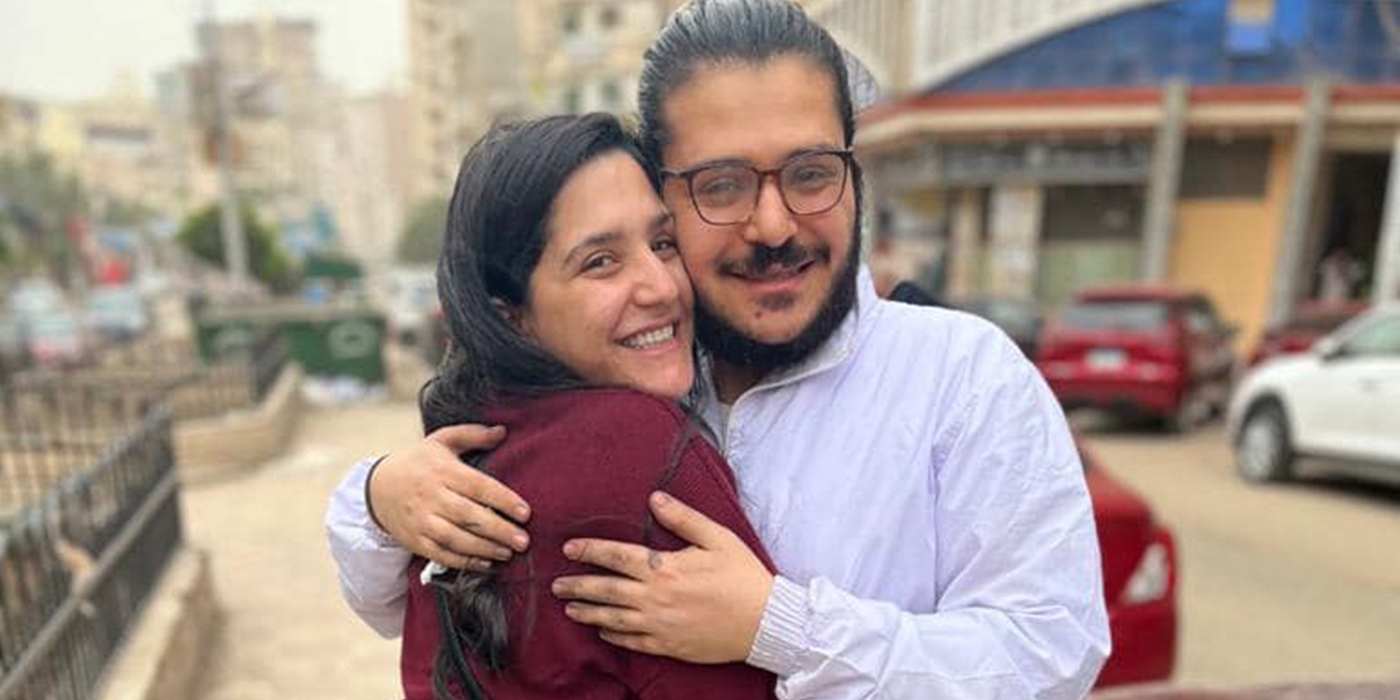
Patrick Zaki after his release on Wednesday 8 December 2021 (Screengrab/EIPR) By Areeb Ullah

Human rights activist Patrick Zaki was freed on Wednesday 8 December 2021, a day after Egypt’s Emergency State Security Misdemeanour Court ordered his provisional release. 

Zaki, a 28-year-old researcher at the Egyptian Initiative for Personal Rights (EIPR), had been studying at Italy’s Bologna University when he was taken into custody upon his return to Cairo in February 2020. Despite his release, he still faces a range of charges, including “calling for protests without permission”, “spreading false news” and “inciting violence and terrorism”. His trial will resume on 1 February 2022.

Tuesday’s hearing was the second time Zaki’s trial has been adjourned since the first session, on 14 September 2020. Human Rights Watch (HRW) told Middle East Eye that Zaki was subjected to physical torture in the days after his arrest.

Commenting on the court’s ruling for his release, Amr Magdi, Egypt researcher for HRW, described it as “rare happy news” for Patrick and his family. “Its a win with a bitter taste,” Magdi told MEE on Tuesday, pointing out that Zaki is technically still on trial as he has not been acquitted.

Zaki had been an outspoken campaigner for the truth about the 2016 murder of Italian student Giulio Regeni in Egypt. Zaki’s arrest sparked a solidarity campaign in Italy, with politicians and activists urging Egyptian authorities to release him.  Italian human rights campaigners have expressed concerns that Zaki could be at risk of torture and ill-treatment in Egypt’s notorious prisons, drawing parallels with the torture of Regeni.  Regeni’s family has also expressed solidarity with the detained activist.

In April, the Italian senate voted to approve a proposal by two lawmakers urging the government to grant Zaki Italian citizenship. Meanwhile, more than 50 Italian cities have announced the granting of “honorary citizenship” to Zaki. This was done, EIPR said, in order to show their appreciation for him as a human rights defender and to demand his immediate release in a campaign called 100 Cities with Patrick, launched by a group of human rights activists in Italy.

https://www.middleeasteye.net/news/egypt-patrick-zaki-released-italy-solidarity-regeni

https://www.middleeastmonitor.com/20220105-egypt-releases-3-prominent-political-prisoners-what-about-the-65000-others/