Posts Tagged ‘Egypt’
March 21, 2019
In two statements delivered to the 40th Session of the Human Rights Council, ISHR and Amnesty International reacted to the latest Joint Communications Report of the UN Special Procedures – independent human rights experts, appointed to monitor and report on human rights violations and to advise and assist in promoting and protecting rights. The report cites nine cases of reprisals against human rights defenders cooperating with the UN, and reveals that 95 states have not responded to letters from the UN experts concerning human rights violations.
There are two, related issues at stake here: (1) non-response to letters from the UN, and even worse (2) reprisals against human rights defenders who cooperate with the UN.
When I started my blog in 2010 (and one of the motivations) a main concern was the lack of response and enforcement [see https://humanrightsdefenders.blog/2011/03/20/taking-on-non-response-this-bloggers-lone-response/ and : https://www.linkedin.com/pulse/20140603192912-22083774–crime-should-not-pay-in-the-area-of-international-human-rights ].
As Helen Nolan of ISHR explains, 35 States have recently failed to respond to two or more of these letters. 13 of these nations are members of the Council. ‘Repeat offenders are a particular concern,’ says Nolan. ‘India has failed to reply to a staggering 8 communications, Mexico 6, Italy 5, and Bangladesh and Nepal 4 each.’ Nolan emphasises that a failure to reply is a failure to cooperate, and welcomes the fact that the recently published report of the Annual Meeting of Special Procedures focuses on non-cooperation, including ‘more subtle forms’, such as selective cooperation with particular mandates. ‘To encourage cooperation, the Council must make non-cooperation more costly,’ says Nolan. ‘We urge the President of the Council to work closely with the Coordinating Committee of the Special Procedures to find ways to do this,‘ adds Nolan.
ISHR and Amnesty International’s second statement noted that under GA Resolution 60/251, Council members must ‘fully cooperate with the Council.’ Yet, the report cites nine cases of reprisals involving these members:
- China sought to revoke the Society for Threatened Peoples’ ECOSOC status after vexatiously alleging that a person accredited by them, Dolkun Isa, participated in incitement and funding of separatism and terrorism, in retaliation for cooperation with the UN;
- Egypt carried out forced evictions, and violations of the rights to physical integrity, liberty and security against individuals who cooperated with the Special Rapporteur on the right to adequate housing during her recent visit;
- Iraq carried out unlawful arrest, enforced disappearance and torture against Imad Al Tamimi and intimidated and threatened Israa Al Dujaili for cooperating with the UN;
- Libya arrested an individual in retaliation for taking steps to clarify the fate and whereabouts of his father, including with UN mechanisms;
- The Philippines labeled defenders “terrorists” in reprisal for their engagement with the UN;
- Russia surveilled, intimidated and harassed Yana Tannagasheva and her husband, for speaking out about impacts of coal mining on indigenous people in Siberia and in possible reprisal for their communication with UN mechanisms;
- Turkmenistan carried out reprisals against a defender and her husband for her cooperation with the UN; and
- In Yemen, forces loyal to President Hadi and the Saudi-led coalition detained human rights defenders Radhya Al-Mutawakel and Abdulrasheed Al-Faqih for cooperating with the UN.
‘We call on the President of the Council to request updates on the cases from Iraq, Libya, Russia, Turkmenistan and Yemen, as there has been no response from the States concerned,’ said Nolan. For an older post on reprisals, see: https://humanrightsdefenders.blog/2014/03/13/zero-tolerance-for-states-that-take-reprisals-against-hrds-lets-up-the-ante/
Full text of the first statement (on failure to reply) available here.
Full text of the second statement (on cases of reprisals) available here.
You can also watch the videos of the statements via the link below:
Posted in Amnesty international, Human Rights Council, Human Rights Defenders, ISHR | Leave a Comment »
Tags: 40th session UN human rights council, AI, China, Egypt, India, international human rights mechanisms, Iraq, ISHR, Joint Communications Report, Libya, non-cooperation, Philippines, reprisals, Russia, Turkmenistan, UN Rapporteurs, Yemen
March 4, 2019
Reuters reports that on Monday 4 March 2019 Egypt released photojournalist Mahmoud Abu Zeid, also known as Shawkan who spent more than five years in jail after covering a 2013 sit-in that ended with security forces killing hundreds of protesters. “I can’t describe how I feel … I am free,” he told Reuters by phone after being released at dawn on Monday. [see also: https://humanrightsdefenders.blog/2018/05/04/world-press-freedom-day-a-good-time-for-honoring-journalists/]
Shawkan was released because he had served out his term before being sentenced. But he must still spend his nights for the next five years at a police station, a penalty he said he would challenge. He vowed to continue with his work, saying: “All journalists are at risk of being arrested or killed while doing their work. I am not the first and I will not be the last.”
(Shawkan was charged with belonging to a banned group and possessing firearms. He was sentenced to five years in prison last September in a mass trial which saw 75 people sentenced to death and more than 600 others to jail terms. Shawkan denied the charges against him, saying he was simply providing freelance coverage of the protest for a British-based photo agency.)
UNESCO awarded him its 2018 Cano Press Freedom Prize and said his detention was an abuse of human rights. See: http://www.trueheroesfilms.org/thedigest/awards/unesco-guillermo-cano-world-press-freedom-prize
Posted in human rights | Leave a Comment »
Tags: Egypt, Mahmoud Abu Zeid, media, photo journalism, release, Reuters, Shawkan, UNESCO/Guillermo Cano World Press Freedom Prize
February 9, 2019
On 28 January 2019 ISHR presented a blueprint for States with recommendations to some of the key issues the Human Rights Council should address in 2019.
In 2018, the Council adopted some landmark decisions
- an independent investigative mechanism on Myanmar
- Yemen, renewing the mandate of the Group of Eminent Experts
- Burundi, extending the mandate of the Commission of Inquiry.
At the same time, several situations of gross rights violations escaped Council scrutiny for political reasons.[see also: https://humanrightsdefenders.blog/2018/12/04/general-assemblys-3rd-committee-concludes-2018-session/]
The annual “High Level Segment” in March 2019 is a critical opportunity to set the agenda for the year. The Human Rights Council’s three regular sessions in March, June/July and September are further opportunities to advance priorities.
Here is ISHR’s checklist on the human rights situations and issues which should be advanced in 2019.
States should commit to strengthening the Council by demonstrating leadership, principled action and sustained follow through.
All regional groups presented the same number of candidates as seats for the 2018 Council elections and several States with terrible human rights records and with poor records of cooperation with UN mechanisms were elected, turning the elections into more of an appointment process, and going against the vision of the Council’s founding document.
States should collectively express concern about China’s failure to uphold human rights principles and protect the rights of its citizens, especially ethnic Uyghurs and Tibetans and those involved in the defence of human rights. China’s rejection of critical dialogue and universal principles is especially worrying as the Chinese government becomes increasingly active in the Council – a space dedicated to those same values.
States should also collectively press for the immediate and unconditional release of detained women human rights defenders in Saudi Arabia. If the international community is serious about contributing to advancing women’s rights in Saudi Arabia, it should recognise Saudi women human rights defenders as agents of change and urge the Saudi authorities to take all necessary measures to guarantee a safe and enabling environment for them to continue their vital work.
States should also initiate Council action to address recent cases of reprisals in Egypt as reported by the Special Rapporteur on the right to adequate housing after her visit in September 2018. These attacks come amidst a context of wide-scale repression against civil society through intimidation, arbitrary arrests, unfair prosecutions and travel bans.
States should collectively denounce the ongoing judicial harassment and arbitrary detention of human rights defenders in Bahrain, including reprisals for engaging or attempting to engage with UN mechanisms. As a minimum, States should call on the Bahraini authorities to immediately release all those detained for exercising their rights to freedom of expression, assembly and association, such as Nabeel Rajab and Abdulhadi Al Khawaja.
At the 40th session:
The Council will consider a resolution on the situation of human rights defenders working on rights related to land and environment. ISHR calls on States to address the particular threats and attacks against this group of defenders, in particular the specific risks faced by women human rights defenders, to combat impunity for attacks against them, and ensure full civil society participation in development and the management of natural resources. The draft resolution should call on States who prioritise the protection of human rights defenders to condition their provision of diplomatic support to business – such as export credit guarantees and trade support – on companies’ commitment to respect, consult and protect defenders. ..The Special Rapporteur on the situation of human rights defenders will present his report on the situation of women human rights defenders. States should publicly recognise the specific risks and threats women defenders face and commit to taking further measures to enhance their protection, underline the legitimacy of their work, their specific protection needs and adequate remedies to the specific violations they face.
At the 41st session:
Thanks to the sustained efforts by civil society and supportive UN Member States, the mandate of the Independent Expert on protection against violence and discrimination based on sexual orientation and gender identity (SOGI) was established in 2016. At the 41st session, ISHR urges States to renew the mandate and ensure that it is not weakened, so that it continues its vital work in capturing good practices and assisting States in ending discrimination and violence based on SOGI. The mandate continues to work with a diverse range of States from all geographical regions. Defenders from across the globe have affirmed that the mandate has contributed to their protection and recognition of their work. ..The Council will also consider a resolution on migrants and human rights. States should ensure that the text reiterates their obligations to support and not restrict defenders’ in their vital work and to protect migrant rights defenders in the face of rising intolerance, xenophobia and illiberalism. ISHR recalls Principle 18, from the OHCHR Principles and Guidelines on the human rights protection of migrants in vulnerable situations, which sets out measures States can take to respect and support the activities of migrant rights defenders.
At the 42nd session:
Human rights defenders must be able to access the UN freely and safely so that the UN can do its crucial work of monitoring countries’ compliance with human rights obligations and protecting victims from abuses. At the 42nd session in September 2019, States should not miss the opportunity to cite specific cases of reprisals at the second interactive dialogue on the Secretary-General’s annual report on reprisals….Finally, the accessibility of the Council to rights holders, victims and defenders is both a key contributor to, and indicator of, the Council’s relevance and success. As discussions on enhancing the efficiency of the Council resume, States should continue to support and guarantee that any proposed measures do not restrict or limit civil society participation at the Council.
Posted in human rights, Human Rights Council, Human Rights Defenders, ISHR, UN | 1 Comment »
Tags: Bahrain, China, Egypt, International Service for Human Rights, ISHR, land rights defender, reprisals, Saudi Arabia, UN Human Rights Council, women human rights defenders
January 31, 2019
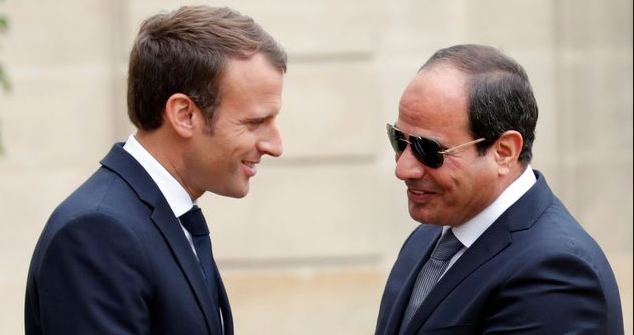
Emmanuel Macron lunched with Egyptian human rights defenders in Cairo on 29 January at the end of a three-day visit (for names see below). On Monday, the French president had visibly annoyed his Egyptian counterpart Abdul Fattah al-Sisi at a press conference, by saying that Sisi ought to restore civil rights and liberties for the good of his country. “Stability and lasting peace in Egypt go hand in hand with respecting individual rights and liberties within a state of law,” Macron said. “A dynamic, active, civil society remains the best rampart against extremism.” In response, President Sisi that “Egypt will not rise up with bloggers… Egypt will develop with efforts and patience.”
The French leader was even more forthright with French journalists in Cairo on Sunday night. He had given Sisi a list of political opponents including “journalists, homosexuals, men and women who have convictions” when Sisi visited Paris in October 2017. “Only two of them were freed,” Macron said. “That’s not enough. And things have got worse since.”
On Tuesday, the Cairo Institute for Human Rights Studies issued a statement providing details about the meeting. It said that Mohamed Zaree told Macron that “France must ensure that French weapons and communication technologies are not being used in Egypt against rights activists and peaceful political dissidents.” Zaree also told Macron that he and 30 of his colleagues are banned from travel and ” stressed that it was vital for the international community to refuse to sanction any attempt to amend the Egyptian constitution to eliminate presidential term limits, on any pretext.” [see also: https://www.voanews.com/a/human-rights-honor-goes-to-egyptian-banned-from-travel/4064632.html; https://humanrightsdefenders.blog/2017/10/10/breaking-news-egyptian-defender-mohammed-zaree-laureate-of-the-martin-ennals-award-2017/]
That the State does not have to do all the criminalisation of HRDs itself was shown a day after the meeting with the HRDs, when Egyptian lawyer Tarek Mahmoud filed a legal complaint against the heads of four of Egypt’s human rights organizations for “threatening national security”, according to local media reports. The complaint was filed on Wednesday against Mohamed Zaree, the director of the Cairo Institute for Human Rights Studies (CIHRS), Gamal Eid, the executive director of the Arabic Network for Human Rights Information, Mohamed Lotfy, the executive director of the Egyptian Commission for Rights and Freedoms, and Gasser Abdel-Razek, the executive director of the Egyptian Initiative for Personal Rights (EIPR). Tarek Mahmoud said in the complaint that the four men “provided French officials with false information on the political conditions in Egypt”. Mahmoud added that they were “insulting the Egyptian state and undermining the country’s national security, and collaborating with the terrorist Muslim Brotherhood group to achieve its goals of bringing down the Egyptian state.”
The Irish human rights group Frontline Defenders has presented a report on Egypt’s Attack on Labour Rights Defenders to French media in the run-up to Macron’s visit (with focus on the ill-treatment of workers at the Alexandria shipyard.).
——
https://www.irishtimes.com/news/world/europe/macron-pivots-towards-focus-on-human-rights-abuses-in-egypt-1.3775181
https://egyptianstreets.com/2019/01/31/human-rights-advocates-accused-of-spreading-false-news-after-meeting-with-macron/
Posted in CIHRS, Front Line, human rights, Human Rights Defenders, MEA | Leave a Comment »
Tags: Abdel Fattah el-Sisi, Cairo Institute for Human Rights, diplomatic pressure, Egypt, Emmanuel Macron, France, Front Line (NGO), Gamal Eid, Gasser Abdel-Razek, Human Rights Defenders, MEA laureate 2017, Mohamed Lotfy, Mohamed Zaree, Tarek Mahmoud, travel ban
January 8, 2019
Posted in human rights, Human Rights Defenders | 2 Comments »
Tags: Alaa Abd El Fattah, Amal Fathy, annual report 2018, Bassel (Safadi) Khartabil, bloggers, Dareen Tatour, Egypt, Electronic Frontier Foundation (EFF), Eman al-Nafjan, Eskinder Nega, Ethiopia, Human Rights Defenders, in memoriam, Iran, Jillian C. York, Offline project, Palestine, Saeed Malekpour, Saudi Arabia, Syria, Wael Abbas
December 20, 2018
Responding to the news that the South Cairo Criminal Court on 20 December 2018 acquitted all 43 defendants in the retrial of Egypt’s notorious “foreign funding” case – also known as Case 173 – Najia Bounaim, Amnesty International’s North Africa Campaigns Director said: “Today’s acquittal of all 43 NGO workers in the first ‘foreign funding’ case is a step in the right direction for Egyptian justice. This was a bogus case that targeted human rights defenders simply for doing their legitimate work and should never have happened in the first place…However, today’s ruling only relates to the first phase of the case which investigated the funding of international organizations; the investigation into local Egyptian NGOs is ongoing and dozens of staff are still at risk.”
Since the ‘foreign funding’ case was opened Egyptian human rights defenders have been treated as enemies of the state, subjected to an unprecedented crackdown, including asset freezes, travel bans and prosecutions. [see also: https://humanrightsdefenders.blog/2018/04/03/egypt-the-foreign-funding-accusation-against-human-rights-defenders-goes-in-overdrive/]
“The key test now will be whether today’s court decision paves the way for an end to the persecution of all human rights defenders in the country. The Egyptian authorities must lift all travel bans and asset freezes against NGO staff and drop their investigations into Egyptian NGOs and human rights defenders for their legitimate human rights work.”
[In June 2013,the first phase of the investigation into NGO funding (Case 173 of 2011) concluded when 42 foreign and Egyptian NGO workers were sentenced to prison terms of between one and five years and a series of international NGOs were closed. Since 2014, investigative judges have been conducting a criminal investigation into the work and funding of local NGOs and have issued asset freezes against six organizations and 10 human rights defenders. They have banned at least 30 human rights defenders and NGO staff from travel abroad. The judges also summoned at least six directors and 61 civil society organization staff for interrogation and later ordered their release on bail.]
Posted in AI, Human Rights Defenders | 1 Comment »
Tags: acquittal, Amnesty International, Case 173, Egypt, foreign funding, Najia Bounaim, NGOs
December 7, 2018
 On 5 December 2018, the North Africa Post reports that two United Nations rights experts have denounced the Egyptian government for its reprisals against human rights defenders who dared to talk to a visiting UN delegation that was enquiring on housing in the North African country a month ago. The reprisals included housing demolitions and arbitrary arrests, against human rights defenders and others.
Special Rapporteur on the right to housing, Leilani Farha, said she had been “shocked” by Egyptian reprisals against the Egyptian human rights defenders she met during her visit. Egypt “failed to adhere” to the assurances it provided to her, that “no person would be harassed, intimidated or subjected to reprisal for meeting or providing information” to her – or others in her official delegation, a UN press release said on Tuesday.
“I am shocked that after my mission a number of families from two communities I visited have suffered forced eviction contrary to international human rights law,” she was quoted as saying in the press release. According to the Special Rapporteur, several multi-storey houses have been demolished, furniture thrown into the street, and residents made homeless. Reportedly, adequate notice was not provided to victims, or any compensation, or new accommodation. Excessive force was also allegedly used by security forces against residents when they refused to leave their homes.
“Among those targeted were several houses and apartments belonging to family members of community leaders with whom I met while I was on official mission,” said Ms. Farha.
Also voicing concern over the reprisals, Michel Forst, the UN Special Rapporteur on human rights defenders said that the alleged incidents represented a worrying pattern against individuals and communities directly related to Ms. Farha’s visit. [see also: https://humanrightsdefenders.blog/2018/11/06/19-missing-human-rights-defenders-in-egypt/]
“Human rights defenders and lawyers working on the right to housing also reported that they have been followed and photographed by persons unknown to them, to have received anonymous and threatening phone calls, or have been summoned to report at police offices for interrogation,” he said, adding that one lawyer Ms. Farha had met, was subsequently slapped with a travel ban. In early November, the two human rights experts raised their concerns and sought clarification regarding the alleged forced evictions and reprisals with the Egyptian Government. They have not yet received an official reply, the UN press release said.
For some of my earlier posts on reprisals: https://humanrightsdefenders.blog/tag/reprisals/
http://northafricapost.com/26594-egypt-forced-evictions-other-reprisals-slap-human-rights-defenders-un-expert.html
Posted in human rights | 2 Comments »
Tags: Egypt, Leilani Farha, Michel Forst, reprisals, right to housing, UN Special Rapporteurs
November 6, 2018
The Middle East Monitor (among many) of 5 November 2018 reports how the Egyptian security forces entered the apartment of 60-year-old Hoda Abdelmonem, legal advisor to the Egyptian Coordination for Rights and Freedoms (ECFR), and trashed her belongings.
Fears grow for 19 missing human rights defenders in Egypt. Hoda was one of 19 activists – eight women and 11 men – swept up Thursday 1 November as the regime escalates pressure on human rights NGOs. Four days later the location and fate of these activists is still unknown. One of the organisations hit hard by this crackdown is the ECFR, which documents enforced disappearances and the expanding use of the death penalty.
A number of prominent members of the group have been targeted before. In September, Executive Director of ECFR, Ezzat Ghoneim, was forcibly disappeared despite being released from Tora prison after serving a six-month prison sentence there. In October Egyptian authorities issued an arrest warrant for Ghoneim for failing to adhere to the terms of his release despite the fact that his family say he is still being held in secret detention.
Along with Ghoneim the group’s co-founder Azzouz Mahgoub was also forcibly disappeared in March. Last Thursday the ECFR announced the suspension of its work citing the current climate in Egypt as “incompatible with human rights work”. “The human rights situation in Egypt, especially with regard to the rights of detainees and human rights defenders, has been the worst in Egypt’s history in the past five years” ECFR said in a statement.
“Furthermore, the Egyptian authorities have committed the most serious violations beyond all humanitarian norms including the storming of women’s homes, their detention and the arrest of their families over the past three months alone.”
see also: https://humanrightsdefenders.blog/2018/04/03/egypt-the-foreign-funding-accusation-against-human-rights-defenders-goes-in-overdrive/
https://www.middleeastmonitor.com/20181105-fears-grow-for-19-missing-human-rights-activists-in-egypt/
Posted in human rights, Human Rights Defenders | 1 Comment »
Tags: Azzouz Mahgoub, break-ins, Egypt, Egyptian Coordination for Rights and Freedoms, Ezzat Ghoneim, Forced disappearance, Hoda Abdelmonem, Human Rights Defenders, illegal detention, Middle East Monitor, suspension
April 20, 2018
As part of the global Celebration of World Press Freedom Day, the winner of the “UNESCO/Guillermo Cano World Press Freedom Prize” will be announced on 3 May 2018. for last year’s award: https://humanrightsdefenders.blog/2017/05/04/eritrean-born-journalist-dawit-isaak-awarded-2017-unescos-guillermo-cano-world-press-freedom-prize/
For more on this award and some 20 other international awards protecting freedom of speech and the media see: http://trueheroesfilms.org/thedigest/awards/unesco-guillermo-cano-world-press-freedom-prize.
The jury on Monday 23 April awarded the honor to Mahmoud Abu Zeid, known as Shawkan, who has been in jail since he was arrested in Cairo in August 2013 for covering a demonstration at Rabaa Al-Adawiya Square. Egypt’s Foreign Ministry strongly warned UNESCO against the move Sunday, saying that Shawkan faces terror-related charges. The U.N. Working Group on Arbitrary Detentions says Shawkan’s arrest is arbitrary and his continued detention infringes his human rights.
http://www.tampabay.com/jailed-egyptian-photographer-wins-unesco-press-freedom-prize-ap_worlda917dda4d8b3494b885425c516bbc1ce
https://www.ghanaweb.com/GhanaHomePage/NewsArchive/The-UNESCO-Guillermo-Cano-World-Press-Freedom-prize-643081
Posted in awards, human rights | Leave a Comment »
Tags: censorship, digest of human rights awards, Egypt, freedom of information, human rights awards, journalists, Mahmoud Abu Zeid, Media and Human Rights, photographer, Shawkan, UNESCO/Guillermo Cano World Press Freedom Prize, World Press Freedom Day (3 May)
April 3, 2018
An Egyptian lawyer, Samir Sabry, has requested the Attorney General to bring human right defender Asmaa Mahfouz to court. The reason? Winning the Sakharov Prize in 2011! If Egypt Today had reported it a day earlier (on 1 April), I would have credited it as a good April 1st spoof, but unfortunately it is not. In his complaint, Sabry called for the Attorney General to transfer Mahfouz to a Criminal Court trial and ban her from travelling outside the country. He stated that the prize, worth €50,000 was given to her suddenly, and he did not know why. He asked whether it is funding, a reward, or for certain service, and what the reason is for this award. The complaint from Sabry also claimed that this is a Jewish award [SIC} and questions the award’s links to Zionism. According to Sabry, the answer is that Mahfouz received the prize money, and accepted the award, in return for betraying Egypt.
Asmaa Mahfouz was one of the founding members of the April 6 Youth Movement, which sparked nation-wide demonstrations in April 2008 and was indeed awarded the Sakharov prize in 2011 (sharing it with four other Arab figures).
The prize in question is the Sakharov Prize for Freedom of Thought [http://trueheroesfilms.org/thedigest/awards/sakharov-prize-for-freedom-of-thought], which is of course is not granted by Israeli but by the European Parliament!
However, the issue of foreign funding is a major one in the Egyptian context as demonstrated by the case of two Egyptian woman human rights defenders in the ‘NGO foreign-funding case” (as ISHR reminds us on 29 March 2018): harassed and targeted Egyptian woman defenders Azza Soliman and Mozn Hassan [https://humanrightsdefenders.blog/2017/02/02/right-livelihood-has-to-go-to-egypt-to-hand-mozn-hassan-her-2016-award/] face life imprisonment if their cases are brought to trial simply for conducting legitimate human rights work.
Read the rest of this entry »
Posted in CIHRS, human rights, Human Rights Defenders, ISHR | 2 Comments »
Tags: Asmaa Mahfouz, Azza Soliman, Cairo Institute for Human Rights Studies, digest of human rights awards, Egypt, foreign funding, human rights award, human rights awards, ISHR, Israel, Mozn Hassan, NGO foreign-funding case, Sakharov Prize for Freedom of Thought, Samir Sabry, travel ban, woman human rights defenders




 Hans Thoolen on Human Rights Defenders and their awards