Posts Tagged ‘detention’

Human rights lawyer Kudratov in Tajikistan sent 9 years to penal colony

January 13, 2015

On 13 January Asia-plus reported that a court in Dushanbe, Tajikistan, sentenced Sukhrat Kudratov to nine years in a penal colony for bribery and fraud. Kudratov’s real crime, it appears, was defending opposition activist Zaid Saidov in 2013.  Last year, another one of Saidov’s lawyers, Fakhriddin Zokirov, was arrested on forgery charges. He was released after eight months on the promise he would no longer defend Saidov. Steve Swerdlow of Human Rights Watch called Kudratov’s jailing “a serious setback for the freedom of expression and the independent legal profession in Tajikistan.”

At the time of the arrest, Frontline Defenders called him “one of few lawyers in Tajikistan who defends opposition activists, victims of police torture, and those accused of ‘religious extremism“. Dushanbe-based Bureau for Human Rights and Rule of Law named Kudratov their human rights defender of the year in 2011.

Tajikistan Jails Prominent Human Rights Lawyer | EurasiaNet.org.

In Memoriam Chan Soveth, Cambodian human rights defender

December 11, 2014

On Human Rights Day, FIDH reports that Chan Soveth, a prominent Cambodian human rights defender, has died at the early age of 51. He was a senior investigator at the Cambodian Human Rights and Development Association (ADHOC, a member organization of FIDH). “Chan Soveth was a voice for the voiceless. For decades, he selflessly worked for victims of human rights violations and abuses, in particular the poor and those living in remote areas, which ADHOC managed to reach out to”, said Karim Lahidji, FIDH President. “Soveth’s death is a great loss for his family, his colleagues and Cambodia’s human rights community, but the heritage of courage and commitment he left will last for generations”.

On many occasions, Soveth’s human rights work and personal commitment had caused him to be subjected to threats, intimidation and reprisals in the form of judicial harassment. In 2012, he had been forced to stay outside his country for several months. Upon his return, despite receiving another summon to appear before Cambodia’s flawed judicial system, and thus, despite the risk of being arbitrarily detained, he had decided to stay in Cambodia, amongst his fellow countrymen. Soveth relentlessly fought against human rights violations – from land grabbing and violations of people’s and communities’ rights to food, water or housing, to extrajudicial killings, arbitrary detention, torture, and violations of the rights to free expression and free assembly. He was not only a great investigator, trainer and human rights advocate, but also an inspiration to many. He was always eager to improve his impressive human rights and professional skills and to celebrate successes.logo FIDH_seul

Cambodia and the community of human rights defenders lose a (…).

more details in: http://www.phnompenhpost.com/national/rights-warrior-passes-age-51

UN General Assembly votes today on Iran: Joint appeal by NGOs

November 18, 2014

Today – 18 November 2014 – the General Assembly is due to vote on a Resolution concerning Iran. Although the human rights situation in Iran has shown some slight improvements since Rouhani became president, it seems that hardliners keep firm control over the judiciary and thus over the life and well-being of human rights defenders. Also Iran continues to deny access to the UN Special Rapporteur on Iran. The Joint Letter to the Member States of the UN General Assembly signed by numerous NGOs makes the point quite clearly:

see also: https://thoolen.wordpress.com/tag/iran/

Text of Letter:

Your Excellency:

We, the undersigned human rights and civil society organizations, write to urge your government to vote in favor of Resolution A/RES/69/L on the promotion and protection of human rights in the Islamic Republic of Iran. This vote will take place during the 69th session of the United Nations General Assembly, scheduled to take place in the Third Committee this Tuesday, 18 November 2014.

This resolution provides a crucial opportunity to reiterate ongoing human rights concerns identified by members of the international community and Iranian civil society. Sixteen months into the presidency of Hassan Rouhani, who won the election after promising to improve the human rights situation, those living in Iran continue to suffer violations at the hands of the authorities. Indeed, during last month’s Universal Periodic Review (UPR) of Iran at the UN Human Rights Council, several UN member states expressed dismay at Iran’s lack of progress over the last four years, including on many of the recommendations Iran had accepted during the first UPR cycle in 2010.

Human rights abuses are deeply rooted in Iran’s laws and policies, both of which pose serious obstacles for much-needed rights reforms to take place. On 28 October 2014, the UN Special Rapporteur on the situation of human rights in the Islamic Republic of Iran, Dr. Ahmed Shaheed, reported that human rights in the country “remain of concern” and detailed violations of the rights to life, the rights to freedom from torture and discrimination based on gender, religion, and ethnicity, the rights to education, health, fair trial, freedom of expression, association, assembly, religion and belief, as well as limits on the press. Despite its 2005 standing invitation to the United Nations’ Special Procedures, Iran remains unwilling to accept their repeated requests to visit the country. Furthermore, the authorities have systematically worked to undermine the efforts of civil society in the country to promote and protect international human rights standards.

The continued attention of the international community is required if the Islamic Republic of Iran is to end this pattern of abuse and noncooperation. UN member states must continue to express their concern about these abuses. In doing so, member states provide support to civil society as well as to those in the Iranian government who wish to see improvements in the human rights situation. By voting in favour of the resolution, states will encourage Iran’s government to prioritize human rights and to advance and protect the rights of Iran’s population.

Since the beginning of 2014, Iran has executed at least 600 people. This figure includes juvenile offenders and individuals who may have been executed for peacefully exercising their rights including the rights to freedom of expression, association, and assembly. Death sentences in Iran are often imposed without any regard to internationally prescribed safeguards. Authorities executed Reyhaneh Jabbari on 25 October 2014, despite repeated calls from UN human rights mechanisms, including the Office of the High Commissioner for Human Rights, to stay the execution out of concern that her prosecution had failed to meet international fair trial standards. Moreover, the vast majority of executions in Iran are implemented for offenses, such as drug-related offenses, that do not meet the threshold of the “most serious crimes.” Iranian law maintains the death penalty for consensual sexual relations between adults, including for adultery and same-sex relations, and for financial crimes. Iran continues to execute in public despite calls by the UN Secretary-General on authorities to halt the practice.

Executions based on national security-related charges that may be politically motivated appear to be carried out disproportionately against members of Iran’s ethnic minority communities, including Ahwazi Arabs, Kurds, and Baluchis. Rights groups are concerned about the situation of 33 Sunni Kurds, most of whom are held in Raha’i Shahr Prison in Karaj and face imminent risk of execution. The men were sentenced to death following grossly unfair trials during which basic safeguards, such as the right to defense, were disregarded, in contravention of international fair trial standards.

The Special Rapporteur and human rights organizations continue to express grave concerns for scores of activists, journalists, human rights defenders, women’s rights activists, trade unionists, students, and members of ethnic and religious minorities currently languishing in arbitrary detention. Iranian detainees and prisoners consistently face the risk of torture or other ill-treatment, including prolonged solitary confinement and denial of medical treatment. They are regularly denied access to legal counsel or fair trials. Many detainees are prosecuted under vaguely defined national security charges, which are regularly used to silence peaceful expression, association, assembly, and religious activity. In July 2014, for example, journalist Sajedeh Arabsorkhi began serving a one-year imprisonment sentence on the charge of “spreading propaganda against the system.” It appears that the charge is related to her open letters to her father, Feyzollah Arabsorkhi, a former deputy trade minister and a senior member of a reformist political party, during the time he was imprisoned.

Systematic discrimination against women in law and practice also merits serious concern. In the past few years, the authorities have increasingly put in place discriminatory measures aimed at restricting women’s access to higher education, including gender quotas, and have adopted new population policies resulting in women’s restricted access to sexual health and family planning programs. The authorities continue to persecute those protesting such discriminatory laws and practices, often by accusing them of vaguely worded national security offences. This month, for example, Ghoncheh Ghavami learned of her one-year prison sentence and two-year travel ban by a Tehran court on the charge of “spreading propaganda against the system”. She was arrested after she protested a ban on women watching matches at sports stadium during a game played by Iran’s national volleyball team.

This resolution on the promotion and protection of human rights in Iran of the 69th UNGA is a vital opportunity for the international community to give expression to human rights concerns. The resolution welcomes recent positive statements by Iranian officials, while effectively drawing attention to the broad range of ongoing violations. Moreover, the resolution calls on authorities to cooperate with all UN Special Procedures, including the Special Rapporteur on the situation of human rights in the Islamic Republic of Iran.

Substantive cooperation with UN mechanisms and tangible rights improvements in line with Iran’s international legal obligations are the real measures of progress. By voting in favor of this resolution on 18 November, the UN General Assembly will send a strong signal to the government and all Iranians that the world is invested in genuine human rights improvements in the country.

Letter to the Member States of the UN General Assembly.

China detains activists for supporting Hong Kong protests

October 1, 2014

If there was any doubt that the Chinese regime fears contamination from Hong Kong, today’s (1 October) report by the NGO China Human Rights Defenders [CHRD] makes clear that any expressions of support are dealt with harshly. Authorities are reported to have detained a dozen activists across China and threatened several others who expressed support for Hong Kong’s pro-democracy protests in recent days….They include activist Wang Long, who was detained by police in the southern boomtown of Shenzhen on Monday for “creating a disturbance” after he posted messages about the protests online, CHRD said. The 25-year-old Wang made headlines last month with his decision to sue a state-owned telecom operator for denying him access to US search engine Google. Another activist, Shanghai-based Shen Yanqiu, posted online photos of herself with a shaved head in support for the Hong Kong protesters on Sunday, CHRD said. She was detained on Tuesday and is “being held in an unknown location”, according to the group. A group of “up to 20 citizens” were seized by police on Tuesday in the southern metropolis of Guangzhou, near Hong Kong, after gathering in a city park to voice support the pro-democracy camp, according to CHRD. At least two activists – Huang Minpeng and Liu Hui – were detained by police and “denied food” while in custody before they were released in the afternoon, the group said. Other areas where activists have reportedly been detained or threatened include Beijing, the southwestern mega-city of Chongqing and central China’s Jiangxi province. (AFP/nd)

via China detains activists for supporting Hong Kong protests: Rights group – Channel NewsAsia.

Bahrain: Travails of a Family of Human Rights Defenders

September 12, 2014

On Tuesday, 16 September, Maryam Al Khawaja, the Bahraini human rights defender will return to court for her second hearing on charges of assaulting a police officer, which she denies. It’s now been nearly two weeks since Maryam was arrested at the airport following her return to Bahrain to visit her father. She was initially detained for seven days, but over the weekend a Bahraini judge ruled to extend her detention by an additional 10 days. This is a good occasion to draw your attention to a long but fascinating piece by Lawrence Weschler on Truthdig of 11 September 2014. Under the title “Terrorizing a Family of Human Rights Champions” he describes in detail what happened to the remarkable al-Khawaja family of democratic non-violent human rights defenders [it is rumored that for the first time a family as such was considered for the 2013 Nobel Peace Prize].  Read the rest of this entry »

British human rights investigators held in Qatar freed

September 9, 2014

The Guardian reported today that Krishna Upadhyaya and Gundev Ghimire, the two British human rights investigators detained in Qatar for almost nine days, have been released from custody (but have not yet left the country).

via UK human rights researchers held in Qatar freed | World news | theguardian.com.

https://thoolen.wordpress.com/2014/09/08/human-rights-investigators-in-qatar-are-now-confirmed-as-detained/

Veteran human rights defender Ahmed Seif Al Islam dies in Egypt

August 29, 2014
On 21 August I reported on the travails of an Egyptian family of human rights defenders [https://thoolen.wordpress.com/2014/08/21/an-exceptional-egyptian-family-of-human-rights-defenders/], a week later Mona Seif’s father has died. Ahmed Seif Al Islam was a veteran Egyptian lawyer, activist and former political prisoner. Arrested and tortured by State Security Investigations officers in 1983 for his political activity, he served five years in prison. Founder of the Hisham Mubarak Law Centre, which since 2008 has been providing legal assistance to protesters. The Hisham Mubarak Law Centre (HMLC ) monitored state violence during the 2011 protests, and became a gathering place for human rights activists during the revolution. Ahmed Seif was arrested by Military Intelligence with his staff at the height of the protests.
Seif, a human rights lawyer, was on the legal defense team in numerous high-profile trials of human rights, labor, and more broadly political activists in the Hosni Mubarak years, but he was above all an activist himself. The was more often than not the coordinating center for planning peaceful demonstrations and then, invariably, for deploying lawyers to various detention centers in response to the usual mass arrests that followed such events.In a conversation I had with Seif several years ago, in February 2007, he told me how he became engaged in human rights activism and lawyering:

Read the rest of this entry »

25 Years Tiananmen ‘celebrated’ with over 100 detentions

June 13, 2014

(A map of all individuals detained in the wake of the Tiananmen anniversary. Some of these persons have already been released. Photo: CHRD)

Yesterday China Human Rights Defenders has released a list of over 100 activists, journalists, lawyers, dissidents and other assorted individuals who are thought to have been detained by the government in the wake of the 25th anniversary of the 1989 Tiananmen Square protests. As of June 11, 116 individuals from various parts of China, including Beijing, Shanghai, Sichuan, Xinjiang and Guangdong are all listed, with an estimated 49 criminal detentions and two confirmed arrests. Many who were not detained were invited by local authorities to “drink tea” – a veiled phrase for questioning – and were warned to avoid participating in any anniversary activities. Chief among the detainees is veteran human rights lawyer Pu Zhiqiang, who was placed in criminal detention on May 6 under charges of “picking quarrels and provoking trouble” after he attended a May 3 Tiananmen commemoration.

(Pu Zhiqiang. Photo: Reuters)

Pu was … a student lawyer in the 1989 protests, [and he] became a prominent human rights lawyer and advocate, taking up some of the most politically sensitive rights-defending cases,” said David Zhao, researcher and representative for CHRD. “He [has made] earlier remarks that he is still ‘deeply emotionally tied to [Tiananmen]’ and has ‘no regrets over his involvements’.”


(Yu Shiwen (left) and Chen Wei (right). Photo: Screenshot via RFA)

Other persons on CHRD’s list include Wang Xiuying, an 83-year-old activist who had her home searched by Beijing police after signing a Tiananmen commemoration petition, Chen Wei and Yu Shiwen, an activist couple who organised Tiananmen memorial services, and Wu Wei, a former South China Morning Post journalist in Beijing who interviewed Pu Zhiqiang in the past. “The clampdown on commemorative events this year is the most severe of all years and this reflects the [government’s] determination to wipe out the memory of Tiananmen,” Zhao said.

View CHRD’s list in full here.

via http://www.scmp.com/news/china-insider/article/1530899/human-rights-group-releases-list-over-100-people-detained-during

A few days earlier, 6 June, Mary Lawlor of Front Line wrote a thoughtful piece on the same issue stating that it “would be fitting that the 25th anniversary of the  Square massacre be marked by a renewed international effort to provide greater support to Chinese human rights defenders.

China-Tiananmen-Square

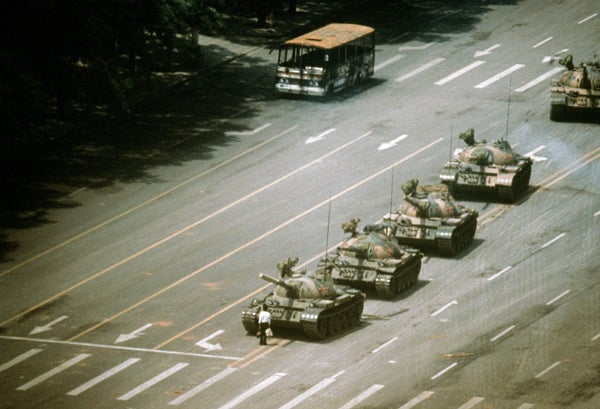
Human rights defenders (HRDs) currently working in China are frequently seen as challenging the Party and as such must be prepared to risk everything, including death, to continue their work. Although the Party’s methods may have changed in the past quarter of a century, its intention to crush dissent at any cost has not. On 3/4 June 1989 hundreds of peaceful demonstrators were killed in the approach roads to Tiananmen Square in Beijing, bringing an end to seven weeks of protests which had drawn up to a million people onto the streets. What started off as a student protest in the capital calling for political reform quickly morphed into a mass movement supported by broad cross-sections of society which spread to dozens of other cities throughout the country.

The legacy of these protests and the massacre that followed is still keenly felt by HRDs in today’s China. The events of 1989 remain a key touchstone to many Chinese HRDs and as the CCP works to erase the memory of what happened that June, HRDs are equally determined to keep that memory alive, and honor those who died. They do this not only through yearly commemorations of the dead, but also through their day-to-day work defending the rights for which the 1989 protesters struggled. These HRDs highlight injustice, campaign against discrimination, defend in court those who have been arrested for expressing themselves freely and shine a spotlight on the myriad of abuses, including corruption, carried out by the CCP.

So threatened does the Party feel by the memory of its actions 25 years ago that it criminalizes the very act of remembering. In early May, five HRDs were arrested following a low-key memorial at a private residence in Beijing. They are being held on charges of “picking quarrels and provoking trouble.” The only “quarrel” these HRDs “picked” was with the CCP’s whitewashed version of history, and the Party’s hysterical overreaction to such a commemoration is as clear an admission of guilt as any signed confession. The author then refers to groups such as the  The Tiananmen Mothers and the New Citizens Movement…

On the surface, the China of today is a much changed place to the China of 1989… Yet beneath the confident exterior lies the reality that the CCP remains a fragile entity, haunted by the possibility that the values of equality, justice and dignity espoused by HRDs in China might threaten its legitimacy, which is based almost solely on an economic growth model…..While various countries trip over each other in a race to secure lucrative trade deals with China, emphasis on human rights gets pushed further and further down the agenda. The CCP knows that no matter how egregious its abuse of rights – as in the recent death of human rights defender Cao Shunli in custody – international reaction will be muted at best. These are the same rights which workers and students died for twenty five years ago and whose deaths were met at the time with a robust international response.

The weakening of such international support for HRDs working today can only be seen as a betrayal of the values espoused in 1989. It would be fitting that the 25th anniversary of the massacre be marked by a renewed international effort to provide greater support to Chinese HRDs as they bravely continue their work in advancing and protecting internationally recognized rights, despite knowing with full certainty that they will be targeted as a result of this work.

Tiananmen 25: More than a Symbolic Legacy | Sharnoffs Global Views.

Iranian human rights defender Nasrin Sotoudeh speaks to the Guardian

June 2, 2014
The Guardian of 1 June 2014 contains a long and fascinating interview with Nasrin Sotoudeh, the Iranian lawyer who won the Sacharov Prize and was a Final Nominee of the MEA in 2012. The now freed Iranian human rights lawyer – in an interview with Simon Tisdall – speaks out in a moving way about why she is a human rights defender and how she coped with the separation from her family. The title of the piece: ‘I’ve a bad feeling about the women I left behind’ is telling of her concern for others.
Nasrin Sotoudeh

(Nasrin Sotoudeh with her son, Nima, after being freed from prison last year. Photograph: Behrouz Mehri/AFP/Getty Images)

“Nasrin Sotoudeh’s seven-year-old son, Nima, wants to go out to play. His mother, the leading Iranian human rights lawyer whose arbitrary imprisonment in 2010 sparked an international campaign to free her, has been talking for ages. Nima is bored. At the door to their apartment in north-west Tehran, Nasrin takes Nima in her arms. The boy stands on tip-toe to embrace his mother. They hold each other for a minute or more. It is as though the two cannot bear to be separated..…….”. For more: Freed Iranian rights lawyer: Ive a bad feeling about the women I left behind | World news | theguardian.com.

other posts on Nasrin: https://thoolen.wordpress.com/tag/nasrin-sotoudeh/

Thai Junta summons human rights defenders

June 2, 2014

The Asian Human Rights Commission reports that only a few hours ago (around 9 pm) on 1 June 2014, the National Council on Peace and Order Maintenance [NPCO] in Thailand issued Orders No. 42-44/2014 – broadcast on the radio and television – demanding that 38 persons report themselves to the Jamjuree Room at the Army Club on Thewet Road between 10 am and noon. Similar to earlier orders, the penalty for not obeying the summons carries a prison term and a 40,000 baht fine.The list includes a number of human rights defenders, activists, academics, and journalists, such as:

  • Jittra Kotchadet, long-time labour rights activist and human rights defender.
  • Tewarit Maneechay, human rights defender and journalist for the independent media site Prachatai.
  • Suthachai Yimprasert, a historian at Chulalongkorn University, and
  • Kengkij Kitirianglarp, a political scientist at Chiang Mai University; the two academics have consistently acted in support of human rights.
  • Pranee Danwattananusorn, the wife of Surachai Danwattananusorn (a former political prisoner) and who has worked to support the rights of political prisoners and human rights defenders.
  • Karom Phonpornklang, a lawyer who has defended numerous political prisoners.

The full lists can be found in:  THAILAND: Junta summons additional human rights defenders, activists, academics, and journalists — Asian Human Rights Commission.