Posts Tagged ‘Democracy’

Shlosberg awarded the inaugural Boris Nemtsov Prize

May 23, 2016

The Boris Nemtsov Foundation was established by Zhanna Nemtsova, a daughter of the murdered politician, Boris Nemtsov, and plans to work in the field of education and raising public awareness, expert evaluations and also in “helping political prisoners and those who are prosecuted on political grounds in Russia.” A new national award, the Boris Nemtsov Prize, was created which is awarded annually for “outstanding courage in fighting for democratic values, human rights and freedom in Russia.”

Lev Schlosberg, a member of the Yabloko Party and a former deputy of the Pskov regional parliament, was announced as the first recipient. The award ceremony will take place in Bonn, Germany, on Russia’s National Day, June 12.

Nemtsov was in 2015 runner-up in the European Parliament’s Sakharov prize: https://thoolen.wordpress.com/2015/10/29/saudi-blogger-raif-badawi-awarded-europes-sakharov-prize/

Source: Human rights activist Shlosberg awarded Boris Nemtsov Foundation Prize | Russia Beyond The Headlines

More on the Tunisian winners of the Nobel Peace Prize

October 13, 2015

My short post on the Nobel Peace Prize for the Tunisian quartet [https://thoolen.wordpress.com/2015/10/09/tunisian-national-dialogue-quartet-laureates-of-2015-nobel-peace-prize/] is better understood with the post by Dan Smith: http://dansmithsblog.com/2015/10/13/the-tunisian-spring-and-the-nobel-peace-prize/.

Tunisian national dialogue quartet laureates of 2015 Nobel peace prize

October 9, 2015

The Tunisian national dialogue quartet, a coalition of civil society organisations, has won the 2015 Nobel peace prize.  The quartet is comprised of four NGOs in Tunisian civil society: the Tunisian General Labour Union, the Tunisian Confederation of Industry, Trade and Handicrafts, the Tunisian Human Rights League [the national affiliate of the FIDH – see press link below] and the Tunisian Order of Lawyers.

Kaci Kullmann Five, the chairman of the Norwegian Nobel committee, said the quartet had formed an alternative peaceful political process in 2013 when the country was on the brink of civil war and subsequently guaranteed fundamental rights for the entire population. Committee says the prize awarded for quartet’s decisive contribution to the building of a pluralistic democracy in Tunisia in the wake of the 2011 Jasmine Revolution

The Tunisia director of Human Rights Watch, Amna Guellali said the prize was being seen in the country as a reward for sticking with democratic principles. “The Quartet enabled the democratic process to go ahead, it was a political crisis that could have led to civil war,” she said. “People here will hope the award is not just a token celebration, but will bring Tunisia real help.

https://www.fidh.org/en/region/north-africa-middle-east/tunisia/national-dialogue-quartet-in-tunisia-2015-peace-nobel-prize-mabrouk
(French:) https://www.fidh.org/fr/regions/maghreb-moyen-orient/tunisie/le-quartet-tunisien-prix-nobel-de-la-paix-2015-mabrouk

Source: Tunisian national dialogue quartet wins 2015 Nobel peace prize | World news | The Guardian

Thai journalist Pravit Rojanaphruk about (self)censorship under the junta

June 19, 2015

On 26 May 2015, at the 2015 Oslo Freedom Forum, Thai journalist Pravit Rojanaphruk describes his fight for democracy in his home country following the May 2014 military coup. Talking about his own arrest, Rojanaphruk denounces the limitations to the right to assembly, expression and movement in Thailand, as well as the regime’s efforts to build the illusion of a happy Thailand. Rojanaphruk concludes his presentation by reminding us that tolerance and dialogue are essential if Thailand is to become a democracy again.

for more on Thailand: https://thoolen.wordpress.com/tag/thailand/

Lessons from the Pinochet regime by Andrés Velasco

June 2, 2015

At the 2015 Oslo Freedom Forum on 26 May Chilean economist, Andrés Velasco, in highly personal account describes how political, economic, and social unrest led to the collapse of Chilean democracy in the 1970s. Growing up under Augusto Pinochet’s military dictatorship, Velasco is familiar with stories of political prisoners, torture, intimidation, and exile. Velasco argues that the extreme brutality of the military dictatorship became too difficult for most Chileans to face, allowing the violence to continue unhindered. As Velasco reminds us, however, Chilean civil society eventually united behind an incredibly creative political campaign, and succeeded in voting Pinochet out of power. Velasco ends his speech on an optimistic note, arguing that the common sense of Chileans will prevent another democratic collapse.

Democracy activist Nurul Izzah Anwar talks about Malaysia

May 31, 2015

On 26 May 2015, Nurul Izzah Anwar, Malaysian MP and daughter of imprisoned opposition leader Anwar Ibrahim, spoke at the Oslo Freedom Forum. In this video he describes how she was drawn into the opposition movement in Malaysia. She tells us about rampant government corruption, the country’s defunct judicial system, and how the government targets dissidents and attempts to limit change. Anwar explains how the lack of genuine parliamentary immunity prevents Malaysian politicians from speaking against the government. She reminds us that “Malaysia’s most wanted” are the activists that challenge the government, and expresses the hope that Malaysia’s future belongs to those seeking a more democratic and fair country.

Chinese Human Rights Defender Xu Youyu gets Olof Palme Prize

December 16, 2014

.Chinese activist wins Swedish rights prize

(Olof Palme – Photo: TT)

The Stockholm-based Olof Palme Memorial Fund said in a statement today that the Chinese pro-democracy activist Xu Youyu, who was among key signatories of a 2008 manifesto seeking sweeping political reforms in China, has won the Olof Palme human rights prize [http://www.brandsaviors.com/thedigest/award/olof-palme-prize]. Born in 1947, Xu is a philosophy professor at the Chinese Academy of Social Science and was one of the most prominent signatories of the 2008 Charter 08 manifesto that urged a series of reforms in China. He was detained in May this year in a crackdown on dissent ahead of the 25th anniversary of the Tiananmen Square massacre.

He has worked consistently for a democratisation of Chinese society, while condemning any form of violence as a political method,” the Fund stated. “Through his research and dialogue-oriented debate articles, Xu Youyu has made a great contribution to the peaceful and democratic development in China.”

http://www.thelocal.se/20141216/chinese-activist-xu-youyu-wins-swedish-rights-prize

Radio Prague: interesting interview with People In Need Director Simon Panek

March 28, 2014

Since its foundation in the early 1990s, Prague-based People in Need [Člověk v tísni] has become one of the biggest NGOs in Central Europe. Founding member Šimon Pánek has for many years been the organisation’s director, and Ian Willoughby of Radio Prague did an lengthy interview with him on 24 March 2014. The conversation touched on targeting of aid, politics, international perception and plans for the future. It has become a most interesting interview that shows how in two decades a NGO in Central Europe can develop into a serious and mature organisation, still mostly local but with international potential. The transcript of the interview follows below:

I first asked Pánek what for him had been its standout projects of the last 20 years-plus “What was important was one of the very first projects, SOS Sarajevo, a big fund-raising campaign in the Czech Republic and relatively massive humanitarian aid into the besieged city of Sarajevo during the war. That was a formative period for us, for sure.

“The second important period I regard as when we were approached by students from Belarus and Cuban immigrants in the second half of the 1990s with a simple question: did you forget that we are not free yet?

“They said, you got your freedom, you got rid of the Communist regime, but we still have Lukashenko, we still have Castro – it’s a bit unfair to forget that we are in a bad situation.

Šimon Pánek, photo: Štěpánka Budková

(Šimon Pánek, photo: Štěpánka Budková)

“At that time we basically established the second department of People in Need, dealing with human rights, or supporting human rights defenders.

“The third pillar was established again at the end of the 1990s when in the North Bohemian city of Ústí nad Labem the mayor started to build a wall between a Roma settlement and the majority…”

This was the notorious Matiční Street.

“Yes, Matiční Street. And we were shamed. We were sitting around the table – I still remember the day – and one of my colleagues said, if we are able to operate in Chechnya, if we are able to do illegal work and support dissidents in Cuba, Burma, Belarus, we should be able to try to do at least something in such a shameful situation in our own country.

“So we started with social work at that time, and now we are running 10 offices around the Czech Republic with almost 200 employees working in 60 localities, dealing with social exclusion and all other connected things.”

Could we get back to the political activities of People in Need? You were saying that you support the opposition in countries like Cuba, Burma – do you have a kind of neo-conservative approach, where you’re trying to in a sense export democracy to these countries? Neoconservativism has been largely discredited politically, I would say.

“Yes, I absolutely agree that the word democracy was discredited, mainly through the Bush era.

“The push for more democracy with a really very simple approach – the more money I pour on the one side, the more democracy will appear the other – we never shared. We’ve never tried to push or export things.

“What we do is we try to support the people who are there in their activities, their interests.

“We do basically the same thing that same things that were done from Sweden, Britain, France, Germany – to a certain extent from the US as well, but mainly from European countries – during communism for [Czechoslovak] writers, intellectuals, dissidents.

“And I think to say ‘opposition’, it means we are supporting the political opposition – in the vast majority of situations that’s not true. We are supporting student groups that want to discuss the economy…”

But they want regime change.

“Some of them. Or regime improvement. They want to get freedom to travel, they want free access to the internet.

“Of course from the point of view of dictatorships or authoritarian regimes we are breaking some of their laws. But is the law legitimate if it deprives people of free access to the internet in the 21st century? I don’t think so.

“We are basically helping people to get very basic things that you and I can have here on any corner.

“What’s important is that if any change is going to happen and to be sustainable, it’s the destiny of the people there. If they can’t read books by Václav Havel or about the economy, or get access to the internet or even publish what they write, I think it’s unfair.

“We are basically helping them to overcome the obstacles and oppression which, in our opinion, illegitimate, undemocratic regimes are imposing on their own people.”

You mentioned Václav Havel. He was a great supporter of People in Need and of you personally – at one point he said that you could follow him as president some day. What did his backing mean to People in Need, especially internationally in terms of creating your profile?

Václav Havel, photo: Filip Jandourek

Václav Havel, photo: Filip Jandourek

“Well, of course it was very important to have a person like Václav Havel here. We did not cooperate directly as much as it might appear – it was more of a convergence of the same principles, values and ideas.

“On the other hand, in some cases yes, we were carrying messages from Václav Havel to people in Burma, Cuba, East Timor, Chechnya.

“It was very important for the people to hear that we are coming from the Czech Republic and that Václav Havel is sending his greetings, whatever.

“Because his life was kind of a fairy tale for people living in unfree countries. And a big hope that if a powerless writer can win over a very strong regime, sooner or later freedom will come even to their countries.

“Internationally, yes it helped, probably. On the other hand, I think 20 years of work without any major mistakes or problems, high credibility among people, a few tens of thousands of stable supporters, I mean financial supporters which we have in the Czech Republic – these are important factors as well, of course.”

There are so many crises around the world and there are always fresh ones it seems – how do you decide which ones to target with aid?

“It’s a very good question, but of course it brings us back to the ultimate question – does this really make sense?

“We try to sit around the table and estimate critically if we are able to really make some change, if it’s reasonable in terms of the size of the crisis and in terms of the resources and capacities which we are able to generate here in the Czech Republic.

“If not, we often cooperate with our colleagues from Alliance 2015, which is eight organisations from Europe.

“If we are able to get together a few hundred thousand euros for a crisis, if it’s in one of the countries where the partner organisations are working, we just channel the money through them. Because there is no sense in spending the money on extra offices, cars, flight tickets.

“What we really don’t want to have is more flags on the map. Often less is more. To be focused and to really be able to achieve more and to go deeper in addressing the needs of the people and the causes of the crisis is more important than how many countries we are active in.”

Does the fact that People in Need comes from the Czech Republic influence how you are seen in different parts of the world?

“Absolutely. Coming from a small Central and Eastern European country has some advantages, but also some disadvantages. The disadvantages are that we really had to work hard to get on the mental map of big institutional international donors.

“The advantage is that we are not seen as having any other agenda. Still people coming from the US and strong Western European countries are… seen with greater suspicion.

“We come from a very small state without imperial ambitions, without really big influence. Basically people welcome us and I think they tend to trust us more quickly than NGOs coming from very strong countries with support from very strong governments.”

How would you like to see People in Need develop into the future?

“The last 20 years were interesting in one regard – we never made any plan as to how big we wanted People in Need to be, or how much money we wanted to turn over every year.

“We were always responding to needs which came from outside, humanitarian needs or the big floods in the Czech Republic, or issues connected with social exclusion, mainly of Roma people.

“It’s slightly changing, because we are too big to just respond. We are discussing more and more some new fields.

“The staff is getting older, including us in the management, which is probably good for the stability of the organisation.

“What I’ve seen during the last few years and what I think is extremely interesting and extremely important is that we are kind of materialising into systemic objectives our experience and cumulative knowledge from concrete work with beneficiaries in humanitarian development, social work, education.

“So while continuing with direct work we are more and more dealing with governments, inter-governmental bodies, coming with different suggestions, procedures.

“We are trying in different fields, like debt issues among the socially weak part of the population in the Czech Republic, to bring in education, some system improvements.

“This is a new ambition – not just to help people do concrete things which are making some change, but trying to address the causes, not just the symptoms but the causes of different problems.

“This is mainly in the Czech Republic, because you can hardly address the causes of the wars in Africa from our level. But in the Czech Republic our systemic work, policy work often, is more and more important. We are basically trying to improve how the state, how the system works.” 

Radio Prague – Work with human rights activists abroad like Western support for dissidents under communism, says PiN chief Pánek.

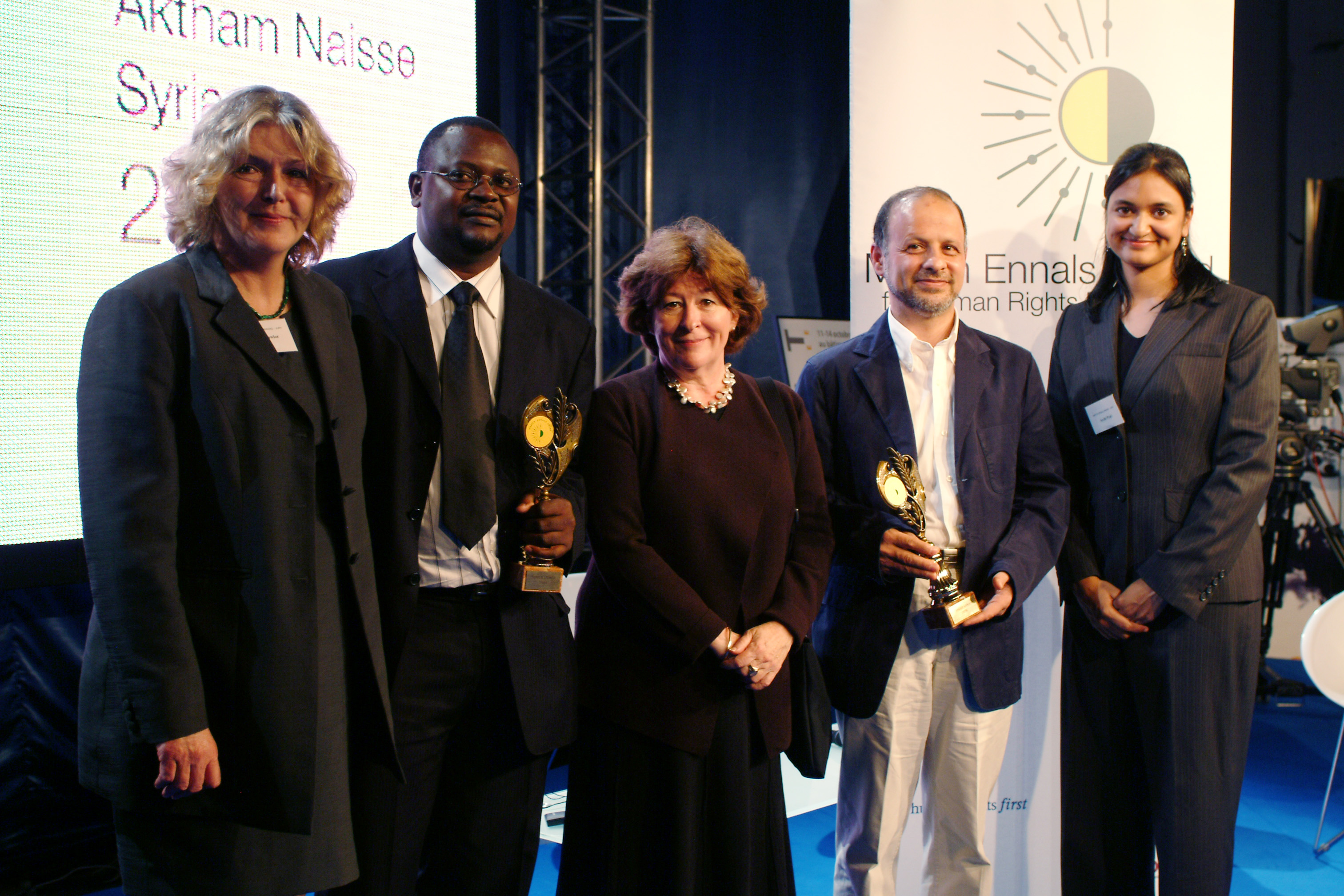
Ganji: Human rights in Iran improved, but still short of expectations

March 26, 2014


Remise du Prix Martin Ennals 2006

(Ganji – second from the right – at the MEA ceremony of 2006, where he received the award from UN High Commissioner Louise Arbour)

Al-Monitor of 25 March carries a lengthy interview with MEA Laureate Akbar Ganji in which Jahandad Memarian records many interesting insights, especially on the issue of sanctions and support to human rights defenders. The whole interview is certainly worth reading; here follow some long excerpts:

It is not an exaggeration to say that Akbar Ganji is the most celebrated dissident within the ranks of Iranian journalists since the inception of the Islamic Republic of Iran in 1979. A former supporter of the revolution, Ganji became disenchanted and turned into one of its most vocal critics. He is best known for his work as a journalist covering the 1998 murders of Iranian dissidents in Reformist newspapers, a series which came to be known as “the chain murders” that implicated top governmental officials. For his work revealing the murders of dissidents and attending a conference in Berlin that was condemned by hard-liners who were reeling after a Reformist victory in parliament, Ganji was arrested and served time in Tehran’s Evin Prison from 2001 to 2006. During his final year in prison, he went on a hunger strike that doctors urged him to end for concerns he would suffer permanent brain damage.

Ganji has won several international awards, including the World Association of Newspapers’ Golden Pen of Freedom Award, the Canadian Journalists for Free Expression’s International Press Freedom Award, the Martin Ennals Award for Human Rights Defenders and the Cato Institute Milton Friedman Prize for Advancing Liberty. In an exclusive interview via email with Al-Monitor, Ganji, based in New York, shared his thoughts about human rights and democracy in the context of President Hassan Rouhani’s administration.

Al-Monitor:  The UN secretary-general, Ban Ki-moon, has sharply criticized the Iranian president, Hassan Rouhani, saying, “He has not made any significant improvement” in ending human rights abuses since taking office. Nevertheless, Mahmoud Sadri — Iranian professor of sociology at the Federation of North Texas Area Universities — is optimistic about the new administration and has asked Iranian dissidents and intellectuals to take advantage of this historic opportunity. How do you evaluate the Rouhani administration?

Ganji:  The situation has improved from various aspects compared with the [Mahmoud] Ahmadinejad administration. However, it falls short of the expectations of democracy advocates and human rights activists. The Rouhani administration truly seeks to improve the state of human rights, but it has faced obstacles in Iran’s power hierarchy, including organizations that [Supreme Leader] Ayatollah [Ali] Khamenei oversees, such as the judiciary, law enforcement, etc., in addition to the Majles [parliament] that is controlled by the conservatives and some radical reactionaries.

…….Since his administration came to power, Rouhani has spoken with the supreme leader about freeing the Green Movement’s leaders (former Prime Minister Mir-Hossein Mousavi and former Majles speaker Mehdi Karoubi) and political prisoners, guaranteeing that nothing would happen, if they were freed.

Al-Monitor:  In January, you wrote a Huffington Post article titled “The Iran Nuclear Accord Is Good for Human Rights.” It seems to me whenever international pressure on the Iranian government increased, Iran improved its record. For example, Tehran released political prisoners ahead of Hassan Rouhani’s UN speech, including prominent human rights lawyer Nasrin Sotoudeh. Don’t you think such actions stem from international pressure? In the absence of this leverage — i.e., international pressure — Iran would continue human rights violations.

Ganji:  With regard to “external pressure on an undemocratic regime and improvement of human rights or increased oppression,” there is no law/rule that would address the cause-reaction relationships. At most, one can speak of “correlation.”[…] we need to know the following:

First, economic sanctions represent the collective punishment of a country’s people and do not necessarily lead to dictatorships’ downfall.

Second, long-term sanctions destroy the internal infrastructure of societies. ..Consequently, trust that is the basis of social capital is destroyed. Because of the sanctions, the oppressive regime’s increasing level of oppression, the internal destruction of society, is not visible. It is only in the aftermath of the dictatorship’s downfall that we will witness the visible spread of a wave of hatred, revenge and violence.

Third, in a life and death situation, the state of human rights, democracy and freedom completely falls by the wayside.

Fourth, consider Iraq’s example again. Before, the invasion al-Qaeda forces did not exist in Iraq, but they were born and bred as a result of the US sanctions and the US attack on Iraq. This story has been repeated in Libya and Syria. …..Iranian, US and European officials have professed that economic sanctions against Iran have affected Iran’s economy negatively. Last year, the economic growth rate fell to -5.8%. The inflation rate rose to 40%. The corruption rate climbed, and other negative outcomes followed. We should ask ourselves, what is the impact of recession on ordinary people’s lives?

The middle class, as a vehicle of democracy, has been transformed to the impoverished class, and its democratic movement may lose its agents. Democracy is the product of the balance of power between the government and civil society.

The transformation of the nuclear agreement from temporary to permanent, improvement of Iran’s relationship with Western governments, rekindling of ties between Iran and the United States, lifting of all the economic sanctions and alleviation of foreign threats can help empower the people through their mobilization and expansion of civil society. In that sense, the regime’s focus and its supporters will not be on discovering conspiracies of foreign governments and military attacks to destroy the regime. Let’s not forget that democracy and human rights have a direct relationship with economic development.

Al-Monitor:  You have opposed US aid to Iranian dissidents and human rights activists. What are your key criticisms against such aid? What actions should foreign countries.. take or avoid ?

Ganji:  The opposition that I have spoken about consists of groups and people that advocate regime change in Iran, so they can come to power. It is not possible for the leaders of a country to be indebted to other foreign governments, including the United States, Israel, Saudi Arabia, Russia and China. In that case, they will become the greater powers’ pawns. Look at the groups that have received financial aid from foreign governments in the past 35 years. What have they done? Do their terrorist and espionage activities constitute human rights activism, or are such activities considered criminal in all countries, including the United States and Israel, and are they strongly punished?

However, I support educational financial aid, including student scholarships and research fellowships for scholars. Just think about what would have happened if the $1.5 trillion that was spent on the wars in Afghanistan and Iraq would have been used toward education and development of the Middle East, and how that would have changed the region. Why do Western governments, the United States included, not grant scholarships to tens of thousands of talented and smart Iranian youth as students in social sciences?

Western governments should protest all human rights violations; they should give ethical and spiritual support to pro-democracy and human rights activists; they should file complaints at the UN Human Rights Council and ease the process of bringing perpetrators to justice. Moreover, Western powers should stop selling weapons of torture and oppression to dictatorial regimes. Ultimately, they should allocate financial resources to form independent labor unions and improve the state of human rights.

Ganji: Human rights improved, still short of expectations in Iran – Al-Monitor: the Pulse of the Middle East.

Read more:

https://thoolen.wordpress.com/tag/iran/

http://www.al-monitor.com/pulse/originals/2014/03/rouhani-reform-nuclear-iran-politics-student-human-rights.html#ixzz2x3K4G8RK

The EU and freedom of expression as seen by Index on Censorship

January 16, 2014

Index on Censorship is basing a series of articles on its larger report by Mike Harris, Time to Step Up: The EU and freedom of expression.

On 14 January 2014 came the one the ‘southern neighbourhood’ arguing that the credibility of the EU’s swing in focus from economic development towards human rights (after the outbreak of the Arab spring) is low.

The EU’s  communication “A partnership for democracy and shared prosperity with the southern Mediterranean“ (published on 8 May 2011) addresses the EU’s commitment to financially support transition to democracy and civil society and heralds the creation of the Civil Society Facility for the neighbourhood (covering both the southern and eastern neighbourhoods), while the European Instrument for Democracy and Human Rights (EIDHR) deployed a number of operations in the region to protect and promote freedom of expression, often without the consent of the host country. Still, the article argues, european countries are often still seen as former allies of repressive regimes.

http://www.indexoncensorship.org/2014/01/eu-freedom-expression-southern-neighbourhood/

The one of 15 January, entitled ‘The EU and free expression: Human rights dialogues’, looks at the situation that the EU runs 30 human rights dialogues across the globe, with the key dialogues taking place in China, Kazakhstan,  Kyrgyzstan, Tajikistan, Turkmenistan, Uzbekistan, Georgia and Belarus. It also has a dialogues with the African Union. The article is more detailed on China 

The article concludes: “With criticism of the effectiveness and openness of the dialogues, the EU should look again at how the dialogues fit into the overall strategy of the Union and its member states in the promotion of human rights with third countries and assess whether the dialogues can be improved.

The EU and free expression: Human rights dialogues – Index on Censorship | Index on Censorship.