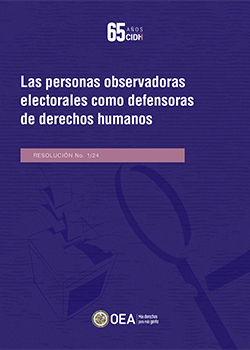
On 23 May 2024 the IACHR Press Office (cidh-prensa@oas.org) informed us that the Inter-American Commission on Human Rights (IACHR) has issued Resolution 01/2024, recognizing national and international election monitors as human rights defenders based on the intrinsic connection between respecting and protecting human rights and defending democracy.
The Commission highlights the important role of election monitors for the defense of democracy and the rule of law. Through their activities, electoral observers stand up for civil and political rights including the rights to freedom of association, assembly, expression, access to information, equality before the law, and non-discrimination, as well as for the rights to a fair trial and to judicial protection.
The activities of election monitors help to protect the rights held in Article XX of the American Declaration of the Rights and Duties of Man and in Article 23 of the American Convention on Human Rights, both of which mention the right to vote and to be elected by universal suffrage in periodic elections.
In the case of national observers, election monitoring is a form of political participation and a way of exercising political rights by looking after, defending, and fostering the principles that should prevail in election processes, including transparency, certainty, legality, fairness, and universal suffrage by secret ballot among a plurality of political options.
The actions of electoral observers ultimately seek to ensure the integrity of election processes and therefore to preserve expressions of citizens’ sovereign will, which is one of the main tenets of representative democracy according to inter-American and international instruments for the protection of human rights.
In its resolution, the Commission acknowledges the importance of electoral observation missions. The IACHR calls on States to enable suitable conditions for independent and impartial election monitoring and to ensure that election monitors can do their work freely, without retaliation of any kind, and enjoy protection from any risks they may face as a result of their efforts.
The New Indian Express of 22 March 2024 reports (based on Al Jazeera) that Prime Minister Narendra Modi government has approached a major Indian think tank to develop its own democracy ratings index that could help it counter recent downgrades in rankings issued by international groups that New Delhi fears could affect the country’s credit rating. The Observer Research Foundation (ORF), which works closely with the Indian government on multiple initiatives, is preparing the ratings framework,
On June 2023, The Guardian reported that the Indian government has been secretly working to keep its reputation as the “world’s largest democracy” alive after being called out by researchers for serious democratic backsliding under the nationalist rule of the Narendra Modi government, according to internal reports seen by The Guardian.
Despite publicly dismissing several global rankings that suggest the country is on a dangerous downward trajectory, officials from government ministries have been quietly assigned to monitor India’s performance, minutes from meetings show, The Guardian said. Al Jazeera revealed that the Observer Research Foundation (ORF), which works closely with the Indian government on multiple initiatives, is preparing the ratings framework. The new rankings system could be released soon, an official was quoted as saying.
Global human rights NGO Amnesty International has continued to highlight the erosion of civil rights and religious freedom under the Narendra Modi regime.
Similarly, Human Rights Watch has also continued to highlight the crackdown on civil society and media under the Modi government citing persecution of activists, journalists, protesters and critics on fabricated counterterrorism and hate speech laws. The vilification of Muslims and other minorities by some BJP leaders and police inaction against government supporters who commit violence are also among HRW’s concerns in India.
Notably, the ‘Democracy Index’, prepared by The Economist Group’s Economist Intelligence Unit, had downgraded India to a “flawed democracy” in its 2022 report due to the serious backsliding of democratic freedom under the Modi government.
On 5 February 2024, the Swedish Government adopted a new five-year strategy for development cooperation for human rights and freedoms, democracy and the rule of law. This strategy is an important part of the implementation of the Government’s new reform agenda for development assistance and contributes to free and inclusive democratic societies built on respect for human rights and freedoms.
Democracy, human rights and freedoms, and the rule of law are essential for freedom, security and the continued development of society. At the same time, we see storm clouds gathering. Democracy is in decline for the seventeenth consecutive year, which gives rise to increased oppression and conflicts. Russia’s full-scale invasion of Ukraine is a clear example of this.
Another is the way authoritarian states are undermining fundamental human rights and freedoms and using new digital technology for oppression and to spread disinformation.
“With this strategy, the Government is placing greater emphasis on the individuals around the world who fight for their freedom every day. We want to help those living under oppressive systems. Unfortunately, we see that democracy is headed in the wrong direction. That’s why Sweden has to do its part. We will do what we can to support the positive forces that exist,” says Minister for International Development Cooperation and Foreign Trade Johan Forssell.
The strategy outlines the Swedish Government’s increased focus on supporting defenders of human rights and democracy, free elections and independent journalism, in comparison with the previous strategy. The allocated budget for the strategy in 2024 is SEK 900 million. This budget is set out by the Government each year.
A new political space wanting to shape the future of Latin America was born in Mexico City on 1 November 2023. In an unprecedented meeting, more than 30 organisations, leaders and young people from Latin America gave life to the Free America Forum. A space to defend an agenda of Freedom and Democracy, as an alternative to the populism of the Puebla Group and the Sao Paulo Forum.
“Those of us who believe in the ideas of freedom and democracy are more and we are also better,” said Mexican Congresswoman Mariana Gómez del Campo, president of ODCA, when she opened the Free America Forum.
This group, together with political leaders from 18 Latin American countries, parliamentarians from Ukraine, Germany, the European Parliament, political representatives from the United States, civil society activists and human rights defenders, ratified their commitment to freedom and democracy.
The result of this first meeting was the signing of the Mexican declaration “For a Free America”, which alerts the world to authoritarianism and its consequences in the region, the need for respect for democratic principles such as free elections, the separation of powers, the need for independent justice, limits to the actions of those in power and respect for human rights.
As part of this declaration, the Free America Forum warns how the conditions of poverty and inequality have been “breeding grounds” for populist alternatives and how we must focus on “the integral development of the people”, guaranteeing a free and competitive economy. In the fight against organised crime, he called for the use of “the full force of the law and the rule of law”, rejecting “radically any negotiation and complicity with those who extort, steal, kidnap, murder and sow terror on the continent”.
In the face of human rights violations, they expressed their support and solidarity with the peoples of Cuba, Venezuela and Nicaragua as “sister nations that Bolivarian socialism has subjected to atrocious dictatorships and suffering”. The declaration also condemns the “unjustified aggression” of Vladimir Putin’s Russia against Ukraine.
This new space linking defenders of democracy around the world was created to counterbalance those who venerate and validate dictators and promote authoritarian narratives.
On 11 July 2023 EFE reported that Vietnam had released Vietnamese-Australian activist Chau Van Kham, sentenced in 2019 to 12 years in prison for extremism over his ties to the Viet Tan pro-democratic party.
Australian Prime Minister Anthony Albanese said he “very much welcomes the release of Chau,” in remarks Monday from Berlin, through Australian public broadcaster ABC.
Chau’s lawyer Dan Nguyen said in a statement through Amnesty International Australia that the activist, who returned Monday night to Australia, is with his wife and two sons. He also thanked the government’s, organizations and individuals’ efforts that fought for his release.
This was due to Chau, 73, being linked to pro-democratic group Viet Tan, considered an extremist entity in the country but a human rights organization in Australia.
Deputy Australian Prime Minister Richard Marles said Chau was released on “humanitarian” reasons and “in the spirit of friendship which exists between Australia and Vietnam,” according to ABC.
Chau is one of “more than 150 political activists in Vietnam who have been detained for peaceful acts in favor of freedom of expression,” Human Rights Watch Asia Human Rights Director Elaine Pearson said in a statement.
Pearson spoke of journalist Dang Dihn Bach and activists Mai Phan Loi, Dang Dinh Bach, and Hoang Thi Minh Hong among them and urged Australia to continue advocating for their release.
The exact number of political prisoners in Vietnam is unknown, as numbers provided by different human rights organizations have discrepancies.
While Human Rights Watch says the total exceeds 150, Amnesty International said there were 128 political prisoners in the country last year. Dissident organization Defend the Defenders raised the number to more than 250.
Zack Beauchamp in VOX of 28 July 2021 makes a strong but perhaps controversial plea that “In the fight for democracy’s future, Indian and American politics is more important than anything China is doing“:
Donald Trump and Narendra Modi.
One of the emerging tenets of the Biden presidency is that the United States and China are locked in ideological conflict over the fate of democracy.
In March, during his first press conference as president, he declared that “this is a battle between the utility of democracies in the 21st century and autocracies.” In April, during his first address to a joint session of Congress, he labeled this struggle “the central challenge of the age” — and that China’s Xi Jinping is “deadly earnest about becoming the most significant, consequential nation in the world.”
More recently, in last week’s CNN town hall, he warned that Xi “truly believes that the 21st century will be determined by oligarchs, [that] democracies cannot function in the 21st century. The argument is, because things are moving so rapidly, so, so rapidly that you can’t pull together a nation that is divided to get a consensus on acting quickly.”
Inasmuch as there is a Biden doctrine, the notion that the US needs to protect democracy from China’s authoritarian model is at the center of it. “Biden’s administration [is] framing the contest as a confrontation of values, with America and its democratic allies standing against the model of authoritarian repression that China seeks to impose on the rest of the world,” Yaroslav Trofimov writes in the Wall Street Journal.
Biden’s thinking captures an important insight: that the struggle over democracy’s fate will be one of the defining conflicts of the 21st century. But his analysis is crucially flawed in one respect: China is not an especially important reason why democracy is currently under threat — and centering it is not only wrong, but potentially dangerous.
In countries where democracy is at real risk of collapse or even outright defeated — places like India, Brazil, Hungary, Israel, and, yes, the United States — the real drivers of democratic collapse are domestic. Far-right parties are taking advantage of ethno-religious divides and public distrust in the political establishment to win electorally — and then twist the rules to entrench their own hold on power. Leaders of these factions, like former US President Donald Trump and Indian Prime Minister Narendra Modi, aid and abet each other’s anti-democratic politics.
More traditional authoritarian states, even powerful ones like China or Russia, have thus far played at best marginal roles in this struggle.
“Much of the recent global democratic backsliding has little to do with China,” Thomas Carothers and Frances Brown, two leading experts on democracy, write in a recent Foreign Affairs essay. “An overriding focus on countering China and Russia risks crowding out policies to address the many other factors fueling democracy’s global decline.”
This misdiagnosis has real policy stakes. Leaning into competition with China could lead the US to excuse anti-democratic behavior by important partners, like Modi or the Philippines’ Rodrigo Duterte, in a manner reminiscent of US relations with anti-communist dictators during the Cold War. Moreover, too much emphasis on competition with China could distract from the place where Biden has the most power to affect democracy’s fate — the home front, an area in which voting rights advocates increasingly see him as indefensibly complacent.
There are real problems associated with China’s rise. Its increasing military belligerence, predatory economic practices, and horrific human rights abuses in places like Xinjiang are all very serious concerns. But the fact that China is the source of many real issues doesn’t mean it’s the source of democratic erosion worldwide — and positioning it as such will do little to advance the democratic cause.
Democracies are rotting from within, not without
In his public rhetoric, Biden often argues that the US needs to prove that democracy “works” — that it can “get something done,” as he said last week — in order to outcompete the Chinese model.
While he hasn’t spelled out the nature of this competition all that precisely, the concern seems to center on Chinese policy success: that its rapid economic growth and authoritarian ability to make swift policy changes will inspire political copycats unless democracies prove that they can also deliver real benefits for their citizens.
“I believe we are in the midst of an historic and fundamental debate about the future direction of our world,” the president wrote in a March letter outlining his national security strategy. “There are those who argue that, given all the challenges we face, autocracy is the best way forward. And there are those who understand that democracy is essential to meeting all the challenges of our changing world.”
But at this point, the fear of Chinese political competition is mostly hypothetical. While the Chinese government and state media frequently tout the superiority of its political model to American-style democracy, there’s little evidence that these efforts are all that influential globally — and certainly not in the countries where democracy is most at risk.
A look back at the Soviet Union, the last major challenge to the hegemony of liberal democracy, is telling. ln ideological terms, there’s no comparison: Soviet communism was a far more powerful model than Chinese authoritarian state capitalism is today.
Xi Jinping.
Marxist ideals inspired revolutionary Communist movements and governments around the globe, successfully toppling Western-backed governments in countries ranging from Cuba to Vietnam to China itself. By contrast, there are vanishingly few foreign governments or even political parties today openly vowing to emulate modern China. While the Soviets had the Iron Curtain in Europe, modern China’s most notable client state is North Korea — perhaps the most isolated and mistrusted government on the planet.
In the countries that observers worry most about — established democratic states experiencing “backsliding” toward authoritarianism — Chinese influence is minimal at best.
In backsliding democracies, authoritarian-inclined leaders win and hold power through the electoral system for domestic reasons. Corruption scandals in India and Hungary, violent crime in the Philippines, a racist backlash against America’s first Black president: These are some of the key factors in the rise of authoritarian populists, and they weren’t created or even significantly promoted by China.
Elected authoritarians still bill themselves as defenders of democracy while in power — even after they start undermining the electoral system with tactics like extreme gerrymandering and takeovers of state election agencies. Their political appeal isn’t grounded in an overt rejection of democracy in favor of a Chinese model, but rather a claim to be taking democracy back from corrupt elites in the name of the “true” people, typically defined in ethno-nationalist terms.
The ideology driving modern democratic decline is vastly different from the sort that China promotes at home and through official state media. It represents a home-grown challenge inside the democratic world, rather than an externally stoked, Cold War-style threat.
That’s not to say China does nothing to undermine democracy outside its borders. It has, for example, exported surveillance technology and provided training in “cybersecurity” for foreign officials that amount to teaching them tools for controlling public opinion — underscoring its role as a global pioneer in using technology to repress dissent.
Yet even in this area, China’s influence can easily be overstated. Backsliding countries typically do not ban websites outright or arrest online dissidents in the way China does. Instead, they rely on spreading misinformation and other more subtle uses of state power. When they do use more traditional authoritarian tools, they often don’t need China’s help in doing so — as shown by recent reporting on Israel’s NSO Group, a company with close links to the Israeli state that sold spy software to India and Hungary (whose governments allegedly used it to surveil journalists and opposition figures).
In his recent book The Rise of Digital Repression, Carnegie Endowment scholar Steven Feldstein attempts to systematically document the use of digital tools and tactics for undermining democracy around the world. He found that while such practices were indeed becoming more widespread, this is largely due to domestic factors in authoritarian and backsliding countries rather than Chinese influence.
“China really wasn’t pushing this technology any more so than other countries were pushing advanced technology or censorship technologies,” he told me in an interview earlier this year. “What I saw — when I spoke on the ground to intelligence officials, government officials, and others — was that there were many other factors at play that were much more determinative in terms of whether they would choose to purchase a surveillance system or use it than just the fact that China was trying to market it.”
The problem with blaming China for democracy’s crisis
Biden and his team recognize that many of the challenges to democracy have domestic roots. But in casting the rise of anti-democratic populism as part of a grander ideological struggle against an authoritarian Chinese model, they conflate two distinct phenomena — and risk making some significant policy errors.
Again, an analogy to the Cold War is helpful here. One of the most grievous errors of America’s containment policy was its repeated willingness to align itself with anti-communist dictators. The perceived need to stop the expansion of Soviet influence consistently trumped America’s commitment to democracy — with horrific consequences for the people of Iran, Argentina, Indonesia, and Bangladesh (to name just a handful of examples from a very long list).
The more China is treated like the new Soviet Union — the principal ideological threat to democracy whose influence must be curtailed — the more likely the US is to repeat that mistake.
Take India, for example. In the past six months, Biden has courted Modi’s government as a potential counterweight to China. “There are few relationships in the world that are more vital than one between the U.S. and India. We are the world’s two leading democracies,” Secretary of State Antony Blinken said in a July 28 press conference in New Delhi.
“There has long been a bipartisan consensus in Washington that India is a critical ally in its attempt to check Chinese influence in Asia,” the Indian intellectual Pankaj Mishra wrote in a June Bloomberg column. “In overlooking the Modi government’s excesses, Biden probably counts on support from a US foreign policy establishment invested more in realpolitik than human rights.”
If you take the notion that democracy’s crisis is emerging from within seriously, then it follows that very best thing that Biden could do for democracy’s global future has nothing to do with China or even foreign policy. It’s arresting creeping authoritarianism at home.
Cliff Albright, co-founder of Black Voters Matter, and Rep. Hank Johnson (D-GA) are arrested during a protest to support voting rights outside of Hart Senate Office Building on Thursday, July 22, 2021.
Biden has acknowledged this at times, writing in his March letter that his global strategy “begins with the revitalization of our most fundamental advantage: our democracy.” And yet that urgency hasn’t translated into action — legislation necessary to safeguard American democracy from the GOP’s increasingly anti-democratic politics appears stalled out. Biden, for his part, has refused to publicly endorse more aggressive action to break the logjam — like abolishing the filibuster for voting rights bills.
The New York Times recently reported that “in private calls with voting rights groups and civil rights leaders, White House officials and close allies of the president have expressed confidence that it is possible to ‘out-organize voter suppression’” — an implausible claim that reflects an administration that, according to activists, has “largely accepted the Republican restrictions as baked in and is now dedicating more of its effort to juicing Democratic turnout.”
Shoring up American democracy after the recent attacks it has suffered should be the top priority of any US government concerned with democracy’s global fate. But for all of Biden’s lofty language about out-competing China and winning the future for democracy, there’s a striking lack of urgency when it comes to the perhaps the most important backsliding country — his own.
In this sense, China has very little influence over the future of democracy globally. The key battles are happening not in the South China Sea or the Taiwan Strait, but in the legislatures of New Delhi and Washington. If there really is to be a grand struggle for democracy’s survival in the 21st century, it needs to start there.
On July 21, 2021, Project Syndicate 2020 published his piece called” The Fight for Open Societies Begins Again”:
Democracy is back on policymakers’ minds. US President Joe Biden plans to host a summit on the theme, and invitations to a host of events on democracy and human rights fill my inbox.
This renewed focus is not good news. Rather, it reflects the erosion of both democracy and respect for human rights in recent years.
Freedom House reports that less than 20% of the world’s population now live in what it categorizes as fully free societies, the lowest share in more than a quarter-century. Many countries are drifting steadily toward authoritarianism.
Freedom is in trouble for well-known reasons. In many countries, increasing inequality and marginalization of different groups has fueled an embrace of right-wing (and in some cases left-wing) authoritarianism.
As the world grapples with rapid technological change and economic restructuring, many are far from convinced that democracies have the edge in terms of adaptation and forward-looking policymaking. The pandemic – which many democracies mishandled – deepened these doubts.
These are difficult times for those of us who profoundly believe that the absolute, non-negotiable basis of good government is a free, democratically empowered citizenry protected equally under law.
In 1980s Eastern Europe, the problem was sclerotic, aging communist governments that could no longer deliver for their people. Today’s situation is more complicated.
I am president of the largest private philanthropy in this domain. If we are honest with ourselves, we know that our traditional models of advancing democratic values and institutions are struggling.
The Open Society Foundations (OSF) was founded in the 1980s on the assumption that there was an urgent global public demand for freedom, and that a growing number of governments around the world were embracing its rules and norms.
That allowed us (in partnership with local activists) to use a mixture of shaming and encouragement to persuade governments to adopt and respect human-rights laws and democratic procedures.
Whether our work concerned the Roma in Central and Eastern Europe, LGBTQI communities in Africa, ethnic minorities in South and East Asia, women’s rights in Latin America, or worldwide migrant and refugee protection, it seemed that we were pursuing a historic mission. And one day, that pursuit might lead to all individuals enjoying full and equal rights and opportunities.
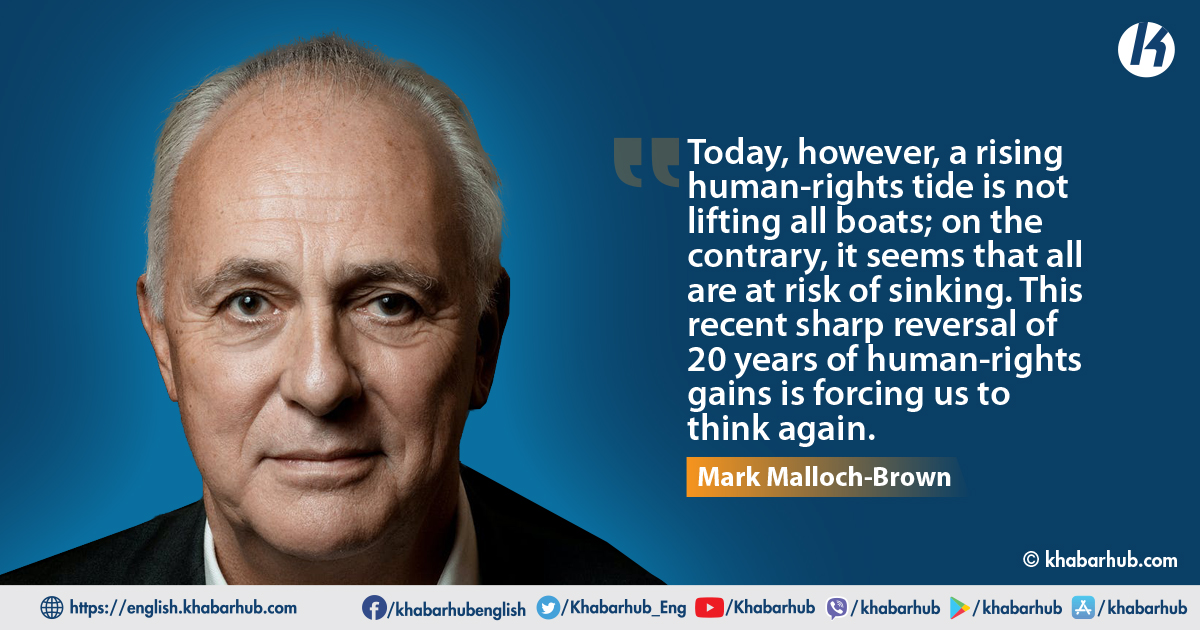
Today, however, a rising human-rights tide is not lifting all boats; on the contrary, it seems that all are at risk of sinking. This recent sharp reversal of 20 years of human-rights gains is forcing us to think again.
As a foundation chaired to this day by its founder, George Soros – a survivor of Nazism and a refugee from communism in his native Hungary – we will not move on to less challenging issues.
After all, Soros started the foundation when prospects for human-rights advances looked as difficult as they do today.
Presidents stole additional terms, official corruption surged, and agreements between states brushed aside people’s rights. Nowadays, human-rights defenders and those who support them are not welcome in much of the world.
So, the mission is non-negotiable. But we must revisit our approach. We must ask how to recover public support for democratic and human-rights norms, while also identifying more clearly the enemies of open societies and what will lead them, even grudgingly, to respect their obligations again.
In 1980s Eastern Europe, the problem was sclerotic, aging communist governments that could no longer deliver for their people. Today’s situation is more complicated.
True, a bipolar world again threatens freedom. Biden’s forthcoming Summit for Democracy is in part an effort to rally like-minded governments but also the wider world against Chinese President Xi Jinping’s authoritarianism. That may mean democracies have some uncomfortable bedfellows as pragmatism risks trumping values.
A dense web of trade, investment, education, and technology links mean China is tied to the West, and vice versa, in ways that the Soviet Union never was.
A relationship that is more economic than military gives democracies an array of options – from governmental and consumer boycotts to a more coherent international containment and engagement strategy – for pressing Xi’s regime to accept norms of good behavior at home and abroad.
Leaders on both sides will frame this contest primarily in terms of economics, but human rights can also be a big winner – or a big loser.
Soros has always called OSF’s work “political philanthropy.” What he means is that we need to engage with the wider dynamics of change and find entry points to champion our issues.
Whereas strong states were the sole or leading human-rights violators during the Cold War, today’s world is one of multidimensional human-rights menaces. Inequalities exacerbated by unregulated transnational financial and corporate power, together with dramatic shifts in individual states’ fortunes, are creating an ever more challenging landscape. The world is becoming more unequal – and angrier.
Many view the renewed attention to deep-seated institutional racism in the United States and around the world – and the recognition that marginalization based on race, gender, religion, and class is often mutually reinforcing – as exposing the limits of a human-rights agenda.
That anger is amplified (and fueled) by social-media platforms where polarization, abuse, and lies undermine trust in institutions. A technology that many saw just a few years ago as an enabler of citizens’ rights has become in many cases a tool for manipulating minds and closing societies.
The insidious copycat behavior that Donald Trump’s four-year presidency allowed and encouraged in regimes around the world accelerated a crisis of respect for the rule of law and human rights.
Presidents stole additional terms, official corruption surged, and agreements between states brushed aside people’s rights. Nowadays, human-rights defenders and those who support them are not welcome in much of the world.
Yet malign governments and globalization, with its unintended financial and corporate consequences, are only half the problem.
Many view the renewed attention to deep-seated institutional racism in the United States and around the world – and the recognition that marginalization based on race, gender, religion, and class is often mutually reinforcing – as exposing the limits of a human-rights agenda. Human-rights remedies, victims argue, have scratched the surface, not reached the roots.
Human-rights work needs to become more political: tougher and smarter in its attacks on oppressors, and clearer about being on the side of the oppressed.
We need to address the challenges people actually face, looking beyond narrow political rights to address the deeper causes of economic and social exclusion.
In 6 August, 2020 HRF’s President sent a letter to the American hip hop artist Tyga pointing out that his performance is part of a plan to distract from the electoral fraud in the imminent election and prevent protesters from gathering at opposition rallies. The concert is organized and funded by the Belarusian dictatorship, led by Alexander Lukashenko. Under this regime, there is no freedom of speech, no freedom of assembly, and no freedom of association.
“This performance, scheduled for the day before Belarus’ elections, is no coincidence. It is an excuse to cancel the opposition’s final electoral rally, and prevent ordinary Belarusians from showing their support for freedom and democracy,” said HRF president Thor Halvorssen. “It is also a deliberate attempt to turn attention away from the massive electoral fraud that is already taking place across the country.” Belarus’ elections, which haven’t been free or fair since 1994, have been met with extreme repression. As HRF recounted in its letter to the performer: “Protestors are grabbed off the street at random, and many are beaten bloody. The two most popular candidates in the upcoming presidential election, Viktor Babryka and Sergei Tikhanouvsky, were both arrested on trumped up charges. Many opposition activists have had to flee the country, along with their children, after receiving threats from the government.” “Tyga has been an outspoken advocate of the Black Lives Matter movement. He has urged followers to vote in local elections and take to the streets in protest. His support for Lukashenko’s regime will greatly undermine the activism he has encouraged in the United States,and provide the Belarusian dictator a useful propaganda stunt,” said Halvorssen. “We hope he will stand on the side of the people of Belarus as opposed to their oppressor. He must decline the invitation to perform for the dictator.” HRF requested that Tyga cancel his concert and use this media opportunity to send an urgent and categorical message of encouraging support to protestors in Belarus.
Sweden’s Ambassador to Cambodia Bjorn Haggmark (left) meets with Kem Sokha, leader of the dissolved main opposition CNRP, at Sokha’s home, in this photograph posted to Sokha’s Facebook page on May 19, 2020.
On 13 June 2020 this newspaper reported that Sweden said it would phase out bilateral development funding to Cambodia by the middle of next year in order to focus aid on promoting human rights, democracy and rule of law in the country following severe rights restrictions in recent years.
In a press statement on Friday, the Swedish Embassy in Phnom Penh said its government decided on Thursday to shift its funding away from bilateral aid to the Cambodian government and toward programs that aim to develop democracy in the Asia Pacific region, which would also aid Cambodia.
The statement said Sweden would still support civil society, human rights defenders and democracy advocates in Cambodia, though it did not clarify which organizations may qualify for assistance.
Courtesy of Reliefweb of 15 Jun 2020, here the introduction to the EU’s annual report on human rights
1. INTRODUCTION
The 2019 EU annual report on human rights and democracy in the world marks the final phase of implementation of the EU Action Plan on Human Rights and Democracy (2015-2019) 1 . It presents the progress achieved to date, by means of a comprehensive set of actions taken by the European External Action Service (EEAS), the European Commission and EU delegations and offices around the world. In 2019, the EU demonstrated once again that it is a reliable, cooperative and principled global player, working for a better world where all human rights are fully protected and respected.
However, in many parts of the world, challenges remain. Human rights defenders (HRDs), journalists and media workers are under threat and attack because of their daily work, civic and democratic space continues to be restricted, women’s and girls’ human rights are being violated, and vulnerable groups are often left behind and exposed to further discrimination and inequality.
Against this background, the international community celebrated in 2019 the 10th anniversary of the Charter of Fundamental Rights, the 30th anniversary of the UN Convention on the Rights of the Child, the 70th anniversary of the Council of Europe and the 100th anniversary of the International Labour Organisation. These anniversaries gave great impetus to the EU’s continuous efforts to translate its legal and policy frameworks on human rights into reality. The EU worked with all partners to turn challenges into opportunities for all human beings, at any time, in any place.
The 21st EU-NGO Forum on Human Rights, held in Brussels on 3-4 December, put the human rights and environment nexus in the spotlight as an emerging challenge and gained unprecedented traction. On 9 December 2019, the Foreign Affairs Council agreed on the political appropriateness of establishing an EU global human rights sanctions regime to tackle serious human rights violations worldwide committed by state and non-state actors.
In 2019, the first ever EU guidelines focusing on economic, social and cultural rights were adopted: the EU Human Rights Guidelines on safe drinking water and sanitation. These guidelines opened new horizons in promoting the indivisibility of civil, political, economic, social and cultural rights. The Council also adopted Guidelines on non-discrimination in external action and revised Guidelines on EU policy towards third countries on torture and other cruel, inhuman or degrading treatment or punishment. Moreover, the Council conclusions on Democracy adopted in October provided a comprehensive framework to advance democratic governance.
This report focuses on thematic issues, using a number of country-specific examples, and aims to be a practical tool for all stakeholders. Reporting on human rights and democracy at country level can be found on the EEAS2 and EU delegations’ webpages.


/cdn.vox-cdn.com/uploads/chorus_image/image/69645731/1203088503.0.jpg)
:no_upscale()/cdn.vox-cdn.com/uploads/chorus_asset/file/22746048/1233728428.jpg)
:no_upscale()/cdn.vox-cdn.com/uploads/chorus_asset/file/22746057/1234113822.jpg)


 Hans Thoolen on Human Rights Defenders and their awards