On 4 November 2026 Amnesty International’s Write for Rights letter-writing kit was published. Here you will find everything you need to successfully take part in the Write for Rights 2026 campaign. Write for Rights changes lives and your words matter.
The people featured in this year’s campaign are from all around the world, like Owen Chow jailed in Hong Kong simply for standing up for democracy, and Rokiatou Doumbia in Mali, detained for daring to ask why food was too expensive on TikTok.
A letter can change someone’s life. That’s the idea behind Write for Rights, our global letter-writing campaign. In 2001, a small group of activists in Poland decided to run a 24-hour letter-writing marathon for 10 December – Human Rights Day. The idea took off and this year marks the 25th anniversary of people taking over 50 million actions against injustice, writing letters and signing petitions in support of people whose human rights have been denied.[https://humanrightsdefenders.blog/2026/10/24/write-for-rights-campaign-turns-25-here-7-successes/]
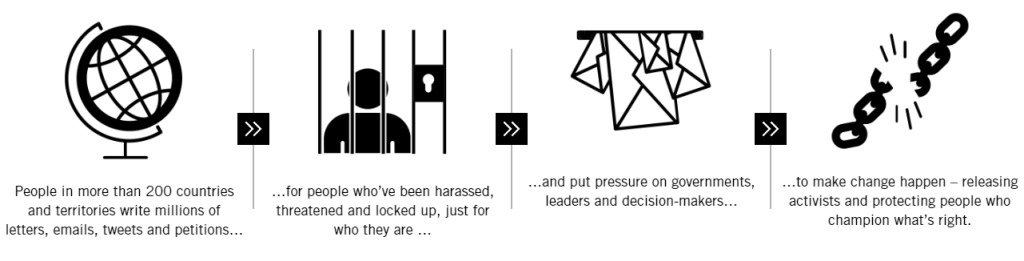
How does Write for Rights work?
2026 Cases
Right now, all around the world, human rights are under attack. This year we’re taking action for individuals and communities from around the world, who are courageously speaking truth to power.
You can check out videos of all the cases here.
For all the cases, in one printable PDF, see our Helpful Resources

TUNISIA: Ayachi Hammami is a Tunisian human rights lawyer imprisoned after a sham terrorism related trial linked to his defence of judges, lawyers, journalists, activists and opposition figures. Ayachi has spent decades fighting for justice and human rights in the country. His imprisonment reflects Tunisia’s growing crackdown on peaceful dissent and misuse of the justice system to silence critics.

RUSSIA: Daria Egereva is an Indigenous rights defender from Russia facing up to 20 years in prison for peaceful activism. A climate justice advocate and proud member of the Selkup People, she has dedicated her life to protecting Indigenous lands, languages and cultures. Despite threats and detention, Daria has remained courageous and committed to defending the rights of her people.[https://humanrightsdefenders.blog/2026/11/02/portraits-break-the-silence-over-the-cost-of-defending-nature/]

TANZANIA: Former ambassador Humphrey Polepole was abducted at his home in Dar es Salaam on 6 October 2025. He has not been seen since. Humphrey appears to have been targeted because of his criticism of the president and ruling party for restrictions on civic space, crackdowns on human rights, and attacks on opposition members. His family miss him dearly, and need answers.

PAKISTAN: Human rights lawyers and married couple Imaan Mazari-Hazir (right) and Hadi Ali Chatth (left) have dedicated their careers to representing victims of state oppression, despite threats and harassment by the authorities. In January 2026, they were given long prison sentences for their posts on sochttps://humanrightsdefenders.blog/2026/01/27/human-rights-lawyers-couple-imaan-mazari-and-hadi-ali-chattha-sentenced-to-jail-in-pakistan/ial media expressing solidarity with Baloch and Pashtun activists and criticizing the Pakistan military.

EGYPT: Marwa Arafa is an Egyptian human rights activist arbitrarily detained for over six years because of her peaceful activism supporting detained children and their families. Arrested in front of her young daughter, she faces unfounded terrorism-related charges which can carry life imprisonment. Her case is part of a wider effort to silence peaceful dissent in Egypt.

HONG KONG: Owen Chow joined his first pro-democracy protest at just 15 years old. He later became one of the “HK47” – a group of activists and politicians prosecuted under Hong Kong’s draconian National Security Law for their political participation.
Owen should be doing the things he loves like photography, hiking and travelling. Instead, he faces more than 12 years in prison for hoping to serve the underprivileged and build a fairer society.

MALI: Rokiatou Doumbia is a businesswoman, activist and social media influencer from Mali who remains in detention after criticizing rising living costs and the failures of Mali’s military authorities during a TikTok livestream. A mother of two and a supporter of women in her community, she has dedicated her life to helping others. Instead of being protected for speaking out, she became a target.

EL SALVADOR: Ruth López is a lawyer and human rights defender who spent years speaking out against corruption and injustices in El Salvador.In May 2025, Ruth was arrested at her home and locked up. One year later she is still in detention, without regular access to her family or lawyer. Her story is an example of the criminal legal system being used as a weapon to silence critical voices.https://humanrightsdefenders.blog/2026/05/19/alarm-over-yearlong-detention-of-woman-human-rights-defender-ruth-lopez-in-el-salvador/
Rainbow case
Alongside the cases, above, Amnesty International Australia has included another action that we think will be of interest to people taking part in Write for Rights 2026, wanting to take powerful written actions for human rights and justice.

TÜRKIYE: Over 100 LGBTI Rights Defenders, including board and oversight committee members of Türkiye’s foremost LGBTI rights organization KAOS GL, Janset Kalan, Nedime Erdoğan, Umut Derin and Selin Berghan, and journalist, Tuğba Tekerek, have been detained in a wave of police operations targeting Türkiye’s LGBTI people, organizations, and allies since 12 September 2026.
https://www.amnesty.org.au/write-for-rights-2026-activist-toolkit


