Neil Giardino for ABC News reports on the passing of Santiago Manuin, one of the most celebrated defenders of Peru’s Amazon rainforest and the leader of the Awajún tribe, whose vast and besieged territory spans the country’s mountainous northern region along the Ecuador border. He died on Wednesday of COVID-19 at the age of 63.
Manuin devoted his life to defending his tribe and their ancestral land, which in recent decades had endured illegal gold mining and logging, persistent threats linked to narco-trafficking and state-sanctioned oil and gas operations….
In 2009, Manuin nearly died defending Awajún territory after he was shot eight times by Peruvian security forces. The incident, referred to as “the Bagua Massacre,” occurred when police fired on thousands of Awajún and Wampis tribespeople who were blocking a jungle highway to protest a U.S.-Peru trade agreement that would’ve opened up land in the Amazon for gas, oil and lumber extraction. More than 30, both officers and natives, died in the clash.
“For the Westerner, the Indigenous person is an impediment to development because we refuse to destroy the land. That’s why they label us anti-development,” he said. “Indigenous peoples are not anti-development. We protect the forest and live for the forest. Our spirituality is tied to it. We don’t need to go to the largest churches to pray. We pray within this natural world. We live in this plenitude.”..
In 1994, Manuin won the international Reina Sofia Prize for his defense of the Amazon, and in 2014 he was awarded Peru’s National Prize for Human Rights for a life lived in service of Indigenous peoples and the rainforest..
In “Media oppression is a shifting landscape” by Sevanti Ninan (a media commentator and founder-editor of TheHoot.org) published on 29 June 2020 in the Indian Telegraph you wil find a good analysis of the problems of news gathering in the current situation. It is about India but the analysis would be valid for many countries.
Arms of the government see journalism (of all kinds) not as a useful source of feedback at a time when the population is in distress but as a nuisance to be squashed. Fake news is no longer seen only as an electronic menace but as reporting with malign intent, whether in Kashmir or elsewhere. Pexels
For some years now, the growing challenge to journalism has come from the increasing use of predictable laws (think of sedition and criminal defamation in the Indian Penal Code)….but media oppression is a shifting landscape. Tracking its changing features is just the first challenge. While the onset of Covid-19 has led to the government putting hitherto under-used laws to work, such as the Disaster Management Act and the Epidemic Diseases Act, these have been used in tandem with Sections of the IPC to criminalize reporting of the government’s response to the pandemic as well of the outcomes of its handling, such as the migrant exodus. Panicky administrations across the country have, so far, used no less than 14 Sections of the IPC and Sections of the IT Act (including the one that was struck down), the DMA, the Unlawful Activities (Prevention) Act, the Motor Vehicles Act and the provisions of Scheduled Castes and Tribes (Prevention of Atrocities) Act to issue showcause notices, lodge first information reports against reporters and arrest, confine and torture them.
If newsgathering is being criminalized in some parts of the country, it is being policed in Jammu and Kashmir… it has been gifted a 50-page media policy, which makes the government the arbiter of fake news and mandates background checks of media owners and editors if they are to receive government advertising. Charming! Who knows what will follow elsewhere in the country.
Overall then, a convergence of factors is at work. Arms of the government see journalism (of all kinds) not as a useful source of feedback at a time when the population is in distress but as a nuisance to be squashed. …
Electronically disseminated fake news, until now, was in the domain of technology. But when the charge is levelled at reporting on the ground in far-flung areas of the country, it enters the domain of physical fact-finding. Busting fake news with internet tools is one thing. Doing it for field reporting is quite another.…..
..What support structures can be put in place? The country has a Press Council, a Human Rights Commission and numerous courts. But it needs a growing network of human rights defenders, a galvanizing force created by an alliance of journalist organizations, concerned lawyers and civil society stalwarts to map a strategy for this canvas. The Press Council is selective in what it takes note of; one must also ask whether its censure changes anything on the ground.
So far, the response to a sustained assault on journalism has been statements issued by media bodies themselves. But journalists need allies at a time like this; solidarity within their own ranks is not enough to put pressure on the oppressors. Just as civil society has come together to keep alive a human rights campaign for the release of Gautam Navlakha, Sudha Bhardwaj and others in the Bhima Koregaon case, journalists, particularly the embattled, invisible ones the districts, now need ballast in their fight to keep up the pressure.
Precedents will be set if the misuse of laws goes unchallenged. District magistrates across states labelling reporting as fake news will be further emboldened without a pushback.
Coronavirus “information heroes” – journalism that saves lives
On 15 June t2020 he NGO Reporters Without Borders (RSF) published a list of 30 coronavirus “information heroes” – 30 journalists, whistleblowers and media outlets whose courage, perseverance or capacity to innovate has helped to circulate reliable and vital information during the Covid-19 pandemic. See the list
Every crisis produces its heroes. Around the world there are journalists, whistleblowers and media outlets that have managed to overcome the barriers to information created since the start of the pandemic. Through their reporting or by means of initiatives that have needed courage, audacity and determination, they have provided access to trustworthy and quality information, helped to resist censorship, and combatted the runaway disinformation that threatens public health.
“Some people have taken such big risks to report the reality of the pandemic that they have died as a result, while others have disappeared or have been jailed,” RSF secretary-general Christophe Deloire said. “Prosecuted, attacked, insulted – many have paid a high price for defending the right to information and for combatting the rumours and disinformation that aggravate the consequences of this public health crisis. These new heroes remind us that journalism can save lives. They deserve our attention and admiration.”…
The list compiled by RSF, which is not intended to be exhaustive, includes both well-known media figures and people the public have not heard of. Although they come from all five main continents, nearly a third of these 30 heroes are from Asia, where the pandemic originated. Six are from Europe and Central Asia, and the others are from Africa, the Americas and the Middle East.
What most of these heroes have in common is the fact that they revealed information highlighting the pandemic’s gravity or their government’s mismanagement of the crisis. Some are veteran reporters like Ana Lalić in Serbia or combative investigators like Blaž Zgaga in Slovenia, Andjouza Abouheir in Comoros and Sergei Satsukin Belarus. However, others are ordinary citizens who, in response to the urgency and gravity of the public health crisis, decided to blow the whistle with the aim of saving as many lives a possible. It was an eye doctor, Li Wenliang, who first alerted the world to the existence of a fast-spreading disease in December 2019. And it was a lawyer, Chen Qiushi, who posted videos on his blog revealing the chaos in the hospitals in Wuhan, the site of the initial Covid-19 outbreak. Li died of the virus while Chen was forcibly quarantined and never reappeared.
You often pay dearly for the truth. In Venezuela, freelance journalist Darvinson Rojas spent 12 days in prison for a tweet questioning official pandemic figures. In India, newspaper reporter Vijay Vineet is facing a possible six-month jail sentence for reporting that lockdown restrictions forced hungry kids to eat cattle fodder. In Bangladesh, the well-known cartoonist Ahmed Kabir Kishore is facing a possible life sentence for posting cartoons on Facebook about politics during the Covid-19 crisis that alluded, inter alia, to corruption.
Others have avoided prison but can no longer work. After a lengthy and violent police interrogation over an article questioning the Kingdom of Eswatini’s handling of the Covid-19 crisis, Swati Newsweek website editor Eugene Dube had to flee to neighbouring South Africa. Chris Buckley, a Beijing-based reporter for the New York Times, was forced to leave China after spending 76 days in Wuhan at the height of the outbreak. For the first time in 24 years, his visa was not renewed.
Many of these heroes displayed courage in resisting pressure and censorship. They include Caixin, an independent English and Chinese-language media outlet in Beijing whose reporting has questioned the Chinese government’s narrative. For some, such as Afghan reporter Anisseh Shahid, it took courage to simply keep reporting in the field with the threat of infection compounding the threat of a Taliban attack. In the United States, several White House correspondents have distinguished themselves by their perseverance in adversity. Despite constant attacks by President Trump and his aides, they continue week after week to question his handling of the pandemic.
This exceptional crisis has also produced innovative initiatives that have helped to get the facts out and combat disinformation. In Africa, the Ivorian web radio WA FM and the Togolese news site TogoCheck were created to combat rumours and fake news and disseminate trustworthy information that the public can use to protect themselves and their health. In Brazil, alternative media outlets pooled resources to form a “Gabinete de crise” to inform the abandoned inhabitants of Rio de Janeiro’s favelas, while the Wayuri Network’s journalists have risen to the challenge of informing more than 750 indigenous communities in the Amazon. In Russia, 25 media outlets formed Syndicate-100 to make it easier for medical personnel, who have been hit hard by the epidemic, to report problems and alert the public.
Finally, RSF pays a special tribute to journalists in Guayaquil, Ecuador’s business capital and the site of Latin America’s biggest Covid-19 outbreak. The photos of bodies in Guayaquil’s streets have gone around the world. Despite being unprepared and lacking personal protective equipment, the city’s journalists have continued to work and to report in locations with a high infection rate. And this has taken a heavy toll. Thirteen of them have died of the virus.
The statement addresses several issues, including:
the right to health;
the rise of stigma and discrimination and scapegoating of LGBTI persons;
access to housing, water and sanitation;
the right to work and impacts on livelihood; and
civic space restrictions.
While acknowledging that actions to combat the COVID-19 pandemic are urgent and necessary, signatories of the statement urge UN Member States and stakeholders to ensure that international human rights obligations are complied with, and specific vulnerabilities of LGBTI persons are taken into account, during the implication of such emergency response measures.
Five key recommendations to States and stakeholders are included in the statement, including:
ensure accessibility of health care and services to every person, including sexual and reproductive health, without discrimination of any kind;
comply with international human rights laws and standards when implementing emergency measures, following requirements of legality, necessity, proportionality and non-discrimination, including on the basis of sexual orientation, gender identity and expression and sex characteristics (SOGIESC);
guarantee that shelters are inclusive for all persons regardless of their SOGIESC and implement measures allowing LGBTI persons to report violence and discrimination suffered in a private context, including at homes and shelters;
ensure that emergency measures to address the socio-economic impacts of the pandemic, as well as recovery plans, are inclusive to LGBTI persons – especially to trans, older and homeless LGBTI persons; and
ensure access to national, regional and international systems of accountability. States and stakeholders should implement lines of action designed to sustain and ensure the continuity of the engagement of civil society and human rights defenders in UN bodies and mechanisms.
In its conclusion, the statement urges authorities ‘to ensure that this public health emergency will neither exacerbate existing misconceptions, prejudices, inequalities or structural barriers, nor lead to increased violence and discrimination against persons with diverse sexual orientation, gender identity and expression and sex characteristics.’
Human rights activist Nabeel Rajab gestures as he leaves a police station in Manama, Bahrain, on May 28, 2012. Rajab, who had been sentenced to five years in prison for tweets alleging abuse at Bahrain’s prisons, has been released amid the ongoing coronavirus pandemic HASAN JAMALI/AP
Nabeel Rajab, 55, wore a garland of white roses after his release, smiling while posing with his family for the first time since being detained in June 2016. Bahrain has been releasing inmates amid the pandemic, but largely had avoided freeing political prisoners. In September, a court denied Rajab’s request to serve out the rest of his sentence at home.
Rajab received a five-year prison sentence over tweets alleging torture at one of the country’s prisons and criticism of the Saudi-led war in Yemen. He separately received a two-year prison sentence over television interviews he gave that included criticism of Bahrain, a small island nation off Saudi Arabia that’s home to the U.S. Navy’s 5th Fleet. Fo rmore posts on Rajab, see: https://humanrightsdefenders.blog/tag/nabeel-rajab/
“Bahrain’s prisons remain crowded with peaceful human rights defenders and opposition leaders, whose lives are threatened by the government’s inadequate response to COVID-19,” said Husain Abdulla, the executive director of the group Americans for Democracy and Human Rights in Bahrain.
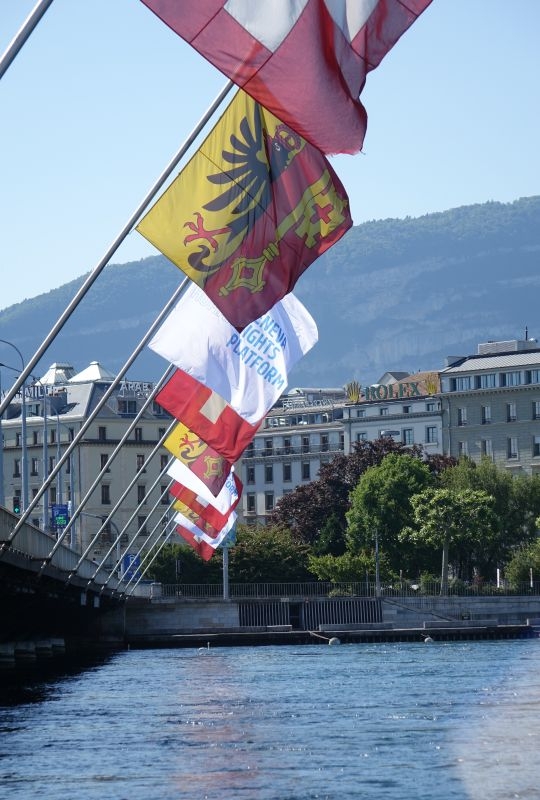
From today until Sunday 7 June 2020, flags with the Geneva Human Rights Platform (GHRP) logo will be flying on the Mont-Blanc Bridge. This should have coincided with the GHRP annual conference – an annual event open to all human rights actors in and outside Geneva that addresses current issues and challenges related to the work of Geneva-based human rights mechanisms. However, due to the COVID-19 situation, we postponed the conference to 15 October 2020.
‘As the space on the bridge was already booked in October, we decided to keep this slot to raise awareness about the platform in Geneva and beyond. This is also the occasion to announce the new date of the 2020 annual conference that will discuss the connectivity between the Geneva-based human rights system and regional human rights mechanisms’ explains Felix Kirchmeier, Executive Director of the Geneva Human Rights Platform..
On 29 May 2020 the UN Human Rights Council adopted a decision appealing to States to ensure human rights were at the front and centre of national responses to the pandemic and not side-lined while contending with the multiple ill effects of the virus on their societies.
“Today’s decision is a profound reminder of the far-reaching effects of this deadly virus on all aspects of our livelihoods and our rights which we cannot take for granted”, stated Council President Elisabeth Tichy-Fisslberger. “We are all in this together, and we must act together with a sense of purpose if we are going to achieve our common agenda to promote and protect human rights around the globe”, she added.
The President’s Statement, presented by Ambassador Tichy-Fisslberger, and adopted by the 47 member States of the human rights body by silence procedure, “calls upon States to ensure that all human rights are respected, protected and fulfilled while combatting the pandemic and that their responses to the COVID-19 pandemic are in full compliance with their human rights obligations and commitments”.
The adopted statement also calls on High Commissioner for Human Rights Michelle Bachelet to produce a report on the impact of the COVID-19 pandemic on the enjoyment of human rights around the world, including highlighting good practices and areas of concern, to be presented at the 46th session of the Human Rights Council scheduled to take place in February/March 2021. [One is to hope that it will include a hard look at the fragmentation of Covid-19 relate policy statements, see: https://humanrightsdefenders.blog/2020/05/27/proliferation-of-human-rights-bodies-guidance-on-covid-19/]
States also invited the High Commissioner to present an oral update on the human rights impact of COVID-19 at the 44th session of the Council which is still scheduled to start on 22 June, which is expected to set the tone for similar statements addressing the multiple human rights angles of the virus during the planned three-week meeting. Since suspending its 43rd session on 13 March due to coronavirus restrictions, the Human Rights Council has been conducting its business in a virtual manner holding regular Bureau meetings, with States and NGOs, and three “virtual informal conversations”, including with the High Commissioner and Special Procedures who have issued more than 90 press releases and statements addressing COVID-19.
Live discussion with 3 human rights defenders from across the globe
This event is part of the ‘Mural of Change’ campaign by Justice and Peace.
Today, more than ever before, we need to bring awareness to human rights, justice and environmental action. For this reason, we from Justice and Peace Netherlands have brought to you the ‘Mural of Change’ – a vibrant graffiti mural in The Hague representing known and unknown human rights defenders from around the world. The mural created by the graffiti-art duo Karski & Beyond is a visual statement and a call to action, as it comes in the unprecedented times of COVID-19 pandemic. [see: https://humanrightsdefenders.blog/2020/05/19/mural-of-human-rights-defenders-vitaly-safarov-greta-thunberg-and-berta-caceres-unveiled-at-hague-university/]
As part of our campaign to spread the message of change and action for human rights, we invite you to join our virtual event ‘Standing Side By Side With Human Rights Defenders’. During this event you will have the opportunity to meet three human rights defenders that took part in Shelter City. They will share with you the challenges they have been facing due to the COVID-19 pandemic; how their countries and the countries in their regions have responded to the spread of the virus; and how we can support them in their work. You will also have the chance to get in a conversation with them and ask your own questions.
SPEAKERS:
Genesis Davila, Human rights lawyer from Venezuela
Shibolo Awali, Lawyer and LGBTI rights defender from Uganda
Asha Kowtal, Dalit women’s rights defender from India
This discussion will be moderated by Tessa de Ryck, Security Training Coordinator for HRDs at Justice and Peace. The event will be in English.
Having just posted a report on the prolifiration of intergovernmental responses to the Corona virus pandemic [https://wp.me/pQKto-4ob], it perhaps good to point to the webinar that Business & human rights is organising on 4 June 2020 on Risks and Protection of Human Rights Defenders.
This webinar will have a focus on the risks and protection of HRDs, particularly labour rights and land/environmental defenders and ensuring their participation in the post-pandemic recovery.
It will have two parts: a closed and an open session. The closed session – happening on Jitsi – will be a safe space for civil society organisations, human rights defenders, including labour rights and land and environmental defenders, labour unions, and journalists to jointly define practical recommendations on what governments and companies can do to address human rights situation, particularly of labour, land, environmental defenders and civic freedoms, in the context of COVID-19. This part of the webinar is invite-only.
The second part – happening on Zoom – will be an open session, will be an opportunity for civil society, defenders, and journalists to interact with government and business representatives and discuss how companies, governments and civil society can work together to ensure all stakeholders are able to shape recovery efforts, and make sure they are human rights compliant. Anyone is free to join us in the public session by RSVP-ing below.
Event details
Event type
Webinar
Location
Online (Jitsi & Zoom)
Organisation
The Asian Forum for Human Rights and Development & Business & Human Rights Resource Centre
On 22 May 2020 Lisa Reinsberg in “Just Security” [see: https://www.justsecurity.org/about-us/) published a post ” Mapping the Proliferation of Human Rights Bodies’ Guidance on COVID-19 Mitigation“. It is in some ways rather critical of the response by intergovernmental bodies in the human rights area when it comes to the COVID-19 pandemic. It starts by pointing out that they have collectively put out more than 150 statements on respecting human rights during the pandemic since late February. ..To help those interested in keeping track of the many statements, the International Justice Resource Center (IJRC) has published a webpage – COVID-19 Guidance from Supranational Human Rights Bodies – listing and linking to all relevant press releases and other guidance. This article serves to provide an overview of – and initial response to – the nature, scope, and sources of human rights advice available to States in the context of the pandemic. Having myself contributed with my blog to the proliferation of policy repsonse by NGOs and IGOs, I feel that this piece deserves full citation:




 Hans Thoolen on Human Rights Defenders and their awards