Posts Tagged ‘coup d’etat’

Myanmar: one year after the coup – only getting worse

February 2, 2022
A crowd of protesters wearing face masks, holding up an image of a woman, Aung San Suu Kyi.

On 1 February last year, the military seized power over Myanmar/Burma by overturning the election results and detaining State Counsellor Aung San Suu Kyi. The military is still controlling power by force and uses brutal violence against human rights defenders, civil society groups, and journalists in order to silence all forms of protest and dissent. More than 1,500 people have been killed by the military and over 8,000 people have been arrested.

The coup prompted mass protests and more than 1,500 people have been killed by the military. Over 8,000 people have been arrested in the harsh crackdowns. In a series of charges, Aung San Suu Kyi has been sentenced to several years in prison. Most recently, five new corruption charges against her were announced and in all she faces up to 164 years in jail. See also: https://humanrightsdefenders.blog/2021/09/30/rohingya-human-rights-leader-mohibullah-murdered-in-bangladesh-refugee/

Despite the military’s brutal response, people have come together to fight the dictatorship. Nationwide protests, boycotts, strikes, and coordinated civil disobedience movements have taken place. Journalists across the country have continued their work despite severe attacks by the military.  

A new report by Athan looks at how the military coup has affected journalists’ work and press freedom in the country. Throughout the country’s history, military coups have led to severe attacks on press freedom and the 2021 coup is no exception.  Since the launch of the coup, 141 journalists have been arrested and 13 have been sentenced to prison. On 10 December, photojournalists Ko Soe Naing and Ko Zaw Tun were arrested while taking photos of a nationwide silent strike. Ko Soe Naing was tortured to death at the interrogation centre four days later. Just a couple of weeks after that, editor of the Federal Journal, A Sai Kay (Aka) Sai Win Aung, was shot dead by the military in Lay Kay Kaw.  See also: https://humanrightsdefenders.blog/2021/05/11/three-democratic-voice-of-burma-journalists-and-two-activists-risk-refoulement-by-thailand/

According to Athan, the attacks on press freedom since the 2021 military coup have been the worst the country has seen.  “Journalists and news media require continuous support to sustain local media and its journalists in order to secure journalists’ careers and their safety, and to enable an environment for journalistic professionals and the industry,” says a representative from Athan about the report. 

On the one-year anniversary of the military coup in Myanmar, the High Representative on behalf of the European Union and the Foreign Ministers of Albania, Australia, Canada, New Zealand, Norway, Republic of Korea, Switzerland, the United Kingdom, and the United States, have made the following declaration:

….The European Union is deeply concerned by the continuing escalation of violence and the evolution towards a protracted conflict with regional implications. Since the military coup, the situation has continuously and gravely deteriorated. A large part of the population is now in a highly precarious situation, experiencing poverty, food shortages, displacement, and violence. ..

The European Union condemns in the strongest terms continuing grave human rights violations including torture, sexual and gender-based violence, the continued persecution of civil society, human rights defenders, and journalists, attacks on the civilian population, including ethnic and religious minorities by the Myanmar armed forces. Therefore, the EU calls for full accountability of the leaders responsible for the coup as well as of the perpetrators of violence and human rights violations. The EU also reiterates its firm demand for the immediate and unconditional release of all prisoners arbitrarily detained in relation to the coup and the return to power of democratically elected leaders.

As a matter of priority, the EU reiterates its calls for an immediate cessation of all hostilities, and an end to the disproportionate use of force and the state of emergency. The military authorities must ensure rapid, safe, and unhindered humanitarian access to all displaced persons and people in need, in all parts of the country. The European Union will continue to provide humanitarian assistance, in accordance with the principles of humanity, neutrality, impartiality, and independence and reiterates its call for the full and immediate respect of international humanitarian law…

In view of the escalating violence in Myanmar, increased international action is required in line with the already existing EU arms embargo on Myanmar. Since the military coup on 1 February 2021, the EU has imposed targeted sanctions on the Myanmar military, its leaders, and entities. In the absence of any swift progress of the situation in Myanmar, the EU stands ready to adopt further restrictive measures against those responsible for undermining democracy and the serious human rights violations in Myanmar.

It is a failed coup,” said Yanghee Lee, co-founder of the Special Advisory Group on Myanmar and former UN special rapporteur for human rights in the country in a CNN report of 1 February. “The coup has not succeeded in the past year. And that is why they are taking even more drastic measures to finish out the coup.” He reported on problems for human rights defenders already in 2015, see: https://humanrightsdefenders.blog/2015/03/19/myanmar-backsliding-by-prosecuting-human-rights-defenders-instead-of-perpetrators/
https://edition.cnn.com/2022/01/31/asia/myanmar-coup-anniversary-resistance-junta-intl-hnk-dst/index.html

Burkina Faso: Coup Puts Rights at Risk – Diallo asks military to respect international law

January 29, 2022

Burkina Faso military officers responsible for the January 2022 coup should ensure the protection of human rights and a swift transition to democratic rule, Human Rights Watch said today. The authorities should give priority to the humane treatment of people in custody, respect freedoms of the media and rights defenders, and ensure that counterterrorism operations respect basic rights. ..  

“The Burkina Faso military coup occurred in a country with weak democratic institutions amid a brutal armed conflict and a growing humanitarian crisis,” said Corinne Dufka, Sahel director at Human Rights Watch. “The military authorities now in control need to act urgently to protect people’s rights and ensure they don’t make a bad human rights situation even worse.”

During a January 24 news conference, the self-proclaimed Patriotic Movement for Safeguard and Restoration led by Lt. Col. Paul-Henri Sandaogo Damiba, announced the suspension of the constitution, the dissolution of the government and national assembly, and a nationwide curfew. The movement’s spokesperson said elections would be held “within a reasonable time frame” and pledged to respect Burkina Faso’s international commitments, notably including human rights.

The coup leaders claimed the coup took place “without bloodshed.” However, there is uncertainty about the safety of President Kaboré and his close associates, amid reports of potential injuries and deaths during the military takeover. The MPSR should publicly account for the whereabouts and condition of government officials in custody and allow the Office of the United Nations High Commissioner for Human Rights, the national human rights commission, and independent human rights monitors to visit Kaboré and any other detainees. All those detained should be promptly brought before a judge and charged or be released.

The coup occurred within the context of a marked deterioration in the country’s human rights and security situation over the past year as attacks and atrocities by armed Islamist groups surged and the humanitarian situation worsened. Burkina Faso was already struggling to ensure justice for hundreds of unlawful killings by all sides, and to uphold the civil and political rights of its population.

During 2021, armed Islamist groups killed at least 250 civilians and scores of security force members during attacks in several provinces. Since 2018, Human Rights Watch has documented that government security forces and pro-government militias allegedly summarily executed hundreds of suspects, mostly in the country’s northern regions. Virtually none of these attacks have resulted in investigations and prosecutions.

Burkinabé rights defender, Dr. Daouda Diallo, secretary-general of the Collective Against Impunity and Stigmatization (CISC), and laureate of the 2022 Martin Ennals Award for Human Rights Defenders, told Human Rights Watch that he hoped the military authorities would “address Burkina Faso’s deepening social divisions, and ensure crucially needed protection for all civilians at risk from conflict, while scrupulously respecting international humanitarian law.”  See also: https://www.trueheroesfilms.org/thedigest/laureates/ca7f1556-8f73-4b48-b868-b93a3df9b4e1

The military authorities should also ensure respect for freedom of expression. In late 2021 and early 2022, the government shut down internet services in a move to quell protesters who had taken to the streets to demand an end to the violence and to protest rising food prices. A 2019 law criminalizing some aspects of reporting on security force operations dampened media freedom, with journalists reluctant to report on allegations of abuses by pro-government forces. Further, in 2021, the government implemented a de facto ban on visits by journalists to internally displaced camps. After taking power, the MPSR issued a warning against the communication of “false news.”..

Military takeovers in Africa in the past year occurred in Chad, Guinea, Mali, and Sudan. Coup leaders have often taken advantage of social unrest, grievances about corruption, and the failure of governments to respect basic rights, uphold constitutional obligations, and carry out promised reforms. Democratically elected governments need to look beyond elections as a marker of democratic progress, and focus on upholding human rights, strengthening the rule of law, and building credible, independent institutions, Human Rights Watch said…

“Burkina Faso’s military leadership should not allow the political upheaval created by the coup to lead to a vacuum in the protection of basic rights,” Dufka said. “The military authorities need to maintain discipline within the security forces and ensure that the human rights of all Burkinabé are respected, including their right to vote freely in elections.”

https://www.hrw.org/news/2022/01/27/burkina-faso-coup-puts-rights-risk

Coup in Myanmar: Aung San Suu Kyi will come to regret her loss of stature

February 1, 2021

Many institutions have responded negatively to the arrest of State Counsellor Aung San Suu Kyi and others in the context of a military coup Myanmar. A military-owned television station announced that a one-year state of emergency was being imposed under the authority of the Commander in Chief, Senior General Min Aung Hlaing.

Amnesty International’s Deputy Regional Director for Campaigns, Ming Yu Hah, said: “The arrest of Aung San Suu Kyi, senior officials and other political figures is extremely alarming. Unless those detained can be charged with a recognizable criminal offence under international law, they must be immediately released.

This is an ominous moment for people in Myanmar, and threatens a severe worsening of military repression and impunity. The concurrent arrests of prominent political activists and human rights defenders sends a chilling message that the military authorities will not tolerate any dissent amid today’s unfolding events.

Previous military coups and crackdowns in Myanmar have seen large scale violence and extrajudicial killings by security forces. We urge the armed forces to exercise restraint, abide by international human rights and humanitarian law and for law enforcement duties to be fully resumed by the police force at the earliest opportunity.

While this kind of coup d’état is clearly shocking, I fear that Aung San Suu Kyi will come to regret her anti- human rights behaviour of the last years which have led several award givers to rescind their human rights award [see: https://humanrightsdefenders.blog/2017/09/03/myanmar-time-for-aung-san-suu-kyi-to-return-at-least-some-of-her-many-human-rights-awards/]. It should not play a role in condemning the coup d’état, but one can imagine the outpouring of support for her that would have followed if she had not tarnished her image. See also: https://www.amnesty.org/en/latest/news/2018/11/amnesty-withdraws-award-from-aung-san-suu-kyi/

https://www.amnesty.org/en/latest/news/2021/02/aung-san-suu-kyi-others-arrested-military-coup/

https://news.sky.com/story/aung-san-suu-kyi-from-symbol-of-human-rights-to-fighting-claims-of-genocide-12205035

https://www.thestandard.com.hk/breaking-news/section/2/164683/Rights-groups-denounce-Myanmar-generals%27-disdain-for-elelctions

https://www.dw.com/en/who-is-myanmars-aung-san-suu-kyi/a-56406128

Hrant Dink Award 2016 to Diyarbakir Bar Association and human rights defender from Malawi

September 26, 2016
dinkodulu_1
ARMENIANHRANT DINKNEWSWORLD

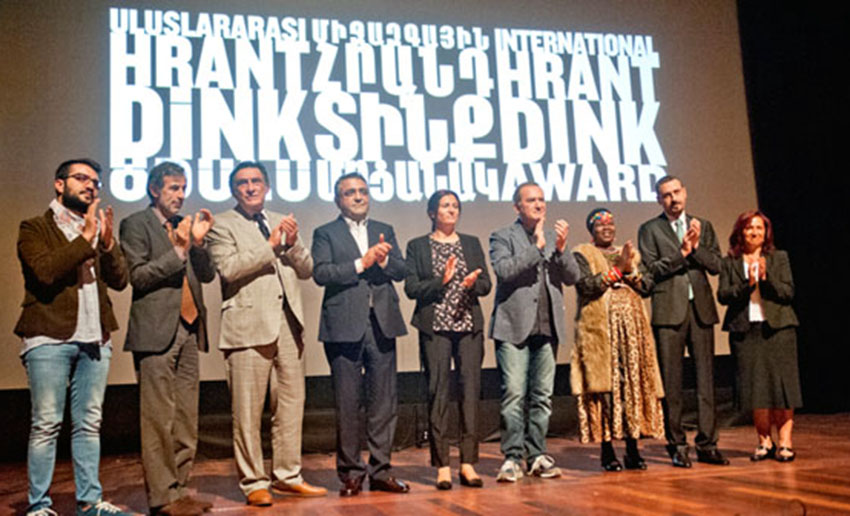
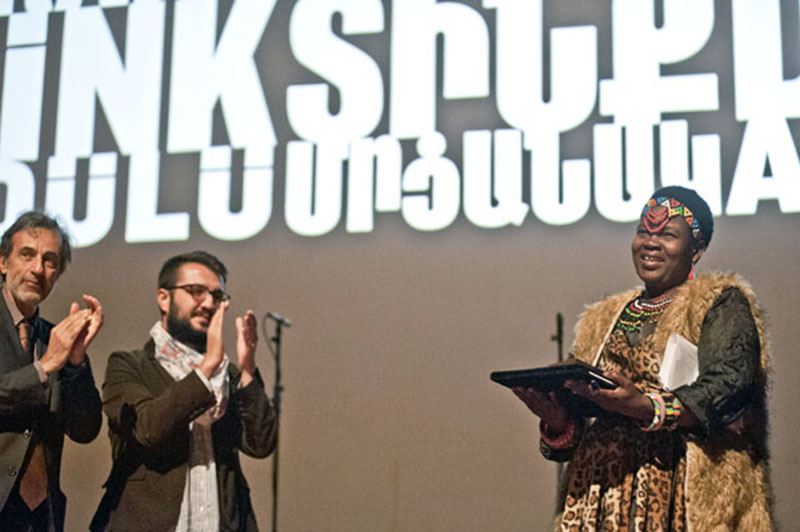
On 22 September 2016 a ceremony took place for the 8th annual ceremony of the Hrant Dink Award Granted. The laureates of the International Hrant Dink Award are the Diyarbakir Bar Association and Malawian human rights defender Theresa Kachindamoto, who works for children’s right.

Ahmet Insel, Head of the Selection Committee, made the opening speech: “It’s been almost 10 years since Hrant Dink was murdered. Nowadays, we are going through much darker times compared to 2007. The abominable coup attempt was foiled, but the state of law is completely suspended. Tens of thousands innocent people are detained without any legal procedure. Hundreds of journalists, academics, lawyers, teachers, artist and human rights defenders, meaning the usual suspects of the authoritarian regime are arrested, suspended and denied right to travel. We witnessed the arrest of Sebnem Korur Fincanci and Ahmet Altan, whose struggles were granted with Hrant Dink Award. Granted with Hrant Dink Award in 2013, Saturday Mothers (Cumartesi Anneleri) have been staging the longest civil obedience action in Turkish history; its their 600th week of protest. In times like these, the significance of the award increases. We greet the ones who struggle for creating a just and free world without violence.”

Diyarbakir Bar Association Chair Tahir Elçi was murdered on 28 November 2015 in Diyarbakir, while he was making a press statement. Deputy Chair Ahmet Özmen received the award on behalf of the association. Ahmet Özmen said inter alia: “I gratefully commemorate our dear chair Tahir Elçi, who devoted his life to the struggle for peace and freedom and sacrificed his life for this struggle….Tahir Elçi and Hrant Dink are two heroes, two human rights defenders who made history. People will remember them as intellectuals who made efforts for establishing a democratic order for the peoples of Turkey. Their only measure was rightfulness and justice. The ones who ordered their murder thought that their strong legacy will vanish and we won’t be able to follow their lead, but they are wrong.”…“Today, our most important duty and historical responsibility is to preserve and improve the legacies of Tahir Elçi and Hrant Dink. Demanding peace and speaking up for building peace is the only way.” During the ceremony, a video titled “Inspirations” was shown. People and institutions from Turkey and all around the world, who gave people hope about the future with their actions, were featured in the video. There were also people who objected to the coup and defended democracy on July 15.


dinkodul3Theresa Kachindamoto is the paramount chief, or Inkosi, of the Dedza District in the central region of Malawi, one of the poorest counties of Africa. For years, she has been working for preventing child marriages and defending their right to education. Becoming the chief of a tribe with 900,000 people, Kachindamoto started to struggle against child marriages, when she saw that half of the girls in the tribe are forced to marry at the ages of 12 or 13. She banned “marriage camps”, where children are abused under the name of sexual education. She managed to convince 50 tribe chiefs to abandon the traditions encouraging child marriage and to annul 850 marriages. Receiving the award from Yildiz Tar on behalf of last year’s laureate KAOS GL and Michèle Marian, Kachindamoto told the story of her struggle: “It wasn’t easy to fight against this problem. For majority of people, this practice was one of the most fundamental traditions of Malawi and encouraged by the society. We had to inform all people about the dangers and consequences of child marriage and abolish the accepted opinion which deems this practice as normal. There is no doubt that I need to push against more of the old ways of thinking to achieve my ultimate goal of removing child marriage from Malawi, and giving all girls and boys the opportunity to complete their education. I am proud of what we have achieved so far, but I am aware that there is still a long way ahead of us. I am grateful to every one who walked this way with me. I hope more people will join us and fight for the rights of Malawian girls. God bless you all.

Source: Hrant Dink Annual Award Granted to Diyarbakir Bar Association and Malawian Activist Theresa Kachindamoto | Armenian News By MassisPost


see also: https://thoolen.wordpress.com/2015/12/17/turkish-human-rights-defender-ragip-zarakolu-receives-pl-foundation-peace-prize/

Thai journalist Pravit Rojanaphruk about (self)censorship under the junta

June 19, 2015

On 26 May 2015, at the 2015 Oslo Freedom Forum, Thai journalist Pravit Rojanaphruk describes his fight for democracy in his home country following the May 2014 military coup. Talking about his own arrest, Rojanaphruk denounces the limitations to the right to assembly, expression and movement in Thailand, as well as the regime’s efforts to build the illusion of a happy Thailand. Rojanaphruk concludes his presentation by reminding us that tolerance and dialogue are essential if Thailand is to become a democracy again.

for more on Thailand: https://thoolen.wordpress.com/tag/thailand/

OHCHR expresses concern about fate of human rights defenders in Burundi

May 16, 2015

The Office of the UN High Commissioner for Human Rights issued the following statement after the failed coup d’etat in Burundi:

“We are very concerned by developments in Burundi over the past two days, and call on all armed forces and non-state actors to refrain from taking actions which may endanger the lives of civilians and to ensure their protection from the effects of conflict. There is a clear risk that the instability may be prolonged, or even made worse, if there are violent reprisals.

We have received reports of numerous attacks on both private and state media with radio and television stations destroyed, endangering the lives of the journalists who were still inside them at the time. We call for a re-opening of all media outlets and the respect of the independence of journalists. There is also an urgent need to ensure the safety of human rights defenders and journalists. To give just one example, one of Burundi’s most prominent human rights defenders, Pierre-Claver Mbonimpa [Laureate of the MEA in 2007 – ed], has had to go into hiding after receiving death threats.

Those who incite or engage in acts of mass violence are liable to be prosecuted by competent judicial bodies, as reflected in the recent statement by the Chief Prosecutor of the International Criminal Court.

We are also very concerned that political instability and reports of intimidation of civilians could result in an even greater humanitarian crisis. There is a significant increase of refugees fleeing Burundi to neighbouring countries, with reports of rapidly deteriorating sanitary conditions in some locations where large numbers of refugees have gathered, such as Kagunga in Tanzania.”

see also: https://thoolen.wordpress.com/2015/04/29/high-commissioner-leaves-burundi-and-the-repression-goes-up/

via OHCHR PRESS BRIEFING NOTE – (1) South East Asia / migrants boats (2) Burundi (3) International Day against Homophobia & Transphobia » Press releases » News – StarAfrica.com – News – StarAfrica.com.

Thai Junta summons human rights defenders

June 2, 2014

The Asian Human Rights Commission reports that only a few hours ago (around 9 pm) on 1 June 2014, the National Council on Peace and Order Maintenance [NPCO] in Thailand issued Orders No. 42-44/2014 – broadcast on the radio and television – demanding that 38 persons report themselves to the Jamjuree Room at the Army Club on Thewet Road between 10 am and noon. Similar to earlier orders, the penalty for not obeying the summons carries a prison term and a 40,000 baht fine.The list includes a number of human rights defenders, activists, academics, and journalists, such as:

  • Jittra Kotchadet, long-time labour rights activist and human rights defender.
  • Tewarit Maneechay, human rights defender and journalist for the independent media site Prachatai.
  • Suthachai Yimprasert, a historian at Chulalongkorn University, and
  • Kengkij Kitirianglarp, a political scientist at Chiang Mai University; the two academics have consistently acted in support of human rights.
  • Pranee Danwattananusorn, the wife of Surachai Danwattananusorn (a former political prisoner) and who has worked to support the rights of political prisoners and human rights defenders.
  • Karom Phonpornklang, a lawyer who has defended numerous political prisoners.

The full lists can be found in:  THAILAND: Junta summons additional human rights defenders, activists, academics, and journalists — Asian Human Rights Commission.