Posts Tagged ‘Colombia’
February 5, 2013
Friday, 1 February 2013 Diego Martinez, national executive secretary, and Jeison Pava of the Permanent Committee for Human Rights (CPDH), have suffered threats in the last weeks. On 16th January, an anonymous call was made to the CPDH head office in Bogota, asking after Mr. Pava, his timetable and when he would be coming and going from the office. On the receptionist’s refusal to relay this information, the caller insulted her and said “We need that head” referring to Mr. Pava. On 28th January, Mr. Martinez’ bodyguard was detained by units of the National Police. Mr. Martinez informed the police officers that this would leave him without security, however the police officers continued their operation. The police then also asked Mr. Martinez to come with them, despite having committed no crime, but he refused. One of the police officers refused to identify himself, and when Mr. Martinez went to lodge a complaint at the police station, they point-blank refused to receive his report. The same police unit has since returned to the CPDH headquarters, threatening Mr. Martinez against denouncing the crime.
On 4th July 2012, Martinez and Pava were described as military targets. Other members of the CPDH human rights organization have also been threatened in recent months, including Harry Caicedo, director of the CPDH branch in Charco, Narino, whose house was shot at in the night on 13th January, following an arson attack months before. CPDH has been requesting security measures since August 2010 and in May 2012 was granted “precautionary measures” by the Inter-American Commission of Human Rights. In December 2012 the government finally provided the requested security. CPDH has expressed concern that, only one month on, in Mr. Martinez’ case, state forces removed the protection they are obligated to provide.
via Justice for Colombia news: Threats and hostilities against CPDH human rights defenders.
Posted in Human Rights Defenders | Leave a Comment »
Tags: attacks, Colombia, Diego Martinez, Human Rights Defenders, Inter-American Commission on Human Rights, Jeison Pava, Justice for Colombia, Permanent Committee for Human Rights, Police, precautionary measures, protection, threats
February 3, 2013
 Human rights defenders from Iran, Cambodia, Kenya, Uzbekistan, Colombia and Mauritania are finalists for the 2013 Front Line Award for Human Rights Defenders at Risk. The jury is made up of members of the Irish and the European Parliament as well as Front Line Defenders board member Noeline Blackwell.
The winner of the 2013 Front Line Award for Human Rights Defenders will be announced at a ceremony in Dublin later in the year.
Finalists for Front Line Award for Human Rights Defenders at Risk 2013 are:
 Mam Sonando – Cambodia – has devoted his life to helping the poor and disenfranchised of Cambodia, fighting for their rights while also following the non-violent precepts of his Buddhist faith. He is a journalist and the Director of one of only three independent radio stations in Cambodia where the state has almost complete monopoly over the media, and crackdowns on free speech have led to widespread self-censorship. He is also founder and president of a national organisation called the Association of Democrats, which actively promotes democracy and human rights. He was arrested In early July 2012 and despite there being absolutely no evidence to link him with the so-called secessionist movement, he was found guilty on 1 October 2012 of instigating insurrection and incitement to take up arms against the state and sentenced to 20 years imprisonment.
 Mansoureh Behkish – Iran – is a women’s rights activist and co-founder of Mothers of Khavaran and Mothers of Laleh Park. As a supporter of non-violent resistance and a HRD she has spent the past three decades empowering survivors and victims of human rights abuses. In particular she seeks to help the mothers, sisters and wives of the thousands imprisoned or executed by the Islamic Republic authorities, to seek justice through legal and humanitarian channels.As a result of her work as a HRD, she herself has faced continuous harassment, confiscation of her passport and violation of her right to travel and three terms of imprisonment.
 David Rabelo Crespo – Colombia – has worked for 35 years in the defence of human rights. In the early years, he worked mainly in defence of social, economic and cultural rights, and later worked for worker’s rights, promoting social and union mobilisation. In more recent years, he has worked to defend the lives of others although in doing so he has put his own life at risk. Between 1998 and 2004 he was director of the Municipal Peace Council, a body devised to protect the lives of the local people who, with the arrival of the paramilitaries were at risk from the upsurge in assassinations of social and community leaders, and a series of massacres carried out with impunity. David Rabelo Crespo has devoted his life to promoting respect for human rights and international humanitarian standards in the Magdalena Medio region of Colombia, and even though he is now imprisoned he continues to work to protect the rights of political prisoners in Colombian prisons.
 Bahtiyor Hamraev – Uzbekistan – has been a dedicated campaigner for human rights in Uzbekistan for the last 15 years. He has been head of the Djizak regional branch of the Human Rights Society of Uzbekistan (HRSU) and has documented human rights violations in this region. In recent years he has become the main contact with families of imprisoned human rights defenders, helping to spread the information about their conditions in detention, the torture and ill-treatment and helping to provide the families with legal aid and financial assistance. The price he has had to pay has sometimes been far too high, but despite all of these difficulties, he has continued to work, refused to leave the country and tried to make a difference in one of the worst human rights situations in the region. Sadly, Hamraev is suffering from terminal cancer, yet he continues to send information about human rights violations and to assist families of imprisoned human rights defenders.
 Biram Dah Ould Abeid – Mauritania – has been threatened, defamed and harassed because of his work for human rights and against slavery in Mauritania. He has been arrested and ill-treated on several occasions and in April 2012 he was “disappeared” for several weeks into a secret, high-security government facility, without being able to contact to his family and without any legal assistance. It is believed he would have been killed but for the international outcry. He was released in September 2012 but has chosen to continue his work inside Mauritania.
 Ruth Mumbi – Kenya – is a passionate community mobiliser, and is the founder and current National Coordinator of Bunge la Wamama, a women’s chapter of Bunge la Mwananchi a movement that conducts strong advocacy and campaigning on issues of social justice and accountability in different parts of Kenya. She was born and still lives in Kiamaiko, a Nairobi slum and she began her involvement in community mobilisation initiatives in the late 1990s, when she was barely 16 years of age.
For further information please contact Jim Loughran, Head of Communications, Front Line Defenders
Tel +353 (0)1 212 37 50
Mobile +353 (0)87 9377586
Email: jimloughran@frontlinedefenders.org
Posted in Front Line, Human Rights Defenders | Leave a Comment »
Tags: awards, Cambodia, Colombia, Front Line, Human right, Human rights defender, Human Rights Defenders, Iran, Kenya, Mauritania, nominees 2013, Uzbekistan
January 31, 2013
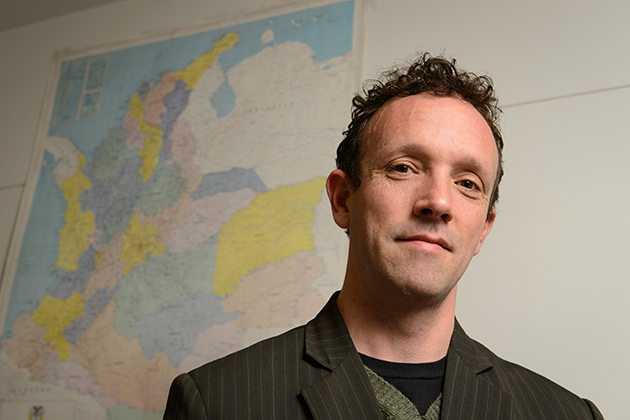
When writing about individual Human Rights Defenders the tendency is to give attention to those in the front line who are in immediate trouble. This time I want to refer to a HRD teaching at the University of Connecticut based on a blog post by Kenneth Best of 30 January 2013. It concerns Luis van Isschot, an assistant professor of history, who specializes in the study of human rights in Latin America ( photo by Peter Morenus/UConn Photo).

Conversation around the dinner table in the van Isschot home in Montreal was a bit different than in most Canadian homes. Growing up with a Spanish, Peruvian, and Dutch family heritage, Luis van Isschot listened to discussions about Latin American history and politics led by his father, a physician who treated families in a clinic based in Montreal’s Latino community…….
…His path to a doctoral degree developed from his volunteer work in Guatemala and later in Colombia, where he served as a human rights observer. It was during his time in Colombia that a friend who was a university professor and a historian told him that one of the most important books of Colombian history was written by a professor from his hometown of Montreal, Catherine Le Grand at McGill University, and that he should look her up. He did, and it led to his enrollment in the doctoral program. “She made it seem that you could be a wonderful teacher, a cutting-edge scholar, and have a balanced life of engagement in your community, and that the Ph.D. was a way of doing that,” van Isschot says. “The university is central to the community, not apart from it. That makes sense to me.”
He later became involved with MEA Laureate 2001 Peace Brigades International, a nonpartisan organization that sends international volunteers to areas of conflict to provide protective accompaniment to human rights defenders threatened by political violence in 11 nations, including in Asia, Africa, and Latin America. In addition to serving as a human rights observer in Colombia, he also traveled to the Great Lakes Region of Africa, doing research in the Democratic Republic of Congo, Rwanda, and Burundi.
“It was a really important experience for me to go somewhere where the language of human rights and social justice and the understanding of history really enriched my own understanding of what I was working on in Latin America,” he says. His experience in Colombia led him to focus his doctoral studies on human rights activities in that nation’s oil capital, Barrancabermeja, where he lived for a year. The city was the center of a major urban war between Colombian paramilitary groups and leftist guerillas. Between 1998 and 2002, in a city of 300,000 there were about 2,000 violent murders. “It was a devastating period. The relationships I made with Colombian human rights activists, teachers, and scholars convinced me that I needed to find some place to explore the issues,” he says.
His book, The Social Origins of Human Rights: Protesting Political Violence in Columbia’s Oil Capital, 1919-2010, is near completion, and scheduled to be published in early 2014. His new research project is titled “When the Courts Make History: the Impact of the Inter American Court of Human Rights in Latin America’s Conflict Zones,” and examines the historical changes set in motion by the pursuit of justice across borders.
http://today.uconn.edu/blog/2013/01/focusing-on-human-rights-with-a-latin-american-perspective/
Posted in human rights, Human Rights Defenders | Leave a Comment »
Tags: Africa, Canada, Colombia, Democratic Republic of Congo, Human rights defender, human rights education, human rights teaching, Latin America, Luis van Isschot, McGill University, PBI, Peace Brigades International, research, University of Connecticut, USA
January 28, 2013
On 24 January 2013, human rights defender Martha Díaz was targeted again with a death threat.
On 24 January, a package in a manila envelope was delivered to the residence of Martha Díaz, which contained a mass card and note with letters cut from a newspaper. The letters stated: “You are dead, you are a collaborator of the guerilla, we are not joking, one of you is going to die”[translated from Spanish]. On 22 January, the human rights defender had already received a pamphlet sent by a group who identified themselves as “Los Rastrojos”.
Martha Díaz is Director of AFUSODO, an organisation of relatives of victims of extrajudicial executions and a member organisation of MOVICE (National Movement of the Victims of State Crimes). Since its creation, AFUSADO has received some 27 threats. Front Line Defenders issued an urgent appeal https://www.frontlinedefenders.org/node/20842 on death threats received by Martha Díaz on 14 November 2012, and has issued previous appeals on threats against human rights organisations in the Cauca and Valle del Cauca departments.
Posted in Front Line, Human Rights Defenders | Leave a Comment »
Tags: Colombia, Death threat, death threats, Front Line, human rights, Human rights defender, impunity, Martha Diaz, MOVICE
December 4, 2012
Today’s HRD in the OMCT series is Franklin Castañeda Villacob, 30 years old, working with the Committee of Solidarity with Political Prisoners (CSPP) in Colombia
Franklin Castañeda: Ten Portraits against Torture and Impunity / December 4, 2012 / Events / Human rights defenders / OMCT.
Posted in Human Rights Defenders, OMCT | Leave a Comment »
Tags: Colombia, CSPP, Franklin Castañeda Villacob, impunity, OMCT, torture
November 30, 2012
In the FPIF edition of 29 November 2012 (Foreign Policy in Focus, a project of the Institute for Policy Studies) Christine Ahn and Erika Guevara-Rosas have published a provocative piece that takes US policy – especially its aid policy – to task for contributing to the process of militarization that adds to the woes of (women) HRDs. A long but well-argued piece worth reading:
“While a significant chunk of USAID spending goes to education and health programs, pockets of aid enlarge the already bloated military budgets of recipient governments. The result: less security and more violence against women, particularly women human rights defenders. ………..we take a look into Colombia and Mexico, the two countries with the largest number of documented instances of death threats against women human rights defenders—and coincidently two major recipients of U.S. aid.”
Endangering Women Human Rights Defenders | FPIF.
Posted in human rights, Human Rights Defenders | Leave a Comment »
Tags: Christine Ahn, Colombia, Erika Guevara-Rosas, Foreign Policy, Foreign Policy in Focus, Human Rights Defenders, Institute for Policy Studies, Mexico, militarization, USA, USAID
August 20, 2012
While there have been some notable improvements in Colombia with regard to the situation of Human Rights Defenders over the last years, there are still terrible lapses as shown by the case of the trade unionists Oscar Arturo Orozco and Wilson Jaramillo’s who were shot at when traveling by car on 4 August in the Caldas Department. The president of the Caldas branch of the Trade Union Congress (Central Unitaria de Trabajadores, CUT), Oscar Arturo Orozco and the secretary-general Wilson Jaramillo were travelling by car between Manizales and the municipality of Palestina in Caldas Department when shots were fired by two men on a motorbike and several others standing at the side of the road. Several shots hit the car, but neither man was injured. Both men are also members of the National Movement of Victims of State Crimes (Movimiento Nacional de Víctimas de Crímenes de Estado, MOVICE) and the Colombian Electricity Workers’ Union (Sindicato de Trabajadores de la Electricidad de Colombia, SINTRAELECOL).
Over recent years flyers containing death threats have been repeatedly left at the office of SINTRAELECOL, most recently in mid-July when the death threat contained a picture of bullet cartridges. According to the CUT, 12 trade unionists have been killed in Colombia in this year alone. This attack comes at a time when there had been an order to remove the protection Oscar Arturo Orozco was receiving and when parts of the budget of the Ministry of Interior Protection Programme have been reduced.
Amnesty International, Protection International and other NGOs call for expressions of support: Go to original article
Posted in human rights | Leave a Comment »
Tags: AI, Amnesty International, Central Unitaria de Trabajadores, Colombia, death threats, Human Rights Defenders, Movimiento Nacional, Protection International, Trade union, trade unionists
April 6, 2012
The Mail & Guardian Online carried an interesting piece that may have gone unnoticed. It is about the appointment of the first ever Rapporteur ‘on the promotion of truth, justice, reparation and guarantees of non-recurrence’. On March 23, the United Nations Human Rights Council appointed Pablo de Greiff, a Colombian national, who is currently the New York-based director of research at the International Centre for Transitional Justice. His tenure as special rapporteur begins on May 1.
The article refers to a recent meeting entitled “African Perspectives on the Appointment and Mandate of the UN Special Rapporteur on the Promotion of Truth, Justice, Reparation and Guarantees of Non-Recurrence”, of which a comprehensive report is forthcoming.
The article also gives a useful background to the what “Special procedures” are and underlines rightly that civil society (i.e. HRDs) should play a vital role in relation to the special rapporteur. Feeding the special rapporteur with succinct, reliable and accurate information on urgent matters relating to the mandate is one important function civil society can take on. Raising awareness about the special rapporteur and the relevant mandate as well as how it translates into reality is equally important in order to ensure increased participation in the broader process.
UN appoints rapporteur for justice – Opinion – Mail & Guardian Online.
Posted in human rights, Human Rights Defenders, UN | Leave a Comment »
Tags: Civil society, Colombia, human rights, justice, Pablo de Greiff, reparations, Truth, UN Special Rapporteur, United Nations, United Nations Human Rights Council, United Nations Special Rapporteur
February 19, 2012
On 6 March 2012, the International Service for Human Rights (ISHR) will organise a side-event to United Nations Human Rights Council in Geneva, where UN and Latin American experts will come together to study and publicize the conditions of human rights defenders working in the Americas.
The Inter-American Commission on Human Rights’ (IACHR) has it own Special Rapporteur on the Situation of Human Rights Defenders, Mr José de Jesús Orozco. His report will highlights an increase in assassinations, extrajudicial executions and enforced disappearances of human rights defenders in the region since 2006, particularly in those countries where democratic rule is interrupted, where there is internal armed conflict, or where clashes occur between defenders and organised crime groups or powerful economic actors. In response, the IACHR has ordered many American States to take specific action to protect defenders. These protection measures have been issued primarily to Colombia (27 percent), Guatemala (24 percent), and Honduras (9 percent).
At the same event, the United Nations Special Rapporteur on human rights defenders, Ms Margaret Sekaggya will present ISHR’s report on the situation of defenders in Colombia. The findings are the result of research into whether recommendations made by the Special Rapporteur have been effectively implemented in Colombia, following her visit to the country in 2009. The report portrays a Colombian Government showing a more constructive attitude in its dealings with human rights defenders. However, it also identifies a failure to mainstream this attitude among local authorities, a worrying increase in attacks on human rights defenders in the past year, and the limited success of State authorities in investigating and addressing such attacks. Executive Director of the Colombian Commission of Jurists, Mr Gustavo Gallón will go on to provide a civil society view on the ISHR report and the situation of defenders in Colombia.
Further information about the event can be downloaded here.
Posted in human rights, Human Rights Defenders, UN | 1 Comment »
Tags: Colombia, Geneva, Guatemala, Honduras, Human Rights Defenders, ISHR, José de Jesús Orozco, Latin America, Margaret Sekaggya, United Nations Special Rapporteur

 Hans Thoolen on Human Rights Defenders and their awards