Posts Tagged ‘climate change’

COP30: Protecting human rights defenders is crucial for climate justice

November 7, 2025

On 5 November, 2025 Camilla Pollera, Human Rights and Climate Change Program Associate at the Center for International Environmental Law published a blog post about the upcoming COP30 and the role of human rights defenders:

There is no climate justice in a climate of fear.  As governments prepare to meet in Belém, Brazil for, COP30, attention turns to a country where defending nature still comes at a high cost. Deep-rooted and intertwined impunity and violence against environmental human rights defenders (EHRDs) — including Indigenous defenders, Afro-descendent communities, women, and defenders from LGBTQIA+ —persist in Brazil.  

COP30 decisions must recognize the efforts of those protecting the planet, in Brazil and beyond,  and ensure that they can do so safely, freely, and without fear.  

Around the world, EHRDs are on the frontlines of the climate crisis —  protecting land, water, communities, and their rights, often at great personal risk. Faced with an escalating climate crisis and the inaction of governments, a growing number of people are stepping up to defend their rights, the rights of future generations and the right to a clean, healthy and sustainable environment, exercising their fundamental freedoms of expression, peaceful assembly, and association, guaranteed under international human rights law.

…The violence and repression faced by defenders are intensified by intersecting forms of marginalization, especially affecting women defending the environment,  who often suffer gender-based violence that rarely appears in the data, including sexual violence, harassment, and rejection within their families and communities. They are targeted not only as defenders of rights and natural resources but also as women, in all their diversity, challenging discriminatory societal norms,  a combination that makes their work particularly dangerous and invisible. …The persistent violence and lack of effective guarantees for human rights protection are a stark reminder of what is at stake as COP30 comes to Belém.   

The Advisory Opinion of the Inter-American Court of Human Rights on the climate emergency and human rights made it clear: States must take proactive steps to ensure the effective protection of environmental defenders — including for those such as Indigenous and women EHRDs who are most at risk of retaliation. The Court recognized EHRDs are “allies of democracy”, whose work takes on even greater importance amid the urgency and complexity of the climate emergency. It reaffirmed the right to defend human rights as an autonomous right and declared that States have a special duty of protection toward those who exercise it, and recognized the double layer of risk faced by women environmental defenders, requiring an even higher duty of care. The Court also formulated very concrete recommendations on what this means at the national level. 

The Escazú Agreement and the Aarhus Convention both enshrine explicit provisions on the protection of EHRDs, setting legal and institutional frameworks to operationalize these duties. Recent work under these instruments has provided concrete guidance for States and businesses to uphold their obligations, safeguard civic space, and ensure defenders are protected and not penalized. The recent Action Plan under Escazú and the ad hoc rapid response mechanism under Aarhus are just a few examples marking concrete advances in protecting those facing threats. 

At COP30, Parties can no longer ignore their human rights obligations. They have a duty to ensure that the UN Framework Convention on Climate Change (UNFCCC)—the central forum for global cooperation on climate action—and its outcomes align with legal standards. Rightsholders have been obstructed from participating and silenced the climate talks, a process that is deciding on their future. Restrictions on the rights to freedom of expression and assembly, lack of transparency in the host country agreements, persistent visa barriers and financial burdens, continue to limit access. In recent COPs, civic space has continued to shrink, with obstruction often led by the very States hosting the negotiations.

Brazil has a chance to do things differently, by making civic space at COP30 and the protection of environmental defenders a true priority. This includes guaranteeing safe conditions for the meaningful participation before, during, and after COP30 and beyond. And it also means taking steps domestically, starting with the urgent ratification of the Escazú Agreement. Brazil has a key role to play in building upon its legacy of international environmental leadership and steering negotiations at the COP towards rights-based outcomes. 

COP30 indeed offers a  crucial moment to enhance the protection of defenders through critical decisions expected in Belém:  the Just Transition Work Programme (JTWP) and the Gender Action Plan (GAP). 

As highlighted by the recent report of the UN Special Rapporteur on Human Rights Defenders, Mary Lawlor, a just transition should be grounded in the protection of those who defend rights and call out false climate solutions, from Indigenous Peoples and land defenders opposing harmful mining projects to workers’ advocates demanding fair and equitable transitions.  All decisions, measures, and mechanisms designed to enable a just transition from the fossil fuel economy must protect a safe and enabling civic space, and ensure the meaningful participation of EHRDs.

..

There is no climate justice without human rights and without protecting those on the frontlines. EHRDs step in to protect what governments have neglected, and their courage exposes States’ failure to meet their climate and human rights obligations. Despite the risk, around the world, defenders continue to organize, resist, and demand climate justice, leading the way forward. In their resistance lies the chance of a just and sustainable future.

Since 1989, CIEL has used the power of law to protect the environment, promote human rights, and ensure a just and sustainable society.

With offices in Washington, DC, and Geneva, Switzerland, CIEL’s team of attorneys, policy experts, and support staff works to provide legal counsel and advocacy, policy research, and capacity building across our four program areas: Climate & Energy, Environmental Health, Fossil Economy, and People, Land & Resources.

On 5 November 2025 Amnesty international endorsed this kind of view under the title “What is COP and why is this year’s meeting in Brazil so important?”

https://www.business-humanrights.org/en/from-us/media-centre/ahead-of-cop-resources-for-reporting-on-the-just-energy-transition/

https://pbicanada.org/2025/11/09/can-cop30-stop-climate-change-aggressions-against-land-and-environmental-defenders-who-resist-destructive-megaprojects/

https://globalwitness.org/en/press-releases/new-global-initiative-aims-to-place-environmental-defenders-at-the-heart-of-climate-decisions/

https://www.oas.org/en/IACHR/jsForm/?File=/en/iachr/media_center/PReleases/2025/230.asp
CESCR General Comment: States should protect environmental and Indigenous HRDs

October 17, 2025

The Committee on Economic, Social and Cultural Rights (CESCR) recently published its General Comment on the environmental dimension of sustainable development. In addition to recognising human rights defenders, the Comment clarifies State obligations towards marginalized communities and notes the importance of transitioning away from fossil fuels. It also outlines States’ extraterritorial obligations.

ISHR provided two written inputs to the draft of this General Comment earlier this year – a standalone submission regarding the recognition and protection of environmental human rights defenders (EHRDs) based on the Declaration+25, a supplement to the UN Declaration on Human Rights Defenders, and a joint submission in partnership with the Center for International Environmental Law, Earthjustice, FIAN International, the Global Initiative for Economic, Social and Cultural Rights, Human Rights Watch and Oxfam.

States parties should respect, protect, and promote the work of environmental and indigenous human rights defenders, as well as other civil society actors who support people in marginalized and disadvantaged situations in realizing their Covenant rights.’ States parties should take all necessary measures to ensure that environmental human rights defenders and journalists can carry out their work, without fear of harassment, intimidation or violence, including by protecting them from harm by third parties.

ISHR welcomes that priorities from the joint NGO submission to the CESCR are reflected in the General Comment, in particular Indigenous Peoples’ right to ‘free, prior and informed consent’ and the need to transition away from fossil fuels (including by reducing ineffective subsidies).

However, we regret that the Comment does not more explicitly acknowledge the critical role of EHRDs in promoting sustainable development or strategic lawsuits against public participation (SLAPPs) as an obstacle to their engagement. The CESCR has previously noted the risks faced by HRDs and provided guidance on their recognition and protection in the context of land issues in General Comment No. 26 and it should have extended this analysis to EHRDs in the context of sustainable development. The use of SLAPPs to silence HRDs has been acknowledged by other UN bodies, including in the most recent report of the Special Rapporteur on the Situation of Human Rights Defenders, Ms. Mary Lawlor, to the Third Committee of the General Assembly.  

 Some additional highlights from the General Comment are set out below. 

  • The Committee found that ‘[t]he full realization of Covenant rights demands a just transition towards a sustainable economy that centres human rights and the well-being of the planet’. 
  • States should supervise commercial activity, establish a legal obligation for businesses in respect of environment and human rights due diligence, and ensure that victims of human rights violations stemming from businesses have redress. 
  • States have obligations to conduct human rights and environmental impact assessments, which are to be undertaken with ‘meaningful public participation’.
  • States have an extraterritorial obligation to ensure that any activities within the State or in areas under its control do not substantially adversely affect the environment in another country. This also extends to preventing businesses in the State from causing such harm in another jurisdiction. Even though the CESCR does not expressly mention it in the Comment, this should also apply to cases of attacks against EHRDs. 
  • The CESCR also clarifies States’ obligations towards marginalized communities, spotlighting the concept of intersectionality. It also explicitly notes that equal exercise of economic, social and cultural rights by women and men is a prerequisite for sustainable development, encouraging States to redistribute the unpaid domestic work undertaken by women and girls.
  • Environment-related obligations have also been set out for States in the context of specific Covenant rights, for example, the right to self-determination , right to freely utilize natural resources , right to work , right to an adequate standard of living, right to the highest attainable standard of physical and mental health, right to education and other economic, social and cultural rights.
  • The General Comment recognises that certain communities are particularly vulnerable to the effects of environmental degradation – it calls on States to identify and protect those at risk. The CESCR focuses particularly on children (specifically calling for child rights defenders to be recognised and protected and for their participation in climate action to be facilitated), Indigenous Peoples, peasants, pastoralists, fishers and others in rural areas, and displaced persons.

‘Environmental degradation, including climate change, intensifies the vulnerabilities of individuals and groups who have historically experienced and/or experience marginalization. These vulnerabilities are shaped by intersecting factors such as socioeconomic status, race, ethnicity, gender, disability, age, migratory status, sexual orientation, and gender identity.’

https://ishr.ch/latest-updates/cescr-general-comment-states-should-protect-environmental-and-indigenous-hrds-work-in-the-context-of-sustainable-development

New report: Human rights defenders at risk in the renewable energy transition

May 27, 2025

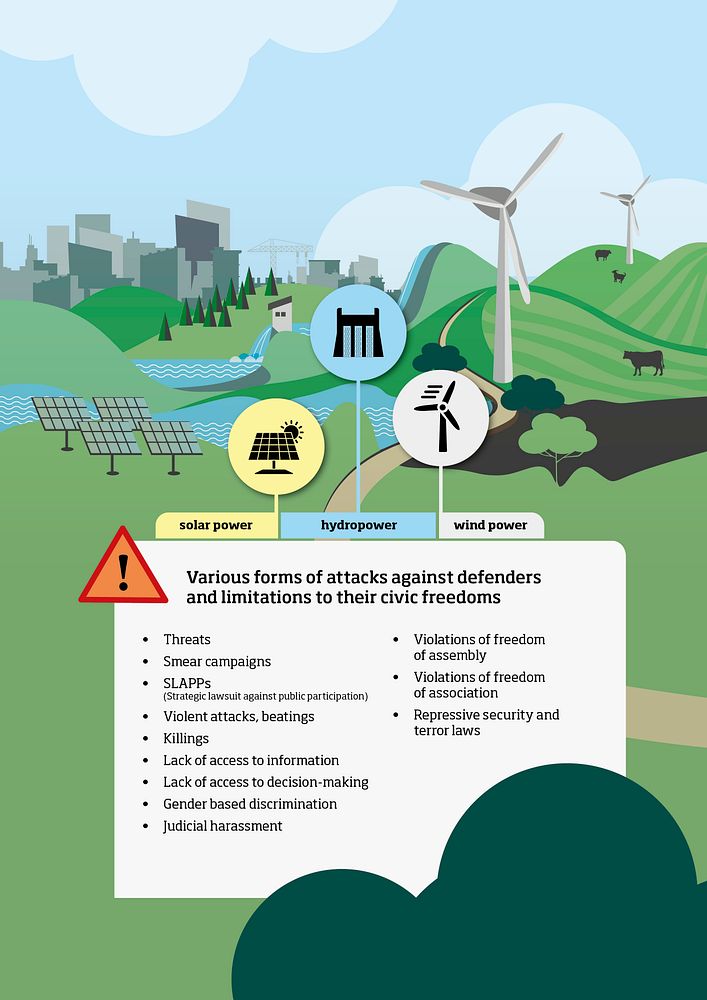
A new report by the research organization Swedwatch of 29 April 2025 highlights critical human rights risks associated with the global transition to renewable energy. The report reveals that human rights and environmental defenders face serious threats and reprisals in countries where renewable energy projects are being rapidly developed.

More than half of the world’s total prospective wind farm capacity, and more than two thirds of the prospective solar farm capacity, is estimated to take place in countries with obstructed, repressed or closed civic space.

While scaling up wind, solar, and hydropower is essential to limiting global warming to 1.5°C, this growth must not come at the expense of human rights.

We cannot build a green future on the backs of those who are silenced or displaced. The renewable energy transition must not come at the cost of human rights. Defenders are not obstacles – they are essential allies in ensuring that this is just, equitable, and sustainable, says Alice Blondel, Director Swedwatch.

Renewable energy projects require large land areas, often affecting local communities, ecosystems, and livelihoods. Swedwatch’s analysis shows that the renewable energy transition will largely take place in countries with restricted civic space and poor human rights protections, where defenders who raise concerns often face harassment, legal persecution and at times even deadly violence.

The report Renewables and Reprisals – Defenders at risk in the green energy transition in Brazil, Honduras, Mozambique, and the Philippines is based on a global mapping of such high-risk areas for defenders, where civic space is restricted and where renewable energy expansion is projected to accelerate. Additionally, the report presents four case studies from Mozambique, Honduras, Brazil, and the Philippines, where defenders and affected community members describe restrictions and reprisals of defenders linked to renewable energy projects.

The report is authored by Swedwatch with input from Terramar Institute (Instituto Terramar), Network of Women Human Rights Lawyers and Defenders (Red de Abogadas Defensoras de Derechos Humanos) and Jalaur River for the People’s Movement (JRPM).

-The report underscores the urgent need for stronger protections for defenders, transparent consultation processes, and corporate accountability. Without immediate action, the rapid expansion of renewables risk repeating the same human rights abuses seen in industries such as mining and agribusiness, rather than fostering a truly just energy transition, says Alice Blondel.

Expansion of renewables in countries with high risks for defenders
Swedwatch’s findings indicate that a large share of the expansion of renewable energy is taking place in countries where civic space is restricted, and defenders are at significant risk.

Case studies: Defenders under threat
In the four case studies, defenders from Mozambique, Honduras, Brazil and the Philippines described restrictions of basic civic freedoms and risks of verbal, legal or violent physical attacks when reporting about impacts of renewable energy projects.

Mozambique: According to interviews in the report, the planning of the Mphanda Nkuwa hydropower project has been marred by inadequate social and environmental impact assessments, lack of transparency, and suppression of civic engagement. Defenders reported threats, violation of freedom of assembly, and an overall disregard for their right to participate in decision-making processes.

Honduras: Human rights defenders have faced legal intimidation through SLAPPs (Strategic Lawsuits Against Public Participation) for their criticism of the Los Prados solar power project, according to a group of women human rights lawyers. Community members involved in protests have allegedly been surveilled and subjected to repressive actions by security forces. Defenders also reported smear campaigns in the media, further restricting their ability to voice concerns.

Brazil: In Brazil, the wind power project Bons Ventos failed to properly include impacted communities, including marginalized groups, traditional fishing, and quilombola communities, in consultations, according to interviews. Defenders decided to remain anonymous in the interviews out of fear of reprisals, citing increasing threats and violence against defenders in the past years.

The Philippines: Indigenous defenders from the Tumandok communities were allegedly threatened, harassed, and killed when the national police and the armed forces raided their communities after community leaders criticized the Jalaur River Multipurpose project, according to a CSO operating in the area. Defenders reporting on the dam project outlined persecution, surveillance and red-tagging – terror-labelling by the government accusing defenders of being communist insurgents, creating an environment of fear and impunity.

Swedwatch´s recommendations
As the world races to meet climate targets, a just transition must include the voices of those most affected by energy projects, and defenders are essential in ensuring that renewable energy projects respect human rights and the environment.

-Governments, businesses, and financial institutions must work together to ensure that human rights are protected, and that defenders can operate without fear of repression or violence. Engaging with defenders as valuable partners rather than as adversaries can help governments and businesses ensure renewable energy projects’ alignment with international human rights obligations, mitigate conflicts, and promote sustainable development, says Jessica Johansson.

Detailed recommendations to different actors can be found in the report, below the main ones are summarized:

Recommendations for governments:

  • Adopt legislation on mandatory human rights due diligence (HRDD) for companies, highlighting risks to defenders and meaningful consultation with defenders.
  • Adopt laws on company transparency laws and access to information.
  • Establish and enforce protections for defenders, ensuring they can operate without fear of retaliation, and provide effective legal remedies for those affected by violations.

Recommendations for companies and investors:

  • Strengthening their HRDD processes by integrating civic space risks and ensuring meaningful stakeholder engagement with defenders.
  • Adopt and enforce a zero-tolerance policy against reprisals targeting defenders (and affected communities).
  • Take appropriate action when business partners or third parties commit violations in relation to their business activities.


https://www.mynewsdesk.com/swedwatch/pressreleases/new-report-from-swedwatch-human-rights-defenders-at-risk-in-the-renewable-energy-transition-3382176?utm_source=rss&utm_medium=rss&utm_campaign=Alert&utm_content=pressrelease

Global summit on climate change and human rights announced for June 2025

April 12, 2025

“Right Here, Right Now” a global dialogue on climate change and human rights are held at Oxford University and universities around the world 4-7 June 2025

In June 2025 UN Human Rights is co-hosting a global summit on climate change and human rights in partnership with the University of Oxford, the Right Here, Right Now Global Climate Alliance, the International Universities Climate Alliance, and co-host universities across the world.

The 2025 Summit aims to advance human rights-based solutions to the climate crisis, amplify environmental human rights defenders’ voices, reinforce the global climate justice movement, and inspire people, particularly students, as advocates and leaders for human rights-based climate action.

Other university partners include the University of the South Pacific, the University of Colorado Boulder, the University of Cape Town, UNSW Sydney, Monash University, the University of Nairobi, the African Climate and Development Initiative, and the University of São Paulo.

The cornerstone of the summit is a hybrid global event on World Environment Day, 5 June 2005. The Summit will bring together leading thinkers and practitioners at the intersection of climate change and human rights for a 24-hour global plenary, which will be broadcast live across time zones. Co-created and co-delivered by universities across the world, the plenary will follow the sun as we pass the baton between different regions.

The High Commissioner will open the Summit at the University of Oxford on 4 June 2025.  Meanwhile, partner universities worldwide will host local activities on climate justice.

More information and registrationhttps://www.ohchr.org/en/events/events/2025/right-here-right-now-global-climate-summit

https://www.ohchr.org/en/events/events/2025/right-here-right-now-global-climate-summit