Posts Tagged ‘Business & Human Rights Resource Centre’

Only 9% of companies assessed by Forrest 500 committed to not tolerate attacks on defenders

September 15, 2025

On 8 September 2025, a report “Defending forests shouldn’t cost lives: Forest 500 assesses corporate zero tolerance policies,” links world’s top banks to social & environmental harms from mining

… Global Canopy’s annual Forest 500 assessment looks at six human rights criteria closely associated with preventing deforestation. Three indicators are interconnected with deforestation as violations of these rights frequently happen around the point of forest loss. They are: Free, Prior and Informed Consent (FPIC); zero tolerance for threats and violence against forest, land and human rights defenders; and customary rights to land, resources and territory.

Among them, zero tolerance is least likely to be addressed by companies: only 9% of the 500 companies assessed have a public commitment in place for at least one forest risk commodity. By comparison, 37% of companies have committed to FPIC, and 24% have commitments to respect the customary rights of IPLCs to land, resources and territory.

… Only 47 Forest 500 companies have commitments for zero tolerance. Companies in the palm oil (18%) and cocoa (14%) supply chains are more likely to have commitments. Commitments are scarce in the beef (10%), soy (11%) and timber (6%) sectors, although these industries are linked to abuses in Latin America. According to BHRRC, 40% of attacks against human rights defenders over the last decade took place in Latin America, with Brazil recording the highest number of killings worldwide.

… Only six of the Forest 500 companies publish evidence of due diligence and progress reporting on eradicating violence and threats f

The report focuses on financing for companies mining critical minerals used in the global energy transition, including lithium, nickel, graphite and cobalt. Nearly 70% of these transition mineral mines overlap with Indigenous lands and roughly an equal amount is in regions of high biodiversity.

“Our findings shed light on the central role that financial institutions play in enabling this new wave of destruction as companies rush to expand mining operations as rapidly as possible,” Steph Dowlen, forests and finance campaigner for the Rainforest Action Network, told Mongabay by email. “While this extraction for raw minerals falls under a ‘green’, ‘clean’ or ‘renewable’ banner, it’s still extraction and the mining sector remains high-risk, dominated by companies with egregious track records on rights, the environment and corporate accountability.”

The report assessed environmental, social and governance policy scores of 30 major financial institutions and found an average score of only 22%. Vanguard and CITIC scored the lowest, each with just 3%. The assessment found that many financial institutions lacked policies to prevent financing issues, including pollution, Indigenous rights abuses or deforestation.

Of all institutions assessed, 80% lacked policies on human rights defenders and none had safeguards for Indigenous peoples living in voluntary isolation. Many institutions (60%) lacked grievance mechanisms, which allow communities that have been negatively impacted by mining activities to seek justice. Also, 60% of institutions had no policies on tax transparency, which is key to preventing companies from shifting profits abroad and ensuring that mining revenues remain in the resource-rich countries.

“Due to the significant overlap with transition minerals and Indigenous Territories, and high-biodiversity areas, there is an immediate need for governments, financial institutions and mining companies to stop and listen,” Dowlen said. “Indigenous Peoples and local communities have been raising the alarm for a long time but continue to face disproportionate harm as well as violence and intimidation for defending their rights and their lands.”

BlackRock and JPMorgan Chase declined to comment on the report. None of the other institutions mentioned in this piece responded to Mongabay’s emails.

https://www.business-humanrights.org/en/latest-news/forest-500-report-finds-only-9-of-companies-assessed-have-a-public-commitment-to-not-tolerate-attacks-on-defenders/

New report: a retrospective on the Business frameworks and actions to support defenders

August 10, 2025

ISHR launched a new report  that summarises and assesses progress and challenges over the past decade in relation to initiatives to protect human rights defenders in the context of business frameworks, guidance, initiatives and tools that have emerged at local, national and regional levels. The protection of human rights defenders in relation to business activities is vital.

Defenders play a crucial role in safeguarding human rights and environmental standards against adverse impacts of business operations globally. Despite their essential work, defenders frequently face severe risks, including threats, surveillance, legal and judicial harassment, and violence.  

According to the Business and Human Rights Resource Centre (BHRRC), more than 6,400 attacks on defenders linked to business activities have been documented over the past decade, emphasising the urgency of addressing these challenges.  While this situation is not new, and civil society organisations have constantly pushed for accountability for and prevention of these attacks, public awareness of the issue increased with early efforts to raise the visibility of defenders at the Human Rights Council and the adoption of key thematic resolutions, as well as raising defenders’ voices at other foras like the UN Forum on Business and Human Rights. 

The report ‘Business Frameworks and Actions to Support Human Rights Defenders: a Retrospective and Recommendations’ takes stock of the frameworks, tools, and advocacy developed over the last decade to protect and support human rights defenders in the context of business activities and operations.

The report examines how various standards have been operationalised through company policies, investor guidance, multi-stakeholder initiatives, legal reforms, and sector-specific commitments. At the same time, it highlights how despite these advancements, the actual implementation by businesses remains inadequate. Effective corporate action remains insufficient, highlighting a critical gap that must be urgently addressed to ensure defenders can safely carry out their vital work protecting human rights and environmental justice. In order to address this, drawing on case studies, civil society tracking tools, and policy analysis, the report identifies key barriers to effective protection and proposes targeted recommendations
Download the report

Indicators on how to track businesses’ respect for human rights defenders

March 11, 2024

According to the Business and Human Rights Resource Center (BHRRC), since January 2015, there have been nearly 5,000 attacks on human rights defenders working on business and human rights issues. Defenders and UN experts have long worked to hold businesses accountable for meeting their responsibilities to defend civic freedoms and protect human rights defenders. Part of this work has included articulating what these responsibilities are and practical steps to meet them.

Inspired by and building from the United Nations Guiding Principles on Business and Human Rights, the BHRRC and ISHR 2018 report, ‘Shared Space Under Pressure: Business Support for Civic Freedoms and Human Rights Defenders, Guidance for Companies,’ lays out the normative framework that clarifies the corporate responsibility to act and to do no harm against HRDs. The UN Working Group on Business and Human Rights reaffirmed this in their 2021 Guidance on ensuring respect for human rights defenders. This guidance develops the implications of the Guiding Principles for engaging with and safeguarding the rights of human rights defenders– providing both States and businesses with a set of recommendations to follow.

Over the last few years, there has been an increasing articulation of the responsibility of businesses to respect and promote civic freedoms and the rights of Human Rights Defenders.  Some recent examples of these efforts include the 2023 Unilever human rights policy and implementation guide and the BHRRC Human Rights Defender Policy Tracker.

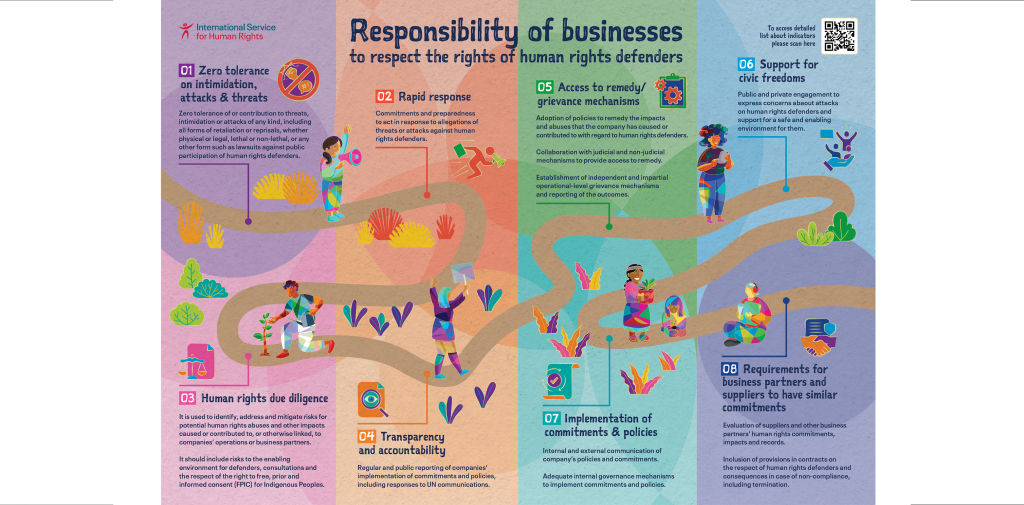
In this same spirit, ISHR is launching a set of Indicators on Business and Human Rights that cover the following areas:

  • Zero tolerance on intimidation, attacks and threats against HRDs
  • Human rights due diligence
  • Transparency and accountability
  • Access to remedy/grievance mechanisms
  • Support for civic freedoms
  • Requirements for business partners and suppliers to have similar commitments

The indicators come in list and poster form. ISHR has also produced a ‘snapshot’ of the UN Working Group’s Guidance on ensuring respect for human rights defenders, in the form of an explainer, available in multiple languages. 

We created a wonderful “Responsibility of businesses” roadmap poster for you. It shows the important steps to take on the journey to a responsible business, respecting the rights of human rights defenders amongst all people. You can download it in poster size print quality in the download section and print it yourself to go on your office wall, to remind everyone about the little steps and big responsibility to take everyday.

https://ishr.ch/defenders-toolbox/resources/business-and-human-rights-indicators

Defending Defenders: Challenging Malicious Lawsuits in Southeast Asia

June 8, 2020

SLAPPs on the increase

shutterstock_1049504825

The work of human rights defenders (HRDs) to expose harm by companies around the world has never been more important, but the space to do so is increasingly under threat as unscrupulous companies and governments around the world use the legal and judicial system to harass critics.

Logo

Strategic Lawsuits Against Public Participation (SLAPPs) are a powerful tool to silence by forcing defendants in a costly fight for their freedom of expression and their organisations’ existence. This year’s Corporate Legal Accountability Annual Briefing by the Business & Human Rights Resource Centre provides an in-depth analysis of nine emblematic case studies from Southeast Asia, and outlines the legal framework in which these lawsuits are brought, including emerging anti-SLAPPs regulation. The briefing also examines the legal and other tactics companies have used to silence HRDs; and analyses the legal strategies that lawyers have employed to successfully defend against SLAPPs while highlighting the role that courts have played in the region in either allowing or dismissing SLAPPs.

Key Findings

  • SLAPPs take place in a broader context of judicial harassment. 40% of all attacks on business-related HRDs globally [2015-2019] were judicial harassment, with numbers growing at an annual rate of 48%.
  • Judicial harassment appears to be the tactic of choice deployed by businesses operating in Southeast Asia to punish or silence defenders. Nearly half (44 %) of all attacks against HRDs in South East Asia constitute judicial harassment.
  • We recorded 127 cases of judicial harassment against HRDs in Southeast Asia between 2015 and 2019, including at least 30 SLAPPs, making Southeast Asia one of the most dangerous regions in the world for HRDs facing such threats.
  • In order to effectively fight SLAPPs in Southeast Asia and globally, we need robust legal frameworks that prevent companies from filing SLAPPs in the first place and allow courts to identify, call out and dismiss them as soon as they are filed. To make this happen, governments, businesses and investors, alongside defenders and civil society (and the lawyers who defend them), need to act decisively for the protection of civic freedoms and human rights defenders.

See also: https://humanrightsdefenders.blog/2020/01/28/ngos-demand-that-rules-against-strategic-lawsuits-against-public-participation-slapp-are-upgraded/

Full Briefing

Honduran defender Iris Argentina Álvarez killed by private security guards

April 22, 2020

With all eyes on the pandemic it is easy to forget that “violence as usual” continues against human rights defenders. Here one case:

Human Rights Defender, Iris Argentina Álvarez, was killed on 2 April 2020, by private security agents from the company CRAE´S, employed by the La Grecia Sugar Mill. Her murder took place during a violent, illegal eviction in the Los Chanchos section of Marcovia, Choluteca in the South of HondurasCommunity witnesses report that National Police officers were in the area when the aggressors opened fire against several families with many children. They affirm that the police did absolutely nothing to stop the violence that ended the life of the defender and left two other people wounded, including an underage child.

The Business and Human Rights Resource Centre attempted to contact La Grecia sugar mill but was not succesful and CRAE´S private security company did not respond.

See also: https://humanrightsdefenders.blog/2019/07/25/four-honduran-woman-human-rights-defenders-say-why-funders-need-to-prioritize-social-movmements/

https://im-defensoras.org/2020/04/whrdalert-honduras-defender-killed-by-security-agents-in-violent-illegal-eviction/


https://www.business-humanrights.org/en/honduras-defender-iris-argentina-álvarez-killed-by-private-security-guards-from-the-company-crae´s-employed-by-the-la-grecia-sugar-mill-the-companies-did-not-respond?mc_cid=4f7a17b150&mc_eid=81043e761b

How can companies take concrete actions to protect human rights defenders?

September 19, 2018

Published a few days ago by the Business & Human Rights Resource Centre and the International Service for Human Rights, this new guidance was commissioned by the Business Network on Civic Freedoms and Human Rights Defenders, seeking to encourage companies to focus on an increasingly inescapable agenda.

‘Shared space’ under pressure

..Data from around the world shows there is a concerted attack in many countries on the essential freedoms and the rule of law on which business and civil society depend. And the defenders and organisations who expose the risk of abuse by companies in their operations and supply chains are under particular attack. Business and civil society operate in and benefit from a ‘shared space’ defined by common, fundamental elements. The rule of law and freedom of expression, association and assembly are essential to the realisation of all human rights, to good governance and accountable institutions. These elements are also critical to stable, profitable and sustainable business environments in which companies thrive and economies prosper. Yet this shared space is as much an ideal as it is a reality.

The strength of the shared space is tested by a history and legacy of mistrust between elements of civil society and business, especially between multinational corporations in certain industries and local communities in the Global South. This mistrust is reflected in actions, whether intentional or inadvertent, by individual companies and even entire industries to undermine civic freedoms and to undercut human rights defenders. It shows up in conflicts and confrontations in almost every region. Yet standards and practices have evolved over the last two decades to encourage or require companies to respect human rights – however incompletely and inconsistently. Moreover, engagement and consultation of companies with local communities and stakeholders are leading to solutions in conflicts in ways that encourage further progress. ‘The time is now for responsible business to act to defend civic freedoms and protect human rights defenders’, said Michael Ineichen, Programme Director at ISHR…

Guidance for companies

But why, when and how should business engage on this urgent agenda? This guidance represents a major step forward towards business action. It is a practical guide to realistic action by responsible companies, investors, industry associations and business leaders. It is informed by pragmatism and the principles of freedom and fair play. It is also the result of over 90 interviews with business leaders, investors, civil society advocates and other international experts who gladly offered their insights.

The document elaborates on why business should be compelled to join civil society and human rights defenders in resisting the crackdown on their work by:

  • Providing the complementary normative framework, business case and moral considerations which all encourage companies to support civic freedoms and defenders under threat;
  • Elaborating on the main elements of the business case to protect defenders, namely the business interest to secure the shared space, to manage operational and reputational risks, to build competitive advantage, and to secure a social license to operate;
  • Outlining a decision framework that is both analytical and operational to determine whether and how to act in various circumstances.

Authored by Bennett Freeman, a leader and innovator in the business and human rights  field for two decades, the guidance intends to further push the thinking and debate on how we can forge new alliances to counter the attacks on civic freedoms and human rights defenders and hold open these precious shared spaces. The Business & Human Rights Resource Centre and the International Service for Human Rights look forward to deeper and more powerful collaboration with business and stronger alliances with civil society partners through the publication of this guidance.

Download the full guidance – Shared space under pressure: business support for civic freedoms and human rights defenders

Download an executive summary – Shared space under pressure: Executive Summary

see also: https://humanrightsdefenders.blog/2017/03/09/2017-9-business-can-be-better-allies-of-human-rights-defenders/

London discussion on business and human rights defenders on 14 July

June 28, 2015

The International Service for Human Rights [ISHR] and the Business & Human Rights Resource Centre [BHRRC] organize a well-stocked panel on “Business and the protection of human rights defenders” on 14 July 2015 (12h30-14h30) in London: DLA Piper, 3 Noble Street, London. RSVP by Friday 10 July. The discussion.. Read the rest of this entry »

Companies speaking out on human rights: less rare but not enough

June 17, 2015

On 17 June 2015 Open Democracy carried an article by Mauricio Lazala (Deputy Director at Business & Human Rights Resource Centre) and Joe Bardwell (Corporate Accountability and Communications Officer at the same) under the title: “What human rights?” Why some companies speak out while others don’t.”

It states that many companies nowadays speak out for human rights when it relates directly to their operations, but not to take a stand on broader human rights issues. It opens with the case of Formula One in Azerbaijan (Bernie Ecclestone, on the country’s human rights record,: “I think everybody seems to be happy. Doesn’t seem to be any big problem there.”

Companies tend to see the risks outweighing the benefits of publicly speaking out. The greater the leverage, the greater the risk, and the greater the reluctance to speak out. For example, earlier this year, Leber Jeweller, Inc., Tiffany & Co. and Brilliant Earth released statements calling on the Angolan government to drop charges against Rafael Marques, a journalist on trial for defamation after exposing abuses in the diamond industry, but none of these companies actually had operations in Angola. In fact, ITM Mining, who does have operations in Angola, pressed their case forward even when settlement with other parties looked likely.

Even where a company has significant leverage over a government, it might be reluctant to use this to further human rights. BP, for example, is the largest foreign investor in Azerbaijan, investing billions each year. Asked to respond to human rights concerns around its sponsorship of the European Games (being  held in Azerbaijan in June 2015), BP replied that it does “not believe that seeking to influence the policies of sovereign governments could be considered to be a part of our role as a sponsor of the European Games”. Of course, as David Petrasek said, BP would certainly seek to ‘influence the policies of sovereign governments‘ when the company’s interests are at stake.

Where the protection of human rights clashes with business interests, even some companies with strong human rights commitments show disregard for them. Earlier this year, 31 Swedish companies released a letter highlighting their concerns around statements by the Swedish Foreign Minister, Margot Wallström, criticizing Saudi Arabia’s human rights record. The Swedish companies called for the protection of economic relationships over these human rights considerations.

The article list some cases of companies speaking out:

  • In January 2014, clothing companies sourcing from Cambodia, including Adidas, Columbia, Gap, H&M, Inditex, Levi Strauss and Puma, condemned the government for its violent crackdown on striking garment workers that resulted in deaths and injuries.
  • In March 2013, in Peru, six US textile firms urged the Peruvian Government to repeal a law that condoned labour rights violations, making it difficult for them to implement their own sourcing codes of conduct.
  • And in 2009, in response to the coup in Honduras, major apparel companies called for the restoration of democracy. 
  • In the ICT sector, Google pulled out of China in 2010 over censorship attempts.
  • In the food sector, two Thai seafood associations provided the bail for rights activist Andy Hall, who was imprisoned and charged in 2014 following his investigations into abuses of migrant workers in the food industry.
  • In March of this year, 379 businesses and organizations submitted a public statement to the US Supreme Court in support of same-sex marriage, including corporate behemoths such as Coca-Cola, Goldman Sachs, Microsoft and Morgan Stanley.
  • And in the last couple years, hundreds of companies have publicly expressed their support for the peace process between the Colombian Government and the FARC guerrillas, when in the past most companies in Colombia kept a very low profile in relation to the armed conflict.
  • More recently, civil society has called on FIFA sponsors to respond to human rights concerns at construction sites for the Qatar 2022 World Cup. So far, Adidas, Coca-Cola and Visa have issued statements supporting workers’ rights in the country.

A “business case” to support tolerant and open civic spaces is not too difficult to make. Businesses clearly benefit when the rules of the game are clear, consumers are empowered, employees are respected, and the judicial system works well. Where human rights thrive and defenders are protected, companies will also find it easier to comply with their own codes of conduct and meet their public commitments to human rights.

Speaking out for human rights could even help companies. Firms in the US are discovering that taking an enlightened public stance on social justice issues hasn’t hurt their bottom line and makes business sense—it helps attract and retain new customers and the best staff. Investors are also increasingly looking at the social and environmental records of companies, and companies needing access to multilateral banks and export credit agencies need to comply with strict international standards. And sometimes businesses just don’t want the bad press that comes with being associated with a repressive government.

Companies can be a powerful voice in the protection of the vulnerable in repressive countries, particularly where abuses are taking place linked to their industry and when they are major investors. Unfortunately, many companies remain unwilling to speak out for human rights, especially when they think that doing so might hurt them financially. However, a few brave companies are helping to create and expand “enabling environments” for human rights. Perhaps they can set a new trend for companies speaking out to protect civic 


“What human rights?” Why some companies speak out while others don’t | openDemocracy.