The 2024 Asia Democracy and Human Rights Award (ADHRA) will be awarded to Odhikar in recognition of “the civil and political rights advocacy they have carried out and expanded in Bangladesh for three decades, despite challenges such as harassment, imprisonment, and surveillance,” TFD said in a press release.
It is hoped that the award will “encourage their work and those in the same field” so they “realize their efforts and perseverance have not gone unnoticed,” said the TFD, a nonprofit organization funded by Taiwan’s government.
Founded in 1994, the group has “deepened democracy and human rights in Bangladesh” through research, advocacy, and training, as well as government oversight efforts, the foundation said.
Odhikar, which means “rights” in Bengali, was founded by human rights activist Adilur Rahman Khan, who currently serves as the group’s secretary.
According to its website, Odhikar’s principal objectives include raising awareness of human rights and its various abuses, and promoting a vibrant democratic system through election monitoring in Bangladesh.
The Bengali group has issued annual reports since 1996 that document human rights abuses, extrajudicial killings, involuntary disappearances and other violations, the TFD said.
The TFD also highlighted Odhikar’s role in urging the Bengali government to ratify the Rome Statute for the International Criminal Court in 2010, which subsequently led the country to contribute to investigations into the persecution of the Rohingya people.
TFD’s award ceremony will be held in Taipei on Dec. 10, the foundation said, adding that the award winner would receive a trophy and a grant of US$100,000.
On the 26th to 28th July 2024, six student human rights defender namely: Nahid Islam, Abu Bakar Majumder,Asif Mahmud,Sarjis Alam,Hasnat Abdullah, and Nusrat Tabassum reportedly have been arbitrarily detained under custody of Dhaka Metropolitan Police’s (DMP) Detective Branch (DB) and coerced to announce the withdrawal of their protest programmes through a video message sent to media from the DB office at around 8:00 PM on 28 July 2024.
Nahid Islam, Abu Bakar Majumder, Asif Mahmud, Sarjis Alam, Hasnat Abdullah, and Nusrat Tabassum are students and dedicated human rights defenders and National Coordinators of the Students Against Discrimination Movement. Nahid Islam is from the Sociology Department, Abu Bakar Majumder from the Geography Department, Asif Mahmud from the Linguistics Department, Sarjis Alam is affiliated with the Zoology Department, Hasnat Abdullah is from the English Department, and Nusrat Tabassum is from the Political Science Department of Dhaka University.
Students Against Discrimination Movement is a student led protest demanding reform of the present quota system in government jobs. A total 56 percent of first and second class government jobs in Bangladesh entailed quotas. 30 percent of the total reserved for the descendants of ‘freedom fighters’. This quota has been widely criticised especially by the students, stating that it create a discriminatory system and allegedly used to recruit students affiliated with the ruling party. Following widespread protests in 2018, the Government of Bangladesh abolished all quotas with an executive order. However, on 5 June 2024, the High Court ordered the Government to reinstate the quota with the power of any adjustment they want to make.
Since 01 July 2024, the protests have escalated in several university campuses.The protests was met with a severe crackdown from the authorities involving ruling party goons, police and paramilitary forces from Rapid Action Battelion (RAB) and Border Guard Bangladesh (BGB). It has reportedly resulted in the deaths of at least 250 people with thousands more injured. With the internet shutdown for almost a week, suspicion remains about many more killings. Since 18 July 2024, local media reported over 10000 people, including many students been arrested in a mass arrest spree.
On 28 July 2024, at around 5:00 AM, woman human rights defender Nusrat Tabassum from Dhaka University had been reportedly picked up by individuals claiming to be from Dhaka Metropolitan Police’s DB at her cousin’s home in Mirpur.
On 27 July 2024, two more student human rights defenders Sarjis Alam and Hasnat Abdullah were picked up and brought to the DB office. The Additional Commissioner of the DB claimed in a press conference that the student human rights defenders have been brought to their custody to ensure their safety, however the comissioner did not clear it whether they have been arrested. While the family members were not allowed to even enter into the DB office on 28 July 2024, they were allowed to meet the students on 29 July – only after their video message of withdrawal of their protest program been covered in media.
On 26 July 2024, at around 4:00 PM, human rights defenders Nahid Islam, Asif Mahmud and Abu Bakar Majumder were forcefully taken from Gonoshasthaya Kendra Hospital by the police in plainclothes in Dhaka and taken to custody of the Dhaka Metropolitan Police’s DB. Nahid and Asif were undergoing treatment Gonoshasthaya Kendra Hospital while Abu Bakar was accompanying them. Police also took away their phones.
Front Line Defenders condemns the arbitrary detention and coercion of student human rights defenders Nahid Islam, Abu Bakar Majumder, Asif Mahmud, Sarjis Alam, Hasnat Abdullah, and Nusrat Tabassum by the Dhaka Metropolitan Police in an attempt to repress their human rights work and target legimate students protests in Bangladesh.
Front Line Defenders urges the relevant authorities in Bangladesh to:
Immediately and unconditionally release Nahid Islam, Abu Bakar Majumder, Asif Mahmud, Sarjis Alam, Hasnat Abdullah, and Nusrat Tabassum.
Ensure the physical and psychological safety and well-being of Nahid Islam, Abu Bakar Majumder, Asif Mahmud, Sarjis Alam, Hasnat Abdullah, and Nusrat Tabassum while they remain in custody.
To secure their immediate access to their families, legal representation, and any medical care they may require.
End to all forms of harassment, intimidation, and arbitrary detention of student human rights defenders in Bangladesh. The rights to freedom of expression, assembly, and association must be respected and protected.
Conduct independent and transparent investigation into the arbitrary detention and coercion of these student human rights defenders.
AFP on 25 January, 2024 reported that UN experts urge Bangladesh to carry out major human rights reforms to reverse “repressive trends” following controversial elections that were boycotted by the opposition.
Bangladeshi Prime Minister Sheikh Hasina was sworn in for a fifth term on January 11. Her ruling Awami League party won nearly three-quarters of elected seats in parliament, with allied parties and friendly independent candidates making up nearly all the remainder.
Hasina has presided over breakneck economic growth in a country once beset by grinding poverty, but her government has been accused of rampant human rights abuses and a ruthless crackdown on dissent.
The UN experts said they were “alarmed” at reports of “widespread attacks, harassment and intimidation of civil society, human rights defenders, journalists and political activists, which marred the recent elections”. See also my earlier posts on Bangladesh: https://humanrightsdefenders.blog/tag/bangladesh/.
The experts called on the Government to:
Immediately and unconditionally release all civil society and political activists detained without charge or on charges inconsistent with international human rights law; and ensure fair public trials in accordance with international human rights standards for those charged with criminal offences.
Institute urgent and substantial reforms to guarantee the integrity and independence of the judicial system.
Guarantee the free and unobstructed exercise of freedom of expression, association and peaceful assembly, refrain from imposing undue restrictions on protests and political rallies, and ensure effective accountability for serious violations of these fundamental freedoms.
Respect the independence, freedom, diversity, and pluralism of the media, and ensure the safety of journalists from threats, physical and online violence, or judicial harassment and criminal prosecution for investigative and critical reporting.
The CIVICUS Monitor, which tracks freedom of association, peaceful assembly and expression in 198 countries and territories, announced in a new report – “People Power Under Attack 2023” – that almost one third of humanity now lives in countries with ‘closed’ civic space.
This is the highest percentage –30.6% of the world’s population– living in the most restrictive possible environment since CIVICUS Monitor’s first report in 2018. Meanwhile, just 2.1% of people live in ‘open’ countries, where civic space is both free and protected, the lowest percentage yet and almost half the rate of six years ago.
“We are witnessing an unprecedented global crackdown on civic space,” said CIVICUS Monitor lead researcher Marianna Belalba Barreto. “The world is nearing a tipping point where repression, already widespread, becomes dominant. Governments and world leaders must work urgently to reverse this downward path before it is too late.”
The CIVICUS Monitor rates each country’s civic space conditions based on data collected throughout the year from country-focused civil society activists, regionally-based research teams, international human rights indices and the Monitor’s own in-house experts. The data from these four separate sources are then combined to assign each country a rating as either ‘open,’ ‘narrowed,’ ‘obstructed,’ ‘repressed’ or ‘closed.’
Seven countries saw their ratings drop this year. These include Venezuela and Bangladesh, each now rated ‘closed’ due to intensifications of existing crackdowns on activists, journalists and civil society.
Democratic countries slipped too. Europe’s largest democracy, Germany, fell from ‘open’ to ‘narrowed’ amid protest bans and targeting of environmental activists. Bosnia & Herzegovina also declined to ‘obstructed,’ the twelfth European country downgraded since 2018.
One of 2023’s most dramatic slides occurred in Senegal, once considered among West Africa’s most stable democracies. Senegal entered the ‘repressed’ category amid sustained government persecution of protesters, journalists and opposition ahead of February elections.
“The range of countries where authorities restricted citizen participation in 2023 shows clampdowns are not isolated incidents but are part of a global pattern,” said Belalba. “A global backslide requires a global response. If citizens are not able to freely gather, organise and speak out, the world will not be able to solve inequality, confront the climate crisis and bring an end to war and conflict.”
CIVICUS Monitor data shows that worldwide, authorities target people’s freedom of expression above all else. Half of all documented violations in 2023 targeted free speech, with incidents ranging from a bombing outside a journalist’s house in Indonesia, the arrest of the head of a radio station in Tunisia and police pepper-spraying a reporter covering a protest in the United States.
Our research also reveals that intimidation is the number one tactic to restrict citizen freedoms. Human rights defenders, activists and media experienced intimidation in at least 107 countries. Media in particular bear the brunt, with 64% of incidents targeting journalists.
Despite these alarming trends, People Power Under Attack 2023 highlights areas of progress too. Timor-Leste’s civic space moved up to the second best rating ‘narrowed’ from ‘obstructed,’ reflecting the country’s commitment to fundamental freedoms. Four other countries saw ratings improve, though they remain in ‘repressed’ or ‘obstructed’ zones.
The report also details bright spots where countries made steps toward opening societies. Among these, Fiji repealed a restrictive media law. The Kenyan courts recognised the right of LGBTQI+ people to associate. Even Tajikistan, rated ‘closed,’ created a national human rights strategy with civil society input. Still, these and other improvements remain halting and often disconnected compared to widespread repression.
“These small steps show that even amid unprecedented restrictions, civil society is pushing back,” said Belalba. “These courageous acts of resistance by active citizens and civil society organisations give us hope that the downward trend is not permanent and can be reversed.”
On 14 September 2023 the Cyber Tribunal, Dhaka sentenced to two years imprisonment Odhikar’s Secretary Adilur Rahman Khan and Director ASM Nasiruddin Elan for allegedly breaching Section 57 of the Information and Communication Technology Act 2006. They were charged for releasing a report on extrajudicial killings committed on 5 and 6 May 2013, centering around the Hefazat-e-Islam protests.
Immediately, 39 organizations in a joint call said that Bangladesh should quash their convictions, and end all reprisals against them and other human rights defenders for their legitimate human rights work. The Bangladesh Government has persistently targeted and launched a smear campaign against Khan and Elan, the secretary and director, respectively, of prominent Bangladesh human rights organization Odhikar. Following the 2013 publication of Odhikar’s fact-finding report documenting extrajudicial killings during a protest, both defenders were arbitrarily detained; Khan for 62 and Elan for 25 days. After being released on bail, they continued to face prosecution and judicial harassment on trumped-up allegations that their 2013 report was “fake, distorted, and defamatory.”
After the Government reopened the examination of witnesses and presented additional prosecution witnesses in July and August 2023, the judge convicted Khan and Elan to two years in prison and a fine of 10,000 Bangladeshi Taka (equivalent of USD$91.17).
Human rights defenders should be allowed to conduct their necessary and important work without fear of harassment, intimidation, and reprisals. Instead of prosecuting and punishing those who document and expose human rights violations, the Government should investigate and hold the perpetrators of these violations accountable.
List of signatories:
Advocacy Forum Nepal
Amnesty International
Anti-Death Penalty Asian Network (ADPAN)
Asian Federation Against Involuntary Disappearances (AFAD)
Asian Forum for Human Rights and Development (FORUM-ASIA)
Asian Network for Free Elections (ANFREL)
Association of Family Members of the Disappeared, Sri Lanka
Capital Punishment Justice Project, Australia
Citizens’ Alliance for North Korean Human Rights (NKHR)
CIVICUS: World Alliance for Citizen Participation
Defence for Human Rights Pakistan (DHR)
Desaparecidos – Philippines
Eleos Justice, Monash University, Australia
Families of Victims of Involuntary Disappearance (FIND)
FIDH (International Federation for Human Rights), within the framework of the Observatory for the Protection of Human Rights Defenders
Forum ONG Timor-leste
Free Jonas Burgos Movement
HAK Association, Timor-leste
Human Rights First
Human Rights Hub
Human Rights Watch
Indonesian Association of Families of the Disappeared Families (IKOHI)
International Coalition Against Enforced Disappearances (ICAED)
International Federation of ACATs (FIACAT)
International Service for Human Rights (ISHR)
Karapatan Alliance Philippines (KARAPATAN)
KontraS (the Commission of the Disappeared and Victims of Violence)
Latin American Federation of Associations of Relatives of Disappeared-Detainees (FEDEFAM)
Legal Literacy – Nepal
Liga Guatemalteca de Higiene Mental
Madres de Plaza de Mayo – Linea Fundadora, Argentina
Martin Ennals Foundation
Nonviolence International Canada
Robert F. Kennedy Human Rights
Sindhi Foundation
The Asian Alliance Against Torture (A3T)
Torture Abolition and Survivors Support Coalition, Washington DC
We Remember-Belarus
World Organisation Against Torture (OMCT), within the framework of the Observatory for the Protection of Human Rights Defenders
Odhikar itself denounces the arrest, trial and imprisonment of these two human rights defenders and added that “It believes that justice has not been served. As an organisation Odhikar has drawn the sustained wrath of the establishment for becoming the voice of the victims of human rights violations, including those of enforced disappearances, extrajudicial killings, torture, arbitrary detention and against the suppression of free expression and assembly; and for its engagement with the United Nations Human Rights Mechanisms. Earlier the government arbitrarily deregistered the organisation. Today’s judgement is likely to have a chilling effect on human rights defenders and civil society organisations around the country.“
Human rights advocates and human rights defenders, including Nobel laureate Muhammad Yunus, are being intimidated and harassed through legal proceedings, said the Office of the High Commissioner for Human Rights (OHCHR).
UN High Commissioner for Human Rights Volker Türk calls on the Bangladeshi authorities to create a safe and enabling environment for human rights defenders and other civil society representatives to carry out their essential work for the welfare and protection of all people in Bangladesh.
“Yunus has faced harassment and intimidation for almost a decade. He currently faces two trials that carry potential prison sentences – one on charges of violating labour laws, the second for alleged corruption,” said media briefing notes on Tuesday 5 September 2023. [see: https://www.trueheroesfilms.org/thedigest/laureates/6DBC0C10-C787-488A-9063-6875D17FF051]
“While Yunus will have the opportunity to defend himself in court, we are concerned that smear campaigns against him, often emanating from the highest levels of government, risk undermining his right to a fair trial and due process in line with international standards.
The OHCHR media briefing further said the legal harassment of civil society leaders, human rights defenders and other dissenting voices, is a worrying sign for civic and democratic space in Bangladesh. “These cases also represent an important test for the independence of the judiciary in Bangladesh.”
The High Commissioner urges the judicial authorities to ensure the most rigorous review in these cases to ensure that rights to due process and fair trial are strictly and consistently applied.
The OHCHR high commissioner further said, “We are also studying closely the new Cyber Security law which has been presented to parliament to replace the problematic Digital Security Act. The new law will replace imprisonment with fines and increase the scope for bail for several offences, but it is very important that parliament address the remaining concerns to prevent any further arbitrary use of the law to suppress freedom of expression.”
On 6 July 2023 Oxfam issued a statement that it stands in solidarity with the Bangladesh Garment and Industrial Workers Federation (BGIWF), trade union leaders and all human rights defenders who stand up for workers’ rights and protect human rights.
Oxfam learned of the horrific news of the brutal murder of Shahidul Islam, a union leader who was beaten to death on June 25th for his labour rights activism in Gazipur, a major garment industry hub on the outskirts of Dhaka, Bangladesh. He was an organizer of the BGIWF for 25 years advocating for workers’ rights as a trade union organizer, and was attacked and killed for standing up for basic human rights. We mourn not only the loss of an individual but also the loss of a powerful voice that championed the rights and well-being of workers, including the right to a living wage. We extend our sincere condolences to the grieving family, friends, colleagues and allies mourning his loss.
Kalpona Akter, the president of BGIWF, said: “Shahidul mobilised thousands of workers to join unions, empowering them to become solid factory-level trade union leaders. Throughout his life, he assisted thousands of workers in receiving arrears and severance pay wrongfully denied by their employers. With workers’ needs always in mind, Shahidul and three other union leaders met on the evening of his death to discuss a peaceful resolution to a wage dispute and the Eid-ul-Azha festival bonus. He met his fate due to the industry’s ill practice to promote yellow unionism for years and the neglect of workers’ voices. This needs to stop. Let our workers be free to organize and join unions. Shahid’s contributions to the labour movement were remarkable and will be sorely missed.”
Ahmed Sharif, a union organizer who was wounded in the attack, told the Guardian “As soon as we came out of the gate, a group of assailants grabbed Islam and separated him from us. They started cursing and randomly beating us, particularly Islam, some of them were kicking him mercilessly.”
As an organisation dedicated to the fight to end poverty and injustice, we are deeply concerned by the murder of Shahidul Islam. This tragic incident highlights the vulnerability of union leaders and activists fighting for workers’ rights. Oxfam joins BGIWF in demanding a thorough investigation and ensure justice is served for the death of Islam. We further call on all brands and stakeholders to conduct ethical purchasing practices upholding human rights within their supply chain and paying a living wage. We call on the government of Bangladesh to step up their protection of trade unionists who are exercising their fundamental human rights to freedom of association and collective bargaining.
Oxfam stands in solidarity with BGIWF, raising a resounding call for justice in the case of Shahidul Islam and demanding the unwavering safety of workers, union members and human rights defenders. We stand united in their relentless struggle to defend workers’ rights at Prince Jacquard Sweaters Ltd factory and in workplaces across Bangladesh. Together we demand accountability and an end to the systemic violations that perpetuate injustice.
Background
Shahidul and his colleagues were attacked after leaving the meeting with the management of a factory named Price Jacquard Sweaters Ltd to help the workers collect their due bonuses and wages. The factory management refused to comply despite being directed by the Deputy Commissioner’s (DC) office of Gazipur District to pay the workers’ salaries.
This is not the first time BGIWF has been the victim of such a fatal attack. Eleven years ago, in April 2012, another worker leader, Aminul Islam was tortured and murdered. Aminul was also an organizer with BGIWF, a vital contributor to the nation’s striving movement to advance workers’ rights. The murders of human rights defenders exemplify the extreme measures employed to suppress freedom of association in Bangladesh.
The tragic death of Shahidul, along with countless incidents of other workers being silenced by violence and fear, highlight the urgent need for change. Brands are responsible for ethical business practices and need to ensure that their purchasing practices are not leading to exploitation and deprivation of human rights. Brands must guarantee the right to a living wage and just, safe and healthy working conditions for garment workers.
Despite legal provisions, union leaders and activists face many challenges and restrictions such as anti-union discrimination, harassment, and retaliation against union leaders and members. Additionally, labour activists have raised concerns about the composition and independence of worker participation committees in factories. Labour activists argue that these ‘yellow unions’ are established by factory owners to exert control on workers raising concerns of workers’ rights to collective bargaining and discriminatory power dynamics.
Oxfam Canada, Oxfam Australia and Oxfam Aotearoa’s What She Makes campaign aims to transform the fashion industry into a more just and equitable space by holding brands accountable for their purchasing practices and advocating for a living wage. A living wage is the minimum amount that a worker should earn in a 48-hour work week and adequately covers workers’ and their family’s basic needs, including food, water, housing, energy, healthcare, clothing, childcare, education, transportation and savings for unexpected events. We stand united with the women who make our clothes, advocating for their right to living wages, freedom of association and labour rights.
On 29 August 2022, on the occasion of the International Day of Victims of Enforced Disappearances, AFAD, FIDH, Maayer Daak and Odhikar urge the government of Bangladesh to: 1) Halt all enforced disappearances and immediately return all disappeared persons to their families. 2) Set up an independent mechanism to investigate all cases of enforced disappearances. 3) Refrain from all forms of reprisals against human rights defenders, family members of the disappeared, and civil society activists, and ensure the safety and security of victims and their families. 4) Hold all perpetrators accountable. 5) Ratify the International Convention for the Protection of All Persons from Enforced Disappearance. 6) Adopt and implement domestic legislation criminalizing enforced disappearance in line with international law.
The Asian Federation Against Involuntary Disappearances (AFAD) is a federation of human rights organizations working directly on the issue of involuntary disappearances in Asia. AFAD was founded on 4 June 1998 in Manila, Philippines and was the recipient of the 2016 Asia Democracy and Human Rights Award. See: https://www.trueheroesfilms.org/thedigest/laureates/5E526725-F43B-83FB-3B7E-2B3C56D01F60 The International Federation for Human Rights (FIDH) is the world’s oldest non-governmental human rights organization. Founded in 1922, FIDH federates 192 member organizations from 117 countries. Its core mandate is to promote respect for all the rights set out in the UDHR. http://www.fidh.org Maayer Daak is a platform of the families of victims of enforced disappearances in Bangladesh with the common goal of seeking the whereabouts of their loved ones and advocating for justice. Odhikar is a human rights organisation in Bangladesh, established on October 10, 1994 by a group of human rights defenders, to monitor human rights violations and create wider awareness. It holds special consultative status with the ECOSOC of the United Nations.
The Office of the United Nations High Commissioner for Human Rights and 11 international and regional rights organisations have demanded that the government must immediately cancel its decision to deregister rights organisation Odhikar and allow the rights organisation to function without fear of reprisal.
Ravina Shamdasani, spokesperson for the UN High Commissioner for Human Rights, said in a press briefing in Geneva statement on Friday, ‘We are concerned by the Government of Bangladesh’s decision not to approve the renewal of registration for Odhikar, a prominent and respected human rights organisation in the country’.
She said, ‘We urge the government to immediately reconsider this decision, and to ensure that Odhikar has the ability to seek full judicial review of any such determination. We are further concerned that this decision will have a chilling effect on the ability of civil society organisations to report serious human rights violations to UN human rights mechanisms.’
Odhikar has documented and reported on rights violations for many years to the Office of the UN High Commissioner for Human Rights, UN Special Procedures mandate holders and human rights treaty bodies, she mentioned in the briefing available on the website of the UN body.
Intimidation and reprisals against Odhikar have been documented since 2013, and appear to have intensified, with accusations of ‘anti-state’ and ‘anti-government’ activities, she added.
‘There has been increased surveillance of its activities in recent months. The UN Secretary-General has also raised concerns about reprisals against Odhikar over the past decade for cooperating with the UN,’ she said.
On June 5, 2022, the bureau sent a letter to Odhikar, denying its application for renewal of registration. Odhikar’s application for renewal of its registration with the NGO Affairs Bureau under the Prime Minister’s Office has been pending since 2014, she said, adding that Odhikar’s bank account was also frozen in 2014. ‘We call for Odhikar to be permitted access to its banked funds pending reconsideration of the renewal application,’ said the UN official.
Eleven international and regional human rights organisations, meanwhile, in a joint statement called on the government to immediately reverse the decision to deregister Odhikar.
‘Human rights defenders should be allowed to conduct their work without fear of reprisals, intimidation, and harassment from the authorities,’ read the statement issued by Human Rights Watch, Amnesty International, Anti-Death Penalty Asia Network, Asian Federation Against Involuntary Disappearances, Capital Punishment Justice Project, Elios Justice at Monash University, Human Rights First, International Coalition Against Enforced Disappearance, International Federation for Human Rights, within the framework of the Observatory for the Protection of Human Rights Defenders, Robert F Kennedy Human Rights and World Organisation Against Torture. {See also: https://humanrightsdefenders.blog/2022/03/17/un-experts-urge-bangladesh-to-end-reprisals-against-human-rights-defenders/]
The rights organisation in the statement said this latest development appeared to be part of a pattern of reprisals by the government against human rights organisations groups and defenders following the US sanctions against the Rapid Action Battalion on December 10, 2021. [See https://humanrightsdefenders.blog/2022/03/21/bangladesh-sanctions-seem-to-work/]
On 14 June 2022 Forum Asia in a strong statement said: FORUM-ASIA expresses its solidarity with Odhikar and calls on the Bangladeshi authorities to immediately recall the decision of rejecting Odhikar’s renewal application thereby ensuring it to carry on their human rights work. FORUM-ASIA reiterates its earlier call to repeal the Foreign Donation (Voluntary Activities) Regulation Act, 2016 as it imposes restrictions on civil society organisations’ ability to access resources.
The same day, the Asian Human Rights Commission (AHRC) and CIVICUS: World Alliance for Citizen Participation said they “are extremely alarmed by the decision of the government to arbitrarily revoke the registration of Odhikar, a leading human rights organisation in Bangladesh. This move is another blow to civil society and human rights defenders who have been facing systematic repression by the Sheikh Hasina regime.“
It is rare to come across a piece that makes such a strong case that there is a causal link between sanctions and human rights improvement…..
Azad Majumder in Online News of 20 March, 2022 reports “No Bangladesh ‘gunfight’ deaths in 100 days after US sanctions”
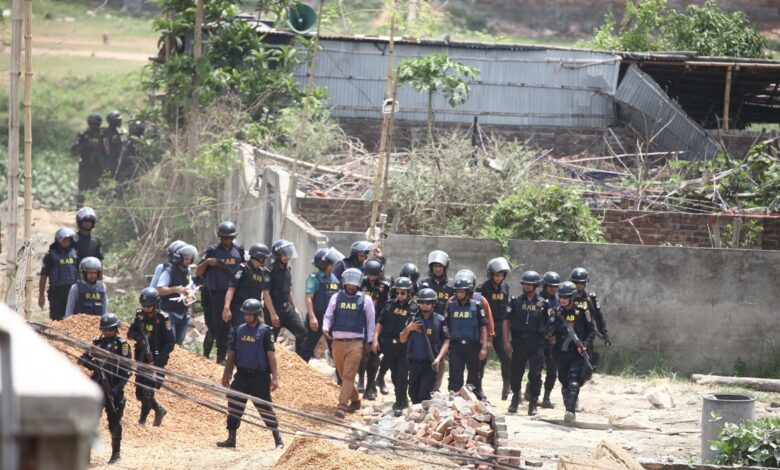
Bangladesh passed a rare 100 days on Sunday without any extrajudicial killing in the name of “gunfight” or “shootout” between law enforcers and suspected criminals. The unexpected pause in the frequent “shootout” incidents came after the United States on 10 December imposed sanctions on the country’s elite security force Rapid Action Battalion (RAB) and seven of its current and former officials, including police chief Benazir Ahmed for alleged human rights abuses.
Human rights defenders said the pause in killings in the so-called gunfights after the US sanctions showed law-enforcing enforcing agencies staged these incidents and provided false narratives.
A similar halt took place in 2020 after the killing of a retired army major in southern Cox’s Bazar district. The alleged murder sparked tension between the military force and police. The “shootout” or “gunfight” resumed slowly, causing the death of 51 people in 2021, said Bangladeshi rights group Ain o Salish Kendra (ASK).
The last such death was reported hours before the imposition of the US sanctions when a suspected “robber” was killed in a “gunfight” between RAB and “a gang of robbers” in southwest Barguna district.
“It has also proven that these incidents were neither spontaneous nor sporadic, instead it was a well-coordinated tactic of the law enforcement agencies, presumably backed by a policy decision,” Ali Riaz, a professor at Illinois State University and non-resident senior fellow of Atlantic Council, told EFE.
Riaz led a research project for the non-profit Center for Governance Studies in Bangladesh, which analyzed 591 incidents of extrajudicial killings in the country between 2019 to 2021. The research, published on Mar.12, found “gunfights” constituted 86.63 percent of such killings.
At least 4,140 people were killed in Bangladesh between 2001 and 2021 in extrajudicial killings by security forces, said human rights group Odhikar.
Riaz said US sanctions had drawn international attention to the human rights records of Bangladesh. But he feared the current pause was unlikely to sustain for long.
“There are three reasons that make it likely to resume. No punitive measures are attached to the sanctions, the US focus is likely to be shifted, and the institutional arrangements of impunity to the law enforcement agencies is not being addressed,” he said.
In the wake of UN sanctions on RAB, Bangladesh appointed a lobbyist firm in the US for a monthly fee of $20,000 with a target to remove the sanctions, deputy minister for Foreign Affairs Shahriar Alam told media in February.
Rights defenders criticized the move. They said appointing a lobbyist or public relations firm for a rosy picture of the human rights situation was not the way. “It is unfortunate that the government seems more focused on its reputation than to address the root problem robustly,” Meenakshi Ganguly, South Asia director at Human Rights Watch, told EFE.
“The government should be committed to the protection of the rights of Bangladeshis to not be arbitrarily detained, tortured, forcibly disappeared, or killed,” she said.




 Hans Thoolen on Human Rights Defenders and their awards