That there is still a lot that needs to be done in the world of sports and human rights is illustrated in the piece by Minky Worden (director of global initiatives at Human Rights Watch) in the Sydney Herald of 7 April 2019 (“Football leaders stand by as human rights abuses pile up”). Article 3 of the FIFA and AFC Statutes requires the AFC and its leaders “promote and protect
human rights”. [see also: https://humanrightsdefenders.blog/2018/12/03/fifas-second-report-on-human-rights-misses-sustainable-approach/]
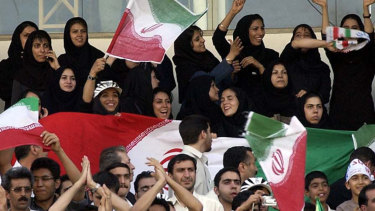
A too-rare sight … Iranian women cheer their national team in an Asian World Cup qualifying match against Bahrain in 2006. Now women resort to disguising themselves as men to enter stadiums.CREDIT:AP
..He is not the only high-level football official who may not be acting in accordance with the policy. In 2018, 20 members of Afghanistan’s women’s national team made detailed allegations to the Guardian and to FIFA of sexual and physical abuse they say they suffered at the hands of the president of the Afghan Football Federation, Keramuddin Karim, and other officials. FIFA suspended Karim for two 90-day periods and during this time he has reportedly threatened witnesses in the case. He stands accused of sexual assault, physical attacks and intimidation…. The federation general secretary, Sayed Ali Reza Aghazada of Afghanistan, was suspended, yet was also just elected to the AFC’s powerful governing body, the executive committee.
Finally, Iran’s Football Federation president, Mehdi Taj, was elevated to AFC vice-president……….On Friday, before the AFC election, Iranian women filed an unprecedented FIFA ethics complaint against Mehdi Taj, for his role in presiding over their exclusion from stadiums for years. FIFA has said clearly in its second Human Rights Advisory Board report that the stadium ban for women violates FIFA’s statutes, which say such discrimination is “punishable by suspension or expulsion”.
The AFC football leaders from Bahrain, Afghanistan and Iran are bound by the FIFA code of ethics, the FIFA statutes and the FIFA human rights policy. FIFA has made admirable progress in implementing its new policy , and could even raise the bar for other sports federations. But FIFA’s reform efforts risk derailment if the sport’s leaders in Asia refuse to uphold the new global standards. FIFA’s Gianni Infantino, up for re-election unopposed himself this year, needs to find his voice to call out football federation leaders who are undermining reforms. It is time to hold accountable those who are threatening the “beautiful game” with ugly human rights abuses.
Ahead of the Bahrain Formula One Grand Prix this weekend, Amnesty International has highlighted the grim human rights record of the country. Samah Hadid, Amnesty International’s Middle East Director of Campaigns, said: “Beneath the glamour of the F1, there is a far more sinister side to Bahrain, revealing the country as a deeply repressive state where anyone critical of the government can be jailed merely for posting a tweet. “Prominent human rights defenders are under relentless attack in the country.
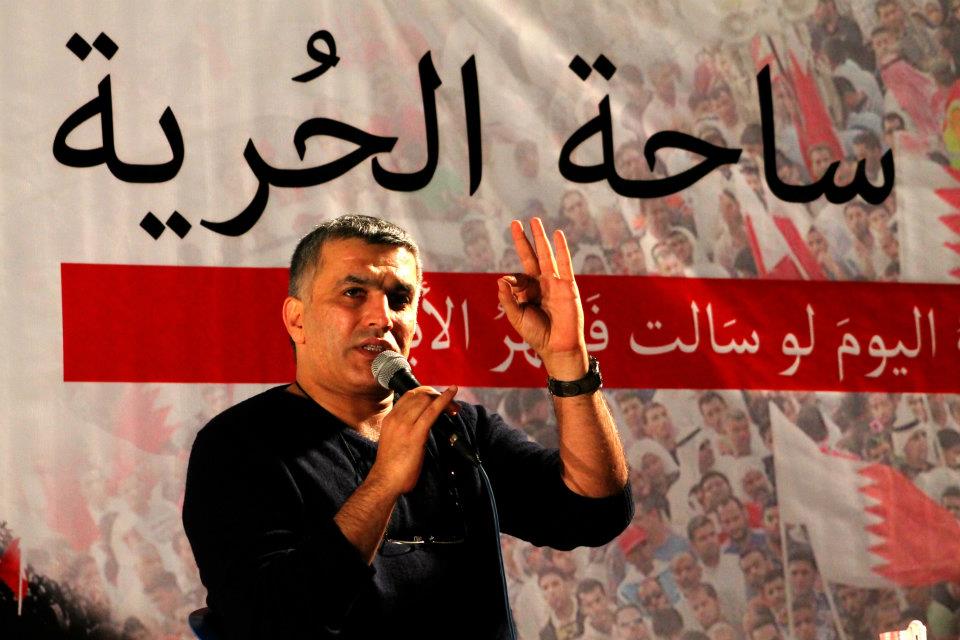
“Nabeel Rajab was shamefully convicted and sentenced to five years in prison for tweeting about the conflict in Yemen and torture allegations in Jaw Prison. “Instead of just ‘sportswashing’ its image and glossing over its dismal human rights record through high-speed sport, the Bahraini government should immediately repeal laws that criminalise freedom of expression and fast track the release of all prisoners of conscience.”
Since mid-2016, the Bahraini authorities have embarked on a systematic campaign to eliminate organised political opposition in the country. The main targets of this far-reaching repression have been human rights defenders, journalists, political activists, Shi’a clerics and phttps://www.amnesty.org.uk/press-releases/bahrain-verdict-against-sheikh-salman-another-nail-coffin-free-speecheaceful protesters…Earlier this month, Ebrahim Sharif was sentenced to six months in prison, suspended for three years, for a tweet criticising Sudanese President Omar al-Bashir. …. Bahrain has used draconian legislation such as Law No. 58 of 2006 on the Protection of Society from Terrorist Acts, the Law on Political Associations, and repressive provisions of the Penal Code including Articles 134, 160, 165, 168, 214, 215, 216 and 310, to target protesters and other critics of the government. Since 2011, more than 800 people have been stripped of their nationalities. Of those, 115 lost their citizenship following a ludicrous mass trial that relied on confessions extracted under torture.
That international’s pressure can have a good result – sometimes – is shown in today’s court order in Thailand to release Bahraini refugee footballer Hakeem al-Araibi. Bahrain dropped the extradition request, said the prosecutor working on the case.
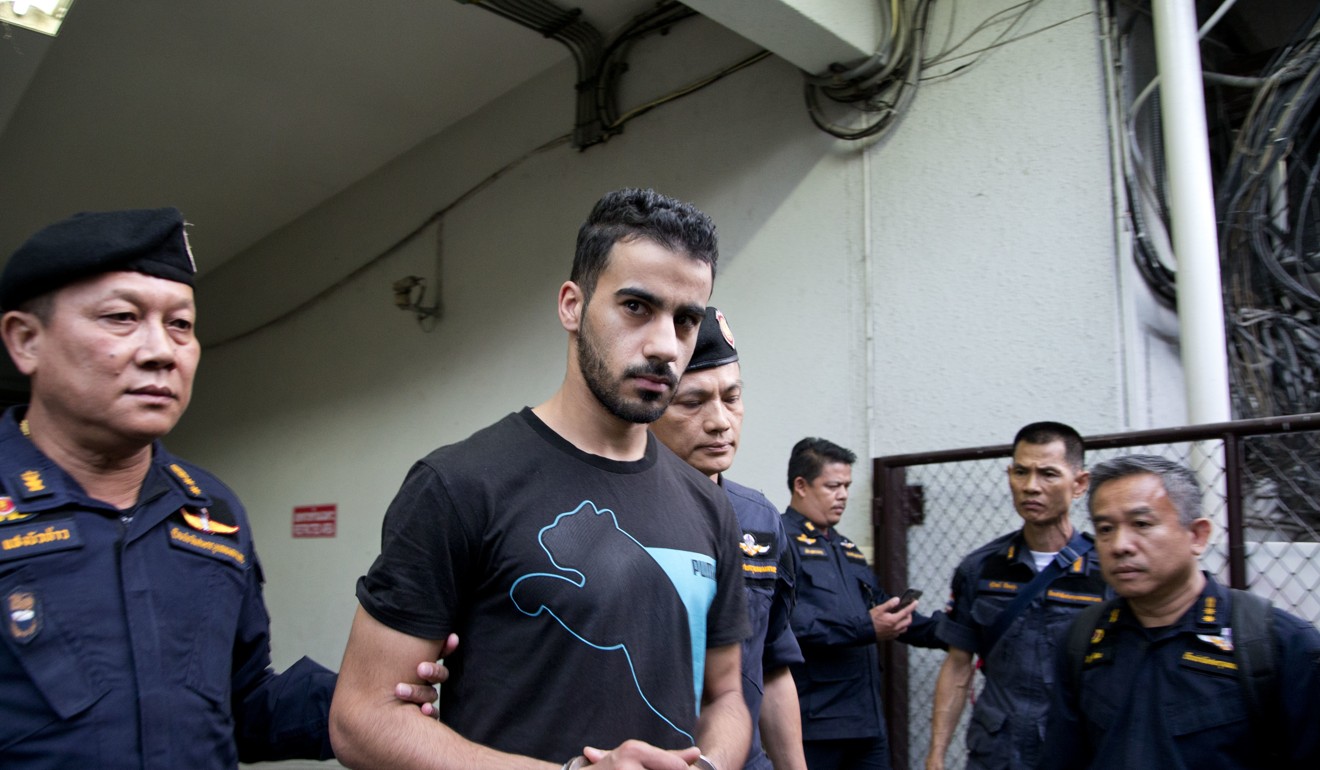
Araibi fled Bahrain in 2014 and subsequently received refugee status in Australia [Gemunu Amarasinghe/AP]
Monday’s decision comes after the 25-year-old footballer Hakeem al-Araibi was jailed for weeks in Bangkok’s Klong Prem Remand Prison. Bahrain wanted him returned to serve a 10-year prison sentence he received in absentia in 2014 for an arson attack that damaged a police station. Al-Araibi denied those charges. See also Craig Foster, Australian footballer and …human rights defender!
Al-Araibi, who fled Bahrain in 2014 and received refugee status in Australia, was arrested in November at a Bangkok airport while on his honeymoon following an Interpol notice issued at Bahrain’s request.
Australian Prime Minister Scott Morisson, meanwhile, praised the decision and said al-Araibi was on his way to the airport, where he should arrive in 12 hours from now.
“This is a huge victory for the human rights movement in Bahrain, Thailand and Australia, and even the whole world,” said Sayed Ahmed Alwadaei, director of advocacy of the Bahrain Institute for Rights and Democracy. “Let’s continue the fight to release all political prisoners who languish in Bahrain’s prisons.”
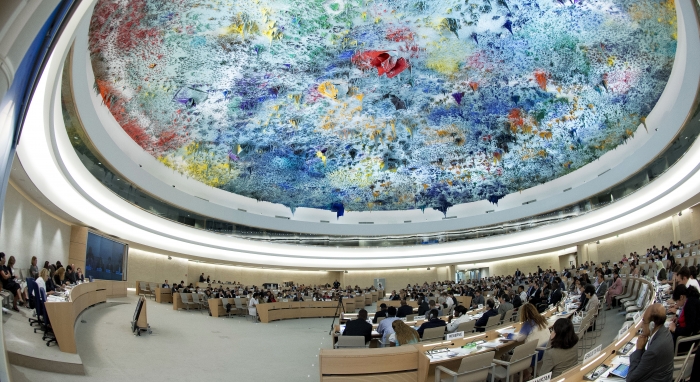
On 28 January 2019 ISHR presented a blueprint for States with recommendations to some of the key issues the Human Rights Council should address in 2019.
In 2018, the Council adopted some landmark decisions
an independent investigative mechanism on Myanmar
Yemen, renewing the mandate of the Group of Eminent Experts
Burundi, extending the mandate of the Commission of Inquiry.
At the same time, several situations of gross rights violations escaped Council scrutiny for political reasons.[see also: https://humanrightsdefenders.blog/2018/12/04/general-assemblys-3rd-committee-concludes-2018-session/]
The annual “High Level Segment” in March 2019 is a critical opportunity to set the agenda for the year. The Human Rights Council’s three regular sessions in March, June/July and September are further opportunities to advance priorities.
Here is ISHR’s checklist on the human rights situations and issues which should be advanced in 2019.
States should commit to strengthening the Council by demonstrating leadership, principled action and sustained follow through.
All regional groups presented the same number of candidates as seats for the 2018 Council elections and several States with terrible human rights records and with poor records of cooperation with UN mechanisms were elected, turning the elections into more of an appointment process, and going against the vision of the Council’s founding document.
States should collectively express concern about China’s failure to uphold human rights principles and protect the rights of its citizens, especially ethnic Uyghurs and Tibetans and those involved in the defence of human rights. China’s rejection of critical dialogue and universal principles is especially worrying as the Chinese government becomes increasingly active in the Council – a space dedicated to those same values.
States should also collectively press for the immediate and unconditional release of detained women human rights defenders in Saudi Arabia. If the international community is serious about contributing to advancing women’s rights in Saudi Arabia, it should recognise Saudi women human rights defenders as agents of change and urge the Saudi authorities to take all necessary measures to guarantee a safe and enabling environment for them to continue their vital work.
States should also initiate Council action to address recent cases of reprisals in Egypt as reported by the Special Rapporteur on the right to adequate housing after her visit in September 2018. These attacks come amidst a context of wide-scale repression against civil society through intimidation, arbitrary arrests, unfair prosecutions and travel bans.
States should collectively denounce the ongoing judicial harassment and arbitrary detention of human rights defenders in Bahrain, including reprisals for engaging or attempting to engage with UN mechanisms. As a minimum, States should call on the Bahraini authorities to immediately release all those detained for exercising their rights to freedom of expression, assembly and association, such as Nabeel Rajab and Abdulhadi Al Khawaja.
At the 40th session:
The Council will consider a resolution on the situation of human rights defenders working on rights related to land and environment. ISHR calls on States to address the particular threats and attacks against this group of defenders, in particular the specific risks faced by women human rights defenders, to combat impunity for attacks against them, and ensure full civil society participation in development and the management of natural resources. The draft resolution should call on States who prioritise the protection of human rights defenders to condition their provision of diplomatic support to business – such as export credit guarantees and trade support – on companies’ commitment to respect, consult and protect defenders. ..The Special Rapporteur on the situation of human rights defenders will present his report on the situation of women human rights defenders. States should publicly recognise the specific risks and threats women defenders face and commit to taking further measures to enhance their protection, underline the legitimacy of their work, their specific protection needs and adequate remedies to the specific violations they face.
At the 41st session:
Thanks to the sustained efforts by civil society and supportive UN Member States, the mandate of the Independent Expert on protection against violence and discrimination based on sexual orientation and gender identity (SOGI) was established in 2016. At the 41st session, ISHR urges States to renew the mandate and ensure that it is not weakened, so that it continues its vital work in capturing good practices and assisting States in ending discrimination and violence based on SOGI. The mandate continues to work with a diverse range of States from all geographical regions. Defenders from across the globe have affirmed that the mandate has contributed to their protection and recognition of their work. ..The Council will also consider a resolution on migrants and human rights. States should ensure that the text reiterates their obligations to support and not restrict defenders’ in their vital work and to protect migrant rights defenders in the face of rising intolerance, xenophobia and illiberalism. ISHR recalls Principle 18, from the OHCHR Principles and Guidelines on the human rights protection of migrants in vulnerable situations, which sets out measures States can take to respect and support the activities of migrant rights defenders.
At the 42nd session:
Human rights defenders must be able to access the UN freely and safely so that the UN can do its crucial work of monitoring countries’ compliance with human rights obligations and protecting victims from abuses. At the 42nd session in September 2019, States should not miss the opportunity to cite specific cases of reprisals at the second interactive dialogue on the Secretary-General’s annual report on reprisals….Finally, the accessibility of the Council to rights holders, victims and defenders is both a key contributor to, and indicator of, the Council’s relevance and success. As discussions on enhancing the efficiency of the Council resume, States should continue to support and guarantee that any proposed measures do not restrict or limit civil society participation at the Council.
Now the regime of SaudiArabia hopes that it can buy its way to a better image with hosting sport events and Amnesty International has warned sports stars not to become a propaganda tool. Saudi Arabia said it has hired the former England captain, David Beckham, to lead an exhibition team against his former Real Madrid teammate Zinedine Zidane. The game, to be held later this year, is part of a £60-billion re-launch of the entertainment industry in Saudi Arabia, called the National Transformation Programme. According to an article in the Sun, it would earn Beckham an estimated £1million. [Beckham also has a lifetime endorsement deal worth £120million with Adidas which I think doesn’t sit well with Adidas’ claimed stance in favor of human rights – see e.g. https://humanrightsdefenders.blog/2018/12/13/first-time-major-companies-say-that-human-rights-defenders-are-essential-for-profitable-business/].
Announcing the match in front of big screen images of the football legends, Saudi sports minister Turki Al-Sheikh said: “This is an exhibition match including two big worldwide stars – Zinedine Zidane and David Beckham playing against each other…If God wills, you will see it this year in the Kingdom of Saudi Arabia.”
The UN children’s aid group UNICEF, for whom Beckham is a goodwill ambassador, has criticised the Saudi-led coalition saying its bombing attacks there have had catastrophic consequences for the local population. Saudi Arabia has detained more than a dozen women’s rights activists such as Loujain al-Hathloul who once appeared in a Vanity Fair. Loujain’s sister, Alia, has criticised US singer Mariah Carey for playing a concert on Thursday at the King Abdullah Economic City. She said: “My own baby sister said she is being whipped, beaten, electrocuted and harassed on a frequent basis.” She stated: “Remember, thanks to my sister @LoujainHathloul, you r able to perform in Saudi Arabia. I wish she can attend your concert. But she’s locked behind bars because she tried to improve women’s condition. Don’t forget to thank her on stage,” she wrote to Carey on Twitter. [but Mariah Carey is an old hand when it comes to selling her soul: see e.g. https://humanrightsdefenders.blog/2013/12/19/mariah-carey-needs-better-informed-staff-and-donate-her-1-million-fee-to-human-rights-defenders-in-angola/].
How difficult if not impossible it is to try and separate sports and politics can be illustrated by the recent case of soccer player, Hakeem al-Araibi, a Bahrain-born soccer player for a team in Australia has been held in detention in Thailand [see https://humanrightsdefenders.blog/2019/01/02/craig-foster-australian-footballer-and-human-rights-defender/]. Hannah Beech in the NYT on 31 January 2019 puts the question “Can Big Global Sports Come Around to Human Rights Advocacy?“
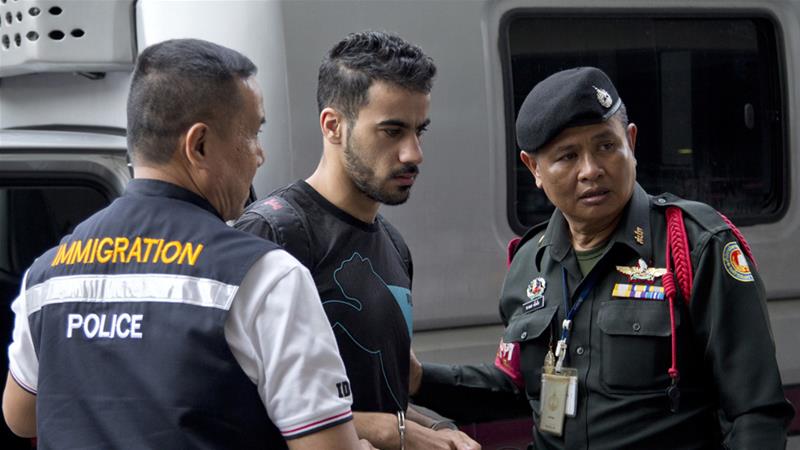
Hakeem al-Araibi, center, a former member of Bahrain’s national soccer team who has refugee status in Australia, at court in Bangkok in December.CreditCreditAthit Perawongmetha/Reuters
The global sports market is worth hundreds of billions of dollars a year. Now, this powerful industry is coming together to promote an unlikely cause: human rights. Since late November, a Bahrain-born soccer player for a minor team in Australia has been held in detention in Thailand. The player, Hakeem al-Araibi, 24, is not a famous athlete. He has no lucrative sponsors. But he has spoken out against one of the most powerful men in international soccer, who is also a member of the ruling family of Bahrain. His testimony of torture at the hands of Bahrain’s repressive government earned him refugee status in Australia, which determined that he faced credible threats of persecution should he return to the Gulf state. Still, over the past week, Mr. Araibi has collected an impressive list of supporters in the world of international sports.
Fatma Samoura, the secretary general of FIFA, has called for Thailand to return him to Australia “as a matter of urgency.”
Thomas Bach, the head of the International Olympic Committee, raised the issue with the United Nations High Commissioner for Refugees.
Praful Patel, of the Asian Football Confederation, issued a statement asking the Prime Minister of Thailand to ensure Mr. Araibi’s return to his adopted home.
[By the way, the head of the Asian Football Confederation is Sheikh Salman bin Ebrahim al-Khalifa, the Bahraini official whom Mr. Araibi accused of not stopping the persecution of athletes in his charge. Sheikh Salman also serves as a FIFA vice president.!]
Mary Harvey, the chief executive of the Center for Sports and Human Rights, said: “Hakeem is a historic test case, because it’s the first time that we’ve seen these big, powerful sports bodies all come together publicly to address the fate of a single person”. [see also: https://humanrightsdefenders.blog/2018/12/12/mary-harvey-her-goal-is-now-human-rights/]. The court ordered al-Araibi, who is in the Bangkok Remand Prison, to appear before it at 8.30am on Monday to answer whether or not he is willing to be extradited, lawyer Bergman said.
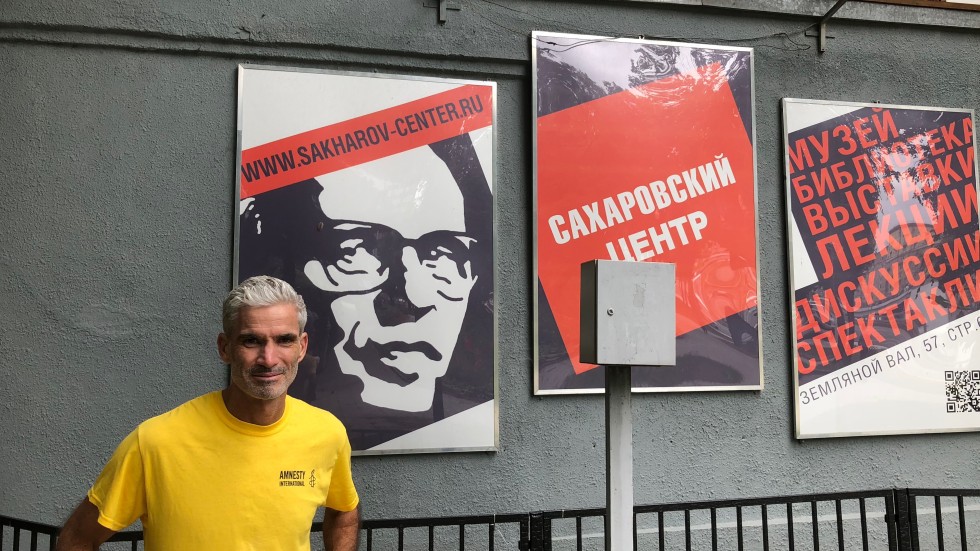
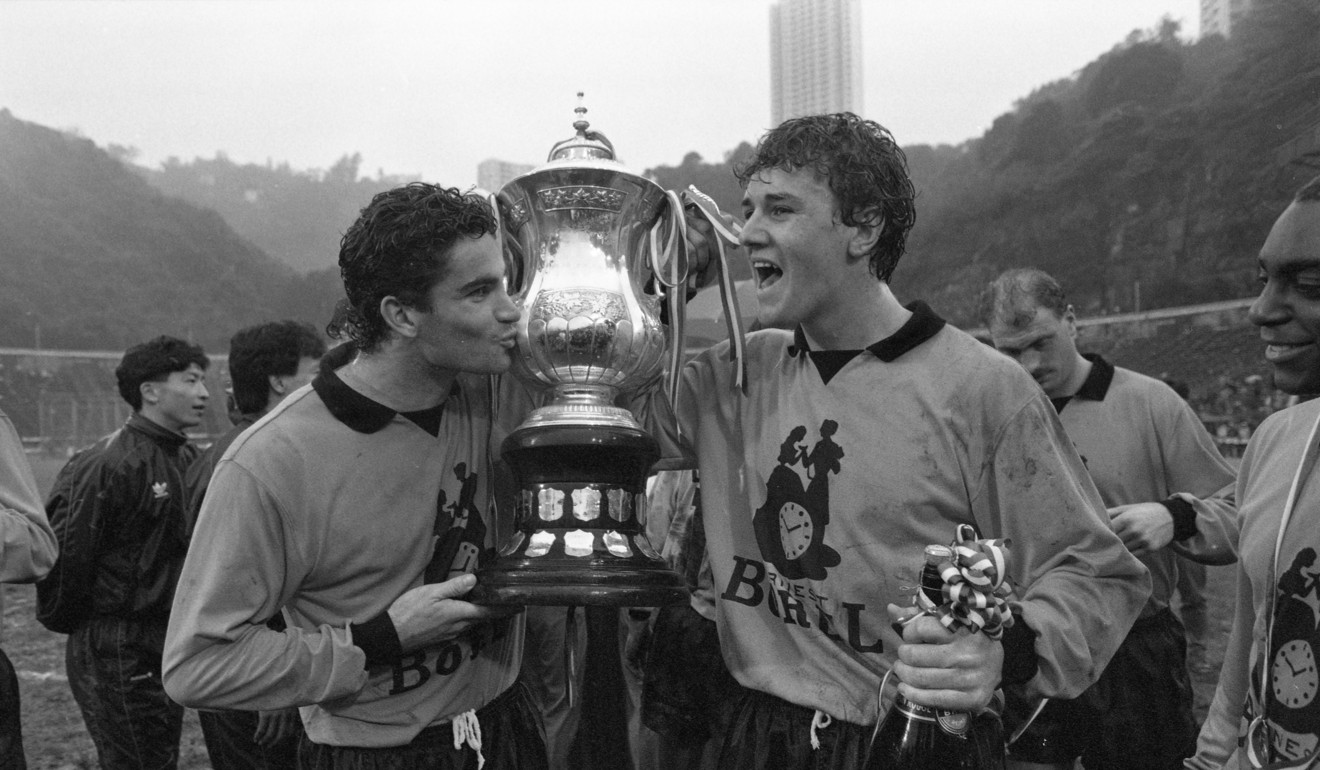
Football’s power to fight injustice motivates Craig Foster. The former Socceroos captain who played for Hong Kong’s Ernest Borel in the early ’90s is a broadcaster in Australia and also works for Amnesty International as a human rights and refugee ambassador. He is among the most vocal of activists in calling out human rights transgressions in football and sport and is one of the many prominent figures fighting for the release of Bahrain’s Hakeem al-Araibi, an Australia-based refugee footballer who is in a Thai jail awaiting extradition to his home country where he fears torture and persecution. [For some of my other posts on football and human rights, see: https://humanrightsdefenders.blog/tag/football/]
On Tuesday, 01 January, 2019, Nazvi Careem wrote a long piece about Craig Foster’s work and dedication:
And if he ever doubted just how powerful this sport can be, he only needs to recall the heartbreaking words of a young African refugee who had lost everything – fleeing his war-torn homeland after his parents, sibling and other members of his family were killed. “He was involved in a football programme over a period of time. He was very, very quiet and said very little,” said Foster. “He was in a new country and was experiencing psychological difficulties, which is totally understandable. “When he was asked why he liked the programme, he simply said: ‘The only thing that still exists in my life is football. It is the only thing that hasn’t been taken away from me’. And he was crying when he said it.
…Since retiring as a player in 2002, Foster became involved in social issues related to football, working with disadvantaged, minority and indigenous communities in a variety of programmes. “I’m just finishing my law degree, which has given me some further insight into the challenges of human rights and international refugee law. I feel strongly about these issues and in football, we are at an advantage because we are the most diverse, multicultural community in Australia.
…..Foster, who played for Portsmouth and Crystal Palace in England and also had a stint in Singapore, said he felt an obligation to give something back to the sport. As an ex-player and a broadcaster with the SBS organisation in Australia, Foster is in an ideal position to reach out to the masses. At the same time, he puts his contribution to social issues in perspective, admitting that he is in a position of comfort compared with activists whose lives are on the line in their efforts to effect change.
“Of course, you can’t fight every battle, but there are key ones which take a huge amount time. But the people I have immense respect for are the human rights defenders in their countries….In Australia we have serious human rights issues, with indigenous Australians and also in terms of refugees and arrivals.
(This article appeared in the South China Morning Post print edition as: using football to fight injustice)
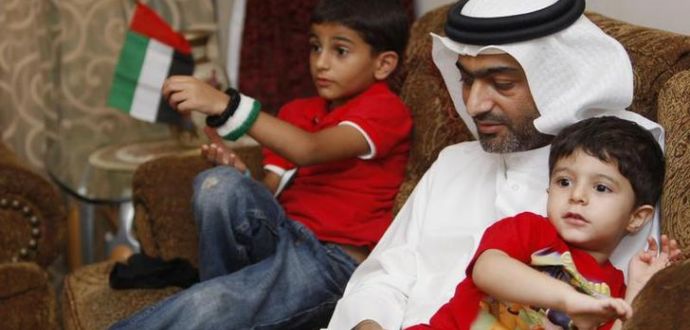
First of all I wish my readers a happy 2019. Unfortunately this year augurs badly for two human rights defenders who have figured frequently in this blog: Ahmed Mansoor [https://humanrightsdefenders.blog/tag/ahmed-mansoor/] and Nabeel Rajab [https://humanrightsdefenders.blog/2015/01/20/video-statement-of-troublemaker-nabeel-rajab-who-is-on-trial-today/]. Courts in the United Arab Emirates and Bahrain on Monday upheld the convictions of these two prominent human rights defenders serving lengthy prison terms for expressing anti-government dissent on social media. They have no right to further appeal. On 4 January 2019 there UN joined the critics of these sentences.
Human rights defender Brian Dooley and Danish MP Rasmussen were not only refused entry into Bahrain but kept in the airport without a passport, reports the Irish Independent on 4 April 2018.
Brian Dooley has been held alongside Danish MP Lars Aslan Rasmussen for more than 12 hours in Bahrain International Airport after they travelled there to visit jailed Bahraini-Danish human rights defender Abdulhadi al-Khawaja, a prominent pro-democracy campaigner in Bahrain, who founded the Gulf Centre for Human Rights and worked for the Dublin-based group Front Line Defenders. He received a life sentence in April 2011 for charges of terrorism and attempting to overthrow the government.
Brian Dooley in Bahrain alongside Danish MP Lars Aslan Rasmussen (L)
“The use of the judiciary in Bahrain to target human rights defenders and other activists” is a side eventorganised by CIVICUS and FIDH in co-operation with Americans for Human Rights & Democracy in Bahrain (ADHRB), the Gulf Centre for Human Rights (GCHR) and co-sponsored by ISHR.
It will take place on 13 March 2018 at 11:00 to 12:30 at Room XXIV. The event will address the politicisation of the judiciary to criminalise human rights defenders.
On 21 February human rights defender Nabeel Rajab, BCHR President and FIDH Deputy Secretary General, was sentenced to 5 years in prison under trumped-up charges in relation to tweets denouncing the torture against detainees at Jaw prison and exposing the killing of civilians in Yemen by the Saudi-led coalition. “This surrealistic verdict”, writes IFEX, “after a trial that was by itself a mockery of justice, illustrates once again the current crackdown on any dissenting voice in Bahrain, where scores of critics are currently jailed’.
Also the Observatory (FIDH-OMCT) and BCHR reiterate their call to the Bahraini authorities to immediately release him, as well as all detained human rights defenders.
Perhaps the most damning information comes from the Bahraini Government itself (8 March 2018) when it responded to the statement of the UN High Commissioner for Human Rights which had been ‘negative’ in his written review on the annual report on Bahrain. Dr. Yusuf Abdulkarim Bucheeri, Permanent Representative to the United Nations Office in Geneva, said in a statement that the review contained inaccurate information such as harassment of human rights defenders and other deleterious comments on the recent legal actions taken by Bahrain. ..They deliberately and unfairly side with malicious elements who have suspicious political agendas and sectarian tendencies and who want to inflict harm on the Kingdom of Bahrain and demean its achievements in the field of human rights, he said. “This is crystal clear from their support for the discourse of hatred and internal violence groups and for this reason, the Kingdom of Bahrain totally rejects the content of this statement with all the wrong and unacceptable descriptions it has given to the state.” Bucheeri said that Bahrain’s constitution stipulates the right to freedom of opinion and expression in an unquestionable manner and in a way that guarantees everyone’s right to express their opinion and disseminate it by word, writing or otherwise, but within the legal framework and without inciting division or sectarianism or undermining national security. …… He called on the Office of the High Commissioner for Human Rights to make concerted effort to understand the reality of human rights and the great challenges facing the Kingdom of Bahrain which faces terrorist acts aimed to destabilize its security and stability. The kingdom, he explained, confronts a phenomenon of violent extremism and it is the duty of the Office of the High Commissioner to do its best to double check the credibility of the information it obtained and to seek such information only from neutral, objective and non-politicized sources…
SALAM for Democracy and Human Rights launched on 23 February 2018 the “I am Bahraini”network in both Arabic and English versions. The website is meant to support and defend Bahrainis whose citizenships were arbitrarily revoked due to political and identity backgrounds. A most timely initiative in view of the horrendous numbers of Bahrainis who have been struck with this measure. See: https://humanrightsdefenders.blog/2016/06/23/bahrain-reprisals-human-rights-defenders-travel-ban-denationalization-geneva/
7 November 2012,it started with he Bahraini Minister of Interior revoking the nationality of 31 citizens, among them clerics, former MPs, academics, journalists, human rights defenders, and members of civil society. The numbers quickly escalated afterwards. Until now, human rights defenders have counted 578 Bahraini citizens whom citizenships were effectively revoked and are rendered stateless.”Citizenship is the most basic and fundamental right of every individual. One losing his/her nationality consists a social demise. One possession of citizenship should not be seen as privilege or reward for allegiance, and its revocation should not be wielded as a weapon of control and oppression. The citizenry is above government and absolutely not vice versa. Citizenship revocation only enhances the discretionary and arbitrary power of the executive authority,” said Jawad Fairooz, President of SALAM for Democracy and Human Rights, also a former Bahraini MP whose nationality has been revoked.
The website gathers all relevant content, including lists of many of the affected persons, as well as the position of both the Bahraini government and the international community. The website also aims at creating a dedicated space for the cases of revoked citizenship in Bahrain and at publishing significant data, reports and news from various human rights organizations, media and research centers that could serve as references in both Arabic and English languages.
Organizers are seeking through this network to cooperate with all interested individuals or groups. People can contact them on: info@salam-dhr.org






 Hans Thoolen on Human Rights Defenders and their awards