In a piece in the Irish Times of 27 March 2013 Mary Lawlor, Director of Front Line Defenders, makes a strong plea for the release of the medical staff arrested and ill-treated in Bahrain:
“Medical ethics is apparently too sensitive an issue to discuss in Bahrain following the cancelling of an international conference that was being organised by the Royal College of Surgeons of Ireland RCSI and Médecins Sans Frontières. Hardly surprising given that the Bahraini government jails and tortures medical professionals and human rights defenders……………..
….It is a pity that the RCSI did not feel strongly enough on the issue of medical ethics to speak out publicly when colleagues, some of whom had studied in Dublin, were being tortured in police custody in 2011………But the reality is that the government continues to jail those who raise their voices in defence of human rights. At this moment Dr Ali Al Ekri, Dr Saeed Al Samahiji and Ibrahim Al Demistani, a nurse, remain in prison having been convicted of “trying to overthrow the monarchy”, by treating injured demonstrators and speaking out about killings and torture. At the same time another 20 medics and health professionals will find out today whether the charges of participating in illegal gatherings have been upheld against them. They face the possibility of receiving a three-month prison sentence, although in practice, many of them have already spent that time in prison awaiting trial. Even those medics who have been released or who have had charges against them dropped have been removed from their posts. …. Repression in Bahrain is not a secret. Medical ethics would best be served by releasing the medics from prison together with Nabeel Rajab and all those human rights defenders who have had the courage to speak truth to power.”
Human rights group Reporters Without Borders has named and shamed five companies it claims allowed their products to be used by countries with bad human rights records and the NGO also named five countries as “enemies of the internet“. It said that five private sector companies; Gamma, Trovicor, Hacking Team, Amesys and Blue Coat are “digital era mercenaries”. The overall list of companies it believed were involved in selling products to authoritarian regimes was “not exhaustive” and will be expanded in the coming months. “They all sell products that are liable to be used by governments to violate human rights and freedom of information,” the group said.”Their products have been or are being used to commit violations of human rights and freedom of information. If these companies decided to sell to authoritarian regimes, they must have known that their products could be used to spy on journalists, dissidents and netizens.” It added that if surveillance products were sold to an authoritarian regime by an intermediary without their knowledge, “their failure to keep track of the exports of their own software means they did not care if their technology was misused and did not care about the vulnerability of those who defend human rights.” Research by Bloomberg, the Wall Street Journal and the University of Toronto’s Citizen Lab has established that surveillance technology used against dissidents and human rights defenders in such countries as Egypt, Bahrain and Libya came from western companies, it claimed.
The Paris-based group labelled Syria, China, Iran, Bahrain and Vietnam as“enemies of the internet” Read the rest of this entry »
I reported earlier that on 28 February the International Federation for Human Rights (FIDH) and the World Organisation Against Torture (OMCT), in the framework of their joint programme the Observatory for the Protection of Human Rights Defenders, organised a meeting on (legal) restrictions increasingly imposed on human rights defenders. This was followed up on 11 March with an oral intervention at the UN Human Rights Council.
The statement referred to the recently published Annual Report 2013 of the Observatory, which states that NGOs’ access to funding, in particular foreign funding, is increasingly being hindered by governments around the world. Restrictive laws combined with unfounded criticism, smear campaigns and judicial harassment directed against human rights defenders because of the source of their funding create a hostile environment towards their activities as a way to silence them. Belarusian law now prohibits any possibility for an NGO to hold a bank account in an institution based abroad, and criminalises the use of so-called unauthorised funds. These new provisions were adopted as FIDH Vice-President and “Viasna” President Ales Bialiatski was sentenced to 4.5 years’ imprisonment after he made use of foreign funds to finance human rights activities in his country. Read the rest of this entry »
In a case that was followed closely in this blog, a Bahraini human rights defender accused of sending out twitters with ‘false information’, there is finally some good news: a Bahraini court has acquitted Said Yousif Al-Muhafdah of the Bahrain Center for Human Rights (BCHR – 2012 Final Nominee of the MEA). “It’s a great relief that Said Yousif was acquitted today, bringing an end to three months of judicial harassment. Let’s hope this means the courts are beginning to show a better understanding of what freedom of expression means,” said Human Rights First’s Brian Dooley. Al-Muhafdah was arrested in December 2012 for “spreading false information on Twitter.”
His case is one in a string cases stemming from the Kingdom’s ongoing judicial harassment of human rights defenders. It followed last year’s jailing of Nabeel Rajab, President of the BCHR, and of human rights activist Zainab Al Khawaja in February 2013. “This is a small victory, but unfortunately there are many other cases of judicial harassment that continue to wind their way through Bahrain’s judicial system,” Brian Dooley noted. On March 21, the appeal of 23 medics, each sentenced to three months in prison after treating injured protestors in 2011, will continue. A verdict is expected at a date soon after. Dooley, who has authored four reports about the ongoing crackdown in Bahrain, has been forbidden access to the nation for more than a year. “This is not how a nation that wants to trumpet its human rights record treats monitors” Dooley added.
Margaret Sekaggya, UN Special Rapporteur on the situation of human rights defenders, presented her report to the Human Rights Council in Geneva. She said inter alia that the response of law enforcement authorities in Tunisia to violations against human rights defenders appears ‘unsatisfactory’ and that the lack of independence of the judiciary is also a cause for concern. “I am concerned about the considerable polarization I observed in Tunisian society between secularists and Islamists, including so-called Salafists, a divide which also transpires to civil society. All stakeholders, including the international community, should work together to ensure dialogue, understanding and respect between different parts of society.”
Ms Sekaggya also told the Human Rights Council that she’s particularly concerned about the way human rights defenders are treated in countries in the Gulf region, especially in Bahrain, Saudi Arabia and the United Arab Emirates. And on recent developments in Egypt she said that the considerable violence suffered by peaceful protesters, including gender-based violence against women human rights defenders, points to a situation that is getting out of hand.
Several NGOs continue to follow closely the development in Bahrain, sadly the subject of may posts in this blog. Here HRF’s and Frontline’s recent statements:
Human Rights First (HRF) says that this week will see a series of high profile court hearings in Bahrain, exposing the authorities continued use of judicial harassment against human rights defenders and activists. On Sunday March 3, Halima Abdulaziz al Sabag is due to hear an appeal verdict. She is a dental assistant and was sentenced to a year in prison after she was convicted for allegedly taking first aid material from the hospital where she worked to treat injured protesters. On Monday March 4, the Bahrain government will continue to press a case against leading human rights defender Said Yousif Al Muhafda of the Bahrain Center for Human Rights for information he tweeted about police using birdshot against protesters. On Tuesday March 5, the appeal of 23 medics is due to return to court. They have all been convicted and sentenced to three months in prison after treating injured protesters in 2011. “This continuing crackdown in the courts tells us more about the reality of what’s happening in Bahrain than the speeches its officials are giving to the U.N. Human Rights Council in Geneva this week,” said Human Rights First’s Brian Dooley…….. Other prominent human rights leaders, including President of the Bahrain Center for Human Rights Nabeel Rajab, remain in jail. Please contact Brenda Bowser Soder at bowsersoderb@humanrightsfirst.org or 202-370-3323.
An impressive list of 20 human rights organizations have signed a statement regarding Omani human rights defenders who are currently in detention, especially those undertaking hunger strikes. 24 defenders and activists including Basma Al-Kiyumi, Bassima Al-Rajhi, Saeed Al-Hashemi, Hamad Al-Kharusi, and Bassam Abu Qasida undertook a hunger strike on 9 February 2013 in Samail Central Prison, protesting the delayed ruling on the appeals that they brought to the Supreme Court against the judgments that were passed against them. Confirmed reports reveal that the conditions of some of the hunger strikers have deteriorated seriously to the point that some are currently at risk of death. Saeed
Al-Hashemi was transferred to the Royal Hospital in Muscat, where a neurologist examined him and confirmed that he is in urgent need of physiotherapy or surgery as a result of an injury on his right side sustained when he was beaten by unknown assailants during peaceful protests in Oman in 2011. The same reports reveal that Hamad Al-Kharusi and Bassam Abu Qasida were transferred to the jail’s clinic due to exhaustion caused by their hunger strike.These human rights defenders were incarcerated following the decisions of the Appeals Court on 5, 12, and 19 December 2012 which upheld sentences of between 6 months and 1 year in prison issued against them by the Muscat Court of First Instance in July and August 2012.
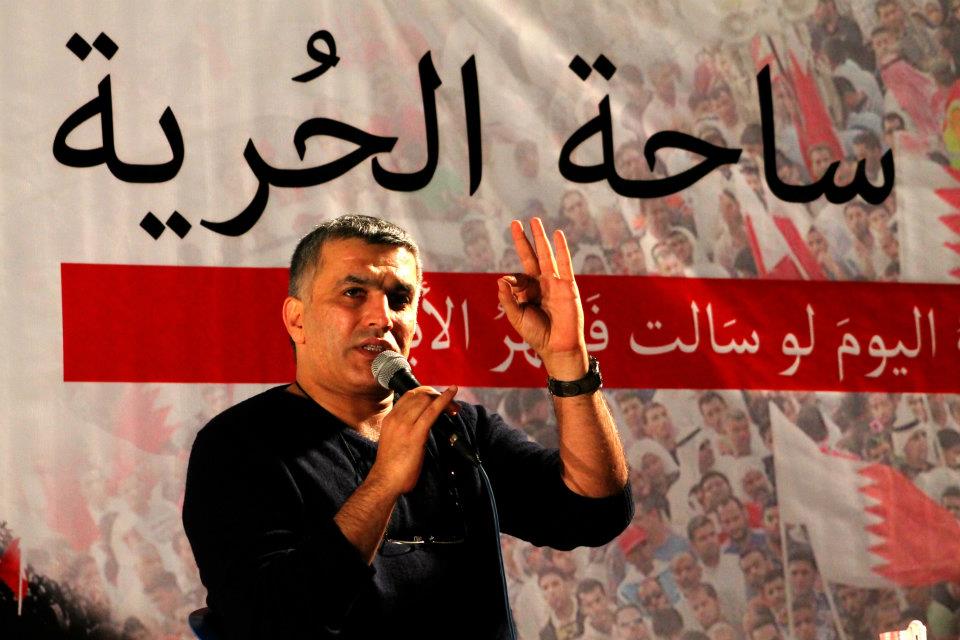
Further to yesterday’s post regarding the trial of Nabeel Rajab, I just came across an older (2012) 10-mn video clip where he speaks himself. In case you want to hear it:
The Observatory for the Protection of Human Rights Defenders, a joint programme of the International Federation for Human Rights (FIDH) and the World Organisation Against Torture (OMCT), published on 14 February 2013 a report, which presents the findings of a judicial observation mission conducted on the trial in appeal of prominent human rights defender Nabeel Rajab. The report concludes that a series of violations of the right to fair trial marred the judicial process and that Nabeel Rajab is suffering judicial harassment (and was sentenced to 2 years imprisonment) for merely advocating for and exercising the right to peaceful assembly in Bahrain. The report is available in English and Arabic.
Nabeel Rajab is President of the Bahrain Centre for Human Rights (BCHR) and Director of the Gulf Centre for Human Rights (GCHR), Deputy Secretary General of FIDH, and the BCHR was 2012 nominee for the MEA. Read the rest of this entry »
The goal of the International Centre for supporting Rights and Freedoms (ICSRF) is “the provision of legal assistance to human rights activists in all countries of the world and its commitment to establish a new generation of cadres working in the field of defense of human rights“, although strangely its website http://www.icsrf.org/ is at the moment only in Arabic and the scope of its activities seems to be restricted to the Arab-speaking world.
The creation of the new network was announced at the conclusion of a regional training course entitled “supporting skills of the defenders of human rights in the Arab countries”, held from 24 to 25 January 2013 in Kuwait with the participation of 32 participants from Kuwait, the UAE, Saudi Arabia, Bahrain and Oman including human rights organizations, human rights defenders and activists monitoring and documenting human rights violations.
The ‘Freedom – Network of Human Rights Defenders’ is established under the management of the International Centre for supporting Rights and Freedoms (ICSRF) and the members of the network will be selected from the participants who attended one of the training courses of the ICSRF or from those who work closely with the ICSRF. They will be trained on how to use international law and communication skills with media – both at the theoretical and practical level – in addition to the role of each member in monitoring and documenting violations. The ICSRF aims to create “a new generation of human rights defenders who are able to practice human rights work in a professional manner in line with the international law and the latest international developments as well as to establish a network of human rights defenders.”
Although everything points more to a regional than an international network, one can only wish them success as the Middle East is a region where Human Rights Defenders require support and freedom.