Margaret Sekaggya, UN Special Rapporteur on the situation of human rights defenders, presented her report to the Human Rights Council in Geneva. She said inter alia that the response of law enforcement authorities in Tunisia to violations against human rights defenders appears ‘unsatisfactory’ and that the lack of independence of the judiciary is also a cause for concern. “I am concerned about the considerable polarization I observed in Tunisian society between secularists and Islamists, including so-called Salafists, a divide which also transpires to civil society. All stakeholders, including the international community, should work together to ensure dialogue, understanding and respect between different parts of society.”
Ms Sekaggya also told the Human Rights Council that she’s particularly concerned about the way human rights defenders are treated in countries in the Gulf region, especially in Bahrain, Saudi Arabia and the United Arab Emirates. And on recent developments in Egypt she said that the considerable violence suffered by peaceful protesters, including gender-based violence against women human rights defenders, points to a situation that is getting out of hand.
Several NGOs continue to follow closely the development in Bahrain, sadly the subject of may posts in this blog. Here HRF’s and Frontline’s recent statements:
Human Rights First (HRF) says that this week will see a series of high profile court hearings in Bahrain, exposing the authorities continued use of judicial harassment against human rights defenders and activists. On Sunday March 3, Halima Abdulaziz al Sabag is due to hear an appeal verdict. She is a dental assistant and was sentenced to a year in prison after she was convicted for allegedly taking first aid material from the hospital where she worked to treat injured protesters. On Monday March 4, the Bahrain government will continue to press a case against leading human rights defender Said Yousif Al Muhafda of the Bahrain Center for Human Rights for information he tweeted about police using birdshot against protesters. On Tuesday March 5, the appeal of 23 medics is due to return to court. They have all been convicted and sentenced to three months in prison after treating injured protesters in 2011. “This continuing crackdown in the courts tells us more about the reality of what’s happening in Bahrain than the speeches its officials are giving to the U.N. Human Rights Council in Geneva this week,” said Human Rights First’s Brian Dooley…….. Other prominent human rights leaders, including President of the Bahrain Center for Human Rights Nabeel Rajab, remain in jail. Please contact Brenda Bowser Soder at bowsersoderb@humanrightsfirst.org or 202-370-3323.
An impressive list of 20 human rights organizations have signed a statement regarding Omani human rights defenders who are currently in detention, especially those undertaking hunger strikes. 24 defenders and activists including Basma Al-Kiyumi, Bassima Al-Rajhi, Saeed Al-Hashemi, Hamad Al-Kharusi, and Bassam Abu Qasida undertook a hunger strike on 9 February 2013 in Samail Central Prison, protesting the delayed ruling on the appeals that they brought to the Supreme Court against the judgments that were passed against them. Confirmed reports reveal that the conditions of some of the hunger strikers have deteriorated seriously to the point that some are currently at risk of death. Saeed
Al-Hashemi was transferred to the Royal Hospital in Muscat, where a neurologist examined him and confirmed that he is in urgent need of physiotherapy or surgery as a result of an injury on his right side sustained when he was beaten by unknown assailants during peaceful protests in Oman in 2011. The same reports reveal that Hamad Al-Kharusi and Bassam Abu Qasida were transferred to the jail’s clinic due to exhaustion caused by their hunger strike.These human rights defenders were incarcerated following the decisions of the Appeals Court on 5, 12, and 19 December 2012 which upheld sentences of between 6 months and 1 year in prison issued against them by the Muscat Court of First Instance in July and August 2012.
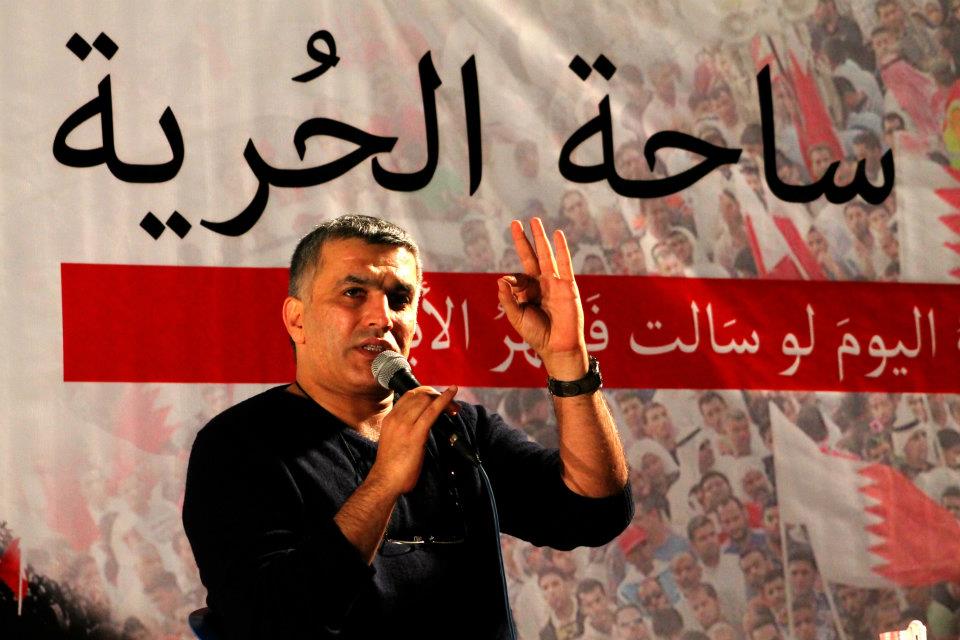
Further to yesterday’s post regarding the trial of Nabeel Rajab, I just came across an older (2012) 10-mn video clip where he speaks himself. In case you want to hear it:
The Observatory for the Protection of Human Rights Defenders, a joint programme of the International Federation for Human Rights (FIDH) and the World Organisation Against Torture (OMCT), published on 14 February 2013 a report, which presents the findings of a judicial observation mission conducted on the trial in appeal of prominent human rights defender Nabeel Rajab. The report concludes that a series of violations of the right to fair trial marred the judicial process and that Nabeel Rajab is suffering judicial harassment (and was sentenced to 2 years imprisonment) for merely advocating for and exercising the right to peaceful assembly in Bahrain. The report is available in English and Arabic.
Nabeel Rajab is President of the Bahrain Centre for Human Rights (BCHR) and Director of the Gulf Centre for Human Rights (GCHR), Deputy Secretary General of FIDH, and the BCHR was 2012 nominee for the MEA. Read the rest of this entry »
The goal of the International Centre for supporting Rights and Freedoms (ICSRF) is “the provision of legal assistance to human rights activists in all countries of the world and its commitment to establish a new generation of cadres working in the field of defense of human rights“, although strangely its website http://www.icsrf.org/ is at the moment only in Arabic and the scope of its activities seems to be restricted to the Arab-speaking world.
The creation of the new network was announced at the conclusion of a regional training course entitled “supporting skills of the defenders of human rights in the Arab countries”, held from 24 to 25 January 2013 in Kuwait with the participation of 32 participants from Kuwait, the UAE, Saudi Arabia, Bahrain and Oman including human rights organizations, human rights defenders and activists monitoring and documenting human rights violations.
The ‘Freedom – Network of Human Rights Defenders’ is established under the management of the International Centre for supporting Rights and Freedoms (ICSRF) and the members of the network will be selected from the participants who attended one of the training courses of the ICSRF or from those who work closely with the ICSRF. They will be trained on how to use international law and communication skills with media – both at the theoretical and practical level – in addition to the role of each member in monitoring and documenting violations. The ICSRF aims to create “a new generation of human rights defenders who are able to practice human rights work in a professional manner in line with the international law and the latest international developments as well as to establish a network of human rights defenders.”
Although everything points more to a regional than an international network, one can only wish them success as the Middle East is a region where Human Rights Defenders require support and freedom.
In an earlier post of 18 December I reported that Sayed Yousif Al-Muhafda was detained (again). After the arrest of most leaders, he was one of the few left to continue the work of the courageous group, the Bahrain Centre for Human Rights, and came to Geneva in October last year to represent the NGO as 2012 nominee of the Martin Ennals Award for Human Rights Defenders.
A court in Bahrain on Thursday released him on bail pending trial for charges of spreading false news to harm security, according to Amnesty International. Al-Muhafda is scheduled to appear in court on January 29 2013 when witnesses are expected to testify. In view of earlier experience with HRDs on trial in Bahrain one should not expect too much.
Several NGOs on the Jury of the MEA (including Front Line Defenders and Human Rights First) have reported on the arrest and detention of Mr Sayed Yousif Al-Muhafdha, a human rights defender who spoke on behalf of Bahrain Centre for Human Rights at the MEA 2012 ceremony in Geneva on 2 October.
On 18 December 2012, the Public Prosecution Office ordered human rights defender Mr Sayed Yousif Al-Muhafdha to be detained for a period of seven days following his arrest the previous day after he attended a protest in Manama. He was arrested on charges of spreading false information over Twitter. He is currently being held in Hooth Al-Jaff prison in the Governorate of Muharraq.
The arrest took place on the eve of a visit to Bahrain by a delegation of Members of the European Parliament (MEPs) with a focus on human rights issues. This is the second time Sayed Yousif Al-Muhafdha has been arrested in the last two months. The previous occasion was on 2 November 2012 in the village of Diraz, where he was arrested on charges of rioting and participating in an illegal gathering. The charges related to a protest that took place in the village that day and in which the human rights defender denied having participated. He was released without charge on 14 November 2012.
Most posts in this blog are of a serious nature, but this one is close to comical if anyone has bothered to read previous posts on Bahrain. Just some excerpts:
Manama, Dec. 3. – His Royal Highness Prime Minister Prince Khalifa bin Salman asserted that the Kingdom of Bahrain and the High Commissioner for Human Rights share the same goal and mission of protecting human rights and respecting human dignity.
“Bahrain is a democracy, reform and popular participation hub where rights are protected and liberties are respected,” HRH Premier said as he met here today a delegation from the Office of the High Commissioner for Human Rights (OHCHR), led by Frej Fennich, Middle East and North Africa Section Chief.
HRH Premier pointed out that “Bahrain is a one-family society and we do not accept that one of our compatriots’ basic rights are abused or dignity undermined,” noting that the government’s main interest is to protect the Bahraini citizens’ rights, including the right to live in security and stability, without intimidation or terrorism.
The Premier emphasized that freedoms are guaranteed in Bahrain by the force of the Constitution, but, he added, when they are used as a pretext to undermine the security of individuals and destabilize countries, jeopardize their economies and pose a threat to their cohesion and civic peace, the matter goes beyond the natural exercise of freedom and becomes “terrorism”, and therefore should be confronted decisively.
………
HRH Prime Minister added that there has been injustice inflicted on the kingdom because of the misleading and incoherent information disseminated by some sides, explaining that Bahrain has invited international organisations in order to allow them to be informed on reality within total transparency.
Perhaps not totally unexpected: the source is the Bahrain New Agency
In various parts of the world human rights defenders brave legal harassment, arbitrary detention, ill treatment, torture and sometimes death, in seeking to secure freedom and dignity for all. In challenging serious abuses of State power, many such defenders find themselves behind bars;
FIDH works endlessly to secure the release of these (and other) human rights defenders, mainly through the Observatory for the Protection of Human Rights Defenders – its joint programme with OMCT.A recent summing up by FIDH of their (local affiliate) in Bahrain, Belarus, Iran, Turkey and Uzbekistan makes sobering reading: Check out the steps that led to their detention:
In BAHRAIN :Nabeel Rajab, FIDH Deputy Secretary General and President of the Bahrain Center for Human Rights (BCHR)
Abdulhadi AlKhawaja, former President of BCHR
The Bahrain Centre or Human Rights is one the 2012 nominees of the Martin Ennals Award.
In BELARUS :Ales Bialiatski, President of the Viasna Human Rights Centre and FIDH Vice President
Since his election in 1994, Belarusian President Alexander Lukashenko, has installed an authoritarian regime that represses freedom of expression, assembly and association. The human rights situation in Belarus markedly deteriorated on 19 December 2010 when riot police brutally dispersed demonstrators protesting against the unfair handling of the presidential election. This event marked the beginning of an unprecedented wave of repression, which continues to this day. Prominent human rights defender, Ales Bialiatski was arrested in Minsk on 4 August 2011 and sentenced to four-and-a-half years in prison on trumped up tax evasion charges. He remains in prison to this day.
In IRAN :Mohammad Ali Dadkhah, founding member of Defenders of Human Rights Centre (DHRC) and human rights lawyer
Abdolfattah Soltani, founding member of DHRC and human rights lawyer
Mohammad Seifzadeh, member of the DHRC and human rights lawyer
Nasrin Sotoudeh, member of DHRC and prominent human rights lawyer known for defending juveniles facing death penalty, prisoners of conscience, human rights activists and child victims of abuse; she is lso a 2012 MEA nominee
In TURKEY :Muharrem Erbey, IHD Vice Chairperson and former Chairperson of Diyarbakır branch Arslan Özdemir, Executive, IHD Diyarbakır branch Şerif Süren, Executive, IHD Aydın branch Orhan Çiçek, Executive, IHD Aydın branch Reşit Teymur, Executive, IHD Siirt branch Abdulkadir Çurğatay, Executive, IHD Mardin branch Veysi Parıltı, Executive, IHD Mardin branch Şaziye Önder, representative IHD Doğubeyazıt (Ağrı) Mensur Işık, former Chairperson, IHD Muş branch Hikmet Tapancı, Executive, IHD Malatya branch Ali Tanrıverdi, Chairperson IHD Mersin branch Osman İşçi, IHD General Headquarters (Ankara) former worker and member of IHD Hanim Koçygit, Executive, IHD Sakarya branch Bekir Gürbüz, former Chairperson, IHD Adıyaman branch
FIDH notes in this respect: Despite Turkey’s considerable human rights progress since 2000, those expressing ideas on “sensitive” human rights related issues continue to be targeted and criminalised by the public authorities. So-called “sensitive” questions include the promotion of alternative identities to the Turkish mainstream (e.g. asserting the rights of ethnic and religious minorities, especially Kurds, as well as the rights of sexual minorities). It also encompasses any criticism of the State and its institutions, including institutional functioning, judicial independence, and impunity for human rights violations. Members of NGOs, lawyers, trade unionists, journalists, intellectuals, academics, conscientious objectors, the families of victims of serious human rights violations, and others have been targeted by State policies that consider their expression of their views to be a threat. Fourteen members of the Human Rights Association (IHD), a Turkish FIDH member organisation, are currently being held in preventive detention under an anti-terrorism law that criminalises legitimate expression of opinion.
In UZBEKISTAN :Zafar Rakhimov, member of the Human Rights Society of Uzbekistan (HRSU) Kashkadarya regional branch Nasim Isakov, member of the HRSU Djizak regional branch Yuldosh Rasulov, member of the HRSU Kashkadarya regional branch Azam Formonov, Head of the Sirdarya regional branch of the HRSU Gaybullo Jalilov, member of the HRSU Karshi regional branch
Uzbekistan has the highest number of human rights defenders serving lengthy prison sentences in Eastern Europe/Central Asia. These sentences are usually served in penal colonies where the regime is extremely strict. Harsh conditions and ill treatment have caused the health of incarcerated defenders to deteriorate quickly. These inhumane and degrading conditions are currently the reality of several members of FIDH member organisation, the Human Rights Society of Uzbekistan.





 Manama, Dec. 3. – His Royal Highness Prime Minister Prince Khalifa bin Salman asserted that the Kingdom of Bahrain and the High Commissioner for Human Rights share the same goal and mission of protecting human rights and respecting human dignity.
 Hans Thoolen on Human Rights Defenders and their awards