Posts Tagged ‘Abdulhadi Al-Khawaja’

Surprise pardon for 1,500 prisoners in Bahrain

April 10, 2024

Patrick Wintour in the Guardian 9 April 2024 reports that Bahrain has unconditionally released more than 1,500 prisoners, including political detainees, in the biggest royal pardon since the 2011.

The amnesty followed years of campaigning inside the country and by international human rights groups but came as a complete surprise to activists. Amnesty Bahrain said: “This is a welcome step. Many of [the prisoners] should not have been imprisoned in the first place.”

The releases were ordered by King Hamad bin Isa Al Khalifa, coinciding with Eid and the silver jubilee of the king taking power. The US embassy in Bahrain welcomed the move and expressed the hope that all those being released will be reunited with their families.

Many of the detainees have been held in Jau prison, where campaigners said more than 600 political prisoners remain, including some in need of urgent medical help. Recent riots inside prisons had made the expense of keeping so many behind bars a burden on the state. [see also: https://humanrightsdefenders.blog/2023/08/20/500-bahraini-prisoners-on-hunger-strike-over-conditions/]

On social media, joyful scenes of families being reunited in their homes were screened, including some who had not been in their family home for as long as a decade.

But Sayed Ahmed Alwadaei, director of advocacy at the British-based Bahrain Institute for Rights and Democracy, said: “This came as a complete shock. There had been no prior indication, and this is the most important release programme since 2011. The release is bittersweet as there are still 600 political prisoners behind bars and on death row.”

see also: https://www.adhrb.org/2024/04/bahrains-kings-pardon-an-act-to-hide-the-human-rights-violations/#utm_source=rss&utm_medium=rss

Among those retained in prison include Hassan Mushaima, the head of the opposition group Al-Haq, and Abdulhadi al-Khawaja, a Danish-Bahraini human rights defender serving a life sentence in Bahrain for peaceful human rights work.

See also: https://www.omct.org/en/resources/statements/letter-to-the-king-of-bahrain-calling-for-the-release-of-jailed-academic-dr-abuljalil-al-singace-marking-abduljalil-al-singaces-1-000-days-on-hunger-strike and

https://www.fidh.org/en/region/north-africa-middle-east/bahrain/bahrain-dr-abduljalil-al-singace-s-1000-days-on-hunger-strike

https://www.theguardian.com/world/2024/apr/09/bahrains-king-takes-activists-by-surprise-with-pardon-for-at-least-1500-prisoners

British Airways ends solidarity trip for al-Khawaya

September 18, 2023

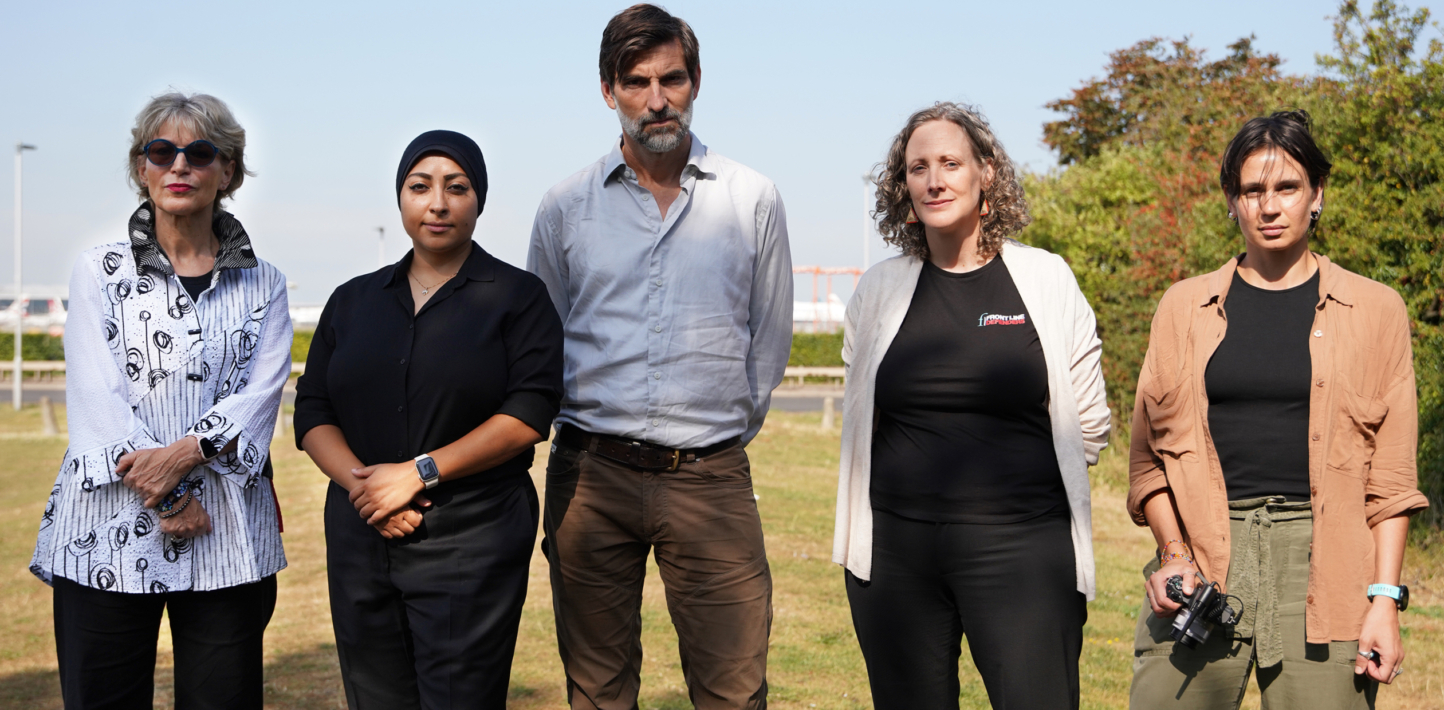
Maryam Al-Khawaja (second right) with members of the human rights delegation who were denied boarding a flight to Bahrain. (c) AI

Bahrani activist Maryam al-Khawaja said on Friday she was denied boarding on a flight to Bahrain by British Airways as she tried to return home to raise awareness of the condition of her imprisoned father. [see: https://humanrightsdefenders.blog/2023/09/14/more-join-maryam-al-khawajas-solidarity-trip-to-bahrain-to-be-continued/]

In a video message posted on X, Khawaja said she was not allowed to board a flight at London’s Heathrow Airport “despite being a Bahraini citizen”.

I was told I have to speak to Bahraini immigration if I want to get a boarding pass to Bahrain. So effectively we are being denied boarding by British Airways on behalf of the Bahraini government,” she said.

Agnes Callamard, the secretary-general of Amnesty International, was among those accompanying Khawaja and said on X that she had also been denied boarding. “Our human rights delegation members are all denied a boarding pass. We are told that British Airways has been instructed by the Bahrain immigration authorities not to give us a boarding pass,” she posted.

A spokesperson for the British Airways Press Office said: “All airlines are legally obliged to comply with immigration control laws and entry requirements for customers as set by individual countries,” he told Middle East Eye in a statement and a government spokesperson in Bahrain added: “…as with other countries, Bahrain reserves the right to refuse entry, if deemed necessary.”

Sayed Alwadaei, a Bahraini activist, and the director of advocacy at the UK-based Bahrain Institute for Rights and Democracy (BIRD), raised concern over al-Khawaja being denied boarding the flight.

“If a Bahraini citizen gets their rights denied at Heathrow airport, in London, in front of international observers and in front of heads of international rights organisations, then imagine what happens to prisoners behind bars, what is happening to Maryam’s father and other political prisoners who are suffering torture and systematic medical denial and slow death without anyone monitoring,” he told MEE. See: https://www.adhrb.org/2023/10/adhrb-at-hrc54-al-singace-al-khawaja-and-naji-fateel-face-reprisals-including-medical-neglect-2/#utm_source=rss&utm_medium=rss

Campaigners and the heads of human rights organisations informed MEE that they are planning to peacefully protest outside the Bahraini embassy in London later today in response to not being allowed to travel to Bahrain. 

Responding to the news, Olive Moore, the Executive Director of Frontline Defenders said that the decision not to let her board the flight was “unjustifiable“.

See also: https://www.ohchr.org/en/press-releases/2023/09/bahrain-un-expert-alarmed-health-human-rights-defenders-prison

https://www.theguardian.com/law/2023/sep/15/bahraini-human-rights-defender-stopped-from-travelling-to-kingdom-to-visit-imprisoned-father

https://www.middleeasteye.net/news/bahrain-activist-denied-boarding-british-airways-manama

More join Maryam Al-Khawaja’s solidarity trip to Bahrain……to be continued

September 14, 2023

On 7 September 2023, Maryam Al-Khawaja announced that she would return from exile to Bahrain to try and save her father Abdulhadi Al-Khawaja [see: https://humanrightsdefenders.blog/2023/09/11/maryam-al-khawaja-risks-prison-by-returning-to-bahrain-to-press-for-her-fathers-release/]. Now Front Line’s Interim Director Olive Moore announced that she will accompany Maryam on the trip to Manama this week to press the Bahraini authorities to release him. Other leading human rights figures have announced their participation in the trip, including Agnès Callamard, Amnesty International’s Secretary General; Tim Whyte, Action Aid-Denmark’s Secretary General; and Andrew Anderson, former Front Line Defenders Executive Director and Amnesty International staff member.

“Front Line Defenders owes a debt of gratitude to Abdulhadi, both as a former staff member and friend to many in the organisation, but more importantly as a principled and trailblazing human rights defender in Bahrain and the region. We will not rest until the Bahraini authorities free him and the human rights defenders Dr Abduljalil Al-Singace and Naji Fateel, both also unjustly imprisoned for over a decade.” said Moore.

The exact timing of the solidarity trip is not being publicised, but it comes the same week as the Bahraini Crown Prince visits Washington, DC, and more than a dozen human rights organisations, including Front Line Defenders, have also called on President Biden’s administration to demand the release of human rights defenders.

“Now is the moment for the Biden administration to step up to the plate and show solidarity with human rights defenders in Bahrain. In meetings with the Crown Prince this week, the US government must be unequivocal in its calls for the immediate and unconditional release of Abdulhadi Al-Khawaja and other unjustly imprisoned human rights defenders,” said Olive Moore.

Human Rights Watch stated on 11 September: “If Maryam al-Khawaja can have the courage to risk her life for democracy and human rights in Bahrain, the least the Biden Administration can do is show the political strength to use its leverage to call on its allied government to free its political prisoners.

The same day Human Rights First’s Brain Dooley blogged about two prisoners (among the hundreds on hunger strike) that have told him about the daily reality of the protest.

One of them is 49-year-old Ahmed Jaafar Mohammed Ali, who has been in prison since he was extradited from Serbia in January 2022 and Sayed Sajjad who has been in prison since September 2013, and is one of the inmates negotiating with the prison authorities. See more at: https://humanrightsfirst.org/library/two-prisoners-on-hunger-strike-in-bahrain-tell-of-their-ordeal/

https://www.frontlinedefenders.org/en/statement-report/front-line-defenders-director-join-solidarity-trip-bahrain-free-abdulhadi-al

https://www.hrw.org/video-photos/audio/2023/09/11/bahrain-brutality-and-biden

https://www.france24.com/en/live-news/20230914-bahrain-activist-says-to-return-home-for-father-despite-arrest-fears-1

Maryam al-Khawaja risks prison by returning to Bahrain to press for her father’s release

September 11, 2023

On 7 September 2023 Maryam Alkhawaja made this surprising and immensely courageous statement on twitter (X): “Today marks one month since the beginning of the largest mass #hungerstrike by political prisoners in #Bahrain, – and I am announcing that I will be traveling there next week to try and save my imprisoned father’s life. #FreeAlKhawaja #DKPol #Solidarity

The trip by Maryam al-Khawaja draws renewed attention to the plight of her 62-year-old ailing father, Abdulhadi al-Khawaja, a dual Danish-Bahraini national convicted of internationally criticised terrorism charges and held in what a United Nations panel calls an “arbitrary” imprisonment ever since. He is the laureate of the 2022 Martin Ennals Award. See also: https://www.trueheroesfilms.org/thedigest/laureates/4d45e316-c636-4d02-852d-7bfc2b08b78d

It also raises the stakes of the month-long hunger strike in Bahrain just ahead of a planned visit to the United States by Crown Prince Salman bin Hamad Al Khalifa. It has become one of the longest-sustained demonstrations of dissent in the decade since Bahrain, aided by Saudi Arabia and the United Arab Emirates, violently suppressed its 2011 Arab Spring protests. [see: https://humanrightsdefenders.blog/2023/08/20/500-bahraini-prisoners-on-hunger-strike-over-conditions/]

“I am afraid, I am terrified of what it potentially means for me to travel back to Bahrain,” al-Khawaja told The Associated Press in an interview before her announcement. ”But if it means potentially saving my father’s life or for me to get to see him, if it means helping any number of political prisoners in Bahrain and bringing attention to their plight, then I’m willing to put my fear aside and do what is necessary to try and achieve that.”

Plans include her being accompanied by other human rights activists to ensure her safety. Several NGOs and personalities are considering to join. However, she faces a variety of charges still on the island, including what she described as unclear terrorism charges that could carry a life sentence. “I know that it carries very high consequences and high risks, my going back,” al-Khawaja said. ”I’ve reached a point where I can no longer sit around and wait for that phone call where I find out that my father has died in prison. … I have reached the point where I am willing to put myself and my physical safety at risk if that means that there’s any chance that I can save my father’s life.” She said her father was aware of her plans, as were other diplomats.

https://english.almayadeen.net/news/politics/bahraini-takes-risk-going-to-manama-to-save-hunger-striking

Human Rights Defenders at the 54th session of the UN Human Rights Council

September 11, 2023

On 6 September 2023 the ISHR published its formidable overview of key issues at the upcoming, 54th session of the UN Human Rights Council (from 11 September – 13 October). I have extracted from it – as ussual [for 53rd see: https://humanrightsdefenders.blog/2023/06/20/human-rights-defenders-issues-at-the-53rd-session-of-the-un-human-rights-council/], the issues most direclty affecting Human Rights defenders

To stay up-to-date: Follow @ISHRglobal and #HRC54 on Twitter/X, and look out for their Human Rights Council Monitor.

Thematic areas of interest

Reprisals

During the 54th session, Ghana, Fiji, Hungary, Ireland and Uruguay will present a draft resolution on cooperation with the UN. ISHR urges all States to support the adoption of a HRC resolution that strengthens the UN’s responses to reprisals.

On 28 September, the Assistant Secretary General for Human Rights, Ilze Brands Kehris, will present the Secretary General’s annual Reprisals Report to the Council in her capacity as UN senior official on reprisals. States raising cases is an important aspect of seeking accountability and ending impunity for acts of reprisal and intimidation against defenders engaging with the UN. It can also send a powerful message of solidarity to defenders, supporting and sustaining their work in repressive environments.

This year, ISHR launched a campaign regarding five cases. ISHR urges States to raise these cases in their statements:

  • Anexa Alfred Cunningham (Nicaragua), a Miskitu Indigenous leader, woman human rights defender, lawyer and expert on Indigenous peoples rights from Nicaragua, who has been denied entry back into her country since July 2022, when she participated in a session of a group of United Nations experts on the rights of Indigenous Peoples. States should demand that Anexa be permitted to return to her country, community and family and enabled to continue her work safely and without restriction.
  • Vanessa Mendoza (Andorra), a psychologist and the president of Associació Stop Violències, which focuses on gender-based violence, sexual and reproductive rights, and advocates for safe and legal abortion in Andorra. After engaging with CEDAW in 2019, Vanessa was charged with ‘slander with publicity’, ‘slander against the co-princes’ and ‘crimes against the prestige of the institutions’. She has been indicted for the alleged “crimes against the prestige of the institutions” involving a potentially heavy fine (up to 30,000 euros) and a criminal record if convicted. States should demand that the authorities in Andorra unconditionally drop all charges against Vanessa and amend laws which violate the rights to freedom of expression and association.
  • Kadar Abdi Ibrahim (Djibouti) is a human rights defender and journalist from Djibouti. He is also the Secretary-General of the political party Movement for Democracy and Freedom (MoDEL). Days after returning from Geneva, where Kadar carried out advocacy activities ahead of Djibouti’s Universal Periodic Review (UPR), intelligence service agents raided his house and confiscated his passport. He has thus been banned from travel for five years. States should call on the authorities in Djibouti to lift the travel ban and return Kadar’s passport immediately and unconditionally.
  • Hong Kong civil society (Hong Kong): Until 2020, civil society in Hong Kong was vibrant and had engaged consistently and constructively with the UN. This engagement came to a screeching halt after the imposition by Beijing of the National Security Law for Hong Kong (NSL), which entered into force on 1 July 2020. States should urge the Hong Kong authorities to repeal the offensive National Security Law and desist from criminalizing cooperation with the UN and other work to defend human rights.
  • Maryam al-Balushi and Amina al-Abduli (United Arab Emirates), Amina Al-Abdouli used to work as a school teacher. She was advocating for the Arab Spring and the Syrian uprising. She is a mother of five. Maryam Al Balushi was a student at the College of Technology. They were arrested for their human rights work, and held in incommunicado detention, tortured and forced into self-incriminatory confessions. After the UN Special Procedures mandate holders sent a letter to the UAE authorities raising concerns about their torture and ill treatment in detention in 2019, the UAE charged Amina and Maryam with three additional crimes. The UN Working Group on Arbitrary Detention found their detention arbitrary and a clear case of reprisals for communicating with Special Procedures. In April 2021, a court sentenced them to three additional years of prison for “publishing false information that disturbs the public order”. States should demand that authorities in the UAE immediately and unconditionally release Maryam and Amina and provide them with reparations for their arbitrary detention and ill-treatment.

Other thematic debates

At this 54th session, the Council will discuss a range of civil, political, economic, social and cultural rights and issues through dedicated debates with the:

  1. Special Rapporteur on truth, justice, reparation and guarantees of non-recurrence
  2. Special Rapporteur on contemporary forms of slavery, including its causes and consequences
  3. Working Group on Arbitrary Detention
  4. Working Group on Enforced or Involuntary Disappearances
  5. Special Rapporteur on the implications for human rights of the environmentally sound management and disposal of hazardous substances and waste
  6. ID on HC oral update on drivers, root causes and human rights impacts of religious hatred constituting incitement to discrimination, hostility or violence

In addition, the Council will hold dedicated debates on the rights of specific groups including with the:

  1. Independent Expert on the enjoyment of all human rights by older persons
  2. Special Rapporteur on the rights of Indigenous Peoples and the Expert Mechanism on the Rights of Indigenous Peoples

Country-specific developments

Afghanistan

The Council will hold an Interactive Dialogue with the Special Rapporteur on Afghanistan on 11 September, and on the OHCHR report on Afghanistan on 12 September, and will consider a resolution on the human rights situation in Afghanistan at this session.

ISHR supports the call of Afghan human rights defenders to the Council to renew the mandate of the Special Rapporteur on the situation of human rights in Afghanistan. We also support the call to establish a parallel independent investigative mechanism in the upcoming September session and to ensure meaningful follow up to the joint report of the Special Rapporteur and the Working Group on discrimination against women and girls, as well as continuation of a dedicated discussion at the Council on the situation of women and girls in Afghanistan. Accountability for widespread human rights violations, including gender apartheid and other crimes against humanity, is imperative to securing sustainable peace and development in the country.

Algeria

We urge States to demand that Algeria, a Council member, end its crackdown on human rights defenders and civil society organisations, amend laws aimed at silencing peaceful dissent and stifling civil society, and immediately and unconditionally release arbitrarily detained human rights defenders and activists, including in the interactive dialogue with the Working Group on arbitrary detention. Since the beginning of the Hirak pro-democracy movement, the Working Group has issued at least 6 decisions of arbitrary detention, highlighting Algerian legislation that is inconsistent with international law, violations of due process and the right to a fair trial, as well as violations to the right to freedom of expression, discrimination based on language, ethnicity and religion. They have also condemned Algeria’s abuse of counter-terrorism legislation. States should call on Algeria to implement the recommendations of the working group.

We also urge States to address the case of reprisals against HRDs Kaddour Chouicha and Jamila Loukil, members of the Algerian League for the Defence of Human Rights (LADDH) before its dissolution by the Algerian authorities. They were prevented from traveling to attend the pre-session organized by UPR-info, a clear case of reprisals against human rights defenders attempting to cooperate with the UPR. Chouicha, Loukil and other HRDs are charged in a criminal case, which includes ‘enrollment in a terrorist or subversive organization active abroad or in Algeria’. They are still awaiting trial as the authorities postponed their court session on 15 June 2023. If convicted of these charges, they face up to twenty years imprisonment.

Bahrain

Civil society organisations, including ISHR, have requested States to urge Bahraini authorities to unconditionally release all those sentenced for their political opinions, including human rights defenders Abdulhadi Al-Khawaja and Abduljalil Al-Singace, and in the meantime, to ensure that they are provided with life-saving medical care to prevent an imminent tragedy. [see also: https://humanrightsdefenders.blog/2023/08/20/500-bahraini-prisoners-on-hunger-strike-over-conditions/]

Burundi

The Council will hold an Interactive Dialogue with the Special Rapporteur on Burundi on 22 September. As serious human rights violations persist in Burundi and the Government has failed to hold per­petrators accountable or take the concerns raised by Burundian and international actors seriously, the Coun­cil should not relax its scrutiny. The Council should extend the Special Rapporteur’s mandate for a further year.

China

31 August marked one year since the release of the groundbreaking OHCHR report finding possible crimes against humanity committed by the Chinese government in Xinjiang. This Council session also marks one year since the failure of the Council, and most of its Council Members, to stand by principle against Beijing’s coercion and promote a dialogue on the human rights of Uyghurs. Since that time, the recommendations of the OHCHR’s report have been echoed by the CERD in its Urgent Action decision on Xinjiang, by the CESCR and CEDAW in their respective Concluding Observations, and by 15 Special Procedures mandates in their seven benchmarks on Xinjiang. Yet, in a surprise visit to the region in August, President Xi Jinping reiterated its hardline policy and called for further efforts to ensure ‘social stability’ and ‘control illegal religious activities’. States should take collective action to urge China to implement key recommendations from the OHCHR Xinjiang report, and from relevant UN Treaty Bodies and Special Procedures, with a focus on root causes of violations that commonly affect Uyghurs, Tibetans, Hong Kongers and mainland Chinese human rights defenders, including the abuse of national security laws and measures.

States should further ask for the prompt release of human rights defenders targeted by the Chinese government’s renewed crackdown on human rights lawyers, including lawyer Lu Siwei at risk of refoulement from Laos, activists Chang Weiping, Ding Jiaxi and Xu Zhiyong, recently convicted to lengthy prison sentences, as well as Yu Wensheng and Xu Yan, detained en route to meet with EU diplomats in Beijing. Ten years after the detention, and subsequent death in custody, of woman human rights defender Cao Shunli on her way to attend China’s UPR in Geneva, the Council must also pierce the veil of impunity for egregious cases of reprisals, and call on China to acknowledge its responsibility, bring perpetrators to justice and provide adequate remedy. [see also: https://humanrightsdefenders.blog/2023/09/05/human-rights-lawyer-gao-zhisheng-and-the-practice-of-enforced-disappearances-joint-letter/]

Egypt

Recent arrests and arbitrary detention of several media figures, dissidents and their family members in Egypt are indicative of the ongoing crackdown on basic freedoms and liberties in the country, and reflect a lack of genuine political will to improve the human rights situation by the Egyptian government. In the last ten years, Egyptian human rights organisations have recorded the enforced disappearance of no less than 3,000 citizens for varying periods of time, death by mistreatment and medical negligence of at least 1,200 people in detention centers, the sexual assault of at least 655 people and their family members, and the extrajudicial killing of more than 750 people. The continued silence on Egypt by States at the Council will only encourage further violations. NGOs continue to urge States to ensure appropriate action on Egypt at the Council though the establishment of a monitoring and reporting mechanisms on the human rights crises in the country. As an immediate step, States should deliver a follow-up joint statement condemning the human rights situation in the country and calling on the Egyptian government to refrain from continuing to carry out wide-spread human rights violations.

Israel/OPT

While Israel rejected all the recommendations on the right of the Palestinian people to self-determination and refugee return made by states during its UPR review, States should reiterate their commitment to putting an end to 75 years of denial of the Palestinian’s people inalienable rights to return and self-determination.

During HRC 53, civil society welcomed the resolution put forward by the OIC to ensure the full implementation of the United Nations database of businesses involved in Israeli’s settlement enterprise in the occupied Palestinian territory. States must ensure that the mandate is implemented in full as it represents a question of credibility to the Council, including by ensuring that the budget adopted in the fifth committee of the General Assembly later this year is in line with the programme budget implications (PBI). 

Russia

The Council will hold an Interactive Dialogue with the Special Rapporteur on the Russian Federation on 21 September. The Council will also be called upon to renew the mandate of the Special Rapporteur (HRC Resolution 51/25). ISHR strongly supports the renewal of the mandate and urges States to oppose Russia’s candidacy to the Human Rights Council.

The human rights situation in Russia continues to deteriorate, while Russia also continues to perpetrate atrocity crimes in Ukraine In recent months, Russia has enacted laws providing immunity against war crimes and crimes against humanity committed in the ‘State’s interests’, intensified its assault against LGBT persons, adopted further measures to repress civil society and silence independent journalists, and continued to arbitrarily imprison human rights defenders. Of further and direct relevance to the Council, Russia adopted a new law on 28 April 2023 which criminalises assistance, cooperation or confidential communications with international bodies, which may include the HRC and its mechanisms. These regressive developments, and the lack of any improvement in the human rights situation in the country, clearly warrant the extension of the mandate of the Special Rapporteur.

With respect to Russia’s candidacy for the Council, ISHR only campaigns against countries based on strict and objective criteria. Russia manifestly fulfils all of these criteria, being a country: (1) responsible for a pattern of reprisals against those who cooperate with the UN; (2) responsible for the repression of civil society (Russia is ranked as ‘closed’ (scoring 17/100 in the Civicus Monitor); and (3) directly responsible for war crimes and crimes against humanity in Ukraine according to the HRC-mandated CoI. On ISHR’s HRC candidate scorecards, Russia scores just 1/20 on objective criteria.

Saudi Arabia

In light of the ongoing diplomatic rehabilitation of crown prince and de facto ruler Mohammed bin Salman, the Saudi authorities’ brazen repression continues to intensify. Some notable recent trends as documented by ALQST include, but are not limited to: the further harsh sentencing against individuals for peaceful social media use, including a death sentence issued against a man for tweets, the prosecution of women such as Manahel al-Otaibi over her choice of clothing and support for women’s rights, the ongoing forcible disappearance of prisoners of conscience including Mohammed al-Qahtani [see: https://www.trueheroesfilms.org/thedigest/laureates/78383825-0b3f-4bca-883a-b81e1baecd09]and Essa al-Nukheifi beyond the expiry of their sentences, and; regressive developments in relation to the death penalty, including a surge in executions (95 individuals were executed in 2023 so far), and several young men at imminent risk of execution for crimes they allegedly committed as minors. Human Rights Watch has documented the brutal massacre of migrants at the Yemen border, in what may amount to further crimes against humanity. ISHR continues to call for States at the Council to adopt a resolution mandating an independent international monitoring and investigative mechanism on massive human rights violations perpetrated in and by Saudi Arabia.

Sudan

On 12 September, the Council will hold Interactive Dialogue on the High Commissioner’s oral update on Sudan.

Sudanese Women Rights Action published a report “laying an overview of the conditions of women’s rights and gender equality in Sudan as an extended crisis started on October 25th, 2021, when the military took over the power in Sudan, ending the transitional period on a bloody note…the report presents verified information about the crises scope, context, and responses from a gender perspective based on the needs on the grounds, the challenges, and the recommended interventions according to local actors and women activists.” ISHR urges the implementation of  the recommendations identified by women activists including to “Pressure both fighting parties to commit to sustainable Ceasefire; Pressure the fighting parties to open humanitarian corridors; Provide urgent funding to the humanitarian aid interventions; Ensure protection and evacuation of women and WHRDs from fighting areas”. Ahead of HRC54, ISHR joined over 110 NGOs in reiterating a call on the Council to establish an independent investigative mechanism on Sudan with a mandate to investigate human rights violations and abuses in Sudan, collect and preserve evidence, and identify those responsible.

Tunisia

We regret that the Council failed to exercise its prevention mandate and address the deteriorating human rights situation in Tunisia during HRC 53, during which the High Commissioner and UN Special Procedures raised alarm at the escalating pattern of human rights violations and the rapidly worsening situation in Tunisia following President Kais Saied’s power grab on 25 July 2021. In the last two years in Tunisia there has been a significant erosion of the rule of law, attacks on the independence of the judiciary, reprisals against independent judges and lawyers and judges associations, a crackdown on peaceful political opposition and abusive use of “counter-terrorism” law in politicised prosecutions, as well as attacks on freedom of expression and threats to freedom of association.

In an open letter against the “Memorandum of Understanding on a Strategic and Comprehensive Partnership between the European Union (EU) and Tunisia” and against the EU’s border externalisation policies, 379 researchers and members of civil society decried the use of vulnerable populations as scapegoats to mask the failures of public policy in Tunisia. While Tunisian authorities were persecuting Black African foreign nationals, including migrants, asylum seekers and refugees – deporting at least 1,200 sub-Saharan nationals to the borders with Libya and Algeria, in inaccessible and militarised desert zones, leaving them abandoned without water and food – the signing of the Memorandum effectively gave Tunisia “a blank check, following a strategy that is all the more irresponsible given its inefficacy”. Unless States tackle “the structural socio-economic causes of so-called irregular migration”, and radically rethink access to mobility, “this security approach to border management will only make crossings more deadly and strengthen smugglers”. Addressing these grave violations cannot be done without also urgently addressing the rule of law crisis in the country.

Venezuela

The UN’s fact-finding mission on Venezuela (FFM) will report to the Council on 25 and 26 September. The Mission will focus on the situation for human rights defenders in the country – an essential focus given the existing and proposed legislation adversely affecting civic space, and the threats and attacks HRDs face. The recent sentencing of 6 union leaders, denounced by UN Special Rapporteurs, is a clear example of the criminalisation of HRDs, as is the continued detention of the HRD Javier Tarazona, since July 2021, and that of many other real or perceived opposition figures. The continuing impunity in regard to the killing of defender Virgilio Trujillo Arana a year ago is an example of how little will exists to prevent attacks against HRDs.

In its first report in 2020, the FFM stated that it had reasonable grounds to believe that crimes against humanity had been carried out in Venezuela, with the principal targets of violations including social activists and political leaders at the forefront of protests. The recommendations made by the FFM at that time have not been implemented. We recall that Venezuela continues to refuse to engage with the FFM or allow it to enter the country.

States must participate in the interactive dialogue with the FFM to highlight the essential role of HRDs; express utmost concern at the ongoing, systematic threats, attacks and restrictions against civic space, and urge the Venezuelan authorities to take immediate steps to implement the recommendations issued by the UN human rights system. States must speak out forcefully in support of the FFM and its work, and encourage other states to do the same. This vital accountability mandate must be supported and its recommendations echoed, so that victims of violations in the country can believe that one day justice will be done.

Other country situations:

The High Commissioner will provide an oral update to the Council on 11 September 2023. The Council will consider updates, reports and is expected to consider resolutions addressing a range of country situations, in some instances involving the renewal of the relevant expert mandates. These include:

  • Interactive Dialogue on the report of the Independent Investigative Mechanism for Myanmar and Interactive Dialogue on the OHCHR report on Myanmar
  • Interactive Dialogue on the report of the High Commissioner on Nicaragua and oral update by the Group of Experts on Nicaragua
  • Interactive Dialogue on the report of the OHCHR on Sri Lanka
  • Interactive Dialogue with the Commission of Human Rights Experts on Ethiopia
  • Interactive Dialogue with the Commission of Inquiry on the Syrian Arab Republic
  • Interactive Dialogue on the interim oral update of the High Commissioner on the situation of human rights in Belarus
  • Interactive Dialogue with the Commission of Inquiry on Ukraine and Interactive Dialogue on the High Commissioner oral update on Ukraine
  • Enhanced Interactive Dialogue on the report of the High Commissioner and experts on the Democratic Republic of Congo
  • Interactive Dialogue on the oral update of OHCHR on technical assistance and capacity-building for South Sudan
  • Interactive Dialogue with the Special Rapporteur on Cambodia and presentation of the Secretary-General’s report
  • Interactive Dialogue with the Independent Expert on Somalia
  • Interactive Dialogue with the Independent Expert on the Central African Republic
  • Interactive Dialogue with the High Commissioner on the interim report on Haiti
  • Presentation of the High Commissioner’s report on cooperation with Georgia
  • Presentation of the High Commissioner’s report on cooperation with Yemen

Council programme, appointments and resolutions

Appointment of mandate holders

The President of the Human Rights Council has proposed candidates for the following mandates:

  1. Special Rapporteur on minority issues
  2. Special Rapporteur on the human rights of migrants
  3. Special Rapporteur on the promotion and protection of human rights and fundamental freedoms while countering terrorism
  4. Independent Expert on protection against violence and discrimination based on sexual orientation and gender identity
  5. Working Group on discrimination against women and girls, several members

Resolutions to be presented to the Council’s 54th session

At the organisational meeting on 28 August resolutions were announced (States leading the resolution in brackets):

  1. From rhetoric to reality: a global call for concrete action against racism, racial discrimination, xenophobia and related intolerance (Africa Group)
  2. Technical assistance and capacity-building in the field of human rights in the Democratic Republic of the Congo (Africa Group)
  3. Question of the death penalty (Benin, Belgium, Costa Rica, France, Mexico, Mongolia, Republic of Moldova, Switzerland)
  4. Special Rapporteur on truth, justice, reparation and guarantees of non-recurrence – mandate renewal (Argentina, Morocco, Switzerland)
  5. Human rights and Indigenous Peoples (Guatemala, Mexico)
  6. Special Rapporteur on the situation of human rights in Afghanistan – mandate renewal (EU)   
  7. Special Rapporteur on the situation of human rights in Burundi – mandate renewal (EU)
  8. Working Group on enforced or involuntary disappearances – mandate renewal (Argentina, France, Japan, Morocco)
  9. Implementation of the UN declaration on the rights of peasants and other people working in rural areas (Bolivia)
  10. Technical assistance and capacity-building for Yemen in the field of human rights (Lebanon on behalf of the Arab Group)
  11. Special Rapporteur on Russia – mandate renewal (Luxembourg on behalf of 26 EU countries)
  12. Right to privacy in the digital age (Austria, Brazil, Germany, Liechtenstein, Mexico)
  13. A world of sports free from racism, racial discrimination, xenophobia and related intolerance (Brazil and Africa Group)
  14. Cooperation with the United Nations, its representatives and mechanisms in the field of human rights (Fiji, Ghana, Hungary, Ireland, Uruguay)

The core group on Sudan (Germany, Norway, UK, US) announced that they are considering presenting a resolution on Sudan at this session. The core group on Syria (Germany, France, Italy, Jordan, Netherlands, Qatar, Turkiye, UK, USA) also announced that they are considering presenting a resolution on the human rights situation in Syria.

Read here the three year programme of work of the Council with supplementary information.

Read here ISHR’s recommendations on the key issues that are or should be on the agenda of the UN Human Rights Council in 2023.

https://ishr.ch/latest-updates/hrc54-key-issues-on-agenda-of-september-2023-session/
500 Bahraini prisoners on hunger strike over conditions

August 20, 2023

On 18 August 2023 Brian Dooley posted for Human Rights First about the new crisis in Bahrain‘s prisons as at least 500 prisoners are on hunger strike refusing food in protest at their detention conditions. Among those denied the care they need are prominent rights activists Abdulhadi Al Khawaja, Abduljalil Al Singace, and Hassan Mushaima, who have been jailed since their peaceful protests in 2011. On 15 August 2023, human rights defender Abdulhadi Al-Khawaja was denied a prearranged video call with his daughter days after he was rushed to the intensive care unit where doctors declared his life was in danger. Abdulhadi Al-Khawaja is at imminent danger of losing his life since he has started a water-only hunger strike on 9 August 2023. [see: https://www.trueheroesfilms.org/thedigest/laureates/4d45e316-c636-4d02-852d-7bfc2b08b78d]

Bahrain’s main prison, Jau, currently holds an estimated 1300 prisoners, around half of whom are on a hunger strike. The current crisis could have been easily avoided – if Bahrain’s government had shown an iota of wisdom, it would have released those unjustly jailed years ago, and given all those who need medical treatment adequate care.

See also: https://humanrightsdefenders.blog/tag/bahrain/

It’s another mishandling of a situation that now threatens to spiral dangerously out of control. In March 2015 there was a prison riot at Jau. HRF predicted that the poor conditions, overcrowding, and poor medical care would erupt into large-scale disturbances, and they did.

I spoke to several former inmates of Jau last night. One recently released prisoner said “This frustration in the prison has to go somewhere, it’s been building for so long. The situation is getting worse every day with more and more prisoners joining the protest. Some have already collapsed.”

Some prisoners began refusing food on August 7, and many more have since joined the protest. International attention is starting to turn towards Jau. Yesterday I joined others in an overnight protest outside the Bahrain embassy in London, praying for those prisoners in urgent need of medical care.

But if any of the hundreds of prisoners on the hunger protest die, the consequences of Bahrain’s failure to resolve the crisis could be catastrophic, with unrest spilling onto the streets. The authorities in Bahrain need to act fast to prevent a similar outcome to 2015, when they responded to prison unrest by torturing and ill-treating dozens of detainees.  Better to make the smart move now, grant the prisoners’ basic demands including proper health care, and avert another disaster.

Among those in most acute danger are the leading rights activists. Human Rights First joined other NGOs this week urging the State Department to use its considerable influence with Bahrain to press for a speedy and humane resolution to the crisis.

https://www.theguardian.com/world/2023/aug/18/bahraini-prisoners-hunger-strike-conditions

https://www.frontlinedefenders.org/en/case/human-rights-defender-abdulhadi-al-khawaja-imminent-danger-losing-his-life

NGOs demand adequate medical treatment and access to Abdulhadi Al-Khawaja in Bahrain

May 25, 2023

14 NGOs call on Bahrain to ensure that human rights defender Abdulhadi Al-Khawaja is allowed adequate medical treatment, as well as the right to access and respond to allegations made by the Government of Bahrain in a response to a UN communication.

In a joint communication made public on 4 May 2023, six UN experts – including the Special Rapporteur on the situation of human rights defenders, Mary Lawlor, and the Vice-Chair of the Working Group on Arbitrary Detention, Mumba Malila – expressed their utmost concern at the continued arbitrary detention of human rights defender Mr. Al-Khawaja. He is a widely recognised HRD, see: https://www.trueheroesfilms.org/thedigest/laureates/4d45e316-c636-4d02-852d-7bfc2b08b78d

The UN communication addresses troubling allegations of torture, ill treatment and poor prison conditions of Mr. Al-Khawaja, including intimidation, restriction of communication with family, deprivation of basic rights, including his inability to give power of attorney to his lawyer in court, as required, shackling of hands, despite doctors’ orders to the contrary, as well as fabrication of cases against him and other political prisoners in Bahrain.

The UN communication was sent to the Government of Bahrain on 17 February 2023 and remained confidential for 60 days, as is UN protocol. The Government of Bahrain replied to the six UN experts on 17 April 2023, which was recently translated and made publicly available.

The Government of Bahrain’s response denies that Mr. Al-Khawaja has been subject to torture. This is contradicted by findings from the Bahrain Independent Commission of Inquiry (BICI), which was established by the King of Bahrain and medically documented that Al-Khawaja was subjected to torture and sexually assaulted by security forces in 2011. Furthermore, the Government of Bahrain’s response fails to adequately recognize Mr. Al-Khawaja as a human rights defender or acknowledge the arbitrary nature of his detention.

On more than one occasion, Mr. Al-Khawaja attempted to receive information over the phone about the nature of the UN communication, including the Government of Bahrain’s response, but the calls were systematically cut by the authorities. Therefore, Mr. Al-Khawaja officially requested through his lawyer that he be allowed a hard copy of the mentioned documents. The signatories call on Bahrain to ensure that the request is honored.

In addition, Mr. Al-Khawaja has continued to be repeatedly denied access to a cardiologist, as well as other appointments with relevant doctors, despite being at risk of a heart attack or stroke at any time. As recently as the past two weeks, Mr. Al-Khawaja was denied two medical appointments, the most recent being on Thursday 11 May 2023.

Since 9 May 2023, Mr. Al-Khawaja has protested in the yard of Jaw Prison on a daily basis holding up two signs in front of the CCTV cameras stating “Treatment prevention is slow systematic killing” and “You commit torture and prevent treatment” in order for him and his fellow prisoners of conscience to be allowed his necessary medical appointments. He informed his family on 14 May 2023 that he has suspended his protest temporarily due to promises made by the prison administration to improve conditions and allow access to adequate treatment.

The signatories call on the Government of Bahrain to:

  1. Immediately and unconditionally release human rights defender Abdulhadi Al-Khawaja, as well as all other prisoners of conscience.
  2. Ensure that Abdulhadi Al-Khawaja is taken to the necessary medical appointments for diagnostics and treatment.
  3. Ensure that Abdulhadi Al-Khawaja obtains the requested documents related to the UN communication and that he is allowed a written response.

Signatories:

  • The #FreeAlKhawaja Campaign
  • Gulf Centre for Human Rights (GCHR)
  • Americans for Democracy & Human Rights in Bahrain (ADHRB)
  • European Center for Democracy and Human Rights (ECDHR)
  • CIVICUS
  • Global Citizen
  • Rafto Foundation for Human Rights
  • Danish PEN
  • The Martin Ennals Foundation
  • IFEX
  • Bahrain Institute for Rights and Democracy (BIRD)
  • Front Line Defenders
  • DIGNITY – Danish Institute Against Torture
  • Freedom House

Daughter of Danish-Bahraini rights activist offers to take his place in prison

April 4, 2023

Ruth Michaelson in the Guardian of Friday 24 March 2023 reports that human rights activist Abdulhadi al-Khawaja’s health has suffered so much inside a Bahraini prison that his daughter Maryam has offered to trade places with him. She fears that without urgent action, her father will slowly die behind bars without being able to see his family.

I don’t know how much longer my dad has. I spend every day dreading each time the phone rings, as it might be someone calling me to let me know my dad is no longer around,” said Maryam. “I know he has serious health issues and the authorities are using [lack of] access to proper treatment as a method of punishment. I don’t want to wait around for my dad to be released to us in a coffin. I can’t do that.” She added: “The central issue is that my father shouldn’t be in prison to begin with.” [see: https://humanrightsdefenders.blog/2022/11/29/mea-laureate-abdulhadi-al-khawaja-facing-new-charges-for-protesting-injustice-in-jau-prison/]

Khawaja is one of Bahrain’s most prominent human rights campaigners. He has a decades-long history of activism, and was arrested in the dead of night at his family home in April 2011 for his involvement in pro-democracy protests that swept the kingdom. Two months later, he was sentenced to life imprisonment. Twelve years into his sentence, his family say the Danish-Bahraini dual national is being denied crucial medical treatment as punishment for his status as a human rights defender, raising the risk that Khawaja could die behind bars without urgent intervention from the Danish authorities. See: https://www.trueheroesfilms.org/thedigest/laureates/4d45e316-c636-4d02-852d-7bfc2b08b78d

He was convicted of terrorism and attempting to overthrow the government, charges that were condemned as politicised by rights groups. The United Nations Working Group on Arbitrary detention declared that the sentence was directly linked to Khawaja’s desire to freely express his political beliefs and participate in protests, despite the Bahraini authorities’ ruling that anti-government protests were illegal. A spokesperson for the Bahraini government, when asked about Khawaja’s case, said that “freedom of expression and opinion is a constitutional right and no one is detained because of their political views or activism.”

https://www.theguardian.com/global-development/2023/mar/24/denmark-bahrain-rights-activist-maryam-al-khawaja-abdulhadi-prison

MEA laureate AbdulHadi Al-Khawaja facing new charges for protesting injustice in Jau Prison

November 29, 2022

There seems to b no end to the persecution of AbdulHadi AlKhawaja, the 2022 laureate of the Martin Ennals Award [see: https://www.trueheroesfilms.org/thedigest/laureates/4d45e316-c636-4d02-852d-7bfc2b08b78d]

On Americans for Democracy and Human Rights in Bahrain strongly denounced new charges brought against this dual Bahraini-Danish citizen, who is serving a life sentence at Jau Prison for his participation in the 2011 pro-democracy demonstrations. See also: https://humanrightsdefenders.blog/2014/09/12/bahrain-travails-of-a-family-of-human-rights-defenders/

In November 2022, AlKhawaja informed his family that authorities are bringing four new charges against him for his protests against the harsh conditions which he and other political prisoners have been subjected to in Jau prison.

On 16 November, the Second Lower Criminal Court scheduled a hearing on the first of these new charges for an incident in November 2021 when authorities denied his right to call his daughters. However, the court postponed this hearing until 28 November on the grounds that Al-Khawaja needed to perform a power of attorney, something which he was going to do in-person during the hearing. A lieutenant attempted to pressure and threatened Al-Khawaja into recording a video stating that he was refusing to attend the hearing. Nevertheless, Al-Khawaja  refused and repeatedly stated on camera his desire to attend the hearing. He was then transferred back to his cell.

The second charge against him is for insulting a public servant and criticizing a foreign state (Israel) in March 2022 when Al-Khawaja led a peaceful protest inside the prison. He was chanting his opposition to the normalization of relations between Bahrain and Israel, as well as insulting a public servant, who allegedly tortured one of his cellmates. The hearing for this charge was set for 21 November. Prior to the hearing, authorities denied him the every-other-day calls with his lawyer. This hearing was also postponed and while the judge stated that AlKhawaja refused to attend, has not presented any evidence to AlKhawaja’s attorney to support this claim. AlKhawaja has informed his daughter that he wanted to attend.

The third charge, by far the most serious, is a charge of incitement to overthrow or change the regime, and relates to an incident in July 2022 when AlKhawaja was scheduled to attend a medical appointment for treatment on his back. During this appointment, authorities insisted on shackling his feet and hands during transfer and putting him in a small bus with no ventilation, creating conditions like an oven. In response, AbdulHadi started protesting and chanting “Down with the Interior Minister ” holding him accountable for his mistreatment and torture.

The fourth and final charge relates to the protest against the ill-treatment of a fellow inmate and is expected in the coming days.

In addition to these charges and violations, AlKhawaja was already suffering the unceasing legal and bodily violations of prison authorities since his arrest 12 years ago. In addition to inhumane restrictions and property confiscation, authorities have systematically used medical negligence as a form of reprisal against AlKhawaja’s activism. He has been denied proper medical treatment which has significantly contributed to the deterioration of his health. He suffers from back pain and vision impairment which were exacerbated by the extreme torture he endured during interrogations by security officers, as well as magnesium deficiency and leg spasms. In response to this treatment, AlKhawaja has gone on multiple hunger strikes and protests with his fellow inmates against the dehumanizing and unjust treatment by authorities.

These charges clearly demonstrate how prison authorities are trying to silence all dissent against their systematic repression of pro-democracy Bahrainis. Many organizations and individuals have condemned these charges because they set a dangerous precedent.

See also: https://humanrightsdefenders.blog/2021/01/27/over-100-ngos-write-to-prime-minister-of-denmark-to-pressure-bahrain-to-release-abdul-hadi-al-khawaja/

Abdulhadi al-Khawaja goes on hunger strike after ban on family calls

November 17, 2021

Jailed Bahraini human rights defender Abdulhadi al-Khawaja has started a hunger strike after being informed that he has been banned from receiving calls from family, his daughter Zaynab said on Tuesday 16 November 2021.

My father, Abdulhadi al-Khawaja, has started a hunger strike today. The prison administration informed him that he is not allowed to make any calls. Having had no visitation rights for the past two years, these calls were his only communication with us,” Zaynab al-Khawaja wrote on Twitter.

Khawaja, who turned 60 in April, is a prominent human rights defender and the former president of the Bahrain Centre for Human Rights. He has been in prison for 10 years, serving a life sentence for “organising and managing a terrorist organisation”, among other charges. See: https://www.trueheroesfilms.org/thedigest/laureates/4d45e316-c636-4d02-852d-7bfc2b08b78d

His case was one of the first high-profile arrests following the beginning of pro-democracy protests in 2011 that sparked a widespread government crackdown in Bahrain. Tens of thousands of people poured out onto the streets at the time, calling for democratic reforms, an end to discrimination against the majority Shia Muslim population and, eventually, the end of the 245-year rule of the Khalifa monarchy.

Mary Lawlor, the UN special rapporteur on the situation of human rights defenders, has called for the release of Khawaja on his 60th birthday, but her calls have been unheeded. See also: https://humanrightsdefenders.blog/2020/04/24/martin-ennals-award-laureates-rally-to-demand-freedom-for-their-imprisoned-fellow-award-winners/

“He’s serving a life sentence in prison for peacefully defending the rights of others,” Lawlor said.  

Earlier this year, Khawaja’s other daughter, Maryam, told Middle East Eye that his family’s access to him had been sporadic.

You can never expect what’s going to happen; you might have a call this week but then next week there isn’t a call. So nothing is ever set in stone,” she said during an interview in February.

Maryam has herself become one of the most prominent voices internationally for the Bahraini democracy movement. It’s a profile that has forced her to live in exile due to a sentence she received in absentia for allegedly assaulting a police officer.

What we see today is what you could call a stalemate, but it goes beyond that because it’s a situation that cannot continue the way that is it. There is absolute control over everything with regards to public space, access to freedoms and so on,” she said at the time.

A report compiled in February by the London-based campaign group Bahrain Institute for Rights and Democracy for the 10th anniversary of the uprising said that, since 2011, at least 51 people had been sentenced to death in Bahrain.

According to the report, mass trials have become “commonplace” in the country, with 167 people sentenced in a single day in February 2019. Hundreds of activists have seen their citizenship stripped by the kingdom, with an estimated 300 currently denaturalised.

https://www.middleeasteye.net/news/bahrain-jailed-activist-abdulhadi-khawaja-hunger-strike-ban-family-calls