Archive for the 'UN' Category

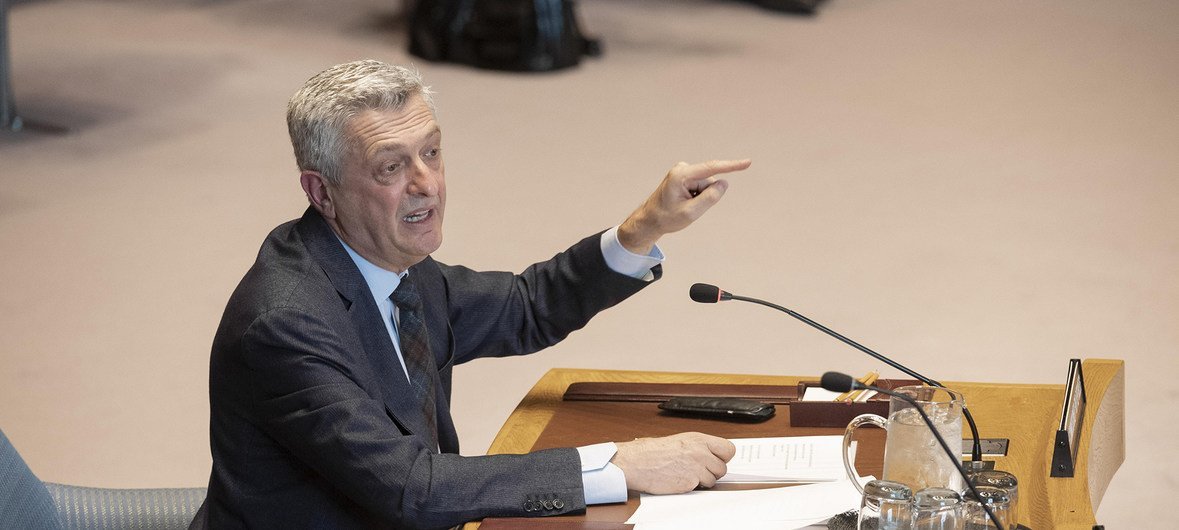
Filippo Grandi in Security Council denounces ‘toxic language of politics’ aimed at refugees, migrants

April 10, 2019

Dissecting the term “refugee crisis” itself, Mr. Grandi asked the Security Council to consider to whom, exactly, that applied: “It is a crisis for a mother with her children fleeing gang violence; it is a crisis for a teenager who wants to flee from war, human rights violations, forced conscription; it is crisis for governments in countries with few resources that, every day, open their borders to thousands. For them, it is a crisis.”

UN Photo/Evan Schneider. The United Nations High Commissioner for Refugees, Filippo Grandi, briefs the Security Council. (9 April 2019)

But it is wrong, he continued, to portray the situation as an unmanageable global crisis: with political will and improved responses, as enshrined by the Global Compact for Refugees, adopted last December, it can be addressed, and the Security Council has a critical role to play, particularly in terms of solving peace and security crises, supporting countries that are hosting refugees, and working to remove obstacles to solutions.

Conflicts, Mr. Grandi pointed out, are the main drivers of refugee flows: of the nearly 70 million people that are displaced, most are escaping deadly fighting. However, from the point of view of the UN High Commission for Refugees, approaches to peace-building are fragmented; addressing the symptoms, rather than the causes.

..[he goes into more detail on the Libyan situation]…

The UN refugee chief went on to exhort the Security council to step up support for the developing countries that host 85 per cent of the world’s refugees, to avoid leaving governments politically exposed, and refugees destitute. With regards to the return of refugees and migrants to their countries of origin, Mr. Grandi countered the misconception that UNHCR blocks returns: refugees have both a right to return, and also a right to not return, he said, in the absence of security and basic support. The informed choice of refugees must be respected, and returns must be dignified.

Mr. Grandi concluded by returning to the consequences of the toxic language surrounding refugees and migration, citing the example of the recent mosque shootings in Christchurch, New Zealand in March, which left 49 dead. The response of the New Zealand Government should, he said, be seen as an good example of effective leadership and how to respond to such toxicity, in a firm and organized manner, restating solidarity with refugees, and reaffirming the principle that our societies cannot be truly prosperous, stable and peaceful, if they do not include everyone.

https://news.un.org/en/story/2019/04/1036391

Brunei back to the middle ages – will hotel boycott work?

April 4, 2019

Cruel and inhuman punishments such as death by stoning for same-sex sexual acts and amputation for robbery came into effect in Brunei Darussalam as Amnesty International feared. The proposed changes to Brunei’s penal code to incorporate punishments under a strict interpretation of Islamic law – including death by stoning – should be halted, the UN’s top human rights official, Michelle Bachelet, said on Monday 1 April 2019. Now some interesting new celebrity action is on the way:

A boycott of Brunei-owned luxury hotels  was sparked last week in an opinion piece by actor George Clooney, who said a boycott of the high-end hotels — where rooms can start at $600 a night or more — is necessary to keep money from flowing “directly into the pockets of men who choose to stone and whip to death their own citizens for being gay or accused of adultery.” It is gaining support from celebrities including Ellen DeGeneres and Elton John as the country on Wednesday implemented what it called Islamic criminal laws including death by stoning for gay sex.

The nine hotels owned by Brunei are:

  • The Dorchester, London
  • 45 Park Lane, London
  • Coworth Park, UK
  • The Beverly Hills Hotel, Beverly Hills
  • Hotel Bel-Air, Los Angeles
  • Le Meurice, Paris
  • Hotel Plaza Athenee, Paris
  • Hotel Eden, Rome
  • Hotel Principe di Savoia, Milan

..In his opinion piece last week, Clooney noted that he’s stayed at many of the hotels owned by Brunei, a small nation located on the island of Borneo, but said he was unaware of their ownership “because I hadn’t done my homework.” He acknowledged that a boycott is unlikely to change Brunei’s laws, but said consumers must decide whether they want their money to support laws that violate human rights. “Are we really going to help fund the murder of innocent citizens?” he wrote. “I’ve learned over years of dealing with murderous regimes that you can’t shame them. But you can shame the banks, the financiers and the institutions that do business with them and choose to look the other way.”

https://www.amnesty.org/en/latest/news/2019/03/brunei-darussalam-heinous-punishments-to-become-law-next-week/
https://www.bbc.co.uk/news/av/world-asia-47813751/will-george-clooney-s-brunei-boycott-really-work
https://www.20min.ch/ro/news/monde/story/Clooney-appelle-au-boycott-des-h-tels-de-Brunei-25250215
https://www.economist.com/asia/2019/04/04/bruneis-ultra-rich-monarch-adopts-harsh-sharia-punishments?
https://news.un.org/en/story/2019/04/1035831

Major study: Do UN Communications Make a Difference for Human Rights Defenders?

March 28, 2019

Do UN Communications Make a Difference for Human Rights Defenders? asked Janika Spannagel in her new study on the “The Effectiveness of Individual Casework on Human Rights Defenders: An Empirical Study of the UN Special Procedure Cases 2004-2015“

After her first study [see: https://humanrightsdefenders.blog/2018/01/26/first-quantitative-analysis-of-16-years-outgoing-communications-by-special-rapporteurs-on-human-rights-defenders/], the University of York has now made public this follow up, which makes fascinating reading for anyone with serious interest in the protection of human rights defenders. Thew full paper is downloadable (see link below) and clarifies many of the tricky issues that this study has to cover. While the highest impact for intervention is always desirable, there remains the ethical and ‘political’ question of intervening even when there is little hope of improvement because the offending regime does not seem to care..’crime should not pay after all’ [On 3 June 2014, that question became the motivation for continuing my blog: https://gr.linkedin.com/in/hans-thoolen-b6648b7]

Despite a growing body of literature on the UN special procedures, we still know very little about the effectiveness of one of its core instruments, namely the use of communications to raise individual cases of human rights abuse with the government concerned. Focusing on the mandate of the UN Special Rapporteur on the situation of human rights defenders, this working paper explores new data to answer the controversially discussed question of whether or not communications generally make a difference in the situations of individual defenders.

The first part of this paper analyses data obtained from a survey of involved advocates, assessing the UN mandate’s impact on a random sample of cases among the Special Rapporteur’s communications between 2004 and 2015. The second part is concerned with external factors that may impact the further development of a case, suggesting alternative explanations of – but also possible conditions for – the medium term effectiveness of communications. For this purpose, the author uses a logistic regression to analyse a sample of almost 500 cases in order to investigate possible explanations for improvement or deterioration among cases addressed by the Special Rapporteur.

The systematic analysis of impact assessments provided by involved advocates convincingly suggests that individual casework is very often effective in providing protection to defenders whose cases are raised. However, the study of predictors of positive case developments also shows that the effectiveness of individual casework is highly contextual and therefore requires strategic adaptation and creative responses.

Implications for Practice
  • In considering only direct impact, the finding that the Special Rapporteur’s individual casework very often positively influences defenders’ situations provides an important argument for continued, or even increased, support for the special procedures’ communications activity.
  • Based on the sample cases, it can be concluded that international attention paid to cases with business involvement did not result in any substantial improvements in the medium term. The recently increased efforts by the Special Rapporteur to raise cases with companies directly, rather than only through the government concerned, may prove more effective.
  • Regime type matters with regard to case development, although only as an indirect effect on the predictive value of certain variables. This includes the previous violations, a country’s aid dependency, and a forthcoming UPR process. Such variables should be taken into account when considering the potential impact of a communication on a certain case.
  • The Special Rapporteur often refers to ‘follow-up’ on cases, however, rarely if ever does this reflect repeat communications regarding the same violation against a given defender. In reality, further communications serve instead to highlight new violations against the individual involved. The data suggests that these – often ‘high profile’ – defenders have a very low chance of seeing their situation improved. This finding makes the case for a more detailed assessment of the likely added value that repeated mentions by the Special Rapporteur can or cannot provide.
  • The main leverage in terms of possible impact relies on the selection of cases. However, both the ethical implications and multiple purposes of casework should be acknowledged and respected. While a focus on increased impact can be useful, the documentation function and more indirect protection effects should also be taken into account during case selection.
  • What remains unclear in the dataset is the extent to which ‘improvements’ in a defender’s situation following a communication also reflect a restored ability to carry out their work, and to what extent the experience of violations, or the continued threat thereof, inhibits this. Further research into the effects of case-specific improvement on defenders’ ability to effect change is needed.

…

https://www.gppi.net/2019/03/26/do-un-communications-make-a-difference-in-the-situations-of-human-rights-defenders

This working paper is available for download from the University of York Human Rights Defenders Hub.

The NGOs summarize the results of the 40th session of the Human Rights Council

March 25, 2019

On 22 March 2019 a group of important international NGOs (Amnesty International, ARTICLE 19, FORUM-ASIA, DefendDefenders, Center for Reproductive Rights, Human Rights House Foundation, Human Rights Watch, International Commission of Jurists, and the FIDH) published a joint assessment of the main result of the 40th session of the UN Human Rights Council including the adoption by consensus of the resolution on environmental human rights defenders, continued Council scrutiny over Sri Lanka, Myanmar, South Sudan, Syria and Iran, as well as initiation of Council action on Nicaragua and several joint statements on Saudi Arabia, Chechnya and Cameroon.

Ten leading human rights organisations* welcomed significant Council outcomes at the 40th session such as a strong consensus resolution recognising the critical role of environmental human rights defenders [see: https://humanrightsdefenders.blog/2019/03/23/human-rights-council-recognises-vital-role-of-environmental-human-rights-defenders/] and the continued and increased scrutiny by the Council over a range of situations of rights violations across the globe. The organisations also expressed their concerns over the Council’s failure to hold the Philippines, Egypt, Libya and China accountable and urged States to take action at upcoming Council sessions.

We welcome the positive step the Council has taken in the direction to effectively protect environmental human rights defenders (EHRDs). By adopting the resolution by consensus, the Council has collectively and explicitly recognized the vital role of EHRDs, including in attaining the SDGs sustainable development goals and ensuring that no-one is left behind, and called for their protection. ……..

We welcome South Africa’s leadership to put on the Council’s agenda emerging human rights issues, in bringing attention to the multiple and intersecting forms of discrimination that women and girls face in the field of sports, especially on the basis of race and gender…

While we welcome the extension of Council attention on Sri Lanka for another two years, a concrete, transparent, and time-bound action plan is urgently needed to implement its commitments under resolution 30/1 in collaboration with OHCHR. Given the lack of progress and political will to implement these commitments, in the absence of immediate progress, the Council should consider additional measures or mechanisms for ensuring victims’ rights to truth, justice and reparations. Individual States need not wait to exercise universal jurisdiction.

We welcome the resolution on Myanmar and its strong focus on ending impunity and ensuring accountability, and we call for the swift operationalisation of the Independent Investigative Mechanism (IIM). We welcome steps taken to review the UN’s involvement in Myanmar. We urge the UN Secretary-General to ensure that it is independent and transparent, and present the findings and recommendations at the Council’s 43rd session.

We welcome the renewal of the mandate of the Commission on Human Rights in South Sudan, a vital mechanism for human rights reporting and evidence gathering. It sends the right message to the government and all parties to the conflict: There can be no lasting peace without justice…

By adopting a resolution on Nicaragua, the Council sent a signal to victims of the current crisis that the international community will not allow impunity for the serious ongoing violations to prevail. We look forward to robust reporting from the OHCHR and we urge the Nicaraguan government to fully engage with the Office to ensure the victims’ rights to truth, justice and reparation.

The Council sent a strong message of support to human rights defenders in Saudi Arabia [see: https://humanrightsdefenders.blog/2019/03/08/saudi-arabia-for-first-time-openly-criticized-in-un-human-rights-council/]……

..We welcome the joint statement on Chechnya delivered by more than 30 States and join the call on the Russian authorities for the persecution to stop: for the immediate and unconditional release of all detained for their actual or perceived sexual orientation or gender identity, and for swift, thorough, and impartial investigations.

We welcome the Cameroon joint statement which advances both Council membership standards and its prevention mandate, and urge the Council to keep the matter under scrutiny.

While we have welcomed the Council’s attention to several situations of gross rights violations, we remain concerned about the lack of consistent and principled leadership by States, in particular by Council members.

We are disappointed that even though the demands of several EU and WEOG States to move the resolution on accountability for crimes committed in the Occupied Palestinian Territories from item 7 to item 2 was met, they still failed to support the resolution. This suggests that no matter the item number, some WEOG members continue in failing to protect the human rights of Palestinians, effectively shielding Israel from accountability.

We regret that States have yet again failed to initiate Council action on the Philippines amidst continued unlawful killings in the government’s so-called war on drugs, and increased targeting of independent media, civil society organisations, and human rights defenders. ……….

We are deeply disappointed that the resolution adopted on Libya again lacks any meaningful accountability mechanism or mandate, despite the impunity for the widespread and systematic violations of international humanitarian and human rights law that prevail there.

We deplore that despite credible reports of the detention of up to 1 million Uyghurs and other Turkic Muslims in western China, the Council has yet again given a pass to China, permitting impunity for widespread and severe human rights violations. The efforts China has made to keep States silent, exemplified by intimidation and threats on the one hand and whitewashing the situation on the other, demonstrate the degree to which Council action could have had meaningful results if States had instead called clearly and collectively for an independent, unrestricted fact-finding mission.

…….We applaud Mexico and other States’ resolve to safeguard the independence of the mandate of the Special Rapporteur on the promotion and protection of human rights while countering terrorism and to resist any attempts to dilute, distract or distort its essential focus, ensuring that the Rapporteur can continue to have positive impacts both in preventing and responding to human rights violations committed in the name of countering terrorism and in relation to the human rights of victims of terrorism. We urge States to remain vigilant to resist future attempts to undermine the Special Procedures system – the eyes and ears of the Council.

We welcome the Council’s renewal of the mandates of the Special Rapporteur on Iran and the Commission of Inquiry on Syria, so that both can continue to perform their vital work fulfilling their respective mandates and addressing the dire human rights situations in both countries.  We urge the Iranian and Syrian authorities to change their posture of noncooperation with the respective mandate .

Several of our organisations have urged the UN High Commissioner to publish the database on businesses in Israeli settlements and were alarmed at its further delay.  We urge the High Commissioner to release the database with all due haste.

We welcome the renewal of the Special Rapporteur on freedom of religion or belief mandate, and the maintenance of consensus on the Council resolution 16/18 framework for addressing religious intolerance . Rising intolerance and hate is a global concern, and States must move beyond rhetoric to action in implementing these standards.

The High Commissioner’s update on Venezuela during this session reflected the dire human rights situation in Venezuela. We urge all States to consider what more the Council can do to address the worsening human rights crisis in the country and to support all victims.

We note the highly disturbing report by the Special Rapporteur on adequate housing concerning grave reprisals by the Egyptian government against those who cooperated with her during her recent visit to the country and urge this Council to take action to address these attacks.

We welcome the passage of the resolution on Georgia and the continued attention devoted to the importance of full and unimpeded access for the Office of the High Commissioner and international and regional human rights mechanisms.

The full statement can be found via the link below:
http://www.ishr.ch/news/hrc40-civil-society-presents-key-takeaways-human-rights-council

https://www.unog.ch/unog/website/news_media.nsf/(httpNewsByYear_en)/F8666286FD4F67E7C12583C5006579ED?OpenDocument

Human Rights Council recognises vital role of environmental human rights defenders

March 23, 2019

The ISHR reports that on 21 March 2019 the UN Human Rights Council has adopted a strong consensus resolution recognising the critical role of environmental human rights defenders in protecting vital ecosystems, addressing climate change, attaining the sustainable development goals (SDGs) and ensuring that no-one is left behind. [See also: https://humanrightsdefenders.blog/2019/01/09/front-line-defenders-says-record-number-of-activists-killed-in-2018/].

The resolution meets many of the civil society demands ISHR expressed in a joint letter along with more than 180 groups (see reference below). By formally acknowledging the important role of environmental human rights defenders, the Council highlights the legitimacy of their work, helps counter stigmatisation and can contribute to expanding their operating space. Though the resolution falls short in some key areas, its adoption by consensus is a positive step towards better protection of environmental human rights defenders. It must now be followed by implementation at the national level by all relevant stakeholders, including States, UN agencies, businesses and development finance institutions….

The resolution was led and presented by Norway, on behalf of 60 States from all regions. In particular, many Latin American States strongly supported the resolution, which is significant given the dangerous situation for defenders in many of those countries. The consensus on the protection of environmental human rights defenders is a welcome sign of unity by the international community in recognising their vital contribution to a biodiverse and healthy environment, to peace and security, and to human rights.

‘We now look to States, business enterprises and development finance institutions to take rapid and decisive steps to address the global crisis facing environmental human rights defenders’, said Michael Ineichen, Programme Director at the International Service for Human Rights. ‘This means States need to create protection mechanisms which guarantee the security of defenders. States must also ensure that businesses put in place specific policies and processes allowing for the inclusion of human rights defenders and their concerns in due diligence processes’, Ineichen said.   

Key points of the resolution:

  • Expresses alarm at increasing violations against environmental defenders, including killings, gender-based violence, threats, harassment, intimidation, smear campaigns, criminalisation, judicial harassment, forced eviction and displacement. It acknowledges that violations are also committed against defenders’ families, communities, associates and lawyers;
  • Recognises that the protection of human rights defenders can only be achieved through an approach which promotes and celebrates their work. It also calls for root causes of violations to be addressed by strengthening democratic institutions, combating impunity and reducing economic inequalities;
  • Pays particular attention to women human rights defenders, by stressing the intersectional nature of violations and abuses against them and against indigenous peoples, children, persons belonging to minorities, and rural and marginalised communities;
  • Urges States to adopt laws guaranteeing the protection of defenders, put in place holistic protection measures for and in consultation with defenders, and ensure investigation and accountability for threats and attacks against environmental human rights defenders; and
  • Calls on businesses to carry out human rights due diligence and to hold meaningful and inclusive consultations with defenders, potentially affected groups and other relevant stakeholders.

While the resolution was adopted by consensus, the unity came at the price of a lack of specificity in certain areas. For instance, the resolution does not clearly recognise all of the root causes of the insecurity facing environmental human rights defenders, as documented by UN experts, nor comprehensively name the perpetrators or the most dangerous industries. It also fails to clearly spell out the human rights obligations of development finance institutions, and to detail the corresponding necessary steps to consult, respect and protect the work of environmental human rights defenders. 

https://www.ishr.ch/news/hrc40-council-unanimously-recognises-vital-role-environmental-human-rights-defenders

https://www.ishr.ch/news/hrc40-states-should-defend-environmental-human-rights-defenders

Human Rights Council: Reprisals instead of responses is the answer by many States

March 21, 2019
Room XX of the Human Rights Council

In two statements delivered to the 40th Session of the Human Rights Council, ISHR and Amnesty International reacted to the latest Joint Communications Report of the UN Special Procedures – independent human rights experts, appointed to monitor and report on human rights violations and to advise and assist in promoting and protecting rights. The report cites nine cases of reprisals against human rights defenders cooperating with the UN, and reveals that 95 states have not responded to letters from the UN experts concerning human rights violations.

There are two, related issues at stake here: (1) non-response to letters from the UN, and even worse (2) reprisals against human rights defenders who cooperate with the UN.

When I started my blog in 2010 (and one of the motivations) a main concern was the lack of response and enforcement [see https://humanrightsdefenders.blog/2011/03/20/taking-on-non-response-this-bloggers-lone-response/ and : https://www.linkedin.com/pulse/20140603192912-22083774–crime-should-not-pay-in-the-area-of-international-human-rights ].

As Helen Nolan of ISHR explains, 35 States have recently failed to respond to two or more of these letters. 13 of these nations are members of the Council. ‘Repeat offenders are a particular concern,’ says Nolan. ‘India has failed to reply to a staggering 8 communications, Mexico 6, Italy 5, and Bangladesh and Nepal 4 each.’ Nolan emphasises that a failure to reply is a failure to cooperate, and welcomes the fact that the recently published report of the Annual Meeting of Special Procedures focuses on non-cooperation, including ‘more subtle forms’, such as selective cooperation with particular mandates. ‘To encourage cooperation, the Council must make non-cooperation more costly,’ says Nolan. ‘We urge the President of the Council to work closely with the Coordinating Committee of the Special Procedures to find ways to do this,‘ adds Nolan.

ISHR and Amnesty International’s second statement noted that under GA Resolution 60/251, Council members must ‘fully cooperate with the Council.’ Yet, the report cites nine cases of reprisals involving these members:

  • China sought to revoke the Society for Threatened Peoples’ ECOSOC status after vexatiously alleging that a person accredited by them, Dolkun Isa, participated in incitement and funding of separatism and terrorism, in retaliation for cooperation with the UN;
  • Egypt carried out forced evictions, and violations of the rights to physical integrity, liberty and security against individuals who cooperated with the Special Rapporteur on the right to adequate housing during her recent visit;
  • Iraq carried out unlawful arrest, enforced disappearance and torture against Imad Al Tamimi and intimidated and threatened Israa Al Dujaili for cooperating with the UN;
  • Libya arrested an individual in retaliation for taking steps to clarify the fate and whereabouts of his father, including with UN mechanisms;
  • The Philippines labeled defenders “terrorists” in reprisal for their engagement with the UN;
  • Russia surveilled, intimidated and harassed Yana Tannagasheva and her husband, for speaking out about impacts of coal mining on indigenous people in Siberia and in possible reprisal for their communication with UN mechanisms;
  • Turkmenistan carried out reprisals against a defender and her husband for her cooperation with the UN; and
  • In Yemen, forces loyal to President Hadi and the Saudi-led coalition detained human rights defenders Radhya Al-Mutawakel and Abdulrasheed Al-Faqih for cooperating with the UN.

‘We call on the President of the Council to request updates on the cases from Iraq, Libya, Russia, Turkmenistan and Yemen, as there has been no response from the States concerned,’ said Nolan. For an older post on reprisals, see: https://humanrightsdefenders.blog/2014/03/13/zero-tolerance-for-states-that-take-reprisals-against-hrds-lets-up-the-ante/

Full text of the first statement (on failure to reply) available here.

Full text of the second statement (on cases of reprisals) available here.

You can also watch the videos of the statements via the link below:

Many NGO participants denied visa to attend Commission on the Status of Women in New York

March 21, 2019

Kena Betancur / Getty Images

reports on 20 March 2019 that many women who were slated to participate in the UN Commission on the Status of Women have been denied visas, especially lawyers, activists, and women who deliver reproductive health care services from African and Middle Eastern countries that fell under Donald Trump’s travel ban.

The US is obliged under a 70-year-old treaty to not restrict people or NGOs from attending the UN headquarters. BuzzFeed News is yet to receive a response from the US Mission to the UN regarding the total number of visas that have been denied this year. [see also: https://humanrightsdefenders.blog/2019/03/18/irans-election-to-a-un-gender-equality-body-should-not-obscure-the-real-work/]

The International Service for Human Rights said it was aware of at least 41 women who have been denied visas to attend the conference this year — but this figure is said to be only “the tip of the iceberg” and likely to increase.

Women who wanted to attend CSW this year from countries like Iran, Sudan, Zimbabwe, and Syria were asked to provide supporting documents like marriage certificates, proof of property ownership, letters stating employment status, proof of finances, and even proof of birth certificates or proof showing that they have children, according to the petition.

Lyndal Rowlands, advocacy officer with the UN-accredited organization CIVICUS, told BuzzFeed News that among all the people that were denied visas, women from countries that fell under the Trump administration’s travel ban were disproportionately affected. “Last year and this year we have also heard of women from Pakistan and Nepal who were denied visas,” she said. …Most of the women applying for visas, Rowlands said, had not traveled to the US before — a deliberate decision by organizers who wanted a diverse range of women present at the United Nations, not just pundits and experts who travel all the time but women who work at the grassroots.

“It’s essential that women who are at the front lines working on women’s rights are present when their rights and the rights of the women they serve are being discussed,” she said. “Governments and UN officials that attend the conference can make better policies when they are informed by the experiences of women who face some of the biggest uphill battles when it comes to fighting for gender equality — for example, delegates who were unable to attend include lawyers and advocates who represent women who have been imprisoned for their activism, [and] women who deliver reproductive health care services.”

https://www.buzzfeednews.com/article/nishitajha/un-women-conference-visas-denied

Special Rapporteur Diego Garcia-Sayan not swayed by Moroccan assurances for his visit

March 21, 2019
Morocco Deplores UN Special Rapporteur’s Reasons for Canceling Visit

https://www.ohchr.org/EN/NewsEvents/Pages/DisplayNews.aspx?NewsID=24356&LangID=E

https://www.moroccoworldnews.com/2019/03/268552/morocco-un-special-rapporteurs-visit/

Sri Lanka and the UN Human Rights Council: a Tale of Two Stories

March 18, 2019

One at the political level: On 17 March it was reported that a Sri Lankan parliamentarian – who will be a member of a delegation to be sent to the UN Human Rights Council next week – has slammed the UN High Commissioner for Human Rights report on his island, calling it “an atrocious piece of writing containing lies, half lies and highly contestable statements”. Sarath Amunugama, a senior former minister said the Sri Lankan delegation would be meeting with the UN High Commissioner for Human Rights to take up their complaints in person.

The report, released last week, said Sri Lanka had made “virtually no progress” on the investigation of war crimes, and also raised several other issues, including concerns over on-going reports of abduction, torture and sexual violence, institutional failures within the criminal justice system, ongoing harassment of human rights defenders since 2015 and the military’s continued occupation of civilian land. Amunugama though claimed the report was “methodologically incorrect” and contained “totally unwarranted statements”.

His comments come after less than a day after Sri Lanka’s ministry of foreign affairs agreed to the co-sponsoring of a roll-over UN resolution, the president Maithripala Sirisena said he wanted it stopped.  Sirisena also said that the delegation he would be sending to Geneva would argue that Sri Lanka should be allowed to ‘solve its own problems’.

—–

And the other more ‘scientific’, fact-based approach of Verité Research which is engaged in a four-part series on government progress in fulfilling commitments in Resolution 30/1.

Iran’s election to a UN ‘Gender Equality’ body should not obscure the real work

March 18, 2019
UN Commission on the Status of Women opening session, March 2019. Photo: Li Muzi/Xinhua News Agency/PA Images. All rights reserved.

Anne Marie Goetz in Open Democracy of 13 March 2019 goes in more depth on what the UN’s Commission on the Status of Women (CSW) in New York can do and points our that  “Never before has social protection – pensions, health insurance, social security, child benefit, parental leave – been addressed by the CSW. Achieving progress on these issues is threatened by both religious and market fundamentalisms – though a number of states including Lebanon, Namibia, and Uruguay are resisting this backlash.“…

The US, Bahrain and Malaysia have reiterated during this week’s CSW discussions that the family – not the state – is the main source of social protection for many women. This is what I’d call a ‘family fallback’ approach which, combined with cuts to public services, requires women to expand their mothering roles to pick up the slack. Some countries, including Russia and Saudi Arabia, defend this maternal focus as a national cultural preference. The US is now among those supporting this view, arguing that any proposals on women’s rights should only be applied ‘as nationally appropriate’. This allows the notion of ‘national sovereignty’ to trump global standards on gender equality.

But the US position is so extreme that Shannon Kowalski, advocacy and policy director at the International Women’s Health Coalition, told me it’s expected that “major fractures will emerge” even with its conservative friends. Few developing countries can stomach the Trump government’s drift towards abstinence as the foundation of family planning.

Moreover, the US’s refusal to participate in the 2018 Global Compact for Immigration discussions has alienated countries such as the Philippines, Mexico and Indonesia, which have proposed, for instance, that social security benefits earned by immigrant women should be portable and redeemable when they return home.

A diverse counter-movement against the current global ‘illiberal drift’ is also visible at this year’s CSW. The ‘Buenos Aires Group’, consisting of many South American states (notably Argentina, Chile and Uruguay), has emerged as a defender of LGBTIQ rights and a skeptic about privatisation of public services. This year Tunisia and Lebanon, in the Arab states group, and South Africa, Namibia, Liberia and Cape Verde in the ‘Africa Group’ of countries, are championing progressive positions on women’s rights as well. This support from the Global South vitally shows that the gender equality agenda is not just the concern of the usual suspects in the North – Canada, New Zealand, Australia, Iceland, Norway, Liechtenstein and the EU.

https://www.opendemocracy.net/en/5050/religious-and-market-fundamentalisms-threaten-gender-equality-un-summit/