Archive for the 'OHCHR' Category

UN cancels all human rights side events because of Covid-19

March 4, 2020

Late last week, Swiss authorities took the unprecedented step of prohibiting large public events in response to a growing number of coronavirus cases. As a consequence, events such as the International Motor Show, which attracts a half-million people and Swiss watch exhibits, which draw enthusiastic crowds of thousands of people, have been canceled.  See also: https://humanrightsdefenders.blog/2020/03/03/another-covid-19-casualty-the-2020-human-rights-film-festival-of-geneva-fifdh/

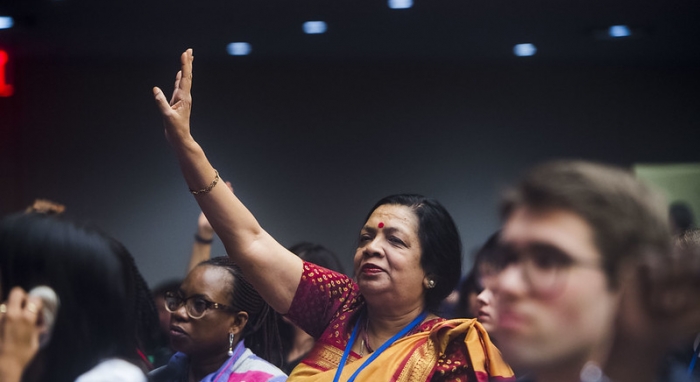
Human Rights spokesman Rolando Gomez says 200 side events will be canceled until the end of this council session on March 20.  He says that is an unfortunate, but responsible measure to take in order to prevent the coronavirus from spreading.  He tells VOA the meetings generally attract on average 4,000 to 6,000 participants during the course of the session. He says those side events are very important.

I should point out just as a technical note they are not official council side events,” said Gomez. “They take place in parallel and they are important as they inform the discussions in the formal proceedings. Of course, those lobbying efforts will continue unabated, which are important.” Side events are organized by non-governmental organizations and states.  The Office of the U.N. High Commissioner for Human Rights also has spent a lot of time and effort in organizing several gatherings aimed at exploring particular aspects of human rights that demand a more comprehensive hearing and analysis. They will not be held.

https://www.voanews.com/science-health/coronavirus-outbreak/coronavirus-prompts-cancellation-human-rights-events-un

Renewal of the UN Special Rapporteur on Human Rights Defenders crucial

February 29, 2020

At the 43rd session of the Human Rights Council, States will consider a resolution extending for three years the mandate of the Special Rapporteur on the situation of Human Rights Defenders. Civil society organisations from across the world are calling on all States to support the consensus renewal of the mandate, and to resist any attempt to undermine the mandate and States’ obligations. This is a key opportunity for States and the Council to demonstrate their support and recognition for the indispensable role defenders play to ensure that all people enjoy freedom, dignity, justice and equality. Despite their vital contribution, both some governments and non-State actors are still seeking to silence defenders as they expose injustices and demand accountability for all.

The mandate of the Special Rapporteur on the situation of human rights defenders is integral to their protection and recognition, globally. It gathers and responds to information on the situation of defenders around the world, engages constructively with governments and non-State actors and provides expert recommendations to promote the effective implementation of the Declaration on human rights defenders (‘the Declaration’).  See also: https://humanrightsdefenders.blog/2019/09/11/what-should-michael-forsts-successor-as-rapporteur-on-hrds-look-like/

In 2019, the Human Rights Council and the General Assembly supported the vital work of defenders. The Human Rights Council recognised the critical role of environmental human rights defenders in protecting natural ecosystems, addressing climate change, attaining the sustainable development goals (SDGs). The General Assembly passed by consensus a resolution focusing on implementation of the Declaration and some key elements of protection policy; the resolution also attracted a record number of co-sponsors.

More than 50 Civil society organisations from across the world are calling on all States to support the extension of the mandate of the Special Rapporteur by:

  • Participating positively in the negotiations on the resolution,
  • Presenting early co-sponsorship of the text,
  • Resisting any attempts to dilute the mandate or State obligations, and
  • Supporting consensus renewal of the mandate.

https://www.ishr.ch/news/hrc43-support-consensus-renewal-un-special-rapporteur-human-rights-defenders

Human Rights Defenders issues on the agenda of 43rd Human Rights Council

February 24, 2020

On 17 February 2020 the International Service for Human Rights (ISHR) published – as usual – its excellent “HRC43 | Key issues on agenda of March 2020 session”. Here some excerpts that relate directly to human rights defenders in the 43rd session of the UN Human Rights Council, which runs from 24 February to 20 March 2020.  If you want to stay up-to-date: with all issues follow @ISHRglobal and #HRC43 on Twitter.

Here are some highlights of the session’s thematic discussions

Protection of human rights defenders including women human rights defenders. The Council will consider a resolution, presented by Norway, to renew the mandate of the Special Rapporteur on the situation of human rights defenders. The mandate gathers and responds to information on the situation of defenders around the world, engages constructively with governments and non-State actors and provides recommendations to promote the effective implementation of the Declaration on human rights defenders. In 2019, the Council and the General Assembly unanimously affirmed the vital work defenders play. The Council recognised the critical role of environmental human rights defenders in protecting vital ecosystems, addressing climate change, attaining the sustainable development goals (SDGs). The General Assembly passed by consensus a resolution focusing on implementation of the Declaration and some key elements of protection policy; the resolution also attracted a record number of co-sponsors. The Special Rapporteur on the situation of human rights defenders will present his report on human rights defenders operating in conflict and post-conflict situations on 4 March, and country visits to Colombia and Mongolia.

Reports of cases of intimidation and reprisal against those cooperating or seeking to cooperate with the UN not only continue, but grow. Intimidation and reprisals violate the rights of the individuals concerned, they constitute violations of international human rights law and undermine the UN human rights system. [for some of my ealrier posts on reprisals, see: https://humanrightsdefenders.blog/tag/reprisals/]. During the 42nd session, the Council adopted a resolution which listed key trends such as the patterns of reprisals, increasing self-censorship, the use of national security arguments and counter-terrorism strategies by States as justification for blocking access to the UN. The resolution also acknowledged the specific risks to individuals in vulnerable situations or belonging to marginalised groups, and called on the UN to implement gender-responsive policies to end reprisals. The Council called on States to combat impunity and to report back to it on how they are preventing reprisals, both online and offline. [see also: https://humanrightsdefenders.blog/2019/11/08/michel-forst-in-last-address-to-general-assembly-pleads-to-fight-reprisals/]. Item 5 of the Human Rights Council’s agenda provides a key opportunity for States to raise concerns about reprisals, and for governments involved in existing cases to provide an update to the Council on any investigation or action taken toward accountability to be carried out.

At this 43rd session, the Council will discuss a range of economic, social and cultural rights in depth through dedicated debates with mandate holders alongside the annual report of the Secretary-General on the realisation of economic, social and cultural rights globally. These include interactive dialogues with the following:

  • The Special Rapporteur on the right to adequate housing on her annual report and country visits reports to Nigeria and France.
  • The Special Rapporteur in the field of cultural rights on her annual report on cultural rights defenders and country visit report to the Maldives and Poland.
  • The Special Rapporteur on human rights and the environment on his annual report and country visits to Fiji and Norway.

The Council will discuss a range of civil and political rights through dedicated debates with the mandate holders, including interactive dialogues with:

  • The Special Rapporteur on torture on his annual report and visit to Comoros.
  • The Special Rapporteur on freedom of religion or belief on his annual report and visits to the Netherlands and Sri Lanka.
  • The Special Rapporteur on the promotion and protection of human rights while countering terrorism on her annual report and visit to Kazakhstan.
  • The Special Rapporteur on the right to privacy on his annual report.

Country-specific developments

China Confronted with mounting evidence of serious human rights violations in China, specifically the mass internment, ‘re-education’, surveillance and harassment of Turkic Muslims in the western province of  Xinjiang, the view of many parts of the UN is incontrovertible. Beginning with a major UN review in August 2018, the UN High Commissioner has pressed for access, while the Special Procedures have expressed serious concerns about protection of freedom of religious belief, the impacts of counter-terrorism and counter-extremism measures, and the imposition of the death penalty in at least one case, that of university president Tashpolat Tiyip. In light of these concerns and the continued deterioration of the situation for human rights lawyers and defenders; the attacks on cultural rights and other freedoms in Tibet; and criminalisation of peaceful assembly and excessive use of police force in Hong Kong, it is high time for the Council to act. Member States should take concrete steps to call for independent, expert monitoring and reporting on the situation in Xinjiang, including access to the region, and urge accountability for actions by public authorities. [see also: https://humanrightsdefenders.blog/2019/07/12/joint-letter-by-22-states-to-human-rights-council-re-chinas-uighurs/ and https://humanrightsdefenders.blog/2019/07/20/china-coalition-anti-human-rights-un/]

Saudi Arabia The Council’s action on Saudi Arabia has contributed to the provisional release of at least seven women’s rights activists from detention. However, they are still facing trial and many remain in detention. Recent revelations of phone hacking, surveillance and possible blackmail and extortion of the owner of the Washington Post demonstrate the measures that the State is prepared to take to silence any form of criticism or dissent. The joint statement delivered by Australia in September sets out benchmarks for the Saudi government to take to demonstrate its willingness to improve the human rights situation. These benchmarks have not been met. States should ensure that Council scrutiny is maintained and in particular establish a monitoring and reporting mechanism over the situation. [for other posts on Saudi Arabia, see: https://humanrightsdefenders.blog/tag/saudi-arabia/]

Egypt The lack of action by the international community has emboldened the Egyptian government to continue to violate fundamental rights of its citizens. Special Procedures have rung the alarm bell regarding the pattern of reprisals against individuals and groups who sought to or engaged with the UN. In the last quarter of 2019 alone, more than 3,000 people were arbitrarily arrested and prosecuted under counter-terrorism laws in a nationwide crackdown against all forms of peaceful expression. The Committee against Torture has found that torture in Egypt is widespread and systematic and the situation meets all of the objective criteria for situations requiring the Council’s attention. States should initiate Council action on the situation before it further deteriorates. [see also: https://humanrightsdefenders.blog/tag/egypt/ ]

India The High Commissioner expressed concern over India’s Citizenship (Amendment) Act 2019 (CAA) for being ‘fundamentally discriminatory’ as it fails to extend protections to Muslim asylum seekers. Nationwide demonstrations and protests have been met with police brutality and arbitrary detentions. Vigilante groups allegedly affiliated with right-wing Hindu nationalist groups close to the government have physically attacked student protestors. Human rights defenders involved in organising peaceful assemblies have been detained and faced online harassment. ISHR calls on States to raise these concerns in their national statements including during the high level segment. [See also: https://humanrightsdefenders.blog/2019/06/27/ngos-come-out-in-support-of-indias-lawyers-collective/]

Burundi. At the last Council session, the Council renewed the mandate of the Commission of Inquiry on Burundi, which will present its oral briefing on 10 March at 10:00. ISHR remains highly concerned about the human rights situation in Burundi and its refusal to cooperate with the Council’s mechanisms. For more information on the situation of human rights defenders in Burundi, check ISHR Briefing Paper for the UPR here. See also: https://humanrightsdefenders.blog/2019/03/29/ngo-statement-condemns-new-irregularities-in-the-case-of-germain-rukuki-burundi/

Sri Lanka. Civil society groups are concerned over the backsliding on the commitments made by Sri Lanka in Human Rights Council Resolution 30/1. The recently elected president, Gotabaya Rajapaksa, along with his brother Mahinda Rajapaksa, who has been appointed prime minister, have been implicated in war crimes and numerous human rights violations when they were defence secretary and president respectively from 2005 to 2015. The new Government has made clear its intention to walk away from the Council process on Sri Lanka, a process that is currently the only hope for victims of human rights violations that truth, justice, reparations, and guarantees of non-recurrence are possible. [see https://www.nwaonline.com/news/2020/feb/23/sri-lanka-details-un-case-pullout/] Meanwhile, the relatively open climate for human rights defenders and journalists of the past few years seems to be rapidly closing. More than a dozen human rights and media organisations have received intimidating visits by members of law enforcement and intelligence agencies, while death threats against journalists have resumed. ISHR calls on States to urge for continued cooperation of the Government of Sri Lanka with OHCHR and the Special Procedures. The Council should reiterate the reference in Resolution 40/1 to “the adoption of a time-bound implementation strategy” for implementation of all elements of Resolution 30/1. [see also: https://humanrightsdefenders.blog/2020/01/22/sri-lankan-government-accused-of-embarking-on-process-to-silence-critics/]

Other country situations:

    • Interactive dialogue with the High Commissioner on the Occupied Palestinian Territories
    • Interactive dialogue with the Special Rapporteur on Eritrea
    • Interactive dialogue with the Special Rapporteur on Myanmar
    • Interactive dialogue with the Special Rapporteur on the Democratic People’s Republic of Korea
    • Interactive dialogue with the High Commissioner on Libya
    • High-level interactive dialogue on the Central African Republic
    • Interactive dialogue with the Commission on human rights on South Sudan
    • Interactive dialogue with the Special Rapporteur on Iran
    • Interactive dialogue with the Commission of Inquiry on Syria
    • Enhanced interactive dialogue on the High Commissioner’s report on the Democratic Republic of Congo
    • Interactive dialogue with the Independent Expert on Mali 
    • Interactive dialogue on the High Commissioner’s oral report on Ukraine
    • High Commissioner briefings on the following countries: Guatemala, Honduras, Colombia, Nicaragua, Yemen, Venezuela, Myanmar, Cyprus, Sri Lanka, Iran, Eritrea, Afghanistan

During this session, the Council will adopt the UPR working group reports on Italy, El Salvador, the Gambia, Bolivia, Fiji, San Marino, Kazakhstan, Angola, Iran, Madagascar, Iraq, Slovenia, Egypt and Bosnia and Herzegovina. This session of the Council will provide an opportunity for Angola, Egypt and Fiji  to to accept recommendations made in relation to human rights defenders, as proposed in ISHR’s briefing papers.

Council programme, appointments and resolutions

The President of the Human Rights Council will propose candidates for the following mandates:

  1. Two members of the Expert Mechanism on the Rights of Indigenous Peoples (one from Asia and one from the Arctic);
  2. Independent Expert on the situation of human rights in Somalia;
  3. Special Rapporteur on adequate housing as a component of the right to an adequate standard of living, and on the right to non-discrimination in this context;
  4. Special Rapporteur on contemporary forms of slavery, including its causes and its consequences;
  5. Special Rapporteur on the rights of indigenous peoples;
  6. Special Rapporteur on the sale and sexual exploitation of children, including child prostitution, child pornography and other child sexual abuse material;
  7. Special Rapporteur on the situation of human rights defenders;
  8. Special Rapporteur on the situation of human rights in Myanmar.

Some resolutions werealready announced (States leading the resolution in brackets):

  1. Prevention of genocide (Armenia)
  2. Special Rapporteur on Torture, mandate renewal (Denmark)
  3. Freedom of religion or belief (EU)
  4. Situation of human rights in Myanmar (EU)
  5. Situation of human rights in the Democratic People’s Republic of Korea, mandate renewal (EU)
  6. Mandate renewal of the Special Rapporteur on the human rights of migrants (Mexico)
  7. Protecting the rights of human rights defenders, mandate renewal (Norway)
  8. Technical assistance and capacity-building to improve human rights in Libya (African Group)
  9. Combating intolerance, negative stereotyping and stigmatization of and discrimination, incitement to violence and violence against persons based on religion or belief (Pakistan on behalf of the OIC)
  10. The human rights situation in the Syrian Arab Republic (France, Germany, Italy, Jordan, Kuwait, Morocco, Netherlands, Qatar, Turkey, United Kingdom of Great Britain and Northern Ireland)
  11. Situation of human rights in South Sudan, mandate renewal (Albania, Norway, United Kingdom of Great Britain and Northern Ireland)
  12. Situation of human rights in the Islamic Republic of Iran, mandate renewal (North Macedonia, Republic of Moldova, Sweden, United Kingdom of Great Britain and Northern Ireland)
  13. Freedom of Expression, mandate renewal (Netherlands, Canada)

Officers of the Human Rights Council

Newly appointed members of the Bureau for the 14th cycle comprises of the following Ambassadors:

  • Ms. Elisabeth Tichy-Fisslberger (Austria), President of the Human Rights Council
  • Mr. Yackoley Kokou Johnson (Togo), Vice-President and Rapporteur
  • Mr. Nasir Ahmad Andisha (Afghanistan), Vice-President
  • Ms. Socorro Flores Liera (Mexico), Vice-President
  • Mr. Juraj Podhorský (Slovakia), Vice-President

Panel discussions

During each Council session, panel discussions are held to provide member States and NGOs with opportunities to hear from subject-matter experts and raise questions. All panel discussions will be broadcast live and archived on http://webtv.un.org. Four panel discussions are scheduled for this upcoming session:

  1. Annual high-level panel discussion on human rights mainstreaming titled “Thirty years of implementation of the Convention on the Rights of the Child: challenges and opportunities” will take place on 24 February at 16:00
  2. High-level panel discussion commemorating the twenty-fifth anniversary of the Beijing Declaration and Platform for Action with a particular focus on their implementation will take place on 25 February at 09:00
  3. Annual interactive debate on the rights of persons with disabilities, titled “Article 8 of the Convention on the Rights of Persons with Disabilities, on awareness-raising”, will take place on 6 March at 16:00
  4. Debate on the midterm review of the International Decade for People of African Descent will take place on 13 March at 16:00.

NOTE: The UN’s liquidity crisis is having a serious impact on this session and the next one (44th in June) and ISHR – jointly with 26 other NGOs – have expressed their concerns to the UNSG that in light of the special emergency measures and ongoing budget constraints, further measures may be imposed to restrict civil society participation at the Council. Despite the adoption of a number of measures by the Council over the years to address the budgetary constraints faced by the United Nations Office at Geneva (UNOG), the Director General of UNOG informed the Council’s President that the Council may not be able to carry out all its mandated activities in 2020. This is due to the special emergency measures instituted by the UNSG to respond to the UN’s liquidity crisis which prohibit all lunch-time meetings, thus making it impossible for UNOG to provide conference services to all the Council’s required meetings. The President of the Council requested the UNSG to issue an exemption of these measures to ensure that the Council can hold all its meetings. The UNSG issued an exemption for meetings during the High-level Segment and voting on resolutions, but not for other meetings in the March session. [see also: https://humanrightsdefenders.blog/2019/05/20/lack-of-funds-forces-lack-of-oversight-by-un/]

For more information contact: Salma El Hosseiny at s.hosseinyATishr.ch 

For a survey of the 42nd session, see: https://humanrightsdefenders.blog/2019/10/02/result-of-the-42nd-session-of-the-un-human-rights-council/

See also CIVICUS advisory on this Council session: https://www.civicus.org/index.php/media-resources/news/united-nations/geneva/4282-advocacy-priorities-at-43rd-session-of-un-human-rights-council

https://www.ishr.ch/news/hrc43-key-issues-agenda-march-2020-session
New academic study of UN human rights treaty system calls for online databases on impact

February 16, 2020

Christof Heyns (University of Pretoria; Member of the UN Human Rights Committee.) and Frans Viljoen (Director, Centre for Human Rights, University of Pretoria) reported on 11 February 2020 in Global Rights on the progress being made in a new, global academic study to answer the question “What difference does the UN human rights treaty system make, and why?”.

An comprehensive research project on the impact of the treaty system, which started some years ago, is now being expanded into a global study….The first steps of the study were taken two decades ago by a team of researchers coordinated from the University of Pretoria, in collaboration with the UN Human Rights Office (OHCHR). …..The researchers documented numerous instances of impact, and we were in a position to draw general conclusions, published as a book and an article. This included that the evidence showed that the treaty system has had an enormous impact on the protection of human rights on the ground, in particular through the—recognized or unrecognized—incorporation of treaty norms into domestic law.

The following factors were found to be among those that have enhanced its impact: a strong domestic constituency for specific treaties; national action plans; and the windows of opportunity that comes with a change to democracy. We also laid strong emphasis on a greater emphasis on the role of national human rights institutions in mediating impact, and for them to do follow-up.

Factors found to have limited the impact of the system included the following: concerns for State sovereignty; a lack of knowledge of the system; the absence of a robust domestic human right culture; ineffective coordination between governmental departments; an ad-hoc approach to reporting; federalism; reprisals against human rights defenders; a preference for regional systems; and weak follow-up by treaty bodies.

We reported a rallying cry from many far-flung countries that ‘Geneva is very far’—not only in terms of geography but also in terms of accessibility and psychological ownership. And we proposed that the treaty bodies should consider holding some of their meetings away from  UN headquarters in Geneva.

Now, twenty years later, we are reviewing the same 20 countries, again with the help of researchers based in the respective countries, and again in collaboration with the OHCHR. We are asking the same questions. This study is now nearing completion, and we plan to publish it in the middle of next year, this time, with Professor Rachel Murray from Bristol University as co-editor. The data from the more recent study is still coming in. So far, the results provide further evidence of the strong impact of the system in most countries. However, a systematic analysis will only be possible once all the data has been gathered.

In the meantime, some of the issues identified up in the earlier study have been taken up within the system. There is for example a much stronger recognition of the role of national implementation and monitoring mechanisms. The Disability Rights Convention adopted in 2007, explicitly calls for creation of national ‘focal points’ and the designation of national human rights institutions to promote, protect and monitor implementation of the Convention….

The need to ‘bring the system closer to the ground’  is now recognized by a range of NGOs in preparation for the 2020 review of treaty bodies. The idea of treaty body meetings outside Geneva was advanced again by Heyns and Gravett in a blog two years ago, also on the basis of the regional experience, and the first such meeting for a UN treaty body is now being planned for 2020.

During the course of these two studies, we became very aware of the importance of getting a clear picture of the impact of the system, but also of the limitations of what we were doing. With only 20 countries covered, the sample size is quite limited; and, providing a snapshot at a particular moment in those countries means they are quickly overtaken by events. Following wide consultation, we are currently in the process of setting up an online database, where information on the impact of the system in all UN member states will be posted. The 20 country studies mentioned above, as well as the supporting documentation, will for a start be posted on a website. In the meantime, clinical groups are being formed at universities around the world, where international students are gathering the relevant information on their home countries, to be posted on the website. We anticipate that up to 50 new countries will be covered per year and ones covered earlier will be updated. In an era of crowd-sourcing, contributions from all interested parties—NGOs, individual researchers etc.—will be solicited.

This will be a large-scale and long-term research project, but hopefully it will help to allow the collective wisdom of people anywhere in the world to ensure that the treaty system remains as effective and as responsive to the needs of our time as is possible. It is also intended, in some way, to be a response to the lament that ‘Geneva is very far’ and to ensure that the treaty system is brought closer to the actual rights-holders, even if only virtually.

The treaty system has played a pivotal role in developing the substantive norms of the global human rights project over the last six decades. The future of the treaty system depends on whether it will continue to lead the way on substance, but more is required: it will have to enhance its visibility and broaden its ownership to a global audience, and treaty norms will have to find their way into domestic law and practices. This is the gap that the new study aims to help fill.

See also: https://humanrightsdefenders.blog/2015/02/17/treaty-bodies-case-law-database-saved-and-resurrected-by-un/

https://www.openglobalrights.org/what-difference-does-un-human-rights-treaty-system-make/

OHCHR’s Minorities Fellowship Programme: Applications invited

February 12, 2020
OHCHR’s Minorities Fellowship Programme: Applications invited

On 10 February 2020 the Office of the United Nations High Commissioner for Human Rights (OHCHR) invited applications for its Minorities Fellowship Programme, a training programme for human rights and minority rights defenders belonging to national or ethnic, religious and linguistic minorities. During the Programme, human rights defenders will get an opportunity to establish contacts with other activists from different parts of the world.

Applicants of the fellowship must belong to a national, ethnic, linguistic or religious minority group. Selected persons will get a ticket from the country of residence to Geneva and stipend.

The application form for the fellowship can be download from the website of OHCHR (click here). Applications form along with the relevant documents can be sent to email id minorityfellowships@ohchr.org or by post to “Mr. Morse Caoagas Flores Coordinator, Indigenous & Minorities Fellowship Programmes Indigenous Peoples and Minorities Section Office of the High Commissioner for Human Rights 48, Avenue Giuseppe-Motta, Office 2-05 CH-1211 Geneva 10, Switzerland”. The deadline is 28 February 2020.

https://www.siasat.com/ohchrs-minorities-fellowship-programme-applications-invited-1821299/

UN seeking out civil society:  on-line consultations from 13 -24 January 2020. 

December 30, 2019

The Office of the High Commissioner for Human Rights (OHCHR) is inviting civil society globally to assist them in defining guidelines on how the UN can best contribute to promoting and safeguarding civil society space.  The aim is to define guidelines to encourage an effective and consistent approach across UN agencies and inform the methods of work of mechanisms.  This initiative was given a boost by the UN Secretary General who, in a recent audit of the work of the UN in regard to human rights defenders, called for the definition of ‘a system-wide approach to strengthen civil society space’ and ‘guidance on United Nations engagement with and support for human rights defenders.’ The consultation process will be held online from the 13-24 January 2020 on the Global Dev Hub platform.

This is a moment for all civil society players who see the value of greater and more effective engagement with UN agencies and bodies, to provide input on how best this should be done,’ said ISHR’s Eleanor Openshaw.There are no national-level consultations being held to our knowledge, but a full week of online consultations will, hopefully, provide many of us with the opportunity to participate,‘ she added.  The UN is seeking thoughts on a series of questions related to three key areas:  partnership and participation, the protection of civil society actors, and the promotion of and advoacy for civic space.

For further information and the key questions, see the UN consultation invitations in  English

Expert Meeting on “Cultural Rights Defenders”

December 27, 2019

In the hard-to-define area of cultural rights, the following is an interesting contribution: On 22 October, 2019, the Artists at Risk Connection (ARC) hosted a meeting alongside the UN Special Rapporteur in the field of Cultural Rights, Karima Bennoune, at the Bahá’í International Community’s UN Offices in New York City. The aim of the meeting was to gain expert insight in support of the Special Rapporteur’s next report, on cultural rights defenders (CRDs), which will be presented in March 2020 to the UN Human Rights Council.

Cultural rights, including the right to take part in cultural life, the right to freedom of artistic expression, the right to scientific freedom, and the right to access and enjoy cultural heritage, are being increasingly recognized and mainstreamed internationally, and at the same time are regularly violated by states and other actors. Cultural rights defenders (CRDs) – those human rights defenders who act in defense of cultural rights – need much greater recognition and support to be able to carry out their critical work defending this part of the universal human rights framework. The meeting invited experts and actors working across the field of human rights and cultural rights, including artistic freedom, to share their knowledge on the state of cultural rights and those working to defend them. Participants included UN experts and representatives of UN bodies, representatives from NGOs, frontline cultural rights defenders, experts in cultural heritage work and scientific freedom, as well as those working on the cultural rights of specific categories of persons, including women, persons with disabilities, LGBTI people, minorities, indigenous peoples, artists, and cultural heritage defenders.

The meeting engendered a thought-provoking discussion on topics such as:

  • An intersectional approach to CRDs that is cognizant of gender, indigeneity, fundamentalism, LGBTQI identity, religion, cultural diversity, climate change, and disability.

  • The nature of the risks faced by CRDs, how they vary contextually across the Global North and South, and the recourse that such a term offers (or fails to offer) to actors in varied contexts.

  • What the term “Cultural Rights Defender (CRD)” entails, its use (or not) by human rights defenders and relevant actors across the field of culture, and the potential for its use as a means of redress for cultural activists at risk.

  • Strategies to better support the work of CRDs, including legal frameworks, the role of the internet, the role of national governments, and systems of censorship.

Inputs from the meeting will be included in the Special Rapporteur’s next report, which will be made public in March 2020. To keep abreast of the mandate of the UN Special Rapporteur in the field of Cultural Rights, you can follow their statements, reports, and feature stories here.

https://artistsatriskconnection.org/story/cultural-rights-defenders-experts-meeting

Thailand: Amnesty and UN Rapporteur agree on misuse of lese-majeste

December 23, 2019

Thailand: Amnesty International published a special 30-page report “They Cannot Keep Us Quiet” on Wednesday 11 December 2019. It is sub-titled “The criminalization of activists, human rights defenders and others in Thailand.” It was released hours after David Kaye, the UN Special Rapporteur on freedom of opinion and expression, after meetings on Tuesday launched a scathing attack on what he called misuse of laws prohibiting defamation of the monarchy. “Thai authorities are waging a campaign to criminalise and punish dissent by targeting civil society and political activists who peacefully exercise their rights to freedom of expression and assembly,” the Amnesty report said.

Mr Kaye said at a media briefing: “Lese-majeste provisions have no place in a democratic country. I urge the authorities of Thailand to take steps to revise the country’s Criminal Code and to repeal the law that establishes a justification for criminal prosecution.

And both singled out the refusal of the regime to back bail for dissident Jatupat Boonpatararaksa, better known as Pai Daodin.

https://wellstonjournal.com/un-envoy-amnesty-denounce-regime-ways.html

https://wellstonjournal.com/un-envoy-amnesty-denounce-regime-ways.html

How to work with the UN and its Rapporteurs: new ISHR guidance for human rights defenders

December 18, 2019

On 18 November 2019 the ISHR launched its new guide to the UN Special Procedures, an essential tool for human rights defenders seeking to engage more strategically with these experts, for greater impact on the ground.

ISHR’s Practical Guide to the UN Special Procedures provides an overview of the system of independent human rights experts known as the Special Procedures, and the different ways human rights defenders can make use of it to further their human rights causes. Often their independence allows them to discuss issues deemed too politically ‘sensitive’ at the international level. It also enables them to act swiftly and react publicly against human rights violations. This handbook is intended to be a practical aid to working with the Special Procedures for non-governmental organisations (NGOs) and human rights defenders. O

Read the Practical Guide to the UN Special Procedures here

You can find more tips and examples of how to engage with Special Procedures in the ISHR Academy, ISHR’s e-learning space for human rights defenders looking to strengthen their advocacy skills with the UN for greater impact on the ground. Helping human rights defenders strengthen their advocacy skills with the UN

Navigating the UN

An overview of the international human rights system and the importance of civil society engagement

Watch the video

Test your knowledge

Learning Modules

Build your advocacy skills

Hand holding a globe in a light bulb

ISHR Academy Introduction

A quick start guide to getting the most out of the learning modules developed by ISHR

People sat around the council debating chamber

UN Human Rights Council

Understand the structure, purpose and mandate of the Human Rights Council and the opportunities for effective engagement

A team of experts

Special Procedures

Explore the purpose and mandates of the Special Procedures and how you can work with them to strengthen your advocacy. For more see: https://academy.ishr.ch/

First High Note Global Prize goes to Cyndi Lauper for her work with LGBTQ youth

November 28, 2019
Cyndi Lauper
Cyndi Lauper will receive the inaugural High Note Global Prize from the Office of the High Commissioner for Human Rights and the High Note Global Initiative.

For her decades of activism with LGBTQ youth, Cyndi Lauper will be awarded the inaugural High Note Global Prize presented by the United Nations Human Rights and the High Note Global Initiative at her annual Home for the Holidays concert December 10, according to Rolling Stone. For more on this award: http://www.trueheroesfilms.org/thedigest/awards/high-note-global-prize

The High Note Global Initiative stated: “In 2008, Lauper co-founded True Colors United after learning that while 10% of American youth identify themselves as LGBTQ, up to 40% of American youth experiencing homelessness do so. The organization works to prevent and end youth homelessness, focusing on the unique experiences of LGBTQ youth. In 2008, Cyndi Lauper co-founded True Colors United, a nonprofit organization that implements innovative solutions to youth homelessness that focus on the unique experiences of LGBTQ young people, who make up to 40% of the youth homelessness population in America.

The 2019 High Note Global Prize will be presented during the High Note Honors segment of Cyndi Lauper & Friends: Home for the Holidays at the Novo Theater at LA Live on December 10th. The award will be presented to Lauper by Kesha during the concert in Los Angeles. In 2008, Lauper cofounded True Colors United (named for her smash hit song about celebrating otherness), which “implements innovative solutions to youth homelessness that focus on the unique experiences of LGBTQ young people,” according to its website.  In addition to Kesha, additional celebrities supporting Cyndi at the Novo Theater on UN Human Rights Day include, Billy Porter, Brandi Carlile, Belinda Carlisle, King Princess, Charlie Musselwhite, Henry Rollins, Perry Farrell with Etty Lau Farrell, Justin Tranter, K. Flay, Emily Estefan, Shawn Wasabi, comics Carol Leifer and Lily Tomlin, U.K. comedian Gina Yashere, Margaret Cho, and Carson Kressley. Taylor Swift, Billie Eilish, Mariah Carey, Dolly Parton, Lady Gaga, Kelly Clarkson, Dua Lipa, Kacey Musgraves, RuPaul, and Tegan and Sara are among the artists who have donated items and experiences for a charity auction with 100% proceeds supporting True Colors.

The prize was created by David Clark, founder of the High Note Global Initiative, which celebrates artists whose work intersects with human rights issues. The award was announced in 2017: https://humanrightsdefenders.blog/2017/12/08/new-human-rights-award-music-to-our-ears/

Cyndi Lauper to Be Honored with Inaugural UN Human Rights Award for Work Helping LGBTQ Youth

https://www.advocate.com/music/2019/11/26/cyndi-lauper-awarded-1st-human-rights-prize-work-lgbtq-youth