Archive for the 'organisations' Category
January 15, 2016
The Asian Human Rights Commission (AHRC) in a press release of 18 December gave a short report of a meeting held on 12-14 December 2015, where 8 laureates of the Gwangju Prize for Human Rights, and human rights defenders from the Asian region participated in an international workshop on“Torture, Violence, and Enforced Disappearances in Asia” organized by Imparsial, IKOHI, and the May 18 Memorial Foundation, (Gwangju, South Korea). The speakers and the victims discussed the realities of human rights issues including torture and enforced disappearances and the implications for the justice institutions to address the problems: Read the rest of this entry »
Posted in AHRC, awards, human rights, Human Rights Defenders | Leave a Comment »
Tags: Asian Federation Against Disappearances, Asian Human Rights Commission, asian region, Bangladesh, disappearances, Gwangju Prize for Human Rights, human rights award, human rights conference, impunity, India, Indonesia, Iran, Irom Sharmila Chanu, justice, Laos, report, Sombath Somphone, torture
January 13, 2016

US First Lady Michelle Obama (left) and Secretary of State Hillary Clinton (right) pose with Samar Badawi (centre) as she receives the 2012 International Women of Courage Award.
In 2012, she was given an International Women of Courage Award. In December 2014, a Saudi Arabian judge imposed a travel ban on Samar. “Samar Badawi’s arrest today is yet another alarming setback for human rights in Saudi Arabia and demonstrates the extreme lengths to which the authorities are prepared to go in their relentless campaign to harass and intimidate human rights defenders into silent submission,” said Philip Luther, AI’S Director of the Middle East and North Africa Programme. “Just weeks after Saudi Arabia shocked the world by executing 47 people in a single day, including the Shi’a Muslim cleric Sheikh Nimr al-Nimr, it has once again demonstrated its utter disregard for human rights. Samar Badawi has been arrested purely for peacefully exercising her right to freedom of expression, she must be immediately and unconditionally released.”
According to AFP, Raif Badawi’s wife, Ensaf Haidar, who lives in Canada as a refugee said in her Twitter account that her sister-in-law was arrested on the charge of directing a Twitter account named “the Monitor of Human Rights in Saudi Arabia @WaleedAbulkhair.”
Samar is the sister of Raif Badawi, a well-known blogger who was awarded the EU’s Sakharov Prize for Freedom of Thought (https://thoolen.wordpress.com/2015/10/29/saudi-blogger-raif-badawi-awarded-europes-sakharov-prize/). Moreover, Waleed Abulkhair, who is Samar’s ex-husband, is also serving a 15-year jail sentence.
Posted in AI, awards, human rights, Human Rights Defenders | 1 Comment »
Tags: AI, Daily Mail, detention, Ensaf Haidar, Hillary Clinton, Human Rights Defenders, International Women of Courage Award, Michele Obama, New Europe, Philip Luther, Raif Badawi, Samar Badawi, saoudi arabia, Sheikh Nimr al-Nimr, Waleed Abulkhair, woman human rights defender
January 13, 2016
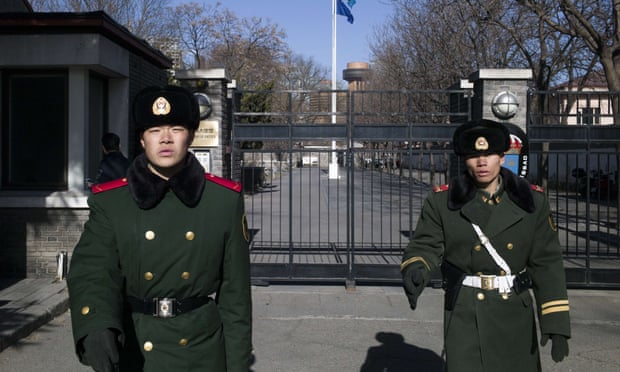
Perhaps one should be ‘grateful’ that China on 3 January 2016 decided to detain the Swedish human rights campaigner Peter Dahlin (first foreigner to be detained for ‘endangering state security’) as this helped international media the take note of the extraordinary crackdown by Chinese president Xi Jinping who is now widely considered to be China’s most authoritarian leader in decades. Here a short overview of the most notable cases in the first two weeks of 2016:
Paramilitary guards stand in front of the gates of Sweden’s embassy in Beijing on Wednesday. Photograph: Fred Dufour/AFP/Getty Images
Read the rest of this entry »
Posted in Front Line, human rights, Human Rights Defenders, OMCT | 2 Comments »
Tags: Cai Xin, China, crackdown, Deng Xiaoming, detention, Fengrui (law firm), Front Line (NGO), Gui Minhai, He Xiaobo, Human Rights Defenders, human rights lawyers, Meng Han, Peter Dahlin, Shu Xiangxin, Sweden, Wang Qiushi, Wang Yu, Zeng Feiyang, Zhou Shifeng, Zhu Xiaomei
January 12, 2016
The ISHR on 3 December 2015 carried a profile on Sharon Hom, human rights defender working on human rights in China.
Read the rest of this entry »
Posted in human rights, Human Rights Defenders, ISHR | Leave a Comment »
Tags: China, Civil society, Hong Kong, Human Rights Defenders, Human Rights in China (HRIC), human rights mechanisms, international cooperation, profiles, Sharon Hom, teaching, treaty bodies, UPR, woman human rights defender
January 11, 2016

reports that on 23 December 2015, the Supreme Court confirmed the 2012 sentencing of human rights defender Ms Chiranuch Premchaiporn to eight months’ imprisonment, suspended for one year, and a fine of 20,000 baht, for failing to delete allegedly offensive comments about the Thai monarchy, which had been posted on the now-defunct Prachatai web forum.
Chiranuch Premchaiporn [https://frontlinedefenders.org/ChiranuchPremchaiporn] is executive director of Prachatai, an independent news website that reports on human rights, social and political issues in Thailand and Southeast Asia. She was the webmaster of the now defunct Prachatai web board which was set up to promote the exchange of information and opinion on Thai political and social issues. Chiranuch Premchaiporn was the recipient of the International Women’s Media Foundation Courage in Journalism Award in May 2011 and the Human Rights Watch Hellman/Hammet Award in September 2011.
The Supreme Court ruling confirmed the verdicts of the Court of Appeals and the Court of First Instance, which were made against the human rights defender in November 2013 and May 2012 respectively. Chiranuch Premchaiporn was convicted under Article 15 of the 2007 Computer Crime Act (CCA) for allowing the alleged offensive comments to remain on the Prachatai web forum for 20 days. Article 15 of the CCA states that any service provider intentionally supporting or consenting to the importation of illegal computer content, as provided for in Article 14 of the CCA, shall be subjected to the same penalty as that imposed upon a person committing an offence under Article 14.
Front Line Defenders expresses concern at the decision of the Supreme Court to confirm the sentence against Chiranuch Premchaiporn, and thus to continue the use of the Computer Crime Act to silence and intimidate human rights defenders in Thailand. Front Line Defenders fears for the potential chilling effect of the decision on the exercise of freedom of expression in Thailand, and the restrictive effect of this on the work of human rights defenders.
Posted in awards, Front Line, Human Rights Defenders | Leave a Comment »
Tags: Chiranuch Premchaiporn, Computer Crime Act (Thailand), freedom of expression, Front Line (NGO), Hellman/Hammet Award, Human Rights Defenders, Journalist, lese majeste, Prachatai, woman human rights defender
January 8, 2016
In December 2015 the ISHR published this profile of Russian human rights defender Stephania Koulaeva

Stephania Koulaeva, a historian by education, explains the ever-expanding scope of her human rights work. Her interest was drawn to the memorial movement in Russia: ‘at first from a historical perspective, then from a human rights perspective.’ As a student, Stephania was involved in anti-fascist and anti-racist groups, primarily focused on the rights of the Roma minority, the most visible minority in Russia at the time. After new waves of migration began from Central Asia in the late nineties, Stephania expanded her work to issues surrounding migration. This then broadened further to include women’s rights, LGBTI rights, and she eventually became involved in the protection of human rights defenders. Her organisation, Anti-Discrimination Centre Memorial (ADC Memorial) is the only organisation in Russia that combats discrimination on such a wide range of issues.
Unfortunately, shrinking space for civil society has consistently been a serious threat within Russia. ‘In the 1990s and early 2000s, neo-nazis attacked and occasionally murdered human rights defenders working on discrimination issues. At that time that was the primary danger; the main danger we face now is political oppression by the Government.’
Over the past few years – particularly since Vladimir Putin’s 2012 return to presidency – the Russian Government has cracked down on NGOs, often by accusing them of being ‘foreign agents’ due to their ‘political activity’. ADC Memorial was forced to choose between officially registering as a ‘foreign agent’ or closing down for submitting a report to the UN Committee against Torture in the lead up to Russia’s 2012 review by that body. As the label of ‘foreign agent’ would greatly restrict the work ADC Memorial was able to carry out, it made the difficult decision of closing the organisation down in 2014. Since then, ADC Memorial has been operating without official Russian registration.
The continued operation of ADC Memorial does not indicate an alleviation in the Government’s harsh approach to civil society, and in November of this year, prominent NGO Memorial Human Rights Centre was targeted in the same manner: ‘They received a letter from the prosecutor stating that they had violated the Constitution of the Russian Federation for fulfilling their work.’ Memorial Human Rights Centre had previously ‘criticised Russian aggression in the Ukraine’ and ‘disagreed with the arrest of certain civil activists’. It is most likely being threatened due to this ‘political action’. ‘This is a very dangerous step for the Government to take. They are now criminalising human rights activity; the situation is rapidly getting worse.’
Stephania has a positive outlook on her previous interactions with the UN, acknowledging that the UN has done their utmost to stop the criminalisation of human rights defenders. ‘We’re very grateful for all the support that we’ve received from various treaty body committees that we’ve worked with; they’ve all recognised the work of civil society and given meaningful recommendations in the framework of their mandate.’ However, the political reality of the UN’s influence is not always as effective. ‘It’s very difficult to oppose Russian politics, even at the level of the United Nations.’ Stephania is now looking outward to bring domestic change to Russia, as anti-discrimination laws now seem ‘unlikely – although pressure on the Government will continue.’ She hopes to find some success in international courts, citing potentially useful precedents at the European Court of Human Rights in cases regarding migrants and stateless people.
‘We can’t simply stay within our borders – it’s impossible to tackle issues solely within Russia without also looking at related issues in neighbouring countries.’
see also: https://thoolen.wordpress.com/2014/02/09/12-human-rights-defenders-who-are-not-on-the-slopes-of-sochi/
Source: Defender profile: Stephania Koulaeva working in Russia | ISHR
Posted in human rights, Human Rights Defenders, ISHR | Leave a Comment »
Tags: ADC Memorial, foreign agent law, foreign funding, Human Rights Defenders, ISHR, Memorial Human Rights Centre, minorities, profiles, restrictive laws, Russia, Stephania Koulaeva, Stephanie Koulaeva, woman human rights defender
January 7, 2016
On 6 and 7 January 2016, human rights lawyers Mr Sui Muqing and Mr Huang Liqun in China were released from police custody reports Front Line Defenders on 7 January. The two human rights defenders were detained on 10 July 2015 in the midst of a nationwide crackdown on human rights lawyers [https://thoolen.wordpress.com/2015/07/29/the-remarkable-crackdown-on-lawyers-in-china-in-july-2015/] and placed under ‘residential surveillance at a designated location‘. Article 73 of the Criminal Procedure Law allows for the detention of suspects in state security, terrorism and serious bribery cases for up to six months in undisclosed locations, under the guise of ‘residential surveillance’. The authorities are not obliged to specify the place of detention or notify the suspect’s relatives or legal representative of the reasons for the residential surveillance in cases relating to the three charges, if doing so may “interfere with the investigation”. Neither of the human rights defenders were permitted access to lawyers during their six months’ detention. https://frontlinedefenders.org/node/29112
(Sui Muqing is a Guangzhou-based human rights lawyer who has represented a number of other human rights defenders, including Guo Feixiong, and has suffered harassment, intimidation and travel bans as a result of his work. Huang Liqun is a human rights lawyer with Beijing Fengrui Law Firm, a firm specifically targeted by the authorities in Beijing. Six other lawyers with the firm remain in detention).
Up to 20 other human rights defenders in the July crackdown are still in detention.
Posted in Front Line, Human Rights Defenders | 1 Comment »
Tags: China, crackdown, Fengrui (law firm), Front Line Defenders, House arrest, Huang Liqun, Human Rights Defenders, human rights lawyers, illegal detention, Sui Muqing
January 6, 2016
The latest statistical report released by Front Line Defenders revealed the appalling reality that human rights defenders all over the world are at great risk to be victims of extreme forms of violence. And based on the organization’s annual report, 157 human rights activists were killed or died in detention in 25 countries in 2015. Latin America, Philippines are named as most dangerous places for Human Rights Defenders. Read the rest of this entry »
Posted in Front Line, human rights, Human Rights Defenders | 6 Comments »
Tags: annual report 2015, asian region, enabling environment, environmental issues, EU, Human Rights Defenders, Ireland, killings, Latin America, Latin Post, LGBTI, Mary Lawlor, Philippines, resource extraction, restrictions, statistics
January 6, 2016
has some openings for staff, interns and volunteers in an open and transparent manner. All positions are advertised via their website:
During a recruitment process Front Line does not generally review applications received until after the closing date. Shortlisting can take some time given the volume of applications it receives, but all applications receive a reply by email.
Source: Recruitment & Volunteering | Front Line Defenders
Posted in Front Line, human rights, Human Rights Defenders | Leave a Comment »
Tags: Dublin, Front Line (NGO), Front Line Defenders, internships, job opportunity, recruitment, vacancy, volunteers
December 29, 2015
Posted in awards, HRW, human rights, Human Rights Defenders | Leave a Comment »
Tags: Association for Human Rights in Central Asia, Elena Urlaeva, Erk opposition, HRW, ill treatment, MEA Laureate 2008, Murod Juraev, Mutabar Tadjibayeva, NGOs, political prisoner, prison sentence, release, Shukhrat Rustamov, Steve Swerdlow, Tji Haksoon Justice and Peace award, Uzbekistan


US First Lady Michelle Obama (left) and Secretary of State Hillary Clinton (right) pose with Samar Badawi (centre) as she receives the 2012 International Women of Courage Award.