Archive for the 'MEA' Category

Ceremony of the Martin Ennals Award to follow on the internet (2 October, 18h00)

September 27, 2012

Every day all over the world, unsung heroes are risking their lives to call attention to injustice and to fight for human rights. On Tuesday October 2nd, one of them will honored with the Martin Ennals Award. The Martin Ennals Award  is chosen by a Jury of ten leading Human Rights organizations including: Amnesty International, Human Rights Watch, Human Rights First and others (see www.martinennalsaward.org). Thus, this prize represents the expression of the whole Human Rights movement.
The winner will be selected from three nominees, who personalize wider issues in their home countries and allow these issues to be represented through individual cases:

  1. Venerable Sovath Luon: sometimes referred to as the “Multimedia Monk”. He challenges the widespread eviction of poor people from land they have long held but without title, often due to the destruction of records during the Khmer Rouge period.
  2. Nasrin Sotoudeh, an Iranian Lawyer serving a 6 year prison sentence in Iran for “… the offences of “acting against the national security”, “propaganda against the regime” and “membership of Human Rights Defenders Centre” – an organisation presided over by the Nobel peace laureate Shirin Ebadi.
  3. Bahrain Center for Human Rights: Currently high on the world media agenda. Two of the main founders: Abdulhadi al-Khawaja and Nabeel Rajab are serving jail sentences. Zainab al-Khawaja was arrested for demonstrating against the government, while other members are regularly arrested and abused.

The ceremony is hosted by the City of Geneva in Victoria Hall. Short films commissioned by the Martin Ennals Foundation. Those who cannot attend in person may want to follow it on the internet (www.martinennalsaward.org) starting at 18h00 Geneva time.

Posters MEA ceremony up in Geneva

September 18, 2012

courtesy Nat Daudrich

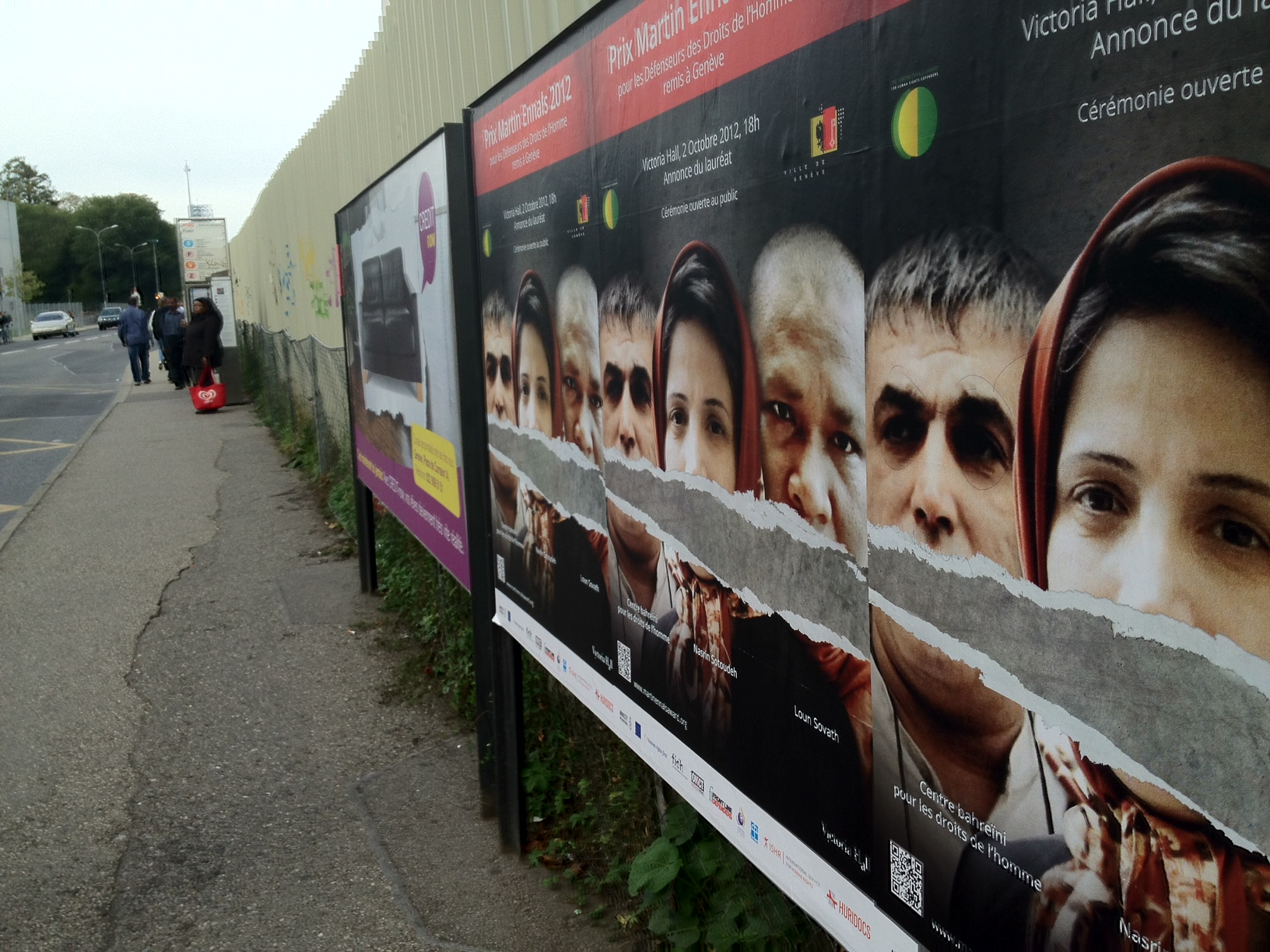
Thanks to the partnership with the City of Geneva hundreds of posters are lining the streets of Geneva in anticipation of the ceremony of the Martin Ennals Award for Human Rights Defenders (MEA) on 2 October in the splendid Victoria Hall. The laureate will be announced that evening but all three nominees will be honored and films on their work shown. The nominees are: Luon Sovath (Cambodia), Nasrin Sotoudeh (Iran) and the Bahrain Centre for Human Rights.

Human rights defender Nabeel Rajab sentenced to 3 years prison in Bahrain

August 16, 2012

 Today, 16 August, Nabeel Rajab, President of the Bahrain Centre for Human Rights (BCHR) which is one the 3 nominees of the Martin Ennals Award for Human Rights Defenders 2012, was sentenced to three years imprisonment on charges of illegal assembly

Nabeel Rajab with one of many tear gas cannisters fired into his houseNabeel Rajab with one of many tear gas cannisters fired into his houseFront Line Defenders, one of the NGOs on the Jury of the MEA, other NGOS condemned the imprisonment of Nabeel Rajab and called for his immediate and unconditional release.
The prosecution of Nabeel Rajab for exercising his rights to freedom of assembly and freedom of expression, was done before a court that has consistently failed to adhere to international fair trial standards. It is part of an ongoing pattern of repression by the Bahraini authorities against human rights defenders.

See interview with Nabeel Rajab at time of his initial arrest in July

Uganda to ban 38 NGOs for “promotion” of homosexuality

June 21, 2012

As I reported recently the Ugandan Government raided a regional workshop of gay rights NGOs as part of its continuing crusade against homosexuality. It is not surprising that on 20 June the news agency AFP reported that Uganda will ban 38 nongovernmental organisations for spreading homosexuality. According to AFP the minister for ethics and integrity, Simon Lokodo: “I have investigated and established beyond reasonable doubt that these NGOs have been involved in the promotion and recruitment in terms of the [gay] issues”. Lokodo did not specify which organisations would be de-registered but said that the list included international and Ugandan group.

“We will tell them to stop operating and they will not have the legal right to practice here”. Lokodo said he submitted the names of the organisations to the internal affairs ministry and hoped they would be de-listed in the near future. “The sooner we can do this the better,” Lokodo added for good measure.

MEA Laureate Kasha is likely to be in the firing line again.

Asma Jahangir, Pakistan’s outstanding HRD, threatened

June 11, 2012

Asma Jahangir MEA Laureate

The Friday Times of June 8, 2012 carries an interesting article in which Raza Rumi talks to Ali Dayan Hasan, the Pakistan Director at Human Rights Watch. The response to the question: “But critics would argue that Asma Jahangir is a politicised figure and she has offered no proof to substantiate her allegations…” is so good and clear it is worth quoting in full: “Let me be blunt. Asma Jahangir is no ordinary person. She is an activist of 30 years with a demonstrable record of unflinching integrity. Not only is she a figure viewed with admiration in Pakistan, she is seen as an icon by many in the international human rights movement. During these decades, she has been a consistent critic of the military and intelligence agencies but has never made such an allegation. But when she speaks the world hears respectfully and with attention. It is for the government of Pakistan to fully investigate the matter and unearth the truth of the matter. And I want to be absolutely clear: the intelligence apparatus must understand that if any harm comes to Asma Jahangir, the response from the international community will be severe.”. Asma was the second person to win the Martin Ennals Award for Human Rights Defenders in 1995!.

Finally some better news from Bahrain – but still a long road ahead

May 31, 2012


On 28 May 2012 there was finally some light at the end of the tunnel. Nabeel Rajab was released on bail and Abdulhadi Al-Khawaja ended his hunger strike. Another HRD Zainab Al-Khawaja was also freed. I reported several times on these cases related to the Bahrain Centre for Human Rights (BCHR), the 2012 nominee of the Martin Ennals Award for Human Rights Defenders.

Throughout Al-Khawaja’s hunger strike he was able to draw international attention to the on-going human rights violations that are taking place in Bahrain. The hunger strike brought attention to the plight of human rights defenders and political activists who are in detention or have been subjected to human rights violations by the authorities. Despite the primary demand of his hunger strike of “freedom or death” not being met, he has achieved one of his main goals by attracting global attention and focus on the human rights situation in the country. In a statement the human rights defender thanked his family for their support and expressed his gratitude to all those who had shown solidarity with him both inside and outside Bahrain. He will now begin a special diet in order for his body to recover from the 110-day hunger strike.

That Nabeel Rajab was released on bail is of course excellent but we should not forget that he should never have been arrested (on the 5th of May) to start with.  He was charged with ‘insulting the statuary bodies” the so-called “Twitter Defamation case”, “participating in illegal assembly and calling others to join” through social networking sites. (See GCHR appeal dated 05-05- 2012 (http://gc4hr.org/news/view/138)

He was released on bail of 300 Bahraini Dinars (appr. $796). However, a travel ban remains in place and the trials will continue (a hearing on the “illegal assembly” case is scheduled for 17 June while another session for the “twitter case” is scheduled for 24 June).

Furthermore, human rights defender Zainab Alkhawaja @angryarabiya was released on 29th May 2012, after more than 1 month imprisonment. She is still facing trials in 2 cases. One of the hearing sessions on the case of “illegal assembly, assaulting a police officer and inciting hatred against the regime is scheduled on June 24th, while the case of “obstructing traffic” is scheduled for November 1st 2012.

While the BCHR welcomes the ending of Abdulhadi Al-Khawaja’s hunger strike and the release of both Nabeel Rajab on bail and Zainab Al-Khawaja, it expresses serious concern for the on-going trials of the released activists, the on-going violations of human rights by Bahraini authorities and the continued detention of human rights defenders including Abdulhadi Alkhawaja on fabricated charges.

MEA nominee Luon Savath just been released

May 24, 2012

We have  just learned that the Venerable Luon Savath been released and is now at the office of the NGO LICADHO. But not sure that this is the end of the story and will keep you posted.

Iran continues its persecution of Human Rights Defenders: Narges Mohammadi detained

May 3, 2012

Prominent human rights defender Narges Mohammadi was arrested last month. On Wednesday 26 April Reporters Without Borders (RSF) in Paris said the group “strongly condemns” her jailing. Narges Mohammadi was a spokeswoman for Ebadi’s now-banned Center for Human Rights Defenders.

She was reportedly detained on Saturday 21 April and brought to Tehran’s Evin prison to begin serving a six-year sentence following a conviction in 2010 after she was accused of anti-government crimes. Mohammadi had remained free pending appeals. Ebadi left Iran after the disputed re-election of President Mahmoud Ahmadinejad in 2009, which touched off unprecedented protests and harsh crackdowns by authorities. Several of her co-workers have been arrested and harassed, such as Nasrin Sotoudeh, recently announced as a 2012 nominee of the Martin Ennals Award for Human Rights Defenders (www.martinennalsaward.org).

For more details on her case see: http://www.iranhumanrights.org/2012/04/narges-arrest/

Reporters Without Borders is concerned by the case because Narges is a journalist and author. In its recently released report on press freedom in 2011, the organisation ranks Iran number 175 outr of 179 countries surveyed. I states inter alia: “It is no surprise that the same trio of countries, Eritrea, Turkmenistan and North Korea, absolute dictatorships that permit no civil liberties, again occupy the last three places in the index. This year, they are immediately preceded at the bottom by Syria, Iran and China, three countries that seem to have lost contact with reality as they have been sucked into an insane spiral of terror, and by Bahrain and Vietnam, quintessential oppressive regimes. Other countries such as Uganda and Belarus have also become much more repressive.”

For the full report go to:

http://en.rsf.org/press-freedom-index-2011-2012,1043.html

Summary of press conference in Geneva on 24 April now on www.martinennalsaward.org

April 30, 2012

The streaming of the press conference in Geneva on 24 April has some technical problems but now there is a nice and short summary of it on the website http://www.martinennalsaward.org. Also the 3 mini portraits on the 3 nominees are available on that site.

‘media framing’ and the independence of the judiciary: the case of water boarding

April 30, 2012

What follows are my  SPEAKING NOTES ON THE OCCASION OF THE NJCM-THOOLEN AWARD  on Thursday 26 April 2012, the Hague. At this gathering of the Dutch Lawyers Committee for Human Rights (NJCM) I had the honor to hand over the award for the best master thesis on human rights. 

Dear friends,

When the Dutch Lawyers Committee, in 2005, decided to make an award in my name, I was most touched, especially as they had apparently dropped the requirement that I should die first.  Being alive has the additional advantage that on occasion I will be able to hand over the award myself, which I will do with the greatest pleasure in a few moments. This pleasure is the greater as the winning master paper touched on a topic very close to my heart: the role of the media or as it is sometimes referred to the “Fourth Estate”. There is some controversy about who exactly coined the term, but the most telling statement comes from Oscar Wilde who wrote: “Somebody — was it Burke? — called journalism the fourth estate. That was true at the time no doubt. But at the present moment it is the only estate. It has eaten up the other three. …”. That was said in 1981 and it is hard to imagine that that Oscar Wilde would come to a different conclusion more than a century later.

Spinning (an important element in the toolkit of media framing) has become a profession and the title ‘spin doctor’ is quite appropriate as the results are indeed often doctored. There are surely great historical cases that we cannot recognise because we ourselves have been successfully framed; who knows what positive image Attila the Hun could have enjoyed if only his PR people had done a more professional job. To take a more serious and recent case: let’s look at the so-called ‘failure’ of the UN in Somalia. This was a combined UN-US operation with a humanitarian mandate. When in October 1993, 18 U.S. Rangers were killed in a fierce battle with Aideed’s forces and television showed the body of a dead American soldier being dragged through the streets, American public opinion overnight turned against further U.S. involvement in Somalia and Clinton pulled out all troops soon afterwards. Although the Rangers were part of Washington’s own separate Somalia operation, and the US did not want to function under UN command, the incident was played and replayed as a major “UN failure.” The UN was widely, and wrongly, blamed for the gruesome deaths of the U.S. Rangers, despite the fact that they were not part of the UN operation, something that President Clinton finally acknowledged in 1996. Yet most people around the worlds continue to hold the UN responsible. I am afraid that each of us can probably come up with a favorite case of the media having got the better of the truth but that should not be tonight’s debate.

Laura Henderson in her paper “Tortured reality” has gone one important step further. She has investigated how media framing of waterboarding affects judicial independence. She had to limit herself to the US judiciary and to the specific case of ‘waterboarding’ in order to create an environment stable enough to draw some statistical conclusions. Her research is done very neatly. She makes clear that the concept of independence of the judiciary has always been defined broadly and not just as a prohibition of interference by the state, although that remains the classical background.  Cases of media pressure are dealt with in jurisprudence but they have always been considered in the context of an independent judge who is well-trained and not easily swayed by what the flimsy press has to say. The little jurisprudence there is does not contemplate a case of wilful, orchestrated influencing of all the media with the purpose of changing the perception and language of an existing concept.

What makes the study of Henderson stand out that it exactly tries pin down to what extent this has happened with the question whether the technique of ‘waterboarding’ changed in the minds of the judges after the 11 September watershed (no pun intended). The torrent of rhetoric not only framed everything in a ‘war’ context but also specifically tried to downplay the labelling of waterboarding as torture. And she did find the evidence. I will not reveal it all – you have to read for yourself the whole article once the NJCM has rightly published it. Laura herself indicates that further work is needed on how the independence of the judiciary is undermined by media framing and I hope that will be the case. She also gives some very useful indications of how the media framing could be countered, e.g. by strengthening the pluriformity of the media and raising the awareness of the judiciary. She describes her recommendations as ‘simple, yet effective”.  Here I beg to differ. There is nothing simple about changing the media landscape, especially if one adds the television and social media, which her study understandably had to leave out. The magnitude and multitude of media is such that no-one can really do much about it. All recent studies on the effect of the internet on our information intake show that they tend to solidify the dominant opinions/news/books etc, while giving great potential to small niche items, including the nutty and the genial. What gets squeezed is the moderate, considered, well-argued, balanced stuff in the middle. My fear is that the voice of the NJCM may well have the qualities described above!

In the end there can be only one winner. A feature of almost any award and painfully brought home two days ago in Geneva where I was for the announcement of the 3 nominees for 2012 Martin Ennals Award for Human Rights Defenders. All 3 nominees are extremely courageous Human Rights Defenders (Bahrain Centre for Human Rights, the multimedia monk form Cambodia, and Shirin Ebadi’s former lawyer: Nasrin Sotoudeh) and the Jury making the final choice on 2 October will have a hard time.

Still, the hard choices have been made already for the NJCM Thoolen Award – may I take this occasion to thank the Jury and Franka for their excellent work – and I am proud to hand over the prizes to the 3 finalists.