On 17 October 2024, the Special Rapporteur on the situation of human rights defenders, Mary Lawlor, presented her latest report in an interactive dialogue with United Nations member States during the 79th session of the United Nations General Assembly in the Third Committee.
In an interactive dialogue presenting her report to the Third Committee of the General Assembly, the Special Rapporteur on the situation of human rights defenders Mary Lawlor urged States to acknowledge the crucial role of human rights defenders in achieving seventeen Sustainable Development Goals (SDGs) and advancing 2030 Agenda. During the interactive dialogue, Mary Lawlor highlighted human rights defenders’ contributions to various SDGs, including zero hunger (Goal 2), good health and well-being (Goal 3), quality education (Goal 4), gender equality (Goal 5), clean water and sanitation (Goal 6) as well as affordable and clean energy (Goal 7). The report illustrates specific examples of human rights defenders’ work and contributions to each of seventeen Sustainable Development Goals.
During the dialogue, the Special Rapporteur noted that ninety percent of SDG targets are linked to human rights obligations. Given that only seventeen percent of the goals are on track, she emphasised the need for human rights defenders to be supported in their work in making the SDGs a reality. She noted that despite this crucial work of defenders in advancing the SDGs, they face severe barriers and threats including stigmatisation, criminalisation and other violations of fundamental rights.
In her concluding remarks, the Special Rapporteur emphasised that amidst global disagreements, the SDGs represent a rare consensus and urged States to support, partner with and respect HRDs working to support 2030 Agenda. Mary Lawlor in her recommendations, urged States to publicly acknowledge the essential role human rights defenders play in advancing the 2030 Agenda and called for legal frameworks that protect rather than restrict defenders and civil society in their legitimate work in achieving SDGs.
‘Indigenous communities must have better political representations to ensure our rights are protected both constitutionally and in practice,‘ says Victoria Maladaeva, and Indigenous peoples’ rights defender from Russia. Victoria was also a participant in ISHR’s Women Rights Advocacy Week this year. She spoke to ISHR about her work and goals.
Hello Victoria, thanks for accepting to tell us your story. Can you briefly introduce yourself and your work?
Sure! I’m a Buryat anti-war decolonial activist, co-founder of the Indigenous of Russia Foundation.
What inspired you to become involved in the defence of human rights?
Since the full-scale Russian invasion of Ukraine, Indigenous peoples, particularly Buryat, have been hit the hardest. I wanted to help my people, fight the Russian propaganda and raise awareness about systemic colonial oppression and discrimination faced by Indigenous people and ethnic minorities in the Russian Federation.
What would Russia and your community look like in the future if you achieved your goals, if the future you are fighting for became a reality?
The country needs a large-scale transformation— political, economic, and cultural. Indigenous communities must have better political representations to ensure our rights are protected both constitutionally and in practice. Genuine democratic reforms involve fundamental rights for self-determination and autonomy where Indigenous peoples gain control of their land and resources. Putin’s constitution’s amendments to national Republics must be reversed, our languages must be mandatory in all schools, universities, and institutions where Indigenous communities live.
How do you think your work is helping make that future come true?
I’m advocating for the rights of Indigenous peoples with international stakeholders and institutions to raise awareness about issues faced by our communities and spreading awareness, producing documentaries, and mobilising diasporas.
Have you been the target of threats or attempts at reprisals because of your work?
Unfortunately, yes. There have been threats because of my anti-war activism and for shedding light on the disproportionate mobilisation in the Republic of Buryatia. For some reason, my colleagues and I were denied participation in the UN Permanent Forum on Indigenous Issues. I would like to believe this was a mistake and that there was no influence from the Russian delegation at the UN.
Do you have a message for the UN and the international community?
Russia needs decolonisation and de-imperialisation. Without revising the past and acknowledging colonial wars (not only in Ukraine) and discrimination, there can be no bright future for Russia—free and democratic. The international and anti-imperialist community should acknowledge that the Russian government is not for any anti-colonial movement. Stand in solidarity with independent Indigenous activists!
At the 57th Human Rights Council session, civil society organisations share reflections on key outcomes and highlight gaps in addressing crucial issues and situations. Full written version below:
States continue to fail to meet their obligations under international law to put an end to decades of Israeli crimes committed against the Palestinian people, including the genocide in Gaza, and most recently Israel’s war on Lebanon. States that continue to provide military, economic and political support to Israel, while suppressing fundamental freedoms such as expression and assembly, as well as attacking independent courts and experts, and defunding humanitarian aid (UNRWA), are complicit in the commission of crimes. We urge the Council to address the root causes of the situation as identified by experts and the ICJ, including settler-colonialism and apartheid, and to address the obligations of third States in the context of the ICJ’s provisional measures stressing the plausible risk of genocide in Gaza and the ICJ advisory opinion recognising that ‘Israel’s legislation and measures constitute a breach of Article 3 of CERD’ pertaining to racial segregation and apartheid. The General Assembly adopted the resolution titled “The Crime of Genocide” in December 1946, which articulates that the denial of existence of entire human groups shocks the conscience of mankind. We remind you of our collective duty and moral responsibility to stop genocide.
States have an obligation to pay UN membership dues in full and in time. The failure of many States to do so, often for politically motivated reasons, is causing a financial liquidity crisis, meaning that resolutions and mandates of the Human Rights Council cannot be implemented. Pay your dues! The visa denials to civil society by host countries is a recurring obstacle to accessing the UN; and acts of intimidation and reprisals are fundamental attacks against the UN system itself. The right to access and communicate with international bodies is firmly grounded in international law and pivotal to the advancement of human rights. In this regard, we welcome the action taken by 11 States to call for investigation and accountability for reprisals against individually named human rights defenders. This sends an important message of solidarity to defenders, many of whom are arbitrarily detained for contributing to the work of the UN, as well as increasing the political costs for perpetrators of such acts. We welcome progress in Indigenous Peoples’ participation in the work of this Council as it is the first time that they could register on their own for specific dialogues.
We welcome the adoption of the resolution that renews the mandate of the Special Rapporteur on the promotion and protection of human rights in the context of climate change by consensus.
We also welcome the adoption of the resolution on biodiversity sending a clear call to take more ambitious commitments at the sixteenth meeting of the Conference of the Parties to the Convention on Biological Diversity and acknowledging the negative impact that the loss of biodiversity can have on the enjoyment of all human rights, including the right to a clean, healthy and sustainable environment. We welcome that these two resolutions recognize the critical and positive role that Environmental Human Right Defenders play. We also welcome the adoption by consensus of the resolutions on the rights on safe drinking water and sanitation; and the resolution on human rights and Indigenous Peoples.
We welcome the adoption of the resolution on equal participation in political and public affairs which for the first time includes language on children and recognises their right to participation as well as the transformative role of civic education in supporting their participation. We also welcome the recognition that hate speech has a restrictive effect on children’s full, meaningful, inclusive and safe participation in political and public affairs.
We welcome the adoption of the resolution from rhetoric to reality: a global call for concrete action against racism, racial discrimination, xenophobia and related intolerance. The resolution contains important language on the implementation of the Durban Declaration and Programme of Action as well as the proclamation by the General Assembly of a second International Decade for People of African Descent commencing in 2025. We welcome the inclusion of a call to States to dispense reparatory justice, including finding ways to remedy historical racial injustices. This involves ensuring that the structures in society that perpetuate past injustices are transformed, including law enforcement and the administration of justice.
We welcome the adoption of a new resolution on human rights on the internet, which recognises that universal and meaningful connectivity is essential for the enjoyment of human rights. The resolution takes a progressive step forward in specifically recommending diverse and human right-based technological solutions to advance connectivity, including through governments creating an enabling and inclusive regulatory environment for small, non-profit and community internet operators. These solutions are particularly essential in ensuring connectivity for remote or rural communities. The resolution also unequivocally condemns internet shutdowns, online censorship, surveillance, and other measures that impede universal and meaningful connectivity. We now call on all Sates to fully implement the commitments in the resolution and ensure the same rights that people have offline are also protected online.
Whilst we welcome the attention in the resolution on the human rights of migrants to dehumanising, harmful and racist narratives about migration, we are disappointed that the resolution falls short of the calls from civil society, supported by the Special Rapporteur on Human Rights of Migrants, for the Human Rights Council to set up an independent and international monitoring mechanism to address deaths, torture and other grave human rights violations at borders. Such a mechanism would not only support prevention and accountability – it would provide a platform for the people at the heart of these human rights violations and abuses to be heard. The study and intersessional mandated in this resolution must be used to enhance independent monitoring and increase access to justice.
We welcome the adoption of the resolution on Afghanistan renewing and strengthening the mandate of the Special Rapporteur. Crucially, the resolution recognises the need to ensure accountability in Afghanistan through “comprehensive, multidimensional, gender-responsive and victim-centred” processes applying a “comprehensive approach to transitional justice.” However, we are disappointed that the resolution once again failed to establish an independent accountability mechanism that can undertake comprehensive investigations and collect and preserve evidence and information of violations and abuses in line with these principles to assist future and ongoing accountability processes. This not only represents a failure by the Council to respond to the demands of many Afghan and international civil society organisations, but also a failure to fulfil its own mandate to ensure prompt, independent and impartial investigations which this and all previous resolutions have recognised as urgent.
We welcome the renewal of the Special Rapporteur on Burundi.
We welcome the renewal of the Special Rapporteur’s mandate on the human rights situation in the Russian Federation. The human rights situation in Russia continues to deteriorate, with the alarming expansion of anti-extremism legislation now also targeting LGBT+ and Indigenous organisations being just the latest example of this trend. The Special Rapporteur has highlighted how such repression against civil society within Russia over many years has facilitated its external aggression. The mandate itself remains a vital lifeline for Russian civil society, connecting it with the Human Rights Council and the broader international community, despite the Russian authorities’ efforts to isolate their people.
We welcome the resolution on promoting reconciliation, accountability and human rights in Sri Lanka renewing for one year the mandate of the OHCHR Sri Lanka Accountability Project and of the High Commissioner to monitor and report on the situation. Its consensual adoption represents the broad recognition by the Council of the crucial need for continued international action to promote accountability and reconciliation in Sri Lanka and keeps the hopes of tens of thousands of victims, their families and survivors who, more than 15 years after the end of the war, continue to wait for justice and accountability. However, the resolution falls short in adequately responding to the calls by civil society. It fails to extend these mandates for two years which would have ensured that the Sri Lanka Accountability Project has the resources, capacity and stability to fulfill its mandate.
We welcome the renewal of the Fact Finding Mission on Sudan with broader support (23 votes in favor in comparison to 19 votes last year, and 12 votes against in comparison to 16 votes last year). This responds to the calls by 80 Sudanese, African, and other international NGOs for an extension of the mandate of the FFM for Sudan. We further reiterate our urgent calls for an immediate ceasefire and the prompt creation of safe corridors for humanitarian aid organisations and groups, and to guarantee the safety of their operations, as well as our call on the UN Security Council to extend the arms embargo on Darfur to all of Sudan and create effective monitoring and reporting mechanisms to ensure the implementation of the embargo.
We welcome the renewal of the mandates of the Fact-Finding Mission on Venezuela (FFM) and of OHCHR for two more years. The deepening repression at the hands of government forces following the fraudulent Presidential elections in July has made evident the vital importance of continued independent documenting, monitoring and reporting by the FFM and its role in early warning of further human rights deterioration. We are pleased that OHCHR is mandated to provide an oral update (with an ID) at the end of this year. This will be key ahead of the end of the term of the current presidency on 10 January 2025. This resolution is an important recognition of and contribution to the demands of victims and civil society for accountability.
We regret that the Council failed to take action on Bangladesh. We welcome Bangladesh’s cooperation with the Office of the High Commissioner for Human Rights including by inviting the Office to undertake investigations into allegations of serious violations and abuses in the context of youth-led protests in July and August, as well as positive steps by the interim government. However, we believe that a Council mandate would provide much needed support, stability and legitimacy to these positive initiatives at a time of serious political uncertainty in the country.
The Council’s persistent inaction and indifference in the face of Yemen’s escalating human rights crisis is deeply troubling. Since the dissolution of the Group of Eminent Experts, and despite years of mounting atrocities, we have yet to see the type of robust, independent international investigation that is desperately needed. Instead, the Council’s approach has been marked by half-measures and complacency, allowing widespread violations to continue unchecked. Despite the precarious humanitarian situation, the recent campaign of enforced disappearances and arbitrary detention by the de facto Houthi authorities and recent Israeli bombardments, Yemen has increasingly become a forgotten crisis. The current resolution on Yemen represents this failure. Technical assistance without reporting or discussion is an insufficient response. The decision to forgo an interactive dialogue on implementing this assistance is an oversight, undermining the principles of accountability and transparency. We welcome the inclusion of language in the resolution recognizing the vital role of NGO workers and humanitarian staff who the Houthis have arbitrarily detained. We call for the immediate and unconditional release of those who continue to be detained for nothing more than attempting to ensure the rule of law is respected and victims are protected. We urge this Council to act decisively, prioritize the creation of an independent international accountability mechanism, and place civilian protection at the forefront of its deliberations on Yemen.
We continue to deplore this Council’s exceptionalism towards serious human rights violations in China committed by the government. On 17 August, the OHCHR stressed that ‘many problematic laws and policies’ documented in its Xinjiang report remain in place, that abuses remain to be investigated, and that reprisals and lack of information hinder human rights monitoring. We welcome the statement by the Xinjiang Core Group on the second anniversary of the OHCHR’s Xinjiang report, regretting the government’s lack of meaningful cooperation with UN bodies, the rejection of UPR recommendations, and urging China to engage meaningfully to implement the OHCHR’s recommendations, including releasing all those arbitrarily detained, clarifying the whereabouts of those disappeared, and facilitating family reunion. It is imperative that the Human Rights Council take action commensurate to the gravity of UN findings, such as by establishing a monitoring and reporting mechanism on China as repeatedly urged by over 40 UN experts since 2020. We urge China to genuinely engage with the UN human rights system to enact meaningful reform, and ensure all individuals and peoples enjoy their human rights. Recommendations from the OHCHR Xinjiang report, UN Treaty Bodies, and UN Special Procedures chart the way for this desperately needed change.
Finally, we welcome the outcome of elections to the Human Rights Council at the General Assembly. States that are responsible for atrocity crimes, the widespread repression of civil society, and patterns of reprisals are not qualified to be elected to this Council. The outcomes of the election demonstrate the importance of all regions fielding competitive slates that are comprised of appropriately qualified candidates.
Signatories:
International Service for Human Rights (ISHR)
Asian Forum for Human Rights and Development (FORUM-ASIA)
Following a concerted campaign led by ISHR together with other civil society partners, Saudi Arabia was just defeated in its bid to be elected to the UN Human Rights Council!
States have an obligation to pay UN membership dues in full and in time. The failure of many States to do so, often for politically motivated reasons, is causing a financial liquidity crisis, meaning that resolutions and mandates of the Human Rights Council cannot be implemented. This is a breach of legal obligations, a betrayal of victims and survivors of violations and abuses, and a waste of the time and resources we have collectively invested over the last 4 weeks. The cuts to Special Procedures’ activities, including fewer country visits and the cancellation of the annual meeting, greatly limit rights holders’ ability to engage with mandate holders and it hinders their access to situations on the ground, and their engagement with domestic authorities for human rights change. Pay your dues!
We deplore the double standards in applying international law and the failure of certain States to push for accountability and ending impunity for all atrocity crimes, when these involve geopolitical interests, despite the clear relevance to thematic principles they endorse. We also deplore initiatives and threats by some States to undermine or sanction the vital work of international justice and accountability bodies, including the International Court of Justice and the International Criminal Court. This undermines the integrity of the framework, the legitimacy of this institution, and the credibility of those States. From Afghanistan to China, to Eritrea to Myanmar, to Palestine to Sri Lanka, to Sudan to Ukraine, resolving grave violations requires States to address root causes, applying human rights norms in a principled and consistent way. States promoting or supporting thematic resolutions must apply these same principles universally, including in their approach to country-specific issues. The Council has a prevention mandate and States have a legal and moral duty to prevent and ensure accountability and non-recurrence for atrocity crimes, wherever they occur. We urge all States to implement resolutions consistently, both nationally and internationally, and to align their actions with the universal human rights standards they claim to uphold, especially in responding to atrocity crimes. We urge States to enhance objective criteria for action, with predictable parameters, consistent actions and a demonstrable way forward to addressing human rights crises.
We welcome the renewal of the mandate of the Expert Mechanism to Advance Racial Justice and Equality in the Context of Law Enforcement (EMLER) by consensus. We welcome the resolution’s request to strengthen the administrative and substantive support to the Mechanism, and to provide the resources necessary for it to effectively fulfill its mandate. This renewal is a recognition of the value of its unique work over the past three years, as well as the need for experts to continue investigating States’ law enforcement practices and their impact on Africans and Afrodescendant people and communities, including the legacies of colonialism and transatlantic slave trade in enslaved Africans. As recognised by the resolution, systemic racism particularly, against Africans and people of African descent needs a systemic response. In this regard, EMLER’s reports offer a powerful tool for much-needed transformation that governments everywhere should implement. We urge States to ensure full cooperation with EMLER towards the effective fulfillment of its mandate, including by implementing its recommendations and responding promptly to its requests for information and country visits.
This session was again marked by increasing attempts at retrogression on well-established human rights standards pertaining to sexual and reproductive rights and other thematic issues related to gender and sexuality. Nevertheless, civil society organisations continue to work together across movements to ensure the resilience of the multilateral system and the upholding of human rights standards. Out of the 26 draft resolutions presented this session, 5 had a stronger focus on gender and sexuality issues and took important steps in developing human rights standards in these areas. Specifically, we welcome the adoption of the resolution on HIV, the resumption of the tradition of adopting this resolution by consensus and the inclusion of a reference to sexual and reproductive health and rights. We welcome the adoption of the resolution on the Elimination of all forms of discrimination against women and girls requesting human rights-based, gender-responsive and intersectional approaches to poverty reduction; while also expressing concern at the multiple attempts to weaken the resolution which the strongest human rights standards on women and girls are reflected, including through amendments. We also welcome the new resolution on Technology-facilitated gender-based violence, the procedural resolution on Accelerating progress towards preventing adolescent girls’ pregnancy and the resolution on menstrual hygiene management, human rights and gender equality.
We welcome the adoption of the resolution on Eritrea, renewing the Special Rapporteur’s mandate.
The resolution on the situation of Rohingya Muslims and other minorities is essential to keep the situation of Rohingya high on the agenda of the Council. However, the resolution’s calls for repatriation of Rohingya refugees to Myanmar in the current context where remaining Rohingya in Myanmar are once again confronting the dire prospects of recurrence of grave atrocities they faced in 2016 and 2017 contradict and undermine the fundamental objectives of the resolution to ensure protection of Rohingya and to create conditions for their safe, voluntary, dignified and sustainable return.
We welcome that the Council decided to devote its annual resolution on climate change and human rights to address just transition. However, we regret that some fundamental points are missing in the resolution. The recognition of the right to a clean, healthy and sustainable environment by the Human Rights Council (res 48/13) and the General Assembly (res 76/300) has been a landmark achievement. Yet, we regret to see that once again, the resolution on human rights and climate change has failed to include this right more explicitly. Parties to the UNFCCC have already acknowledged that when taking action on climate change, States should respect, promote and consider the right to a clean, healthy and sustainable environment, among other rights (decision 1/CP.27). This resolution also failed to call upon States to transition away from fossil fuels. As has been repeatedly stated by the UN Secretary General, the High Commissioner for Human Rights, and several Special Rapporteurs, fossil fuels are the root cause of the triple planetary crisis, and the main driver of climate change. Despite the support expressed by numerous delegations, this resolution is deliberately silent in recognizing the positive, important, legitimate and vital role that environmental human rights defenders play in the promotion and protection of human rights and the environment. As recognized by the HRC resolution 40/11, EHRDs are one of the most exposed and at risk around the world. Many of these attacks include Indigenous Peoples and defenders raising concerns about climate related projects, transition minerals mining and renewal projects. We will not have a just transition in the context of climate change without listening and consulting EHRDs. It is time that the annual resolutions on human rights and climate change align itself to the recent developments and strongly reaffirm a commitment to effective, rights- and science-based climate action.
We welcome the Council’s continued efforts to address the human rights impacts of arms, including by highlighting human rights obligations of States and responsibilities of the arms industry and other businesses contributing to its operations. The adoption of the resolution on human rights and the civilian acquisition, possession and use of firearms is another significant contribution to these efforts. The OHCHR report requested by the resolution, —which will explore the root causes and risk factors of firearms-related violence and its impact on the enjoyment of the right to participation, particularly of individuals in vulnerable or marginalised situations, — presents a key opportunity to highlight critical concerns surrounding civilian firearms and their broader human rights impacts and to promote an effective response to these concerns.
We welcome a new resolution on freedom of opinion and expression, which rightly highlights how this right is an enabler for all other human rights and sustainable development. Among other key issues, the resolution has been updated to express concern at the growing trend of strategic lawsuits against public participation and calls on governments to adopt and implement measures to discourage such legal harassment. In this vein, it mandates a report and expert workshop to explore the impact of strategic lawsuits against public participation. We urge all States committed to freedom of opinion and expression to co-sponsor and fully implement the commitments of the resolution.
We welcome the adoption of the resolution on Independence and Impartiality of Judges and Independence of Lawyers, focusing on the use of Digital Technologies, including Artificial Intelligence. We welcome the inclusion of language addressing serious concerns relating to the potential negative impact on international fair trial standards, including equality of arms, confidentiality and the protection of legal professions, as well as risks connected to judicial independence and impartiality, the perpetration of existing stereotypes, discrimination or harmful biases. We also welcome the emphasis on the need to always ensure human oversight, scrutiny and accountability with respect to the use of artificial intelligence in the administration of justice.
We continue to deplore this Council’s exceptionalism towards serious human rights violations committed by the Chinese government. Despite China’s efforts to instrumentalise allied countries and GONGOs to portray itself as a constructive actor during its UPR adoption, NGO statements pointed to evidence of Beijing’s lack of willingness to engage in good faith with the UN system, including: a 30% rejection rate higher than its last UPR, acts of reprisals against civil society committed during the UPR cycle, disregard for calls from Western and Global South States to implement Treaty Body recommendations and to provide unfettered access to UN experts. We urge China to genuinely engage with the UN human rights system to enact meaningful reform, and ensure all individuals and peoples enjoy internationally protected human rights. Recommendations from the OHCHR Xinjiang report, UN Treaty Bodies, and UN Special Procedures chart the way for this desperately needed change. In the absence of genuine efforts, it is equally imperative that this Council establishes a monitoring and reporting mechanism on China as repeatedly urged by over 40 UN experts since 2020.
We regret that the Council failed to uphold its obligations to the Libyan people. We are concerned that the resolution on Libya falls short in addressing the urgent need to end impunity for widespread and serious human rights abuses across the country. It ignores the findings of the Independent Fact-Finding Mission on Libya, which documented likely war crimes and crimes against humanity perpetrated by State security forces and armed militia groups, and recommended the creation of an independent international investigation mechanism. Moreover, the resolution overlooks the inability of OHCHR and UNSMIL to conduct capacity-building activities in much of Libya due to threats of violence and governmental non-cooperation. Additionally, it neglects the severe suppression of civil society through arbitrary arrests, enforced disappearances, abductions, social media monitoring, harassment, and other forms of intimidation.
We regret that the Council failed to adequately respond to the situation in Saudi Arabia. Saudi Arabia is not fit to sit at the Human Rights Council, as it is responsible for the commission of atrocity crimes, a pattern of reprisals against those who cooperate with the UN, and the repression of civil society. The human rights situation in the country is dire, with the criminalisation of women human rights defenders, arbitrary detention and the application of the death penalty, among other abuses. We call on all UN States at the General Assembly not to vote for Saudi Arabia in the upcoming HRC elections.
We regret that once more, civil society representatives faced numerous obstacles to accessing the Palais and engaging in discussions during this session, as well as continuing and worsening incidents of reprisals and transnational repression here in Geneva against those seeking to cooperate with the Council. We are concerned by the barriers imposed to access room XX and that the majority of informal consultations on resolutions were held exclusively in person. We remind UN member States, as well as UNOG, that the Council’s mandate, as set out in HRC Res 5/1, requires that arrangements be made, and practices observed to ensure ‘the most effective contribution’ of NGOs. We reiterate that an inclusive approach to participation requires that the UN addresses the limited space for civil society engagement. Undermining civil society access and participation not only undermines the capacities and effectiveness of civil society but also of the Council itself.
Signatories:
Asian Forum for Human Rights and Development (FORUM-ASIA)
Cairo Institute for Human Rights Studies (CIHRS)
CIVICUS
Egyptian Initiative for Personal Right (EIPR)
FIDH
GIN SSOGIE – The Global Interfaith Network For People of All Sexes, Sexual Orientations, Gender Identities and Expressions
Óscar Calles is a journalist and human rights defender from Venezuela. Since 2019, he has been working for PROVEA, one of the country’s most prominent rights groups.
In an interview with ISHR, he recalled his experience of witnessing and broadcasting mass protests in his country in 2017, and how harshly these were repressed. This, he said, led him to take direct action in the defence of human rights and civil liberties.
Human rights organisations, activists and defenders only exist to ensure that all persons can live with dignity,’ says Oscar Calles. ‘Do not turn your backs on the hundreds of victims who are still awaiting justice to this day,’ he further urges States at the UN Human Rights Council, calling on to renew a key accountability mechanism for Venezuela.
In June 2024, Óscar was also one of 16 defenders who participated in ISHR’s Human Rights Defender Advocacy Programme (HRDAP)
Sara Nabil is a human rights defender and artist from Afghanistan. She spoke to ISHR about her dream of one day seeing a ‘free democratic Afghanistan, where each human being [regardless of which] gender they are, man or woman, neutral or other genders, [would be] treated equally.’
Stand in solidarity with Sara and other women human rights defenders from Afghanistan: join us in our campaign to push for UN experts and States to explicitly and publicly recognise the situation in Afghanistan as a form of gender apartheid and the need for an accountability mechanism to address gross human rights violations against women.
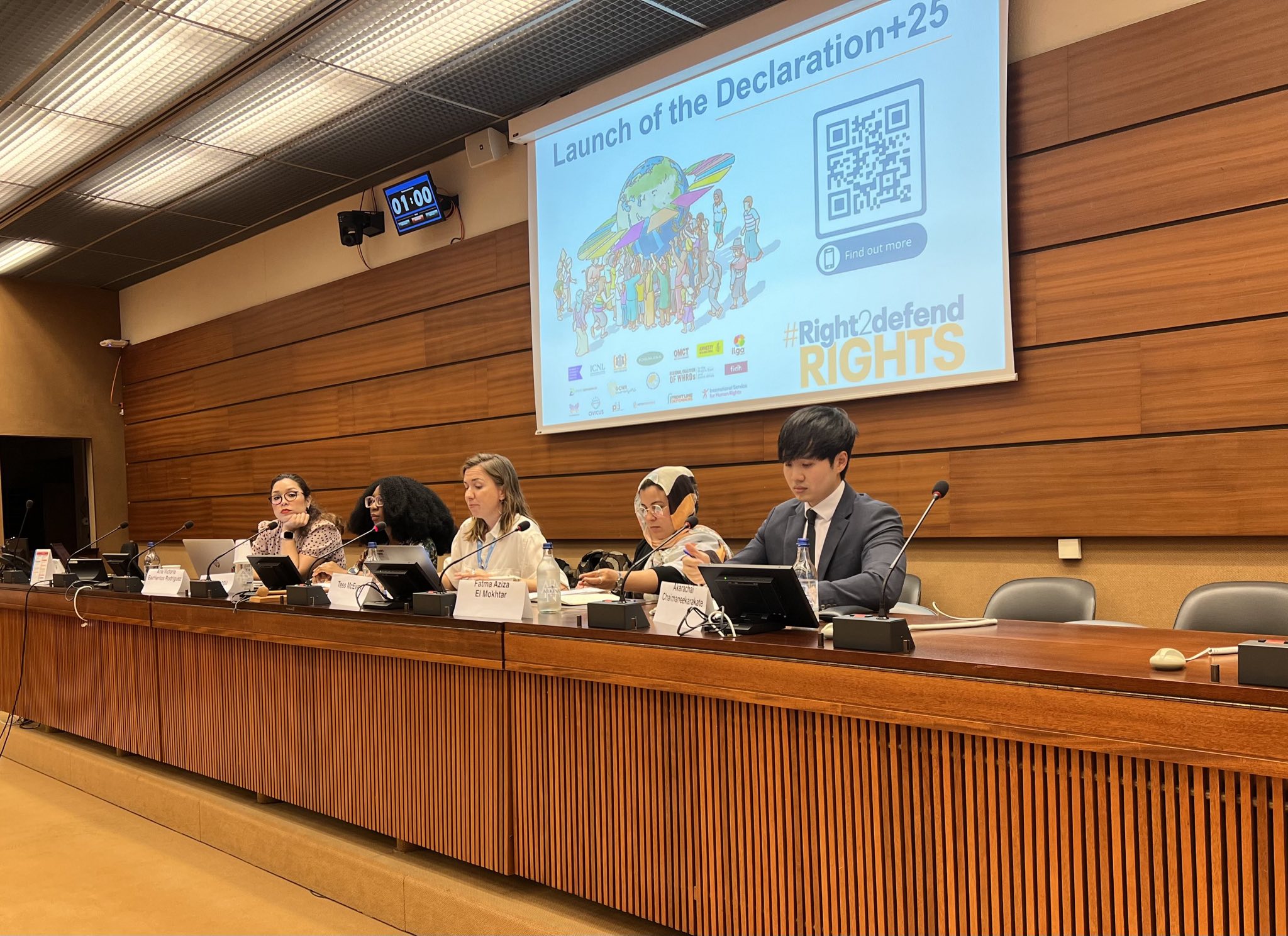
19 June 2024: in a ground-breaking initiative, civil society organisations worldwide have united to produce an authoritative articulation of the international legal framework for the protection of human rights defenders.
Following a year-long project involving consultations with human rights defenders, a coalition of 18 international (full list below) and regional human rights organisations released the Declaration +25, a landmark document systematising relevant developments in regional and international human rights law and standards of the last 25 years.
The principles contained in the two documents together represent a baseline for the protection and promotion of human rights defenders while addressing their enduring and evolving needs.
‘The 1998 Declaration was a turning point in human rights history,’ the coalition of 18 international and regional human rights groups said today, ‘it recognised the importance and legitimacy of human rights defenders, and the need to protect the right to defend human rights.’
However, the Declaration has never been fully implemented or enforced, and human rights defenders have had to adapt their work to rising issues such as the climate crisis, racism, discrimination, the backlash against sexual and reproductive rights, but also to new threats – including digital surveillance, and different forms of stigmatisation, and criminalisation.
‘With grassroots and frontline activists’ lived experiences and concerns at its heart, the Declaration + 25 will help tackle the current challenges faced by human rights defenders. It will also be a major step towards fulfilling the promise of the 1998 Declaration: enshrining in law the protection of human rights defenders around the world.’
The project commenced in 2023 with the coalition conducting online and in person consultations with defenders to identify the key issues they face in the defence of human rights that were not fully addressed by the 1998 Declaration, and analyse developments in international and regional contexts and jurisprudence.
Over 700 human rights defenders from all regions of the world took part in these consultations, which, along with inputs from legal and human rights experts and civil society organisations, fed into the Declaration + 25. The document was adopted unanimously at a two-day experts’ meeting in Bangkok, Thailand in April 2024. The result is a call to action to governments, multilateral organisations, businesses, and civil society to protect human rights defenders and their activities.
‘People everywhere have the right to defend human rights and unite to achieve justice for all, and States have an obligation under international law to protect those exercising that right, and ensure they can work freely and safely,’ the 18 rights groups emphasised.
‘The Declaration +25 is a powerful new tool and reminder of the existing standards and principles that States, corporations and society at large must implement to protect and enable human rights defenders across the world for the years to come.’
ISHR are celebrating longstanding and collective efforts in supporting human rights defenders. Join and find out more! ISHR’s journey began in 1984, inspired by the courageous actions of human rights defenders who dared to challenge injustices and advocate for a fairer world.
We’ve created a list of 40 things you can do to shed light on our mission and the vital work of human rights defenders and advocates who tirelessly strive to make our world a better and more equal place for all.
Twice a week, we will suggest an action that you can do to support ISHR’s work until we reach 40 actions, representing our 40 years of engagement. These actions are designed to be simple yet impactful, allowing everyone to actively participate in the celebration and contribute to the advancement of human rights. Whether you are a long-time supporter or new to our mission, each action will provide a tangible way to support and promote human rights defenders and advocates around the world.
The actions will be published on this page as well as on our social media feeds. From sharing a resource that inspires you, to watching a defender story and sharing what you love about ISHR, every action counts and helps amplify the voices of those who are fighting for justice, equality and freedom.
Please share these links with your network. The success of our mobilisation relies on the collective effort of our community, so we encourage you to spread the word and invite others to join us. By participating, you are not only celebrating our anniversary but also reinforcing the importance of human rights and the tireless work of those who defend them. We are looking forward to your participation and can’t wait to see the creative ways in which you will engage!
Sayed Ahmed AlWadaei is a human rights defender from Bahrain and the director of advocacy at the Bahrain Institute for Rights and Democracy (BIRD).
‘All we are asking for are the most basic rights. We hope to see Bahrain healing from over a decade of ordeal, of repression, of imprisonment, of torture, into a State where individuals can challenge their State without fear.’
He spoke to ISHR about how the 2011 Arab Spring uprising in Bahrain led him into activism and shared his hopes for a free, democratic future for his country despite the regime’s efforts to silence him and all those it perceives as opponents.
On 12 June 2024, a group of important NGOs addressed the following letter to Josep Borrell, EU High Representative for Foreign Affairs:
We, the undersigned civil society organisations, are writing to reiterate our request for the European Union to suspend its human rights dialogue with China, and to consider other, more impactful measures at the EU’s disposal to address the Chinese government’s assault on human rights at home and abroad.
While appreciative of the open and frank discussion and engagement with the EEAS in preparation of each round of human rights dialogue with China, we regret that the EU continues this exercise despite its amply proven ineffectiveness over 38 rounds. While the EU raises concerns during these dialogues, it knows that the Chinese government will not acknowledge abuses, will not undertake any effort to secure accountability, and will not be persuaded to undertake any policy or legislative action to comply with China’s international human rights obligations. The EU’s reluctance to establish any measurable benchmark of progress, or even to establish clearly defined objectives beyond having a dialogue, exacerbates the ineffectiveness of this exercise.
This year’s human rights dialogue would also entail EU officials sitting down with authorities in Beijing to “engage… through dialogue and cooperation” on human rights, days after the 35th anniversary of the Tiananmen massacre.
Since Xi Jinping came to power in 2013, the Chinese government has intensified its crackdown on dissent, harassing and imprisoning human rights defenders and activists including the Swedish bookseller Gui Minhai, the Uyghur economist and Sakharov Prize laureate Ilham Tohti [7 human rights awards, see: https://www.trueheroesfilms.org/thedigest/laureates/37AE7DC4-16DB-51E9-4CF8-AB0828AEF491], the Hong-Kong barrister and human rights activist Chow Hang-tung and human rights lawyers Yu Wensheng and his wife Xu Yan, who were arrested a little over a year ago on their way to meet with the EU delegation [see: https://www.trueheroesfilms.org/thedigest/laureates/69fc7057-b583-40c3-b6fa-b8603531248e and https://humanrightsdefenders.blog/2023/07/12/new-wave-of-repression-against-human-rights-lawyers-unleashed-in-china/]. The Chinese government has committed egregious violations against Uyghur and other Turkic communities in Xinjiang/The Uyghur Region, which a report of the UN High Commissioner for Human Rights in August 2022 stated “may constitute international crimes, in particular crimes against humanity.” Beijing has also intensified its repression in Tibet, while in Hong Kong the creation of a new national security architecture at Beijing’s behest has severely restricted the rights and freedoms long enjoyed by Hong Kong’s people.
Beijing’s foreign policy has also been increasingly detrimental to human rights, both in the region and beyond. The Chinese government continues to support highly abusive governments, to challenge international efforts to secure accountability for grave abuses, and to intensify efforts to undermine the international human rights system and rewrite its norms. The Chinese government has also engaged in increasingly brazen transnational repression – abuses committed outside its borders – including in EU countries.
The EU has already suspended human rights dialogues with highly repressive countries such as Russia, Syria, Belarus, and Myanmar, among others, in light of the nature, scale and pervasiveness of their authorities’ human rights abuses and violations of international law. The Chinese government has committed serious crimes amounting to crimes against humanity. It has long been evident that the human rights dialogue is not an appropriate nor an effective tool to address them. There is no reason to expect the 39th round will prove more beneficial to the rights of people in China than the previous 38. The EU and its member states should pursue different, more effective actions to press the Chinese government to end its crimes against humanity and other serious violations – and to hold accountable those responsible for failing to do so.
We have long been suggesting alternative action, latest in this February 2023 letter. We stand ready to discuss these and other options with you any time.
Signatories: Amnesty International Front Line Defenders Human Rights Watch International Service for Human Rights World Uyghur Congress


 Hans Thoolen on Human Rights Defenders and their awards