Archive for the 'ISHR' Category

List of side events re HRDs at the 39th session of the UN Human Rights Council

September 19, 2018

A bit late, here the promised selection of side events at the 39th session of the UN Human Rights Council [https://humanrightsdefenders.blog/2018/09/08/many-hrd-issues-at-the-39th-session-of-the-un-human-rights-council/]. I only list those that are most relevant to human rights defenders. With apologies for those that have already taken place but it allows you to contact the organizers for any reports:

  • Shared Space under Pressure launch of guidance document on business support for civic freedoms and human rights defenders is an event organised by ISHR and took place on 17 September from 13:30 to 14:30 in Room XXVII. The panelists will present and discuss a new publication by the Business Network on Civic Freedoms and Human Rights Defenders, which provides concrete advice to companies on how to protect human rights defenders.
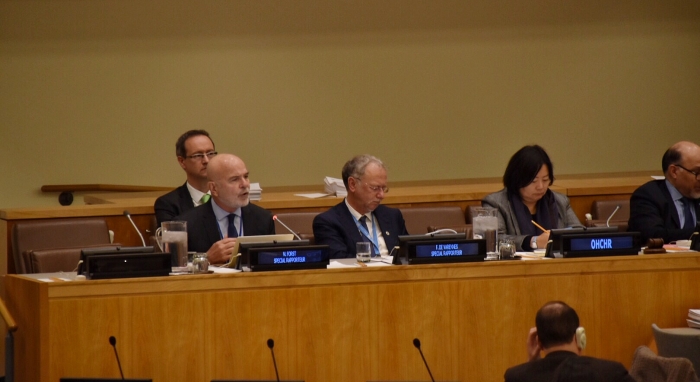
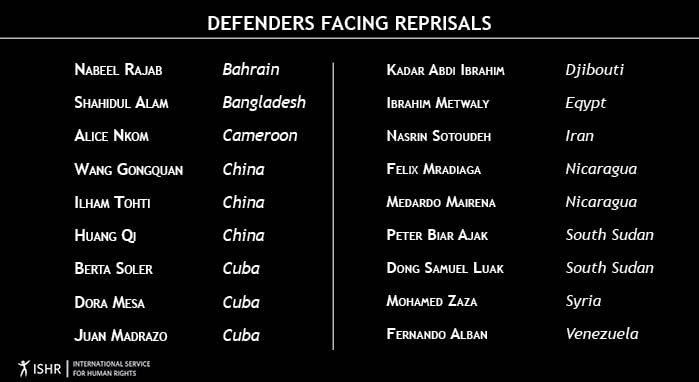
  • Ending reprisals: Discussion with human rights defenders and experts. The event will highlight the nature and extent of reprisals and intimidation for those cooperating with the UN, discuss and expand on the Secretary General’s report on cooperation with the UN and consider efforts to date to address reprisals as well as ways to further develop and strengthen policies to prevent and address reprisals. It will take place on 20 September from 10:00 to 11:00 in Room XXV.
  • Accountability and the need to end impunity for human rights violations in Yemen: Human rights defenders including bloggers, Internet activists and journalists at extreme risk of persecution is an event organised by the Gulf Center for Human Rights and co-sponsored by ISHR, CIVICUS and FIDH. It took place on 10 September from 12:00 to 13:00 in Room XXIV.
  • Saudi Arabia’s 3rd Cycle UPR: a Refusal to Reform is an event organised by Americans for Democracy and Human Rights in Bahrain. It will review the Kingdom’s human rights record over the past five years, taking a look at some of the recommendations offered during the previous cycle in October 2013 that have gone unfulfilled, from women’s rights to capital punishment, torture to the lack of a written penal code, and human rights defenders and civil society. It took place on 11 September from 12:00 to 13:00 in Room XXIII.
  • Gross human rights violations in Myanmar: options for international criminal accountability is an event organised by the International Commission of Jurists (ICJ), Human Rights Watch and Amnesty International and took place on 13 September at 12:00 in  Room XXVII. The discussion will focus on means of documenting violations, possible evidence-gathering mechanisms and the role of the International Criminal Court.
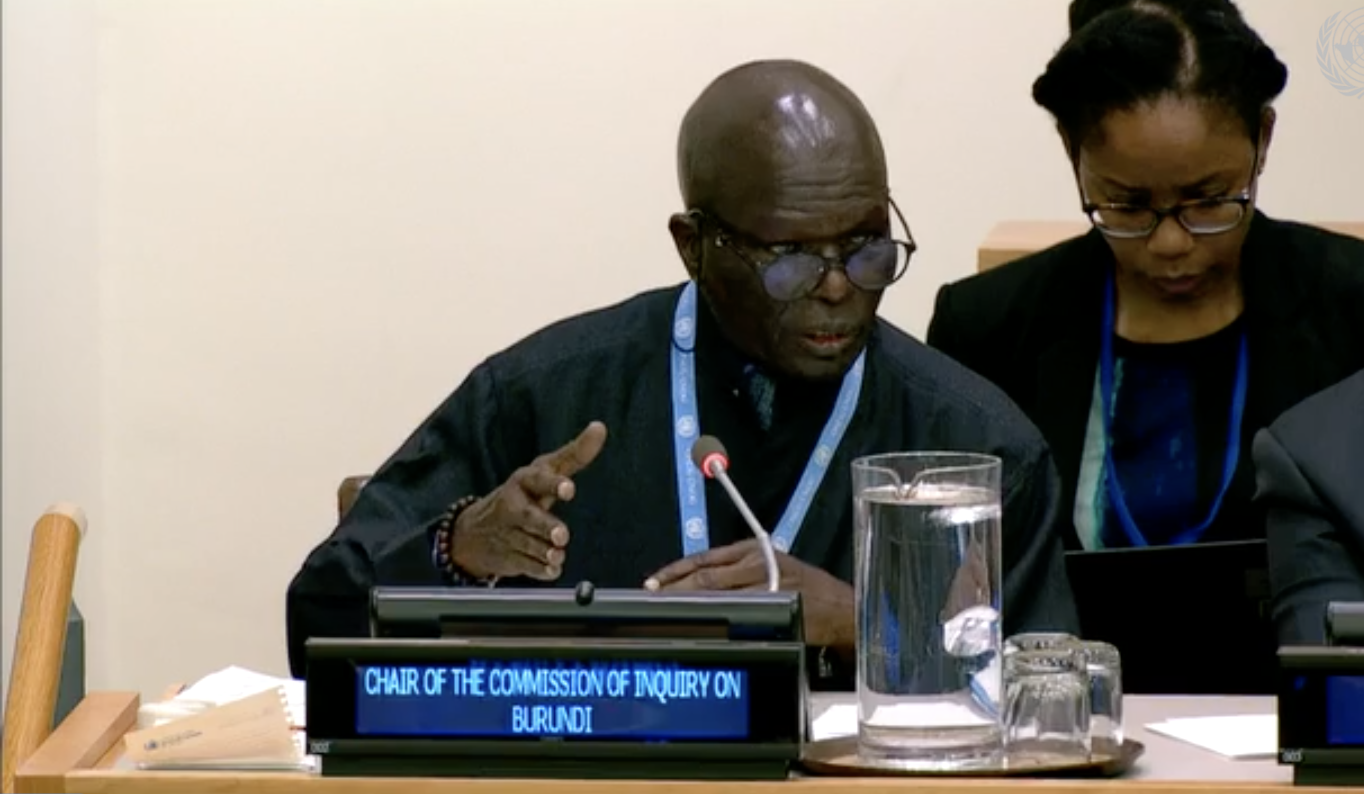
  • Burundi: ending the crisis and paving the way for accountability is an event organised by DefendDefenders in collaboration with a range of Burundian and international partners including ISHR. It will highlight ongoing grave violations in Burundi, lack of domestic accountability, and the need to renew the mandate of the Commission of Inquiry (CoI) on Burundi to avoid a monitoring and reporting gap and to prepare for accountability at the international level took place on Thursday 13 September from 13:00-14:00 in Room XXIV.
  • Bridging the gap: HRC resolutions and the human rights situation in Sudan will examine Sudan’s human rights and humanitarian situation and the last UN Human Rights Council resolutions, which have failed to adequately reflect it. During this side event organised by DefendDefenders, panelists will discuss Sudan’s record, ongoing violations and abuses, and what the HRC needs to do to fulfil its mandate and prioritize the rights of all Sudanese. It took place on Friday 14 September from 14:00-15:00 in Room XXIV.
  • Women’s Access to Justice is an event organised by the International Commission of Jurists (ICJ) and took place on 17 September at 14:00 in  Room XXIV. The discussion will focus on how to implement a women-centred approach in strengthening access to justice, considering ways to ensure that gender issues are robustly integrated into human rights investigations and judicial mechanisms and implemented by the actors operating within these areas. The discussion will draw on themes relevant to the annual discussion on the integration of a gender perspective taking place on 24 September.
  • Human Rights in Myanmar is an event organised by Forum Asia on 17 September from 10:00 to 11:00 in Room XXV. Human rights defenders from Myanmar presented their perspectives on the findings of the report of the Independent International Fact-Finding Mission on Myanmar, and key recommendations for the UN Human Rights Council.
  • From Documenting Violations to Preparing for Prosecutions: How can the UN respond effectively to crimes under international law in situations of crisis? is an event organised by the International Commission of Jurists (ICJ) and the Permanent Mission of the Netherlands and will take place on 18 September at  15:30 in Room XXII. The discussion will focus on why the Council and other international bodies need to move quickly to preserve evidence of crimes under international law, and options for doing so, with the International Impartial and Independent Mechanism (IIIM) for Syria, and the Commission on Human Rights in South Sudan, as examples to inform possible future mechanisms or a permanent standing mechanism.
  • Crisis in the DRC: a country-wide perspective is an event organised by CIVICUS that will take place on 18 September. The exact time and room will be announced soon.
  • Human Rights in Cambodia is an event organised by Forum Asia on 19 September from 10:00 to 11:00 in Room XXV. Civil society will discuss the closure of civic space in Cambodia following the July 2018 national elections, which have been widely condemned as neither free nor fair, as well as what the UN Human Rights Council should do to respond to attacks on civil society and the degradation of democratic freedoms.

States and NGOs are holding a lot more side events. You can download the list of State events here and NGO events here.

https://www.ishr.ch/news/hrc39-key-issues-agenda-september-2018-session


How can companies take concrete actions to protect human rights defenders?

September 19, 2018

Published a few days ago by the Business & Human Rights Resource Centre and the International Service for Human Rights, this new guidance was commissioned by the Business Network on Civic Freedoms and Human Rights Defenders, seeking to encourage companies to focus on an increasingly inescapable agenda.

‘Shared space’ under pressure

..Data from around the world shows there is a concerted attack in many countries on the essential freedoms and the rule of law on which business and civil society depend. And the defenders and organisations who expose the risk of abuse by companies in their operations and supply chains are under particular attack. Business and civil society operate in and benefit from a ‘shared space’ defined by common, fundamental elements. The rule of law and freedom of expression, association and assembly are essential to the realisation of all human rights, to good governance and accountable institutions. These elements are also critical to stable, profitable and sustainable business environments in which companies thrive and economies prosper. Yet this shared space is as much an ideal as it is a reality.

The strength of the shared space is tested by a history and legacy of mistrust between elements of civil society and business, especially between multinational corporations in certain industries and local communities in the Global South. This mistrust is reflected in actions, whether intentional or inadvertent, by individual companies and even entire industries to undermine civic freedoms and to undercut human rights defenders. It shows up in conflicts and confrontations in almost every region. Yet standards and practices have evolved over the last two decades to encourage or require companies to respect human rights – however incompletely and inconsistently. Moreover, engagement and consultation of companies with local communities and stakeholders are leading to solutions in conflicts in ways that encourage further progress. ‘The time is now for responsible business to act to defend civic freedoms and protect human rights defenders’, said Michael Ineichen, Programme Director at ISHR…

Guidance for companies

But why, when and how should business engage on this urgent agenda? This guidance represents a major step forward towards business action. It is a practical guide to realistic action by responsible companies, investors, industry associations and business leaders. It is informed by pragmatism and the principles of freedom and fair play. It is also the result of over 90 interviews with business leaders, investors, civil society advocates and other international experts who gladly offered their insights.

The document elaborates on why business should be compelled to join civil society and human rights defenders in resisting the crackdown on their work by:

  • Providing the complementary normative framework, business case and moral considerations which all encourage companies to support civic freedoms and defenders under threat;
  • Elaborating on the main elements of the business case to protect defenders, namely the business interest to secure the shared space, to manage operational and reputational risks, to build competitive advantage, and to secure a social license to operate;
  • Outlining a decision framework that is both analytical and operational to determine whether and how to act in various circumstances.

Authored by Bennett Freeman, a leader and innovator in the business and human rights  field for two decades, the guidance intends to further push the thinking and debate on how we can forge new alliances to counter the attacks on civic freedoms and human rights defenders and hold open these precious shared spaces. The Business & Human Rights Resource Centre and the International Service for Human Rights look forward to deeper and more powerful collaboration with business and stronger alliances with civil society partners through the publication of this guidance.

Download the full guidance – Shared space under pressure: business support for civic freedoms and human rights defenders

Download an executive summary – Shared space under pressure: Executive Summary

see also: https://humanrightsdefenders.blog/2017/03/09/2017-9-business-can-be-better-allies-of-human-rights-defenders/

Important side event in Geneva on ending reprisals coming up

September 12, 2018

On Wednesday 19 September (16:00-17:30 – Room XXIV, Palais des Nations, Geneva) the International Service for Human Rights (ISHR) is organizing a side event Ending reprisals: Discussion with human rights defenders and experts.

This event seeks to provide a space for human rights defenders and experts to shed light on the nature and extent of reprisals and intimidation against those cooperating with the UN; discuss and expand on the Secretary-General’s report; and to consider efforts to date to address reprisals and intimidation against those cooperating with the UN as well as ways to further develop and strengthen policies and practices to prevent and address reprisals.

Participants: 

  • Andrew Gilmour, Assistant Secretary General for Human Rights
  • Victoria Tauli-Corpuz, Special Rapporteur on the Rights of Indigenous Peoples
  • National human rights defenders

Moderator: Phil Lynch, Director of ISHR (see also: https://humanrightsdefenders.blog/2018/06/08/ishr-new-report-on-reprisals-and-restrictions-against-ngo-participation-in-the-un/)

The event is co-sponsored by the Permanent Mission of Ireland to the United Nations and the Permanent Mission of Uruguay to the Office of the United Nations.

Download the flyer here

some of my earlier posts on reprisals: https://humanrightsdefenders.blog/tag/reprisals/

Many HRD issues at the 39th session of the UN Human Rights Council

September 8, 2018

The 39th session of the UN Human Rights Council is held from coming Monday to 28 September 2018. Human Rights Defenders issues abound. Thanks to the excellent overview of the ISHR I can provide a short summary. To stay up-to-date, follow @ISHRglobal and #HRC39 on Twitter.

Reprisals

On 19 September, the Council will hold its first dedicated interactive dialogue on reprisals. It will engage with the Assistant Secretary General for Human Rights (Andrew Gilmour) who as UN senior official on reprisals will present the Secretary General’s annual report on the United Nations’ “the reprisals report”. The dedicated dialogue to address acts of intimidation and reprisals was mandated by the resolution on reprisals in September 2017 and provides a key opportunity for States to raise concerns about reprisals, and demand that Governments involved in existing cases provide an update on any investigation or action taken toward accountability. [for some of my earlier posts on reprisals: https://humanrightsdefenders.blog/tag/reprisals/]

Other key thematic reports relevant to HRDs

The Council will hold interactive dialogues and consider the reports of the Working Group on Arbitrary Detention, including on their country visits to Argentina and Sri Lanka, as well as the Working Group on Enforced or Involuntary Disappearance including on their country visit to Gambia.

The Council will consider the human rights of indigenous peoples on several occasions: it will hold a panel on the issue (see further below), the annual reports by the High Commissioner,  the Special Rapporteur on the rights of indigenous peoples, including on her visits to Mexico and Guatemala, and the Expert Mechanism on the Rights of Indigenous Peoples.

The Special Rapporteur on the promotion of truth, justice, reparation and guarantees of non-recurrence will also present his annual report, followed by an interactive dialogue, in addition to discussing the Secretary General report on the prevention of genocide.

The Council will discuss the report of the Secretary-General on capital punishment and the implementation of the safeguards guaranteeing protection of the rights of those facing the death penalty.

The Council will also discuss the report of the High Commissioner on mechanisms concerned with ensuring the safety of journalists and the Council will consider a resolution on the issue. The first informal consultation is scheduled for 11 September at 15:30.

The Special Rapporteur on the implications for human rights of the environmentally sound management and disposal of hazardous substances and wastes will present a set of principles for States, businesses and other actors to protect workers, including the need to protect worker representatives and human rights defenders from reprisal.

Country-specific developments

Burundi. During its 36th session, the Council passed two resolutions on Burundi (read here ISHR’s analysis of these two resolutions). At the 39th session, the Council will hold an interactive dialogue with the High Commissioner on his final report on Burundi on 11 September from 15:00 to 18:00. The Council will also hold an interactive dialogue with the Commission of Inquiry on 17 September between 09:00 and 12:00. ISHR continues to remain highly concerned about the human rights situation in Burundi and its refusal to cooperate with the Council’s mechanisms, which clearly warrant an invitation to the General Assembly to consider the suspension of Burundi as a member of the Council. ISHR joined a group of NGOs in calling for the renewal of the mandate of the Commission of Inquiry. [for earlier posts on Burundi: https://humanrightsdefenders.blog/tag/burundi/]

Yemen. Last September, the Council appointed a Group of Eminent Experts to carry out a comprehensive examination of all alleged violations of international human rights law committed by all parties to the conflict since September 2014. They will present their report followed by an interactive dialogue on 26 September from 09:00 to 12:00. The Council will also consider a report of the High Commissioner on the human rights situation in Yemen and on the implementation of the technical assistance. The Group of Eminent Experts’ report strongly suggests that parties to the armed conflict have perpetrated, and continue to perpetrate, violations and crimes under international law. Over 50 civil society organisations have called on the Council to renew and strengthen the mandate of the Group of Eminent Experts through the enhancement of its reporting structure and strengthening language on accountability.

China. The 39th session is the final session before China’s Universal Periodic Review. [https://humanrightsdefenders.blog/2016/03/15/remember-2nd-anniversary-of-the-death-of-cao-shunli/; https://humanrightsdefenders.blog/2018/03/26/chinas-win-win-resolution-gets-the-votes-in-the-un-council/ and many more]

Other country situations where HRD issues are relevant

The Council will hear reports on and is expected to consider resolutions addressing a range of country situations, in some instances involving the renewal of the relevant expert mandates.

They include:

  • Interactive dialogue with the Commission on Syria
  • Interactive dialogue with the Commission on human rights in South Sudan
  • Interactive dialogue with the Fact-finding mission on Myanmar
  • Interactive dialogue on the High Commissioner’s oral update on Ukraine
  • Interactive dialogue on the High Commissioner’s report on the Democratic Republic of the Congo
  • Interactive dialogue on the High Commissioner’s oral update on Libya
  • Interactive dialogue with the Special Rapporteur on Cambodia
  • Interactive dialogue with the Independent Expert on Somalia
  • Interactive dialogue with the Independent Expert on Sudan
  • Interactive dialogue with the Independent Expert on the Central African Republic

Adoption of Universal Periodic Review (UPR) reports

During this session, the Council will adopt the UPR working group reports on Turkmenistan, Burkina Faso, Cabo Verde, Colombia, Uzbekistan, Tuvalu, Germany, Djibouti, Canada, Bangladesh, Russian Federation, Azerbaijan, Cameroon, and Cuba.

Appointment of mandate holders

The President of the Human Rights Council has proposed candidates for the following two vacancies of mandate holders to be filled at this session:

  1. Special Rapporteur on the situation of human rights in Belarus
  2. Special Rapporteur on the situation of human rights in Eritrea

Resolutions to be presented to the Council’s 39th session

At the organisational meeting the following resolutions relevant to HRDs were announced (States sponsoring the resolution in brackets):

  1. The human rights situation in Yemen (Yemen and a group of countries)
  2. The protection of human rights in the Democratic Republic of Congo (Togo on behalf of the African group)
  3. The protection of human rights in the Sudan (Togo on behalf of the African group)
  4. World Programme for Human Rights Education (Brazil, Costa Rica, Italy, Morocco, Slovenia, Senegal,  Philippines, Thailand)
  5. The human rights situation in Syria (France, Germany, Italy, Jordan, Kuwait, Morocco, Qatar, Saudi Arabia, Turkey, the United Kingdom)
  6. The human rights situation in Somalia (the UK and a group of countries)
  7. The safety of journalists (Austria, Brazil, France, Greece, Morocco, Qatar and Tunisia)
  8. The human rights of indigenous peoples (Guatemala and Mexico)
  9. The promotion and protection of the human rights of peasants and other people working in rural areas (Bolivia, Cuba, Ecuador, South Africa)
  10. The human rights situation in Burundi (the European Union)
  11. The human rights situation in Myanmar (the European Union)
  12. Equal participation in political and public affairs (Botswana, Czech Republic, Indonesia, Netherlands, Peru)
  13. The situation of Rohingya muslims and other minorities in Myanmar (Pakistan on behalf of the Organisation for Islamic Cooperation)

Panel discussions

During each Council session, panel discussions are held to provide member States and NGOs with opportunities to hear from subject-matter experts and raise questions. All panel discussions will be broadcast live and archived on http://webtv.un.org. Three panel discussions are scheduled for this upcoming session:

  • The high-level panel discussion to commemorate the seventieth anniversary of the Convention on the Prevention and Punishment of the Crime of Genocide will take place on 13 September from 10:00 to 12:00.
  • The annual half-day panel discussion on the rights of indigenous peoples will take place on 19 September from 9:00 to 11:00. The theme will be the participation and inclusion of indigenous peoples in the development and implementation of strategies and projects in the context of the 2030 Agenda for Sustainable Development.
  • The annual discussion on the integration of a gender perspective throughout the work of the Human Rights Council and that of its mechanisms will take place on 24 September from 16:00 to 18:00. The theme will be gender integration and human rights investigations: strengthening a victim-centred approach.

Side events. As always there will be many side events concerning HRDs to which I will refer in the future.

——

https://www.ishr.ch/news/hrc39-key-issues-agenda-september-2018-session

China, Russia and Pakistan in UN fail at attempt to muzzle human rights defenders (for now)

July 7, 2018

On 6 July 2018 Stephanie Nebehay reported for Reuters that China, Russia and Pakistan lost their bid on Friday to weaken a U.N. resolution upholding the crucial rule of human rights defenders. The United Nations Human Rights Council adopted a resolution calling on all states to protect civil society groups from threats and intimidation, and prosecute reprisals against them. Chile presented the resolution text on behalf of more than 50 countries on the final day of a three-week session. Amendments proposed by China, Pakistan and Russia – declaring that civil society groups must respect “the sovereignty and territorial integrity of states” and that their funding must be “legal and transparent” – were soundly defeated. So, in spite of increasing retaliation against human right defenders and pressure on civil society in many countries [see recently: https://humanrightsdefenders.blog/2018/06/08/ishr-new-report-on-reprisals-and-restrictions-against-ngo-participation-in-the-un/ ], the UN is still able to resist some of the more blatant attempt to silence critics.

China and Russia are often the least tolerant of civil society at home. They are now seeking to introduce similar restrictions at the international level,” John Fisher of Human Rights Watch told Reuters. Their attempts to place national sovereignty above international human rights law “would turn guarantees of peaceful assembly and association on their heads”.

“These amendments were a swing and a miss for China and its allies on the Council,” Sarah Brooks of the International Service for Human Rights told Reuters, using an American baseball term. “Their efforts to limit civil society’s independence and shut down civil society voices were rebuffed by a strong message – from member states across the globe – about the importance of keeping defenders’ voices at the table”.

[At the current session, China tried unsuccessfully to block the accreditation of Uighur activist Dolkun Isa, U.N. sources said. China’s delegation publicly challenged activists speaking on behalf of Uighur and Tibetan ethnic minorities. Council president Vojislav Suc, Slovenia’s ambassador, said allegations of intimidation and reprisals had emerged during the session and urged “all necessary measures” to prevent such acts.]

https://www.reuters.com/article/us-un-rights/china-russia-fail-to-curb-activists-role-at-u-n-rights-forum-campaigners-idUSKBN1JW2EM

Inventivity of evil: how states restrict HRDs access to the UN in 10 case studies

June 27, 2018

In a new report entitled “The Backlash Against Civil Society Access and Participation at the United Nations” the ISHR outlines the many different ways States employ to keep critical voices out of multilateral spaces. ISHR’s new report provides a road map for States and UN representatives to prevent and counter restrictions on civil society participation in UN processes.

Civil society has the right to ‘unhindered access to and communication with international bodies. However, that right is not being respected.  ISHR’s new report documents a broad range of obstacles faced by human rights defenders, from opaque bureaucracies and procedures to reprisals, physical threats and attacks. ‘States decide who gets through the door,’ said ISHR’s Eleanor Openshaw.  ‘States that fear calls for accountability and justice do what they can to prevent civil society access to and participation in UN spaces’.

Click on the video below to get an insight into the report:

Opaque practices and procedures provide covers for States seeking to block NGO entry.  An NGO seeking to participate in a UN high-level event can be a victim of the ‘no-objection’ procedure.  This is the means by which any State can veto their participation without being named or providing any justification. ‘The no-objection procedure is poorly defined, and provides no formal criteria for objections to NGO participation,’ said ISHR’s John Indergaard. ‘It’s carte blanche to exclude legitimate NGOs for illegitimate reasons.’

Even when civil society representatives make it into an actual UN building, they have been thrown out without explanation or asked to leave while events were ongoing. At some high-level events and committee meetings, NGO representatives have been barred from giving statements or bringing in documents related to their work. Physical attacks and intimidation against those seeking to cooperate with the UN are well documented.  ‘These restrictions and reprisals are all aimed at dissuading civil society participation,’ said Openshaw. ‘They need to be challenged in each and every case.’

For some of my earlier posts on reprisals: https://humanrightsdefenders.blog/tag/reprisals/

To say it again clearly: assaults on human rights defenders are incompatible with international human rights treaties

June 27, 2018
In a ground-breaking joint statement on 23 May 2018, the UN Special Rapporteur on human rights defenders and representatives from all of the UN human rights treaty bodies have affirmed that all forms of abuse or undue restrictions against human rights defenders constitute violations of States’ parties obligations towards the realisation of rights set out in the Treaties. The statement was adopted on the eve of the 30th annual meeting of Treaty Body chairs on the occasion of a consultation initiated by the UN Special Rapporteur on human rights defenders and ISHR in New York.

This pronouncement constitutes a major step forward in the protection of human rights defenders and lays the ground for substantial enhancement of treaty body recommendations and jurisprudence in that area” says ISHR head of treaty body advocacy Vincent Ploton.

The statement reiterates the vital and central role played by human rights defenders to promote and support the application of the fundamental rights enshrined in the core international human rights treaties. It further contextualises the importance and relevance of the UN Declaration on human rights defenders which “reaffirms, is underpinned by, and elaborates binding human rights obligations, including rights set out in the Treaties, and is relevant to the interpretation and implementation of the Treaties”.

The Committee on economic, social and cultural rights (CESCR) was the first to adopt in 2016 a statement affirming that threats and violence against human rights defenders amount to violations of the Covenant. “We are delighted that fellow Treaty Bodies are now following suit with the adoption of this new joint statement”, says ISHR’s New York Director Madeleine Sinclair.

Marking the 20th anniversary of the UN Declaration on human rights defenders, the statement confirms that the core international human rights treaties and the Declaration prohibit discrimination against individuals and groups who champion such human rights norms and standards. It reaffirms that all individuals should be able to engage with treaty bodies free from all forms of interference, intimidation, abuse, threat, violence, reprisal, or undue restriction. It concludes with a series of practical measures that States ought to take to guarantee the protection of human rights defenders, including the adoption of specific legislation to protect and recognise defenders, and the revocation of legislation which restricts or hinders their work.

Read the full statement: http://www.ohchr.org/EN/NewsEvents/Pages/DisplayNews.aspx?NewsID=23154&LangID=E

[The statement was endorsed by the Committee on Enforced Disappearances, the Special Rapporteur on Human Rights Defenders, and the following Treaty Body members in their individual capacity: Virginia Brás-Gomes, CESCR Chair; Dalia Leinarte, CEDAW Chair; Noureddine Amir, CERD Chair; Ahmadou Tall, CMW Chair; Danlami Basharu, CRPD Vice-Chair; Felice Gaer, CAT Vice-Chair; Marcia Kran, HRCttee member; Olga Khazova, CRC Vice-Chair and Satyabhooshun Gut Domah, SPT member.]

https://www.ishr.ch/news/treaty-bodies-threats-and-assaults-human-rights-defenders-incompatible-core-international-human

Guide to HRD issues at the 38th session of the UN Human Rights Council

June 15, 2018

The UN Human Rights Council will hold its 38th regular session at Palais des Nations in Geneva from 18 June to 6 July 2018. The International Service for Human Rights (ISHR) has – as usual – published an excellent alert full of substantive issues (see link at the bottom of this post). Here I just highlight some of the session’s features that are of special interest to human rights defenders;

Sexual orientation and gender identity. The first interactive dialogue with the new Independent Expert on protection against violence and discrimination based on sexual orientation and gender identity will be held between 9:00 and 12:00 on Monday 18 June. The Council will consider the new report of the mandate holder as well as the report of the country visit to Argentina.
In a joint written submission to the Independent Expert submitted in the lead-up to the presentation of his report to the Council, a group of 12 NGOs detail State obligations that if  implemented, would work towards ensuring that LGBTI defenders’ rights are protected (based in existing international human rights law and articulated in the Yogyakarta Principles (YP) and Yogyakarta Principles plus 10, (YP +10). ISHR and ILGA will organise a side-event that will build on this submission and discuss in more detail State obligations set out in the YP +10. The event will take place on 21 June 2018 from 15:00 to 16:30 in Room XXIII.

Reprisals. Reports of cases of intimidation and reprisal against those seeking to cooperate with the UN not only continue, but grow.  Item 5 of the Human Rights Council’s agenda provides a key opportunity for States to raise concerns about reprisals, and for governments involved in existing cases to provide an update to the Council on any investigation or action taken toward accountability to be carried out. [see recent: https://humanrightsdefenders.blog/2018/06/08/ishr-new-report-on-reprisals-and-restrictions-against-ngo-participation-in-the-un/]

Women human rights defenders and women’s rights. The Annual Full Day Discussion on the human rights of women will take place on Thursday 21 June from 16:00 to 18:00. It will focus on the specific impact of online violence on the work of women human rights defenders. It is crucial that the Council’s discussions and resolutions recognise the critical role of women human rights defenders (WHRDs) and organisations led by women and girls as rights holders and agents of change. The Council will hold an interactive dialogue with the Special Rapporteur on violence against women, its causes and consequences on 20 June between 09:00 and 12:00 and will consider her report including the report of her visit to Australia. The Council will also hold an interactive dialogue with the Working Group on the issue of discrimination against women in law and in practice and will consider their reports including a report on the country visit to Samoa and Chad.

Business and human rights. The Council consider the report of the Working Group on the issue of human rights and business. It examines the duty of States to protect against human rights abuses by business enterprises to whom they provide support for trade and investment promotion. It will also consider the Working Group’s report on its mission to CanadaPeru, and on the sixth session of the Forum on Business and Human Rights. Both country reports contain specific sections analysing the situation of human rights defenders, with the report on Peru raising serious concerns about the high level of threats, attacks and violence against local leaders and human rights defenders. The interactive dialogue will be an opportunity for States to follow-up to recommendations made in the UPR in that regard. The core group on the resolution on business and human rights (Argentina, Norway, Ghana and Russia) have announced that they will present a resolution at this Council session to request the OHCHR to continue with the accountability and remedy report with a focus on non-State based remedy mechanisms. The first informal consultation on the draft resolution will be held on 18 June at 16:30 in Room XXIV.

Other thematic reports

The Council will also hold an interactive dialogue and consider the report of the new Special Rapporteur on the rights to freedom of peaceful assembly and of association. Switzerland with Costa Rica also announced that they will be running the resolution on the protection and promotion of human rights in the context of peaceful protests. The first informal consultations will be held on 19 June from 11:30 to 12:30 in Room V.

The Council will also hold an interactive dialogue and consider the report of the Special Rapporteur on the promotion and protection of the right to freedom of opinion and expression, which examines regulation of user-generated content online. The Council will consider the report of the High Commissioner on procedures and practices in respect of civil society engagement with international and regional organisations. The core group on the civil society space resolution (Chile, Ireland, Japan, Sierra Leone and Tunisia) announced that they will present a resolution this session.

The Council will also consider the reports of and hold interactive dialogues with the Special Rapporteur on the independence of judges and lawyers, including the report of his mission to Poland, and with the Special Rapporteur on extrajudicial, summary or arbitrary executions, including reports of her missions to Iraq and El Salvador.

Country specific developments

Burundi During its 36th session, the Council passed two resolutions on Burundi. One resolution was led by the European Union and extended the mandate of the Commission of Inquiry. The second resolution was led by the African Group and requested OHCHR to urgently dispatch a team of three experts to engage with the Burundian authorities and all other stakeholders to “collect and preserve information, to determine the facts and circumstances in accordance with international standards and to forward to the judicial authorities of Burundi such information”. The aim was to establish the truth and ensure that the perpetrators are held accountable. Read here ISHR’s analysis of the two resolutions. At the 38th session, the Council will hear the oral briefing by the High Commissioner on the mission of OHCHR on 4 July between 15:00 and 18:00. The Council will also hear an oral briefing by the Commission of Inquiry on 27 June between 09:00 and 12:00. For more information on the situation of human rights defenders in Burundi, check ISHR Briefing Paper for the UPR here. [see also: https://humanrightsdefenders.blog/2016/10/26/enough-is-enough-ngos-call-for-burundi-suspension-from-un-human-rights-council/]

China. By any measure, the Chinese government is not living up to the commitments to protect and promote human rights inherent in its Human Rights Council membership. Since the twelve-country joint statement on the human rights situation in China in March 2016, there has been no concerted effort to use the Council space creatively to call for accountability and transparency related to violations in China. This, despite the fact that in July 2017, Chinese security authorities presided over the death in custody of Liu Xiaobo, the first Nobel Peace Prize winner to die in detention since Carl von Ossietzky died in Nazi Germany in 1938… In this context NGOs , incl. the iSHR, continue to call for the release of individuals arbitrarily detained and/or held incommunicado, including Wang Quanzhang, Gui Minhai, Tashi Wangchuk, Lee Ming-che, and Yu Wensheng. [see also: https://humanrightsdefenders.blog/2018/03/07/china-and-the-un-human-rights-council-really-win-win/]

Eritrea. The Council will hold an interactive dialogue with and consider the report of the Special Rapporteur on the situation of human rights in Eritrea on 25 June. A cross-re­gional group of non-governmental organisations urged the Council to support and co-sponsor at the 38th session a streamlined resolution that accurately reflects the gravity of the situation on the ground, renews the mandate of the Special Rapporteur under the Council’s agenda item 4, and sets out a framework for needed reforms to improve the human rights situation in the country and advance accountability.

Other country situations include: 

  • An interactive dialogue on the oral update by the High Commissioner on the situation of human rights of the minority Rohingya Muslim population and other minorities in Rakhine State of Myanmar, and the oral report of the Special Rapporteur on the situation of human rights in Myanmar
  • An enhanced interactive dialogue on the report of the High Commissioner on the findings of the team of international experts on the situation in the Kasai regions of the Democratic Republic of the Congo (DRC) and on the oral update by OHCHR on the situation of human rights in the DRC
  • An oral update by the High Commissioner on the situation of human rights in Ukraine
  • An oral update by the Independent Expert on the situation of human rights in the Central African Republic
  • An interactive dialogue with the Commission of Inquiry on Syria (oral update) and consideration of the summary report of OHCHR on the high-level panel discussion on violations of the human rights of children in Syria
  • An interactive dialogue with the Special Rapporteur on the situation of human rights in Belarus on his report
  • During this session, the Council will adopt the UPR working group reports as part of the 29th session of the UPR. These reports list recommendations the following States under review are expected to implement: France, Tonga, Romania, Mali, Botswana, the Bahamas, Burundi, Luxembourg, Barbados, Montenegro, the United Arab Emirates, Israel, Liechtenstein, and Serbia.

This session of the Council will provide an opportunity for BurundiMali and the United Arab Emirates to to accept recommendations made in relation to human rights defenders, as proposed in ISHR’s briefing papers on those countries.

The Council appointed new Bureau members due to the departure of the Ambassadors of Chile and Germany. The members of the Bureau for 2018 now comprises of the following Ambassadors:

  • Vojislav ŠUC (Slovenia), President of the Human Rights Council
  • Evan P. GARCIA (Philippines), Vice President
  • Cristobal Gonzalez-Aller Jurado (Spain), Vice President
  • Juan Eduardo EGUIGUREN (Chile), Vice President and Rapporteur
  • François Xavier NGARAMBÉ (Rwanda), Vice President

Panel discussions

During each Council session, panel discussions are held to provide member States and NGOs with opportunities to hear from subject-matter experts and raise questions. All panel discussions will be broadcast live and archived on http://webtv.un.org. Four panel discussions are scheduled for this upcoming session:

  • The Annual Full Day Discussion on the human rights of women will be held in two sessions. First, on 21 June from 16:00 to 18:00, the panel will focus on the impact of violence against women human rights defenders and women’s organisations in digital spaces. The concept note of the panel is available here.
  • The second panel will be held on 22 June from 10:00 to 12:00 and will focus on advancing women’s rights through access and participation in information and communication technologies (ICTs). The concept note of the panel is available here.
  • A panel discussion will be held on 26 June from 16:00 to 18:00 on the human rights of internally displaced persons in commemoration of the twentieth anniversary of the Guiding Principles on Internal Displacement. The concept note of the panel is available here.
  • The Annual Thematic Panel Discussion on technical cooperation in the promotion and protection of human rights will be held on 4 July from 10:00 to 12:00. The topic will be “Human rights and the Sustainable Development Goals: enhancing human rights technical cooperation and capacity-building to contribute to the effective and inclusive implementation of the 2030 Agenda for Sustainable Development”. The concept note of the panel is available here.

The ISHR and other NGOs will again organize quite a few side events on which I will report separately.

https://www.ishr.ch/news/hrc38-key-issues-agenda-june-2018-session

ISHR: new report on reprisals and restrictions against NGO participation in the UN

June 8, 2018

There are many different approaches States employ to keep critical voices out of multilateral spaces. ISHR’s new report of 30 May 2018 [The Backlash Against Civil Society Access and Participation at the United Nations] outlines what these are and provides a road map for States and UN representatives to prevent and counter reprisals and restrictions on civil society participation in UN processes.

Civil society has the right to ‘unhindered access to and communication with international bodies’. However, that right is not being respected.  ISHR’s new report, ‘The Backlash Against Civil Society Access and Participation at the United Nations‘ documents a broad range of obstacles faced by human rights defenders, from opaque bureaucracies and procedures to physical threats and attacks.

States decide who gets through the door,’ said ISHR’s Eleanor Openshaw.  ‘States that fear calls for accountability and justice do what they can to prevent civil society access to and participation in UN spaces’. Opaque practices and procedures provide covers for States seeking to block NGO entry.  An NGO seeking to participate in a UN high-level event can be a victim of the ‘no-objection’ procedure.  This is the means by which any State can veto their participation without being named or providing any justification. ‘The no-objection procedure is poorly defined, and provides no formal criteria for objections to NGO participation,’ said ISHR’s John Indergaard. ‘It’s carte blanche to exclude legitimate NGOs for illegitimate reasons.

Even when civil society representatives make it into an actual UN building, they have been thrown out without explanation or asked to leave while events were ongoing. At some high-level events and committee meetings, NGO representatives have been barred from giving statements or bringing in documents related to their work. Physical attacks and intimidation against those seeking to coöperate with the UN are well documented.

These restrictions and reprisals are all aimed at dissuading civil society participation,’ said Openshaw. ‘They need to be challenged in each and every case.’

I have published many posts on the issue of reprisals [https://humanrightsdefenders.blog/tag/reprisals/] starting with https://humanrightsdefenders.blog/2014/03/13/zero-tolerance-for-states-that-take-reprisals-against-hrds-lets-up-the-ante/

Click on the video below to get an insight into the report:

ISHR Annual Report 2017: how the Service serves

May 2, 2018
On 1 May 2018 the International Service for Human Rights (ISHR) published its 2017 annual report (“Time for ambition, cause for hope”), outlining its impacts during 2017 and vision for 2018 and the years ahead.


Here are just a few examples of major achievements:

  • Through its Human Rights Defender Advocacy Programme, ISHR helped defenders from across the world develop networks of support and influence, build energy and resilience, and become even more effective advocates for national-level change.
  • In consultation with LGBTI persons and organisations from all regions, and with input from eminent legal experts from across the world, ISHR developed and launched the Yogyakarta Principles Plus 10.
  • Following a three year campaign undertaken in partnership with the Burkina Faso Coalition of Human Rights Defenders and the West African Human Rights Defenders Network, in June ISHR secured the adoption of a national law on the protection of defenders in Burkina Faso.
  • ISHR provided human rights defenders with international and regional advocacy platforms by supporting them in giving evidence and testimony at the Human Rights Council in Geneva and the African Commission on Human and Peoples’ Rights in Banjul.
  • ISHR provided defenders with comprehensive and practical guidance to leverage the UN, with a new manual on engaging with the Third Committee of the General Assembly in English, Spanish and French, and a fully revised manual on navigating the UN Committee on NGOs in Arabic, Spanish, French and English.
  • ISHR also provided defenders with access to the most up-to-date information and advice via social media in Chinese, French, English and Spanish.

[for some of my earlier posts on the ISHR: https://humanrightsdefenders.blog/tag/ishr/]

For the future the ISHR says:

We’ll leverage the 20th anniversary of the Declaration on Human Rights Defenders to strengthen the recognition and protection of human rights defenders under international and regional law, and through the development and effective implementation of corporate policies on defenders.(eg, https://humanrightsdefenders.blog/2018/04/17/20th-anniversary-un-work-on-human-rights-defenders-assessed-by-ishr/) We’ll ensure that national mechanisms for the protection of defenders are adapted and respond to the particular risks faced by women human rights defenders.  Our Human Rights Defender Advocacy Programme will substantially strengthen the skills, networks, resilience and impact of defenders working on women’s rights, LGBTI rights and in restrictive environments.  Additionally we’ll provide human rights defenders from across the world with an innovative online e-learning platform, giving them access to training and tactical support and linking them with a community of practice and solidarity. And through our Human Rights Defender Fellowship Programme, we will provide at least three defenders at risk with up to six months of intensive training and strategic advocacy support.