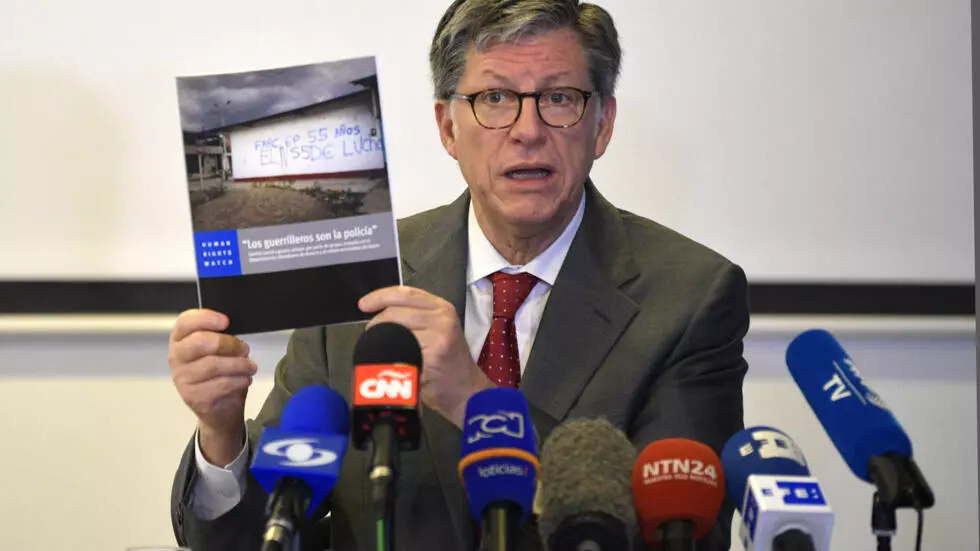
Jose Miguel Vivanco, HRW director for the Americas, accuses the Colombian government of failing to act on the murders of rights activists Raul ARBOLEDA AFP
Human Rights Watch on Wednesday 10 Febuary 2021 hit out at Colombia’s government over the rising number of human rights defenders and activists being murdered in the South American country.
Since the 2016 peace accord that ended half a century of fighting between government forces and the Revolutionary Armed Forces of Colombia (FARC), an increasing number of civil society leaders have been killed each year. But “the government has acted slowly and weakly in the implementation of policies to prevent these murders,” HRW said in a statement.
Despite Colombia suffering the largest number of such murders on the continent, “the government’s response has been more focussed on making speeches and announcements than adopting measures that will have an impact in the territories” affected by the violence, said Jose Miguel Vivanco, HRW director for the Americas.
Behind the wave of violence targeting advocates are National Liberation Army Marxist rebels, dissident FARC guerrillas and right-wing paramilitaries, as well as armed drug-trafficking groups. They are fighting each other over access to lucrative cocaine and illegal mining markets.
HRW says most victims were murdered as reprisals for opposing drug-trafficking in their territories, allegedly collaborating with the army or supporting the replacement of illegal coca plantations with legal ones. The digest of Human Rights Laureates lists 50 HRDs in Colombia. See: https://www.trueheroesfilms.org/thedigest
On 11 February 2021 Human Rights Watch stated that The Democratic Republic of Congo government should reopen its investigation into the 2010 double murder of the leading human rights defender Floribert Chebeya and his driver, Fidèle Bazana, following new revelations about the case. Amid allegations reported by international media outlets that the murders were carried out on the orders of the police chief at that time, Gen. John Numbi, Human Rights Watch called for a credible, impartial, and independent inquiry.
On February 8, 2021, in radio interviews with Radio France Internationale (RFI) and Deutsche Welle, two Congolese police officers in exile admitted to taking part in the murders of Chebeya and Bazana on the premises of police headquarters on June 1, 2010 and provided a detailed account of the murder. At a meeting in April 2019, President Felix Tshisekedi personally told Chebeya’s wife and human rights groups that he was committed to conducting an impartial investigation into the murder.
“President Tshisekedi should put his words about investigating the Chebeya murder into action,” said Thomas Fessy, senior Congo researcher at Human Rights Watch. “The latest revelations show the need for a new inquiry and present the best chance to see that justice is done.”
On June 1, 2010, Chebeya received a telephone call asking him to attend a meeting at General Numbi’s office. The next day, the police said that Chebeya had been found dead in his car in the Mont Ngafula area of Kinshasa, the capital. The body of his driver, Bazana, is still missing.
Speaking to RFI and Deutsche Welle from an undisclosed location abroad, the former police drivers Hergil Ilunga and Alain Kayeye revealed details about the plan to kill Chebeya and how it was carried out. They alleged that police officers asphyxiated Chebeya and Bazana, one after the other, in different police vehicles at the police headquarters.
They admitted to taking part in the murders and covering them up on the orders of Col. Daniel Mukalay, then the police intelligence chief, and Christian Ngoy, then the commander of the feared Simba battalion. The two former drivers said that both senior officers were acting upon Numbi’s instructions.
Ilunga and Kayeye said they would be ready to face justice if their safety were guaranteed. They claimed to have fled Congo in late 2020 for fear of their lives as Numbi was allegedly looking to kill them.
Chebeya was among Congo’s most vocal human rights defenders, regularly exposing abuses by the country’s security services and successive governments over many years. He was threatened and intimidated repeatedly by Congolese authorities because of his work. He received the now defunct Reebok award: https://www.trueheroesfilms.org/thedigest/laureates/BA601D45-292F-61CB-530A-17FE52D5F974
Following a widely criticized trial by a military court – with a first verdict in June 2011 and an appeal decision in September 2015 – four police officers were found guilty of murdering Chebeya and Bazana. Ngoy, along with Paul Mwilambwe and Jacques Mugabo, were tried in absentia and sentenced to death. Mukalay, the highest-ranking officer on trial, was sentenced to 15 years in prison and is currently serving his sentence at Kinshasa’s central prison. The military court also found the Congolese government at fault and ordered it to pay damages to the families of both victims.
When the trial began in November 2010, Numbi, then police inspector general, was presented to the court as a witness even though he was widely suspected to be behind the murders. In 2014, one of the fugitives, Mwilambwe, resurfaced in Senegal, where he accused Numbi of orchestrating the murders. Senegalese authorities opened an investigation and Mwilambwe was indicted in January 2015. But the proceedings stalled, and the investigation is ongoing in Senegal. Mwilambwe, a presumed key witness, has since moved to Belgium and has also said he was ready to stand trial. [https://humanrightsdefenders.blog/2015/01/13/indictment-in-senegal-a-breakthrough-in-the-congolese-chebeya-bazana-case/]
On September 3, 2020, Ngoy was arrested in Lubumbashi and immediately transferred to Ndolo military prison in Kinshasa for possession of illegal weapons. Following his arrest, Congolese human rights organizations said that the authorities should reopen the Chebeya case.
Following these new revelations, over 100 Congolese human rights groups called for the immediate arrest of Gen. Numbi and the reopening of Chebeya’s case. Ambassadors in Congo from the EU, Belgium, and the US have also all publicly backed reopening the inquiry. The United Nations Joint Human Rights Office said it was “available to assist the judiciary in shedding light on the despicable murder of Chebeya and Bazana.”
“The Chebeya and Bazana families have yet to learn the full truth and obtain justice for the gruesome killings of their loved ones,” Fessy said. “With these new revelations, the Congolese government needs to act. The judiciary should provide safe conditions to hear those who have come forward while General Numbi and other senior officials implicated in the murders should be fully and fairly investigated.”
The Danish government should renew and strengthen efforts to secure the immediate and unconditional release of prominent human rights defender and dual Danish-Bahraini citizen, Abdulhadi Al-Khawaja, 108 international and Bahraini rights groups said on 24 January 2021 in a joint letter to Prime Minister Mette Frederiksen of Denmark. As reported by the AhlulBayt News Agency (ABNA).
The human rights defender, Abdulhadi Al-Khawaja, 59, is serving a life sentence in Bahrain’s Jaw prison for his peaceful political and human rights activities, in violation of his right to freedom of expression. [see also https://humanrightsdefenders.blog/tag/abdulhadi-al-khawaja/]
“There is no doubt that the conviction and sentencing of Abdulhadi al-Khawaja was unfair and oppressive and tried to silence his prominent voice demanding the rights of Bahrainis,” said Joe Stork, deputy Middle East director at Human Rights Watch. “Al-Khawaja should not have had to spend a single minute behind bars, yet he has been unjustly detained for almost a decade.”
World Report 2021, Human Rights Watch’s 31st annual review of human rights practices and trends around the globe, reviews developments in more than 100 countries.
In his introductory essay, Executive Director Kenneth Roth calls on the incoming US administration to more deeply embed respect for human rights as an element of domestic and foreign policy to counter the “wild oscillations in human rights policy” that in recent decades have come with each new resident of the White House. Roth emphasizes that even as the Trump administration mostly abandoned the protection of human rights, joined by China, Russia and others, other governments—typically working in coalition and some new to the cause—stepped forward to champion rights. As it works to entrench rights protections, the Biden administration should seek to join, not supplant, this new collective effort.
On 8 January, 2021 RFE/RL’s Tatar-Bashkir Service reports on a worrying development in Russia: On 28 December, Russia said it had placed five people — three journalists who contribute to RFE/RL and two human rights activists — on the Justice Ministry’s registry of “foreign mass media performing the functions of a foreign agent.” Previously, only foreign-funded NGOs had been placed on the registry, in keeping with Russia’s passage of its controversial “foreign agents law” in 2012. The law was later expanded to include media outlets and independent journalists [SEE: https://humanrightsdefenders.blog/2019/11/19/russias-foreign-agents-bill-goes-in-overdrive/]
The three listed individuals affiliated with RFE/RL are Lyudmila Stavitskaya and Sergei Markelov, freelance correspondents for the North Desk of RFE/RL’s Russian Service; and Denis Kamalyagin, editor in chief of the online news site Pskov Province and a contributor to RFE/RL’s Russian Service.
On December 29, the ministry expanded the list again, adding the Nasiliu.net human rights center, which deals with domestic violence cases. The additions bring the total number of individuals or entities listed to 18, the majority of them affiliated with RFE/RL.
Two international rights organisations have expressed concerns:
“The UN Human Rights Office regrets the inclusion of the five individuals in the foreign agents list, which targets human rights defenders and journalists and appears to be aimed at limiting their freedom of expression and speech,” Liz Throssell, a spokeswoman for the UN Human Rights Office, said in a comment to RFE/RL on January 8.
The Office of the OSCE Representative on Freedom of the Media added in a separate comment that the move “narrows the space for freedom of expression, freedom of the media, and free flow of information in the Russian Federation.“
The Justice Ministry did not explain on what grounds it included the recent additions of the five individuals and one entity to the registry.
In 2017, Human Rights Watch, a U.S.-based rights group, called the law “devastating” for local NGOs, saying more than a dozen had been forced to close their doors.
RFE/RL has said it is “reprehensible” that professional journalists were among the first individuals singled out by Russia as “foreign agents.”
The Council of Europe also has expressed concerns over situation, saying that the foreign agent law in general — “stifles the development of civil society and freedom of expression.”
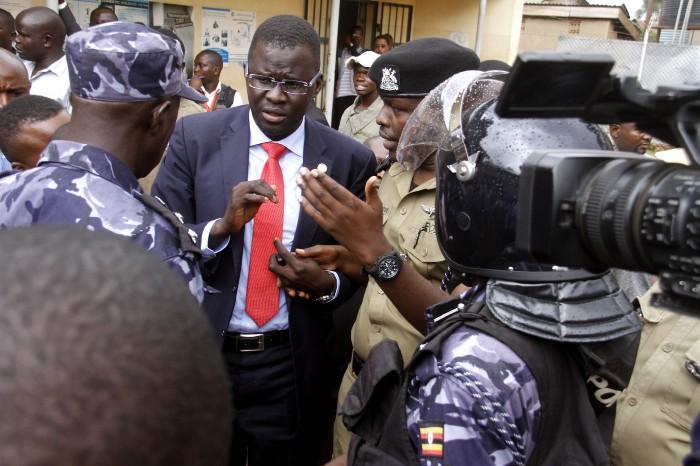
Nicholas Opiyo is confronted outside a magistrate court in 2018 after attempting to prosecute Uganda’s chief of police. (Photo courtesy of Nicholas Opiyo)
In a message on its Facebook page, the Uganda Police Force stated that Opiyo was arrested by a “Joint Task team of Security and Financial Intelligence, on allegations of money laundering and related malicious acts. The investigations are progressing well and any new developments will be communicated in due course,” the message continued. “He remains in our custody at the Special Investigations Division.”
Opiyo, a strong ally of the LGBTI community in Uganda, is the executive director and lead attorney of Chapter Four Uganda, a human rights advocacy organization. As an attorney, he represented presidential candidate Robert Kyagulanyi (Bobi Wine) after Wine’s arrest before a campaign rally on Nov. 18. That arrest sparked widespread violence. Opiyo said Wine was arrested on a coronavirus violation, but “the actual reason really is that it is part of the broader attempt to stifle opposition campaigns.” He noted that Ugandan President Yoweri Museveni was also holding political rallies during the same period, but without police interference.
National Unity Platform Presidential candidate Robert Kyagulanyi Bobi Wine claimed Opiyo was arrested because he was looking into the aftermath of the November 18th protests in which over 50 people were killed. The protests were sparked by the arrest of the candidate. Bobi Wine said Opiyo was “abducted by security from restaurant in Kamwokya [a section of Kampala, the capital of Uganda], alongside other lawyers investigating murders of 18th & 19th, Nov. Thrown into private van with tinted glasses and driven at breakneck speed to unknown destination.”
The Uganda Police Force message about Opiyo was harshly criticized in hundreds of comments on Facebook, including remarks.
He was until March of 2017, a member of the Team of Expert to the United Nations Special Rapporteur on the Rights to Peaceful Assembly and Association. He is also a visiting scholar at the Centre for African Studies, Stanford University, CA, USA and the Global Health Program at the University of San Francisco (UCSF), California, USA.
Nicholas is the Board Chair of Action Aid Uganda, a member of the Human Rights Advisory Board BENETECH, a Silicon Valley human rights and tech company based in Palo Alto in California and African Middle Eastern Leadership Project (AMEL), a Washington, DC-based think and action group.
A group of 13 important human rights NGOs – in a joint statement – condemn the Thai police’s unnecessary and excessive use of force against peaceful protesters marching to the national parliament in Bangkok on November 17, 2020. They are concerned that authorities could employ similar measures when facing protesters who have declared they will march to the Siam Commercial Bank headquarters on November 25.
On November 17, police set out barriers and barbed wire to prevent a peaceful march organized by pro-democracy movements from reaching the parliament. Protesters planned to protest outside the parliament as members of parliament and senators debated seven different proposals for constitutional amendments, including an amendment proposed by the lawyers’ non-governmental organization iLAW (Internet Law Reform Dialogue), which was supported by the People’s Movement and its allies. Police refused to let protesters through the barriers, and when the demonstrators acted to breach those barriers, police crowd control units used water cannons laced with purple dye and an apparent teargas chemical, as well as teargas grenades and pepper spray grenades, to forcibly disperse thousands of demonstrators, including students, some of whom are children. Water cannons were first used at approximately 2:25 pm and police continued their efforts to disperse protesters, with constant use of water cannons, teargas and pepper spray into the evening.
Police also failed to prevent violence between pro-democracy protesters and royalist “yellow shirts” near the Kiak Kai intersection, near the parliament. Initially, riot police separated the two groups. However, video posted on social media later showed police officers informing the royalist protesters that they would withdraw and seconds later they vacated their position between the two groups. During the ensuing skirmishes, both sides were filmed throwing rocks and wielding clubs. Live broadcasts included sounds that appeared to be gunfire.
The Erawan Medical Centre reported that there were at least 55 protesters injured, mostly from inhaling teargas. It also reported that there were six protesters who suffered gunshot wounds. The injured included children: a kindergartener and elementary school students….
On November 18, the spokesperson for United Nations Secretary-General António Guterres “expressed concern about the [human rights] situation in Thailand … it’s disturbing to see the repeated use of less lethal weapons against peaceful protesters, including water cannons … it’s very important that the government of Thailand refrain from the use of force and ensures the full protection of all people in Thailand who are exercising a fundamental peaceful right to protest.”
We call on the Thai government to respect, protect and fulfill the right of demonstrators to peacefully protest, in line with Thailand’s international obligations under the ICCPR and customary international law. Specifically, Thailand should:
1. Permit the People’s Movement march to proceed on November 25 and allow for non-violent protesters, including those who are children, to peacefully protest in front of the Siam Commercial Bank headquarters.
2. Protect the rights of protesters, including those who are children, in accordance with the Human Rights Committee’s General Comment No. 37 on the Right of Peaceful Assembly.
3. Facilitate the exercise of the right to peacefully assemble and refrain from dispersing assemblies by using weapons, including less-lethal weapons, against protesters in line with the United Nations Basic Principles on the Use of Force and Firearms by Law Enforcement Officials and UN and other guidance on less-lethal weapons.
4. Protect protesters, including those who are children, from violence and interference by non-State actors, while also protecting the rights of counter-demonstrators.
5. Take steps to ensure accountability for rights violations associated with the government’s crackdown on the protest movement and to ensure that those whose rights have been violated enjoy the right to an effective remedy, as guaranteed under ICCPR article 2(3).
Signed by:
Amnesty International
Article 19
ASEAN Parliamentarians for Human Rights
Asia Democracy Network
Asian Forum for Human Rights and Development (FORUM-ASIA)
International media (here CNN) reported on 11 November 2020 on the killing of prominent Libyan lawyer and women’s rights activist Hanan al-Barassi, who was gunned down by armed men Tuesday in the eastern city of Benghazi. Her killing in Benghazi, which falls under the control of the Libyan National Army (LNA), came just a day after she shared comments on social media criticizing the son of renegade military general and LNA leader Khalifa Haftar. “The assassination of human rights defenders and opinion-holders and the silencing of voices is a heinous crime and a disgraceful form of tyranny and a desperate attempt to destroy hope for the establishment of a civil and democratic state,” Libya’s Interior Minister, Fathi Bashagha, tweeted Tuesday.
According to the United Nations Support Mission in Libya (UNSMIL), al-Barassi — whom the mission describes as a “vocal critic of corruption, abuse of power and human rights violations” — was shot “in broad daylight” by unidentified armed men. “Her tragic death illustrates the threats faced by Libyan women as they dare to speak out,” UNSMIL added. In videos posted publicly on her Facebook page, al-Barassi expressed criticism of figures loyal to the LNA. In a livestream shared on Monday, just a day before her killing, al-Barassi said she would not be silenced by threats. “I won’t surrender, only with bullets will I ever surrender — if I die, so be it. Only in death will I be silenced. Tomorrow I will have several surprises [to share], several surprises,” she told viewers. The LNA has not yet responded to a CNN request for comment on al-Barassi’s death.
Elham Saudi, the director of Lawyers for Justice in Libya, an organization which seeks to defend and promote human rights in the conflict-ridden country, called the attack an “appalling and painful reminder of the reality on the ground” for women in Libya. “With no accountability, violators will continue to get away with literal murder in broad daylight,” she added.Al-Barassi’s killing follows a series of attacks against those critical of forces aligned to the LNA.
“The killing of an outspoken lawyer in broad daylight in Benghazi will send chills through activists across the region,” said Hanan Salah, senior Libya researcher at Human Rights Watch. “This brutal killing smacks of a cold-blooded execution. The only way to end this cycle of violence is if authorities hold criminals to account for these terrible acts.”
On 25 October 2020 Mariana Castro published on Polygraph.info an overview article showing that despite official denials torture does occur in Nicaragua’s Prisons.
NICARAGUA – Anti-government demonstrators take part in a vigil to demand the release of political prisoners and justice for the victims of protests against President Daniel Ortega, outside the Metropolitan Cathedral of Managua on October 3, 2019.
“There are always prisoners who make up that they’re being tortured. …They invent things simply to create a negative image on Nicaragua before international organizations run by the yanquis…”
On October 15, the General Secretariat of the Organization of American States (OAS) publicly denounced persistent human rights violations in Nicaragua and urged the government to release political prisoners, restore fundamental freedoms and respect the separation of powers and rule of law: “The government’s has refused to comply with the recommendations of the Inter-American Commission on Human Rights, the Interdisciplinary Group of Independent Experts (GIEI), and the office of the United Nations High Commissioner for Human Rights and to fulfill its duties under the Inter-American Democratic Charter.”
Four days later, Nicaragua’s president, Daniel Ortega, dismissed allegations that political prisoners made of being tortured, calling them “lies” and an attempt to taint the country’s image.
“There are always prisoners who make up that they’re being tortured … they invent things simply to create a negative image on Nicaragua before international organizations run by the yanquis [referring to the United States], like the OAS,” Ortega said during a speech. (Source: El 19 Digital, October 19, 2020)
Based on multiple published reports, Ortega’s claim that torture accusations are invented is false.
Nicaragua under Ortega has faced extensive international scrutiny for violations of human rights. These include “targeting civil society, human rights defenders, including women human rights defenders, community and religious leaders, journalists and other media workers, students, victims and their family members, and individuals expressing critical views of the Government,” according to the United Nations Human Rights Council (HRC).
In April 2018, protests broke out in Nicaragua as fiscal reforms slashed social security. Protestors were met with a violent and lethal response from the government, fueling a civil uprising demanding Ortega’s resignation. More than 100,000 Nicaraguans have since fled the country.
Between the start of the protests and September 2019, 651 people died, nearly 5,000 were injured, 516 were kidnapped and 853 have gone missing, according to the Nicaraguan Association for Human Rights (ANPDH). Twenty-two police officers died, as stated by the U.N.
According to Human Rights Watch, many of those detained during the protests were subjected torture, including electric shocks, asphyxiation and rape. Detainees were also reportedly denied care in public hospitals.
The organization interviewed 12 former detainees, 11 of whom described suffering one of more forms of abuse, and seven who said they witnessed 39 detainees suffering abuses. It also interviewed three doctors and a psychologist who treated some detainees. They reported that many “showed signs of physical harm consistent with physical abuse and torture similar to that described by the 12 detainees.”
This week, Monitoreo Azul y Blanco (Blue and White Monitoring), a group that since 2018 registers and consolidates complaints of human rights violations in Nicaragua, published a video by Expediente Publico (an investigative journalism magazine in Honduras and Nicaragua) with testimonies from former political prisoners about their experiences of ill treatments and torture while incarcerated.
The testimonies mentioned the details of the event that resulted in the death of Eddy Montes, a Nicaraguan-American and U.S. Navy veteran who was shot dead in La Modelo prison in May 2019 after “a serious disturbance” inside of the prison, according to Nicaragua’s interior ministry.
The magazine also published an article on October 20 detailing testimonies of victims of abuse by the Nicaraguan police. They tell the story of J, an opposition protestor who between May 6 and May 13, 2019, was subjected to “constant questioning” and abuse by the police. Her complaint is one of dozens of cases.
Between April 2018 and June 2020, the Nicaraguan Human Rights Collective Never Again (Colectivo de Derechos Humanos Nicaragua Nunca+) registered complaints of five rapes, eight sexual abuses, seven threats of rape to detainees or their family members and three witnesses of rape to one or more fellow inmates, the article reported.
NICARAGUA – Members of the organization Mothers of April (AMA) hold portraits of their late loved ones outside the Cathedral in Managua on February 23, 2020.
On June 19, the Office of the United Nations High Commissioner for Human Rights issued a resolution to promote and protect human rights in Venezuela, and requesting the U.N.’s High Commissioner for Human Rights, Michelle Bachelet, to “enhance monitoring” and “continue to report on the situation of human rights in Nicaragua.”
Amid increased international pressure, Ortega’s government has released some political prisoners, including 91 people whose sentences were converted to house arrest in December 2019. But some 100 political prisoners (estimates vary slightly) remain in jails.
On September 30, more than 50 political prisoners went on a hunger strike as part of protests demanding their freedom. At least three of them sewed their mouths as part of protests and were then transferred to maximum security cells at the Jorge Navarro prison complex known as La Modelo. Amnesty International has described the complex as “one of the main destinations for those detained and punished for reporting human rights violations in the country.”
During his October 19 speech, Ortega said prison doors were open to those calling out the government, including relatives of prisoners, for them “to visit them when they say they’re being tortured, they are saying, they have sown their lips.”
But on the following day, representatives from the Permanent Commission on Human Rights (CPDH), one of Nicaragua’s oldest rights groups, went to visit the prison and were not allowed in, as La Prensa reported.
Allan Gomez, a member of the Union of Political Prisoners (UPPN), told Nicaragua Investiga that the denial of abuses is nothing new, “but human rights violations are fully visible.”
Earlier this month, the U.S. imposed its latest round of sanctions on top Nicaraguan officials, including the attorney general. According to The Associated Press, about two dozen people close to Ortega and his wife, Vice President Rosario Murillo, have been sanctioned – including Murillo and three of the couple’s children – since late 2017.
The European Union also recently renewed sanctions on Nicaragua – introduced in October 2019 – for another year, citing the “deteriorating political and social situation in Nicaragua.”
The normally reliable Jerusalem (By SARAH CHEMLA) reports on 22 Ocrtober 2020 that US President Donald Trump may declare major international Human Rights NGO’s Amnesty International,Human Rights Watch and Oxfam as antisemitic in a soon-to-be released State Department declaration, voicing that governments should not support them any longer. If the declaration happens, it is likely to cause an uproar among civil society groups and might incite litigation. Critics of the possible move also worry it could lead other governments to further crack down on such groups, according to Politico.
T’ruah, a rabbinic human rights organization that represents over 2,000 rabbis, responded to the allegation on Wednesday, saying that “any US government declaration that these groups are antisemitic for criticizing the Israeli government is ridiculous, and contributes to the silencing of Israel’s human rights defenders.” It continued, adding that “the Trump administration’s smear of these three human rights organizations is yet one more example of this administration’s disregard for democracy and human rights at home and abroad.” “In casting aspersion on longtime respected human rights organizations, the Trump administration joins an ignoble list of autocratic governments that have discredited, smeared and even banned their own internal human rights organizations,” T’ruah said.”Actions such as these damage US democracy by threatening the transparency necessary to protect human rights. Human rights and civil society groups play a prophetic role, even if their words may not be ones governments want to hear.”Israel is a state bound by international human rights law, like all other members of the United Nations, and like other countries can be criticized when it fails to live up to these commitments,” it said.”By falsely smearing human rights organizations as antisemitic, the Trump administration only makes it harder to counter actual acts of antisemitism when they happen, while simultaneously harming these organizations’ effectiveness in reporting on all countries’ human rights abuses – including those of the United States.”
ACCORDING TO Politico, the declaration is expected to take the form of a report from the office of Elan Carr, the US special envoy to monitor and combat antisemitism. It would declare that it is US policy not to support such groups, including financially (NOTE: AI and HRW do not accept government funding as a matter of policy!) , and urge other governments to cease their support.The report would cite such groups’ alleged or perceived support for the Boycott, Divestment and Sanctions movement, which has targeted Israel over its construction of settlements on land Palestinians claim for a future state. The declaration is also expected to point to reports and press statements such groups have released about the impact of Israeli settlements, as well as their involvement or perceived support for a United Nations database of businesses that operate in disputed territories, Politico said. Contacted by Politico, the organizations named in the report denied any allegations that they are antisemitic. [In 2019, David Collier released a report into the work of Amnesty International after monitoring dozens of social media accounts maintained by the NGO and people who work for it, and concluded that the amount of hatred Israel receives is beyond any proportion, to a level that is, he said, antisemitic.“Targets are not chosen for their actions, but rather for their identity,” wrote Collier. “Persecuted Christians are blatantly ignored.”[see also: https://electronicintifada.net/blogs/asa-winstanley/how-racist-blogger-david-collier-infiltrated-labour-party]
Thailand: joint statement by International NGOs on Pro-Democracy Protests
November 29, 2020A group of 13 important human rights NGOs – in a joint statement – condemn the Thai police’s unnecessary and excessive use of force against peaceful protesters marching to the national parliament in Bangkok on November 17, 2020. They are concerned that authorities could employ similar measures when facing protesters who have declared they will march to the Siam Commercial Bank headquarters on November 25.
On November 17, police set out barriers and barbed wire to prevent a peaceful march organized by pro-democracy movements from reaching the parliament. Protesters planned to protest outside the parliament as members of parliament and senators debated seven different proposals for constitutional amendments, including an amendment proposed by the lawyers’ non-governmental organization iLAW (Internet Law Reform Dialogue), which was supported by the People’s Movement and its allies. Police refused to let protesters through the barriers, and when the demonstrators acted to breach those barriers, police crowd control units used water cannons laced with purple dye and an apparent teargas chemical, as well as teargas grenades and pepper spray grenades, to forcibly disperse thousands of demonstrators, including students, some of whom are children. Water cannons were first used at approximately 2:25 pm and police continued their efforts to disperse protesters, with constant use of water cannons, teargas and pepper spray into the evening.
Police also failed to prevent violence between pro-democracy protesters and royalist “yellow shirts” near the Kiak Kai intersection, near the parliament. Initially, riot police separated the two groups. However, video posted on social media later showed police officers informing the royalist protesters that they would withdraw and seconds later they vacated their position between the two groups. During the ensuing skirmishes, both sides were filmed throwing rocks and wielding clubs. Live broadcasts included sounds that appeared to be gunfire.
The Erawan Medical Centre reported that there were at least 55 protesters injured, mostly from inhaling teargas. It also reported that there were six protesters who suffered gunshot wounds. The injured included children: a kindergartener and elementary school students….
On November 18, the spokesperson for United Nations Secretary-General António Guterres “expressed concern about the [human rights] situation in Thailand … it’s disturbing to see the repeated use of less lethal weapons against peaceful protesters, including water cannons … it’s very important that the government of Thailand refrain from the use of force and ensures the full protection of all people in Thailand who are exercising a fundamental peaceful right to protest.”
We call on the Thai government to respect, protect and fulfill the right of demonstrators to peacefully protest, in line with Thailand’s international obligations under the ICCPR and customary international law. Specifically, Thailand should:
1. Permit the People’s Movement march to proceed on November 25 and allow for non-violent protesters, including those who are children, to peacefully protest in front of the Siam Commercial Bank headquarters.
2. Protect the rights of protesters, including those who are children, in accordance with the Human Rights Committee’s General Comment No. 37 on the Right of Peaceful Assembly.
3. Facilitate the exercise of the right to peacefully assemble and refrain from dispersing assemblies by using weapons, including less-lethal weapons, against protesters in line with the United Nations Basic Principles on the Use of Force and Firearms by Law Enforcement Officials and UN and other guidance on less-lethal weapons.
4. Protect protesters, including those who are children, from violence and interference by non-State actors, while also protecting the rights of counter-demonstrators.
5. Take steps to ensure accountability for rights violations associated with the government’s crackdown on the protest movement and to ensure that those whose rights have been violated enjoy the right to an effective remedy, as guaranteed under ICCPR article 2(3).
Signed by:
Amnesty International
Article 19
ASEAN Parliamentarians for Human Rights
Asia Democracy Network
Asian Forum for Human Rights and Development (FORUM-ASIA)
Asian Network for Free Elections (ANFREL)
CIVICUS: World Alliance for Citizen Participation
Civil Rights Defenders
FIDH – International Federation for Human Rights
Fortify Rights
Human Rights Watch
International Commission of Jurists
Manushya Foundation
———–
https://www.hrw.org/news/2020/11/25/statement-international-ngos-pro-democracy-protests-november-17-and-25-2020
Posted in AI, Civil Rights Defenders (NGO), Front Line, HRW, human rights, Human Rights Defenders, ICJ | Leave a Comment »
Tags: freedom to demonstrate, General comment ICCPR, joint statement, NGOs, police violence, students, Thailand