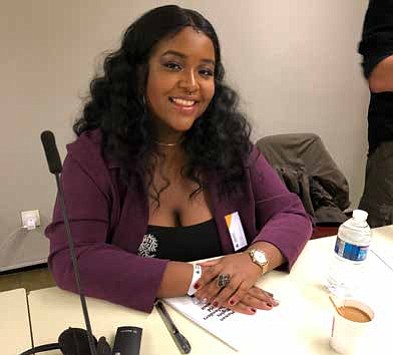
Eva Lewis, founder of the I Project. Photo Credit: Provided by Eva Lewis
Katherine Newman in the Chicago Citizen proudly profiles the young woman from Chicago Eva Lewis who – as only HRD from the USA almost represented “the United States At Human Rights Defenders World Summit” [https://humanrightsdefenders.blog/2018/07/24/announcement-of-the-human-rights-defenders-world-summit-in-paris-october-2018/].
A young activist, Eva Lewis, who grew up on the south side of Chicago recently traveled to Paris to participate in the Human Rights Defenders World Summit 2018. Lewis spoke on the Americas panel, alongside activists from Latin America, and discussed youth-led movements in the United States as well as the state of black and brown people in the country. “What the Summit aims to do is bring together representatives from each country to talk about the state of human rights defenders and to brainstorm ways that we can elevate our fight for human rights and create a direct action plan that can be implemented to protect human rights defenders internationally,” said Lewis.
Lewis was one representative in a diverse group of 150 human rights defenders from around the world that came to Paris for the three-day Summit. “I was on the Americas panel and I was the only US representative and also the youngest delegate at the Summit and I was the only English speaker on my panel. Everyone on the panel talked about their own fight for human rights and how it pertains to their country and the people that they were there to represent,” said Lewis.
“I set my self up to fulfill a specific agenda which was to bring human rights of black and brown folks in the U.S. to an international platform because we don’t talk about human rights violations against black and brown people in the US as a human rights issue. This was the first time anyone had that conversation at the Summit and I was happy to be able to be the one to present that conversation.”
Nineteen-year-old Lewis is an award-winning student, activist, and artist. She is also known for founding the I Project, a non-profit organization aiming to create equitable communities in Chicago.
“I really liked hearing about how people structure their organizations so what I think I gained the most from the Summit is good information about how to make the infrastructure of my own organization more sustainable. The I Project is relatively new and we’ve only had a fiscal sponsorship for about a year and we are not sustainable at all and I’m comfortable admitting that because the journey is important and part of the process,” said Lewis.
On 11 November 2018, Phil Bloomer Phil Bloomerof the Business & Human Rights Resource Centre assesses the results of the 2018 Corporate Human Rights Benchmark and finds that while there has been welcome progress among a small group of leaders, the vast majority of companies are content to under-perform. [for some of my earlier posts on business and human rights see: https://humanrightsdefenders.blog/tag/business-and-human-rights/]
The first full version of the Corporate Human Rights Benchmark was published yesterday, with key findings on companies in the apparel, agricultural products and extractives sectors. The results reveal that there is a race to the top in business and human rights performance, but only amongst a welcome but small cluster of leaders. The great majority have barely left the starting line, with 40 of the 101 companies surveyed failing to show any evidence of identifying or mitigating human rights issues in their supply chains.
CHRB measures how companies perform across 100 indicators based on the UN Guiding Principles on Human Rights. It uses publicly available information on issues such as forced labour, protecting human rights activists and the living wage to give companies a maximum possible score of up to 100%. In this year’s ranking, two-thirds of companies scored less than 30% overall. However, members of the small leadership group from the 2017 Pilot Benchmark have continued to compete to be the “best in class”, and each has made progress to ensure they do not fall behind direct competitors.
……..
The most challenging news from this benchmark is the lack of significant progress on last year by the majority. There is an unacceptably large group of companies who are not doing enough and appear content to hide in the pack of under-performers. …..First, leading companies are beginning to gain greater access to cheaper capital, based on their lower human rights risks. The fact that sustainable investment funds have effectively doubled in size each year since 2012 demonstrates the growing appetite for companies that manage their environmental and social risks. And this year Danone successfully pioneered a $300m social bond that attracted investors focused on ESG risks.
Second, faced with the collapse of public trust in global markets, governments are beginning to exert themselves with increasingly bold steps toward regulation for mandatory transparency and due diligence. Good practice by leading companies emboldens timid governments to raise the minimum floor of corporate behaviour through regulation and incentives. This should be welcomed as it outlaws the reckless cowboys in every high-risk sector.
Third, we see civil society and investors using the results of the benchmarks to exert pressure on laggard companies and recently a number of investors have teamed up, privately, with campaign groups to ensure that harder-hitting shareholder resolutions are raised at the AGMs. These pressures look set to grow and spread over the coming years. This is essential.
With humankind facing extraordinary transitions – to zero-carbon economies, to automation and gig economies, to mass migration, all amidst the challenges to democracy and open societies – the Corporate Human Rights Benchmark will be one key assessment to press companies to play their full role in helping create a more sustainable and prosperous future for all. Equally our association now with the World Benchmarking Alliance will ensure that human rights in business is unavoidable if companies want their operations to be recognised as playing a part in delivering the Sustainable Development Goals.
Phil Bloomer is executive director of the Business & Human Rights Resource Centre
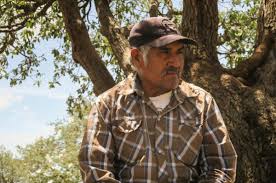
On 6 November 2018, four UN Special Rapporteurs have strongly condemned the killing of Julián Carrillo, an indigenous rights defender from the state of Chihuahua, Mexico, who had worked tirelessly for over two decades to defend his community against the exploitation of Rarámuri ancestral lands.
On 23 October 23 2018, Julián Carrillo told a friend by phone that he believed he was being watched and said he would go into the forest in an attempt to hide. On the evening of 25 October, his body was found. He had multiple bullet wounds. “We urge the Mexican authorities to identify the perpetrators of this reprehensible crime and to bring them to justice in accordance with the law,” the experts said.
The experts also urged the Government to address the underlying causes of such violence. “The killing of Julián Carrillo highlights the serious situation in the Sierra Tarahumara where the lack of recognition of indigenous land rights is a root cause of the recurring violence against and displacements of indigenous communities.”… [The UN experts are: Mr. Michel Forst, Special Rapporteur on the situation of human rights defenders; Ms. Victoria Tauli Corpuz, Special Rapporteur on the rights of indigenous peoples; Ms. Agnès Callamard, Special Rapporteur on extrajudicial, summary or arbitrary executions; and Ms. Cecilia Jimenez-Damary, Special Rapporteur on the Human Rights of Internally Displaced Persons.]
Julián Carrillo’s murder is one of a spate of killings of human rights defenders in the country. According to official OHCHR figures, 21 human rights defenders have been killed so far this year, nine of them from indigenous communities. Four members of Julián Carrillo’s family – his son, son-in-law and two nephews – have been killed since February 2016.
This follows soon after the assassination on Wednesday 23 October of journalist Gabriel Soriano Kuri. Soriano had been covering Governor Héctor Astudillo Flores’ third annual report for the Radio y Televisión de Guerrero (RTG) broadcaster that evening. After the event, held in Acapulco, he was driving a company vehicle when he was attacked and killed by armed civilians. Following the murder, Astudillo offered his condolences to Soriano’s family via Twitter. But it didn’t go down very well. Soriano’s daughter replied with a blunt message: “My dad was assassinated doing his job. Covering your report to the state! Do your job and fix the situation the state is in. It’s not right,” she wrote. Her discontent was echoed in at least three demonstrations where journalists demanded that authorities solve the assassination of their colleague. A state journalists’ association reported that three members of the profession have been slain during Astudillo’s three years in office.
The Middle East Monitor (among many) of 5 November 2018 reports how the Egyptian security forces entered the apartment of 60-year-old Hoda Abdelmonem, legal advisor to the Egyptian Coordination for Rights and Freedoms (ECFR), and trashed her belongings.
Fears grow for 19 missing human rights defenders in Egypt. Hoda was one of 19 activists – eight women and 11 men – swept up Thursday 1 November as the regime escalates pressure on human rights NGOs. Four days later the location and fate of these activists is still unknown. One of the organisations hit hard by this crackdown is the ECFR, which documents enforced disappearances and the expanding use of the death penalty.
A number of prominent members of the group have been targeted before. In September, Executive Director of ECFR, Ezzat Ghoneim, was forcibly disappeared despite being released from Tora prison after serving a six-month prison sentence there. In October Egyptian authorities issued an arrest warrant for Ghoneim for failing to adhere to the terms of his release despite the fact that his family say he is still being held in secret detention.
Along with Ghoneim the group’s co-founder Azzouz Mahgoub was also forcibly disappeared in March. Last Thursday the ECFR announced the suspension of its work citing the current climate in Egypt as “incompatible with human rights work”. “The human rights situation in Egypt, especially with regard to the rights of detainees and human rights defenders, has been the worst in Egypt’s history in the past five years” ECFR said in a statement.
“Furthermore, the Egyptian authorities have committed the most serious violations beyond all humanitarian norms including the storming of women’s homes, their detention and the arrest of their families over the past three months alone.”
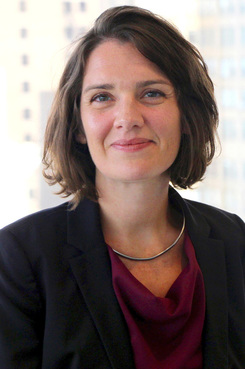
Since joining McCarter & English as pro bono director two years ago, Michelle Movahed has helped bring about increases in firmwide pro bono hours (by 3,000 hours annually) and in pro bono-to-billable hours ratio (even as billables increased, according to the firm). The program also has taken up a broader range of cases under Movahed, including immigration detainee asylum matters. And she recently saw through the firm’s creation of a pro bono fellowship to benefit the city of Newark, which includes a full-time attorney position. David Gialanella interviewed her on November 2018 for the New Jersey Law Journal:
What’s your single best piece of advice for handling a crisis?
Focus on what you can control, take ownership of all of it, and move forward.
Name a mentor or someone you admire, and why.
I deeply admire my clients. I’ve been very lucky to work for human rights defenders, for individuals who have stepped up to right a wrong, and, most recently, for asylum-seekers who have made harrowing journeys to escape truly horrendous trauma.
Best advice you ever got…
I’ve never been as nervous as I was the night before my first big oral argument, on our motion for a TRO to keep the doors open at the last comprehensive reproductive health clinic in Mississippi. By around 10 p.m., everyone I worked with was telling me to go to sleep and stop preparing so I’d be well-rested. I just didn’t feel like it was time yet, but I also knew I didn’t know enough to make that judgment call. So I asked for help: I wrote to the judge I’d clerked for, whose opinion I value more than almost anyone, to ask for words of wisdom. The advice he gave me was incredible, and I must have read his email a hundred times over the next 12 hours until I went in to the courthouse. He reminded me that I couldn’t lie to myself about how nervous I was, how high the stakes were, and how hard my case was. So, he said, “don’t f— it up.” If I could have that embroidered on a pillow, I would. I stayed up late, prepared until I knew I had done everything I could to avoid f-ing up, and was completely on my game at the argument. (We got the TRO, and the clinic stayed open.)
What has the #MeToo movement meant to the legal profession?
The hashtag is new, but the issues aren’t. #MeToo, #BlackLivesMatter, and #TimesUp are reminders that lawyers have a responsibility to use our privilege to challenge oppression wherever it appears. Our professional obligations include the duty to speak up when we know another lawyer has violated the rules of professional conduct; but our ability to promote justice is much broader, and we should use it.
In 50 words or less, what does the legal profession need to do to improve opportunities for women lawyers?
Every lawyer should seek out opportunities to teach, mentor, and otherwise make space for lawyers with less privilege: not only women, but also lawyers of color, who are LGBTQIA, who have disabilities, who are from other traditionally marginalized groups, and who are at the intersections of those identities.
Already on 9 March 2018 Robert Hårdh was succeeded as Executive Director of the Stockholm-based NGO Civil Rights Defenders [see e.g.: https://humanrightsdefenders.blog/tag/civil-rights-defenders/] by Anders Pettersson. An oversight on my part that I am glad to correct. Anders has had a variety of international jobs of which the latest was head of Ecpat Sweden.
Margie Orford – an internationally acclaimed writer – wrote an excellent and very readable report on Hillary Clinton‘s visit to Oxford where she dedicated a statue to Eleanor Roosevelt in the garden of the newly opened Centre for Human Rights. It was a published in the Daily Maverick on 18 October 2018 under the title: London Eye: Democratic institutions must be defended in an era of machismo and aggression. It is worth the read and I only quote a short section to give a flavor:
…The sun is shining, I think Eleanor is great, I have no real objection to public art and I’ve been a lifelong fan of human rights, but it’s all I can do not to yell:
“Hillary! you should be in the White House. I know you’re not perfect and you had Bill as a husband, but you won the popular vote and you are sane, personable, experienced. You are not hell-bent on turning America into The Handmaid’s Tale and you’re equipped to do that really big job of being the boss of the world. Why are you here?”
As I listen to former Secretary Clinton describing this historical moment — that is now – with eloquence and erudition, I pay attention to her speech. How she speaks. What she says. …....Not only is Trump conducting a sustained attack on language and thought, he is doing the same to America’s democratic institutions. Listening to Clinton gives me that Titanic feeling. The iceberg might be orange this time, but what she says convinces me that — unless there’s a miracle, one that ordinary people opposed to tyranny will have to perform — we’re all going down…..
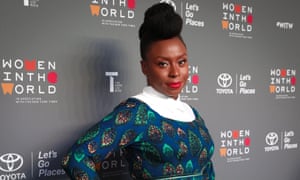
Chimamanda Ngozi Adichie accepts PEN Pinter prize with call to speak out. Arguing that authors have a duty to ‘call a lie a lie’, the Nigerian novelist also names human rights activist Waleed Abulkhair as the 2018 International Writer of Courage. Alison Flood in the Guardian of
Chimamanda Ngozi Adichie pictured at the Women in the World Summit in 2017. Photograph: Matteo Prandoni/BFA/Rex/Shutterstock
The Nigerian novelist was described by the Jury as “sophisticated beyond measure in her understanding of gender, race, and global inequality”. In her acceptance lecture at the British Library, Adichie said that while writers should not necessarily speak out on political issues, she did not believe “that art is a valid reason for evading the responsibilities of citizenship – which are to think clearly, to remain informed, and, sometimes, to act and speak”.
…The award-winning novelist revealed how she has been criticised in Nigeria for speaking out about its law criminalising homosexuality, and for her efforts to start a “much-needed conversation” about women’s rights in the country….
Adichie said that she did not choose to speak out about social issues because she is a writer. “But my writing gave me a platform to speak about issues that I have always cared about,” she said. “I do not want to use my art as an armour of neutrality behind which to hide. I am a writer and I am a citizen, and I see my speaking out on social issues as a responsibility of citizenship. I am struck by how often this speaking out is met, in Nigeria, not with genuine engagement, whether to agree or disagree, but with a desire to silence me. A journalist once helpfully summed it up for me: people don’t like it when you talk about feminism, they just want you to shut up and write.”
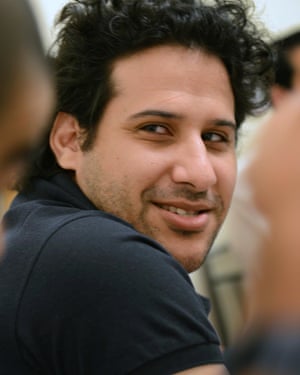
At the ceremony, Adichie named the lawyer and human rights activist Waleed Abulkhair as this year’s International Writer of Courage, a title awarded by the PEN Pinter winner each year. Abulkhair, a founding member of the Monitor of Human Rights in Saudi Arabia .
“Waleed has dedicated his life to holding the Saudi authorities accountable for human rights abuses,” said Adichie. “He has dedicated his life to speaking out, to supporting the victims of those abuses. Waleed, like Harold Pinter, has shown a lucid dedication to telling his truth. But rather than being lauded for this dedication, Waleed has paid a heavy price – 15 years behind bars.” She said she was deeply proud to share the prize with Abulkhair, “and I hope that this small act of solidarity will bring him some comfort, and will remind him that his struggle has not been forgotten, nor will it be in vain.”
In a rare case of triumph over impunity, the Zimbabwean High Court, on 27 September 2018, ordered the state to pay $150 000 to Jestina Mungareva Mukoko, a pro-democracy campaigner and Director of Zimbabwe Peace Project (ZPP). In a Deed of Settlement endorsed by the High Court, the defendants have been ordered to pay $100.000 to Jestina in respect of her claims while a further $50.000 will be paid as a contribution towards her legal costs (before 31 October 2018).
This exceptional decision was welcomed by many NGOs, including the Zimbabwe Peace Project (ZPP) and Zimbabwe Lawyers for Human Rights (ZLHR).
My good friend and long-time Zimbabwean human rights defender Arnold Tsunga said the following: “I think it’s a very good resolution of the case. The damages are significant but the case was also quite serious including the torture meted out on Jestina that the damages seem to fit the case. In a way it’s a double benefit in that the abduction and torture resulted in criminal case against her collapsing and on top of that she gets paid. Hopefully the security sector have learnt a lesson. It is also good that the judiciary is getting stronger and confident to pronounce itself this way“. Especially the latter is an important outcome!
ackground Information (Jestina Mukoko Triumph: The Facts): Jestina was abducted by some unidentified armed men from her home in Norton on 3 December 2008, and her whereabouts together with two ZPP employees Broderick Takawira and Pascal Gonzo, who were also abducted later in December 2008 remained unknown until December 24, 2008, when they first appeared before the Harare Magistrates Court, after weeks of being held incommunicado and being tortured. In court, Jestina and her colleagues and dozens of other pro-democracy campaigners were accused by government of plotting to topple Robert Mugabe’s administration through recruiting people to undergo military training in neighbouring Botswana. After her release from a torturous three months stay in prison, Mukoko with the assistance of her lawyer Beatrice Mtetwa, a member of ZLHR, took legal action against the state.
In September 2009, the Supreme Court granted a permanent stay of prosecution in favour of Jestina due to the violation of several of her fundamental rights by state security agents as she had been subjected to torture and inhuman and degrading treatment including simulated drowning, being locked in a freezer and being subjected to physical assaults as her tormentors tried to make her confess to plotting to overthrow the administration of Zimbabwe’s former leader Robert Mugabe.
In 2017, the High Court ruled that those who had illegally arrested her could be held liable in their own individual capacities and the case culminated in lengthy protracted negotiations that have led to this outcome. During this time, Jestina was called different names such as ‘regime change agent, reactionary and other unprintable words in a bid to delegitimise her legitimate human rights activism. She was portrayed as a criminal, a tag which remains today but this settlement in the court vindicates her and her work in defending human rights.
Jestina Mukoko herself added the following piece on the “Significance of my case” (which I reproduce almost in full as it is such a good lessons learnt):
..The patrimonial settlement cannot atone for the trauma and suffering that I suffered and went through at the hands of the state security agents who were ruthless, merciless and very evil. It will not make for lost time as my liberty and all other human rights accorded to me by virtue of my being human was unjustifiably curtailed nor will it provide solace for my traumatised family – my mother, son, brothers, sisters in law, extended family, friends and other peace loving citizens.
However, it is a victory for the rule of law, constitutionalism and a mortal blow to impunity. The High Court’s decision is proof that the justice system is still able to prove the involvement of the state and its representatives in gross human rights violations, and bring them to account, with justice being done for the victims like myself.
It sets a landmark precedent and shows that the state actors can be held accountable for their illegal conduct. It also sends a message to the overzealous enforcers of orders and in this case very illegal orders to violate a plethora of my rights that they will be held responsible for their actions and this can even be in their personal capacity.
I hope my story will inspire many other victims. To some extent, justice has now been done and this case will stand as an example in the continuing fight against impunity for state crimes and excesses.
My resort to litigation and the subsequent victory in court sends a strong signal that state sponsored crimes cannot go unpunished.
It is also an encouragement to human rights defenders that the dangers of their work will not be in vain. I hope this case will embolden younger activists to pursue social justice in the comfort that they can rely on this case to hold the state or anyone accountable who may threaten their liberties. It is also a vindication of the advocacy work done by all human rights activists and those who have invested in promoting and protecting human rights that even though the fruits of this cumbersome and often arduous journey may come late , they eventually come. This is a victory for everyone who has been in the trenches with me and who has walked this risky journey of human rights work.
I hope that this victory will set an example, particularly to the Zimbabwean authorities, who must now prosecute the perpetrators of abductions and enforced disappearances which is a heinous crime.
The High Court’s decision sends a clear signal to the Zimbabwean authorities, who must do everything in their power to guarantee victims access to impartial justice and to put an end to the endemic impunity that is enjoyed by torturers and the perpetrators of serious human rights violations.
This settlement comes at a time when the Commission of Inquiry into Post Election Violence set by President Emmerson Mnangagwa has started its work to establish the facts around the circumstances that led to the death of six people on 1 August 2018 in Harare after members of the Zimbabwe Defence Forces opened fire against protesters. It must be established whether the force used by members of the Zimbabwe Defence Forces was proportionate to the threat posed by unarmed protesters. It must also be established whether in doing so they overstepped their mandate and therefore should be held liable or the state vicariously liable. This case must form the basis for national rejection of all forms of impunity and the same principles must be followed by the Commission of Inquiry into Post Election Violence.
In conclusion, I, Jestina through the Zimbabwe Peace Project, which plays a critical role in documenting human rights abuses, will continue to join hands with other civil society organisations such as ZLHR to champion human rights in the post-Robert Mugabe era without fear or favour. The journey to full implementation of the Constitution and compliance with the supreme law of the land continues.
Independent Catholic News of 4 October 2018 carries the following story on the London Mining Network 12-20 October 2018:
“I am Misael Socarras Ipuana, of the Wayuu People. I live in the north of Colombia, in the peninsula of La Guajira, in the community of La Gran Parada. I am a human rights defender, indigenous communicator, director, cultural expert and leader of my community. I am 48 years old, married according to the traditions of my people to Moncia Lopez Pushaina. I have six children, for whom I struggle daily to give them a better future, free of contamination and mining. We want to be autonomous in our territories, free and able to enjoy Mother Nature without restrictions or fear.”
Misael is one of the five human rights and environmental defenders joining the London Mining Network for a week of action 12-20 October around the annual shareholder meeting of BHP Billiton, the world’s largest mining company. He will be speaking at events, meeting anti-coal campaigners in County Durham and holding BHP executives to account.
The London Mining Network, which highlights justice, peace and environmental issues related to extractive industries, is supported by religious and missionary groups with experience of the problems in countries where they work. Most of the world’s biggest mining companies, and many smaller mining companies, are listed on the London Stock Exchange, and on its Alternative Investment Market (AIM).
Communities all over the world are rising against mining violence and building alternatives that offer truly-sustainable futures, assert people’s rights and are deeply rooted in custodianship of land and water. This week of action will be an opportunity to explore this resurgence. They call for the UK government to commit to a Binding Treaty on Business and Human Rights to end corporate impunity.
As the world’s largest multinational mining company, Anglo-Australian-owned BHP’s AGM is an important moment to build these arguments. BHP’s record of forced displacement, dispossession and catastrophic environmental damage stretches back decades. The company is so powerful it is seldom held to account for this devastation, while indigenous, Afro-descendant and peasant communities are hardest hit.






 Hans Thoolen on Human Rights Defenders and their awards