Archive for the 'human rights' Category

Three Saudi human rights defenders honored with PEN/Barbey Freedom to Write Award

March 15, 2019

Nouf Abdulaziz, Loujain al-Hathloul and Eman al-Nafjan have won the PEN/Barbey Freedom to Write Award, the literary and human rights organization announced Thursday. The award was established in 1987 and is given to writers imprisoned for their work, with previous recipients coming from Ukraine, Egypt and Ethiopia among other countries. [for more the award and the change of name in 2015 see: http://www.trueheroesfilms.org/thedigest/awards/freedom-to-write-award-pen]

In custody for working to “undermine the security” of the kingdom, Abdulaziz, Al-Hathloul and Al-Nafjan have openly opposed such government policies as a ban on women driving and the restriction of women’s travel, education and other rights without approval from a male guardian. On Wednesday, al-Hathloul and al-Nafjan were among those at a closed-door hearing in Riyadh, according to Amnesty International. Reporters were not allowed in. [see: https://humanrightsdefenders.blog/2019/03/13/saudi-arabia-persist-with-trial-for-women-human-rights-defenders/]

The fleeting hope that generational transition in the Saudi leadership would open the door toward greater respect for individual rights and international law has collapsed entirely, with individuals paying the highest price as the government resorts to rank barbarism as a blunt means to suppress and deter dissent,” PEN America CEO Suzanne Nossel said in a statement. “These gutsy women have challenged one of the world’s most notoriously misogynist governments, inspiring the world with their demand to drive, to govern their own lives, and to liberate all Saudi women from a form of medieval bondage that has no place in the 21st century.

PEN officials have not determined who will accept the Freedom to Write Award on behalf of the three winners at the annual PEN gala, being held in Manhattan on May 21. Others receiving prizes — and able to collect them in person — include Bob Woodward of Watergate fame and the CEO of Scholastic, Richard Robinson.

PEN has long highlighted the Freedom to Write Award as a way of turning advocacy into concrete action, noting that 37 of the 43 previous winners have since been freed, at least in part because of the attention raised by the prize. “It helped me to survive while I was in prison,” said the 2016 winner, Ahmed Naji, an author and journalist who had been imprisoned in Egypt and now lives in Washington, D.C. …

Al-Nafjan is a blogger and linguistics professor who has written for The Guardian and CNN among other publications. Al-Hathloul is a prominent opponent of the driving ban, lifted shortly after her arrest last year, and was arrested in 2014 and detained for 73 days. Abdulaziz is a journalist and blogger who has written for years about human rights violations. After her arrest, fellow women’s rights activist Mayya al-Zahrani posted online a letter Abdulaziz had written in case she was captured.

“I usually sum up myself with a few characteristics: a writer, a reading addict since I was six years old, my father tells me that I am intelligent; I am a quiet girl except for the questions that storm my mind,” Abdulaziz wrote. “I will talk to you and share some of the questions that overcome my mind: Why is our homeland so small and tight, and why am I considered a criminal or an enemy that threatens it! I was never but a good citizen that loved her country and wished the best for it, a loving daughter and a hardworking student and a devoted worker, who never demeaned hated or envied anyone.

http://www.startribune.com/3-saudi-women-activists-receive-pen-freedom-to-write-award/507137352/

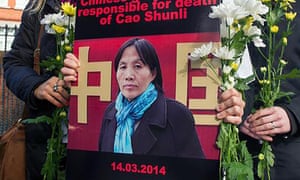
Cao Shunli died five years ago – how many more before there is a change?

March 14, 2019

On 14 March 

Veteran Chinese human rights activist Cao Shunli, who died in 2014 in a Beijing hospital.

Veteran Chinese human rights activist Cao Shunli, who died in 2014 in a Beijing hospital. Photograph: Front Line Defenders

Five years ago today, Chinese activist Cao Shunli died in a Beijing hospital surrounded by police. [see: https://humanrightsdefenders.blog/2016/02/12/cao-shunli-a-profile-and-new-award-in-her-name/]

...This week is an opportunity to pay tribute to Cao Shunli, but also importantly, for the international community to speak up and remind the Chinese government of its obligations to safeguard human rights. On March 15, the UNHRC will be meeting to adopt a final report on recommendations made in November during China’s third Universal Periodic Review (UPR). ……States can use Friday’s meeting to speak out and pay tribute to Cao Shunli and all those who have died under Chinese police custody, reject China’s denials made during the UPR over its rights abuses in Xinjiang, and build momentum towards passing a resolution on the human rights situation in China……..Since the council’s creation in 2006, there has not been a single country-specific resolution directed at China despite a worsening rights situation. It’s time for the UNHRC to end its double standards and mandate an international fact-finding mission to look into the credible reports of internment camps in Xinjiang.

Many human rights defenders, like Cao, and ethnic and religious minorities have died in Chinese custody due to torture or deprivation of medical treatment. China’s only Nobel peace prize laureate Liu Xiaobo, Uighur scholar Muhammad Salih Hajim, and Tibetan monk Tenzin Delek Rinpoche all died in police custody in recent years.

Others, like detained citizen journalist Huang Qi, await such a fate without urgent intervention. Police have denied Huang, who has kidney and heart diseases, medical treatment and have repeatedly beaten him in custody. His condition has deteriorated to the point where supporters fear he may become “another Cao Shunli” and UN independent experts recently expressed concern he might die in detention.

Ten other Chinese activists, journalists, scholars, and lawyers are on a medical watchlist of political prisoners, launched after Cao’s death to draw attention to China’s practice of torture by withholding medical treatment…………..

It’s no coincidence that following a weak response internationally to the deaths of prominent human rights defenders and a widespread crackdown on civil society that the Xi government felt confident enough to establish a system of mass internment camps for ethnic Uighurs and Muslims and turn the Xinjiang region into a “no-rights zone”.

Human rights defenders and ethnic and religious minorities in China face real risks for standing up to the Chinese government. They don’t pay with lost trade deals but with their lives. The risks of speaking out in defence of human rights and fundamental freedoms in China include losing your job, your home, your family, or being disappeared, arbitrarily detained, tortured, or even killed.

Cao Shunli said before her death: “Our impact may be large, may be small, and may be nothing. But we must try. It is our duty to the dispossessed and it is the right of civil society.” States should remember her spirit and not be afraid to speak truth to power.

Note that on 14 March a group of UN experts have renewed their call for a comprehensive and independent investigation into her death by Chinese authorities (https://www.protecting-defenders.org/en/news/china-un-experts-renew-calls-probe-death-cao-shunli).

https://www.theguardian.com/world/2019/mar/14/cao-shunli-died-five-years-ago-she-stood-up-to-china-on-human-rights-and-so-must-we

One journalist who did NOT get the Women of Courage Award (but almost)

March 12, 2019
First lady Melania Trump honors the International Women of Courage awardees during a ceremony at the State Department in Washington on March 29, 2017. (Jim Watson/AFP/Getty Images)

A few days ago I referred to the International Women of Courage Awards [see; https://humanrightsdefenders.blog/2019/03/11/international-women-of-courage-awards-2019-given-out-at-the-us-state-department/]. One name you will NOT see listed there is that of Jessikka Aro, a Finnish investigative journalist.   explain why in Foreign Policy of 7 March 2019.

Jessikka Aro was to receive a “Women of Courage” prize. Then officials read her Twitter feed.

“It created a shitstorm of getting her unceremoniously kicked off the list,” said one U.S. diplomatic source familiar with the internal deliberations. “I think it was absolutely the wrong decision on so many levels,” the source said. The decision “had nothing to do with her work.”

The State Department spokesperson said in an email that Aro was “incorrectly notified” that she had been chosen for the award and that it was a mistake that resulted from “a lack of coordination in communications with candidates and our embassies.” “We regret this error. We admire Ms. Aro’s achievements as a journalist, which were the basis of U.S. Embassy Helsinki’s nomination,” the spokesperson said.

Aro received a formal invitation to the award ceremony not from the embassy but from the State Department’s Office of the Chief of Protocol on Feb. 12.

There is no indication that the decision to revoke the award came from the secretary of state or the White House. Officials who spoke to FP have suggested the decision came from lower-level State Department officials wary of the optics of Pompeo granting an award to an outspoken critic of the Trump administration. The department spokesperson did not respond to questions on who made the decision or why.

To U.S. officials who spoke to FP, the incident underscores how skittish some officials—career and political alike—have become over government dealings with vocal critics of a notoriously thin-skinned president. ….In the minds of some diplomats, this has created an atmosphere where lower-level officials self-censor dealings with critics of the administration abroad, even without senior officials weighing in.

Aro said the decision to cancel her award and corresponding trip to the United States caught her completely by surprise. “[When] I was informed about the withdrawal out of the blue, I felt appalled and shocked,” Aro told FP. …

U.S. Cancels Journalist’s Award Over Her Criticism of Trump

High Commissioner Bachelet presents her annual report: quite a list of problem areas

March 7, 2019

In the 40th session of the UN Human Rights Council, in presenting her annual report and oral update, High Commissioner Michelle Bachelet focused on explaining how inequalities in income, wealth, access to resources, and access to justice constituted fundamental challenges to the principles of equality, dignity and human rights for every human being. Inequalities affected all countries. Even in prosperous States, people felt excluded from the benefits of development and deprived of economic and social rights, leading to alienation, unrest and sometimes violence. To achieve the 2030 Agenda, the world’s States needed to advance on tackling inequalities – inequalities of resources, income, power, access to justice and with respect to the basic conditions for human dignity.

Inequalities were a driver of several of the global trends which were of greatest concern to the Human Rights Council and other inter-governmental bodies, the High Commissioner stressed. Involuntary and precarious migration was a case in point. She underlined that inequalities and the failure to give equal weight and respect to all human rights had the power to erode all three pillars of the United Nations: peace and security, development, and human rights. However, human rights provided hope. They bound humanity together with shared principles and a better future, in sharp contrast to the divisive, destructive forces of repression, exploitation, scapegoating, discrimination and inequalities. She then listed many specific situations:

In Sudan, for the past several months, people protesting harsh economic conditions, and bad governance, have been violently dispersed by security forces, sometimes using live ammunition…

In Zimbabwe, protests against austerity measures have also been met with unacceptable violence by security forces. The Government’s effort to launch a dialogue process in recent days is encouraging, but I am worried by reports of door-to-door raids, as well as intimidation and harassment of activists, human rights defenders, and lawyers representing those arrested.

In Haiti, protests also broke out last month over rising food prices and corruption. At least 41 people were killed and 100 injured. The government has announced measures to curb high prices, raise wages and fight corruption. Ensuring accountability – including for alleged cases of excessive use of force by police – and a constructive dialogue will also be essential.

In France, the “Gilets Jaunes” have been protesting what they see as exclusion from economic rights and participation in public affairs. We encourage the Government to continue dialogue – including follow-up to the national discussions which are currently underway – and urge full investigation of all reported cases of excessive use of force.

She then turned to:

The situation in Venezuela clearly illustrates the way violations of civil and political rights – including failure to uphold fundamental freedoms, and the independence of key institutions – can accentuate a decline of economic and social rights. ..

In the context of Nicaragua‘s very serious social and political crisis, the resumption of national dialogue could constitute a significant step to address the grave problems facing the country. These include increasing restrictions to civic space; persecution of dissenting voices; and crackdowns on press freedom, as well as austerity measures, and unemployment. ..

In the Occupied Palestinian Territory, the devastating impact of the occupation on economic and social rights is closely interlinked with violations of civil and political rights. …

..

I am shocked by the number of killings of human rights defenders around the world – some, reportedly, by State agents, and others, insufficiently protected by the State from attack by economic or other interests. Attacks on journalists, and media freedoms, are becoming increasingly widespread. Sound, independent information is the foundation of public participation in democratic governance. Restrictions on the civic space are being enacted by numerous States, across several regions. I remain very concerned about reprisals against victims, human rights defenders and non-governmental organisations who cooperate with the UN.

Today, allow me to voice my concern at the apparently arbitrary arrest and detention, and alleged ill-treatment or torture, of several women human rights defenders in Saudi Arabia. The persecution of peaceful activists would clearly contradict the spirit of the country’s proclaimed new reforms. We urge that these women be released.

In Turkey, I call on the authorities to view critical or dissenting voices – including human rights defenders, academics and journalists – as valuable contributors to social dialogue, rather than destabilizing forces. The recent prosecution of 16 civil society activists for “attempting to overthrow the government,” for their alleged roles during protests in 2013, is emblematic of many other trials lacking international due process standards.

In China, rapid development has lifted millions of people out of poverty – and yet in some areas, communities and individuals have been left behind. My Office seeks to engage on this issue with the Government for full access to carry out an independent assessment of the continuing reports pointing to wide patterns of enforced disappearances and arbitrary detentions, particularly in the Xinjiang Uyghur Autonomous Region…

In India, where there has also been significant poverty reduction in overall terms, inequality remains a serious issue. In addition, we are receiving reports that indicate increasing harassment and targeting of minorities – in particular Muslims and people from historically disadvantaged and marginalised groups, such as Dalits and Adivasis. It appears that narrow political agendas are driving the further marginalisation of vulnerable people. I fear that these divisive policies will not only harm many individuals, but also undermine the success of India’s economic growth story.

….The continuing movement of people from El Salvador, Guatemala and Honduras to the United States is a result of failure to ensure that development reaches everyone – with persistent violations of rights leading to profound inequalities. The comprehensive development plan being developed by Mexico, Guatemala, Honduras, El Salvador and ECLAC is a welcome response to this challenge, very much in line with the Global Compact for Migration. In Mexico, too, the government is making efforts to move from an approach focused on detention and deportation of migrants to a new focus on protection of the rights of migrants, including opportunities for regularization, and alternatives to detention. In the United States of America, the new Migrant Protection Protocols which restrict access to asylum and other forms of human rights protection – and push migrants back across the border to wait for their proceedings without due process or safeguards– are a source of concern. A recent report by the Inspector General for the United States Department of Health and Human Services indicates that thousands more migrant children have been separated from their families than had been previously reported.

The Office has raised concerns with Australia about the imminent transfer of migrants from Manus Island and Nauru to new detention centres. Those people have been suffering for more than six years; more humane policies could, and should, be implemented….

I commend Germany‘s successful programmes to help migrants integrate into the economy and society, as well as legislation in several countries – including Finland, Portugal and Spain – which enable the entry and stay of migrants in vulnerable situations, based on human rights grounds. I am troubled about other aspects of European migration policies, particularly the number of fatalities in the Mediterranean. Another 226 deaths were recorded in the first two months of this year. With several NGO vessels forced to suspend operations by measures that essentially criminalise solidarity, the ancient responsibility of rescue at sea is increasingly falling on merchant vessels – which are often ill-suited to such a task. In addition, some governments have refused entry to ships.

..

In the Sahel, the Office has been implementing an innovative approach aimed at reducing the risk of harm to civilians during counter-terrorism operations. OHCHR is working with the G5 Sahel Joint Force operating in Burkina Faso, Chad, Mali, Mauritania and Niger to establish a Compliance Framework to guide military operations. A training programme is underway; standard operating procedures are being developed which aim to reduce civilian harm and ensure sensitivity to gender issues; and a network of legal advisors is being established within the Joint Force to ensure the operational application of international human rights and humanitarian law…I encourage Cameroon to also consider the benefits of such an approach….

In Myanmar, economic interests and activities appear to be a key factor driving both violence and displacement by the Myanmar military, together with the dehumanisation of the Rohingya, and long-term discrimination. I am concerned by the failure to take any meaningful measures towards the safe, dignified, voluntary and sustainable return of the Rohingya and others – in compliance with their rights to citizenship and other rights. …..

……

In Yemen, I am deeply concerned by the suffering of civilians, despite the current ceasefire. This remains the world’s worst humanitarian crisis. The conflict has not just killed and injured thousands of civilians.

Amid these negative trends, there are some hopeful areas, in which far-sighted leadership seeks to advance civil, political, economic, social and cultural rights, to ensure a convergence of positive and constructive forces.

In Ethiopia, reforms have sought to address a wide spectrum of human rights issues, including benefit to sustainable development. The depth and pace of Prime Minister Abiy’s political and economic reforms, and the appointment of women to senior positions, could open the path to a more inclusive and effective development model, providing hope for Ethiopia’s young population. My Office will continue to assist the Government to devise sound laws, mend grievances, and set up measures to prevent violence in areas of the country.

………

At this session, the Council’s Special Rapporteur on the situation of human rights defenders presents a report on the rising attacks on, and repression of, women’s human rights defenders in the context of today’s backlash against women’s human rights. It makes clear that women defenders face the same risks as men, but with additional threats shaped by a view that women should be bound to the service of a male-dominated society. Physical and sexual violence, public shaming – including on the Internet – and attacks on their families and children are among the tactics increasingly used to silence women activists.

Recently a group of 30 women leaders issued an Open Letter emphasising the “urgency and peril” of the current roll-backs to hard-won rights and freedoms. I fully share their concerns, and will continue to work against gender inequalities with all the energy and principle that I can muster.

….. Before closing today, I would like to add a few additional situations of increasing concern.

In Libya, escalating violence since the beginning of the year – in particular, hostilities in the city of Derna and in the south of the country – could spark an even more chaotic situation, given the increasingly fragmented political context and continuing lawlessness. Armed groups which fall outside of effective State command and control structures, but which are integrated into State institutions, continue to commit grave violations of international humanitarian and human rights law throughout the country, in almost complete impunity. The number of civilians killed and injured in 2018, as documented by UNSMIL and OHCHR, was 40% higher than in 2017. Prevention measures should be considered a matter of urgency.

I remain concerned about the ongoing tensions in Kashmir, as shelling and firing on both sides of the Line of Control continue to contribute to loss of life and displacement. I encourage both India and Pakistan to invite my Office to monitor the situation on the ground, and to assist both States to address the human rights issues that must be part of any solution to the conflict.

In the Philippines, …..  I encourage the Philippines to adopt a public health approach, and harm reduction initiatives, that comply with human rights standards, as recommended to the 2016 General Assembly Special Session.  ……. The drug policies in place in the Philippines, and its lack of respect for rule of law and international standards, should not be considered a model by any country.

United Nations High Commissioner for Human Rights Michelle Bachelet takes her place to present her annual report before the UN Human right council members in Geneva. March 6, 2019.
United Nations High Commissioner for Human Rights Michelle Bachelet takes her place to present her annual report before the UN Human right council members in Geneva. March 6, 2019. (AFP)

Many media have picked on one more aspects of her speech. E.g. TRT World focused on:

Bachelet renewed her request to access China‘s Xinjiang region, where large numbers of the Uighur ethnic minority are reportedly being held in re-education camps. She also re-issued her requests for “full access to carry out an independent assessment of the continuing reports pointing to wide patterns of enforced disappearances and arbitrary detentions, particularly in the Xinjiang Uyghur Autonomous Region.” (A UN panel of independent experts has said there are credible reports that nearly one million Uighurs and other Turkic language-speaking minorities are being held in Xinjiang, known as ‘East Turkistan’ by Uighurs who want a homeland separate from China. Beijing at first denied the allegation, but later admitted putting people into “vocational education centres”) [see also: https://humanrightsdefenders.blog/2019/01/29/three-ngos-urge-you-to-nominate-ilham-tohti-for-the-rafto-prize/]

Bachelet also called on Saudi Arabia to release women activists allegedly tortured in detention after authorities accused them of harming the country’s interests. Human rights defenders have named 10 Saudi women held for their campaigning, voicing fears that they could face harsh sentences. Saudi Arabia’s public prosecutor is preparing the trials of detainees, identified by watchdog groups as women’s rights activists, after completing its investigations, state news agency SPA said last Friday. “Today, allow me to voice my concern at the apparently arbitrary arrest and detention, and alleged ill-treatment or torture, of several women human rights defenders in Saudi Arabia,” Bachelet said.

(European countries will urge Saudi Arabia on Thursday to release activists and cooperate with a UN-led probe into the murder of journalist Jamal Khashoggi, in the first rebuke of the kingdom at the Human Rights Council, diplomats and campaigners told Reuters.) [see also: https://humanrightsdefenders.blog/tag/jamal-khashoggi/]

The United Nations High Commissioner for Human Rights also urged the Philippine government to comply with international human rights standard in its brutal drug war, which she said lacks respect for the rule of law. Bachelet encouraged the Duterte administration to “adopt a public health approach, and harm reduction initiatives, that comply with human rights standards.” “The drug policies in place in the Philippines, and its lack of respect for the rule of law and international standards should not be considered a model by any country,” she said.


https://www.ohchr.org/EN/NewsEvents/Pages/DisplayNews.aspx?NewsID=24265&LangID=E

https://www.trtworld.com/europe/un-human-rights-chief-paints-bleak-picture-in-annual-report-24708

https://newsinfo.inquirer.net/1092840/un-human-rights-chief-urges-govt-to-respect-rule-of-law-in-drug-war?utm_expid=.XqNwTug2W6nwDVUSgFJXed.1
Pacific human rights defenders can do more to deal with extractive industries

March 7, 2019

Patrick Earle, the director of the Diplomacy Training Programme.

Patrick Earle, the director of the Diplomacy Training Programme. Photo: RNZ Pacific

The Australia-based Diplomacy Training Programme offers education and training, as well as capacity-building for NGOs, human rights defenders, and community advocates.

The NGO turns 30 this year, and its director Patrick Earle said it is refocusing its work on the Pacific region. “Because we feel there is a lot of vulnerability. There’s a lot of economic activity. A lot of people see the Pacific as a place they can take things from, and take things from in a way that doesn’t recognise standards of human rights that are accepted internationally,” Patrick Earle said.

Mr Earle said if local people gain better understanding of their rights, and of the responsibilities of governments and companies, they will be in a better position to negotiate better outcomes from local development. Mr Earle said that in the Pacific, people tended to talk about victims of development rather than beneficiaries of development. “So where people aren’t giving their free, prior, informed consent based on both knowledge of their rights but also knowledge of the outcomes of particular forms of development, then we see very negative impacts that can feed into community conflict, that can feed into environmental damage, a whole wide range of issues,.

Mr Earle said that his organisation’s work in human rights in the Pacific was revealing a pattern of issues particularly in the extractive industries. He also mentioned concerns around deep sea mining, concerns about labour in fisheries, and treatment of migrant or seasonal workers. “There’s a wide range of issues, but there’s very little knowledge and awareness of the international standards that people can use to try and shape their development.”

https://www.radionz.co.nz/international/pacific-news/383669/pacific-communities-urged-to-hold-companies-and-governments-accountable

70th Anniversary of ACANU: focus on journalists under attack and creation of new human rights award

March 5, 2019

To celebrate its 70th anniversary, the Geneva Association of United Nations Correspondents (ACANU) organised a public lecture, panel discussion and award presentation in partnership with the Graduate Institute and the Club Diplomatique de Genève on “Press Freedom and Journalists Under Attack” on 25 February 2019.

Photo credit: Magali Girardin

The lecture, delivered by António Guterres, Secretary-General of the United Nations, addressed issues on the physical attacks and growing number of assaults on the credibility of journalists and media organisations, which are taking a heavy toll on media freedom. It also sought to answer what is spurring the growing hostility and violence and what can be done to protect professional journalists.

Journalists are on the front lines, sounding the first alarm, questioning official accounts, looking into difficult and dangerous issues and – at their best – asking questions that demand an answer and telling truths that must be heard. […] In the face of this sustained campaign of harassment, intimidation and lack of accountability, we – the international community – cannot remain silent. […] I call on Governments and the international community to protect journalists and media workers, and to create the conditions they need to do their essential work, and to investigate and prosecute the perpetrators of attacks on them.

Nina Larson, President of ACANU, then moderated a panel discussion on the situation facing journalists, which included Peggy Hicks, Director Thematic Engagement, Special Procedures and Right to Development Division, UN High Commissioner for Human Rights; Christophe Deloire, Secretary-General, Reporters Without Borders and David Sylvan, Professor, International Relations/Political Science, the Graduate Institute.

During the discussion, Ms Hicks pointed out that “one of the [phenomena] that’s really important for us to look at in this context is the extent to which we have a whole new world of threats in terms of how some of these [attacks] happen online as opposed to offline”. Mr Deloire found that oligarchical control of the media and restrictive laws were like invisible prisons, where “there is no visible victim, there is no blood, no people in jail, but the information can be controlled”. Citing ways that state entities falsely present themselves as independent journalists, Professor Sylvan added that “there are so many alternatives – “fake” or otherwise – to regular news media that the problem now for many journalists is just to try to distinguish what they are doing from the hundreds and hundreds of things that appear similar but are not. So on the one hand, there are many more means – quite apart from physical violence […] of putting sharp restrictions on press freedom, but also there is a much greater demand for this.”

In the final segment of the event, ACANU presented two new international journalism awards, created for the 70th anniversary celebration and to recognise journalists for outstanding work in the face of growing hostility. Jennifer O’Mahony, a British freelancer, was awarded the prize for “Excellence in Reporting” for her article published in The Telegraph: “Algeria dumps thousands of migrants in the Sahara amid EU-funded crackdown”. The ACANU award for “Best Journalistic Coverage of Human Rights” was given to two Geneva journalists, Adrià Budry Carbó of Le Temps and Camille Pagella of L’illustré, for their article, “Piège en haute mer”, published in Le Temps.

For more on this new award and others for the protection of journalists, see: http://www.trueheroesfilms.org/thedigest/awards/acanu-prize-for-reporting-on-human-rights-issues

http://graduateinstitute.ch/home/relations-publiques/news-at-the-institute/news-archives.html/_/news/corporate/2019/press-freedom-and-journalists-un

https://www.unog.ch/unog/website/news_media.nsf/(httpNewsByYear_en)/E955F9CF21E417CDC12583AC006920E4?OpenDocument

http://www.acanu.ch/prize_concept.html

Shawkan released in Egypt after 5 years jail for taking pictures

March 4, 2019

Reuters reports that on Monday 4 March 2019 Egypt released photojournalist Mahmoud Abu Zeid, also known as Shawkan who spent more than five years in jail after covering a 2013 sit-in that ended with security forces killing hundreds of protesters. “I can’t describe how I feel … I am free,” he told Reuters by phone after being released at dawn on Monday. [see also: https://humanrightsdefenders.blog/2018/05/04/world-press-freedom-day-a-good-time-for-honoring-journalists/]

Shawkan was released because he had served out his term before being sentenced. But he must still spend his nights for the next five years at a police station, a penalty he said he would challenge. He vowed to continue with his work, saying: “All journalists are at risk of being arrested or killed while doing their work. I am not the first and I will not be the last.

(Shawkan was charged with belonging to a banned group and possessing firearms. He was sentenced to five years in prison last September in a mass trial which saw 75 people sentenced to death and more than 600 others to jail terms. Shawkan denied the charges against him, saying he was simply providing freelance coverage of the protest for a British-based photo agency.)

UNESCO awarded him its 2018 Cano Press Freedom Prize and said his detention was an abuse of human rights. See: http://www.trueheroesfilms.org/thedigest/awards/unesco-guillermo-cano-world-press-freedom-prize

The U.N. Hates Hate Speech More Than It Loves Free Speech

March 4, 2019

In a blog post in Foreign Policy of 28 February J (Executive director of Justitia, a Copenhagen based think tank) tackles the thorny issue of hate speech versus freedom of speech: “The U.N. Hates Hate Speech More Than It Loves Free Speech – The U.N. Secretary General is going soft on one of the most fundamental human rights“. It is an excellent read! Read the rest of this entry »

China’s freedom of expression subject of side event on 13 March

March 4, 2019


In November 2018, China underwent its Universal Periodic Review and received many recommendations on freedom of expression, both online and off. This side event will elevate the views of civil society actors who are committed to seeing improvements in the protection of freedom of expression in China.

13 March 2019 , 13h30-14h30, in Room XXIII, Palais des Nations, Geneva

Panelists:

  • Judith Lichtenberg, Director of Lawyers for Lawyers
  • A 1989 democracy activist
  • Uyghur PEN representative
  • Steven Butler, Asia Program Coordinator, Committee to Protect Journalists
  • Sarah M Brooks, Asia Advocate, International Service for Human Rights.

Event co-organised by:

Download the event flyer

For some of my earlier posts re China: https://humanrightsdefenders.blog/tag/china/

Join the conversation on Twitter: #ChinaUPR

https://mailchi.mp/ishr/749qlxejj6-32025?e=d1945ebb90

Duterte: there is no ‘war’ on human rights defenders – only on criminals

March 2, 2019

Gillan Ropero, ABS-CBN News, reported on 28 February 2019 that the Malacañang Palace on Thursday slammed as a “rehash of old issues” the latest report of The Observatory for the Protection of Human Rights Defenders alleging that President Rodrigo Duterte was waging war against human rights defenders: While it is true that the President’s words may be hurtful to some quarters, including human rights defenders, they are actually zeroed in on those who mock and derail the President’s efforts towards creating a society free from drugs, crime and corruption,” ,,,,”We reiterate that there is no such thing as a war against human rights defenders. There is only one against criminals, including drug pushers, and their protectors.”

In its 40-page report, the Observatory said at least 76 land and environmental rights defenders, 12 journalists, and 8 labor rights activists were murdered from July 2016, when Duterte ascended to power, to November 2018. The title is: “Philippines: I’ll kill you along with drug addicts – President Duterte’s war on human rights defenders in the Philippines”. [see also https://humanrightsdefenders.blog/2018/03/10/there-seems-to-be-no-limit-to-what-duterte-is-willing-to-say-and-may-get-away-with/]

The report also cited government’s alleged harassment of the Commission on Human Rights and the justice department’s pursuit of criminal charges against a number of Duterte’s political opponents who have taken strong pro-human rights views, such as Sen. Leila de Lima, currently detained on drug charges.

Spokesperson Panelo urged the International Federation for Human Rights (FIDH) and World Organization Against Torture (OMCT) to file their cases against the Philippine government to “settle this matter once and for all.” “File all cases and let’s be done with it. In the absence of this, the allegations will remain unfounded and politically motivated untruths aimed at shaming the Philippine government before the international community,” he said. “Sans this, the report is but recycled rubbish based on information peddled by the usual critiques of government, such as Karapatan, who must do so to remain relevant and to generate funds to exist from gullible sources abroad.

The President is facing complaints at the International Criminal Court over the drug war killings. He has ordered the country’s withdrawal from the tribunal.

http://www.omct.org/human-rights-defenders/reports-and-publications/philippines/2019/02/d25257/

:https://thedailyguardian.net/opinion/red-tagging-a-vicious-form-of-fake-news/

https://news.abs-cbn.com/news/02/28/19/palace-no-such-thing-as-war-vs-human-rights-defenders

https://aliran.com/civil-society-voices/casualties-rise-in-dutertes-war-on-rights-defenders-new-report/