“We try to defend happiness from a principle of reality” – Donovan Ortega, Human Rights Defender. Donovan Ortega is a human rights defender from Mexico who participated in the 2021 online edition of ISHR’s Human Rights Defender Advocacy Programme (HRDAP). Donovan is responsible for the international advocacy agenda at the Fray Francisco de Vitoria Human Rights Center in Mexico, and had the opportunity to do advocacy activities at the Human Rights Council in the framework of Mexico’s Universal Periodic Review (UPR).
In this short video, he explains how his work will help to achieve his objectives and vision in the future.
In Newsweek of 3 February 2022 Omar Baddar, Director of the Arab American Institute, published an opinion piece entitled “Amnesty Settles It: It’s Time for U.S. Accountability on Israel”.
Amnesty International, issued on 1 February 2022 an extensive report titled “Israel’s Apartheid against Palestinians: Cruel System of Domination and Crime against Humanity.” As the report documents, “Israel has imposed a system of oppression and domination over Palestinians wherever it exercises control over the enjoyment of their right.” The report further found that Israel’s policies are part of a “systematic as well as widespread attack directed against the Palestinian population, and that the inhuman or inhumane acts committed within the context of this attack have been committed with the intention to maintain this system and amount to the crime against humanity of apartheid.“
Omar Baddar, states: The most important consequence of this consensus is that it lays to rest the false but popular notion of an “Israeli-Palestinian conflict” between two equal sides. The new consensus instead frames the issue more accurately as a struggle between an oppressor and an oppressed people. In the same way that Apartheid in South Africa and Jim Crow segregation in the American South denied people the ability to live in freedom with their full rights simply because of who they are, Israel also denies freedom to Palestinians and many basic rights to Palestinians just because they are Palestinians.
Like the Human Rights Watch report before it, what’s remarkable about the new Amnesty report is how extensive and detailed it is. Amnesty did its due diligence and made sure that its central claims are backed by a mountain of evidence, meticulously documenting unlawful killings, forced displacement and systemic discrimination on a massive scale. Unsurprisingly, the devastating and irreproachable nature of this report triggered a meltdown among Israel’s apologists. See for this also: https://yubanet.com/world/human-rights-organizations-from-israel-condemn-vicious-attacks-on-amnesty-international/
Unable to argue with the substance of the Amnesty report, pro-Israel groups have resorted either to blindly asserting—as AIPAC did—that Amnesty was lying, or baselessly claiming—as the ADL did—that the report would spark antisemitic attacks. The latter is nothing short of a cynical weaponization of antisemitism—which, in fact, is a serious and rising scourge in America and across the world—unscrupulously exploited in order to silence criticism of Israeli government policy.
We cannot have the open debate we need in a free society if speaking honestly about Israeli policy results in smears of bigotry. By misusing the charge of antisemitism in this fashion, Israel’s apologists aren’t just harming the human rights defenders being smeared by it; they’re also harming the real effort to eliminate antisemitism—a goal that we all have a moral obligation to come together and accomplish.
What this Amnesty report should have done is serve as a wake-up call to an American political establishment that prioritizes pandering over sensible policy, and that has turned a blind eye to a grave injustice for far too long. After all, it is U.S. military funding, to the unrivaled tune of $3.8 billion per year, which enables the Israeli military to maintain its suffocating grip on the occupied Palestinian population, and it is U.S. diplomatic protection, through more than 40 vetoes at the UN Security Council and beyond, that shields Israel from accountability for its crimes.
And yet, despite repeatedly claiming to prioritize human rights in its foreign policy, the Biden administration’s reaction to this report was utterly disappointing. The administration rejected it out of hand.
The Amnesty report bemoans the fact that, “for over seven decades, the international community has stood by as Israel has been given free rein to dispossess, segregate, control, oppress and dominate Palestinians.” It criticizes countries like ours that have “actively supported Israel’s violations by supplying it with arms, equipment and other tools to perpetrate crimes under international law and by providing diplomatic cover, including at the UN Security Council, to shield it from accountability.” The report also reiterated its call for “states to immediately suspend the direct and indirect supply, sale or transfer of all weapons, munitions and other military and security equipment.”
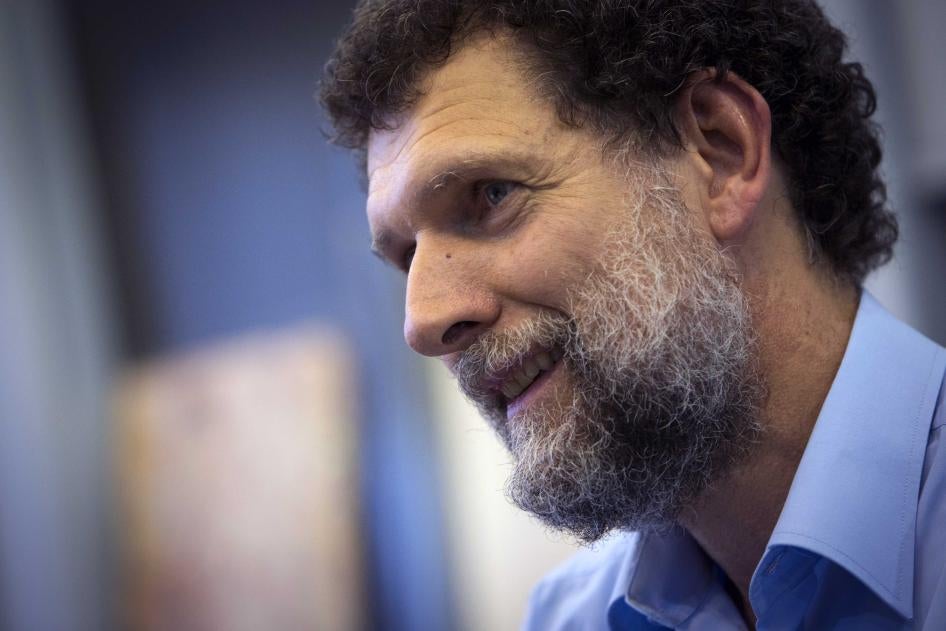
The Council of Europe Committee of Ministers voted on 2 February, 2022 to begin infringement proceedings against Turkey. Human Rights Watch called it an important step to support human rights protection in Turkey and uphold the international human rights framework. The resolution concerns Turkey’s failure over the past two years to comply with the European Court of Human Rights’ judgment in which the Court ruled that Turkey should free human rights defender Osman Kavala and fully restore his rights. See also: https://humanrightsdefenders.blog/2022/01/18/kavala-saga-continues-turkish-court-keeps-philanthropist-in-prison/
“The Committee of Ministers’ vote to pursue infringement proceedings against Turkey for its politically motivated, arbitrary detention of human rights defender Osman Kavala shows a resolve to uphold the international human rights law framework on which the Council of Europe is based,” said Aisling Reidy, senior legal adviser at Human Rights Watch. “The resolution sends a reminder to all Council of Europe member states that European Court of Human Rights judgments are binding, and it is an important acknowledgement of Turkey’s rule of law crisis.”
The Committee voted to send the case of Kavala v Turkey back to the European Court of Human Rights for a legal opinion on whether Turkey has met its obligations to comply with the judgment. If the European Court confirms – as it is expected to do – that Turkey has failed to implement its judgment, the Committee of Ministers may then take additional measures against Turkey.
These could include ultimately suspending Turkey’s voting rights in the Council of Europe and could even jeopardize Turkey’s membership. Turkey is the second country in Council of Europe history to be subjected to the sanction process for breaching member states’ obligations to implement European Court of Human Rights judgments. (first time was in 2017 against Azerbaijan in the case of Ilgar Mammadov).
The Kavala judgment is legally binding, yet the Turkish authorities have snubbed the Strasbourg court and ignored the decisions of the Committee of Ministers, which represents the Council’s 47 member states, calling for his release and the full restoration of his rights. Ankara has already reacted as expexted: it has accused the Council of Europe of “interfering in an ongoing judicial process“
The Turkish courts and prosecutors have engaged in a series of tactics to circumvent the authority of the European Court and the Council of Europe, using domestic court decisions to prolong Kavala’s detention and extend the life of baseless prosecutions. The courts have issued sham release orders, initiated multiple criminal proceedings against Kavala on the same facts, and separated and re-joined case files accusing him of bogus offenses.
In 2021, Turkey merged the proceedings against Kavala with an entirely separate and much older case against football fans and others charged with a demonstration during 2013 protests a few kilometers away from Istanbul’s Gezi Park.
Turkey’s international partners, in particular countries that supported the infringement vote, should make it clear that Turkey’s continued failure to implement the Court’s judgment and to release Osman Kavala would have consequences on their relations with Turkey. In particular, the European Union should tie its proposed “positive agenda” with Turkey to Kavala’s release and make respect for rights a prerequisite for opening talks on the Customs Union modernization that Turkey is seeking.
“Turkey knows that the European Court’s judgments are binding but has chosen to defy its obligations and the rule of law,” Reidy said. “Through the infringement proceedings and engagement from other countries, that needs to change, and Turkey should free Osman Kavala immediately and restore all of his rights.”
On 1 February last year, the military seized power over Myanmar/Burma by overturning the election results and detaining State Counsellor Aung San Suu Kyi. The military is still controlling power by force and uses brutal violence against human rights defenders, civil society groups, and journalists in order to silence all forms of protest and dissent. More than 1,500 people have been killed by the military and over 8,000 people have been arrested.
Despite the military’s brutal response, people have come together to fight the dictatorship. Nationwide protests, boycotts, strikes, and coordinated civil disobedience movements have taken place. Journalists across the country have continued their work despite severe attacks by the military.
A new report by Athan looks at how the military coup has affected journalists’ work and press freedom in the country. Throughout the country’s history, military coups have led to severe attacks on press freedom and the 2021 coup is no exception. Since the launch of the coup, 141 journalists have been arrested and 13 have been sentenced to prison. On 10 December, photojournalists Ko Soe Naing and Ko Zaw Tun were arrested while taking photos of a nationwide silent strike. Ko Soe Naing was tortured to death at the interrogation centre four days later. Just a couple of weeks after that, editor of the Federal Journal, A Sai Kay (Aka) Sai Win Aung, was shot dead by the military in Lay Kay Kaw. See also: https://humanrightsdefenders.blog/2021/05/11/three-democratic-voice-of-burma-journalists-and-two-activists-risk-refoulement-by-thailand/
According to Athan, the attacks on press freedom since the 2021 military coup have been the worst the country has seen. “Journalists and news media require continuous support to sustain local media and its journalists in order to secure journalists’ careers and their safety, and to enable an environment for journalistic professionals and the industry,” says a representative from Athan about the report.
On the one-year anniversary of the military coup in Myanmar, the High Representative on behalf of the European Union and the Foreign Ministers of Albania, Australia, Canada, New Zealand, Norway, Republic of Korea, Switzerland, the United Kingdom, and the United States, have made the following declaration:
….The European Union is deeply concerned by the continuing escalation of violence and the evolution towards a protracted conflict with regional implications. Since the military coup, the situation has continuously and gravely deteriorated. A large part of the population is now in a highly precarious situation, experiencing poverty, food shortages, displacement, and violence. ..
The European Union condemns in the strongest terms continuing grave human rights violations including torture, sexual and gender-based violence, the continued persecution of civil society, human rights defenders, and journalists, attacks on the civilian population, including ethnic and religious minorities by the Myanmar armed forces. Therefore, the EU calls for full accountability of the leaders responsible for the coup as well as of the perpetrators of violence and human rights violations. The EU also reiterates its firm demand for the immediate and unconditional release of all prisoners arbitrarily detained in relation to the coup and the return to power of democratically elected leaders.
As a matter of priority, the EU reiterates its calls for an immediate cessation of all hostilities, and an end to the disproportionate use of force and the state of emergency. The military authorities must ensure rapid, safe, and unhindered humanitarian access to all displaced persons and people in need, in all parts of the country. The European Union will continue to provide humanitarian assistance, in accordance with the principles of humanity, neutrality, impartiality, and independence and reiterates its call for the full and immediate respect of international humanitarian law…
In view of the escalating violence in Myanmar, increased international action is required in line with the already existing EU arms embargo on Myanmar. Since the military coup on 1 February 2021, the EU has imposed targeted sanctions on the Myanmar military, its leaders, and entities. In the absence of any swift progress of the situation in Myanmar, the EU stands ready to adopt further restrictive measures against those responsible for undermining democracy and the serious human rights violations in Myanmar.
“It is a failed coup,” said Yanghee Lee, co-founder of the Special Advisory Group on Myanmar and former UN special rapporteur for human rights in the country in a CNN report of 1 February. “The coup has not succeeded in the past year. And that is why they are taking even more drastic measures to finish out the coup.” He reported on problems for human rights defenders already in 2015, see: https://humanrightsdefenders.blog/2015/03/19/myanmar-backsliding-by-prosecuting-human-rights-defenders-instead-of-perpetrators/
Mexican journalist Lourdes Maldonado dedicated her last program to a fellow journalist one day after he was gunned down outside his home, and then she described her own vulnerability covering the violent border city of Tijuana. She blasted Mexico’s corruption and accused a state official of drug ties before telling her viewers she had been under state government protection for eight months. “They take good care of you,” she said on her internet radio and television show called “Brebaje” or “Potion.” “But no one can avoid—not even under police supervision—getting killed outside your house in a cowardly manner.”
Her words eerily predicted her fate. Five days later, Maldonado was shot outside her home at 7 p.m. in the evening. She was the third journalist this year to be killed in Mexico. Their deaths over the span of a month is an unusually high toll in such a short period even in Mexico and drew the largest protest yet over the killings with thousands demonstrating nationwide on Tuesday. The murders have left journalists working in the most dangerous place for their trade in the Western Hemisphere — feeling angry and hopeless. See also: https://humanrightsdefenders.blog/2020/08/24/killing-of-journalists-in-mexico-juan-carlos-morrugares-the-latest-victim/
And just now arrives the news that a fourth journalist has been killed:
Roberto Toledo, a journalist with an online news outlet was preparing to record a video interview Monday when he was shot by assailants, becoming the fourth journalist killed in less than a month in Mexico, the outlet’s director said. Roberto Toledo had just arrived at the law offices of the deputy director of the outlet, Monitor Michoacan, when three armed men shot him, said Monitor director Armando Linares, who had also planned to be there. See: https://www.sandiegouniontribune.com/news/nation-world/story/2022-01-31/another-journalist-slain-in-mexico-the-4th-this-month
On Friday, a day after Maldonado’s funeral, President Andrés Manuel López Obrador returned to criticizing the press. He said that his government guarantees free speech but “very few journalists, women and men, are fulfilling their noble duty to inform. Most are looking to see how we fail.”
“[T]he discrediting by the president is seen by others as permission to attack,” media advocate Leopoldo Maldonado (no relation to Lourdes Maldonado) says. Leopoldo Maldonado’s anger is shared by many in Mexico, as frustration and grief over their ever-growing number of dead peers pushes journalists to call for change. And despite promises by politicians like A.M.L.O., the government can do much more than conduct a simple investigation, because the inaction of the Mexican government is at the heart of the issue. Journalist violence isn’t solely the result of powerful cartels. Rather, journalist violence in Mexico is symptom of poor government policy, which creates dangerous social conditions, fails to hold perpetrators of violence accountable or build systems that protect journalists, and both directly and indirectly creates policies that hinder journalists.
On top of this on 28 January 2022 Mexican anti-femicide activist Ana Luisa Garduno Juarez was found dead by local authorities of southern Morelos state of Mexico in the early hours of Friday. Police reports said that a call was placed over gunfire inside a bar in Morelos’ Temixco city, on Thursday night. By the time authorities arrived, Garduno was found dead suffering gunshot wounds on her body. in this context, see also: https://www.amnesty.org/en/latest/news/2022/01/dignified-justice-women-human-rights-defenders-mexico/
Burkina Faso military officers responsible for the January 2022 coup should ensure the protection of human rights and a swift transition to democratic rule, Human Rights Watch said today. The authorities should give priority to the humane treatment of people in custody, respect freedoms of the media and rights defenders, and ensure that counterterrorism operations respect basic rights. ..
“The Burkina Faso military coup occurred in a country with weak democratic institutions amid a brutal armed conflict and a growing humanitarian crisis,” said Corinne Dufka, Sahel director at Human Rights Watch. “The military authorities now in control need to act urgently to protect people’s rights and ensure they don’t make a bad human rights situation even worse.”
During a January 24 news conference, the self-proclaimed Patriotic Movement for Safeguard and Restoration led by Lt. Col. Paul-Henri Sandaogo Damiba, announced the suspension of the constitution, the dissolution of the government and national assembly, and a nationwide curfew. The movement’s spokesperson said elections would be held “within a reasonable time frame” and pledged to respect Burkina Faso’s international commitments, notably including human rights.
The coup leaders claimed the coup took place “without bloodshed.” However, there is uncertainty about the safety of President Kaboré and his close associates, amid reports of potential injuries and deaths during the military takeover. The MPSR should publicly account for the whereabouts and condition of government officials in custody and allow the Office of the United Nations High Commissioner for Human Rights, the national human rights commission, and independent human rights monitors to visit Kaboré and any other detainees. All those detained should be promptly brought before a judge and charged or be released.
The coup occurred within the context of a marked deterioration in the country’s human rights and security situation over the past year as attacks and atrocities by armed Islamist groups surged and the humanitarian situation worsened. Burkina Faso was already struggling to ensure justice for hundreds of unlawful killings by all sides, and to uphold the civil and political rights of its population.
During 2021, armed Islamist groups killed at least 250 civilians and scores of security force members during attacks in several provinces. Since 2018, Human Rights Watch has documented that government security forces and pro-government militias allegedly summarily executed hundreds of suspects, mostly in the country’s northern regions. Virtually none of these attacks have resulted in investigations and prosecutions.
Burkinabé rights defender, Dr. Daouda Diallo, secretary-general of the Collective Against Impunity and Stigmatization (CISC), and laureate of the 2022 Martin Ennals Award for Human Rights Defenders, told Human Rights Watch that he hoped the military authorities would “address Burkina Faso’s deepening social divisions, and ensure crucially needed protection for all civilians at risk from conflict, while scrupulously respecting international humanitarian law.” See also: https://www.trueheroesfilms.org/thedigest/laureates/ca7f1556-8f73-4b48-b868-b93a3df9b4e1
The military authorities should also ensure respect for freedom of expression. In late 2021 and early 2022, the government shut down internet services in a move to quell protesters who had taken to the streets to demand an end to the violence and to protest rising food prices. A 2019 law criminalizing some aspects of reporting on security force operations dampened media freedom, with journalists reluctant to report on allegations of abuses by pro-government forces. Further, in 2021, the government implemented a de facto ban on visits by journalists to internally displaced camps. After taking power, the MPSR issued a warning against the communication of “false news.”..
Military takeovers in Africa in the past year occurred in Chad, Guinea, Mali, and Sudan. Coup leaders have often taken advantage of social unrest, grievances about corruption, and the failure of governments to respect basic rights, uphold constitutional obligations, and carry out promised reforms. Democratically elected governments need to look beyond elections as a marker of democratic progress, and focus on upholding human rights, strengthening the rule of law, and building credible, independent institutions, Human Rights Watch said…
“Burkina Faso’s military leadership should not allow the political upheaval created by the coup to lead to a vacuum in the protection of basic rights,” Dufka said. “The military authorities need to maintain discipline within the security forces and ensure that the human rights of all Burkinabé are respected, including their right to vote freely in elections.”
Nominations can be submitted in either in English, French or Spanish, through the dedicated forms below.
Please note: Each individual may only submit one nomination per year.
Please reach out to Submittable’s Customer Support team with any technical questions at support@submittable.com
For further information, please visit the website and for any questions directly relating to process or information required, please contact the research team by email: research@rightlivelihood.org.
On 26 January 2022 four major NGOs made a strong joint statement on India:
We, the undersigned civil society organizations, are deeply concerned about the ongoing harassment of 18 human rights defenders under the Unlawful Activities (Prevention) Act (UAPA) in reprisal for their advocacy work against the Citizenship (Amendment) Act (CAA) 2019. Thirteen of those arrested under the UAPA are currently in Rohini, Tihar, and Mandoli jails, New Delhi. We call for the immediate and unconditional release of all the human rights defenders arrested, and the dismissal of all charges against them.
The CAA has been widely criticized by activists, human rights defenders, civil society organizations, students and the international community for being openly sectarian and discriminatory against Muslims. After the CAA’s adoption, protesters across the country took the street to voice their concerns against the legislation, which goes against India’s Constitutional principles of secularism and equality. Police authorities responded by arresting human rights defenders and activists who spoke up against the CAA. Most of them were student activists and human rights defenders from the minority Muslim community.
The arrests of human rights defenders began in February 2020 and are still ongoing. Many of them had multiple First Information Reports (FIR) registered against them and were charged with serious offenses, including under UAPA. Of those arrested, only five human rights defenders – Natasha Narwal, Devangana Kalita, Safoora Zargar, Asif Iqbal Tanha, and Md. Faizan Khan – were released on bail. Thirteen others – Sharjeel Imam, Umar Khalid, Khalid Saifi, Tahir Hussain, Saleem Malik, Mohd. Saleem Khan, Meeran Haider, Shadab Ahmed, Tasleem Ahmed, Shifa Ur Rehman, Athar Khan, and women human rights defenders Ishrat Jahan and Gulfisha Fatima– remain in jail. Despite prolonged incarceration, the trial for their case has not commenced yet.
On 24 January 2022, a Delhi court framed charges against human rights defender Sharjeel Imam while rejecting his application for bail. The charges include Sections 124A (“sedition”), 153A (“promoting enmity between different groups on grounds of religion), 153B (“imputations, assertions prejudicial to national integration”), 505 (“statements conducing to public mischief”), along with Section 13 (“punishment for unlawful activities”) of the UAPA.
Khalid Saifi, Ishrat Jahan, and Gulfisha Fatima have reported custodial violence and torture by the Delhi police. There has been no effective investigations into these allegations or responsibility taken for their treatment. Shifa Ur Rehman, who has been in detention since 26 April 2020, suffers from severe kidney disease and has been denied access to adequate medical care in prison.
We express our deep concern over the harassment and arbitrary detention of human rights defenders that appear to be in retaliation to their peaceful activism and the legitimate expression of dissent against a discriminatory law. Despite the risks, human rights defenders have raised their voice for those oppressed by the CAA and in support of the Constitutional values that represent India.
We call on the Indian authorities to protect those defending human rights values and principles enshrined in national laws and to uphold international human rights commitments. We stand in solidarity with those who cannot speak out due to their incarceration, threats by Indian authorities, or due to a prevailing sense of fear. The treatment of these human rights defenders highlights a pattern of perpetrated abuse and violence, which is also exerted through legal mechanisms. This is especially concerning given India’s membership in the United Nations Human Rights Council and its pledge to preserve and protect human rights.
We urge the relevant authorities in India to:
1. Immediately and unconditionally release all human rights defenders arrested for protesting against the CAA, dismiss all charges, and cease all forms of harassment against them. 2. Guarantee under all circumstances that the arrested human rights defenders are not subjected to any form of torture and other ill-treatment while in police custody, and guarantee their access to adequate medical care and treatment. 3. Initiate a thorough judicial review of the Unlawful Activities (Prevention) Act and the Citizenship (Amendment) Act in genuine consultation with independent civil society organizations and human rights defenders, with a view to aligning these laws with India’s obligations under international human rights law. 4. Guarantee in all circumstances that all human rights defenders in India are able to carry out their legitimate human rights activities without fear of reprisals, and free of all restrictions—including police and judicial harassment.
Please inform us of any actions that may be taken with regard to the above case.
-FIDH · Civicus: · Front Line Defenders · World Organisation Against Torture (OMCT)
Their key point is worth noting: The problem for human rights defenders in the Gulf region and neighbouring countries is that states have exploited the opportunity to align their cybercrime laws with European standards to double-down on laws restricting legitimate online expression BUT without any of the judicial safeguards that exist in that region.
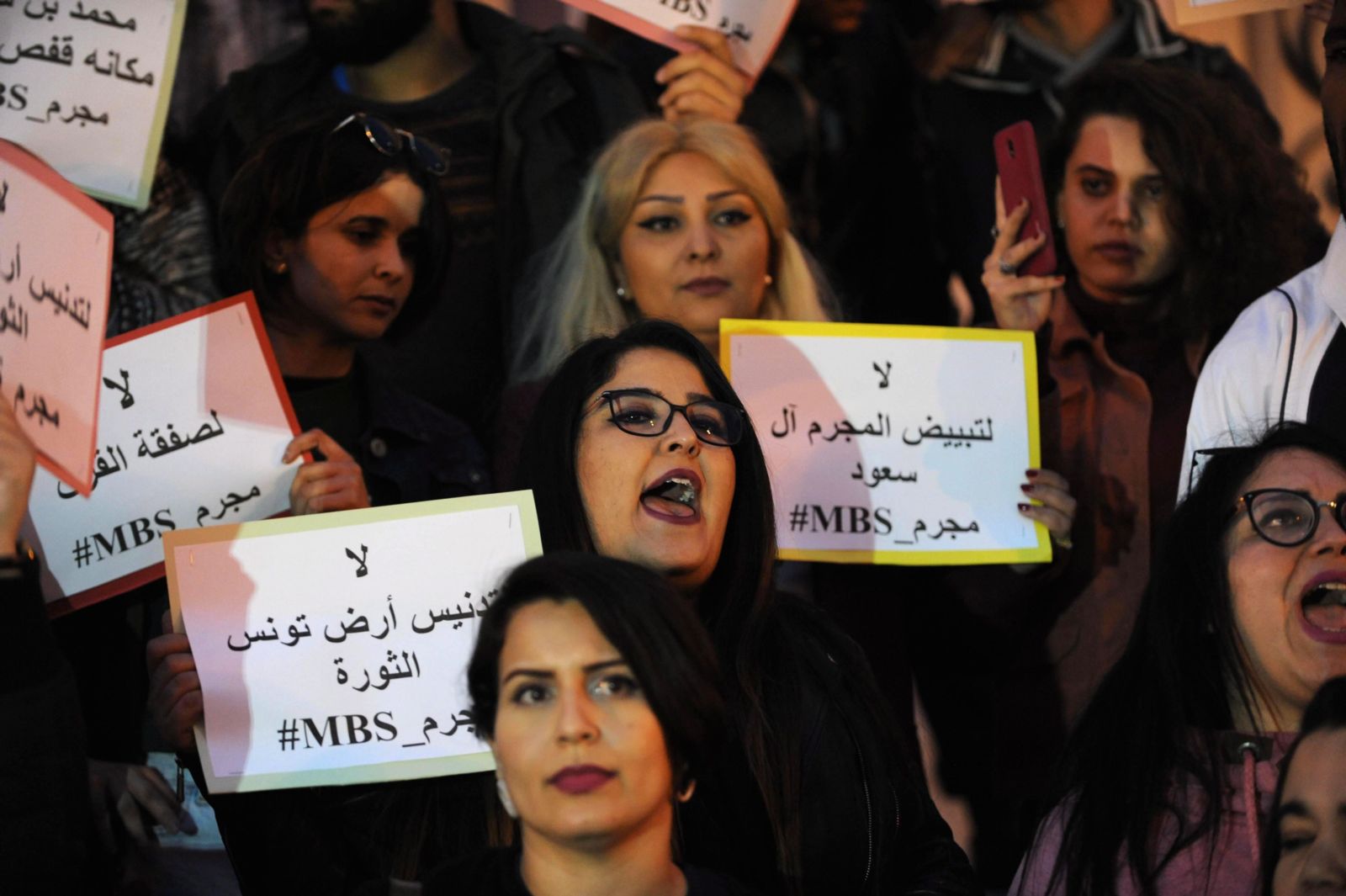
Several women take part in a protest, using a hashtag, against Saudi Crown Prince Mohamed bin Salman’s visit to the country in Tunis, Tunisia, in November 2018. EFE / Stringer
Governments in every region of the world are criminalizing human rights activism. They do it by prosecuting protest organizers, journalists, internet activists, and leaders of civil society organizations under laws that make it a crime to insult public figures, disseminate information that damages “public order,” “national security,” and “fake news.”
In the Gulf region and neighbouring countries, oppressive governments have further weaponized their legal arsenal by adopting anti-cybercrime laws that apply these overly broad and ill-defined offline restrictions to online communications.
In an age when online communications are ubiquitous, and in societies where free press is crippled, laws that criminalize the promotion of human rights on social media networks and other online platforms undermine the ability to publicize and discuss human rights violations and threaten the foundation of any human rights movement.
In May of 2018, for example, the Saudi government carried out mass arrests of women advocating online for women’s right to drive. Charged under the country’s cybercrime law including article six which prohibits online communication “impinging on public order, religious values, public morals, and privacy,” these human rights activists were detained, tortured, and received multi-year sentences for the “crime” of promoting women’s rights.
There is certainly a necessity to address the prevalence and impact of cybercrimes but without criminalizing people who speak out for human rights.
European countries and the United Nations (UN) have encouraged states to adopt a standard approach to addressing crimes committed with online technologies ranging from wire fraud to financing terrorist groups. The Council of Europe issued a 2001 regional convention on cybercrime, to which any state may accede, and the UN is promoting a cybercrime treaty.
Common standards can prevent the abuse of online technologies by enabling the sharing of online evidence and promoting accountability since the evidence of online crimes often resides on servers outside the country where the harm occurred or where the wrongdoers reside.
The problem for human rights defenders in the Gulf region and neighbouring countries is that states have exploited the opportunity to align their cybercrime laws with European standards to double-down on laws restricting legitimate online expression.
European countries have robust human rights oversight from the European Court of Human Rights, which ensures that limitations on freedom of expression online meet stringent international standards. There is no comparable human rights oversight for the Gulf region. Without adequate international judicial review, governments can successfully exploit international processes to strengthen their ability to stifle online expression.
The regional model cybercrime law drafted by the United Arab Emirates and adopted by the Arab League in 2004, follows international guidance. However, it incorporates a regional twist and includes provisions that criminalize online dissemination of content that is “contrary to the public order and morals,” facilitates assistance to terrorist groups, along with disclosure of confidential government information related to national security or the economy.
UN experts reviewed the UAE law and gave it a seal of approval, noting it complied with the European convention, ignoring the fact that UN human rights experts have documented repeatedly that governments use such restrictions to crack down on dissent. A UN-sponsored global cybercrime study, published in 2013, similarly soft-pedaled the threat of criminalizing online dissent by noting that governments had leeway to protect local values. Such protection does not extend to speaking up for universal rights like equality and democracy.
Actually, the universal right to freedom of expression protects online content, and limitations must meet international standards of legality, legitimacy, necessity, and proportionality. In our recent report on the use of anti-cybercrime legislation throughout the Gulf region and neighbouring countries, we found that over an 18-month period (May 2018-October 2020), there were 225 credible incidents of online freedom of expression violations against activists and journalist in ten countries: Bahrain, Iran, Iraq, Jordan, Kuwait, Oman, Qatar, Saudi Arabia, Syria, and the UAE. Each country has adopted anti-cybercrime laws except Iraq, where lawmakers’ drafts of proposed legislation have been met with stiff opposition from domestic and international human rights groups.
The international community needs to increase pressure on the Gulf region and neighboring countries to comply with their international obligations to protect freedom of expression off and online. Turning away from the clear evidence that oppressive governments are expanding the reach of criminal law to stifle online human rights activism undermines legitimate international efforts to address cybercrime.
How can we trust the UN to safeguard the voices advocating online for human rights and democracy in a region that so desperately needs both, if it fails to insist human rights safeguards be written into the regional and national cybercrime laws it champions?
In the age of the internet, online human rights activism needs to be supported—and protected—as a vital part of the cybercommunications ecosystem. In the Gulf region, defenders of human rights pay an untenable price for their work, risking arrest, torture, and even death. It is time to reverse the trend while there are still defenders left.
One of the women human rights defenders in Saudi Arabia said before she was imprisoned, “If the repressive authorities here put behind bars every peaceful voice calling for respect for public freedoms and the achievement of social justice in the Gulf region and neighboring countries, only terrorists will remain out.” History has proven the truth of her words, as most of the individuals who led terrorist groups with a global reach have come from this region and have caused, and still cause, chronic problems for the whole world.
The important lesson that we must learn here is that repressive governments foster a destructive dynamic of expansion and intensification of human rights violations. Repressive governments cooperate with and look to one another for strategies and tactics. Further troubling is that what we see in the Gulf region is enabled by the essentially unconditional support provided by some Western governments, especially the US and UK. This toxic template of Western support to governments that oppress their own people constitutes a threat to world peace and prosperity and must be addressed.
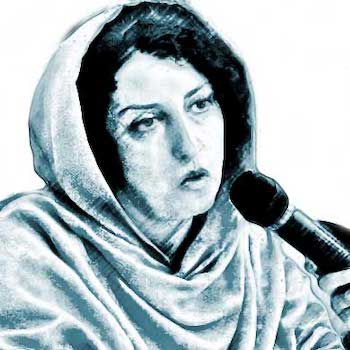
Mohammadi’s new conviction was after a 5-minute trial, her husband Taghi Rahmani wrote. He stated she also had a two–year ban on “communication,” but that she has not contacted the family and he did not know the details of the trial or the new sentence.
The prominent activist’s latest conviction comes as the authorities intensify their efforts to squash growing dissent in Iran by imprisoning activists and human rights attorneys after grossly unfair trials, shooting to kill protesters in the street, imposing death sentences on dissidents and protesters, and causing the death of political prisoners by egregiously neglecting their medical needs. See e.g. https://humanrightsdefenders.blog/2020/06/24/list-of-lawyers-imprisoned-in-iran-for-defending-human-rights/
“One by one, the Iranian authorities are trying to silence the voices of dissent in Iran, through imprisonment, torture, and even death,” said Hadi Ghaemi, executive director of the Center for Human Rights in Iran (CHRI). “The Iranian government fears these brave individuals because they speak truth to power and their voices carry great authority in Iranian society,”
Outrage at the government’s actions—not only the unjust imprisonments but also the treatment of political prisoners—is growing both inside and outside Iran’s prisons.
In solidarity with the hunger strikers, Shakila Monfared began a hunger strike in Gharchak Prison for women on January 17; Sina Beheshti joined the hunger strike on January 17 in the Greater Tehran Central Penitentiary; and Mohammad Abdolhassani joined the hunger strike on January 17 in the Greater Tehran Central Penitentiary.
Meanwhile, British-Iranian dual national Anoosheh Ashoori, who is being held in Iran on unsubstantiated spying charges, began a hunger strike in Evin Prison on January 23, to bring “global attention to the plight” of those unfairly held by Iran.
Outside Iran, In Vienna, journalist Jamshid Barzegar, began a hunger strike on January 18 in solidarity with hunger strikers in Iran, in front of the hotel where the nuclear talks are being held in Vienna. He has been joined by more than a dozen Iranian activists abroad. Former American hostage Barry Rosen was on hunger strike from January 16-24 in Vienna “to demand the release of all hostages being held by Iran.” Nizar Zakka, a Lebanese former hostage in Iran, joined the hunger strikers in Vienna on January 21.
These names are only part of a larger, rapidly growing group. A list from January 24 was published on Twitter that included names of more than 40 activists hunger-striking outside prison to demonstrate solidarity with the hunger strikers and protest the government’s actions.
Iran’s Foreign Ministry Spokesman Saeed Khatibzadeh, responding to a question on hunger strikers in Vienna at January 24 press conference in Tehran, said: “These matters are not very important. What’s important is to reach a reliable and stable agreement that satisfies Iran’s interests.”
Mohammadi has proved to be a particular thorn in the authorities’ side, refusing to be silent either in prison or during her brief periods of release between convictions. She had already been serving a 30-month sentence at Gharchak Prison after she organized a sit-in at Evin Prison’s Women’s Ward to condemn the killing of hundreds of protesters by state security forces during the November 2019 protests, and the unjust execution of wrestler Navid Afkari.
“Narges Mohammadi is only one of many individuals behind bars in Iran because of their peaceful dissent and the willingness of a judiciary to do the bidding of a brutal and unlawful security state,” Ghaemi added.


 Hans Thoolen on Human Rights Defenders and their awards