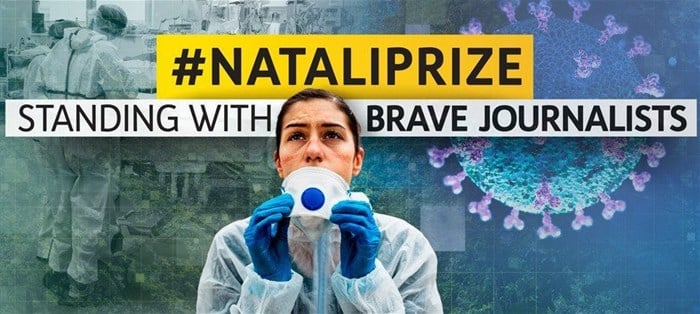
The Lorenzo Natali Media Prize has announced that it is open for applications. The European Union’s journalism award is celebrating its 30th anniversary, and awards journalists reporting on themes such as inequality, poverty, climate, education, migration, employment, digital, healthcare, peace, democracy, and human rights.
Commissioner for International Partnerships, Jutta Urpilainen, said, “The Lorenzo Natali Media Prize celebrates its 30th anniversary. Democratic backsliding that we have witnessed during the pandemic, hybrid threats, disinformation and shrinking space for civil society are all worrying phenomena, which brave journalists tackle. As showcased at the Summit for Democracy in December, the EU is a firm supporter of fundamental freedoms and those who defend them, often with high personal risk. The Lorenzo Natali Media Prize is a symbol of our support to those who give voice to the voiceless and bring truth to light.”:
The submission should be made online in one of the five accepted languages (English, French, Spanish, Portuguese, or German). Applications can be submitted from today until 31 March 2022. Submissions can be entered online here.
A Grand Jury of international renowned journalists and specialists in international development from around the world will choose the winners in each category. Each winner will receive €10,000. The winner of the Best Emerging Journalist category will also be offered work experience with a media partner. The winners will be announced at the Lorenzo Natali Media Prize Award Ceremony during the 2022 European Development Days between 14 – 15 June 2022.
The “Don’t be afraid” film directed by Mikhail Arshynski has won the “Best Documentary on Human Rights” nomination at the Best Film Awards in London.
The film shows the struggle of the Belarusian people for fair elections the fate of people who responded to the call of blogger Syarhei Tsikhanouski and took part in the 2020 presidential campaign. Events are shown through the lenses of Arshynski, who witnessed an unthinkable political confrontation. With a camera in hand, he followed each stage of the campaign. He filmed how the authorities prevented the collection of signatures and their transfer to the election commissions how the headquarters of alternative candidates united. Mikhail traveled with them to the regions of Belarus.
The film won also the top prize at the South Korean “Hinzpeter Awards” film festival.
That things are getting worse is also shown by the report that on 25 January, officers of the Financial Investigation Department of the State Control Committee of Belarus searched the apartment of the director of Mahiliou Human Rights Center, Valery Krauchanka. After the search, the law enforcers took his son’s toy gun and 10-year-old leaflets of the Belarusian Helsinki Committee. On January 26, another search was conducted in Krauchanka’s home, as a result of which a laptop was seized.
The Mahiliou Human Rights Center has been actively engaged in human rights activities in the Mahiliou region for more than 20 years. For this, they had repeatedly come under the scrutiny of local authorities, who are dissatisfied with the criticism coming from human rights defenders.
The hearing about the “Mahiliou Human Rights Center” liquidation will be held on February 17 at 14.30, reports the Human Rights Center “Viasna.”
ISHR, the Martin Ennals Foundation and eight other major human rights groups urge in a joint statement the Chinese government to ensure lawyer Yu Wensheng is able to leave Nanjing Prison on March 1st, and freely reunite with his family in Beijing.
The signatory organisations also called in the joint statement for sustained attention on the growing risks and threats his wife, Xu Yan, faces for advocating for his rights and release.
For this, the authorities revoked his legal license on 16 January, 2018. Three days later, he was forcibly disappeared, a day after publishing an open letter calling for constitutional reform. He was put on trial in secret on 9 May 2019, but his wife, Xu Yan, was only informed of his four-years jail sentence in June 2020.
The signatories of the joint statement express grave concern that Yu Wensheng may be put under a de facto home arrest, severely restricted in his movements and communication, and unable to reunite with his family in Beijing.
Human rights lawyers have endured such restrictions upon leaving prison on grounds of a supplemental sentence of ‘deprivation of political rights’, in a phenomenon known as ‘non-release release’. In September 2019, UN experts condemned the use of this practice against lawyer Jiang Tianyong as ‘gratuitously punitive and legally unjustified’.
IThe signatory organisations urge the Chinese authorities to:
Ensure that Yu Wensheng is able to reunite with his family in Beijing on 1 March, to exercise his rights to move and communicate freely, and that he is not subjected to surveillance and harassment. He must also be able to resume his legal work without restrictions;
Put an end to the surveillance and harassment of Yu Wensheng’s family;
Guarantee in all circumstances that all lawyers in China, including human rights lawyers, are able to carry out their legitimate professional duties without fear of reprisals and free of restrictions.
On 14 February 2022 FIDH published a joint statement to support Sri Lankan human rights defender Ambika Satkunanathan:
We the undersigned human rights organizations, express our deep concern about the statement issued by the Sri Lankan Foreign Ministry on February 4, 2022, in which the government denounced testimony given by Ambika Satkunanathan, a leading human rights lawyer, to the European Parliament on January 27. The government statement clearly constitutes an act of harassment and intimidation. We condemn the Sri Lankan government’s tactics to intimidate human rights defenders, and express our full solidarity with Ms. Satkunanathan, a well-known, respected and courageous human rights defender. Targeting her for providing accurate testimony about the human rights situation in Sri Lanka to the European Parliament is completely unacceptable, and sends a chilling message to all Sri Lankan civil society, especially those in the north and east, who are already operating under considerable duress under the current administration.
Sri Lanka’s international partners, including the European Union, should publicly condemn the Sri Lankan government’s statement and express solidarity with Ms. Satkunanathan, who has been targeted for her international engagement, and increase their efforts to engage with Sri Lankan civil society at large.
The Foreign Ministry’s statement contains numerous false claims in an attempt to disparage and delegitimize a distinguished human rights advocate, placing her at risk of physical danger in retribution for her brave work. The government’s claim that her testimony was “reminiscent of LTTE [Liberation Tigers of Tamil Eelam] propaganda that once stoked hatred among communities,” and that “such allegations need to be refuted in the interest of social harmony” Is particularly insidious and dangerous.
The government’s statement mirrors its repeated practice of falsely equating human rights defenders and human rights advocacy with those pursuing “terrorism.” The statement’s language aligns these baseless allegations with vague and frequently abused provisions under the Prevention of Terrorism Act (PTA), exposing Ms. Satkunanathan to a heightened risk of threats, attacks and persecution.
Ms. Satkunanathan was a commissioner of the National Human Rights Commission of Sri Lanka before that body’s independence was compromised under the current administration and led the first national study on Sri Lanka’s prisons. Prior to that, she was for many years a legal consultant to the Office of the United Nations High Commissioner for Human Rights. She is the author of an important recent report on abuses committed during the so-called “war on drugs.”
We are concerned that the government’s statement seeks to place the blame on human rights defenders if the European Union determines that Sri Lanka failed to meet its human rights commitments under GSP+, the preferential tariff system. The European Union should remind the Sri Lankan government that the responsibility to uphold its international human rights obligations rests with the government. The government’s treatment of human rights defenders reflects its lack of respect for international human rights law.
We support Ms. Satkunanathan’s testimony to the European Parliament, which accurately described a situation already reported by the United Nations and many domestic and international human rights organizations. The government’s response contains numerous false statements, including:
The government claims to be “engaged in long standing cooperation with the UN human rights mechanisms and the UN Human Rights Council.” On the contrary, in February 2020, soon after taking office, the government of President Gotabaya Rajapaksa withdrew Sri Lankan support from consensus resolutions of the council, repudiating commitments made by the previous government. Special Procedures mandate holders of the Council issued a statement on February 5, 2021, noting that their recommendations, including on torture, the independence of the judiciary, arbitrary detention, enforced disappearances, minority rights, counterterrorism, freedom of religion or belief, and freedom of assembly and association, had been ignored.
The government claims to be “strengthen[ing] rule of law, access to justice and accountability.” However, President Rajapaksa campaigned on a platform of protecting “war heroes” from prosecution, and has appointed individuals implicated in war crimes to senior government posts. His presidential commission on “political victimization” has sought to interfere in judicial proceedings and block trials and investigations in human rights cases implicating the president’s associates and the president himself. The president pardoned Sunil Ratnayake, one of very few members of the armed forces ever convicted of human rights violations, who murdered eight Tamil civilians including children.
The government denies that civic space is shrinking, as Ms. Satkunanathan described in her testimony. Yet under the current government, many human rights defenders have said that they are subjected to continual government intimidation, intrusive surveillance, and attempts to block their access to funds. In her most recent update to the Human Rights Council, High Commissioner Michelle Bachelet wrote that, “surveillance, intimidation and judicial harassment of human rights defenders, journalists and families of the disappeared has not only continued, but has broadened to a wider spectrum of students, academics, medical professionals and religious leaders critical of government policies.” The UN Special Rapporteur on contemporary forms of slavery in his end-of-mission statement last December documented government intimidation of civil society and a “shrinking civic space.”
The government claims there is no “concrete evidence of discrimination against minorities.” In fact, for nearly a year the government banned the burial of people said to have died with Covid-19, causing immense distress to the Muslim community without any medical justification in what is only but one example of discrimination against ethnic and religious minorities. Such burials are now permitted only at a single remote site. In January 2021 High Commissioner Bachelet found that, “Tamil and Muslim minorities are being increasingly marginalized and excluded in statements about the national vision and Government policy… Sri Lanka’s Muslim community is increasingly scapegoated.” The High Commissioner’s findings are in line with reports by Amnesty International, Human Rights Watch, and others that the Prevention of Terrorism Act is used almost exclusively against members of the Tamil and Muslim communities. The government continues to deny efforts to commemorate war victims belonging to the Tamil community.
The government denies Ms. Satkunanathan’s description of alleged extrajudicial killings committed in the context of Sri Lanka’s “war on drugs.” However, these abuses are widely documented. In September, High Commissioner Bachelet said, “I am deeply concerned about further deaths in police custody, and in the context of police encounters with alleged drug criminal gangs, as well as continuing reports of torture and ill-treatment by law enforcement officials.”
The Sri Lankan government’s statement attacking Ambika Satkunanathan for her testimony to the European Parliament’s Sub-Committee on Human Rights exemplifies threats faced by human rights defenders, particularly when they engage with foreign and international forums, and it further shows the government’s refusal to address the ongoing serious human rights violations taking place in the country. Instead of trying to silence those who seek to defend human rights, the government should give serious consideration to their input and contributions, and take urgent action to ensure that they can work in a safe environment without fear of reprisals.
The Geneva Human Rights Film Festival of 2020 (FIFDH – The Festival) dedicates its 20th edition to human rights defenders Pham Doan Trang and Ida Leblanc
Journalist and blogger Pham Doan Trang has been in detention since October 2020 and was recently sentenced to 9 years in prison for “propaganda against the state”. The 43-year-old was accused by the Hanoi regime of “defaming the Vietnamese government and inventing fake news“. In one of the world’s most repressive countries towards civil society, where freedom of the press is non-existent, Pham Doan Trang – RSF 2019 Prize – has founded numerous independent media and publishing houses – including Nha Xuat Ban Tu Do or Law Magazine – and the NGO Green Trees, making her the target of a government that does not tolerate dissent. Despite intimidation, torture and repeated arrests, Pham Doan Trang is fighting to end systematic abuse of both human rights and freedom of the press in Vietnam. She won several awards including recently the Martin Ennals Award 2022. See: https://www.trueheroesfilms.org/thedigest/laureates/fe8bf320-1d78-11e8-aacf-35c4dd34b7ba
Trinidad and Tobago is home to more than 10,000 domestic workers, most of them without any social protection. Ida Leblanc fights daily for them to obtain rights similar to those of all workers, notably as General Secretary of the National Union of Domestic Employees (NUDE), which she founded. In 2011, the International Labour Organisation adopted the Convention on Domestic Workers thanks to Ida Leblanc’s active campaigning. Though the government of Trinidad and Tobago has never implemented the Convention, tireless Ida Leblanc remains undeterred.
She successfully campaigned for the decriminalisation of the Minimum Wage Act, giving unions the right to hear cases of non-compliance with the Act in the Labour Court. She has spearheaded many victories on behalf of low-income workers in cases of unfair dismissal, lay-offs and breaches of the Maternity Protection and Minimum Wage Acts.
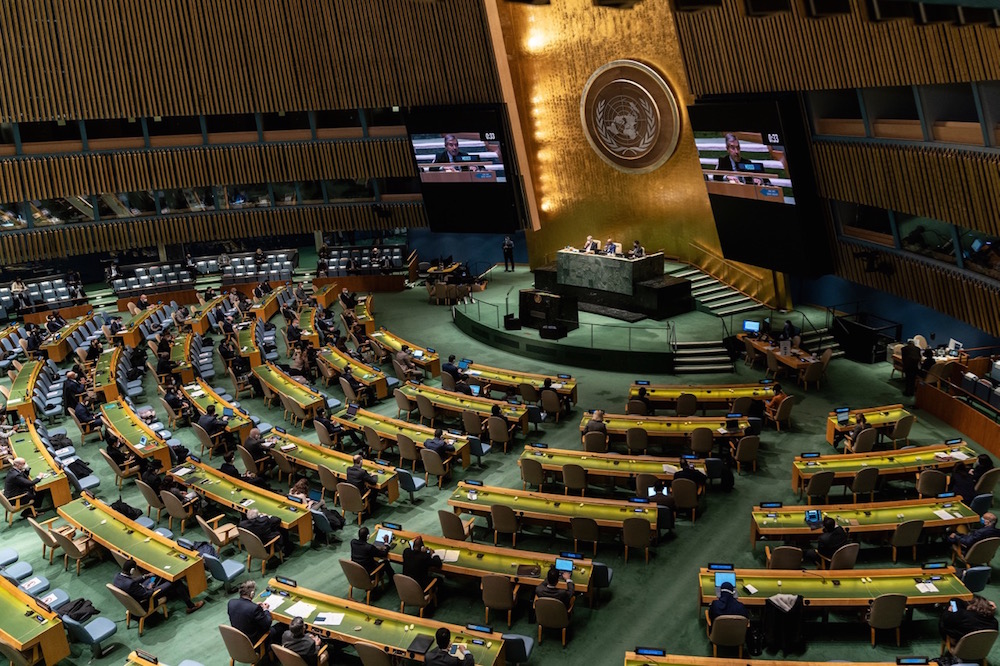
A plenary meeting at the 76th Session of the General Assembly, at the UN Headquarters, in New York, USA, 21 January 2022, Lev Radin/Pacific Press/LightRocket via Getty Images
NGOs that seek to participate fully at the UN – making statements and organising events to highlight injustice and provide recommendations – have to get accredited. The “Committee on NGOs” manages the process – as the gateway for NGOs into the United Nations. If you’re a State with a mind to block NGOs, membership of the Committee is perfect. This is where you can sit and control who comes in. By asking questions of NGO applicants, members of the Committee can push their accreditation for many years. For more on this see: https://humanrightsdefenders.blog/2018/02/09/the-saga-of-the-anti-ngo-committee-in-the-un-continues/
Currently there are 70 organisations that have faced over four years of deferrals. Two human rights organisations have been deferred for over ten years. Some NGOs have also been accused by Committee members of having terrorist sympathies: baseless accusations against which the NGOs have been denied appeal.
In four short months there’s a chance to change things. Elections to the Committee on NGOs will be held in April 2022. The 54 members of the UN’s Economic and Social Council (ECOSOC) vote to fill the 19 seats on the Committee across all regional groups.
A joint letter by a massive number of NGOs of 10 February 2022 makes the point:
To: Member States of the UN General Assembly
Excellencies:
We are five months out from elections to the ECOSOC Committee on Non-Governmental Organisations for the 2023-2026 term. These are key elections for all those who value the expertise of civil society and seek to ensure the UN can benefit from it.
The Secretary General has called civil society the UN’s ‘indispensable partners”. Member States recently committed to boosting partnerships ‘to ensure an effective response to our common challenges’. In recommending approval of the participation of non-governmental organisations in a range of UN bodies and processes, the Committee on NGOs plays a key role in facilitating such partnerships. It is essential that the members of the Committee are committed to fulfilling such a task fairly and judiciously.
With this in mind, we would like to request the following, that:
1/ States with an interest in facilitating and safeguarding civil society access to and participation in UN processes stand for election to the Committee.
2/ Candidates make public the reasons for their candidacy and their commitment to fulfil their responsibilities as members of the Committee, as per ECOSOC Resolution 1996/31.
3/ All regions put up competitive slates, as the Asia-Pacific and GRULAC regions did in the last elections for the Committee in 2018. Competitive elections are important to create buy-in to the process and encourage states to be accountable for their commitments.
4/ All regions make public candidacies at least two months before the elections to allow for proper consideration of candidates.
5/ All ECOSOC members vote (and be encouraged to vote) only for candidates with positive track records in regard to civil society access and participation. Candidates could be assessed in regard to indicators such as support for relevant UN resolutions, such as those on civil society space and human rights defenders; on responses to cases of intimidation and reprisals; and on national level initiatives to safeguard civic space, press freedom – online as offline – and the right to defend human rights.
6/ ECOSOC members should consider introducing term limits for membership of the Committee on NGOs, among other reforms encouraging openness and accountability. As with other UN bodies, states should be required to leave the Committee for a specific interval of time after serving for a maximum agreed period. Term limits would encourage greater diversity in membership over time and encourage states to step up as candidates.
The Committee on NGOs is entrusted with the task of facilitating civil society access so that the expertise and experience of civil society partners can enrich and inform UN debates. It needs members that are committed to fulfilling the Committee’s mandate in a fair, transparent, non-discriminatory, expeditious and apolitical manner. It falls on all member states – as potential candidates and / or electors – to ensure that the Committee membership is fit for purpose.
Please elect to stand up for civil society!
Yours sincerely,
In addition to the letter, individuals can undertake additional steps. You can engage with States on all the campaign objectives!
On competitive elections and voting with integrity: See here for a model email for sending to those who get to vote, ECOSOC members. Check here whether your State is going to vote.
On candidates: Does your state have a positive record on promoting civil society but isn’t running? See here for a model email to encourage them.
Devon Kearney in NPQ of 8 February 2022, reports on a worrying legislative development in El Salvador….
It has been nearly a decade since the Russian government passed its “foreign agent law,” a measure that requires nonprofit groups that engage in political activity to register with the government if they receive money from overseas. Russia justified the bill by saying it was based on a U.S. law—a statute from the lead-up to World War II that many of us came to know only after Donald Trump’s campaign manager, Paul Manafort, was accused of being an unregistered foreign agent. Putin’s message was that this was just an ordinary, even boring regulatory measure.
The sinister brilliance of the foreign agent law is twofold. First, it targets human rights NGOs’ supply lines, as it were, making it difficult to accept the funds they need to survive. In much of the world, human rights defenders rely on support from global philanthropies like the Open Society Foundations for the funding they need to operate. By the standards of Russia’s law, most would be required to register as foreign agents. Groups that take foreign money would be subject to government meddling and harassment; those that opted to do without would struggle to keep their doors open.
Second, the law accomplishes this by co-opting legitimate regulatory functions of the state to crush dissent. Setting the rules for nonprofits—along with corporations, lobbyists, and a wide range of activities that impact the public good—is something governments are supposed to do. The great innovation of Putin and the autocrats that followed him was to turn regulatory schemes into instruments of their own political dominance. By obviating the need for violence against opponents, these methods may avoid the consequences of harsher exercises of state power. They are key to creating, in the words of Hungarian semi-dictator Viktor Orbán, an “illiberal democracy,” a state where elections continue but the rights and liberties of the people are curtailed.
Under 38-year-old President Nayib Bukele, a charismatic young politician, El Salvador has taken a sharp turn toward authoritarianism. Bukele made headlines in February 2020 when he brought armed soldiers into Congress to stand behind him as he demanded funding for the military. He has since fired prosecutors and judges in order to pack the legal system with loyalists. Bukele is the latest in a growing number of modernized dictators who adopt the tactics but not the swagger of their forebears. But his style is distinctive. In the Journal of Democracy, Salvadoran political scholar Manuel Meléndez-Sánchez writes: “Bukele relies on millennial authoritarianism, a distinctive political strategy that combines traditional populist appeals, classic authoritarian behavior, and a youthful and modern personal brand built primarily via social media.”
Bukele’s authoritarian moves have raised alarms among Salvadoran civil society and around the world. The US has expressed its concern by hitting the government in the pocketbook: in May 2021, the United States Agency for International Development announced that it would pull funding from the Salvadoran police and other national agencies, instead directing the funds to civil society groups carrying out local development projects. More recently, USAID Administrator Samantha Power said the agency would commit $300 million for direct civil society funding in Central America, and promised to increase the amount of funding bypassing national governments to 50 percent within 10 years.
All of this is in keeping with Power’s stated intention to provide aid to developing nations with a local, “bottom up” approach that prioritizes small businesses over big international contractors, and local civil society groups over national governments—“[t]o engage authentically with local partners and to move toward a more locally led development approach,” as she told the Senate Foreign Relations Committee in July 2021.
But in a region where US interference has long rankled rulers and their people, the move may be seen as ham-fisted—taking aid money to support opponents of a duly-elected government brings to mind the ways in which our country funded proxy wars that killed hundreds of thousands of Salvadorans and left a bloody trail in Nicaragua and Guatemala, as well. More recently, in 2019 the Trump Administration slashed hundreds of millions of dollars in aid to the region in the hopes that by increasing financial pain it could pressure countries to take harsher measures to prevent their people from fleeing to the U.S.
With this history as a pretext, and perhaps stinging at this new reduction in aid funding, Bukele’s government struck back. On November 9, 2021, the government introduced a bill to require domestic nonprofits or social enterprises (solely commercial enterprises are exempted) to register as foreign agents if they “respond to the interests of, or are directly or indirectly funded by, a foreigner.”
“That the Legislative Assembly is even considering such a restrictive bill sends a chilling message to human rights groups and organizations fighting against impunity and corruption,” says Ricardo González Bernal, the Fund for Global Human Rights’ Program Director for Latin America. The Fund supports grassroots human rights defenders and independent journalism in El Salvador, across Central America, and throughout the world.
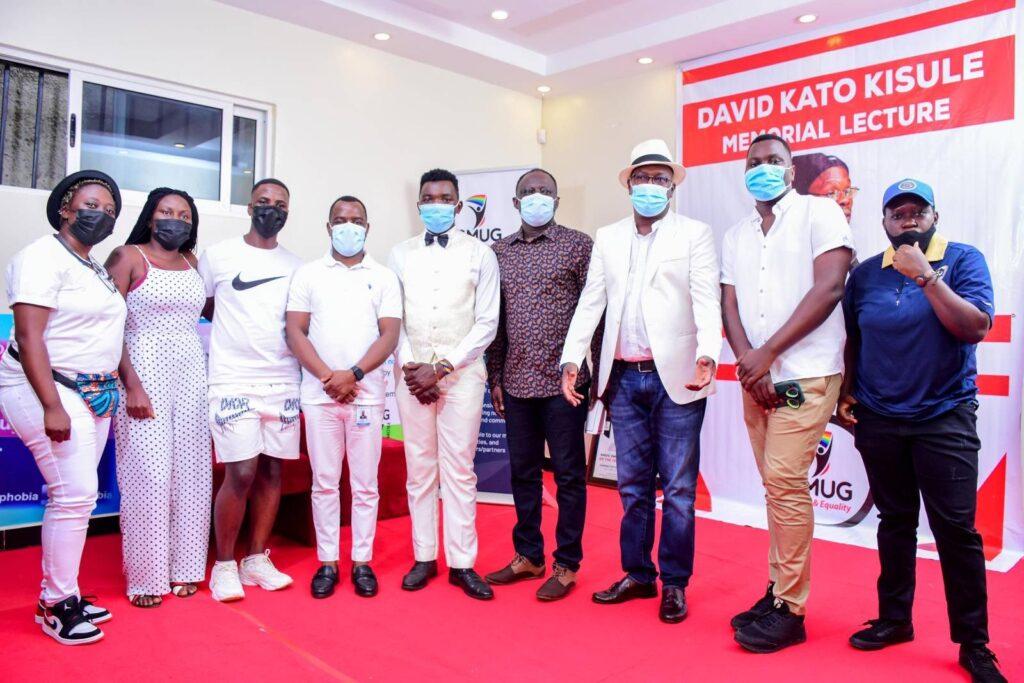
Human rights defenders pose at Kuchu Remembrance Day on Jan. 26, 2022, in honor of LGBT people killed. The event marked the launch of the planned David Kato Memorial Lectures in Kampala, Uganda. (Photo courtesy of Frank Mugisha)
The future “David Kato Memorial Lectures” were launched on 26 January 2022, during an event in Kampala organized by Hassan Shire, executive director of Defend Defenders, and Clément Nyaletsossi, United Nations Special Rapporteur on the Rights to Freedom of Peaceful Assembly and of Association. That date, the anniversary of Kato’s death, has been commemorated by Ugandan LGBT people since 2020 as Kuchu Remembrance Day, a day to remember the lives of LGBT activists who have been killed because of their activism and sexuality.
David Kato was considered a father of Uganda’s gay rights movement and described as “Uganda’s first openly gay man.” He became highly involved with the underground LGBT rights movement in Uganda, eventually becoming one of the founding members of Sexual Minorities Uganda (SMUG) in 2004.
On 26 January 2011, Kato was murdered in his home in Bukusa, Mukono Town, by a man who hit him twice in the head with a hammer. Kato died en route to hospital. Nsubuga Enoch, the man who confessed to murdering Kato, was found guilty at Mukono High Court and sentenced to 30 years with hard labour on 10 November 2011.
In October 2010, Kato was among the 100 people whose names, addresses, and photographs were published by the Ugandan tabloid newspaper Rolling Stone in an article which called for the murder of homosexuals. Kato and two other SMUG members who were listed in the article – Kasha Nabagesera and Pepe Julian Onziema – sued the newspaper to force it to stop publishing the names and pictures of people it believed to be gay or lesbian. The petition was granted on 2 November 2010, and the court later ordered the newspaper to pay Kato and the other two plaintiffs 1.5 million Ugandan shillings each (approx. US$450 as of May 2012).
Giles Muhame, the paper’s managing editor, was defiant at the time. “I haven’t seen the court injunction but the war against gays will and must continue. We have to protect our children from this dirty homosexual affront,” Muhame said of the court’s decision against his paper.
Several homophobic attacks have happened since Kato’s murder, resulting in deaths, body injuries, property damage and displacement. In memory of Kato, his former colleague Frank Mugisha, the executive director of SMUG, released a video on Twitter in which he pays him tribute. “The memorial lecture will bring out the core values that Kato stood for,” Mugisha says.
In a tweet about the David Kato memorial lectures, SMUG writes:
“It’s been 11 years since we lost David Kato due to homophobia and transphobia. Today we remember and celebrate the life of a remarkable man, an outstanding Human Rights activist.”
He was first arrested in February 1982, when he was held for four months and tortured. In 1989 the CDDL-HR formed an underground publication, Sawt al-Dimuqratiyya (The voice of democracy). In 1991 the group called for free elections, leading to Naisse’s arrest in December 1991. In 1992 he was tried and sentenced to 9 years imprisonment in Sednaya prison. Released in July 1998, Naisse was not subsequently permitted to practice law.
In August 2003 Naisse was questioned and threatened by military security. The committee posted a public letter on the Internet, calling for the lifting of the state of emergency. On 8 March 2004 they led around 700 demonstrators in a peaceful sit-in in front of the Syrian parliament building in Damascus. Naisse and one hundred others presented the parliament with a petition against the state of emergency, signed by over 7,000 people.
On 13 April 2004 Naisse was arrested and returned to Sednaya prison. There he suffered a stroke, leaving him partially paralysed. He began a hunger strike, and was released on bail pending trial on 16 August 2004. After international appeals on his behalf, the court acquitted him on 26 June 2005.
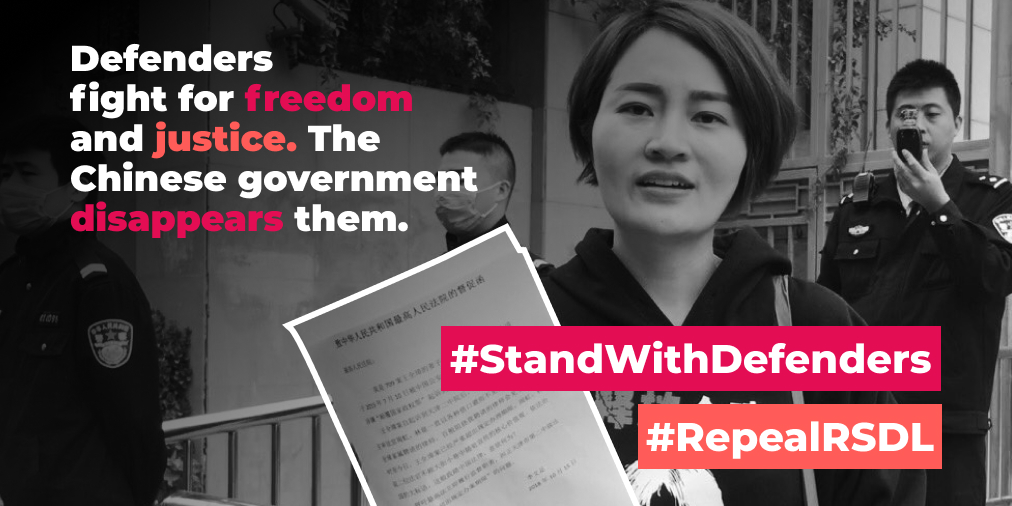
In China, brave activists are trying to improve the daily life of their fellow citizens and defend their rights to speak freely, to be treated on an equal footing with others, to protest peacefully, or to practice a religion. But the Chinese government fears that their actions will challenge its power and that their criticisms will undermine it. Like the Uyghur and Tibetan peoples, many who stand up for human rights are repressed and silenced, and the authorities have found a very effective way to do that: they disappear them.
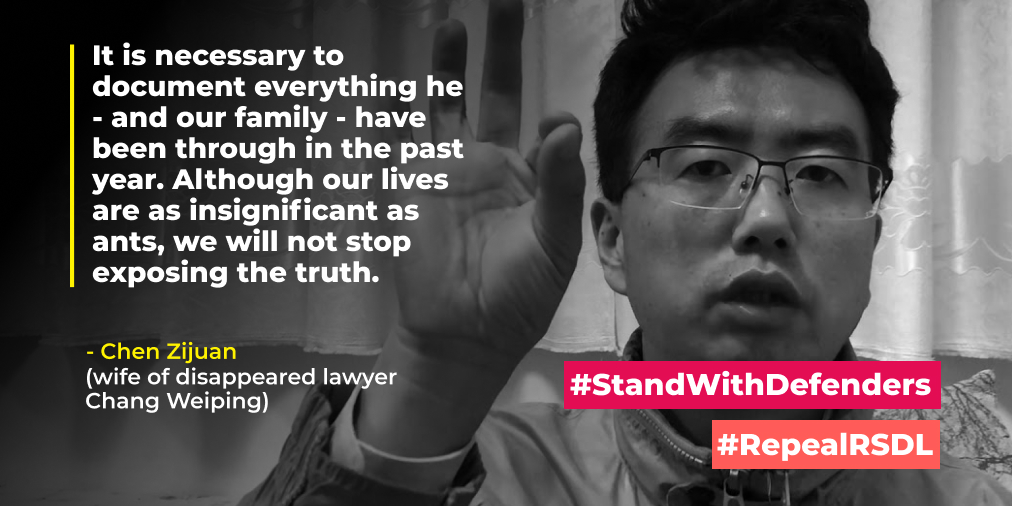
On 22 October 2020, exactly a year ago, lawyer Chang Weiping was disappeared under ‘Residential Surveillance at a Designated Location’ (or ‘RSDL’) for ‘inciting subversion of State power.’ Lawyer Chang is a human rights lawyer, who has bravely defended sensitive cases of victims of sexual harassment during China’s ‘Me Too’. He has also worked with victims of discriminatory practices due to their sexual orientation or HIV status, or targeted for speaking freely or practicing their religion. Ten days before his disappearance, he had published a video denouncing torture he had endured when he was first held under RSDL in January 2020, after attending a meeting with other activists a month earlier. UN experts have publicly called for his release. No one knows where he is held. [see also: https://www.trueheroesfilms.org/thedigest/laureates/2e6ec951-79e7-4a36-b077-76bfe05e3817]
Since 2012, China’s rubber-stamp legislative body passed and amended several articles in its Criminal Procedure Law that give police the power to take people into custody without disclosing where they will be held: this is called ‘Residential Surveillance at a Designated Location’. When this happens, people are denied all contact with the outside world, even with their family or a lawyer, for up to six months. No one knows where they are. They are interrogated and often tortured to extract confessions. Meanwhile, despite the barriers and risks they have to overcome, their families persist in seeking knowledge about their loved one’s fate and justice for what they suffered.
Many human rights activists have stopped promoting dignity, peace and justice in their communities because they fear to be disappeared by the police. This practice – enforced disappearance – is absolutely wrong and prohibited under international law. Everyone should be able to speak their mind and participate in the life of their communities.
ISHR, Safeguard Defenders, The Rights Practice and The 29 Principles are mobilising the international community to put pressure on China to #RepealRSDL and end enforced disappearances against human rights defenders.
They want the Chinese government to repeal RSDL (articles 74 to 79 of China’s Criminal Procedure Law), and to bring truth and justice to victims.
RSDL should be high on the agenda of any human rights exchange with the Chinese government. We want governments worldwide to speak out and use all bilateral and multilateral channels to press the Chinese government to #RepealRSDL. We want the UN to amplify its monitoring of RSDL in China, and to sustain its pressure on the authorities to respect international law and to #RepealRSDL.
Feeling supported is vital for disappeared defenders and their relatives. We want the media, human rights groups and activists across the world to pay closer attention to RSDL, to raise awareness around them, and to stand in solidarity with disappeared Chinese human rights defenders and their relatives.
How do we achieve this?
We are working hard to:
Increase the awareness and legal understanding of government officials and diplomats, UN experts, journalists, and human rights groups, there is a short document that explains clearly what UN experts have said about RSDL, and are spreading the word online and offline.
Mobilise diplomatic missions, through meetings and letters, and encourage them to speak out on RSDL at the UN and in other spaces;
Push UN experts to take up individual cases and pay a closer look at the use and impact of RSDL in light of China’s obligations under international human rights law ;
Encourage governments, activists, and concerned individuals to stand in solidarity with disappeared human rights defenders and their relatives
What can you do?
Stand in solidarity! Feeling supported is vital for disappeared defenders and their relatives. Send a solidarity message with Chen Zijuan, lawyer Chang’s wife: write a postcard, and share it with her on your social media by clicking on the image below. Don’t hesitate to personalise it before tweeting. Alternatively you can copy paste this link in your browser: https://ctt.ac/477cf
You can also raise awareness! Check out the informational and communication material in our ‘Campaign Toolbox’, and share it with your country’s ministry of foreign affairs, a journalist you know, your friends or your social media followers – and remember to tag @ISHRglobal, and #StandWithDefenders #RepealRSDL.
 Imaged sourced: Natali Prize

 The government claims to be “engaged in long standing cooperation with the UN human rights mechanisms and the UN Human Rights Council.” On the contrary, in February 2020, soon after taking office, the government of President Gotabaya Rajapaksa
 Hans Thoolen on Human Rights Defenders and their awards