Archive for the 'Human Rights Defenders' Category

Olympics: IOC getting closer to a human rights strategy

June 8, 2022

The International Olympic Committee’s (IOC) progress update released on May 20, 2022, is an important step toward adopting a desperately needed human rights strategic framework, the Sport & Rights Alliance said today. The move follows decades of calls from civil society and addresses several long-time demands from nongovernmental organizations and trade unions. [See: https://humanrightsdefenders.blog/2020/12/03/ioc-moves-on-its-human-rights-approach-more-of-a-marathon-than-a-sprint/]

“The International Olympic Committee should immediately adopt and entrench human rights across its operations, and add protecting and respecting human rights to the Olympic Charter as a fundamental principle,” said Minky Worden, director of global initiatives at Human Rights Watch. “Though overdue, this is a critically important step. It is a testament to what happens when athletes, activists, fans, journalists, workers and communities come together to make change.”

The IOC’s progress report acknowledges its responsibility to “respect human rights in accordance with the UN Guiding Principles on Business and Human Rights (the UN Guiding Principles),” and makes a commitment to “amending the Olympic Charter to better articulate human rights responsibilities.” The IOC also rightly focused on salient rights issues, such as equality and non-discrimination; safety and well-being; livelihoods and decent work; voice – including freedom of expression, association and assembly, and meaningful representation –and privacy.

“The IOC report is right to say that athletes sit at the heart of sport, and the IOC’s human rights strategy must deliver for them,” said Brendan Schwab, executive director of the World Players Association. “This means defining athlete rights in accordance with international law, recognizing the right of athletes to organize, and ensuring that bodies such as the Court of Arbitration for Sport will enable athletes to access justice where their human rights have been violated. The IOC has long purported to advance athlete rights without respecting international human rights standards.”

The Sport & Rights Alliance has found key gaps in the document which need to be addressed in the final IOC Human Rights Strategic Framework, scheduled to be launched in September 2022. Most notably, the IOC failed to acknowledge journalists, people with disabilities, spectators and fans, as well as racial and ethnic minority groups as “particularly at-risk populations.”

“The chaos that unfolded around the UEFA Champions League final in Paris clearly shows that the IOC also needs to look closer to how fans are treated, especially for the next Games in Paris 2024,” said Ronan Evain, executive director of Football Supporters Europe. “The Olympic movement has no audience without its spectators. In its role as authoritative leader of the Olympic Movement and global sports governance, the IOC’s decisions determine how and whether fans participate in events, where we travel, how we’re treated, yet it has once again forgotten that fans too have human rights.”

Eli Wolff, director of the Power of Sport Lab and co-founder of Disability in Sport International, said that, “Persons with disabilities are a critically affected group in sport and in society and are protected and recognized by the United Nations and specifically in the Convention on the Rights of Persons with Disabilities. Persons with disabilities are more than 15 percent of the global population and must be recognized in the human rights strategies and all equality and non-discrimination policies of the International Olympic Committee.”

The Sport & Rights Alliance added that the gaps identified in the progress report are not entirely surprising, given that it was developed without direct input from representatives of affected people and communities. Ongoing stakeholder engagement is an essential requirement of the UN Guiding Principles, in the identification and prioritization of human rights risks, when informing effective mitigation strategies, tracking its effectiveness and addressing violations.

Affirming the IOC’s commitment to “integrating meaningful engagement with affected stakeholders” into its ongoing due diligence processes, the Sport & Rights Alliance underlines the need for this to start as soon as possible. As the leader of global sport, the IOC should also take the additional step of including stakeholder representation in its governance structures to ensure the voice and lived experience of affected people are included in all decision-making processes.

“Given the declared launch date of September 2022, the IOC should immediately engage representatives for all affected groups — including spectators, journalists, children, survivors, athletes, LGBTQI+ population and people with disabilities — in meaningful and ongoing consultations for the next steps,” said Andrea Florence, acting director of the Sport & Rights Alliance. “It is only through transparent participation of people and communities directly impacted in decision-making processes that the IOC will actually understand how to prevent and address human rights harms related to their operations.”

Since the UN Guiding Principles were unanimously endorsed by UN Member States in 2011, the IOC has resisted pressures from civil society to adopt human rights across its operations and effectively engage with representatives of affected people and communities, even as it awarded the Olympics to countries with poor or worsening human rights environments.

Members of the Sport & Rights Alliance have long met with Olympic leaders to urge the IOC to adopt a human rights framework, accept their responsibility to seek to prevent and address human rights harms linked to the Olympic Movement, and to mitigate and remedy harms that they cause or contribute to directly. The IOC should also use its enormous power to improve often abysmal human rights conditions in host countries including ChinaBrazilRussiaBelarus and Japan.

https://www.hrw.org/news/2022/06/07/olympics-ioc-heeds-calls-embed-rights
Emirates’ claim to improve its legal system are nonsense

June 7, 2022

Human Rights Watch on 5 June 2022 published a detailed piece showing that wide-ranging legal changes introduced by the United Arab Emirates (UAE) in late 2021 fail to address the long-standing and systematic restrictions on citizens’ and residents’ civil and political rights. The new laws maintain previous provisions and include new ones that pose grave threats to fundamental human rights.

As reported by the state news agency WAM in November, the legal changes include amendments to over 40 laws including on crime and punishment, cybercrimes, and drugs, aiming “to strengthen economic, investment and commercial opportunities, in addition to maximizing social stability, security and ensuring the rights of both individuals and institutions.” While the changes allow for a moderate broadening of personal freedoms, the new legal framework retains severe restrictions on the rights to free expression, association, and assembly.

While the UAE government and its state-controlled media outlets trumpeted these new legislative changes as a massive step forward for economic and social freedoms, they will further entrench government-imposed repression,” said Michael Page, deputy Middle East director at Human Rights Watch. “The UAE government has chosen to squander an opportunity to improve freedoms across the board and instead has doubled down on repression.”

Human Rights Watch conducted a comprehensive legal analysis of two of the new laws, the crime and punishment law and the cybercrimes law, to identify any changes related to the rights to free expression and free assembly. Both laws went into effect in January 2022.

The laws continue to prohibit criticism of rulers and speech that is deemed to create or encourage social unrest, imposing severe penalties for vaguely defined charges. They maintain provisions that criminalize defamation and both verbal and written insults, whether published or made in private, as prosecutable offences. New provisions criminalize “false” and “misleading” information, sharing information with foreign groups or countries, and “offending foreign states.” Protests and demonstrations would still be prohibited.

UAE authorities have also spied on international journalists, activists, and even world leaders using sophisticated Israeli and EU-produced spyware, or with the help of former US intelligence officials. Some of those whose communications and devices were targeted by the government surveillance and who are residents of the UAE, were subsequently arrested and abused in detention. Among them is the prominent Emirati human rights activist Ahmed Mansoor [see: https://humanrightsdefenders.blog/2016/08/29/apple-tackles-iphone-one-tap-spyware-flaws-after-mea-laureate-discovers-hacking-attempt/]. A UAE court sentenced Mansoor to 10 years in prison in May 2018 following a grossly unfair trial, partly based on private email exchanges and WhatsApp conversations. See also: https://humanrightsdefenders.blog/2019/11/05/massive-call-in-support-of-ahmed-mansoor-at-his-50th-birthday-how-can-emirates-remain-deaf/ and https://www.trueheroesfilms.org/thedigest/laureates/074ACCD4-A327-4A21-B056-440C4C378A1A

The UAE authorities should take immediate steps to bring the penal code and cybercrime law into line with international and regional standards on free speech and individual freedoms, Human Rights Watch said. The UAE has not ratified the ICCPR, article 19 of which outlines the right to freedom of opinion and expression. But it is a state party to the Arab Charter on Human Rights. Article 32 of the Arab Charter ensures the right to information, freedom of opinion and freedom of expression, and article 24 guarantees the right to freedom of political activity, the right to form and join associations, and the right to freedom of assembly and association.

The UAE cannot market itself as a reformist and tolerant state while introducing new laws that increase its already alarming levels of repression and censorship,” Page said….

The piece further provides a detailed analysis of penal and Cybercrimes Law.

https://www.hrw.org/news/2022/06/05/uae-sweeping-legal-reforms-deepen-repression

Many NGOs join to demand release of human rights defenders in Algeria

May 23, 2022

38 NGOs, including HRW and AI, ask Algeria to end the repression of human rights and the “immediate” release of detainees. They have launched a campaign calling on Algeria to end the repression of Human Rights and demand the immediate release of people detained in the country for exercising their freedom of expression. “The campaign calls on all relevant individuals, organizations and parties to contribute to collectively demanding an end to the criminalization of the exercise of fundamental freedoms in Algeria using the label At least 300 people have been arrested since the beginning of 2022, and until April 17, in the country for exercising their right to free expression, peaceful assembly or association, according to human rights defender Zaki Hannache. “The arrests and sentences of peaceful activists, independent trade unionists, journalists and human rights defenders have not decreased, even after the protest movement was closed,” they said in a statement. The organizations have given the example of the hunger strike of the Algerian activist, Hadi Lassouli, to protest against his arbitrary imprisonment, as well as the case of Hakim Debazi, who died in custody on April 24 after being placed in preventive detention on April 22. February for social media posts. “Those suspected of criminal responsibility for serious human rights violations must be brought to justice in trials with due guarantees, and the authorities must provide victims with access to justice and effective reparations,” they have requested. This awareness campaign will be carried out until the anniversary of the death of Kamel Eddine Fejar, a human rights defender who died in custody on May 28, 2019 after a 50-day hunger strike. The United Nations High Commissioner for Human Rights, Michelle Bachelet, was “concerned” last March at the increase in fundamental restrictions in the country, including an increase in arrests and detentions of human rights defenders, as well as members of civil society and political opponents. “I call on the government to change course and take all necessary measures to guarantee the rights of its people to freedom of expression, association and peaceful assembly,” she said in a statement from the UN High Commissioner for Human Rights.

https://www.indonewyork.com/breaking/38-ngos-including-hrw-and-ai-ask-algeria-to-end-the-repression-of-human-h30616.html

Davos’ annual meeting starts on 22 May under human rights cloud

May 22, 2022
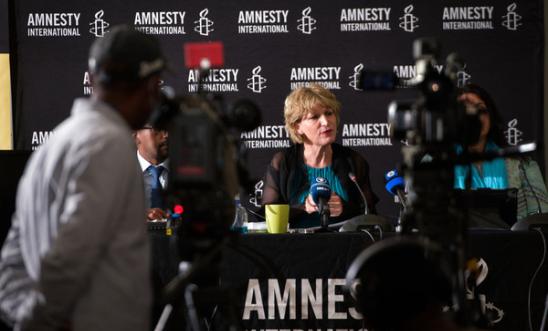
Agnès Callamard at a press conference

Agnès Callamard at a press conference © Amnesty International

Ahead of the World Economic Forum’s annual meeting in Davos that starts today, Sunday 22 May 2022, Agnès Callamard, Amnesty International’s Secretary General, said: 

This year’s Davos conference takes place amid a gathering storm of human rights crises. Russia’s mounting war crimes in Ukraine, the terrifying rollback on abortion rights in the US, the still-neglected climate emergency, the ongoing failure to secure universal vaccine access – these are just a few examples of what happens when human rights are sacrificed for power and profit.  

“Many of the political and business leaders attending Davos are directly responsible for these catastrophes, whether through their explicit pursuit of anti-human rights agendas or through their contemptible inaction and failure to implement solutions.  

“The Davos guestlist includes some of the richest and most powerful people in the world, and they have a moral obligation to put respect for human rights at the top of the agenda. They must use their vast wealth and influence to change the status quo and end the rampant inequality which has been the root cause of so much recent suffering.

The World Economic Forum’s annual meeting will take place in Davos, Switzerland, between 22 and 26 May.

https://www.amnesty.org.uk/press-releases/global-rich-and-powerful-meet-davos-amid-gathering-storm-human-rights-crises

Oslo Freedom Forum 2022 starts on 23 May

May 22, 2022

Every year, champions of human rights bring their stories to the Oslo Freedom Forum to shed light on the struggle for freedom around the world.

The theme for the 2022 Oslo Freedom Forum, CHAMPION OF CHANGE, celebrates both activists, who are themselves champions, and their causes. This theme represents a strong, scalable call to action, inviting you to act and advocate on behalf of activists and in support of human rights. At the Oslo Freedom Forum, we realize that everyone has the potential to effect change — either as a champion on an individual level, or as part of a larger movement.

The 2022 Oslo Freedom Forum, is from May 23-25 in Oslo at the Oslo Konserthus. You can also follow it as a stream: https://oslofreedomforum.com/?mc_cid=17de5f8b1f&mc_eid=f80cec329e

The 2022 mainstage program includes keynote speakers, who will be shedding light on the struggle for freedom around the world, including:

  • The three women who are leading the democratic movement in Belarus: Maria KolesnikovaSviatlana Tsikhanouskaya, and Veronica Tsepkalo, first stood on stage together in 2020 in Belarus, when Aleksandr Lukashenko brazenly stole the country’s elections. They will reunite with us, to provide an update on the Belarusian people’s remarkable multi-year protest, and explain how we can help.
  • Carine Kanimba, daughter of imprisoned “Hotel Rwanda” hero — who saved more than a thousand people during the Rwandan genocide — will share her extremely risky quest to liberate her father, who was was kidnapped by the state in 2020, and is now serving a life sentence in prison for criticizing the Kagame regime. Despite being wiretapped and targeted by Pegasus spyware, Carine continues to speak out to bring justice to her father.
  • At the young age of 26, Zarifa Ghafari became the unlikely mayor of Maidan Shar, a town in Afghanistan filled with Taliban support. Hatred toward her as a woman leader led to the assassination of her father in 2020. Last summer, with her life at risk after the fall of Kabul, she made a daring escape in the footwell of a car, evading Taliban fighters. Today she lives in exile, where she continues to advocate for human rights in Afghanistan, committed to the cause of freedom in her country. 
  • Jewher Ilham’s father, Uyghur scholar Ilham Tohti, has been held under a life sentence since 2014, imprisoned in a concentration camp in China’s Xinjiang region. Jewher has been speaking truth to power, shedding light on China’s forced labor police by testifying before US Congress, publishing op-eds, receiving numerous international awards on behalf of her father, and writing two books on the subject. 
  • In 2012, Syrian activist and Georgetown student Omar Alshogre was detained along with his cousin for demonstrating against the Syrian regime. He spent more than three years in Assad’s infamous jail system, where he endured and survived unspeakable torture. At the age of 20, his mother helped smuggle him out to freedom. His story is a bedrock piece of evidence in the international case to hold the Assad regime accountable for crimes against humanity.
  • One of the 100 most influential women defining the last century according to TIME Magazine, Nobel Peace Prize laureate Tawakkol Karman, also known as the “mother of the revolution,” “the iron woman,” “Lady of the Arab Spring,” as well as one of the Most Rebellious Women in History, is a notoriously true powerhouse. She is a human rights activist, journalist, politician, and founder of her own international foundation.

Kasparov and Khodorkovsky are now also foreign agents

May 21, 2022
Agence France-Presse

On 21 May 2022 Agence France-Presse reported that Russia on Friday added two high-profile Kremlin critics to its list of “foreign agents“: former chess champion Garry Kasparov and ex-tycoon Mikhail Khodorkovsky.

The infamous label, reminiscent of the “enemies of the people” of the Soviet period, is used extensively against opponents, journalists and human rights activists accused of conducting foreign-funded political activities. Such “foreign agents” are subject to numerous constraints and laborious procedures, under pain of severe sanctions. In particular, they must indicate this status in all their publications. See also: https://humanrightsdefenders.blog/2016/02/09/foreign-agent-law-in-russia-keeps-widening-its-net/ and https://humanrightsdefenders.blog/2021/12/29/russias-supreme-court-orders-closure-emblematic-memorial/

In its updated website list, the Russian justice ministry said that Khodorkovsky, 58, and Kasparov, 59, have “sources” in Ukraine to finance their activities.

Soviet-born former world chess champion Kasparov is a long-time opponent of President Vladimir Putin and has lived in the United States for almost a decade.

Khodorkovsky was one of Russia’s most powerful businessmen in the 1990s, before coming into conflict with the Kremlin when Putin came to power in 2000. He spent ten years, from 2003 to 2013, in prison and then went into exile. For years, he helped to finance the Russian opposition organisation Open Russia, which dissolved itself in May last year in the face of growing repression.

Since the start of Moscow’s military operation in Ukraine on 24 February, dozens of members of the Russian intellectual elite and journalists have left the country, as the authorities step up pressure against the last critical voices and media. See also: https://humanrightsdefenders.blog/2022/04/26/lev-ponomarev-human-rights-defender-leaves-russia/

https://www.thesouthafrican.com/news/world-news/kasparov-and-khodorkovsky-added-to-foreign-agents-list-russia/

BIG question: what to do with long-term detention of Human Rights defenders?

May 21, 2022

Event on 1 June 2022, 12:00-14:00: “Don’t forget about us: Strategies for resisting long-term detention of Human Rights Defenders”. Location: Cassese Room,  Villa Moynier, 120B Rue de Lausanne, Geneva (and online)

Figure of a person in a prison hallway

Logo Ennals

In 2021, the UN Special Rapporteur on Human Rights Defenders published a report on cases of long-term detention of activists, which were estimated to number hundreds or thousands worldwide. This report confirms the terrible treatment and conditions many defenders bear in prison. However, while an objective of long-term detention may be to discourage defenders, many cases result in perennial campaigns and increased publicity for the defenders themselves.

How can governments, civil society and international mechanisms work together to keep the pressure on long-term detention cases? What strategies have proven successful in improving respect for defenders’ rights and physical integrity while imprisoned?

This event is co-organized by Geneva Human Rights Platform and the Martin Ennals Awards, which has a long experience with its laureates being detained. This year, two of its three winners are in prison! See: https://humanrightsdefenders.blog/2022/04/20/save-the-date-and-come-to-the-mea-ceremony-2022-or-watch-online/

Opening

  • Gloria Gaggioli, Director, Geneva Academy of International Humanitarian Law and Human Rights

Moderation

  • Brian Dooley, Senior advisor on human rights, Human Rights First

Panelists

  • Maryam Al-Khawaja, Human Rights defender and daughter of Abdul-Hadi Al-Khawaja, detained in Bahrain since 2011
  • Quynh Vi Tran, Journalist and colleague of Pham Doan Trang, detained in Vietnam since 2020
  • Fr. Xavier Soreng SJ, Lecturer, Ranchi Social Sciences Institute, on behalf of Father Stan Swamy (1937-2021), India
  • Gerald Staberock, Secretary-General, World Organisation Against Torture
  • Tor Hodefield, Vuka! Coalition Coordinator, CIVICUS

Registration

This event will take place in a hybrid format:

  • Register here to attend the event at Villa Moynier (places are limited and will be allocated on a first-come-first-served basis) until 26 May 2022
  • Register here to join online via Zoom.

https://www.geneva-academy.ch/event/all-events/detail/336-don-t-forget-about-us-strategies-for-resisting-long-term-detention-of-human-rights-defenders

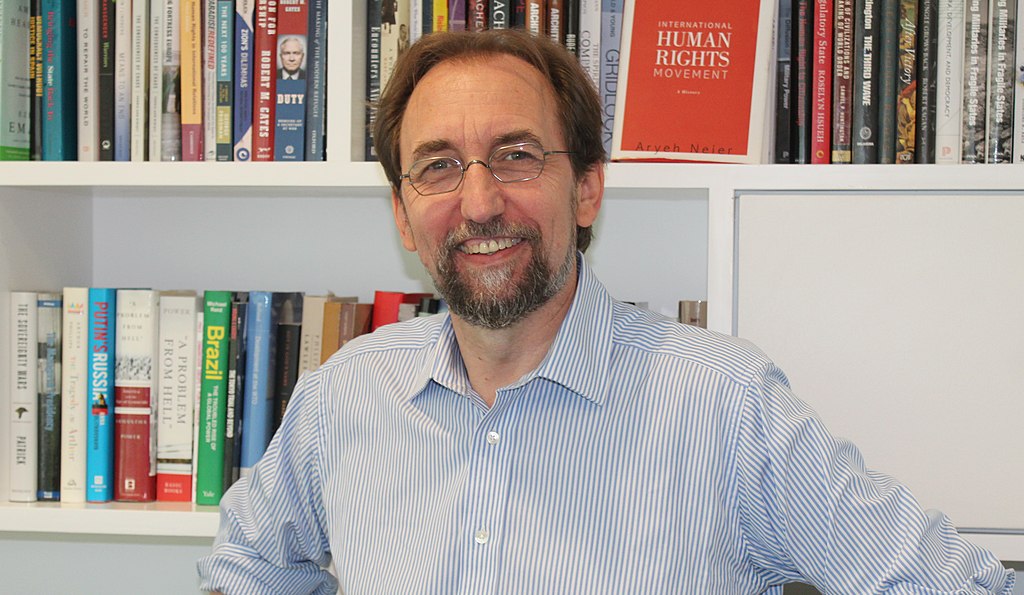
SHIFT’s new Chair is former High Commissioner Zeid Ra’ad Al Hussein

May 20, 2022

Shift, the centre of expertise on the UN Guiding Principles on Business and Human Rights, announced the appointment of HRH Prince Zeid Ra’ad Al Hussein as the new Chair of its Board of Trustees. He served as the United Nations High Commissioner for Human Rights from 2014-2018, as well as Jordan’s Permanent Representative to the UN, and as the first president of the International Criminal Court (ICC), among other leadership roles.

He is currently the CEO and President of the International Peace Institute and the Perry World House Professor of Practice of Law and Human Rights at the University of Pennsylvania Carey Law School. He is also a member of The Elders, an independent group of global leaders working together for peace, justice and human rights, first established by Nelson Mandela in 2007. He has been recognized globally and received 5 human rights awards, see: https://www.trueheroesfilms.org/thedigest/laureates/8ec8e85a-66ba-404c-b82e-720ebf044549]  

Prince Zeid succeeds Shift’s late founding Chair, Professor John Ruggie, author of the UN Guiding Principles on Business and Human Rights. [See also: https://humanrightsdefenders.blog/2021/09/28/in-memoriam-john-ruggie-father-of-business-and-human-rights/]

On taking up the role of Shift’s Chair, Prince Zeid said:  

The unanimous endorsement of the Guiding Principles in 2011 represented a watershed moment in changing the understanding of companies’ responsibility for the negative impacts that business activities can have on people. For a decade now, Shift has worked relentlessly to embed the ethos of the UNGPs in the way business gets done, with the focus where it must always be – on delivering better outcomes for the most vulnerable workers and communities. I am delighted to take up the role of Chair of Shift’s Trustees at a time when we see so much growth in the appetite and need for the organization’s work and leadership, not least as regulators, legislators, investors and financiers become more attuned to their own roles in incentivizing rights-respecting business practices, including as an essential component of a Just Transition to carbon neutral economies. I look forward to working with the Board and the management team to seize these growing opportunities to deliver on the promise of the UN Guiding Principles.”

For the past three years, Shift has worked closely with Prince Zeid in strategic partnerships to advise global sports bodies––including the International Olympic Committee and the Féderation Internationale de l’Automobile ––on their responsibility to respect human rights under the UN Guiding Principles.

Taliban dissolves ‘unnecessary’ Human Rights Commision

May 20, 2022

Patrick Slater, from the Vermont Law School, reports in Jurist.org of 18 May 2022 that the Taliban authorities in Afghanistan announced that the country’s Human Rights Commission will be dissolved, calling it “unnecessary.”

The Afghan Independent Human Rights Commission (AIHRC) was the national human rights institution of Afghanistan, dedicated to the promotion, protection, and monitoring of human rights and the investigation of human rights abuses.

The Kabul-based Commission was established on the basis of a decree of the Chairman of the Interim Administration on June 6, 2002, pursuant to the Bonn Agreement (5 December 2001); United Nations General Assembly resolution 48/134 of 1993 endorsing the Paris Principles on national human rights institutions, and article 58 of the Constitution of Islamic Republic of Afghanistan.

The much-honoured Sima Samar was the Chairperson of the Afghan Independent Human Rights Commission [see: https://www.trueheroesfilms.org/thedigest/laureates/4AEEBC97-C788-49F5-8DE1-33F7855D2192] and as of 2019, its chairperson was Shaharzad Akbar [see: https://www.trueheroesfilms.org/thedigest/laureates/46068051-7f6e-403a-9663-8286238d7d2e]

Following the Taliban capture of the country in 2021, the AIHRC has been unable to carry out its work, due to confiscation of he human rights commission’s “buildings, vehicles and computers”

Along with the Commission, four other departments were dissolved. The Taliban faces a $500 million budget deficit, and the dissolution of these agencies was deemed necessary to avert a financial disaster. In addition to the Human Rights Commission, key agencies such as the National Security Council and the High Council for National Reconciliation have been dissolved.

For other posts on Afghan human rights defenders, see: https://humanrightsdefenders.blog/tag/afghanistan/

https://www.jurist.org/news/2022/05/taliban-authorities-dissolve-afghanistan-human-rights-agency/

Polish Border NGO Granica receives 2022 Zabel award

May 20, 2022

Human Rights First announced that it will present Grupa Granica with the William D. Zabel Human Rights Award 2022 in recognition of its commitment to human rights at the Poland-Belarus border.

For more about this award and its laureates, see: https://www.trueheroesfilms.org/thedigest/awards/984CA015-FE02-4992-8AED-4EB1AEC7D0EE

Grupa Granica are front-line human rights defenders working at a flashpoint for human rights and freedom of migration,” said Michael Breen, president and CEO of Human Rights First. “We hope that Human Rights First’s presentation of the William D. Zabel Award provides additional recognition to the importance of their work and helps to stem this humanitarian and geopolitical crisis.

Formed in 2021 in response to the humanitarian crisis at the Polish-Belarusian border, Grupa Granica is an informal network of Polish NGOs, activists, and inhabitants of the border region that provides humanitarian, medical, and legal aid to migrants stranded in the forests there.  They monitor the situation on the ground, provide assistance to people searching for missing family members, document human rights violations and educate Polish society on the situation at the border.

Our network was formed in August last year in response to the humanitarian crisis at the Polish-Belarusian border. It consists of local inhabitants, activists, NGO staff, doctors, lawyers, interpreters, psychologists, public figures and many others working hand in hand to save the lives of migrants stranded at the border,” says Marta Górczyńska of Grupa Granica.  “This prestigious award sends a clear message to the public that despite the recent attempts by the Polish authorities, providing humanitarian aid and defending human rights must never be criminalized. We hope it will also make it more difficult for the international community to turn a blind eye to the violations at the border.”

The 2022 award will be officially presented to Grupa Granica on June 8. 

For last year’s, see: https://humanrightsdefenders.blog/2021/05/27/william-zabel-human-rights-award-2021-to-philippines-ngo-karapatan/

https://www.humanrightsfirst.org/press-release/human-rights-first-present-poland-s-grupa-granica-2022-william-d-zabel-human-rights