Archive for the 'Human Rights Defenders' Category

Protest follows sentencing of Adilur Rahman Khan and Nasiruddin Elan in Bangladesh

September 15, 2023

On 14 September 2023 the Cyber Tribunal, Dhaka sentenced to two years imprisonment Odhikar’s Secretary Adilur Rahman Khan and Director ASM Nasiruddin Elan for allegedly breaching Section 57 of the Information and Communication Technology Act 2006. They were charged for releasing a report on extrajudicial killings committed on 5 and 6 May 2013, centering around the Hefazat-e-Islam protests.

Immediately, 39 organizations in a joint call said that Bangladesh should quash their convictions, and end all reprisals against them and other human rights defenders for their legitimate human rights work. The Bangladesh Government has persistently targeted and launched a smear campaign against Khan and Elan, the secretary and director, respectively, of prominent Bangladesh human rights organization Odhikar. Following the 2013 publication of Odhikar’s fact-finding report documenting extrajudicial killings during a protest, both defenders were arbitrarily detained; Khan for 62 and Elan for 25 days. After being released on bail, they continued to face prosecution and judicial harassment on trumped-up allegations that their 2013 report was “fake, distorted, and defamatory.”

After years of stalling, Bangladeshi judicial authorities accelerated the hearings in their case following the designation of US sanctions against the country’s notoriously abusive paramilitary Rapid Action Battalion (RAB) and its officials in December 2021, blaming human rights organizations like Odhikar for this outcome. Their case has been marred with due process violations, such as the failure to provide the defense with advance information on the prosecution witnesses or a copy of the Criminal Investigation Department’s further investigation report until the day before a hearing. See also: https://humanrightsdefenders.blog/2021/12/21/harassment-of-adilur-rahman-khan-and-other-human-rights-defenders-in-bangladesh/

After the Government reopened the examination of witnesses and presented additional prosecution witnesses in July and August 2023, the judge convicted Khan and Elan to two years in prison and a fine of 10,000 Bangladeshi Taka (equivalent of USD$91.17).

In addition to targeting Odhikar’s leaders, the Government interfered with the organization’s ability to conduct its human rights work by blocking their access to funds and leaving its registration renewal application pending since 2014. Following the US sanction designations, the Government increased surveillance and harassment against those affiliated with Odhikar and ordered the organization to provide sources and proof for its findings of enforced disappearances and extrajudicial killings. On June 5, 2022, the Government’s NGO Affairs Bureau officially denied Odhikar’s application for renewal, stating that the organization’s publications have “seriously tarnished the image of the state to the world.” See also: https://humanrightsdefenders.blog/2023/09/06/ohchr-says-nobel-laureate-yunus-and-other-human-rights-defenders-being-harassed-through-legal-proceedings/

The Government then continued to besmirch the organization publicly, even criticizing and questioning the credibility of the US Department of State’s 2022 Country Report on Human Rights Practices: Bangladesh for relying on Odhikar’s documentation. United Nations human rights experts have expressed their concerns over the Government’s actions, stating that “the defamation of Bangladeshi-based human rights organisations by high-profile public figures is a clear attempt to undermine their credibility, reputation and human rights work in the country.” [see also: https://www.dhakatribune.com/bangladesh/foreign-affairs/325311/us-embassy-voices-concern-over-verdict-against]

Human rights defenders should be allowed to conduct their necessary and important work without fear of harassment, intimidation, and reprisals. Instead of prosecuting and punishing those who document and expose human rights violations, the Government should investigate and hold the perpetrators of these violations accountable.

List of signatories: 

  1. Advocacy Forum Nepal 
  2. Amnesty International
  3. Anti-Death Penalty Asian Network (ADPAN)
  4. Asian Federation Against Involuntary Disappearances (AFAD)
  5. Asian Forum for Human Rights and Development (FORUM-ASIA)
  6. Asian Network for Free Elections (ANFREL)
  7. Association of Family Members of the Disappeared, Sri Lanka
  8. Capital Punishment Justice Project, Australia 
  9. Citizens’ Alliance for North Korean Human Rights (NKHR)
  10. CIVICUS: World Alliance for Citizen Participation
  11. Defence for Human Rights Pakistan (DHR)
  12. Desaparecidos – Philippines
  13. Eleos Justice, Monash University, Australia 
  14. Families of Victims of Involuntary Disappearance (FIND)
  15. FIDH (International Federation for Human Rights), within the framework of the Observatory for the Protection of Human Rights Defenders
  16. Forum ONG Timor-leste
  17. Free Jonas Burgos Movement
  18. HAK Association, Timor-leste
  19. Human Rights First
  20. Human Rights Hub
  21. Human Rights Watch 
  22. Indonesian Association of Families of the Disappeared Families (IKOHI)
  23. International Coalition Against Enforced Disappearances (ICAED)
  24. International Federation of ACATs (FIACAT)
  25. International Service for Human Rights (ISHR)
  26. Karapatan Alliance Philippines (KARAPATAN) 
  27. KontraS (the Commission of the Disappeared and Victims of Violence) 
  28. Latin American Federation of Associations of Relatives of Disappeared-Detainees (FEDEFAM)
  29. Legal Literacy – Nepal
  30. Liga Guatemalteca de Higiene Mental
  31. Madres de Plaza de Mayo – Linea Fundadora, Argentina
  32. Martin Ennals Foundation
  33. Nonviolence International Canada
  34. Robert F. Kennedy Human Rights 
  35. Sindhi Foundation
  36. The Asian Alliance Against Torture (A3T) 
  37. Torture Abolition and Survivors Support Coalition, Washington DC
  38. We Remember-Belarus
  39. World Organisation Against Torture (OMCT), within the framework of the Observatory for the Protection of Human Rights Defenders

Odhikar itself denounces the arrest, trial and imprisonment of these two human rights defenders and added that “It believes that justice has not been served. As an organisation Odhikar has drawn the sustained wrath of the establishment for becoming the voice of the victims of human rights violations, including those of enforced disappearances, extrajudicial killings, torture, arbitrary detention and against the suppression of free expression and assembly; and for its engagement with the United Nations Human Rights Mechanisms. Earlier the government arbitrarily deregistered the organisation. Today’s judgement is likely to have a chilling effect on human rights defenders and civil society organisations around the country.

Also: https://www.thedailystar.net/news/bangladesh/news/human-rights-bangladesh-european-parliament-moves-resolution-expressing-concern-3418651

https://www.hrw.org/news/2023/09/14/bangladesh-quash-conviction-and-release-rights-defenders

https://www.newagebd.net/article/212570/switzerland-canada-27-rights-groups-condemn-jailing-adilur-elan

but then on 16 October “Bangladesh rights activists Adilur Rahman Khan and ASM Nasiruddin Elan were released on bail Sunday evening after being in prison since Sept. 14 in a cybercrime case.”: https://www.voanews.com/a/top-bangladesh-rights-activists-released-on-bail-/7313942.html

Iran: One year after uprising in Iran the international community must combat impunity says Amnesty

September 15, 2023

The international community must pursue pathways for justice at the international level to address systemic impunity for Iranian officials responsible for hundreds of unlawful killings of protesters and widespread torture, Amnesty International said on 13 September 2023, as Iran marks the one-year anniversary of the “Woman Life Freedom” uprising.

Over the past year, Iranian authorities have committed a litany of crimes under international law to eradicate any challenge to their iron grip on power. These include hundreds of unlawful killings; the arbitrary execution of seven protesters; tens of thousands of arbitrary arrests; widespread torture, including rape of detainees; widespread harassment of victims’ families who call for truth and justice; and reprisals against women and girls who defy discriminatory compulsory veiling laws.

The anniversary of the ‘Woman Life Freedom’ protests offers a stark reminder for countries around the world of the need to initiate criminal investigations into the heinous crimes committed by the Iranian authorities under universal jurisdiction. Government statements calling on the Iranian authorities to halt the unlawful use of firearms against protesters, stop torturing detainees, and release all individuals detained for peacefully exercising their human rights remain as crucial as ever. These actions show victims they are not alone in their darkest hour.

The anniversary of the ‘Woman Life Freedom’ protests offers a stark reminder for countries around the world of the need to initiate criminal investigations into the heinous crimes committed by the Iranian authorities under universal jurisdiction. Diana Eltahawy, Amnesty International’s Deputy Regional Director for the Middle East and North Africa

The Iranian authorities have waged an all-out assault on the human rights of women and girls over the past year. Despite months of protests against Iran’s compulsory veiling laws, triggered by the arbitrary arrest and death in custody of Mahsa/Zhina Amini, the authorities have reinstated “morality” policing and introduced a raft of other measures that deprive women and girls who defy compulsory veiling of their rights.

These include the confiscation of cars and denial of access to employment, education, healthcare, banking services and public transport. Simultaneously, they have prosecuted and sentenced women to imprisonment, fines and degrading punishments, such as washing corpses.

This assault on women’s rights is taking place amid a spate of hateful official statements referring to unveiling as a “virus”, “social illness” or “disorder” as well as equating the choice to appear without a headscarf to “sexual depravity.”

The authorities are also working on new legislation that will introduce even more severe penalties for defying compulsory veiling.

Mass arbitrary detentions and summons

During the uprising and in the months that followed, the authorities arbitrarily arrested tens of thousands of men, women and children, including protesters, human rights defenders and minority rights activists.  Those arrested include at least 90 journalists and other media workers and 60 lawyers, including those representing families of individuals unlawfully killed. Scores of other lawyers were summoned for interrogations. [see e.g. https://humanrightsdefenders.blog/2023/05/11/now-it-is-the-turn-of-the-iranian-journalists-who-reported-on-mahsa-amini/]

Ahead of the anniversary, the authorities have intensified their campaign of arbitrary arrests targeting, among others, family members of those unlawfully killed, and forcing thousands of university students to sign undertakings not to participate in anniversary protests.

Execution of protesters

Over the past year, the authorities have increasingly used the death penalty as a tool of political repression to instil fear among the public, arbitrarily executing seven men in relation to the uprising following grossly unfair sham trials. Some were executed for alleged crimes such as damage to public property and others in relation to the deaths of security forces during the protests. All were executed after Iran’s Supreme Court rubber stamped their unjust convictions and sentences despite a lack of evidence and without carrying out investigations into their allegations of torture. Dozens remain at risk of execution or being sentenced to death in connection with the protests.

A crisis of impunity

The authorities have refused to conduct any thorough, independent and impartial investigations into the human rights violations committed during and in the aftermath of the “Woman Life Freedom” uprising and have failed to take any steps to hold those suspected of criminal responsibility to account.

Instead, authorities have applauded the security forces for suppressing the unrest and shielded officials from accountability, including two officials who admitted raping women protesters in Tehran. They have also dismissed complaints from victims and/or their families, threatening them with death or other harm if they pursued their complaints.

Amnesty International welcomed the establishment of a Fact-Finding Mission on Iran by the UN Human Rights Council in November 2022, yet much more is needed to combat the crisis of impunity for serious crimes in Iran – and to deter further cycles of bloodshed.

Amnesty International urges all states to consider exercising universal and other extraterritorial jurisdiction in relation to crimes under international law and other serious human rights violations committed by Iranian authorities, irrespective of the absence or presence of the accused in their territory. This includes initiating adequately resourced criminal investigations aimed at disclosing the truth about the crimes, identifying those suspected of responsibility, including commanders and other superiors and issuing, when there is sufficient admissible evidence, international arrest warrants. States should also contribute to achieving reparations for the victims.

https://www.amnesty.org/en/latest/news/

https://www.hrw.org/news/2023/09/15/iran-crackdown-dissent-ahead-protest-anniversary

see also:

https://www.fidh.org/en/region/asia/iran/iran-statement-on-the-un-fact-finding-mission-s-oral-upda

https://news.un.org/en/story/2023/09/1141017

https://www.ohchr.org/en/press-releases/2023/09/iran-un-experts-denounce-crackdown-public-commemoration-jina-mahsa-aminis

More join Maryam Al-Khawaja’s solidarity trip to Bahrain……to be continued

September 14, 2023

On 7 September 2023, Maryam Al-Khawaja announced that she would return from exile to Bahrain to try and save her father Abdulhadi Al-Khawaja [see: https://humanrightsdefenders.blog/2023/09/11/maryam-al-khawaja-risks-prison-by-returning-to-bahrain-to-press-for-her-fathers-release/]. Now Front Line’s Interim Director Olive Moore announced that she will accompany Maryam on the trip to Manama this week to press the Bahraini authorities to release him. Other leading human rights figures have announced their participation in the trip, including Agnès Callamard, Amnesty International’s Secretary General; Tim Whyte, Action Aid-Denmark’s Secretary General; and Andrew Anderson, former Front Line Defenders Executive Director and Amnesty International staff member.

“Front Line Defenders owes a debt of gratitude to Abdulhadi, both as a former staff member and friend to many in the organisation, but more importantly as a principled and trailblazing human rights defender in Bahrain and the region. We will not rest until the Bahraini authorities free him and the human rights defenders Dr Abduljalil Al-Singace and Naji Fateel, both also unjustly imprisoned for over a decade.” said Moore.

The exact timing of the solidarity trip is not being publicised, but it comes the same week as the Bahraini Crown Prince visits Washington, DC, and more than a dozen human rights organisations, including Front Line Defenders, have also called on President Biden’s administration to demand the release of human rights defenders.

“Now is the moment for the Biden administration to step up to the plate and show solidarity with human rights defenders in Bahrain. In meetings with the Crown Prince this week, the US government must be unequivocal in its calls for the immediate and unconditional release of Abdulhadi Al-Khawaja and other unjustly imprisoned human rights defenders,” said Olive Moore.

Human Rights Watch stated on 11 September: “If Maryam al-Khawaja can have the courage to risk her life for democracy and human rights in Bahrain, the least the Biden Administration can do is show the political strength to use its leverage to call on its allied government to free its political prisoners.

The same day Human Rights First’s Brain Dooley blogged about two prisoners (among the hundreds on hunger strike) that have told him about the daily reality of the protest.

One of them is 49-year-old Ahmed Jaafar Mohammed Ali, who has been in prison since he was extradited from Serbia in January 2022 and Sayed Sajjad who has been in prison since September 2013, and is one of the inmates negotiating with the prison authorities. See more at: https://humanrightsfirst.org/library/two-prisoners-on-hunger-strike-in-bahrain-tell-of-their-ordeal/

https://www.frontlinedefenders.org/en/statement-report/front-line-defenders-director-join-solidarity-trip-bahrain-free-abdulhadi-al

https://www.hrw.org/video-photos/audio/2023/09/11/bahrain-brutality-and-biden

https://www.france24.com/en/live-news/20230914-bahrain-activist-says-to-return-home-for-father-despite-arrest-fears-1

Call to release human rights defender Manuchehr Kholiqnazarov and others in Tajikistan

September 14, 2023

With Tajikistan marking its Independence Day on 9 September 2023, CIVICUS and the Brussels-based International Partnership for Human Rights (IPHR) called on 7 September 2023 on Tajikistan’s authorities to immediately release imprisoned human rights defender Manuchehr Kholiqnazarov, and other activists and journalists detained for their human rights activities.

Manuchehr Kholiqnazarov is a peaceful human rights lawyer and activist who has sat in jail for far too long on trumped-up charges,” said Mandeep Tiwana, CIVICUS Chief Programmes Officer. “As Tajikistan celebrates its national day, the authorities must free him and others unjustly imprisoned without hesitation.”

Authorities arrested Manuchehr on 28 May 2022 while he was a member of “Commission 44,” an official body investigating a November 2021 extrajudicial killing which sparked mass protests in Tajikistan’s Gorno-Badakhshan Autonomous Oblast (GBAO). Prosecutors falsely charged Manuchehr with participating in a criminal association and publicly calling for violent change of the constitutional order. After a closed trial which failed to meet international fairness standards, Tajikistan’s Supreme Court sentenced him to 16 years’ imprisonment in December 2022.

It is completely absurd that the government appointed someone to a commission to investigate and report on human rights violations and then charged that same person for doing the work they were commissioned to do,” said IPHR director Brigitte Dufour. “Manuchehr should be released immediately.

Manuchehr’s continued detention is symptomatic of the ongoing civic space restrictions in Tajikistan, which is one of the world’s most repressed countries. Tajikistan authorities have repeatedly levelled trumped-up charges of “extremism” and “terrorism” against journalists, bloggers and activists who criticise the government. CIVICUS Monitor, which assesses civic space worldwide, rates Tajikistan as “closed,” its worst possible ranking.

CIVICUS and IPHR recognise Manuchehr as part of the Stand As My Witness campaign, which advocates for the release of jailed activists and human rights defenders worldwide.

On 11 September 2023 the Norwegian Helsinki Committee, Human Rights Watch, Freedom for Eurasia, and Freedom Now demanded that he Tajik authorities drop trumped up charges against Nizomiddin Nasriddinov and immediately release him. Nasriddinov, a political activist, was recently extradited from Belarus at the request of the Tajik government.

https://www.civicus.org/index.php/media-resources/news/6551-civil-society-demands-tajikistan-release-jailed-human-rights-defender

https://www.hrw.org/news/2023/09/11/tajikistan-free-political-activist-and-drop-charges

Sakharov Fellowship for Human Rights Defenders – Call for Applications

September 11, 2023

The European Parliament’s Sakharov Fellowship is a two-week training experience for human rights defenders from non-EU countries. Since its inception in 2016, this program has empowered individuals to champion human rights across the globe, thanks to the initiative of the Sakharov Prize Community at the 25th Anniversary Conference.

EU Sakharov Fellowship Scholarship

What We Offer:

  • Training in Brussels and Venice: Immerse yourself in a comprehensive program that delves into EU and international human rights frameworks, policies, and mechanisms. Equip yourself with the skills to advocate for positive change and protect human rights.
  • Networking Opportunities: Join an expanding network of Sakharov Fellows to share best practices and disseminate knowledge. Forge lasting connections with the European Parliament and EU Delegations in your home country.
  • Bespoke Curriculum: In Brussels, focus on EU policies, funding opportunities, communication skills, and security challenges facing human rights defenders. Engage with EU decision-makers, Members of Parliament, and NGOs. Enjoy opportunities for individual advocacy and networking.
  • Venice Experience: At the Global Campus of Human Rights, benefit from academic expertise in international human rights law, practical tools, and case studies. Learn from distinguished academics, human rights leaders, and Sakharov Prize laureates.
  • In-Person and Online: Our program will be held in person in Brussels and Venice, with the flexibility to switch to an online format if necessary due to health concerns.

Who Should Apply:

If you have a proven track record in advocating for human rights in an NGO, organization, or individually, this fellowship is for you. Proficiency in English, enabling active participation in discussions and workshops, is essential. We aim to ensure diversity in terms of gender, geography, and human rights focus in our selection process.

Benefits:

The Sakharov Fellowship covers return travel from your home country, accommodation in Brussels and Venice, and a daily living allowance.

Application Deadline: Midnight, October 8, 2023 (CET)

Confirmation Emails: Successful candidates will receive confirmation by November 17, 2023. Regrettably, we will not be able to provide feedback to unsuccessful applicants.

For more information and to apply, go to the website.

https://www.eeas.europa.eu/delegations/montenegro/2026-sakharov-fellowship-programme-7-20-june-2026-call-applications_en

Maryam al-Khawaja risks prison by returning to Bahrain to press for her father’s release

September 11, 2023

On 7 September 2023 Maryam Alkhawaja made this surprising and immensely courageous statement on twitter (X): “Today marks one month since the beginning of the largest mass #hungerstrike by political prisoners in #Bahrain, – and I am announcing that I will be traveling there next week to try and save my imprisoned father’s life. #FreeAlKhawaja #DKPol #Solidarity

The trip by Maryam al-Khawaja draws renewed attention to the plight of her 62-year-old ailing father, Abdulhadi al-Khawaja, a dual Danish-Bahraini national convicted of internationally criticised terrorism charges and held in what a United Nations panel calls an “arbitrary” imprisonment ever since. He is the laureate of the 2022 Martin Ennals Award. See also: https://www.trueheroesfilms.org/thedigest/laureates/4d45e316-c636-4d02-852d-7bfc2b08b78d

It also raises the stakes of the month-long hunger strike in Bahrain just ahead of a planned visit to the United States by Crown Prince Salman bin Hamad Al Khalifa. It has become one of the longest-sustained demonstrations of dissent in the decade since Bahrain, aided by Saudi Arabia and the United Arab Emirates, violently suppressed its 2011 Arab Spring protests. [see: https://humanrightsdefenders.blog/2023/08/20/500-bahraini-prisoners-on-hunger-strike-over-conditions/]

“I am afraid, I am terrified of what it potentially means for me to travel back to Bahrain,” al-Khawaja told The Associated Press in an interview before her announcement. ”But if it means potentially saving my father’s life or for me to get to see him, if it means helping any number of political prisoners in Bahrain and bringing attention to their plight, then I’m willing to put my fear aside and do what is necessary to try and achieve that.”

Plans include her being accompanied by other human rights activists to ensure her safety. Several NGOs and personalities are considering to join. However, she faces a variety of charges still on the island, including what she described as unclear terrorism charges that could carry a life sentence. “I know that it carries very high consequences and high risks, my going back,” al-Khawaja said. ”I’ve reached a point where I can no longer sit around and wait for that phone call where I find out that my father has died in prison. … I have reached the point where I am willing to put myself and my physical safety at risk if that means that there’s any chance that I can save my father’s life.” She said her father was aware of her plans, as were other diplomats.

https://english.almayadeen.net/news/politics/bahraini-takes-risk-going-to-manama-to-save-hunger-striking

Human Rights Defenders at the 54th session of the UN Human Rights Council

September 11, 2023

On 6 September 2023 the ISHR published its formidable overview of key issues at the upcoming, 54th session of the UN Human Rights Council (from 11 September – 13 October). I have extracted from it – as ussual [for 53rd see: https://humanrightsdefenders.blog/2023/06/20/human-rights-defenders-issues-at-the-53rd-session-of-the-un-human-rights-council/], the issues most direclty affecting Human Rights defenders

To stay up-to-date: Follow @ISHRglobal and #HRC54 on Twitter/X, and look out for their Human Rights Council Monitor.

Thematic areas of interest

Reprisals

During the 54th session, Ghana, Fiji, Hungary, Ireland and Uruguay will present a draft resolution on cooperation with the UN. ISHR urges all States to support the adoption of a HRC resolution that strengthens the UN’s responses to reprisals.

On 28 September, the Assistant Secretary General for Human Rights, Ilze Brands Kehris, will present the Secretary General’s annual Reprisals Report to the Council in her capacity as UN senior official on reprisals. States raising cases is an important aspect of seeking accountability and ending impunity for acts of reprisal and intimidation against defenders engaging with the UN. It can also send a powerful message of solidarity to defenders, supporting and sustaining their work in repressive environments.

This year, ISHR launched a campaign regarding five cases. ISHR urges States to raise these cases in their statements:

  • Anexa Alfred Cunningham (Nicaragua), a Miskitu Indigenous leader, woman human rights defender, lawyer and expert on Indigenous peoples rights from Nicaragua, who has been denied entry back into her country since July 2022, when she participated in a session of a group of United Nations experts on the rights of Indigenous Peoples. States should demand that Anexa be permitted to return to her country, community and family and enabled to continue her work safely and without restriction.
  • Vanessa Mendoza (Andorra), a psychologist and the president of Associació Stop Violències, which focuses on gender-based violence, sexual and reproductive rights, and advocates for safe and legal abortion in Andorra. After engaging with CEDAW in 2019, Vanessa was charged with ‘slander with publicity’, ‘slander against the co-princes’ and ‘crimes against the prestige of the institutions’. She has been indicted for the alleged “crimes against the prestige of the institutions” involving a potentially heavy fine (up to 30,000 euros) and a criminal record if convicted. States should demand that the authorities in Andorra unconditionally drop all charges against Vanessa and amend laws which violate the rights to freedom of expression and association.
  • Kadar Abdi Ibrahim (Djibouti) is a human rights defender and journalist from Djibouti. He is also the Secretary-General of the political party Movement for Democracy and Freedom (MoDEL). Days after returning from Geneva, where Kadar carried out advocacy activities ahead of Djibouti’s Universal Periodic Review (UPR), intelligence service agents raided his house and confiscated his passport. He has thus been banned from travel for five years. States should call on the authorities in Djibouti to lift the travel ban and return Kadar’s passport immediately and unconditionally.
  • Hong Kong civil society (Hong Kong): Until 2020, civil society in Hong Kong was vibrant and had engaged consistently and constructively with the UN. This engagement came to a screeching halt after the imposition by Beijing of the National Security Law for Hong Kong (NSL), which entered into force on 1 July 2020. States should urge the Hong Kong authorities to repeal the offensive National Security Law and desist from criminalizing cooperation with the UN and other work to defend human rights.
  • Maryam al-Balushi and Amina al-Abduli (United Arab Emirates), Amina Al-Abdouli used to work as a school teacher. She was advocating for the Arab Spring and the Syrian uprising. She is a mother of five. Maryam Al Balushi was a student at the College of Technology. They were arrested for their human rights work, and held in incommunicado detention, tortured and forced into self-incriminatory confessions. After the UN Special Procedures mandate holders sent a letter to the UAE authorities raising concerns about their torture and ill treatment in detention in 2019, the UAE charged Amina and Maryam with three additional crimes. The UN Working Group on Arbitrary Detention found their detention arbitrary and a clear case of reprisals for communicating with Special Procedures. In April 2021, a court sentenced them to three additional years of prison for “publishing false information that disturbs the public order”. States should demand that authorities in the UAE immediately and unconditionally release Maryam and Amina and provide them with reparations for their arbitrary detention and ill-treatment.

Other thematic debates

At this 54th session, the Council will discuss a range of civil, political, economic, social and cultural rights and issues through dedicated debates with the:

  1. Special Rapporteur on truth, justice, reparation and guarantees of non-recurrence
  2. Special Rapporteur on contemporary forms of slavery, including its causes and consequences
  3. Working Group on Arbitrary Detention
  4. Working Group on Enforced or Involuntary Disappearances
  5. Special Rapporteur on the implications for human rights of the environmentally sound management and disposal of hazardous substances and waste
  6. ID on HC oral update on drivers, root causes and human rights impacts of religious hatred constituting incitement to discrimination, hostility or violence

In addition, the Council will hold dedicated debates on the rights of specific groups including with the:

  1. Independent Expert on the enjoyment of all human rights by older persons
  2. Special Rapporteur on the rights of Indigenous Peoples and the Expert Mechanism on the Rights of Indigenous Peoples

Country-specific developments

Afghanistan

The Council will hold an Interactive Dialogue with the Special Rapporteur on Afghanistan on 11 September, and on the OHCHR report on Afghanistan on 12 September, and will consider a resolution on the human rights situation in Afghanistan at this session.

ISHR supports the call of Afghan human rights defenders to the Council to renew the mandate of the Special Rapporteur on the situation of human rights in Afghanistan. We also support the call to establish a parallel independent investigative mechanism in the upcoming September session and to ensure meaningful follow up to the joint report of the Special Rapporteur and the Working Group on discrimination against women and girls, as well as continuation of a dedicated discussion at the Council on the situation of women and girls in Afghanistan. Accountability for widespread human rights violations, including gender apartheid and other crimes against humanity, is imperative to securing sustainable peace and development in the country.

Algeria

We urge States to demand that Algeria, a Council member, end its crackdown on human rights defenders and civil society organisations, amend laws aimed at silencing peaceful dissent and stifling civil society, and immediately and unconditionally release arbitrarily detained human rights defenders and activists, including in the interactive dialogue with the Working Group on arbitrary detention. Since the beginning of the Hirak pro-democracy movement, the Working Group has issued at least 6 decisions of arbitrary detention, highlighting Algerian legislation that is inconsistent with international law, violations of due process and the right to a fair trial, as well as violations to the right to freedom of expression, discrimination based on language, ethnicity and religion. They have also condemned Algeria’s abuse of counter-terrorism legislation. States should call on Algeria to implement the recommendations of the working group.

We also urge States to address the case of reprisals against HRDs Kaddour Chouicha and Jamila Loukil, members of the Algerian League for the Defence of Human Rights (LADDH) before its dissolution by the Algerian authorities. They were prevented from traveling to attend the pre-session organized by UPR-info, a clear case of reprisals against human rights defenders attempting to cooperate with the UPR. Chouicha, Loukil and other HRDs are charged in a criminal case, which includes ‘enrollment in a terrorist or subversive organization active abroad or in Algeria’. They are still awaiting trial as the authorities postponed their court session on 15 June 2023. If convicted of these charges, they face up to twenty years imprisonment.

Bahrain

Civil society organisations, including ISHR, have requested States to urge Bahraini authorities to unconditionally release all those sentenced for their political opinions, including human rights defenders Abdulhadi Al-Khawaja and Abduljalil Al-Singace, and in the meantime, to ensure that they are provided with life-saving medical care to prevent an imminent tragedy. [see also: https://humanrightsdefenders.blog/2023/08/20/500-bahraini-prisoners-on-hunger-strike-over-conditions/]

Burundi

The Council will hold an Interactive Dialogue with the Special Rapporteur on Burundi on 22 September. As serious human rights violations persist in Burundi and the Government has failed to hold per­petrators accountable or take the concerns raised by Burundian and international actors seriously, the Coun­cil should not relax its scrutiny. The Council should extend the Special Rapporteur’s mandate for a further year.

China

31 August marked one year since the release of the groundbreaking OHCHR report finding possible crimes against humanity committed by the Chinese government in Xinjiang. This Council session also marks one year since the failure of the Council, and most of its Council Members, to stand by principle against Beijing’s coercion and promote a dialogue on the human rights of Uyghurs. Since that time, the recommendations of the OHCHR’s report have been echoed by the CERD in its Urgent Action decision on Xinjiang, by the CESCR and CEDAW in their respective Concluding Observations, and by 15 Special Procedures mandates in their seven benchmarks on Xinjiang. Yet, in a surprise visit to the region in August, President Xi Jinping reiterated its hardline policy and called for further efforts to ensure ‘social stability’ and ‘control illegal religious activities’. States should take collective action to urge China to implement key recommendations from the OHCHR Xinjiang report, and from relevant UN Treaty Bodies and Special Procedures, with a focus on root causes of violations that commonly affect Uyghurs, Tibetans, Hong Kongers and mainland Chinese human rights defenders, including the abuse of national security laws and measures.

States should further ask for the prompt release of human rights defenders targeted by the Chinese government’s renewed crackdown on human rights lawyers, including lawyer Lu Siwei at risk of refoulement from Laos, activists Chang Weiping, Ding Jiaxi and Xu Zhiyong, recently convicted to lengthy prison sentences, as well as Yu Wensheng and Xu Yan, detained en route to meet with EU diplomats in Beijing. Ten years after the detention, and subsequent death in custody, of woman human rights defender Cao Shunli on her way to attend China’s UPR in Geneva, the Council must also pierce the veil of impunity for egregious cases of reprisals, and call on China to acknowledge its responsibility, bring perpetrators to justice and provide adequate remedy. [see also: https://humanrightsdefenders.blog/2023/09/05/human-rights-lawyer-gao-zhisheng-and-the-practice-of-enforced-disappearances-joint-letter/]

Egypt

Recent arrests and arbitrary detention of several media figures, dissidents and their family members in Egypt are indicative of the ongoing crackdown on basic freedoms and liberties in the country, and reflect a lack of genuine political will to improve the human rights situation by the Egyptian government. In the last ten years, Egyptian human rights organisations have recorded the enforced disappearance of no less than 3,000 citizens for varying periods of time, death by mistreatment and medical negligence of at least 1,200 people in detention centers, the sexual assault of at least 655 people and their family members, and the extrajudicial killing of more than 750 people. The continued silence on Egypt by States at the Council will only encourage further violations. NGOs continue to urge States to ensure appropriate action on Egypt at the Council though the establishment of a monitoring and reporting mechanisms on the human rights crises in the country. As an immediate step, States should deliver a follow-up joint statement condemning the human rights situation in the country and calling on the Egyptian government to refrain from continuing to carry out wide-spread human rights violations.

Israel/OPT

While Israel rejected all the recommendations on the right of the Palestinian people to self-determination and refugee return made by states during its UPR review, States should reiterate their commitment to putting an end to 75 years of denial of the Palestinian’s people inalienable rights to return and self-determination.

During HRC 53, civil society welcomed the resolution put forward by the OIC to ensure the full implementation of the United Nations database of businesses involved in Israeli’s settlement enterprise in the occupied Palestinian territory. States must ensure that the mandate is implemented in full as it represents a question of credibility to the Council, including by ensuring that the budget adopted in the fifth committee of the General Assembly later this year is in line with the programme budget implications (PBI). 

Russia

The Council will hold an Interactive Dialogue with the Special Rapporteur on the Russian Federation on 21 September. The Council will also be called upon to renew the mandate of the Special Rapporteur (HRC Resolution 51/25). ISHR strongly supports the renewal of the mandate and urges States to oppose Russia’s candidacy to the Human Rights Council.

The human rights situation in Russia continues to deteriorate, while Russia also continues to perpetrate atrocity crimes in Ukraine In recent months, Russia has enacted laws providing immunity against war crimes and crimes against humanity committed in the ‘State’s interests’, intensified its assault against LGBT persons, adopted further measures to repress civil society and silence independent journalists, and continued to arbitrarily imprison human rights defenders. Of further and direct relevance to the Council, Russia adopted a new law on 28 April 2023 which criminalises assistance, cooperation or confidential communications with international bodies, which may include the HRC and its mechanisms. These regressive developments, and the lack of any improvement in the human rights situation in the country, clearly warrant the extension of the mandate of the Special Rapporteur.

With respect to Russia’s candidacy for the Council, ISHR only campaigns against countries based on strict and objective criteria. Russia manifestly fulfils all of these criteria, being a country: (1) responsible for a pattern of reprisals against those who cooperate with the UN; (2) responsible for the repression of civil society (Russia is ranked as ‘closed’ (scoring 17/100 in the Civicus Monitor); and (3) directly responsible for war crimes and crimes against humanity in Ukraine according to the HRC-mandated CoI. On ISHR’s HRC candidate scorecards, Russia scores just 1/20 on objective criteria.

Saudi Arabia

In light of the ongoing diplomatic rehabilitation of crown prince and de facto ruler Mohammed bin Salman, the Saudi authorities’ brazen repression continues to intensify. Some notable recent trends as documented by ALQST include, but are not limited to: the further harsh sentencing against individuals for peaceful social media use, including a death sentence issued against a man for tweets, the prosecution of women such as Manahel al-Otaibi over her choice of clothing and support for women’s rights, the ongoing forcible disappearance of prisoners of conscience including Mohammed al-Qahtani [see: https://www.trueheroesfilms.org/thedigest/laureates/78383825-0b3f-4bca-883a-b81e1baecd09]and Essa al-Nukheifi beyond the expiry of their sentences, and; regressive developments in relation to the death penalty, including a surge in executions (95 individuals were executed in 2023 so far), and several young men at imminent risk of execution for crimes they allegedly committed as minors. Human Rights Watch has documented the brutal massacre of migrants at the Yemen border, in what may amount to further crimes against humanity. ISHR continues to call for States at the Council to adopt a resolution mandating an independent international monitoring and investigative mechanism on massive human rights violations perpetrated in and by Saudi Arabia.

Sudan

On 12 September, the Council will hold Interactive Dialogue on the High Commissioner’s oral update on Sudan.

Sudanese Women Rights Action published a report “laying an overview of the conditions of women’s rights and gender equality in Sudan as an extended crisis started on October 25th, 2021, when the military took over the power in Sudan, ending the transitional period on a bloody note…the report presents verified information about the crises scope, context, and responses from a gender perspective based on the needs on the grounds, the challenges, and the recommended interventions according to local actors and women activists.” ISHR urges the implementation of  the recommendations identified by women activists including to “Pressure both fighting parties to commit to sustainable Ceasefire; Pressure the fighting parties to open humanitarian corridors; Provide urgent funding to the humanitarian aid interventions; Ensure protection and evacuation of women and WHRDs from fighting areas”. Ahead of HRC54, ISHR joined over 110 NGOs in reiterating a call on the Council to establish an independent investigative mechanism on Sudan with a mandate to investigate human rights violations and abuses in Sudan, collect and preserve evidence, and identify those responsible.

Tunisia

We regret that the Council failed to exercise its prevention mandate and address the deteriorating human rights situation in Tunisia during HRC 53, during which the High Commissioner and UN Special Procedures raised alarm at the escalating pattern of human rights violations and the rapidly worsening situation in Tunisia following President Kais Saied’s power grab on 25 July 2021. In the last two years in Tunisia there has been a significant erosion of the rule of law, attacks on the independence of the judiciary, reprisals against independent judges and lawyers and judges associations, a crackdown on peaceful political opposition and abusive use of “counter-terrorism” law in politicised prosecutions, as well as attacks on freedom of expression and threats to freedom of association.

In an open letter against the “Memorandum of Understanding on a Strategic and Comprehensive Partnership between the European Union (EU) and Tunisia” and against the EU’s border externalisation policies, 379 researchers and members of civil society decried the use of vulnerable populations as scapegoats to mask the failures of public policy in Tunisia. While Tunisian authorities were persecuting Black African foreign nationals, including migrants, asylum seekers and refugees – deporting at least 1,200 sub-Saharan nationals to the borders with Libya and Algeria, in inaccessible and militarised desert zones, leaving them abandoned without water and food – the signing of the Memorandum effectively gave Tunisia “a blank check, following a strategy that is all the more irresponsible given its inefficacy”. Unless States tackle “the structural socio-economic causes of so-called irregular migration”, and radically rethink access to mobility, “this security approach to border management will only make crossings more deadly and strengthen smugglers”. Addressing these grave violations cannot be done without also urgently addressing the rule of law crisis in the country.

Venezuela

The UN’s fact-finding mission on Venezuela (FFM) will report to the Council on 25 and 26 September. The Mission will focus on the situation for human rights defenders in the country – an essential focus given the existing and proposed legislation adversely affecting civic space, and the threats and attacks HRDs face. The recent sentencing of 6 union leaders, denounced by UN Special Rapporteurs, is a clear example of the criminalisation of HRDs, as is the continued detention of the HRD Javier Tarazona, since July 2021, and that of many other real or perceived opposition figures. The continuing impunity in regard to the killing of defender Virgilio Trujillo Arana a year ago is an example of how little will exists to prevent attacks against HRDs.

In its first report in 2020, the FFM stated that it had reasonable grounds to believe that crimes against humanity had been carried out in Venezuela, with the principal targets of violations including social activists and political leaders at the forefront of protests. The recommendations made by the FFM at that time have not been implemented. We recall that Venezuela continues to refuse to engage with the FFM or allow it to enter the country.

States must participate in the interactive dialogue with the FFM to highlight the essential role of HRDs; express utmost concern at the ongoing, systematic threats, attacks and restrictions against civic space, and urge the Venezuelan authorities to take immediate steps to implement the recommendations issued by the UN human rights system. States must speak out forcefully in support of the FFM and its work, and encourage other states to do the same. This vital accountability mandate must be supported and its recommendations echoed, so that victims of violations in the country can believe that one day justice will be done.

Other country situations:

The High Commissioner will provide an oral update to the Council on 11 September 2023. The Council will consider updates, reports and is expected to consider resolutions addressing a range of country situations, in some instances involving the renewal of the relevant expert mandates. These include:

  • Interactive Dialogue on the report of the Independent Investigative Mechanism for Myanmar and Interactive Dialogue on the OHCHR report on Myanmar
  • Interactive Dialogue on the report of the High Commissioner on Nicaragua and oral update by the Group of Experts on Nicaragua
  • Interactive Dialogue on the report of the OHCHR on Sri Lanka
  • Interactive Dialogue with the Commission of Human Rights Experts on Ethiopia
  • Interactive Dialogue with the Commission of Inquiry on the Syrian Arab Republic
  • Interactive Dialogue on the interim oral update of the High Commissioner on the situation of human rights in Belarus
  • Interactive Dialogue with the Commission of Inquiry on Ukraine and Interactive Dialogue on the High Commissioner oral update on Ukraine
  • Enhanced Interactive Dialogue on the report of the High Commissioner and experts on the Democratic Republic of Congo
  • Interactive Dialogue on the oral update of OHCHR on technical assistance and capacity-building for South Sudan
  • Interactive Dialogue with the Special Rapporteur on Cambodia and presentation of the Secretary-General’s report
  • Interactive Dialogue with the Independent Expert on Somalia
  • Interactive Dialogue with the Independent Expert on the Central African Republic
  • Interactive Dialogue with the High Commissioner on the interim report on Haiti
  • Presentation of the High Commissioner’s report on cooperation with Georgia
  • Presentation of the High Commissioner’s report on cooperation with Yemen

Council programme, appointments and resolutions

Appointment of mandate holders

The President of the Human Rights Council has proposed candidates for the following mandates:

  1. Special Rapporteur on minority issues
  2. Special Rapporteur on the human rights of migrants
  3. Special Rapporteur on the promotion and protection of human rights and fundamental freedoms while countering terrorism
  4. Independent Expert on protection against violence and discrimination based on sexual orientation and gender identity
  5. Working Group on discrimination against women and girls, several members

Resolutions to be presented to the Council’s 54th session

At the organisational meeting on 28 August resolutions were announced (States leading the resolution in brackets):

  1. From rhetoric to reality: a global call for concrete action against racism, racial discrimination, xenophobia and related intolerance (Africa Group)
  2. Technical assistance and capacity-building in the field of human rights in the Democratic Republic of the Congo (Africa Group)
  3. Question of the death penalty (Benin, Belgium, Costa Rica, France, Mexico, Mongolia, Republic of Moldova, Switzerland)
  4. Special Rapporteur on truth, justice, reparation and guarantees of non-recurrence – mandate renewal (Argentina, Morocco, Switzerland)
  5. Human rights and Indigenous Peoples (Guatemala, Mexico)
  6. Special Rapporteur on the situation of human rights in Afghanistan – mandate renewal (EU)   
  7. Special Rapporteur on the situation of human rights in Burundi – mandate renewal (EU)
  8. Working Group on enforced or involuntary disappearances – mandate renewal (Argentina, France, Japan, Morocco)
  9. Implementation of the UN declaration on the rights of peasants and other people working in rural areas (Bolivia)
  10. Technical assistance and capacity-building for Yemen in the field of human rights (Lebanon on behalf of the Arab Group)
  11. Special Rapporteur on Russia – mandate renewal (Luxembourg on behalf of 26 EU countries)
  12. Right to privacy in the digital age (Austria, Brazil, Germany, Liechtenstein, Mexico)
  13. A world of sports free from racism, racial discrimination, xenophobia and related intolerance (Brazil and Africa Group)
  14. Cooperation with the United Nations, its representatives and mechanisms in the field of human rights (Fiji, Ghana, Hungary, Ireland, Uruguay)

The core group on Sudan (Germany, Norway, UK, US) announced that they are considering presenting a resolution on Sudan at this session. The core group on Syria (Germany, France, Italy, Jordan, Netherlands, Qatar, Turkiye, UK, USA) also announced that they are considering presenting a resolution on the human rights situation in Syria.

Read here the three year programme of work of the Council with supplementary information.

Read here ISHR’s recommendations on the key issues that are or should be on the agenda of the UN Human Rights Council in 2023.

https://ishr.ch/latest-updates/hrc54-key-issues-on-agenda-of-september-2023-session/

OHCHR says Nobel laureate Yunus and other human rights defenders being harassed through legal proceedings

September 6, 2023

Human rights advocates and human rights defenders, including Nobel laureate Muhammad Yunus, are being intimidated and harassed through legal proceedings, said the Office of the High Commissioner for Human Rights (OHCHR).

UN High Commissioner for Human Rights Volker Türk calls on the Bangladeshi authorities to create a safe and enabling environment for human rights defenders and other civil society representatives to carry out their essential work for the welfare and protection of all people in Bangladesh.

Yunus has faced harassment and intimidation for almost a decade. He currently faces two trials that carry potential prison sentences – one on charges of violating labour laws, the second for alleged corruption,” said media briefing notes on Tuesday 5 September 2023. [see: https://www.trueheroesfilms.org/thedigest/laureates/6DBC0C10-C787-488A-9063-6875D17FF051]

“While Yunus will have the opportunity to defend himself in court, we are concerned that smear campaigns against him, often emanating from the highest levels of government, risk undermining his right to a fair trial and due process in line with international standards.

“We have also been following closely the cases brought against the leaders of the Odhikar organization, Adilur Rahman Khan and Nasiruddin Elan, in which the verdicts are due to be delivered on Thursday (7 September). The criminal charges relate to a fact-finding report they compiled 10 years ago on extra-judicial killings. Both have faced harassment and intimidation, and their organisation’s licence was not renewed.” [see also: https://humanrightsdefenders.blog/2022/06/16/un-and-ngos-denounce-odhikars-deregistration-in-bangladesh/ and https://www.trueheroesfilms.org/thedigest/laureates/88F17E2F-F919-580F-2FDA-59B8E24ACBF6]

The OHCHR media briefing further said the legal harassment of civil society leaders, human rights defenders and other dissenting voices, is a worrying sign for civic and democratic space in Bangladesh. “These cases also represent an important test for the independence of the judiciary in Bangladesh.”

The High Commissioner urges the judicial authorities to ensure the most rigorous review in these cases to ensure that rights to due process and fair trial are strictly and consistently applied.

The OHCHR high commissioner further said, “We are also studying closely the new Cyber Security law which has been presented to parliament to replace the problematic Digital Security Act. The new law will replace imprisonment with fines and increase the scope for bail for several offences, but it is very important that parliament address the remaining concerns to prevent any further arbitrary use of the law to suppress freedom of expression.”

See: https://www.eurasiareview.com/06092023-bangladesh-to-fire-govt-lawyer-who-voiced-support-for-yunus/

and https://www.tbsnews.net/bangladesh/verdict-against-odhikar-leaders-deferred-14-sept-696306

https://en.prothomalo.com/bangladesh/j64f1g8pwt

https://www.ohchr.org/en/press-briefing-notes/2023/09/bangladesh-legal-harassment-hrds-and-civil-society-leaders

UN Special Rapporteurs express serious concern about Kashmiri human rights defenders

September 5, 2023

The Pakistan Observer of August 11, 2023 carries the story which I wished Indian newspapers would also cover..:

The UN Special Rapporteur on Human Rights Defenders and other UN experts have expressed their serious concern at the arrest, detention and accusations brought against Kashmiri human rights defenders Irfan Mehraj and Khurram Parvez, which they said are “designed to delegitimize their human rights work and obstruct monitoring of the human rights situation in” Indian occupied Jammu and Kashmir

A joint communication released by the UN Special Rapporteur on Human Rights Defenders and other UN experts, and which is available at the website of the UN Special Rapporteur on Human Rights Defenders [https://srdefenders.org/india-arrest-detention-of-kashmiri-human-rights-defenders-irfan-mehraj-khurram-parvez-joint-communication/], said, “We underline the legitimacy of their work and of the activities of the JKCSS and express our fear that the arrest and detention of Mr. Mehraj, as well as the continued detention of Mr. Parvez since 2021 and his involvement in the second case at hand, are designed to delegitimize their human rights work and obstruct monitoring of the human rights situation in India-administered Jammu and Kashmir. [see: https://www.trueheroesfilms.org/thedigest/laureates/81468931-79AA-24FF-58F7-10351638AFE3]

“As we have repeatedly stressed in the past, counter-terrorism legislation should never be used to sanction human rights defenders. We express our abhorrence at the continued instrumentalization of national-security measures and discourse to undermine, obstruct and persecute those peacefully promoting, defending and seeking the advancement of human rights in the country, as well as to frustrate accountability for human rights violations.”

Disagreeing with the definition of a terrorist by the Modi government, the joint communication said, “As we previously raised in OL IND 7/2020, we are deeply concerned about the definition of ‘terrorist act’ in the UAPA, which substantially departs from the model definition offered by the Special Rapporteur on the promotion and protection of human rights and fundamental freedoms while countering terrorism and provides broad powers to the executive, without oversight or control from the judiciary. We further remind your Excellency Government that the definition of terrorism and terrorism offences must be ‘genuinely’ terrorist in nature in accordance with the elements identified by the Security Council in its resolution 1566 (2004).”

The statement warned that “Conflation of human rights work with terrorism is inconsistent with the obligations of State affirmed by the Security Council that counter-terrorism activities by States should not conflict with other international law obligations, particularly human rights, and with the agreed consensus of Member States contained in the Global Counter-Terrorism strategy opposing the misuse of counter-terrorism measures against civil society (A/RES/60/288).”

“We also note our deep concerns about allegation of ‘terror funding’ and highlight that the Financial Action Task Force (FATF) has set forth international practices and guidelines aimed at preventing global money laundering and terrorist financing. The FATF recommendations, while non-binding, provide recognized international guidance for the countering of terrorism financing. Recommendation (1) states that ‘countries should apply a risk-based approach (RBA) to ensure that measures to prevent or mitigate money laundering and terrorist financing are commensurate with the risks identified’ Recommendation (8) provides guidance to States on the laws and regulations that should be adopted to oversee and protect NPOs that have been identified as being vulnerable to terrorist financing concerns.”

“Such measures must be ‘focused and proportionate’; ‘ ‘one size fits all’ approach to address all NPOs is not appropriate.’ FATF has reaffirmed that State compliance with Recommendation (8) and the other FATF Recommendations ‘should not contravene a country’s obligations under the Charter of the United Nations and international human rights law to promote universal respect for, and observance of, fundamental human rights and freedoms, such as freedom of expression, religion or belief and freedom of peaceful assembly and of association.”

Blaming India for targeting civil society, the joint statement said, “We are concerned that these arrests appear to contravene a “risk-based” approach to countering terrorism finance and appear to demonstrate a misuse of countering terrorism finance laws and practice to disproportionately target civil society.”

It is worth mentioning here that the “communication written by the UN Special Rapporteur on Human Rights Defenders and other UN experts to the Government of India on 5 June 2023. The communication remained confidential for 60 days before being made public, giving the Government time to reply. Regrettably, the Government did not reply within this time frame.

The communication stated that “If a reply is received it will be posted on the UN Special Procedures communications database”.

“Since the communication was sent, the detention of Mr. Mehraj and Mr. Parvez has twice been extended following petitions by the National Investigation Agency (NIA), with the latest extension granted on 27 July 2023. Both human rights defenders remain detained in Rohini Prison in Delhi”.—KMS.

see also: https://humanrightsdefenders.blog/2020/02/09/forgotten-kashmir-something-has-to-be-done/

https://www.ohchr.org/en/press-releases/2023/03/india-un-expert-demands-immediate-end-crackdown-kashmiri-human-rights

https://spcommreports.ohchr.org/TMResultsBase/DownLoadPublicCommunicationFile?gId=28286

International Day for the Disappeared observed in Beirut by Amnesty

September 4, 2023
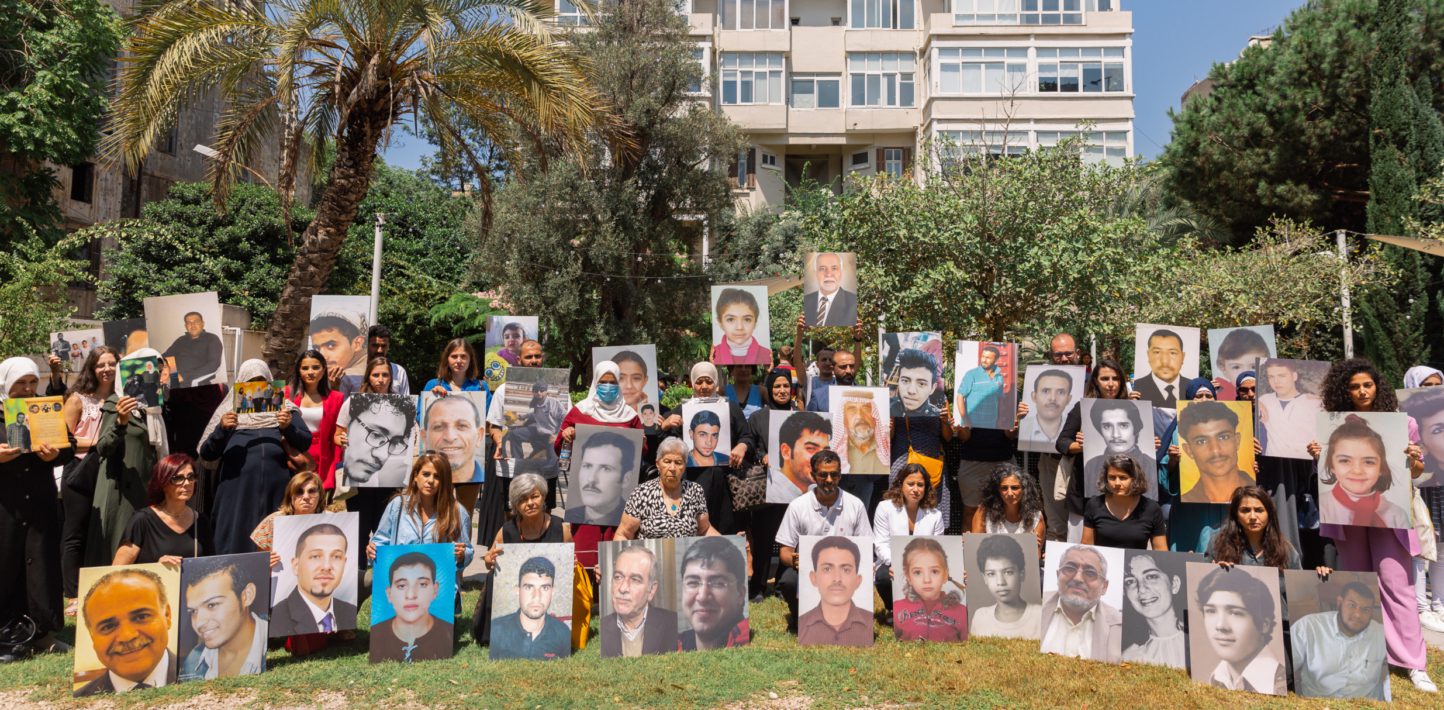
Family members of people who have been forcibly disappeared in the Middle East gather outside venue marking day of the disappeared in Beirut holding photos of their missing loved ones.

On 30 August 2023, Amnesty International reported on that Representatives of the families of people forcibly disappeared in Iraq, Lebanon, Syria and Yemen gathered in Beirut to demand that their governments uphold their rights to truth, justice and reparation, during an event organized by AI to mark the International Day of the Victims of Enforced Disappearances.    

Across the Middle East, both state authorities and non-state actors, such as armed opposition groups, abduct and disappear people as a way to crush dissent, cement their power, and spread terror within societies, largely with impunity.   

While most governments in the region have not yet investigated disappearances nor provided accurate numbers of those missing or disappeared, civil society organizations and UN bodies have published estimated numbers of people abducted and disappeared in each country. These numbers in Iraq, Lebanon, Syria and Yemen, when multiplied by a conservative estimate of the total years these individuals have been missing, suggest that families have spent more than a million years waiting for answers – an agonizing length of time.  

In the face of their governments’ apathy and complicity for the crime of enforced disappearances, the families of the disappeared across the Middle East have led the charge, year after year, in demanding their right to know what happened to their loved ones and to get justice and reparation – often at great personal risk,” said Aya Majzoub, Amnesty International’s Deputy Director for the Middle East and North Africa.   

“Today we honour their perseverance and add our voice to theirs in calling for authorities to take real action to investigate these crimes, hold those suspected of criminal responsibility accountable and ensure these crimes are not committed again.”  

Iraq  

In Iraq, the UN estimates that between 250,000 to 1,000,000 individuals have been disappeared since 1968 – making it one of the countries with the highest number of disappearances in the world. Disappearances are still being carried out today at hands of militias affiliated with the government. Consecutive Iraqi governments have repeatedly failed to take meaningful steps to investigate disappearances or hold those suspected of criminal responsibility to account. Widad Shammari from Iraqi organization Al Haq Foundation for Human Rights, whose son has been missing since 2006, said: “I was a single protester until I met many others who shared my struggle, and we formed a strong coalition who fights for the truth for all the disappeared in the Arab region, not just Iraq.”  

Lebanon    

In Lebanon, the official estimate of those abducted or missing as a result of the 1975-1990 civil war is 17,415. Every year, on 13 April – the anniversary of the start of the Lebanese Civil War – the families of the missing and disappeared gather to mark the beginning of the conflict, repeating the mantra, “Let it be remembered, not repeated.”   

The Lebanese authorities granted amnesty to the perpetrators of crimes that occurred during the civil war, but after years of campaigning, in 2018, the families of the disappeared successfully pressured the government to acknowledge the disappearances that took place. The government also passed a law that established the National Commission for the Missing and Forcibly Disappeared with a mandate to investigate individual cases, locate and exhume mass graves and enable a tracing process.   

However, Wadad Halawani, whose husband was kidnapped in 1982 and who leads the Committee of the Kidnapped and Missing in Lebanon said: “Today, we raise our voice and shout out loud. The National Commission for the Missing and Forcibly Disappeared is 3 years old already. Only two years remain in its mandate. The Commission established a clear strategy for its work, but it cannot carry on without the needed financial and logistical support. The government must provide it with all the needed resources immediately.” 

Syria  

Since 2011, the Syrian authorities have forcibly disappeared tens of thousands of its actual or perceived opponents, including political activists, protestors, human rights defenders, journalists, lawyers, doctors, and humanitarian aid workers, as part of a widespread and systematic attack against the civilian population that amounts to crimes against humanity. Thousands have also gone missing after being detained by armed opposition groups and the so-called Islamic State. Given the Syrian government’s role in orchestrating the campaign of enforced disappearances, there has been total impunity for these crimes in Syria. The families have therefore resorted to international justice mechanisms.  

In a momentous victory for the families, on 29 June 2023, the UN General Assembly voted to establish an international institution dedicated to shedding light on the fate and whereabouts of those missing and disappeared since the start of the armed conflict in Syria.  

Fadwa Mahmoud from Families for Freedom, whose husband and son were disappeared in Syria in 2012 said: “We had big dreams in 2011. But we paid a very heavy price. My husband and son have been disappeared since September 2012… We faced our fears and raised our voice until it reached the United Nations …this [institution] is the product of our labour as the families of the detained…and this is its strength. We are demanding that we have an instrumental role in the institution.”

My husband and son have been disappeared since September 2012… We faced our fears and raised our voice until it reached the United Nations …this [institution] is the product of our labour as the families of the detained…and this is its strength.Fadwa Mahmoud from Families for Freedom, whose husband and son were disappeared in Syria in 2012

Yemen  

In Yemen, human rights organizations have documented 1,547  cases of disappeared and missing people since 2015. All parties to the conflict, including the Huthi de facto authorities and the internationally recognized government forces, are still committing these crimes with impunity at a time when the world’s attention has turned away. Since the Human Rights Council voted in 2021 to end the mandate of the Group of Eminent Experts, following heavy lobbying from Saudi Arabia, efforts to hold all those suspected of criminal responsibility accountable in fair trials and realize victims’ rights to reparations have stalled.   

The Abductees’ Mothers Association in Yemen said: “We were harassed and threatened and beaten-up during demonstrations, but we will not give up and we are determined at ensuring some progress every step of the way. We are not mothers of our own disappeared family members only; we consider ourselves mothers of every single disappeared person in the region and we will continue our fight for the truth for all of them.

See also: https://humanrightsdefenders.blog/2022/09/14/portraits-of-disappeared-defenders-paraded-in-bangkok/

https://www.amnesty.org/en/latest/campaigns/