Archive for the 'Human Rights Defenders' Category

Write for Rights: Global letter writing campaign 2023 started

November 2, 2023

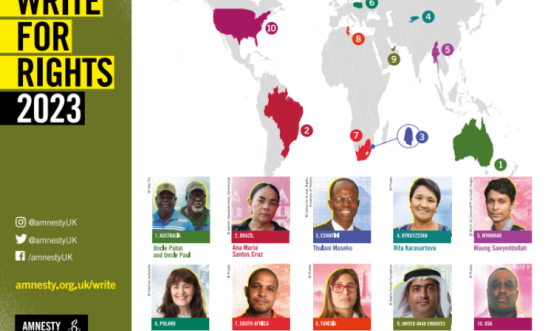
Amnesty International launched its flagship Write for Rights campaign to help people facing human rights abuses around the world. Millions of letters and emails will be sent to support these individuals and urge authorities to end injustices. While sending a letter may seem like a small gesture for any single one of us, the collective action of many of us has the potential to transform lives’ said Sacha Deshmukh, Chief Executive of Amnesty International UK.

Taking place across November and December, Write for Rights will see people around the world send millions of cards, emails and social media posts of solidarity to individuals whose fundamental rights are being threatened or denied, while urging those in power to put a halt to the abuses.

This year, the global Write for Rights campaign will focus on 10 cases of individuals and communities from across the world who are facing human rights violations, including:

  • Rocky Myers, a Black man, has been on death row in Alabama, USA, since 1994. A nearly all-white jury convicted and sentenced him to life without the possibility of parole for the murder of his white neighbour. The trial judge overrode their decision and imposed a death sentence – a practice now outlawed in Alabama. No evidence linked Rocky to the murder, except for a VCR stolen from the victim, which he maintains he had found abandoned in the street. In 2018, Rocky and others on death row were given 30 days to choose if they wanted to die by nitrogen gas asphyxiation or by amended lethal injection protocols. Rocky chose the former, and his execution could be reset as soon as the new protocol for execution by nitrogen gas asphyxiation is finalised and ready to be implemented, which is expected by the end of this year.
  • Rita Karasartova, a Kyrgyzstan-based human rights defender who works for the Institute of Civic Analysis – a human rights organisation and think-tank. Rita was arrested in October 2022 for joining group of activists who objected to a border demarcation agreement with Uzbekistan. After the group called for a public assembly and formed a committee to oppose the agreement, Rita and others were charged with attempting to violently overthrow the government, which carries a maximum sentence of 15 years imprisonment. Rita is now under house arrest and a strict curfew.
  • Ahmed Mansoor is a human rights defender and previously won the prestigious Martin Ennals Award for Human Rights Defenders in 2015. Ahmed has documented human rights abuses in the UAE since 2006, until he was arrested in early 2011 and March 2017, he was given a 10-year prison sentence. He has been held in solitary confinement since the beginning of his detention, and continues to be denied a mattress, access to books, and to be permitted to go out in a yard. See: https://humanrightsdefenders.blog/tag/ahmed-mansoor/ and https://www.trueheroesfilms.org/thedigest/laureates/074ACCD4-A327-4A21-B056-440C4C378A1A]
  • Justyna Wydrzyńska is a reproductive rights defender in Poland and is one of the co-founders of the Abortion Dream Team, an activist collective campaigning against abortion stigma and offering advice on accessing safe abortion in Poland, where abortion laws are among the most restrictive in Europe. In March 2023 Justyna was convicted to 8 months’ community service for helping a pregnant woman to access abortion pills in Poland, setting a dangerous precedent in a country where abortion is almost completely banned.

Amnesty International’s Write for Rights campaign dates back to the origins of Amnesty International in 1961. In the organisation’s early days, Amnesty campaigners wrote letters of support to individuals facing human rights violations. Now, Write for Rights is Amnesty’s flagship campaign, running every year to raise awareness about individuals whose rights are being seriously threatened.

Last year’s Write for Rights saw:

  • Over 5.3 million actions worldwide – of which at least 234,801 letters and cards were solidarity actions.
  • Letters were sent from around the world, from Zimbabwe to Hong Kong.
  • Amnesty’s International Secretariat digitally collected almost double the number of digital actions from 2021.

For 2021 see: https://humanrightsdefenders.blog/2021/11/08/write-for-rights-2021-launched/
https://www.amnesty.org.uk/press-releases/write-rights-global-letter-writing-movement-stands-victims-human-rights-abuses

Call for nominations of the 2024 Front Line Defenders Award for human rights defenders

November 2, 2023

Front Line Defenders is currently accepting nominations for the 2024 Front Line Defenders Award for Human Rights Defenders at Risk:

award banner

For more on the annual Front Line Defenders Award and its laureates see: https://www.trueheroesfilms.org/thedigest/awards/2E90A0F4-6DFE-497B-8C08-56F4E831B47D

For each region of the world (Africa; Americas; Asia-Pacific; Europe & Central Asia; and Middle East & North Africa) there will be one winner selected and Front Line Defenders will recognize all five as the 2024 Front Line Defenders Award Laureates.

The nomination process is open for anyone to submit a nomination of a human rights defender, collective, organisation or community working on any human rights issue and facing significant risk due to their work or operating in an environment that itself is characterised as insecure. The purpose of the Award is to give visibility to HRDs who are not normally acknowledged or recognised at the international level. At the same time, the Award should not bring additional risk for which the HRD is not prepared. In addition to the Award, winners will receive:

  • a modest financial prize;
  • a security grant to improve their security measures;
  • collaboration with Front Line Defenders for media work in recognition of the Award;
  • advocacy by Front Line Defenders related to the Award and the work of the winners;
  • an event co-organized by the HRD, local partners and Front Line Defenders to give visibility to the Award in the winners’ countries (as determined and guided by the winners);
  • the Global Laureates will attend a ceremony in Dublin at a date to be determined;
  • ongoing security consultation with Front Line Defenders

For last year’s see:https://humanrightsdefenders.blog/2023/06/05/front-line-defenders-award-2023-goes-to-front-line-defenders/

If you would like to nominate a HRD for the 2024 Front Line Defenders Award for Human Rights Defenders at Risk, please follow this link to the secure online nomination form.

2024 Front Line Defenders Award – Nomination Form

https://www.frontlinedefenders.org/en/call-nominations-2024-front-line-defenders-award-human-rights-defenders-risk

Magomed Alamov’s life in Chechnya threatened

October 31, 2023

On 24 October 2023, human rights group Crew Against Torture reported that the Chechen Authorities had held Crew Against Torture member and Chechen human rights defender Magomed Alamov, and issued death threats. The authorities also threatened Magomed Alamov by threatening his family’s safety.

Magomed Alamov returned to the Chechen Republic after accompanying a young woman, who was a survivor of domestic, violence from Russia’s North Caucasus on 5 October 2023. Since his return, his colleagues have not been able to reach him.

Magomed Alamov is a human rights defender and lawyer of Chechen origin. Up until very recently, he has collaborated with the human rights group Crew Against Torture; an informal union of Russian lawyers who, individually, continue the work they used to do as a Russian-based human rights organisation “Committee Against Torture” (CAT). Following the listing of CAT as a foreign agent by Russian authorities on 10 June 2022, the organisation was forced to close its doors. Established in 2000, CAT was a prominent human rights organisation in Russia, investigating allegations of torture by state agents and representing victims of torture in the court system, including at the European Court of Human Rights. Human rights defenders who used to work with CAT were regularly subjected to defamation campaigns, physical attacks, detentions, and judicial persecution because of their peaceful human rights work.

On 5 October 2023, at the request of the human rights organisation ‘North Caucasus: SOS’, Magomed Alamov accompanied a survivor of domestic violence from Ingushetia to a safehouse. On 11 October 2023, the human rights defender started to receive phone calls from the General Administration for Combating Extremism (Centre E). The caller demanded that Magomed Alamov present himself for questioning in relation to his involvement in the alleged disappearance of the aforementioned survivor. In the absence of a subpoena, the human rights defender refused to present himself.

On 13 October, Chechen law enforcement officers unlawfully detained the human rights defender’s brother, at the Special Police Regiment #2, where the authorities threatened him, and demanded him to get in touch with Magomed Alamov and to convince the human rights defender to return to the Chechen Republic. Fearing for his brother’s life, Magomed Alamov travelled to the Chechen Republic; his colleagues from Crew against Torture are unsure about his current whereabouts.

On 23 October2023, the survivor of domestic violence got in touch with her relatives in the Chechen Republic, and reported that Magomed Alamov was present at their house during the call. She reported that the human rights defender addressed her and said “I am at your house, surrounded by your relatives. My life and the life of my family is in danger. They gave me a week for you to return home. If you are not home in a week – they will kill me.” On 23 October 2023 the Crew against Torture filed complaints to the Ministry of Interior and to the Office of the Prosecutor General of the Russian Federation demanding protection for the human rights defender.

Front Line Defenders condemns the harassment and death threats against the human rigths defender and lawyer Magomed Alamov. The organisation believes he is being targeted for his peaceful and legitimate human rights work. Front Line Defenders reminds the Russian authorities that the Chechen Republic is a part of the Russian Federation, and calls upon them to end systemic harassment against human rights defenders in the North Caucasus. Front Line Defenders urges the Russian authorities to confirm the whereabouts of Magomed Alamov, and ensure his safety in the Chechen Republic, as well as elsewhere in the country.

https://www.frontlinedefenders.org/en/case/chechen-authorities-hold-human-rights-defender-magomed-alamov-promising-kill-him-5-days

Meet lawyer Dennis Muñoz, human rights defender in El Salvador

October 31, 2023

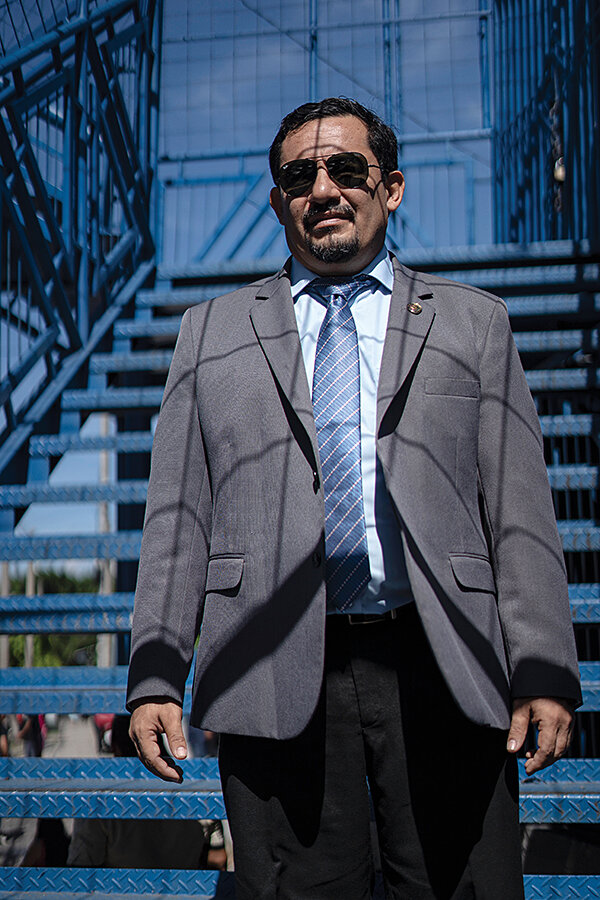
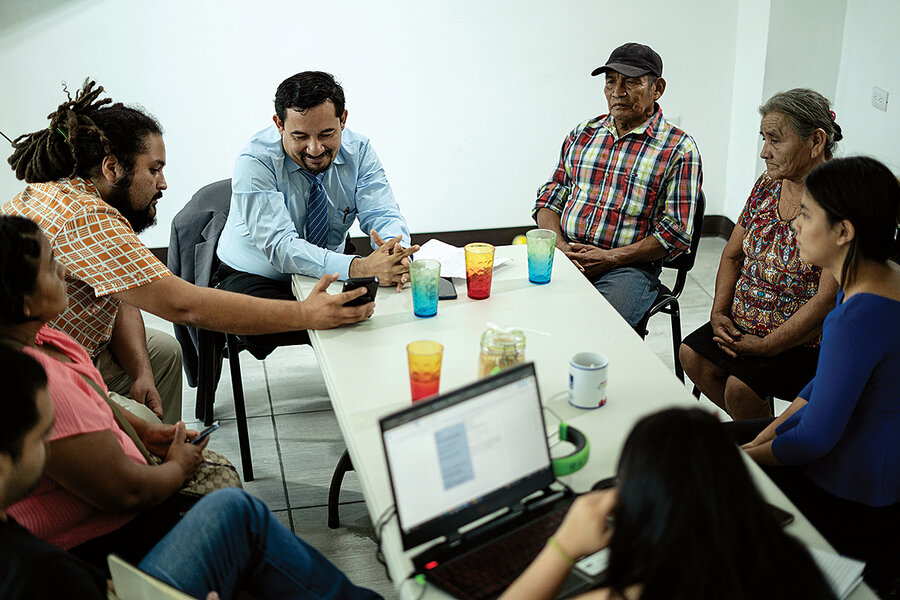
The Christian Science Monitor of 30 October 2023, tells the story of attorney Dennis Muñoz who seeks to uphold human rights in El Salvador, despite increasingly difficult and dangerous odds.

Víctor Peña/Special to The Christian Science Monitor

Mr. Muñoz found a way to channel his deep-seated desire for justice by becoming a lawyer in 2005. But he doesn’t work with just anyone – he goes for the tough cases of human rights abuses. He has defended multiple women who suffered miscarriages but were accused of murder in a nation where abortion is banned without exception. He has fought arbitrary arrests of environmentalists, activists, and average citizens. He could be called a defender of lost causes.

There’s no shortage of demand for Mr. Muñoz’s work in El Salvador, which has the highest incarceration rate in the world. And these days the risks of his work are almost as high as the demand for it.

In March 2022, a monthlong “state of exception” was enacted in response to extreme gang violence. The order suspended basic constitutional rights for those arrested under it. Securing a court warrant before searching private communications was no longer required, for example, and arrestees were barred from their right to a defense attorney and their right to see a judge within 72 hours. 

But what started as an emergency measure has become ordinary practice. The state of exception has been extended every month for more than a year and a half now, with no end in sight. Violence has declined dramatically, but critics say the order’s extreme powers are seeping far beyond the gang-related arrests they were meant to address. Even those detained outside of the state-of-
exception category are having their rights suspended. 

That’s the group Mr. Muñoz focuses on. While he has taken a few state-of-exception cases, he primarily works on human rights violations, with the added burden now of his clients getting caught in the emergency order’s crosshairs. Despite death threats and intimidation, he’s not slowing down. Instead, fellow lawyers doing similarly risky work ask him to be on call if – or, perhaps more likely, when – they themselves are arrested. 

… Despite quashing constitutional rights, the move has been overwhelmingly popular for providing a long-elusive sense of calm. 

A tired society, fed up with a lack of answers to the chronic problem of violence, is willing to accept short-term answers,” says Verónica Reyna, director of human rights for the Passionist Social Service, a nongovernmental organization focused on local violence prevention and support of human rights. 

Gustavo Villatoro, minister of justice and public security, acknowledges that the state of exception is affecting more than gang members. Over 7,000 innocent people have been arrested, Mr. Villatoro said in August, noting that some degree of error is inevitable. But the consequences of those errors can be grave. Even if a case has nothing to do with gang activity, lawyers can be blocked from visiting their clients in detention, and court hearings can be suspended. Over 71,000 Salvadorans have been arrested under state-of-exception rules. With 6 million people in El Salvador, close to 2% of the adult population is currently behind bars. And many of them, even those not under the emergency order, lack access to a lawyer and may be tried en masse.

Margaret Satterthwaite, the United Nations special rapporteur on the independence of judges and lawyers, tweeted in May that in El Salvador, “public defenders reportedly have 3-4 minutes to present the cases of 400 to 500 detainees.” She warned that “fair trial rights must not be trampled in the name of public safety.” 

In the last week of July, Salvadoran lawmakers eliminated a previous two-year limit on pretrial detentions and passed reforms to allow mass trials that could bring together 1,000 individuals in a single appearance before a judge.

Maybe they won’t let us be lawyers anymore,” says Mr. Muñoz, “at least not private attorneys with independent criteria.

The reforms have disrupted the whole system and have turned innocence into an exception,” says Ursula Indacochea, program director at the Due Process of Law Foundation, based in Washington. “Presumption of innocence is disappearing because the roles have shifted. The state no longer has to prove I’m guilty, but now I’m guilty and have to prove I’m innocent,” Ms. Indacochea said in a Sept. 7 radio interview in El Salvador. 

Of the 35,000 authorized lawyers registered in El Salvador, Mr. Muñoz stands out for almost exclusively taking cases of human rights violations.

“Things aren’t easy right now,” he says, describing the justice system as “made to convict.” The government is “criminalizing the job of lawyers,” he adds.

Yet Mr. Muñoz looked anything but cautious at a press conference in early July, where he was the only person wearing a suit at the San Salvador offices of the Christian Committee for Displaced People in El Salvador, a wartime human rights organization. He headed to the podium in the ample room, sparsely decorated with pictures of St. Óscar Romero, the archbishop of San Salvador murdered by right-wing death squads in 1980. 

Mr. Muñoz discussed openly a forbidden topic. Five environmentalists were arrested in January over the alleged 1989 murder of a Salvadoran woman during the war. The case was under a court-issued gag order.  

It’s very serious that environmentalists are being unjustly accused, bending [what are considered] the rules of due process anywhere in the world,” Mr. Muñoz said, staring into the cameras.

His clients in this case are former guerrilla members, and two of the accused are part of the Association of Economic and Social Development Santa Marta, known as ADES. One of the country’s oldest environmental organizations, ADES was key in achieving the total ban on mining here in 2017. In a country where almost the entirety of war crimes remain unresolved and defendants in active cases are rarely imprisoned, the arrest of these men was an outlier, apparently due to their vocal criticism of the government. The U.N. called for the activists’ immediate release. 

“Dare I say there are crimes being committed against these environmentalists,” Mr. Muñoz said before the media. “It’s nefarious that things like this happen in a country that calls itself democratic but really has a criminal injustice system in place.” 

Víctor Peña/Special to The Christian Science Monitor

By late August, Mr. Muñoz had successfully convinced a judge to grant an order for his clients’ release. “It’s a crumb of justice, but we shouldn’t celebrate until there’s a dismissal of proceedings,” he said at a later press conference.

It’s hard to reconcile this image of seeming fearlessness with Mr. Muñoz’s request when the Monitor approached him for an interview: Could the piece leave out his last name? The question reflects a sense of fear that has built up over many years of doing this work. 

Mr. Muñoz downplays receiving death threats, normalizing the culture of violence he’s lived under for most of his professional life. “They say they wish that I was extorted or killed because of the people I’ve defended,” he says about the social media threats. He thinks he’s been able to stay off the political radar by censoring his opinions. “I issue legal and technical opinions,” he explains. “Other colleagues have entered the political arena and expose themselves more to attacks.” 

https://www.csmonitor.com/World/Americas/2023/1030/Meet-Dennis-Munoz-defender-of-lost-causes-in-El-Salvador

Matiullah Wesa, Afghan human rights defender, released but what about the others?

October 30, 2023
FILE - Matiullah Wesa, a girls' education advocate, reads to students in the open area in Spin Boldak district in the southern Kandahar province of Afghanistan on May 21, 2022. The Taliban have freed the Afghan activist who campaigned for the education of girls, a local nonprofit organization said Thursday, Oct. 26, 2023. Wesa was arrested seven months ago and spent 215 days in prison, according to the group, Pen Path.
Matiullah Wesa, a girls’ education advocate, reads to students in the open area in Spin Boldak district in the southern Kandahar province of Afghanistan on May 21, 2022. Siddiqullah Khan/AP

On 26 October 2023 AP reported that the Taliban have freed an Afghan activist who campaigned for the education of girls. Matiullah Wesa was arrested seven months ago and spent 215 days in prison, according to the group, Pen Path.

The Special Rapporteur on Human Rights of the United Nations Human Rights Council, Rina Amiri,, has welcomed the release of Matiullah Wesa, the founder of the “Rah-e-Qalam” organization and an education activist, and has called for the freedom of all human rights defenders in Afghanistan. Richard Bennett, the Special Rapporteur on Human Rights of the United Nations, has requested the immediate and unconditional release of all individuals detained “arbitrarily for defending their rights and the rights of others.”

Ataullah Wesa, Matiullah’s brother, announced on his social media account that he had been released after 215 days. However, some human rights activists and well-known members of Afghan civil society remain in prison.

Amnesty International said that Wesa should never have been jailed for promoting girls’ rights to education.

The Taliban de-facto authorities must release human rights defenders and women protesters Rasool Parsi, Neda Parwani, Zholia Parsi and Manizha Sediqi and all others who are unfairly kept behind bars for standing up for equality and denouncing repression,” the rights group tweeted.

https://www.ourmidland.com/news/education/article/taliban-free-afghan-activist-arrested-7-months-18449253.php

https://www.ohchr.org/en/press-releases/2023/10/taliban-must-immediately-release-women-human-rights-defenders-say-un-experts

National Human Rights Institutions of Egypt and Bahrain fail the Paris Principles

October 30, 2023
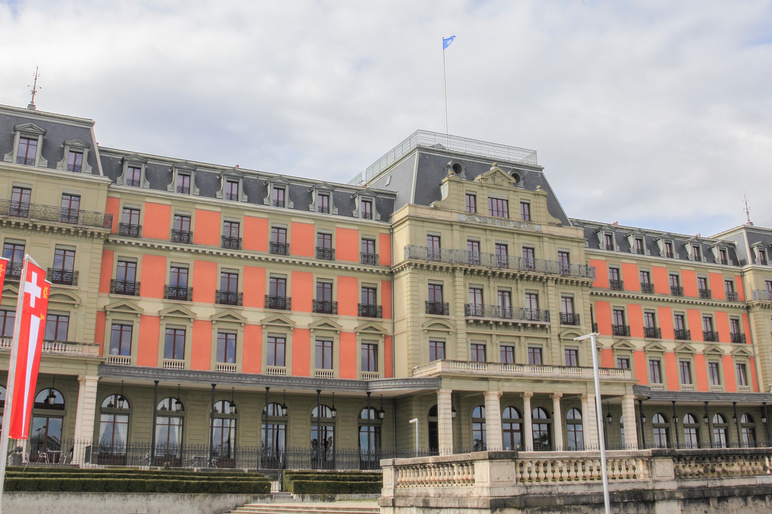
Palais Wilson shutterstock 1084789991

In a letter addressed to the Sub-Committee on Accreditation (SCA) of the Global Alliance of National Human Rights Institutions (GANHRI), civil society organisations, including the FIDH and the World Organisation Against Torture (OMCT), warn that Bahrain and Egypt do not comply with the Paris Principles, failing to respect the very pillars of these principles: pluralism, independence and effectiveness.

The undersigned civil society organisations believe that the two countries’ NHRIs have failed to comply with the Paris Principles and to implement recommendations outlined by the SCA’s previous reports in 2016 and 2018, respectively.

The Paris Principles define the minimal standards that NHRIs must abide by “in order to be considered credible and to operate effectively.” The pillars of these principles are pluralism, independence and effectiveness. NHRIs must be independent from the government, represent and cooperate with civil society, and effectively promote human rights by monitoring violations and addressing them. Based on civil society reports, the Bahraini and Egyptian NHRIs fall short of these standards.

In Bahrain, all the current members of the National Institution for Human Rights (NIHR) were appointed by King Hamad through a royal decree issued on 9 May 2021, and there is no democratic or independant mechanism through which these selections are made. The current Chairman of the NIHR, Ali al-Derazi, was reportedly implicated in abuses against migrant workers. Furthermore, the Vice-Chairperson of the NIHR, Mr. Khaled Abdulaziz Alshaer had previously called on those who criticised the Bahraini government to receive the death penalty.

In August 2022, the UN Committee on Economic, Social and Cultural Rights concluded that “[the NIHR] has not yet attained the independence required to perform its functions.” Previously in 2018, the UN Human Rights Committee had expressed similar concern and “[regretted] the lack of information on the complaints [the NIHR] has received and the investigations it has carried out in response to those complaints.”

In addition, Bahrain’s NIHR fails to address and outright denies the human rights abuses committed by the authorities, including arbitrary detention, ill-treatment and medical negligence in various detention facilities. This contradicts the UN Working Group on Arbitrary Detention’s findings regarding Abduljalil al-Singace, Abdulhadi al-Khawaja and Naji Fateel, three Bahraini human rights defenders who were arbitrarily detained, tortured, medically neglected and subjected to sham trials. [see also: https://humanrightsdefenders.blog/tag/bahrain/]

As for the Egyptian National Council for Human Rights (NCHR), it also lacks independence from the government. In 2021, new members of the NCHR were appointed for four years. The Chair, Ms. Moushira Khattab, and the Vice-President, Mr. Mahmoud Karem Mahmoud are both former Egyptian officials and diplomats. In both 2014 and 2018, Mahmoud was the coordinator of al-Sisi’s presidential campaign, which clearly demonstrates the NCHR’s close relationship with the executive.

In March 2023, the UN Human Rights Committee had echoed these concerns over the “lack of safeguards to ensure [the NCHR’s] full independence and effectiveness”, as well as over “the lack of information provided on the effective implementation of its recommendations.”

The NCHR has left hundreds of complaints unanswered and blatantly denies that certain human rights abuses are being committed. In 2020, the Council stated that findings of the UN Committee against Torture, according to which torture was “systematic” in Egypt, were a “politicized categorization” seeking to “undermine the efforts of the government”. The NCHR has also remained silent on prominent human rights issues such as the practice of enforced disappearance or the dire conditions of detention. In July 2023, the Council’s president compared a new correctional facility in Wadi al-Natroun to a “5-star hotel”. We believe that the Egyptian NCHR is far from acting as a NHRI with “A” status, which it has worryingly been granted since 2006 by the SCA. [see also: https://humanrightsdefenders.blog/tag/egypt/]

In light of the above, it is clear that the NHRIs of Bahrain and Egypt have consistently failed to comply with the Paris Principles and to implement the SCA’s recommendations.

We urge you to consider the aforementioned shortcomings of Bahrain and Egypt’s NHRIs when reviewing them during your upcoming session, and to not grant them status “A”.

Signatories:

  • Bahrain Institute for Rights and Democracy (BIRD)
  • CIVICUS
  • Democracy for the Arab World Now (DAWN)
  • Egyptian Commission for Rights and Freedoms
  • Egyptian Front for Human Rights (EFHR)
  • El Nadeem against Violence and Torture
  • Human Rights Foundation (HRF)
  • HuMENA for Human Rights and Civic Engagement
  • International Federation for Human Rights (FIDH) – within the framework of the Observatory for the Protection of Human Rights Defenders
  • International Service for Human Rights (ISHR)
  • Law and Democracy Support Foundation (LDSF)
  • MENA Rights Group
  • Rights Realization Centre (UK)
  • Salam for Democracy and Human Rights (SALAM DHR)
  • The #FreeAlKhawaja Campaign
  • The Freedom Initiative (FI)
  • World Organisation Against Torture (OMCT) – within the framework of the Observatory for the Protection of Human Rights Defenders

https://www.omct.org/en/resources/statements/bahrain-and-egypts-national-human-rights-institutions-do-not-comply-with-the-paris-principles

Human rights defender Oleg Orlov in further trouble

October 30, 2023

The Prosecutor’s Office has appealed against the verdict passed to human rights defender, Oleg Orlov, who was fined on charges of discrediting the Russian Army, and demanded to sentence him to three years in colony. [see: https://humanrightsdefenders.blog/2022/04/01/grim-times-for-human-rights-defenders-and-real-journalists-in-russia/]

The “Caucasian Knot” has reported that on October 11, the Golovinsky District Court of Moscow sentenced Oleg Orlov, a co-chairman of the “Memorial” Centre for Human Rights Defence, to a fine of 150,000 roubles. At the same time, the prosecutor asked the court to fine Orlov by 250,000 roubles, and his defence stated that the article of the Criminal Code about discrediting the Russian Army was contrary to the Russian Constitution and the international law.

The reason to accuse Orlov was a Russian translation of his article posted on the Facebook*; the original was published in the French outlet named “Mediapart”. The article condemns the special military operation (SMO) in Ukraine.

On October 26, Orlov and his defence filed a complaint against the court verdict, the above “Memorial” Centre reported in its Telegram channel.

“The PO has also challenged the verdict. They demand to sentence Orlov to three years of freedom deprivation – this is the maximum punishment under the article under which he is being tried,” the outlet says.

The PO has justified the change in its position by saying that Orlov experiences political and ideological hatred of the Russian Federation, and also, together with the “Memorial”, continues undermining the stability of the civil society.

Oleg Orlov has treated the PO’s appeal presentation as “an act of self-exposure.” “Now no one can doubt that this trial was and continues to be of a political nature. I am being prosecuted for my dissent,” he has noted.

https://eng.kavkaz-uzel.eu/articles/63362

Death threats against Ecuadorian human rights defender Javier Medardo Feijoo Villa

October 22, 2023

On 20 October 2023 Front Line Defenders wrote that between 2 October 2023 and 16 October 2023, human rights defender Javier Medardo Feijoo Villa received several death threats via phone calls and voice messages towards both him and his family. The unidentified perpetrators claimed that they were keeping the human rights defender under surveillance, and maintained that they had access to his data and aware of all his moves within the community.l

Javier Medardo Feijoo Villa is the president of the Estero Piedras community, located in the coastal area of the Molleturo on Azuay province. This community is also part of the San Felipe de Molleturo Commune, an ancestral territory that has been of great importance to the region, given that it has fought to defend against attempts by transnational mining companies to dispossess the people in the region of their land and water sources. He is also president of the North Zone Road Committee, which represents 15 communities in the region. As a community leader, the human rights defender has sought support from the competent authorities to stop criminal acts and illicit activities, mainly assaults and robberies caused by criminal groups that threaten the area. Javier has played an important role in the defence of water, nature and the territories belonging to the communities who he represents.

Since 2 October 2023, human rights defender Javier Medardo Feijoo Villa has been the target of several death threats. Over the course of two weeks, he has received calls and voice messages threatening to kill him and his family. The callers claimed to be keeping the human rights defender under surveillance, and maintained that they had access to his data, as well as all his moves. The level of violence articulated in these threats increased over the weeks, causing the human rights defender to stop responding to messages or calls altogether, and provoking him to block the numbers of those who called him. The threats continued up until 16 October 2023. The human rights defender has been filing relevant complaints with the Prosecutor’s Office about the recent threats and has requested that the Police Commander of Zone 6 take the necessary measures protect him and his family.

Violence against human rights defenders working on indigenous, land and environmental rights has been on the rise in Ecuador; human rights defenders Andrés Durazno and Alba Bermeo were murdered in 2021 and 2022 respectively. Still to this day no one has been charged with their murder.

https://www.frontlinedefenders.org/en/case/ecuador-death-threats-against-human-rights-defender-and-community-leader-javier-medardo-feijoo

EU’s Lorenzo Natali Media Prize 2023 to 3 Venezuelan journalists

October 21, 2023

The winners of this year’s edition of the Lorenzo Natali Media Prize, awarded by the European Commission, were announced on 11 October at a ceremony hosted at the Solvay Library in Brussels.

The winners of the International Prize are:

Three Venezuelan journalists Carmen Victoria Inojosa, Claudia Smolansky and a third whose name cannot be disclosed for security reasons, were awarded the International Prize for their compelling article ‘Así funcionan las casas clandestinas de la Dgcim en Caracas‘ published in Armando.info. Their work exposed the harrowing reality of systematic persecution in Venezuela, targeting political opponents and their families with alarming impunity.

For more on this award see: https://www.trueheroesfilms.org/thedigest/awards/D49ECF35-4B42-444D-B4FA-F7ACE2BF65BC

Lorenzo Natali Media Prize website

https://ec.europa.eu/commission/presscorner/detail/en/ip_23_4881

Mahsa Amini and Woman, Life and Freedom Movement in Iran awarded EU’S Sakharov Prize

October 19, 2023
Women attend a protest against the death of Mahsa Amini, a woman who died while in police custody in Iran, during a rally in Tel Aviv, Oct. 29, 2022.

 Euronews reported on 19 October 2023 that Mahsa Amini and the Woman, Life and Freedom Movement in Iran were awarded the European Parliament’s Sakharov Prize for Freedom of Thought.

The 16 September 2022 is a date that will live in infamy and the brutal murder of 22-year-old Jina Mahsa Amini marked a turning point. It has triggered a women-led movement that is making history,” European Parliament President Roberta Metsola said after announcing the winner. 

Two other nominees made it on the finalist shortlist: Women rights’ defenders and Nicaraguan activists. See: https://humanrightsdefenders.blog/2023/10/18/sakharov-prize-2023-finalists-announced/