Archive for the 'Human Rights Defenders' Category

Frontline’s Guide to Secure Group Chat and Conferencing Tools

July 21, 2020

With teams increasingly working remotely during COVID-19, we are all facing questions regarding the security of our communication with one another: Which communication platform or tool is best to use? Which is the most secure for holding sensitive internal meetings? Which will have adequate features for online training sessions or remote courses without compromising the privacy and security of participants?

Front Line Defenders presents this simple overview which may help you choose the right tool for your specific needs.
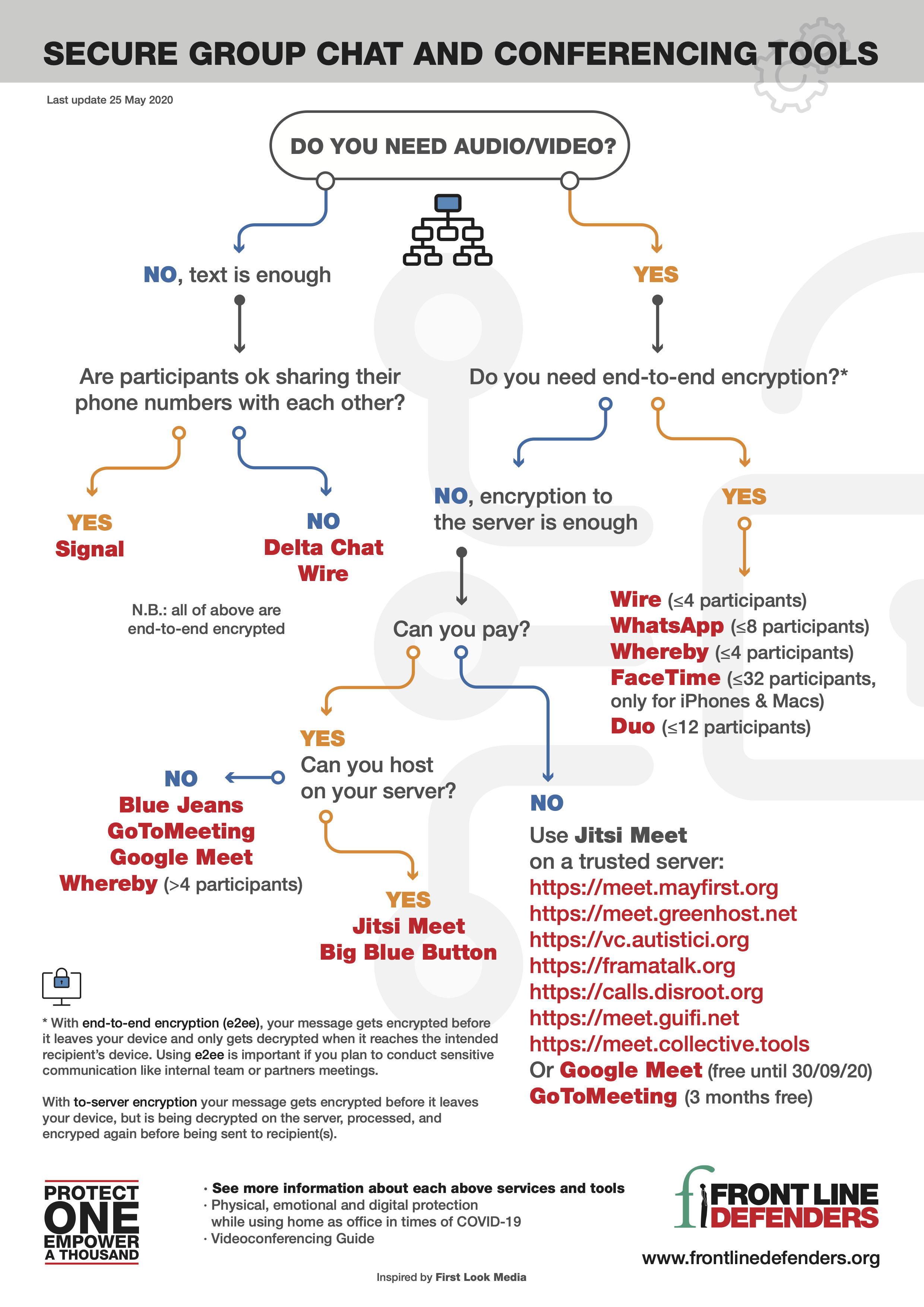
FLD Secure Group Chat Flowchart

Download PDF of the flow chart

Note:

  • With end-to-end encryption (e2ee), your message gets encrypted before it leaves your device and only gets decrypted when it reaches the intended recipient’s device. Using e2ee is important if you plan to transmit sensitive communication, such as during internal team or partners meetings.
  • With encryption to-server, your message gets encrypted before it leaves your device, but is being decrypted on the server, processed, and encrypted again before being sent to recipient(s). Having encryption to-server is OK if you fully trust the server.

Why Zoom or other platforms/tools are not listed here: There are many platforms which can be used for group communication. In this guide we focused on those we think will deliver good user experiences and offer the best privacy and security features. Of course none of the platforms can offer 100% privacy or security as in all communications, there is a margin of risk. We have not included tools such as Zoom, Skype, Telegram etc. in this guide, as we believe that the margin of risk incurred whilst using them is too wide, and therefore Front Line Defenders does not feel comfortable recommending them.

Surveillance and behaviour: Some companies like Facebook, Google, Apple and others regularly collect, analyse and monetize information about users and their online activities. Most, if not all, of us are already profiled by these companies to some extent. If the communication is encrypted to-server owners of the platform may store this communication. Even with end-to-end encryption, communication practices such as location, time, whom you connect with, how often, etc. may still be stored. If you are uncomfortable with this data being collected, stored and shared, we recommended refraining from using services by those companies.

The level of protection of your call depends not only on which platform you choose, but also on the physical security of the space you and others on the call are in and the digital protection of the devices you and others use for the call.

See also:

Caution: Use of encryption is illegal in some countries. You should understand and consider the law in your country before deciding on using any of the tools mentioned in this guide.

Criteria for selecting the tools or platforms

Before selecting any communication platform, app or program it is always strongly recommended that you research it first. Below we list some important questions to consider:

  • Is the platform mature enough? How long has it been running for? Is it still being actively developed? Does it have a large community of active developers? How many active users does it have?
  • Does the platform provide encryption? Is it end-to-end encrypted or just to-server encrypted?
  • In which jurisdiction is the owner of the platform and where are servers located? Does this pose a potential challenge for your or your partners?
  • Does the platform allow for self-hosting?
  • Is the platform open source? Does it provide source code to anyone to inspect?
  • Was the platform independently audited? When was the last audit? What do experts say about the platform?
  • What is the history of the development and ownership of the platform? Have there been any security challenges? How have the owners and developers reacted to those challenges?
  • How do you connect with others? Do you need to provide phone number, email or nickname? Do you need to install a dedicated app/program? What will this app/program have access to on your device? Is it your address book, location, mic, camera, etc.?
  • What is stored on the server? What does the platform’s owner have access to?
  • Does the platform have features needed for the specific task/s you require?
  • Is the platform affordable? This needs to include potential subscription fees, learning and implementing, and possible IT support needed, hosting costs, etc.

The document then proceeds to give more detailed information related to each tool/service listed in this guide

Signal – https://signal.org/

Delta Chat – https://delta.chat/

Wire – https://wire.com/

Jitsi Meet – https://jitsi.org/jitsi-meet/

BigBlueButton – https://bigbluebutton.org/

Whereby – https://whereby.com

Blue Jeans – https://www.bluejeans.com/

GoToMeeting – https://www.gotomeeting.com/

Facetime / iMessage –https://www.apple.com/ios/facetime

Google Meet – https://meet.google.com/

Duo – https://duo.google.com/

WhatsApp – https://www.whatsapp.com/

Video calls, webinar or online training recommendations

Video calls recommendations: In the current situation you will undoubtedly find yourself organizing or participating in many more video calls than before. It may not be obvious to everyone how to do it securely and without exposing yourself and your data to too much risk:

  • Assume that when you connect to talk your camera and microphone may be turned on by default. Consider covering your camera with a sticker (making sure it doesn’t leave any sticky residue on the camera lens) and only remove it when you use the camera.
  • You may not want to give away too much information on your house, family pictures, notes on the walls or boards, etc. Be mindful of the background, who and what is also in the frame aside from yourself? Test before the call by, for example, opening meet.jit.si and click on GO button to get to a random empty room with your camera switched on to see what is in the picture. Consider clearing your background of clutter.
  • Also be mindful who can be heard in the background. Maybe close the door and windows, or alert those sharing your space about your meeting.
  • Video call services may collect information on your location and activity, consider using a VPN (see Physical, emotional and digital protection while using home as office in times of COVID-19 guide).
  • It is best to position your face so your eyes are more or less at the upper third of the picture without cutting off your head. Unless you do not want to reveal your face, do not sit with your back to a light or a window. Daylight or a lamp from the front is the best. Stay within the camera frame. You may want to look into the lens from time to time to make “eye contact” with others. If you are using your cellphone, rest it against a steady object (e.g. a pile of books) so that the video picture remains stable.
  • You may want to mute your microphone to prevent others hearing you typing notes or any background noise as it can be very distracting to others on the call.
  • If the internet connection is slow you may want to switch off your camera, pause other programs, mute the microphone and ask others to do same. You may also want to try sitting closer to the router, or connecting your computer directly to the router with an ethernet cable. If you share internet connection with others, you may ask them to reduce extensive use of internet for the duration of your call.
  • It it very tempting to multitask especially during group calls. But you may very soon realise that you are lost in the meeting and others may realize this.
  • If this is a new situation for you or you are using a new calling tool, you may want to give yourself a few extra minutes to learn and test it prior to the scheduled meeting to get familiar with options like turning on/off the camera and the microphone, etc.
  • If possible, prepare and test a backup communication plan in case you will have trouble connecting with others. For example, adding them to a Signal group so you can still text chat or troubleshoot problems on the call. Sometimes it helps to have an alternate browser installed on your computer or app on the phone to try connecting with those.

If you would like to organise a webinar or online training, you can use tools outlined above in the group communication. Some of best practices include:

  • Make sure that you know who is connected. If this is needed check the identities of all people participating by asking them to speak. Do not assume you know who is connected only by reading assigned names.
  • Agree on ground-rules, like keeping cameras on/off, keeping microphone on/off when one is not speaking, flagging when participants would like to speak, who will be chairing the meeting, who will take notes – where and how will those notes be written and then distributed, is it ok to take screenshots of a video call, is it ok to record the call, etc.
  • Agree on clear agendas and time schedules. If your webinar is longer than one hour, it is probably best to divide it into clear one-hour sessions separated by some time agreed with participants, so they have time to have a short break. Plan for the possibility that not all participants will return after a break. Have alternative methods to reach out to them to remind them to return, like Signal/Wire/DeltaChat contacts for them.
  • It is easiest to use a meeting service that participants connect to using a browser without a need to register or install a special program, one that also gives the webinar organiser the ability to mute microphones and close cameras of participants.
  • Prior to the call, check with all participants whether they have particular needs, such as if they are deaf or hard of hearing, if they are visually impaired or blind, or any other conditions which would affect their participation in the call. With this in mind, ensure that the selected platform will accommodate these needs and to be sure, test the platform beforehand. Simple measures can also improve inclusion and participation in your calls, such as turning on cameras when possible, as it can allow for lip-reading.
  • Encourage all participants to speak slowly and to avoid jargon where possible, as the working language of the call is most likely not everyone’s mother tongue language. Naturally, there will be moments of silences and pauses, embrace them. They can help to support understanding and can be helpful for participants who are hard of hearing, interpreters and will also aid assistive technology to pick up words correctly.

https://www.frontlinedefenders.org/en/resource-publication/guide-secure-group-chat-and-conferencing-tools

Posdcast with Ketty Nivyabandi, poet & woman human rights defender from Burundi

July 20, 2020

Ketty Nivyabandi is a Burundian activist and poet who led the first women-only demonstrations against Burundi’s president in 2015. She defied police beatings, tear gas, and a water cannon to make women’s voices heard.

In this podcast THE HUMAN RIGHTS FOUNDATION dives into Burundi’s authoritarian regime and Ketty’s resistance to Burundi’s dictatorship. What role can women play in protesting and organizing? How do you survive police brutality? How can people remain hopeful and support protestors in Burundi?

https://www.youtube.com/watch?v=XfJuctTwAuA&feature=youtu.be

Human rights defenders in Canada subject to pressure from China

July 20, 2020
CP-Web. People wearing masks stand during a rally to show support for Uighurs and their fight for human rights in Hong Kong, Sunday, Dec. 22, 2019. (AP Photo/Lee Jin-man) ORG XMIT: LJM106
People wearing masks stand during a rally to show support for Uighurs and their fight for human rights in Hong Kong, Sunday, Dec. 22, 2019. Lee Jin-man / The Associated Press

Marcus Kolga (documentary filmmaker and a senior fellow at the Macdonald-Laurier Institute’s Center for Advancing Canada’s Interests Abroad) and Yang Jianli (former political prisnoner in China – founder and president of Initiatives for China) wrote an inteteresting piece in the Vancouver Sun of 18 July 2020. Here the piece in full:

In May of this year, the Coalition for Human Rights in China published a report exposing incidents of Chinese government harassment against human rights activists in Canada that have taken place between July 2019 and March 2020. The report described efforts undertaken by the Chinese government to suppress dissidents and mobilize overseas Chinese communities to act as agents of influence.

This civil society report follows one published in March by Canada’s National Security and Intelligence Committee of Parliamentarians (NSICOP), which explicitly warned that regimes like those in China, Russia and Iran are “harassing human rights defenders in Canada and interfering with freedom of assembly and media,” with the aim being to impose a “chilling effect on human rights activism and freedom of expression.

Both reports provide clear evidence that the Chinese government is intensifying its clandestine operations to threaten, bully, intimidate and silence activists in Canada when they raise concerns about democracy and civil rights in Hong Kong, Beijing’s systemic mass abuse of Uyghur, Tibetan or Falun Gong human rights, or Chinese government influence operations in Canada.

China’s efforts to mute criticism in Canada is occurring in the shadow of that country’s arbitrary, unlawful detention of Canadians Michael Kovrig and Michael Spavor, who were taken hostage in retaliation for the lawful arrest of Huawei CEO Meng Wanzhou on a United States extradition request.

Amnesty International Canada has stated that Chinese state actors have almost certainly become emboldened by the inadequate response of Canadian officials.

The academic freedom and freedom of expression of university students in Canada speaking out on China has been stifled. Indeed, many fear that the Chinese government is monitoring their speech and activities — a fact that has been confirmed by the NSICOP report, which states that Canada’s intelligence agency “CSIS assesses that the PRC and the Russian Federation are the primary threat actors on Canadian campuses.”

The Canadian Coalition on Human Rights in China has called for a public inquiry into threats at Canadian educational institutions and has recommended setting up a monitoring office to register complaints of harassment and refer such incidents to police. Amnesty International has warned about the rampant hacking of phones, computers and websites on university and college campuses, public rallies, and cultural events in Canada, implicating China for hacking. The individuals behind these threats are often anonymous but can be characterized as state propagandists and foreign influence agents who are supported and often directed by the Chinese government.

Among the threats outlined in the Canadian Coalition on Human Rights for China report are “bullying, racist, bigoted, threats of violence including sexual violence and even death.” It has called for the expelling of Chinese diplomats — of which China has more of in Canada than any other country — and applying Magnitsky sanctions on those responsible for engaging in information warfare and threats against Canadian civil society activists.

On August 17, 2019, at a Toronto rally held in support of civil rights in Hong Kong, more than one hundred protesters blocked the pro-democracy activists, loudly chanting “One China.” They insulted the pro-democracy demonstrators and took photos of them in efforts to intimidate them. When activists sang “O Canada,” the counter protesters booed them and sang China’s national anthem, eventually requiring a police escort for the pro-democracy activists to leave safely.

Mehmet Tohti, a leading Uyghur Canadian activist, says that threatening phone calls are another method by which the Chinese government intimidates those who raise concerns about the over one million Muslim Uyghurs who have been forced into concentration and forced labour camps in Xinjiang and elsewhere. Chinese security officials are making direct phone calls to Uyghur-Canadians demanding that they remain silent with the threat of targeting family members who remain in China with harassment or worse.

Chemi Lhamo, a member of Canada Tibet Committee and Students for a Free Tibet, faced a massive harassment campaign in 2019, when she was elected president of a University of Toronto student union. Among the racist, anti-Tibetan messages she received was one that read: “China is your daddy — you better know this.”

While Canadian Foreign Minister Francois-Philippe Champagne welcomed the Coalition for Human Rights in China report and promised to follow up on its recommendations, no meaningful action was taken. Chinese government harassment against Canadian civil society activists continues to escalate, and the mass human rights abuses committed by Beijing continue unabated, with total impunity.

In order to protect its own citizens and uphold its commitment to protecting human rights, Canada must immediately apply Magnitsky human rights sanctions against Chinese officials responsible for the mass violation of human rights against Uyghurs, Tibetans, the citizens of Hong Kong and in mainland China. According to China expert Jonathan Manthorpe, roughly US$1 trillion has been “spirited out of China by Communist party leaders and their hangers-on” who seek to hide their assets “in stable overseas havens like Canada, the United States, Australia or Europe.”

Canada can help curb China’s barbaric abuse of human rights by threatening to freeze the assets of those who are responsible for them. Minister Champagne signalled last Wednesday, that the government is open to considering the option of Magnitsky sanctions and we urge him to do so in co-ordination with UK Foreign Minister Dominic Raab and U.S. Secretary of State Mike Pompeo.

Canada should immediately consider adopting legislation that requires the registration of Canadian citizens acting as agents for foreign governments — similar to Australia’s Foreign Influence Transparency law. Such legislation will introduce serious punitive consequences for anyone who acts against Canada and its citizens on behalf of malign foreign regimes.

Finally, Canada should consider expelling Chinese diplomats who use their diplomatic cover to engage in information warfare, intimidation and influence operations. Canada’s security agencies are likely aware of which “diplomats” are engaging in such activity. It should be noted that, as of March 2020, China had many more diplomats accredited to Canada than any other nation, with 163 compared to 146 for the United States or 22 for the United Kingdom.

China’s information warfare and influence operations targeting Canada will assuredly only intensify over the coming months. If Canada wishes to protect its citizens against foreign harassment, intimidation and threats, it must act immediately to show Beijing, Moscow and Tehran that their actions have consequences.

The Canadian government speaks loudly of the need to protect international human rights, but it must now back that rhetoric with action if defending the values of human rights, freedom and democracy are truly its aims.

https://vancouversun.com/opinion/marcus-kolga-and-yang-jianli-canada-must-take-measures-to-end-foreign-attacks-on-human-rights-activists-in-canada

The South Africa based NGO CIVICUS celebrates Mandela Day with campaign #StandAsMyWitness

July 18, 2020

On 18 July, the world celebrates the birth and legacy of Nelson Mandela: In prison for 27-years, South Africa’s first democratic president, resilient spirit, and compassionate advocate for human rights for all. It’s been 30 years since the world rejoiced his release from prison as a global icon of peace. Yet, all around the world people are still imprisoned, persecuted, and harassed for their stand for freedom, rights and democratic values, and for calling out corrupt governments and multinational companies.

They are asking you to #StandAsMyWitness.

Thousands are in jail following unfair trials and trumped-up charges. Many are currently in pre-trial detention, facing long prison sentences for their human rights activities. For defenders locked up in overcrowded prisons, the COVID-19 pandemic threatens their already precarious health and welfare. They need you to use your voice so they are not silenced.

Launching on Nelson Mandela’s birthday, the campaign calls for rights defenders’ immediate release from jail and persecution, and for states, authorities and multinational corporations to guarantee peaceful human rights activities – without fear of reprisals and intimidation.

Adding your voice will give human right defenders, families, friends and colleagues a reason to renew their hopes for a better future during these unprecedented times.

1. Engage on Social Media

Use this social media toolkit to share your messages of solidarity. https://thesocialpresskit.com/standasmywitness

2. Send a Letter

We’re featuring 6 activists to shine a spotlight on their cases and demand their immediate release. They are from 6 countries, and you will find 6 template letters for each of them! Take a look. Choose 1, or if you have time 2. Write to their respective governments and demand their release:

  1. Teresita
  2. Sudha
  3. Asya
  4. Maria Esperanza
  5. Niger activists
  6. Loujain

3. Share the details of HRDs not mentioned in our Interactive Map.

Do you know any human rights defenders in detention or facing judicial harassment that you would like us to profile? Tell us about them by following the link below.

HRDs Map

Interactive Map of Human Rights Defenders in Detention

see also; https://humanrightsdefenders.blog/2019/07/12/nelson-mandela-human-rights-lecture-in-geneva-on-18-july-2019/

https://www.civicus.org/index.php/involved/support-campaigns/stand-as-my-witness

UN Representative for Colombia: killing of human rights defenders most serious threat to peace

July 16, 2020

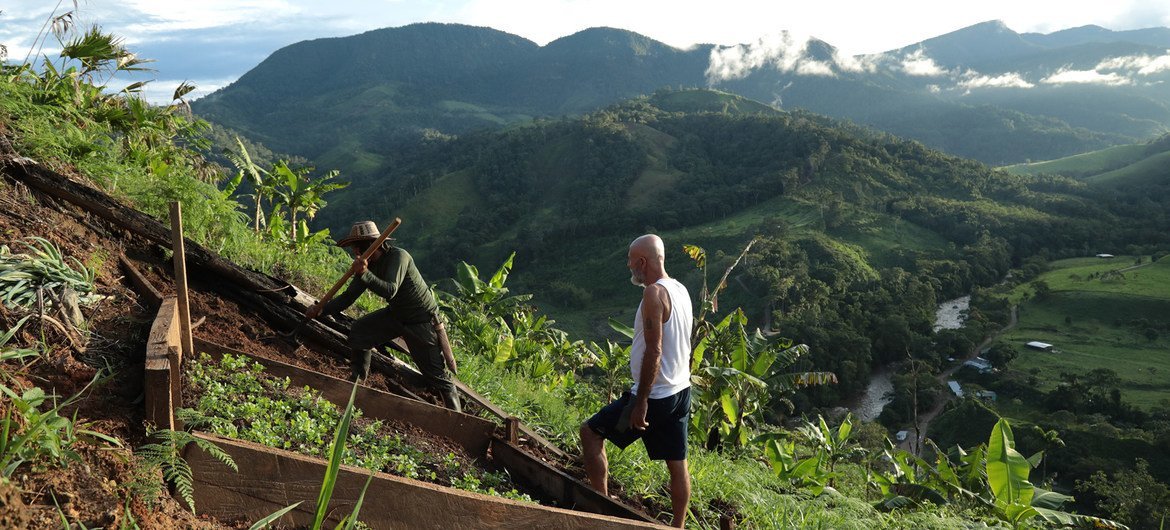
Some former combatants in Colombia, have now turned to farming following the historic 2016 Peace Agreement – UN Verification Mission in Colombia/Marcos Guevara.

On 14 July 2020 UN News made public the following assessement:

The killing of former combatants, human rights defenders and social leaders of communities devastated by decades of conflict, remains the most serious threat to peace in Colombia since the signing of a landmark peace agreement in 2016, the top UN official in the country told the Security Council on Tuesday, meeting in-person at UN Headquarters in New York, for the first time in four months.

Carlos Ruiz Massieu, Special Representative and head of the UN Verification Mission in Colombia, said authorities on 6 July arrested an individual allegedly behind the killing of Alexander Parra, a former member of the Revolutionary Armed Forces of Colombia—People’s Army, and leader of the former territorial area for training and reintegration in Mesetas, “These arrests are an example of the results that the mechanisms in the Peace Agreement can deliver”, Mr. Massieu said, and a reminder of the need to provide them with the support required to carry out their tasks. e.

Safety essential for those who laid down arms

After months of uncertainty and mounting security risks from illegal armed groups, Mr. Massieu said operations are now underway to transfer the former territorial area for training and reintegration in Ituango – where 11 former FARC-EP members and seven of their relatives were killed – to a new location in Mutatá…..

Presenting the Secretary-General’s report on the Mission, he said the COVID-19 pandemic has laid bare the vulnerable situation of roughly two-thirds of accredited former combatants who currently reside outside the former territorial areas for training and reintegration.

Offering a perspective from her own life, Clemencia Carabalí Rodallega, of the Municipal Association of Women, in Cauca, introduced herself as a survivor of a 4 May 2019 attack, which also threatened the lives of 25 other people working to defend the ethnic and territorial rights of communities in Colombia.

“Ethnocide in Colombia has not stopped,” she said. Not a day has passed since the Spanish invasion 528 years ago that a black or indigenous person has not been killed, a member of the indigenous or cimarrona guard has not been threatened, a woman has not been raped, or a human rights defender has not died by violence.

She said that since the signing of the Peace Agreement, 686 leaders and human rights defenders have been murdered, 160 of them in this year alone.  She described the 2019 assassinations of a mayoral candidate from Suárez municipality and a governor of the Nasa indigenous community, along with the dismemberment, earlier this month, of a member of the Renacer Afro-Colombian Community Council, in Cañón del Micay.

“These situations have increased exponentially due to the COVID-19 pandemic”, she stressed.

She urged the President to fully implement the Comprehensive Programme of Safeguards for Women Leaders and Human Rights Defenders, and the Comprehensive Protection and Security Programme for Communities and Organizations in the Territories.

More broadly, she said the Government must comply with the entire Peace Agreement – especially its Ethnic Chapter and provisions on gender – and effectively investigate and prosecute those behind the violations.

She invited the international community to “put yourselves in our shoes” and visit the territories, accompanying Colombians in their peacebuilding initiatives, “not only through technical and economic support, but also with political commitment, as guarantors.”

See also: https://humanrightsdefenders.blog/2020/01/20/colombia-21-january-2020-civil-society-begins-a-much-needed-patriotic-march/

https://news.un.org/en/story/2020/07/1068371

Even simply remembering Kem Ley is forbidden in Cambodia

July 16, 2020

Cambodia continues to block memorial activities honoring murdered political analyst Kem Ley [See: https://humanrightsdefenders.blog/2019/07/12/third-anniversary-kem-ley-murder-cambodia-impunity/]

Individuals and groups were blocked by police and local authorities in Cambodia from holding activities commemorating the fourth anniversary of the death of political analyst Kem Ley.

Kem Ley was killed at a gas station on July 10, 2016. Many suspect the murder was linked to his work as a commentator and political analyst. He was murdered days after he gave a radio interview about a Global Witness report detailing corruption under the Hun Sen government, which has ruled the country since 1985.

On July 8, a group of monks and young activists were prevented by police from holding a memorial service at the gas station where the late analyst was killed. They were forced instead to hold their prayers on a sidewalk more than 100 meters from the site.

A young man wearing a shirt with Kem Ley’s face printed on it was arrested that day. The next day, a group of youth leaders were blocked by security forces from travelling to Kem Ley’s family home in Takeo.

Another convoy of monks and activists was blocked on July 10. But supporters of the slain commentator continued to honor him by embarking on a march of several kilometers. Chheang Sinath, a tuk-tuk (three-wheeled vehicle) driver and member of the Independent Democracy of Informal Economy Association, criticized authorities’ actions in an interview with VOD news:

We just came to participate and show respect. Just participating and remembering [Kem Ley’s] sacrifice for society is seen as a wrongdoing [by authorities]. This is not appropriate unless we hold a demonstration or protest something. This is just a ceremony to pay gratitude to him, but authorities tried to stop us.

Venerable Bo Bet, a monk from a Phnom Penh pagoda, expressed frustration that his group of 10 monks was not allowed to pay respects to Kem Ley:

We want to pay respects at the place he was killed, and we will also hold ceremonies at other places. We come here and want to burn incense. We want to hold funeral rites at the site. We want to remember his good deeds here because we do this only once a year.

Kem Ley’s wife and kids were forced to seek asylum in Australia after his death. Bou Rachana thanked supporters of her late husband for their efforts.

See also; https://humanrightsdefenders.blog/2020/06/17/swedens-aid-to-cambodia-refocuses-on-civil-society/

https://globalvoices.org/2020/07/15/cambodia-continues-to-block-memorial-activities-honoring-murdered-analyst-kem-ley/

Hannah Foster decries Human Rights Violations amid COVID-19 in Africa

July 16, 2020

On 14 July 2020 the FOROYAA Newspaper carried a summary of remarks made by Hannah Foster, who is the spokesperson of the NGOs Forum at the opening ceremony of the 66th Ordinary Session of the African Commission on Human and Peoples’ Rights (ACHPR) which started on Monday July 13th 2020 (via Zoom)

Gambian human rights defender, Mrs. Hannah Foster, has raised concern about human rights violations in Africa, in particular amid the spread of Covid-19

We all have seen that from all parts of the world human rights violations have remained a major concern in most countries. Since late December 2019, the Coronavirus which causes Covid-19 has held the world captive with uncertainties, fear and insecurity. In most countries, we’ve seen the freedom of association and assembly remains a major cause for concern in most of the countries reviewed,” she said

Madam Foster said it is also a cause for concern that with Covid-19, there has been an increase of gender based violence registered in most of the countries that have been reviewed by the Forum.

She added that it was reported at the Forum that systematic harassment and targeting of human rights defenders in many countries persist and or have intensified the closing of civic space due to the existence of restrictive legislations.

“It was ascertained that a lot more needs to be done as many African countries continue to face challenges of insecurity, violence, terror attacks and the volatile situation brought about by Covid-19,” she said.

Speaking further, Madam Foster said they had raised the issue of overcrowding in prisons especially during Covid-19. “The overcrowding of prisons due to non-observance of judicial guarantees in respect of remand detainees as well as standard minimum rules, also have created challenges. And the Forum calls on the African Commission to urge States to respect and implement all laws governing the treatment of prisoners especially in this time of Covid-19, which has brought about an extension of restricting laws that are being implemented,” Foster informed the participants.

Foster said the Forum urged more States and NGOs to use and popularize the African Commission processes and decisions and to encourage States to comply with decisions as well as consider signing the Protocol on the right to individul complaint

We have challenges of Benin and Cote d’Ivoire withdrawing their signatures of Article 346. And we will like to urge the Commission to enter into dialogue with them to ensure that they encourage them to review the decision,” she said.

Foster said the forum also observed that freedom of expressions, the criminalization of bloggers and internet restrictions continue to hinder the independent and freedom of journalists and like-minded groups.

Humanitarian access has also become very problematic. The Forum took this opportunity to call on the African Commission and all States that have not ratified pertinent treaties to speedily do so in order to enable their implementation as the enjoyment of those rights by all citizens,” she added.

Read the original article on Foroyaa.

https://allafrica.com/stories/202007150349.html

Anti-Censorship initiative with free VPN accounts for human rights defenders

July 15, 2020

On 14 July Business-Wire reported that the VPN company TunnelBear has partnered with NGOs to give away 20,000 accounts (these NGOs inlcude Access Now, Frontline Defenders, Internews, and one other undisclosed participant).

This program aims to empower individuals and organizations with the tools they need to browse a safe and open internet environment, regardless of where they live. The VPN provider is encouraging other NGOs or media organizations across the world to reach out if they too are in need of support. “At TunnelBear, we strongly believe in an open and uncensored internet. Whenever we can use our technology to help people towards that end, we will,” said TunnelBear Cofounder Ryan Dochuk.

TunnelBear’s VPN encrypts its user’s internet traffic to enable a private and censor-free browsing experience.

By undergoing and releasing independent audits of their systems, adopting open source tools, and collaborating with the open source community, TunnelBear has proven itself to be an industry leader in the VPN space and a valuable private sector partner within the internet freedom movement. Internews is happy to support TunnelBear in extending its VPN service to the media organizations, journalists, activists, and human rights defenders around the globe who can benefit from it,” said Jon Camfield, Director of Global Technology Strategy at Internews.

Contact: Shames Abdelwahab press@tunnelbear.com

See also: https://humanrightsdefenders.blog/2020/06/23/trump-now-starts-dismanteling-the-open-technology-fund/

https://www.businesswire.com/news/home/20200714005302/en/TunnelBear-Kicks-Anti-Censorship-Initiative-Free-Accounts-Activists

Amnesty International’s bid to block spyware company NSO fails in Israeli court

July 15, 2020

Amnesty International’s bid to block spyware company NSO Group’s international export licence has been shut down in a Tel Aviv court, apparently due to a lack of evidence, reported several media, here in the New Statesman of 14 July 2020. [see: https://humanrightsdefenders.blog/2019/09/17/has-nso-really-changed-its-attitude-with-regard-to-spyware/ ]

The case argued that the Israeli defence ministry should revoke the group’s export licence in light of numerous allegations that its phone-hacking Pegasus spyware has been used by governments (including Mexico, Saudi Arabia, Morocco and the UAE) to spy on civilians including an Amnesty International employee, human rights activists, lawyers and journalists..

The district court judge Rachel Barkai wrote in a statement that there was not enough evidence to “substantiate the claim that an attempt was made to monitor a human rights activist”. She wrote that in reviewing materials provided by the Ministry of Defence and Ministry of Foreign Affairs, she was persuaded that export licences were granted as part of a “sensitive and rigorous process”, and closely monitored and revoked if conditions were violated, “in particular in cases of human rights violations.”

Amnesty International decried the court’s decision. Danna Ingleton, acting co-director of Amnesty Tech, said in a statement: “Today’s disgraceful ruling is a cruel blow to people put at risk around the world by NSO Group selling its products to notorious human rights abusers. […] The ruling of the court flies in the face of the mountains of evidence of NSO Group’s spyware being used to target human rights defenders from Saudi Arabia to Mexico, including the basis of this case – the targeting of one of our own Amnesty employees.

NSO said: “Our detractors, who have made baseless accusations to fit their own agendas, have no answer to the security challenges of the 21st century. Now that the court’s decision has shown that our industry is sufficiently regulated, the focus should turn to what answer those who seek to criticise NSO have to the abuse of encryption by nefarious groups.”

The NSO Group is currently embroiled in another lawsuit brought by WhatsApp, which alleges that Pegasus spyware was used to hack more than a thousand of the messaging platform’s users. [see: https://humanrightsdefenders.blog/2019/10/30/nso-accused-of-largest-attack-on-civil-society-through-its-spyware/]

https://tech.newstatesman.com/security/amnesty-international-nso-group-export-licence

Annual Report 2019 of the Human Rights Foundation

July 14, 2020

Thor Halvorssen, President of the Human Rights Foundation, writes in the foreword that ‘since our launch 15 years ago, the Human Rights Foundation has created a global network of support for hundreds of the bravest and most influential dissidents in the world. These individuals dedicate their lives, often at great personal risk, to challenging authoritarian governments that violate the most basic rights of 4.18 billion people in 94 countries across the globe. In order to better serve these individuals and turn the tide toward a freer and more open world, we are challenging ourselves to significantly grow our reach and impact in 2020. .. the Human Rights Foundation exists to challenge tyranny and promote freedom in closed and closing societies. So how do we accomplish that?:

We engage in political prisoner legal advocacy

We educate a global audience through media and events that reach millions of people every month

We conduct research and analyses that change government policy across the world;

We produce high-impact reports and publications focusing on human rights and authoritarianism; and

We directly support individual activists and civil society organizations on the frontlines of democratic change

See also: https://humanrightsdefenders.blog/2020/06/29/un-representative-in-south-korea-sees-balloon-actions-as-freedom-of-expression/

https://hrf.org/wp-content/uploads/2020/07/2019-HRF-Annual-Report-digital.pdf