On 23 April the Guardian and other papers announced the laureates of the 2018 Goldman environmental prize and note that most of the winners are women. They are grassroots activists who have taken on powerful vested interests. For more on this award: http://trueheroesfilms.org/thedigest/awards/goldman-environmental-prize.
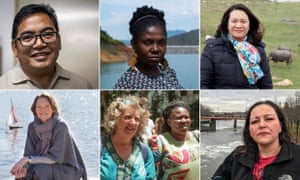
Goldman environment prize winners 2018: (clockwise from top left) Manny Calonzo, Francia Márquez, Nguy Thi Khanh, LeAnne Walters, Makoma Lekalakala and Liz McDaid, Claire Nouvian. Photograph: 2018 Goldman Environmental Prize
This year’s Goldman environmental prizes celebrate six remarkable success stories, five of them driven by women.
In Latin America, the winner is Francia Márquez, an Afro-Colombian community leader who led a 10-day, 350-mile march of 80 women from the Amazon to Bogotá that prompted the government to send troops to remove illegal miners who were polluting rivers with cyanide and mercury. [The dangers of environmental activism have been evident in the murder of two Goldman-prize recipients in the past two years: the 2015 winner Berta Cáceres and the 2005 winner Mexican activist Isidro Baldenegro López] “The first thing we need is to be more aware of the historical moment in which we find ourselves: the planet is being destroyed, it’s that simple, and if we do nothing to avoid it we will we will be part of that destruction,” Francia Márquez said. “Our time has come, we must act, we have a responsibility to future generations to leave a better world, in which taking care of life is more important than producing cumulative wealth.”
Three Child Rights Heroes are honoured by the World’s Children’s Prize(WCP) 2018. Learn more about them by clicking their names below.
• Gabriel Mejía Montoya for his efforts over the course of more than 30 years to support Colombia’s street children, child soldiers and children in prison. Father Gabriel has suffered repeated attempts on his life because of his work.
• Rachel Lloyd for her 20-year fight against commercial sexual exploitation, CSEC, and domestic trafficking of girls and young women in the US. Rachel is a survivor of sexual and mental abuse during her childhood in England and exploitation in the sex industry in Europe.
• Valeriu Nicolae for his tireless struggle to protect the poorest and most vulnerable children in Romania’s Ferentari ghetto. Valeriu grew up in extreme poverty and was discriminated against because he was Roma.
The candidates were selected by a jury of children from 15 different countries. Rachel Lloyd has been elected Child Rights Hero by millions of young people. Gabriel Mejía Montoya from Colombia and Valeriu Nicolae from Romania get the World’s Children’s Honorary Awards.
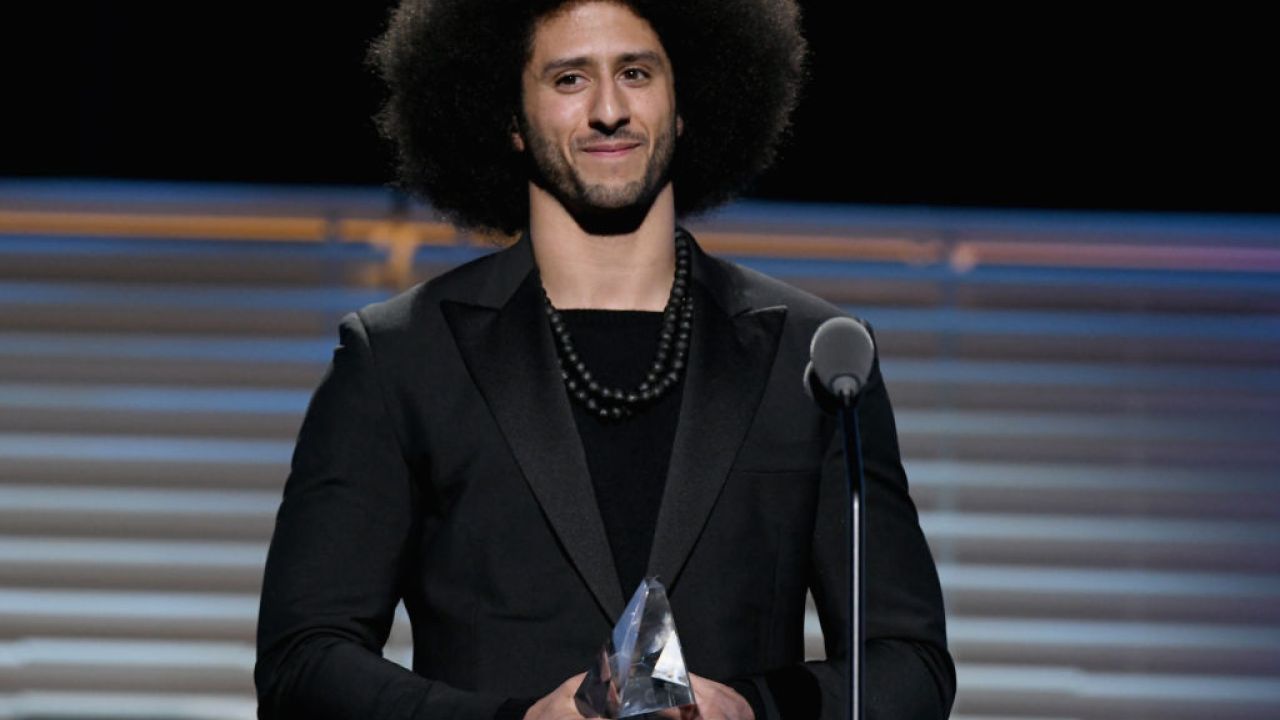
SPORTS ILLUSTRATED 2017 Sportsperson of the Year Show on December 5, 2017 at Barclays Center in New York City.
USA athlete and activist Colin Kaepernick has been honoured with Amnesty International’s Ambassador of Conscience Award for 2018. The award was officially presented at a ceremony in Amsterdam, Netherlands, on 21 April 2018, to coincide with the 50th anniversary of AI Netherlands.
“The Ambassador of Conscience award celebrates the spirit of activism and exceptional courage, as embodied by Colin Kaepernick. He is an athlete who is now widely recognised for his activism because of his refusal to ignore or accept racial discrimination,” said Salil Shetty, Secretary General of Amnesty International. [for more on this and other human rights awards see: http://trueheroesfilms.org/thedigest/awards/ambassador-of-conscience-award]
[During the 2016 pre-season of the American National Football League, Colin Kaepernick knelt during the US national anthem, as a respectful way of calling for the country to protect and uphold the rights of all its people. The bold move was a response to the disproportionate numbers of black people being killed by police. It sparked a movement that follows a long tradition of non-violent protests that have made history. While the polarised response to the “take-a-knee” protest has ignited a debate about the right to protest and free speech, Colin Kaepernick has remained focused on highlighting the injustices that moved him to act. His charity, the Colin Kaepernick Foundation, works to fight oppression around the world through education and social activism, including through free “Know Your Rights” camps which educate and empower young people.]
“I would like to thank Amnesty International for the Ambassador of Conscience Award. But in truth, this is an award that I share with all of the countless people throughout the world combating the human rights violations of police officers, and their uses of oppressive and excessive force. …said Colin Kaepernick. “While taking a knee is a physical display that challenges the merits of who is excluded from the notion of freedom, liberty, and justice for all, the protest is also rooted in a convergence of my moralistic beliefs, and my love for the people.“
See also: https://humanrightsdefenders.blog/2016/05/07/ais-ambassador-of-conscience-award-2016-shared-by-angelique-kidjo-and-african-youth-groups/
As part of the global Celebration of World Press Freedom Day, the winner of the “UNESCO/Guillermo Cano World Press Freedom Prize” will be announced on 3 May 2018. for last year’s award: https://humanrightsdefenders.blog/2017/05/04/eritrean-born-journalist-dawit-isaak-awarded-2017-unescos-guillermo-cano-world-press-freedom-prize/
The jury on Monday 23 April awarded the honor to Mahmoud Abu Zeid, known as Shawkan, who has been in jail since he was arrested in Cairo in August 2013 for covering a demonstration at Rabaa Al-Adawiya Square. Egypt’s Foreign Ministry strongly warned UNESCO against the move Sunday, saying that Shawkan faces terror-related charges. The U.N. Working Group on Arbitrary Detentions says Shawkan’s arrest is arbitrary and his continued detention infringes his human rights.
On 16 April 2018 the NGO-network Scholars at Risk (SAR) announced that Turkey’s Academics for Peace is the recipient of its 2018 Courage to Think Defender Award, for their extraordinary efforts in building academic solidarity and in promoting the principles of academic freedom, freedom of inquiry, and the peaceful exchange of ideas. The award, which will be presented at the Scholars at Risk Network 2018 Global Congress, will be accepted on behalf of the group by Muzaffer Kaya, of Technische Universität Berlin, and Tebessüm Yılmaz, of Humboldt-Universität zu Berlin.
Rose Anderson, SAR’s Director of Protection Services stated: “By connecting their threatened colleagues both inside and outside of Turkey to resources, opportunities, and support, they are working to ensure that Turkey’s vibrant higher education community can continue to pursue scholarship, and be free to think, question and share ideas. The solidarity of the Academics for Peace community is an inspiration for all of us who work on behalf of threatened scholars and academic freedom worldwide.”
For more information about the Courage to Think Award and the Global Congress, including registration information, the Congress program and speaker bios, visit https://www.con-gressa.de/gc2018.
Viatcheslav Moshe Kantor launched in early March 2018 a new award – the European Medal of Tolerance – aimed at fighting extremism and promoting peace in Europe. The European Jewish leader announced the prize at the European Council on Tolerance and Reconciliation (ECTR) round-table event at the Salon Bellevue in Monaco.The €1 million prize also referred to as the “Kantor Prize for Secure Tolerance” is awarded by ECTR’s panel of academic advisers to those who achieve exceptional research that advance the idea of “secure tolerance.” Candidates for the award need to present original and creative research on the ways the practice of tolerance can address the challenges of a globalized world and societies that exhibit rich diversity. The award is intended to foster progressive thinking that will be helpful for Europeans as they deal with security and human rights threats.
Monaco’s Prince Albert II was the first laureate of the 2018 European Medal of Tolerance. Moshe Kantor expressed his admiration over the commitment of HSH Prince Albert II in advancing a true account of the Holocaust. He praised the Monaco prince’s focus on historical accuracy as it supports “the best traditions of the Principality in tackling challenges of coexistence, respect, and compassion.”
On 12 April 2018 the Human Rights Foundation (HRF) announced two of the three recipients of the 2018 Václav Havel International Prize for Creative Dissent. This year’s laureates include the underground group Belarus Free Theatre and the South Sudanese hip hop musician and former child soldier Emmanuel Jal. Their efforts will be honored in a ceremony during the 2018 Oslo Freedom Forum on Wednesday, 30 May (to avoid possible travel restrictions imposed on the third laureate, the final award will be announced only in May).
For more on the this and other awards: http://trueheroesfilms.org/thedigest/awards/vaclav-havel-prize-for-creative-dissent
Belarus Free Theatre(BFT) was founded in 2005 in response to the severe censorship and repression of Alexander Lukashenko’s regime. BFT has staged powerful social and political documentary theater from secret locations (private homes, cafes, and even the woods), characterized by stripped-down performances and topics, including refugees, climate change, torture, and sexuality. According to co-founder and artistic director Natalia Kaliada, “In a country where the state seeks to control every aspect of life, everyone has the potential to rebel in their own way. And a million small acts of rebellion can chip away at even the most entrenched dictatorship.” In April 2017, the company had to postpone a premiere after several members were arrested or injured during large-scale, anti-government protests. BFT is the only theater company in Europe banned by its government on political grounds.
Emmanuel Jalis a South Sudanese hip hop artist and a former child soldier of Sudan’s brutal civil war that took place between 1983 and 2005. With five critically acclaimed albums, an autobiography, and a documentary to his name, Jal is focused on supporting South Sudanese youth with educational scholarships through his “Survivors of War” program. He founded the charity Gua Africa to work with individuals, families, and communities to help them overcome the effects of war and poverty. “Emmanuel uses powerful music as a vehicle to spread a message of freedom and hope for a better future in war-torn South Sudan. He inspires people everywhere to stand up for the freedom of others, and in so doing brings people closer together,” said Havel Prize Committee member Garry Kasparov.
The Havel Prize ceremony will be broadcast live at oslofreedomforum.com on Wednesday, 30 May. If you would like to attend the ceremony in Oslo please email info@hrf.org and follow @HRF and @OsloFF for updates.
The nomination form, and the full list of past awardees of the Baldwin Medal is available on the award webpage of Human Rights First. Deadline is 10 May 2018
Nominations can be made by an individual or an organization. Nominees will be judged based on the following criteria:
The nominee’s work is unique or particularly distinctive;
The nominee’s work has been effective in advancing human rights in a country other than the United States;
The nominee faces risk or insecurity as a result of their work; and
The nominee would benefit significantly from receiving the Baldwin Award, in the form of enhanced protection, or in any other way.
For further information about the award or the nomination process, please contact Zahava Moerdler at Moerdlerz@humanrightsfirst.org or (212)-845-5272.
On 9 March 2018 the International Humanist and Ethical Union (IHEU) made a strongly-worded and totally correct statement “Actually, ‘freedom from religion’ is a human right”. Religious freedom is usually thought of in terms of (minority) religions being allowed to freely practice their religion but the limelight rarely shines on the situation of those who do not want to belong to a religion or express atheist views.
The IHEU) was responding to comments made by the Vatican delegation during a discussion (video) of the report of the UN Special Rapporteur on Freedom of Religion or Belief. The Vatican representative, Ivan Jurkovic, had disputed that ‘freedom from religion’ is covered by international law, saying that “Of the utmost concern, the use of the term freedom from religion, which is not contemplated in the international instruments, reveals a patronising idea of religion, going beyond the mandate of the special rapporteur.”
In response IHEU’s Director of Advocacy, Elizabeth O’Casey, corrected the Holy See listing the established rights which constitute freedom from religion, and highlighted why freedom from religion is so necessary for those professing no religious beliefs around the world: “freedom from coercion to adopt a religion is protected by law; freedom to have no religion is protected by law; freedom to leave a religion is protected by law; and freedom to criticise a religion is protected by law.”
She also noted that in his own comments to the Council, the UN Special Rapporteur on Freedom of Religion of Belief, Dr Ahmed Shaheed, also corrected the Holy See. Shaheed stated categorically that freedom from religion is protected by the right to freedom of religion or belief. Dr Shaheed mentioned specifically how humanist, atheist and secular bloggers are under attack, and that the right to freedom of religion or belief protects the individual, not the religion or belief itself.
In her statement, O’Casey went on to highlight just why statements such as those made by the Holy See are so objectionable and dangerous; especially in the context of state-based hate and a culture of impunity allowing for violence against those who have no religious beliefs. O’casey reminded the Council that 85 countries severely discriminate against non-religious individuals whilst seven countries were found to actively persecute the non-religious during last year. She also reminded the Council of the situation of those jailed in states such as Pakistan, Saudi Arabia and Iran for being atheist or humanist, and the brutal murder of so many secularists and rationalists with impunity in Bangladesh, India and the Maldives. O’Casey also mentioned Saudi Arabia, Egypt, Malaysia and Cyprus in their promoting state hatred against atheists and humanists.
In the light of this situation, O’Casey asked how many more humanists, atheists and secularists need to be killed, imprisoned, persecuted and disproportionately targeted for the international community to begin to understand the absolute importance of freedom of religion or belief for those with no religion? She concluded, “so long as the rest of the international community stay silent, the rights of the invisible minority of non-believers across the world will continue to be trampled upon, including by members of this Council.” The full text of O’Casey’s statement can be seen through the link below.
In this context it was interesting to see that in the UK a Burnley vicar, who has campaigned to expose sexual abuse and its cover-up in the Church of England, has been named Secularist of the Year!The Rev Graham Sawyer, who is the vicar of St James’ Church, was one of two joint winners presented with a £5,000 prize at a lunch hosted by the National Secular Society. Human rights campaigner Peter Tatchell, who won the award in 2012, presented the prize at the event in central London.
Journalists take part in a protest outside the State Government building in Ciudad Juarez, Mexico to mark one year since the murder of journalist Miroslava Breach (AFP Photo/HERIKA MARTINEZ)
The UN and AFP launched an award Thursday 22 March 2018 to honor journalists who risk their lives to cover human rights abuses in Mexico, in tribute to two celebrated reporters murdered last year. The Breach-Valdez Prizewill honor journalists who follow in the footsteps of their slain colleagues Miroslava Breach and Javier Valdez, two of the more than 100 reporters murdered since 2000 in one of the world’s most dangerous countries for the press. (see also: https://humanrightsdefenders.blog/2018/01/05/front-lines-2017-report-confirms-worst-expectation-over-300-hrds-killed/)
Its aim is “to recognize the careers of Mexican journalists who have distinguished themselves in defending human rights,” said Giancarlo Summa, director of the United Nations Information Center in Mexico.
Valdez, an award-winning journalist who covered Mexico’s powerful drug cartels, was gunned down last May in broad daylight outside the offices of Riodoce, the newspaper he co-founded in Culiacan, the capital of his native Sinaloa state. He was also a long-time AFP collaborator.
Miroslava Breach, a correspondent for Mexican daily La Jornada in the state of Chihuahua, on the US border, was a celebrated investigative journalist known for hard-hitting reports on links between politicians and organized crime. She was shot dead in broad daylight last March as she drove her son to school.
The annual prize is also co-sponsored by UNESCO, the Ibero-American University and the French embassy in Mexico. The first edition will be awarded on May 3 in Mexico City. The winner will receive a grant and a trip to France to take part in a series of events on free speech.
(Breach and Valdez were among at least 11 journalists murdered in Mexico last year, making it the deadliest country in the world for the press after Syria, according to watchdog group Reporters Without Borders. The latest murder came just Wednesday, when journalist Leobardo Vazquez was gunned down outside his house in Veracruz state — the second killed in 2018.)
“There is no indication these crimes are going to stop. Let’s hope this prize will help all the country’s brave journalists keep up the fight,” Valdez’s widow, Griselda Triana, said at the launch of the award.
This is a national award. There are many awards for journalists and for freedom of expression at the international level, see: http://trueheroesfilms.org/thedigest/