Archive for the 'awards' Category

2020 Front Line Defenders Award Ceremony on 9 December and the winners of 2020

November 30, 2020

Front Line Defenders will be celebrating the 2020 Front Line Defenders Award Winners at an online Award Ceremony on 9 December.

The event will be available on the Front Line Defenders Facebook page http://www.facebook.com/FrontLineDefenders, YouTube channel https://www.youtube.com/frontlinehrd  and at http://www.frontlinedefenders.org/2020award

For more on this and other awards especially for human rights defenders, see: https://www.trueheroesfilms.org/thedigest/award/2E90A0F4-6DFE-497B-8C08-56F4E831B47D

This year’s Regional Award Winners include four women human rights defenders and an indigenous collective.

The 2020 Laureates are:

Mekfoula

Mekfoula Mint Brahim is is the President of Pour une Mauritanie Verte et Démocratique (For a Green and Democratic Mauritania), an organisation leading women’s empowerment projects in rural areas. She is also a member of Alliance pour la Refondation de l’Etat Mauritanien (AREM), which promotes good governance and fights against impunity.

Read More

The Guardia Indígena del Cauca – Kiwe Thegnas (Defenders of Life and Territory), member of the organization Asociación de Cabildos Indígenas del Norte del Cauca (ACIN), CRIC branch, is a community life and ancestral resistance composed of women, men, boys and girls who defend their territories in a peaceful, unarmed way.

Read More

Juwairiya Mohideen is a Muslim woman human rights defender based in Puttalam in the North West of Sri Lanka. In 2010 she established the Muslim Women’s Development Trust (MWDT), providing daily practical support, comfort, advice and legal assistance to women and girls facing abuse, violence and discrimination.

Read More

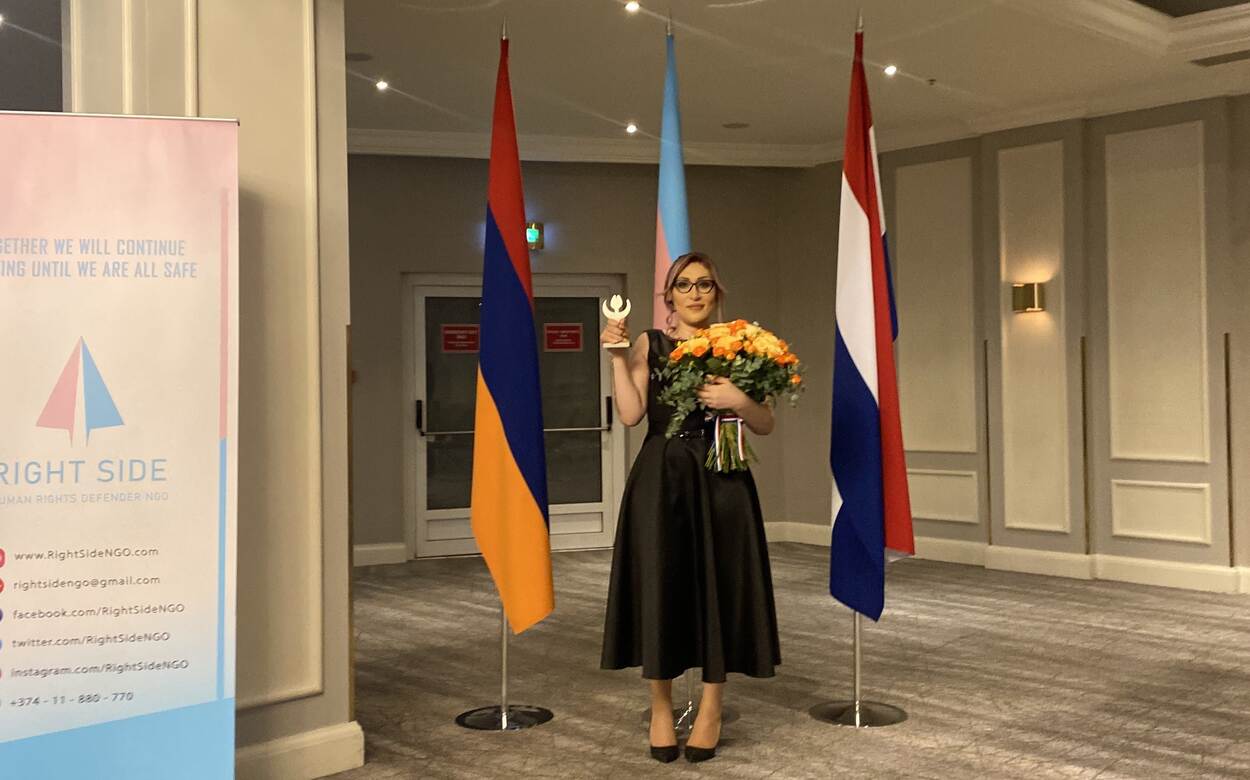
Lara Aharonian is co-founder of the Women’s Resource Center Armenia, a non-governmental feminist organization based in Yerevan that works to empower women and girls to become active citizens by combatting gender stereotypes and providing psychological and legal support to survivors of gender-based violence in Armenia.

Read More

Iraqi Women Human Rights Defenders have faced a wave of assassinations and attempted killings, particularly especially in the southern city of Basra. Since mass popular protests erupted throughout the country in 2019, human rights defenders have been targeted for attack, including kidnappings, physical attacks and killings.

For last year’s Front line award see: https://humanrightsdefenders.blog/2019/05/17/breaking-news-2019-front-line-defenders-award-to-5-lgbti-human-rights-defenders/

https://www.frontlinedefenders.org/en/2020-front-line-defenders-award-human-rights-defenders-risk

For 30 years Parveena Ahangar has fought for justice against disappearances in Kashmir

November 30, 2020
Parveena Ahangar
Parveena Ahangar

Several weeks ago authorities in Indian-administered Kashmir raided the home and offices of Parveena Ahangar, a local human rights defender, over alleged “terrorist funding,” sending shockwaves in NGOs operating in the region. [see also: https://humanrightsdefenders.blog/2017/09/30/parveena-ahangar-and-parvez-imroz-in-kashmir-awarded-rafto-prize-2017/]

The “iron lady of Kashmir” said that in 30 years of activism, the October raid by the Indian National Investigation Agency was the first time such brazen action was taken against her, calling it “saddening.”

On the eve of International Women Human Rights Defenders Day, Anadolu Agency spoke with Ahangar, who is chair and founder of the Association of Parents of Disappeared Persons (APDP), a group seeking justice for victims of enforced disappearances in the Indian-administered region.

“For the last three decades, nobody has raised questions on my work and integrity. This is for the first time that the Indian Investigating Agency wants to prove otherwise, but I will not budge what I am committed to before my God,” Ahangar said in her office in Srinagar.

In 2017, the Indian National Investigation Agency started pursuing a case against pro-freedom activists and groups, claiming that they were getting money from undisclosed sources and using it to fund terrorist activities Since then, many raids have been carried out across the region..

Ahangar’s son, Javed Ahmed Ahangar, was abducted Aug. 18, 1990, by the Indian army and consequently disappeared. He was a Class 11 student at the time. Overtaken with grief, she looked long and hard to find him, but to no avail. She took the legal route and filed various petitions, but that did not help.

In 1994, she formed the association of Parents of Disappeared Persons when the government and every other institution failed to deliver justice in her son’s case and other victims.

I am myself a sufferer. My 18-year-old son who was abducted by the Indian Army in 1990 has not been returned to me, and there are hundreds of mothers who are still waiting for their sons but have not been returned. I’m fighting for the return of our sons,” said Ahangar.

She said for four years she fought the legal battle to find his whereabouts. “I saw hundreds of mothers waiting at the doors of these institutions pleading for the same but the reply used to come ‘untraced’ with no accountability. Where are our sons, I am asking the Indian government.”

According to APDP figures, 8,000-10,000 people in the disputed region have disappeared with no trace.

In an in-depth peer-reviewed study, Lubna Mohiuddin (1997) observed that despite no formal declaration of a state of emergency, the presence of Indian troops in the region shot up from 0.15 million in 1990 to 0.7 million by 1997, which aggravated human rights abuses in the region.

“Despite India being a signatory of multiple international covenants, charters and declarations, violence in Kashmir continues to occur in the form of extra-judicial killings, arbitrary arrests, tortures, burning of houses, and gang-rapes,” the study said.

On Aug. 5, 2019, when India scrapped the limited autonomy of the Jammu and Kashmir region, the APDP documented the Kashmir region as going through one of the worst forms of state authoritarianism and high handedness.

“The Indian Government has continuously asserted that ‘normalcy’ has been returned to Kashmir. But, the testimonies and ground level reports indicate the contrary, as there are still severe restrictions and curtailment of basic human rights of the residents of the Kashmir region,” according to the report.

Ahangar says if India thinks “by taking out raids at my home or at my office will stop me from doing what I have been doing for the last 30 years, it will not happen. I have been hardened by the pain and grief after hearing thousands of stories of people who have been trampled under the foot of oppression for so long.

If I am asking for protection of my and their rights, what wrong I am committing?” she said. “It is a long battle to go. If I have to stand alone, I will and nothing by the grace of God can deter me from doing that.”

On the tenth of every month, the APDP used to hold a sit-in-protest to demand justice against enforced disappearances but after the abrogation of special status and the current pandemic crisis, it has been suspended.

——

https://www.aa.com.tr/en/asia-pacific/parveena-ahangar-a-story-of-courage-from-kashmir/2059667

https://www.yenisafak.com/en/world/parveena-ahangar-a-story-of-courage-from-kashmirs-iron-lady-3555432

2020 Award of European Bars Associations (CCBE) goes to seven Egyptian lawyers who are in prison.

November 29, 2020

CCBE awards 2020 prize to Egyptian lawyers Ebru Timtik

The Council of Bars and Law Societies of Europe (CCBE) has granted its 2020 Human Rights Award to seven Egyptian lawyers who are currently in prison.

The body, which represents the Bars and Law Societies of 45 countries, has also given an exceptional posthumous award to Turkish lawyer Ebru Timtik (pictured), who died in August 2020.

For more on this and other awards for lawyers see: https://www.trueheroesfilms.org/thedigest/award/A3C73F81-6FCB-4DDD-9356-61C422713949

The seven Egyptian lawyers are:

  • Haytham Mohammadein, a human rights lawyer and labour activist,
  • Hoda Abdelmoniem, former member of the National Council for Human Rights, spokesperson for the Revolutionary Coalition of Egyptian Women and consultant for the Egyptian Commission for Rights and Freedoms (ECRF),
  • Ibrahim Metwally Hegazy, a lawyer, member of the ECRF and co-founder of the Egyptian Association of Families of the Disappeared (EAFD),
  • Mahienour El-Massry, who is often described as a voice of the revolution and is active in the defence of women’s rights and many other citizen’s rights,
  • Mohamed El-Baqer, director of Adalah Center for Rights and Freedoms, 
  • Mohamed Ramadan, a lawyer whose work involves legally representing human rights defenders,
  • Zyad El-Eleimy, a lawyer and a former parliamentarian in Egypt.
  • See also: https://humanrightsdefenders.blog/2014/06/24/egypt-extended-detention-of-human-rights-defenders-protesting-the-protests-law/

Ebru Timtik was a distinguished Turkish lawyer belonging to the Progressive Lawyers Association and the People’s Law Office.

See: https://humanrightsdefenders.blog/2020/09/26/timtik-sisters-in-turkey-share-2020-ludovic-trarieux-prize/

The virtual Award ceremony will be held during the CCBE Plenary Session today (27 November).

https://www.lawsociety.ie/gazette/top-stories/ccbe-awards-2020-prize-to-egyptian-lawyers/

Amazon Forest Defender Osvalinda winner Edelstam Prize 2020

November 25, 2020

The Edelstam Prize 2020 is awarded to Osvalinda Marcelino Alves Pereira from the Amazon rainforest territory in Brazil for outstanding contributions and exceptional courage. She has fearlessly and continuously been reporting to federal authorities illegal logging of the forest in the Areia region. For more on this and similar awards, see: https://www.trueheroesfilms.org/thedigest/award/CAA00E38-C320-41E0-9FD4-B3BF3DC0D54F

Mrs. Osvalinda Alves Pereira from Pará in Brazil is an Amazon rainforest defender and community organizer who puts herself at great risk in defending the forest and its population. Defending the forest from illegal logging is very dangerous, as laws are rarely enforced against the perpetrators of the abuses. Criminal logging networks deploy men to protect their illegal activities and intimidate, threaten and kill those who obstruct their activities which are causing the deforestation and destruction of the Amazon rainforest.

Osvalinda Alves Pereira and her husband, Mr. Daniel Alves Pereira, have received numerous threats for nearly a decade from criminal networks involved in illegal logging in the state of Pará. For more than 18 months they have been in hiding, with the support of the Federal Program to Protect Human Rights Defenders, Journalists, and Environmental Defenders; however, they are now back in Pará as they feel that, even if the security is not strong enough, they have to continue their work within the rainforest areas where the illegal logging is taking place.

“The courageous activity of Mrs. Osvalinda in reporting illegal logging of the Amazon rainforest despite constant threats and in standing up for her convictions in times when justice is required sets an important example for the resilience needed to protect and defend our environment. Brazil has signed the Paris Agreement on Climate Change and has committed to eliminate illegal deforestation in the Amazon by 2030. However, authorities are failing to implement and enforce environmental laws in the Amazon, which heavily undermines the work to protect the forest,” says Caroline Edelstam, Chair of the Edelstam Prize Jury and co-founder of the Edelstam Foundation

Large farmers involved in illegal logging often use land-reform settlements where poor farmers have small plots to have access to the nearby protected forests. Osvalinda Alves Pereira founded the Areia II Women’s Association to develop sustainable organic agriculture and to reforest areas where logging has occurred. She is a local leader of the Areia Settlement Project, which is geographically situated as a gateway to three major conservation units: the Trairao National Forest, the Riozinho de Afrisio Extractive Reserve, and the Jamanxim National Park, which are areas of great interest to illegal loggers. Pará is today the state with the highest reported number of conflicts over land and resources.

In spite of offers of bribes and persistent threats, Osvalinda Alves Pereira has courageously continued to report the activities of the illegal loggers. Criminal networks are engaged in the large-scale extraction, processing, and sale of timber, illegal land seizures, as well as illegal mining in the Amazon. They employ armed men to intimidate the local population. The vast majority of threats and attacks against forest defenders is never properly investigated or punished. As a consequence, forest defenders are at great risk, and Osvalinda Alves Pereira fears for her life.

“It is important to find ways to enforce national and international law and promote accountability for serious abuses of human rights. In this case, Brazil, should be able to provide protection to forest defenders who receive death threats. Impunity is not an option. The international community also has a responsibility to uphold justice and ensure the protection of victims and defenders of the forest, including both environmental enforcement officials and members of the Indigenous and other local communities, and to uphold the principle that nobody is above the law. This year, nearly 8000 square kilometres have been deforested,” says Caroline Edelstam, Chair of the Edelstam Prize Jury.

The prize will be awarded during a live-streamed ceremony tomorrow, the 24th of November at 5 pm CET, 2020 on http://www.edelstam.org

See also: https://humanrightsdefenders.blog/2018/12/05/li-wenzu-wife-of-wang-quanzhang-wins-2018-edelstam-award/

https://www.hrw.org/news/2020/11/23/brazilian-forest-defenders-are-not-alone

b

http://www.edelstam.org/news/threatened-amazon-forest-defender-receives-the-edelstam-prize/

You can watch the RAFTO 2020 ceremony online

November 20, 2020

The Rafto Prize Award Ceremony took place on 8 November 2020. The Rafto Prize for 2020 was awarded the Egyptian Commission for Rights and Freedoms (ECRF) See: https://humanrightsdefenders.blog/2020/09/25/rafto-prize-for-2020-goes-to-the-egyptian-commission-for-rights-and-freedoms-ecrf/

If you did miss out, you can rewatch the entire Rafto Prize Award Ceremony here: https://player.vimeo.com/video/477734125

PERFORMANCES:

JONAS ALASKA// With his down-to-earth, personal and honest portrayals, it’s no wonder Jonas Alaska is a critic’s favourite. Already with his debut album, he was triple-nominated for the Norwegian Grammy.

NORA GUNDERSEN & ODA VOLTERSVIK // Nora Gundersen and concert pianist Oda Voltersvik will perform at Den Nationale Scene in November! They have both played as solo artists and chamber musicians both in Norway and abroad.

DØSSI // Ingrid Døssland, known as DØSSI, is a producer and singer/songwriter. With her dreamy voice, DØSSI draws you in to her own world of feelings and melancholy.

FRODE GRYTTEN // Frode Grytten has, throughout an extensive and critically acclaimed career, distinguished himself as one of Norway’s foremost writers.

SHARQANT // Sharquant is a band consisting of three musicians with backgrounds from Syria and Iraq. The band was established in 2018, in Bergen. Their music consists of a blend of different parts of the Arab culture, and their music transports the audience to the Mediterranean region.

Guri Solberg is the host of the Rafto Prize Award Ceremony!

3rd Human Rights and Business Award goes to Myanmar Migrant Workers Rights Network

November 17, 2020

On 17 November 2020, during the annual United Nations Forum on Business and Human Rights, the Migrant Workers Rights Network (MWRN) as recipient of the 2020 Human Rights and Business Award. [see my earlier today: https://humanrightsdefenders.blog/2020/11/17/2020-un-annual-forum-on-business-and-human-rights-hopefully-not-business-as-usual/]

Migrant Workers Rights Network is a grassroots member-based association that works to protect the rights of migrant workers who live and work in Thailand, the majority being from Myanmar. The organization was founded in 2009 by nine Myanmar migrant leaders after seeing extensive exploitation and abuse of migrant workers in Thai factories, the seafood industry, agriculture, and construction. They decided that empowerment of migrants is the best way for migrant workers to protect themselves.

For more on this and similar awards, see: https://www.trueheroesfilms.org/thedigest/award/fd511ca0-10f0-11ea-8f61-d1d879c27588

For last year’s award see; https://humanrightsdefenders.blog/tag/human-rights-and-business-award/

——

Rahile Dawut recipient of Courage to Think Award 2020

November 11, 2020

Dr. Rahile Dawut, photo by Lisa Ross

On 10 November 2020 Scholars at Risk (SAR) announced that Dr. Rahile Dawut is the recipient of its Courage to Think Award for 2020. Dr. Dawut is being recognized for her own work, as well as that of all the scholars and students of the Xinjiang Uyghur Autonomous Region, who together struggle for academic freedom and freedom of opinion, expression, belief, association, and movement.

The award, which will be presented at SAR’s virtual conference Free to Think 2020: Responding to Attacks on Higher Education, will be accepted by Dr. Dawut’s daughter, Akeda Pulati. For more on the Courage to Think Award see: https://www.trueheroesfilms.org/thedigest/award/165B4CC5-0BC2-4A77-B3B4-E26937BA553C.

Dr. Dawut is an Associate Professor in the Human Science Institute of Xinjiang University and founder of the Minorities Folklore Research Center in Xinjiang University. In December 2017, Dr. Dawut told a relative of her plans to travel from Urumqi to Beijing. Shortly thereafter, her family and friends lost contact with her. Professor Dawut’s disappearance was made public in August 2018. It is suspected that she is held by state authorities at an undisclosed location.

“My mother is a scholar, not a criminal,” said Akeda Pulati. “She studies the folklore and cultural traditions of minority populations. That is not a threat to the government, other institutions, or the people of China.”

The imprisonment of Dr. Dawut, an internationally recognized scholar of Uyghur culture, reveals the Chinese government’s blatant repression of voices and ideas it finds displeasing,” said Rob Quinn, executive director of SAR. “This constricts academic activity and public expression, threatening minority traditions, histories, and languages. The disappearance of Dr. Dawut, along with many thousands of others, is an atrocity we should all strive to end.”

See also: https://humanrightsdefenders.blog/2018/04/16/turkeys-academics-for-peace-to-receive-2018-courage-to-think-defender-award/

The 2020 Courage to Think award will be presented during SAR’s virtual conference Free to Think 2020: Responding to Attacks on Higher Education on Thursday, November 19 at 11:00 am ET (3:00 pm GMT). There is no charge to attend. Register here.

Philippine lawyer Neri Colmenares wins 2020 IBA award

November 10, 2020

Bulatlat of 10 November 2020 reports that Neri Colmenares, one of the country’s most prominent public interest lawyers, has won the human rights award of the International Bar Association (IBA) for his “extensive contribution to human rights, and his continuing determination and advocacy, in the face of great adversity.”

The presentation was made on Monday, 9 November, during the online Section on Public and Professional Interest Awards ceremony as part of the IBA 2020 – Virtually Together Conference. For more on this and other awards for human rights lawyers, see: https://www.trueheroesfilms.org/thedigest/award/AD2B7828-1A5B-4224-B85B-FA2CC0121114

Himself a victim of unrelenting red-baiting by military, police and government officials for his human rights advocacy and activism, Colmenares is a former three-term member of the Philippine House of Representatives and is currently the national chairperson of the National Union of People’s Lawyers (NUPL). He is also a leader of the Concerned Lawyers for Civil Liberties and adviser for advocacy of the Integrated Bar of the Philippines.

Colmenares’ human rights advocacy began when he became the Western Visayas regional chairperson of the Student Catholic Action of the Philippines during martial law in the 1970s. While campaigning for the return of student councils in schools ordered closed by then President Ferdinand Marcos, Colmenares was arrested and tortured by the military.

He spent four years in jail as one of martial law’s youngest political prisoners at 18. After his release from prison, Colmenares earned his BA Economics degree from San Beda University (SBU), his law degree from the University of the Philippines and his Master of Laws degree from the University of Melbourne in Australia on scholarship.

As a human rights lawyer, Colmenares has argued a number of cases before the Supreme Court and championed causes in the legislature in support of marginalized sectors, including the following:

* The Party List Election Case in 2000, which led to the High Court ordering that 20 per cent of the seats in Congress be reserved for the marginalized and underrepresented poorer .

* The Pork Barrel Case during the Gloria Macapagal-Arroyo administration that led the Supreme Court to declare the Congressional practice as unconstitutional.

* In 2017 Mr Colmenares, alongside fellow human rights lawyers, constitutionalists and several law students, established Manlaban sa EJK that campaigns against the continuing extra judicial killings under President Rodrigo Duterte.

* Colmenares is also acting as co-counsel in a complaint against President Duterte for crimes against humanity, filed to the International Criminal Court (ICC) by families of extrajudicial killing victims.

* Colmenares is a counsel-complainant in one of the 37 petitions questioning the constitutionality of the Anti-Terrorism Act of 2020

As a parliamentarian, Colmenares advocated for the democratic rights of those with disabilities and the elderly, such as special election precincts to assist them in voting, as well as introducing the Early Voting Law for media personnel who would be covering the election on the day.

He also authored the law mandating the Philippine government to issue early warning to citizens during disasters and calamities as well as an increase of benefits given to social security system pensioners, among many other pieces of legislation.

In 2005, Colmenares helped organize the Counsels for the Defense against Attacks on Lawyers, a group of lawyers and law students advocating against the unlawful killings and arrests of their colleagues under then President Arroyo.

Colmenares (second from left) denouncing extra-judicial killings. (Photo from Neri Colmenares’s Facebook account)

In bestowing him the award, IBA Human Rights Law Committee co-chairperson Federica D’Alessandra said Colmenares has drawn on every tool in the legal toolbox, from legislation, to litigation, to advocacy in order to advance human rights and the rule of law for the protection of the Filipino people.

With this award the IBA recognizes [Colmenares’] incredible accomplishments, and celebrates his great resolve as he continues to fight for media freedom, and stand against extrajudicial killings, forced disappearances and unlawful detention in the Philippines,” D’Alessandra said.

“It could not have come at a better time than now that human rights lawyers and defenders in the Philippines are under attack especially in the form of vicious vilification commonly referred to as red-tagging,” the NUPL said.

Colmenares said the award is both an honor and an inspiration to human rights lawyers like them to continue their work with the people despite the threats and difficulties. He said awards from established international institutions like the IBA serves as a mantle of protection to threatened lawyers worldwide.

See also: https://humanrightsdefenders.blog/2020/09/25/duterte-speech-at-general-asembly-tries-to-divert-attention-from-killings-by-discrediting-ngos/

Fifty (50) lawyers and judges have been killed in the Philippines since 2016 and this award will also provide a mantle of protection for human rights lawyers like me,” Colmenares said.

https://www.bulatlat.com/2020/11/10/neri-colmenares-wins-international-human-rights-award/

MEA 2019 laureate Abdul Aziz Muhamat wants refugees themselves to be heard

November 9, 2020

Geneva Solutions of 7 November 2020 published a call to give “a voice back to the voiceless: a call to empower refugees” written by Abdul Aziz Muhamat, who is a human rights advocate for migrants and refugees now based in Geneva. He is the 2019 Martin Ennals Award Laureate for Human Rights Defenders (see: https://humanrightsdefenders.blog/2019/09/30/flight-from-manus-the-inside-story-of-an-exceptional-case/),

He is currently a UN fellow at OHCHR, and the former recipient of the ISHR Human Rights Defenders Fellowship. He is involved in social work, advocacy, and is authoring in collaboration with other refugees offshore and inshore ( They Can’t Take The Sky):

I’m tired of hearing celebrities saying they are  “voices of the voiceless.” Unfortunately, I hear it often from celebrities with our pictures and stories, rather than from refugees themselves.

The so-called “voiceless” are individuals living in poverty and conflict zones, and were forced to leave their countries while they were muffled, hushed, pushed down and left out. But they are not voiceless. They do not need your voices but they do need you to put them behind the microphone, make room at the table, and give them a chance to speak up. If we want to find lasting and sustainable solutions for the refugee and migrant crisis, then stop speaking for the so-called voiceless, and start working alongside them to make sure their powerful voices are heard.

Media, the arts and celebrities often say they strive to “give voice to the voiceless”. While this can empower, it can also be a potentially harmful tool for them too. It makes me feel like an object, it discourages me from speaking for myself and most importantly, it is dehumanising because someone else is speaking on my behalf. Being a refugee means more than being an alien, no right, no voice; this can sound trite, clichéd, even patronising. Speaking on our behalf can take the real voices of the concerned people away and replace them with a slogan, “Voice of the Voiceless”. Are they really voiceless? If so, then who took their voices?

What refugees urgently need, besides food and water, medical care, and a roof over their heads, is hope! And prospects of a homeland, friends, and a sense of security. Unfortunately, reality presents a completely different picture to many of them. Here is a call for reflection.

Protests and public ceremonies at least remind us of the problem, even if they do not solve them. Anyone who has never been part of a refugee trek has little idea of everything that happens along the way. These people have just turned their backs on violence, persecution, and human rights violations only to walk into hopelessness, hunger, and cold! It is a vicious cycle of evil that has been set in motion. People with a permanent home and a roof over their heads can barely imagine this. There are millions of fates and stories that tell of violence, human abysses, but some also of hope and courage.

Why is it easy to listen to someone who speaks out on behalf of victims but not to the victims directly? Is it also time to question this invisibility? The fact is that no-one is listening and no-one is offering them a platform to express their concerns on their own, so it doubles their suffering. We hide them in detention centres or camps, away from us, making it harder for them to connect with reality. But it also prevents the truth from coming out as it is, and that’s part of the complexity. The majority of these refugees are coming from countries that are torn apart by wars, extreme poverty, lack of freedom of speech, human rights abuses etc.

The media are not interested in listening to the people concerned. Instead they listen to the rich and famous, and this makes them complicit. It is on journalists and the media’s shoulders to seek out the stories of those who would be left out of the public record, like refugees, asylum seekers and migrants. If we aim “to give voice to the voiceless,” it requires more than asking for sound-bite quotes, taking pictures in refugee camps or using them to sell newspapers. No, it is bigger than that, it means listening to their stories, offering them a safe platform to speak for themselves rather than to speak on their behalf, no-one was born without a voice.

No media so far asks the refugees about the impact of the US election or the EU migration policy, why? Because we don’t have a voice and our point of view is not considered as valuable. The Trump administration, but also the Democratic party, have largely dismantled the US asylum seekers and refugees resettlement programme. It became a model for the EU member States and Australia, and even questioned the refugees convention of 1951.

The actions of the US government over the last four years shaped the dichotomy of “Us-vs-Them”. It has also created social and economical inequality among the refugee communities: some were seen as vulnerable and others not, and this in turn has increased tensions within refugee communities. As an example, in 2017 when the US government made a deal with the Australians to take refugees from offshore detention centres on Manus Island and Nauru several countries were banned and it created big tensions between the refugees. These actions show a lack of compassion for the victims of armed violence and persecution and abdicates US leadership and support for countries struggling to cope with refugee crises. The Trump administration turned a cold shoulder to countries on the frontlines of conflict, many of which are close US allies and bear the burden of caring for and protecting the overwhelming majority of the world’s refugees. Even at its most robust, US refugee resettlement only directly benefits a small fraction of the world’s 26 million refugees. But when used strategically, and in combination with humanitarian assistance and technical support, it can have enormous benefits beyond helping the relatively few people rescued.

The US refugee resettlement program has traditionally aimed to identify the most vulnerable refugees, often those who are not only persecuted in their home country but also unwelcome in the country of first arrival, such as members of religious minorities or LGBT.  The American refugee policies have inspired many countries such as Australia, Europe, the UK, and especially after the domination of the right-wing in Europe. In Australia, refugees are forcibly sent to remote islands and detained for almost seven years, in Europe especially Greece became the EU warehouse for asylum seekers and migrants, and some were forcibly pushed back by some EU member States to Libya or left to drown off the coast of Libya.

Europe’s humanity is lost at sea when it comes to refugees and no-one knows when or how will the EU get it back.

————-

https://genevasolutions.news/peace-humanitarian/giving-a-voice-back-to-the-voiceless-a-call-to-empower-refugees

Good news: Iran temporarily frees human rights defender Nasrin Sotoudeh

November 9, 2020

Many media outlets (here the Guardian) reported on Saturday 7 November 2020 that Iran has temporarily released Nasrin Sotoudeh, a prominent human rights lawyer who was jailed two years ago on spying and propaganda charges. Sotoudeh’s release followed warnings last month by human rights groups that her health had severely deteriorated after she staged a six-week hunger strike to demand the release of political prisoners and rights activists.

{see: https://humanrightsdefenders.blog/2020/10/07/un-rights-chief-urges-iran-to-release-jailed-sotoudeh-and-other-human-rights-defenders-citing-covid-19-risk/ as well as:https://humanrightsdefenders.blog/2019/06/13/1-million-people-demand-that-iranian-government-release-nasrin-sotoudeh/ ]

“Nasrin Sotoudeh … went on furlough with the agreement of the assistant superintendent of the women’s prison,” the judiciary’s Mizan news agency said, without giving further details.

Sotoudeh, 57, who has represented opposition activists including women prosecuted for removing their headscarf, was arrested in 2018 and charged with spying, spreading propaganda and insulting Iran’s supreme leader.

Sotoudeh has been recognised widely with seven major human rights awards.

https://humanrightsdefenders.blog/2020/04/24/martin-ennals-award-laureates-rally-to-demand-freedom-for-their-imprisoned-fellow-award-winners/

See also: https://www.lawgazette.co.uk/news/sotoudeh-thanks-global-colleagues-as-she-is-freed-for-now/5106333.article

https://www.theguardian.com/world/2020/nov/07/iran-temporarily-frees-human-rights-lawyer-nasrin-sotoudeh