Many newspapers reported (here India Today) that a group of UN human rights experts has expressed concern over continued threats to journalist Rana Ayyub, calling on the Indian government to urgently take steps to protect her and ensure the threats against her are promptly and thoroughly investigated. “We are highly concerned that the life of Rana Ayyub is at serious risk following these graphic and disturbing threats,” said the UN experts.
Ayyub is an independent journalist and writer whose work has included investigations into alleged crimes committed by public and government officials.
The UN experts are: Special Rapporteur on extrajudicial, summary or arbitrary executions, Special Rapporteur on the situation of human rights defenders, Special Rapporteur on the promotion and protection the right to freedom of opinion and expression, Special Rapporteur on freedom of religion or belief and Special Rapporteur on violence against women.
The human rights defender explains her mission. Photo by Moses Muwulya
The Ugandan Monitor of 26 May 2018 carries a profile of a human rights defender who has only a local reputation. And there must be many more around the world. Good to see her recognized:
Clad in a veil, Shifa Kateregga listens attentively and sorrowfully to the tale of Scovia Kamashanyu, a woman from Kakuuto, Kyotera District, whose husband abandoned her with five children, leaving them to survive at the mercy of neighbours….. Kateregga is the executive director of Human Rights Defenders Masaka (Huridem). She is committed to advocating for and defending human rights, especially domestic violence, land succession and child abuse cases.
The calm, jolly woman was born 50 years ago to Sheik Mustafa Walusimbi and Mitina Namaganda (both deceased). The motivational speaker and counsellor holds a Bachelors in Social Sciences from Islamic University In Uganda, a Diploma in Development Studies, a certificate in Public Law from Abuja University, as well as a Post graduate Diploma in Counselling, which academic disciplines have moulded her into a passionate human rights defender. The former Masaka District community development officer, who also doubled as the rehabilitation, probation and welfare officer for a decade, shares that she has heard all sorts of problems that women go through.
“Then our office was referred to as ‘office yebizibu’ translated as office for those with problems,” Kateregga shares. With sadness, she recalls the suffering and manipulation of women and children whom she says were marginalised and yet these practices were supported by culture. Kateregga notes that she would intervene wholeheartedly, fighting tooth and nail to see that mothers’ rights are not infringed upon, in the guise of culture and gender. “I had to change the mindset of men and culture that denies women a say in the home setting,” the mother of seven shares.
However, along the way, for reasons she is yet to understand, Kateregga was forced into early retirement. But the staunch Moslem shares that the experience she went through could not allow her to sit back and look on because she had left a public office. In 2005, she joined her colleague Teddy Nampera, a retired social worker who had started Huridem, to fight for people’s rights especially women. When Nampera requested her to join the struggle, she embraced the cause wholeheartedly and the organisation is still running to date.
Between 2011 and 2017, Kateregga shares that they received close to 430 walk in clients whose cases have been about domestic violence, land succession disputes and child abuse. On top of these, a series of human rights awareness campaigns have been conducted in outreaches. “Allah has been good to us. Most of the cases we have handled have emerged successful, with just a few cases referred to our partners,” Kateregga happily shares, adding that sometimes Uganda Human Rights Commission in Masaka District, refers certain cases to them on grounds that they can ably handle them “I’m a human rights defender not activist because the latter sometimes use force but for us we want a win win situation, because if we use force, sometimes the offenders may retaliate bitterly.” She quickly gives an example of the case, I found her handling saying, she intends to call the husband and bring the matter before him to see if he responds as per the demands of his ex-wife. It is only after negotiations fail that she resorts to strong arm methods.
Kateregga does not only defend women’s rights but men as well especially those whose rights at home are violated by their spouses. She says although some men are shy due to the cultural settings which place them in an upper position, some are bold and seek redress from her. “This year I have received eight cases of domestic violence being reported by men,” She notes.
Kateregga’s journey has not been smooth. She says several challenges have come across her way including negative attitude of some elements in police and local government over her style of work. Financial constraints have also affected their activities especially when it comes to mass sensitisation of citizens. “Most people are ignorant about their rights and thus need to be sensitised to know when their rights are violated,” she adds…
“She is a great woman whom I admire; an activist who has really fought for human rights to a bigger extent and rescued many from the jaws of domestic violence.” Mariam Tusiime, Former Masaka Municipality Councillor
“Kateregga has been our strength in defending human rights and when it comes to land wrangles, defending mothers who tend to be denied access to their deceased spouse’s property. Her continuous sensitisation campaigns about human rights have seen mothers get to know their rights and quickly report any kind of violation.” Joseph Ssekasamba, Deputy RDC Masaka
Khoi is an independent artist who is shaping public discourse in Vietnam. She reached stardom in 2010, when she won the highest award for songwriting in Vietnam. As a celebrity, Mai advocated for women’s rights, LGBT rights, and to end violence against women. More recently, she became the focal point of public discourse after nominating herself to run in the 2016 parliamentary elections. Her pro-democracy campaign sparked a nationwide debate about political participation and ultimately led to a meeting with then-U.S. President Barack Obama. Since running for parliament, Mai has had her concerts raided, has been evicted from her house twice, and is effectively banned from singing in Vietnam. In March 2018, she was detained at Hanoi airport on suspicion of “terrorism” after returning from a European tour.
Despite this harassment, Mai continues to find creative ways to spark conversation on art, human rights, and democracy. In February 2018, she released a new album, “Mai Khoi Chem Gio – Dissent.” In a review of the album, The Economist commented, “If music alone could break chains, this would be the music to do it.” Mai’s work aims to counter the authoritarian ways of thinking that justify social control. She is currently the subject of a feature-length documentary that is scheduled to air on Netflix in 2019.
“Mai Khoi is outstanding in her commitment to human rights,” said Havel Prize Committee Chairman Thor Halvorssen. “Through her music and her campaigns, she has put civil liberties and democracy on the forefront of public conversation in Vietnam.”
The Havel Prize ceremony will be broadcast live at oslofreedomforum.com at 3:00 p.m. Oslo time (GMT+2) on Wednesday, May 30.
The Swedish-based Anna Lindh Memorial Fundhas named pro-Kurdish human rights lawyer from Turkey Eren Keskin as the recipient of the 2018 Anna Lindh Prize. “She has worked tirelessly to help … girls and women as well as LGTBQ people and [displaced] Syrians in Turkey,” said Lena Hjelm-Wallén, chairman of the memorial fund’s board. “Even when her work led to imprisonment, she still stood up for human rights without regard to political or religious background. Keskin’s brave voice is needed today more than ever and is a work entirely in Anna Lindh’s spirit.
The prize will be awarded at a ceremony in Stockholm on June 19.
The prize is awarded in memory of slain Swedish politician Anna Lindh since 2004 and aims “to encourage primarily women and youth who, in Anna Lindh’s spirit, show the courage to work against indifference, prejudice, oppression and injustice in order to stimulate a society where human rights are respected.” See also: https://humanrightsdefenders.blog/2014/10/27/the-anna-lindh-lecture-2014-focused-on-human-rights-defenders/
On24 May 2018, the UN High Commissioner for Human Rights, Zeid Ra’ad Al Hussein, welcomed the ruling issued unanimously by the High Risk “C” Tribunal in Guatemala yesterday against four high-ranking former military officials for crimes against humanity, aggravated sexual violence and enforced disappearance. “This is a milestone judgement for Guatemala and beyond with regards to the investigation, prosecution and punishment of serious human rights violations committed by senior military officers during an internal armed conflict,” High Commissioner Zeid said. The judgment, citing international human rights standards, found that the practice of sexual violence, torture and enforced disappearance formed part of the military strategy during the internal armed conflict in Guatemala. It also held that past crimes involving serious human rights violations are not subject to time limits for prosecution and cannot be subject to amnesty.
The High Commissioner said that this ruling, together with the jurisprudential precedents established in other transitional justice cases, such as Sepur Zarco, Dos Erres, Plan de Sánchez and Myrna Mack, sends a clear message that it is possible for Guatemala to advance in the fight against impunity of the past, which in turn, strengthens the fight against the impunity of the present and the consolidation of the rule of law. On 4 May 2004, the Inter-American Court of Human Rights had already held the State of Guatemala responsible for the enforced disappearance of Marco Antonio.“
I pay tribute to the Molina Theissen family for their courage and perseverance to fight for over three decades for their right to justice and the truth,” Zeid said. Emma Guadalupe Molina Theissen was detained at a military checkpoint on 27 September 1981 and transferred to the “Manuel Lisandro Barillas” Military Brigade in Quetzaltenango, where she was held captive, interrogated, subjected to torture and other cruel, inhuman or degrading treatment, as well as sexual violence. She escaped on 5 October 1981. The following day, her 14-year-old brother Marco Antonio was taken by force from the family’s home in Guatemala City, put into a nylon sack and taken to an unknown destination in a vehicle with an official Government license plate. He has never been found.
The soul-searching of the human rights movement continues unabated in a climate of growing hostility towards some of the basic tenets which the international human rights movement assumed were widely accepted. Now this can no longer be taken for granted as shown in action by some major players (China, Russia) and inaction(USA, EU) and by a worrying number of middle-sized states (such as Turkey, Hungary, Philippines, Venezuela) where backsliding on human rights is underpinned by populist leaders.
In this context the Martin Ennals Award for Humans Rights Defenders (MEA) is organising its 25th Anniversary event on 30 May in Geneva with a public event “Human Rights in a Changing World”. The leaders of the 10 international NGOs on the MEA Jury and several laureates come together for this occasion. In the morning they meet in private session on the same topics.
Panel 1 (35 Min)- The rising influence of autocratic states
Speakers: Kenneth Roth, Executive Director, Human Rights Watch Debbie Stothard, Secretary-General, International Federation for Human Rights Sam Zarifi, Secretary-General, International Commission of Jurists
Panel 2 (35 Min)- Populism as a threat to human rights
Speakers: Elisa Massimino, President and CEO, Human Rights First Gerald Staberock, Secretary-General, World Organization Against Torture Friedhelm Weinberg, Executive Director, HURIDOCS Julie Verhaar, Senior Director, Amnesty International
Panel 3 (35 Min)- Effective human rights action in today’s environment
Speakers: Julia Duchrow, Head of Human Rights, Brot Für die Welt Andrew Anderson, Executive Director, Front Line Defenders Vincent Ploton, Director, Treaty Body Advocacy, Int’l Service for Human Rights.
This blog has devoted several posts to these developments and here is a small selection that may help prepare for the meeting:
Joseph S. Nye, a professor at Harvard, in a piece of 10 May 2018 entitled “Human rights and the fate of the liberal order“, takes issue with those who despair of the current slide of the human rights system as we know it. The piece is certainly worth reading in total:
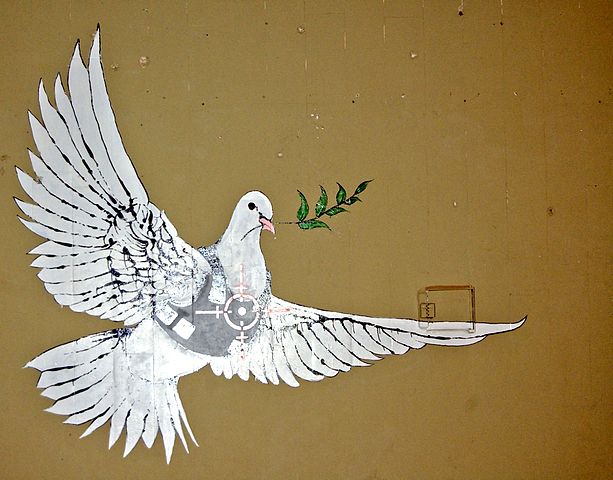
Many experts have proclaimed the death of the post‑1945 liberal international order, including the human-rights regime set forth in the 1948 Universal Declaration of Human Rights. The cover of Foreign Policy recently displayed the white dove of human rights pierced by the bloody arrows of authoritarian reaction.
According to ‘realist’ international relations theorists, one cannot sustain a liberal world order when two of the three great powers—Russia and China—are anti-liberal. Writing in Foreign Affairs, Yascha Mounk and Roberto Stefan Foa argue that the era when Western liberal democracies were the world’s top cultural and economic powers may be drawing to a close. Within the next five years, ‘the share of global income held by countries considered “not free”—such as China, Russia, and Saudi Arabia—will surpass the share held by Western liberal democracies’.
There are several problems with this argument. For starters, it relies on a measure called purchasing power parity, which is good for some purposes, but not for comparing international influence. At current exchange rates, China’s annual GDP is $12 trillion, and Russia’s is $2.5 trillion, compared to the United States’ $20 trillion economy. But the more serious flaw is lumping countries as disparate as China and Russia together as an authoritarian axis. There is nothing today like the infamous Axis of Nazi Germany and its allies in the 1930s.
While Russia and China are both authoritarian and find it useful to caucus against the US in international bodies like the United Nations Security Council, they have very different interests. China is a rising power that is highly intertwined with the international economy, including the US. In contrast, Russia is a declining country with serious demographic and public health problems, with energy rather than finished goods accounting for two-thirds of its exports.
Declining countries are often more dangerous than rising ones. Vladimir Putin has been a clever tactician, seeking to ‘make Russia great again’ through military intervention in neighbouring countries and Syria, and by using cyber-based information warfare to disrupt—with only partial success—Western democracies. A study of Russian broadcasting in Ukraine found that it was effective only with the minority that was already Russia-oriented, though it was able to produce polarising and disruptive effects in the political system. And the revival of Cold War–style information warfare has done little to create soft power for Russia. The London-based Soft Power 30 index ranks Russia 26th. Russia has had some success cultivating allies in Eastern Europe, but it is not part of a powerful authoritarian axis such as existed in the 1930s.
China is different. It has announced its willingness to spend billions to increase its soft power. At meetings in Davos in 2017 and Hainan in 2018, Xi Jinping presented China as a defender of the existing international order, but one with Chinese rather than liberal characteristics. China does not want to overturn the current international order, but rather to reshape it to increase its gains.
It has the economic tools to do so. It rations access to its huge market for political purposes. Norway was punished after the dissident Liu Xiaobo was awarded the Nobel Peace Prize. Eastern Europeans were rewarded after they watered down European Union resolutions on human rights. And Singaporean and Korean companies suffered after their governments took positions that displeased China. The Chinese government’s massive Belt and Road Initiative to build trade infrastructure throughout Eurasia provides ample opportunities to use business contracts to wield political influence. And China has increasingly restricted human rights at home. As Chinese power increases, the global human-rights regime’s problems will increase.
But no one should be tempted by exaggerated projections of Chinese power. If the US maintains its alliances with democratic Japan and Australia, and continues to develop good relations with India, it will hold the high cards in Asia. In the global military balance, China lags far behind, and in terms of demography, technology, the monetary system and energy dependence, the US is better placed than China in the coming decade. In the Soft Power 30 index, China ranks 25th, while the US is third.
Moreover, no one knows what the future will bring for China. Xi has torn up Deng Xiaoping’s institutional framework for leadership succession, but how long will Xi’s authority last? In the meantime, on issues such as climate change, pandemics, terrorism and financial stability, both an authoritarian China and the US will benefit from cooperation. The good news is that some aspects of the current international order will persist; the bad news is that it may not include the liberal element of human rights.
The human-rights regime may face a tougher environment, but that is not the same as a collapse. A future US administration can work more closely with the EU and other like-minded states to build a human-rights caucus. A G10, comprising the world’s major democracies, could coordinate on values alongside the existing G20 (which includes non-democracies such as China, Russia and Saudi Arabia), with its focus on economic issues.
Others can help. As Kathryn Sikkink points out in her new book, Evidence for hope, while US support has been important to human rights, the US was not always very liberal during the Cold War, and the origins of the regime in the 1940s owed much to Latin Americans and others. Moreover, transnational rights organisations have developed domestic support in numerous countries.
In short, we should be concerned about the multiple challenges to liberal democracy during the current setback to what Samuel P. Huntington called the ‘third wave’ of democratisation. But that is no reason to give up on human rights.
In less than a month, millions of people will turn their eyes upon Russia as the 2018 Football World Cup kicks off. On 23 May 2018, the NGO Civil Rights Defenders published FIFA’s reply to an open letter it and and 13 other international and Russian human rights groups sent to FIFA, urging the association to start engaging with the Russian authorities on the human rights crisis in Chechnya, especially the case of Oyub Titiev [see also: https://humanrightsdefenders.blog/2018/01/15/chechen-human-rights-defender-oyub-titiev-arrested-on-trumped-up-charges/].
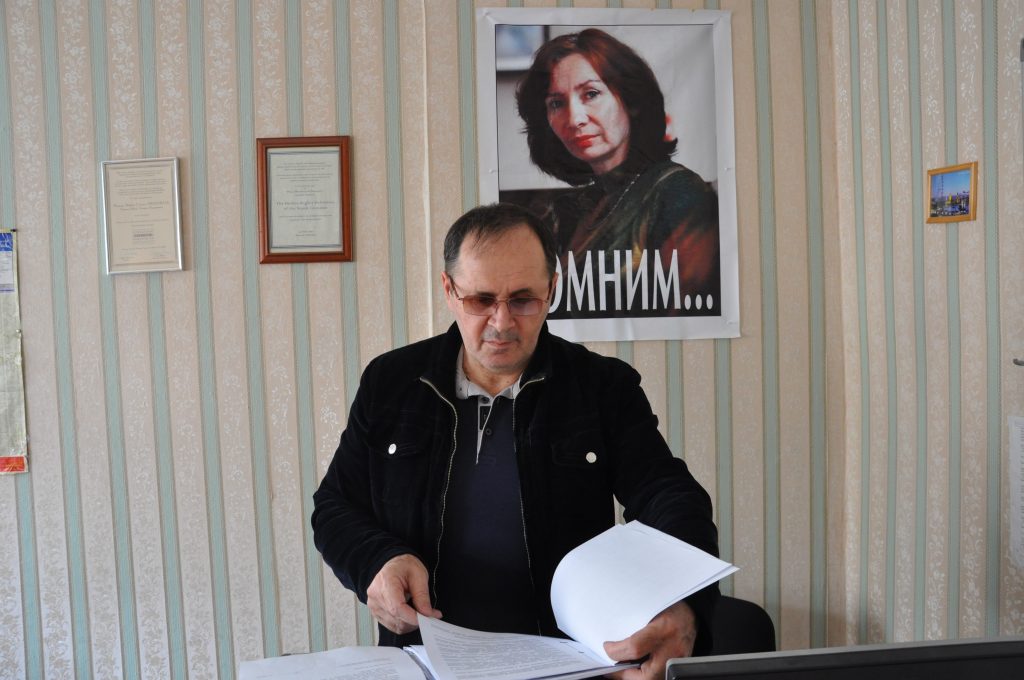
Oyub Titiev in Memorial’s local office in Grozny, Chechnya. In the background a portrait of his murdered colleague, Natalia Estemirova.
[In January 2018, Chechen authorities started a campaign against the leading Russian human rights organisation Memorial, by jailing prominent human rights defender and head of Memorial’s local office, Oyub Titiev, on fabricated charges. In February, it was announced that the capital of Chechnya, Grozny, was confirmed by FIFA as the team base for Egypt.]
“Such engagement is consistent with FIFA’s responsibility to respect human rights under the UN Guiding Principles on Business and Human Rights,” the letter addressed to Mr. Infantino, President of FIFA, read. “It is also consistent with the commitment in article 3 of FIFA’s statutes to promote the protection of international human rights, and would demonstrate determination to implement its new Human Rights Policy”. [see also: https://humanrightsdefenders.blog/2017/02/02/fifa-governance-committee-starts-dealing-with-a-human-rights-policy/]
FIFA has now replied (follow link for full text) to the letter, thanking the rights groups for raising concern about the detention of Oyub Titiev: “… FIFA values the important work done by human rights defenders such as Mr. Titiev and yourselves and is, in accordance with paragraph 11 of its human rights policy, committed to respect and help protect the rights of everyone who is working to advance human rights in relation to FIFA’s activities.”
This is quite a change from the traditional view that politics and sport have nothing to do with each other, but it does not say WHAT and with WHOM in Russia FIFA has taken up the case. That will probably remain confidential.
Justice and Peace NL is launching a new call for Human Rights Defenders to participate in the Shelter City Initiative which offers human rights defenders a possibility for rest and respite by letting them escape temporarily from a threatening situation. Shelter City offer a safe space to human rights defenders at a moment where they are particularly vulnerable and their security can no longer be guaranteed at home. The programme’s objective is to offer the human rights defender a shelter for three months, during which she/he will rest, build up capacity, extend her/his network and raise awareness about the situation in their country. At the end of the programme, participants are expected to return with new tools and energy to carry out their work at home. An important principle of the Shelter City Initiative is that human rights defenders can continue their work while they are temporarily relocated. From September 2018, eleven cities in the Netherlands will receive human rights defenders for a period of three months. Please circulate this message to all interested candidates who you may know. In order to be eligible to the Shelter City program, you must meet the following conditions:
The HRD should implement a non-violent approach in his/her work
They are threatened or otherwise under pressure due to their work.
They should be able to be relocated for a period of maximum 3 months. Limited spots are available for people who are not able to stay for the full 3 months;
They are willing and able to return to their country of origin after 3 months;
They are willing to speak publicly about their experience or about human rights in their country to the extent that their security situation allows.
They can speak basic English (limited spots are available for French or Spanish speaking HRDs);
They are willing and able to come to the Netherlands without accompaniment;
They are willing to begin their stay in the Netherlands around September 2018.
Note that additional factors will be taken into consideration in the final round of selection, such as the added value of a stay in the Netherlands as well as gender, geographic, and thematic balance.
To apply or submit the application of a human rights defender, please e-mail sheltercity@justiceandpeace.nl . You will then receive an application form. Application forms must be returned before 11 June 2018. An independent commission will select the participants.
Peter Sewakiryanga (left) and Margret Arach Orech after receiving their awards at a function in Bugolobi. Photo by Ashraf Kasirye
The 2018 Human Rights Defenders Award went to Margaret Arach Orech, the founder of Uganda Landmine Survivors’ Association and Peter Sewakiryanga, the founder of Kyampisi Childcare Ministries, an organisation that supports child victims of sacrifice.
Arach, who lost her leg to a landmine during an attack by the Lord’s Resistance Army (LRA) rebels in 1998, uses her organisation to solicit for support for fellow survivors and persons with disabilities.
Sewakiryanga, a pastor now takes care of 80 child survivors of trafficking and human sacrifice has built an extensive network linking communities and security to track suspected cases. In 2017, Sewakiryanga travelled to Oman to rescue six victims of child trafficking. He is credited for championing research and spearheading an awareness campaign in communities to stop the crime.




 Hans Thoolen on Human Rights Defenders and their awards