Now the NGO “Asian Human Rights Commission” (AHRC) published its own view in a Statement of 23 January 2019 entitled : “New imagination needed to understand global human rights situation.“.
Former UN human rights chief Zeid Ra’ad Al Hussein. AP Photo
After four years as an outspoken defender of human rights for the United Nations, Jordanian royal Zeid Ra’ad Al Hussein is set to continue his work as a member of The Elders, the group of statesmen formed by Nelson Mandela in 2007 to promote equality and world peace. Mr Al Hussein stepped down as UN High Commissioner for Human Rights last September after a four-year term in which he became became increasingly at odds with world powers he accused of failing to uphold the ideals of the very international system they created. His refusal to stand for a second term, because he expected to be opposed by these same countries, ended a stellar career of more than two decades in the United Nations. [see: https://humanrightsdefenders.blog/tag/zeid-raad-al-hussein/]
Ellen Johnson Sirleaf was Africa’s first female Head of State and former Liberian president, Ellen Johnson Sirleaf is a laureate of the Nobel Peace Prize.
Also joined former Colombian president Juan Manuel Santos, also a Nobel Peace prize winner.
The Elders Group is chair by former president of Ireland and former UN High Commissioner for Human Rights Mary Robinson.
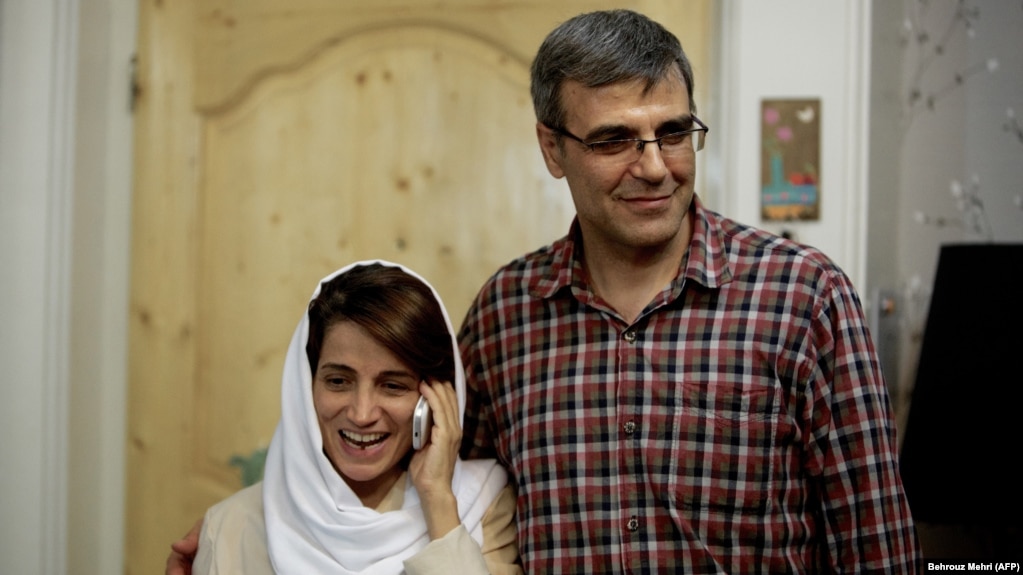
On 23 January 2019 RFE/RL reported that Iranian human rights defender Reza Khandan got a six-tear prison sentence. The next day Amnesty International issued a damning overview of the situation of human rights defenders in that country: Iran arrested more than 7,000 people in a sweeping crackdown against protesters and dissidents in the past year. See more below:
Rez Khandan with his wife, Nasrin Sotoudeh, in Tehran in 2013
2019 will see the Right Livelihood Award being presented for the 40th time. The RLF maintains an open nomination process, so anyone is able to propose any individual or organisation they feel are creating structural changes through concrete and successful work. The deadline for submitting a nomination is 1 March, 2019. For more on this and other such award see: http://www.trueheroesfilms.org/thedigest/awards/right-livelihood-award
Read more about the nomination process here. Do not hesitate to contact the RLF via email at research@rightlivelihood.org or by phone at +41 (0)22 555 0943 if you have questions about the nomination process. As is stated in the guidelines, proposals for the award must remain confidential and will not be published, as publicising of a proposal will unfortunately result in disqualification.
For last year’s winners: https://humanrightsdefenders.blog/2018/09/24/laureates-of-the-2018-right-livelihood-award-announced/
So the likelihood that tomorrow – 24 February – one or more are included in the final nominee list is pretty high.Here’s a quick guide to the five HRWFF title that made the short list.
Working with local journalists and spending more than three years with communities in Baltimore, Maryland, has made for one of the most unassuming films we have seen on policing and racism in the U.S. This brilliant film was directed by Marilyn Ness (who produced E-Team, a film featuring Human Rights Watch researchers working in crisis situations).
A hauntingly beautiful film, The Distant Barking of Dogsby Simon Lereng Wilmont embeds the viewer into the lives of two young boys growing up in eastern Ukraine on the conflict’s frontline. The film captures the boys’ diminishing innocence in the midst of war, while bringing to the fore the most basic human rights of life, liberty, and security.
Filmmaker Bing Liu shares a coming-of-age story shot over 12 years in Rockford, Illinois, where he captured footage of himself and two friends, young men bound by a love of skateboarding and the desire to escape volatile family life. The film grapples with the cycles of shame and abuse in a town with some of the highest rates of domestic abuse in the U.S. While navigating a relationship between his camera, his friends, and his past, Liu weaves a rich and epic story while remaining intimate and immersive.
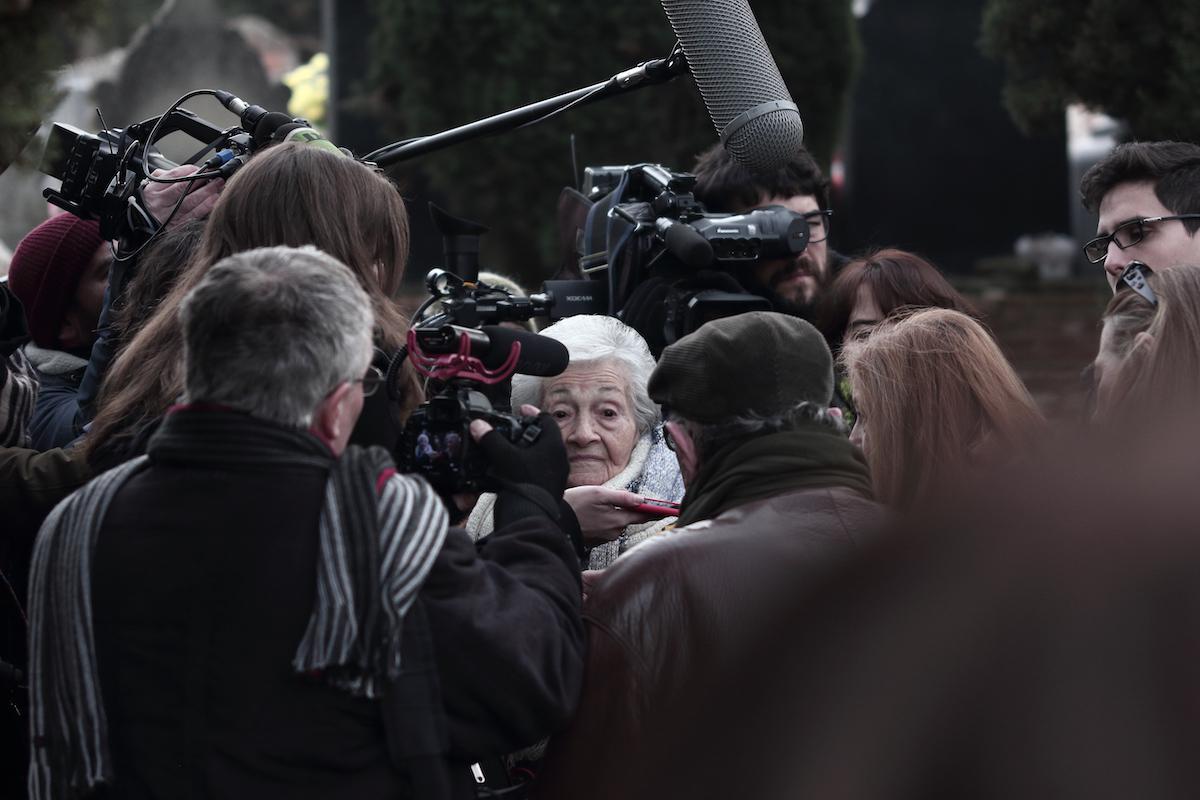
Almudena Carracedo and Robert Bahar’s film has won awards around the world, shedding light on a dark era of Spain’s history that haunts it to this day. Under General Francisco Franco’s rule, it is estimated that 100,000 people were disappeared and murdered. With its “Amnesty Law,” Spain prohibited legal recourse by survivors and families. The film follows brave people, assisted by others navigating international criminal processes in Chile and Guatemala, as they break the silence and seek justice.
In the last few years, the Academy Awards nominees for Best Documentary have diversified, as the Academy expanded the number of its members able to vote for documentaries, and increased the number of women and people of color who are members. We hope this will open up additional opportunities and support for people to tell their stories and share their perspectives,
Kaleck’s work has taken him to Buenos Aires, to stand with the mothers of youngsters “disappeared” under the Argentinian military dictatorship; to exiled Syrian communities, where he assembled the case against torture mandated by those high up in the Assad government; to Central America, where he collaborated with those pursuing the Guatemalan military for its massacres of indigenous people; to New York, to partner with the Center for Constitutional Rights in taking action against Donald Rumsfeld for the “enhanced interrogation techniques” he greenlighted after 9/11; and to Moscow, where he represents the whistle-blower Edward Snowden, “a likeable man whose talents go far beyond his technical skills.” In recounting his involvement in such cases, Kaleck gives voice to those he is representing, emphasizing the courage and persistence they bring to the global search for justice.
The Berlin book launch will take place on 6 February 2019 in Berlin (19h00) at the Denkerei, ORANIENPLATZ 2, where Wolfgang Kaleck will discuss – with Nadja Vancauwenberghe, publisher and editor in chief of Exberliner – today’s challenges and opportunities in the struggle for human rights. Syrian musician Abdahllah Rahhal is an international artists whose work aims to highlight humanity in every moment of life.. The event will be held in English and can be followed via livestream.
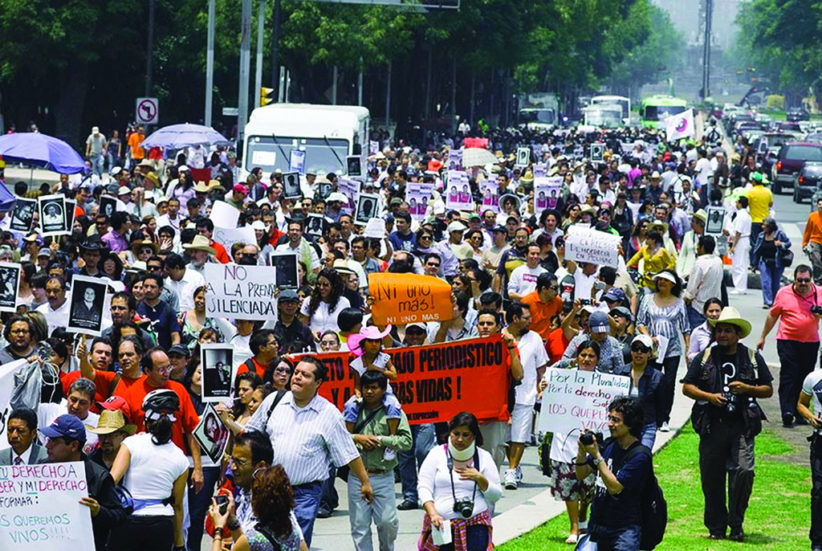
The body of 34-year-old Rafael Murua Manriquez was found by the side of a road in Northern Mexico Sunday 20 January 2019, the same day he had been reported missing by his family. The former director of the community radio station, Radiokashana in Santa Rosalia, has become the first Mexican journalist to be killed in 2019.
Within his news reporting, Rafael Murúa Manríquez, is believed to have denounced the aggressions of the municipal president of Mulegé Felipe Prado, according to El Comercio. Following a statement from the Mexican representative of the Committee to Protect Journalists, Jan-Albert Hootsen, it has also been confirmed that the young journalist had already received threats since last year and had been placed under the country’s journalist protection programme since 2016.
It is the second journalist to have been reported as murdered within the presidency of Andres Manuel Lopez Obrador, the first of which was killed just one day after his inauguration. The country’s leading NGOs and media protection agencies have since called upon a thorough investigation into the murder, in hopes of finding the people responsible.
At least ten journalists were killed last year alone, and in 2018 Mexico recorded the highest rate of press disappearances around the globe. The attacks continue on a long line of violence against the press throughout the past decade in Mexico as cartels brush shoulders with politicians creating a violent treat towards the investigation of ‘narcopolitics’. See also: https://humanrightsdefenders.blog/2018/03/24/new-national-award-to-honor-slain-mexican-journalists/
The Federal Mechanism for the Protection of Human Rights Defenders and Journalists, which is used by Mexicans who have had their lives threatened, came into play in 2012. However, the initiative is believed to already be overwhelmed with recent enrollment. …With both federal and state protection mechanisms, there are also concerns that journalists with state-level support are often seeking protection from the very authorities trusted with guarding them. Last year, Mario Gómez Sanchez was gunned down by armed motorbikers, however, human rights groups could not explain why his protection mechanism was removed before his killing. The State Attorney General’s office declined to comment when contacted by Aztec Reports.
Josephine Christopher reports that two human rights groups have initiated a special campaign on Tuesday, 22 January 2019, seeking to encourage the public to speak against violation of rights of suspects when they get arrested by the police force. The campaign titled: “Tetea haki za watuhimiwa (Defend the rights of suspects)” is a brainchild of the Legal and Human Rights Centre (LHRC) in association with the Tanzania Human Rights Defenders Coalition (THRDC). [see also: https://humanrightsdefenders.blog/2014/04/09/journalists-get-training-in-africa-examples-from-tanzania-and-south-sudan/]
Speaking in Dar es Salaam, the THRDC national coordinator Mr Onesmo Ole Ngurumo said violation of rights of suspects – held by law enforcers – was becoming a new normal in Tanzania, citing the recent ‘unlawful’ detention of three human rights defenders and two citizens at the Loliondo Police Station. “While in custody, the suspects were badly beaten badly. Besides, though they needed emergency medical care, the police continued to hold them in cells until their fellow inmates start rioting for their rights,” he said “Putting suspects under police custody for more than 24 hours without any legal assistance is a violation of human rights, considering that police don’t have the skills and resources to hold people for such long time,” he said.
he Russian authorities have for the first time used the repressive “undesirable organizations” law to open a criminal case against human rights defender Anastasia Shevchenko, exposing her to the risk of a six-year prison term. Until now, violations of this law were punished under administrative law.
This morning Anastasia Shevchenko, a Coordinator with the Otkrytaya Rossiya (Open Russia) movement, was charged with “repeated participation in the activities of an undesirable organization.” “In recent years, the Russian authorities have progressively suffocated and criminalized dissent. The Open Russia movement has become the latest victim of this crackdown,” said Marie Struthers, Director for Eastern Europe and Central Asia at AI.
It’s clear that the authorities are expanding their toolkit for imprisoning human rights defenders and activists, so if applied broadly this practice will have far-reaching implications for the right to freedom of expression.”In recent days, police have opened criminal investigations, conducted searches and arrests of Open Russia’s activists across the country. [see also my older post: https://humanrightsdefenders.blog/2015/05/21/russia-human-rights-ngos-likely-to-become-officially-undesirable/]
Background: On 17 January, Open Russia Coordinator in Pskov Liya Milushkina and her husband Artyom Milushkin were arrested and accused of selling drugs, an offense punishable by up to 20 years’ imprisonment. Artyom, who is also a political activist, previously reported that police officers threatened to plant drugs on him during his recent arrest in November. Amnesty International has interviewed several associates of the Milushkins all of whom are adamant that the criminal case against the couple is fabricated. Amnesty International has documented a number of cases in which activists in Russia have been prosecuted on trumped-up drug charges, including human rights defender Oyub Titiev who is currently standing trial in Chechnya. On 18 January, police filed a case against Open Russia Coordinator in Krasnodar Yana Antonova for posting a video about the shortage of schools in the region. She was charged with “participation in the activities of an undesirable organization”, an administrative offence when “committed” for the first time.
 Former UN human rights chief Zeid Ra’ad Al Hussein. AP Photo



 Hans Thoolen on Human Rights Defenders and their awards