Author Archive

Interview with Kenyan human rights defender Okiya Omtatah

September 3, 2019
The Kenyan newspaper the Daily Nation of 1 September 2019 carries a long profile of the human rights defender Okiya Omtatah. See also: https://humanrightsdefenders.blog/2018/12/03/human-rights-defenders-in-kenya-honored-with-national-awards/

Okiya Omtatah

Activist Okiya Omtatah at Milimani Law Courts on September 14, 2018. PHOTO | FILE | NATION MEDIA GROUP

1. The many petitions you have presented in court on behalf of Kenyans and the fact that you have succeeded in many of them points to a void in our public life as ordinary citizens created by the government through its many agencies. Sir, who is sleeping on the job that has prompted you to step in? How can we hold these public servants or institutions responsible as taxpayers for sustainable quality service delivery? Komen Moris, Eldoret

My activism is anchored on the Constitution of Kenya, 2010. My overriding objective is to the immense power of the Constitution to have the Judiciary entrench constitutionalism and the rule of law in the conduct of public affairs.

Hence, all the petitions I have filed concern public law, and they fall in three broad categories: motions challenging decisions of law-making institutions where I contest the constitutionality of statutes by Parliament or by county assemblies, and both the constitutionality and legality of subsidiary legislation; motions contesting the constitutional and legal validity of policy decisions and other administrative actions of the executive at both national and county levels, and motions seeking to protect public property from thieving public officials and private individuals.

From my experience, the struggle is against contemptuous disregard of the constitutionally prescribed limits and powers of government, and affirmation that Kenyans are not subjects but sovereign citizens with their rights and fundamental freedoms enshrined in the Bill of Rights. From the above, it follows that the solution to our problems is to uphold the Constitution. However, it is clear our political leadership has failed in its duty to whip us as a nation into fully implementing the Constitution so as to realise its great promise.

2. Not long ago you called on Kenyans to contribute towards instituting a suit against all the MPs over house allowances they had awarded themselves. How did this initiative go and how much were you able to raise? Githuku Mungai

The initiative was not for instituting the case but to pay for the costs of serving the petition on the MPs through full page adverts published in the Daily Nation and Standard newspapers as ordered by the High Court. I required at least a million shillings but only raised some Sh130,000.

3. Over the course of your public life, you have largely been plastered with two labels: a defender of public interest by many and a rebel to a few. This can be attributed to the many cases you have argued out in the corridors of justice, among them bank capping rates, judges retirement age, most recently the CBA-NIC tax waiver. These cases largely touch on the crucial interests of the ordinary citizen. I can’t help but ask, what is the philosophy behind what you do? Do you feel intimidated or shaken by the weight of cases you take on considering the fact that in many cases you take them on your own? Kagwera Raphael, Kisii

The philosophy behind what I do is the Gospel of Christ, who preached about God’s love and divine mercy, and continues to reveal that the Kingdom of God is among us and therefore we must do right. At creation time, God gave Adam and Eve the power over all that he had created, but He did not give them the power over themselves; He gave them the law.

And when they broke that law they lost the Garden of Eden. Hence, the rule of men is doomed since it is anathema to the will of God. Only the rule of law works. Hence, humanity cannot rule itself and prosper except by the laws anchored on promoting the rights and fundamental freedoms of all people – and that includes obeying the Constitution of Kenya, which largely mirrors the Gospel of Christ. I don’t feel threatened or intimidated by the cases I take on since I take them up as part of my apostolate. And for as long as God wants to use me to call upon all Kenyans to obey the law, I will be available to do so.

4. Having had a peaceful, respectful, issue-based and effective campaign for the Busia senatorial race during the 2017 elections, one which didn’t turn out as most of us had expected, what is your objective opinion on Kenyan politics and campaigns? Kagwera Raphael, Kisii

My Busia senatorial race was a very rewarding experience for me. Though I vied on a Ford-Kenya ticket in an ODM stronghold and, literally, I had no money to match what the incumbent unleashed, I chose the route of civic and political education to agitate for resource-based leadership and it worked very well. It was a neck and neck race where I got more than 100,000 votes, and the difference between me and the Senator wasn’t much. But even though we can’t cap the amounts of money candidates spend on campaigns, the amounts and their sources must be disclosed to law enforcement. That way, it will at least reduce the distortion illicit money has on the democratic process, especially on poverty-stricken populations scavenging for basics. We must also eradicate mass poverty at the grassroots.

5. Your nature of work in the areas of human rights demands that you really need a good and reliable sponsorship so to speak, or stable source of income from where you can get resources to mount the kind of legal challenges you undertake. What is the source of your income? What is your reaction to allegations that you are often paid to institute the cases you do? Francis Njuguna, Kibichoi

First of all I don’t need a lot of money because I don’t hire lawyers to research, draft and prosecute my cases. I do so myself. Second, I lead a very simple lifestyle which is basically a source of income through the savings I make. I have seen people who earn much more than I do lead very miserable lives due to reckless lifestyles. As for allegations, they are just that. It is human nature to speculate where you have no facts. And it is written in the Holy Book that John the Baptist ate not and he was called a madman; Christ ate and drunk and He was called a glutton.

6. Our history is full of examples of good human rights activists including yourself, Kepta Ombati, Cyprian Nyamwamu, Boniface Mwangi, among others who tried to unsuccessfully run for political office. No doubt, political office is an expansion of activism and movement work. What should good activists do to win elections and continue their good work as politicians? Raphael Obonyo, Nairobi

They should not give up and I don’t think they have. The society is changing and, soon, we will have issue-based politics and one’s ethnicity or capacity to give handouts will not be trump cards at elections. While still at it, I point out that Prof Kivutha Kibwana, the Makueni Governor who has performed exceptionally well, was and is an activist who was elected into office and has delivered on his convictions.

7. There is a popular joke in Kenya about the Judiciary: ‘Why hire a lawyer when you can buy a judge?’ Former Chief Justice Dr Willy Mutunga began ambitious efforts to transform Kenya’s courts and earn back the people’s trust. What is your assessment of the transformation at the Judiciary given that you frequently interact with them? Raphael Obonyo, Nairobi

The joke is just a joke. Whereas one or two judges may not be up to scratch, most judges and other judicial officers are very hard working individuals who deliver for Kenyans in very difficult situations. The Kenyan Judiciary is the only arm of government that retains and espouses Kenya’s republican character. We cannot compare the Judiciary to the Executive and the Legislature, at both national and county levels, which are totally captive to ethnicity and corruption

8. Due to the nature of your work, sometimes you challenge decisions of the powerful and mighty. Don’t you ever fear for your life when making such challenges? Have you ever received threats to have you drop the matter you are pursuing? Emmanuel Lesikito

Though I take precaution, I know that there are no human beings who are mighty and powerful. Only God is mighty and powerful. So I have no fear of any man and their threats, since God is my shield. No man can destroy my soul.

9. Of all the advocacy and litigation cases that you have undertaken in the interest of the public good, explain the one case that posed the greatest challenge and possibly a danger to your life. Nyongesa Chris Makhanu, Nairobi

A 2012 petition where I challenged the flawed procurement of the BVR kits which failed to work on Election Day. I was offered a bribe of Sh9 million to drop the case but I refused. I then applied to court for police protection but Justice Majanja dismissed my application. Two days later I was attacked by two men who hit my head with metal bars and left me for dead. As they were clobbering me, I could hear them say something to the effect that “Ulikataa pesa sasa utakufa na kesi yako pia itakufa” (You refused our offer; we are going to kill you and your case is going to collapse). But God saved me.

10. Do you really always read Kenyan’s mood before you move to court? I am referring to the case on the new currency, which by and large has been welcomed by a majority of Kenyans. Bernard Nyang’ondi, Mombasa

No, I am driven by fidelity to the law and the public interest.

11. Thank you for fighting for the common person. My question is: Fresh job seekers are required to produce a Certificate of Good Conduct and clearance certificate from Ethics and Anti-corruption Commission, among others. These requirements make me wonder, do jobseekers have to pay for not committing crime? Do they have to pay for not being corrupt? Why have you never gone to court to challenge these primitive requirements? Evans Muteti, Mombasa

Justice Odunga declared those requirements to be unconstitutional in the case that was filed by Justice GBM Kariuki. I also filed another case on the same — but it is pending at the High Court — to allow the Supreme Court to determine whether it will allow the High Court to proceed or it will hear an advisory reference on the same issue that was filed by the Kenya National Commission on Human Rights (KNCHR).

12 Sir, you are known to be one of the most relentless and leading human rights defenders in Kenya. You are no guest in our courts and all these court cases require resources. What motivates you? Geoffrey Oyoo, Embakasi East

The Holy Scripture, especially the teachings on the salt and light of the world; the Good Samaritan, and the call to be witnesses of Christ.

13. Recently, a young woman died at KNH after she developed maternal complications due to negligence by staff on duty. Of course many other preventable deaths occur in public hospitals due to negligence. Don’t you think it is more worthwhile to fight for the rights of such helpless victims as opposed to, say, pursuing elitist court cases like the one on new currency notes? Stephen Kathurima, Nairobi

There are no elites under the law. All are equal. Secondly, I believe in draining the swamp not waiting to kill every snake and mosquito that escapes from the swamp. The mess in our hospitals and other institutions is a rule of law problem. Let’s drain the swamp by implementing the Constitution and upholding the rule of law.

https://www.nation.co.ke/news/One-on-one-with-activist-Okiya-Omtatah/1056-5256164-l8pfwyz/index.html


First “True story award winners” named in Bern

September 2, 2019

The winners of the first-ever True Story Award were announced during a ceremony at the Reportagen Festival in Bern on Saturday 31 August 2019. Three journalists from three countries were given top honours for their exceptional and courageous reporting:

Journalist Aleksandr Burtin was awarded first prize and CHF30,000 for his profile of Chechen human rights activist Oyub Titiyev, who was imprisoned on fabricated charges. [see also: https://humanrightsdefenders.blog/2019/06/11/two-welcome-paroles-in-russia-and-zimbabwe-but-justice-is-still-to-be-done/] His report Monitor 1, first published in the Russian-language paper Meduza, was commended for its excellent narrative and the unexpected way it shined a spotlight on a forgotten war.

Second prize went to the American journalist Mark Arax for A Kingdom from Dust – a sweeping, in-depth investigation into the world of agribusiness in California. Arax was recognised for weaving social themes such as climate change, water resources and California history into the narrative.

Chinese journalist Du Qiang received the third spot for The Vagabond Club, capturing the lives of a rebellious group of migrant workers in Shenzhen. Qiang’s report was “the most surprising story of all the entries” according to the jury and was praised for the way it captured an unknown aspect of society.

The winners were chosen from 39 nominees who were selected from more than 900 submissions from 98 countries in 21 languages. All nominees were invited to the Reportagen Festival taking place on August 30-September 1, of which 36 are attending and sharing their stories throughout the weekend. The True Story Award is a global journalism prize. It aims to recognize quality journalism and make reporters’ voices known beyond the borders of their home countries, and in doing so to increase the diversity of perspectives offered in the media. Winners were chosen by an eight-member jury from eight countries that evaluated submissions based on their depth of research, the quality of the journalism and social relevance.

https://www.swissinfo.ch/eng/true-story-award_winners-of-first-global-journalism-prize-named-in-bern/45198318

NGOs call Canada’s revised guidelines on human rights defenders a step in the right direction

September 1, 2019

With human rights defenders increasingly under attack around the world, civil society organizations in June 2019 welcomed the Government of Canada’s revised guidelines aimed at strengthening its approach to ensuring the safety and security of these courageous activists. In 2016 [see https://humanrightsdefenders.blog/2016/12/13/canada-joins-select-group-of-governments-with-guidelines-on-human-rights-defenders/] they were first made public. After input from civil society, the government now has revised and updated the guidelines.

.. The groups welcome Canada’s acknowledgement that human rights defenders put themselves at great risk—along with their families, communities and the movements they represent—as they work to promote human rights and strengthen the rule of law. Women and LGBTI human rights defenders, for example, face high-levels of sexual and other forms of gender-based violence because of their gender and the rights they are advocating for. “In many parts of the world, human rights defenders are at risk as a result of their courageous work and their willingness to speak truth to power. Canada and the international community need to be strong supporters of these brave individuals. Human rights defenders must be able to act freely and without any interference, intimidation, abuse, threats, violence or reprisal. We are committed to speaking out against violations, standing up for human rights defenders and striving for a world where the rights and freedoms of all people are respected,” said Foreign Affairs Minister Chrystia Freeland on 17 June in Ottawa at a human rights event where the guidelines were announced.

For Canada’s new guidelines to be effective in helping to protect and support human rights defenders, they will need to be accompanied by a comprehensive implementation plan and increased Canadian funding going directly to human rights defenders and the movements they represent.  Canada also needs to take a stronger approach to support human rights defenders advocating for corporate accountability, for instance, by enabling robust investigations when defenders face heightened risks linked to private sector investments.  It will also be critically important that Canada create an advisory body that includes the participation of human rights defenders with experience and first-hand knowledge of the threats facing human rights defenders….

Importantly, the new guidelines call for Canadian diplomats working abroad at overseas missions or at Global Affairs Canada headquarters in Ottawa to take a more feminist and intersectional approach to promoting the rights of defenders. The document notes that many human rights defenders have multiple and “overlapping” identities, and often work on multiple issues.  Human rights defenders may belong to one or more groups facing discrimination, including women, LGBTI people, Indigenous people, land and environment defenders, people with disabilities, journalists, and those seeking greater freedom of religion or beliefs.  Human rights defenders in conflict and post-conflict countries face unique risks posed by high levels of militarization.

Quotes from Canada’s Voices at Risk: Canada’s Guidelines on Supporting Human Rights Defenders

Canada recognizes the key role played by human right defenders in protecting and promoting human rights and strengthening the rule of law, often at great risk to themselves, their families and communities, and to the organizations and movements they often represent.

Canada’s guidelines on supporting human rights defenders is a clear statement of Canada’s commitment to supporting the vital work of HRDs.”

Endorsed by:
  • Amnesty International Canada
  • The MATCH International Women’s Fund
  • Nobel Women’s Initiative
  • Oxfam Canada
  • United Church of Canada

https://www.oxfam.ca/news/canadas-new-guidelines-to-support-human-rights-defenders-a-step-in-the-right-direction/

Irwin Cotler in Canada receives Heintz Award for Humanitarian Achievement

September 1, 2019
Irwin Cotler

On 1 September 2019 Sohail Choudhury reported in Blitz that the founding Chair of the Montreal-based Raoul Wallenberg Centre for Human Rights (RWCHR), Dr. Irwin Cotler, was awarded the Heintz Memorial Award for Humanitarian Achievement.

Presented at the International Humanitarian Law Dialogues, the event brought together the founding Prosecutors and Presidents of the world’s International Tribunals and Courts, along with other top international legal experts. The gathering was organized in partnership with the Robert H. Jackson Center, named after the U.S. Supreme Court Justice who served as Chief Prosecutor at the Nuremberg Trials of Nazi War Criminals. In the words of the Jackson Center, “Cotler has been a long-time champion of human rights and supporter of modern international criminal law. As Minister of Justice for Canada, he made the pursuit of international justice a government priority. As an international human rights lawyer, he served as counsel to numerous prisoners of conscience, including Nelson Mandela and Salah Uddin Shoaib Choudhury. His continued work in founding the Raoul Wallenberg Centre places him at the center of human rights advocacy.

https://www.weeklyblitz.net/news/irwin-cotler-receives-heintz-award-for-humanitarian-achievement/

More than 400 Global Shapers Meet in Geneva to Spark Global Change – why not start with Saba Kord Afshari?

August 30, 2019

The World Economic Forum announced that from 30 August to 1 September 2019 more than 400 members of the World Economic Forum’s Global Shapers Community of innovators, activists and entrepreneurs under the age of 30 meet in Geneva to Spark Global Change. The theme of the summit is Leading for Impact. The Shapers, representing about 150 countries, will share their experiences, their impact and the lessons learned in managing grassroots projects in their local Global Shaper Hubs and through regional and global collaborations. They will also participate in skills-building and leadership-development workshops.

The summit will focus on enhancing leadership in the community’s three main impact areas: standing up for equity and inclusion, protecting the planet, and shaping the future of education and employment.

In the past year, Shapers in 125 cities have developed grassroots projects to promote equity and inclusion, including awareness campaigns, education initiatives and skill-building efforts to reduce barriers to women in the workplace, increase civic engagement among minority groups and advocate for the rights of refugees.

Perhaps a good case would be that of Saba Kord Afshari who for the simple act of removing her hijab and taking a video was made a “criminal” in Iran. #SabaKordafshari was sentenced to 24 years prison for #WalkingUnveiled and being voice of the voiceless. Activists call on the world, all politicians, all celebrities, MeToo movement – and why not the Shapers of the WEF ? – to take action.

Today, 30 August, International Day of the Victims of Enforced Disappearance

August 30, 2019

Many NGOs pay today attention to the International Day of the Victims of Enforced Disappearances. Here the example of AfricanDefenders (Pan-African Human Rights Defenders Network) which published the following on 27 August:

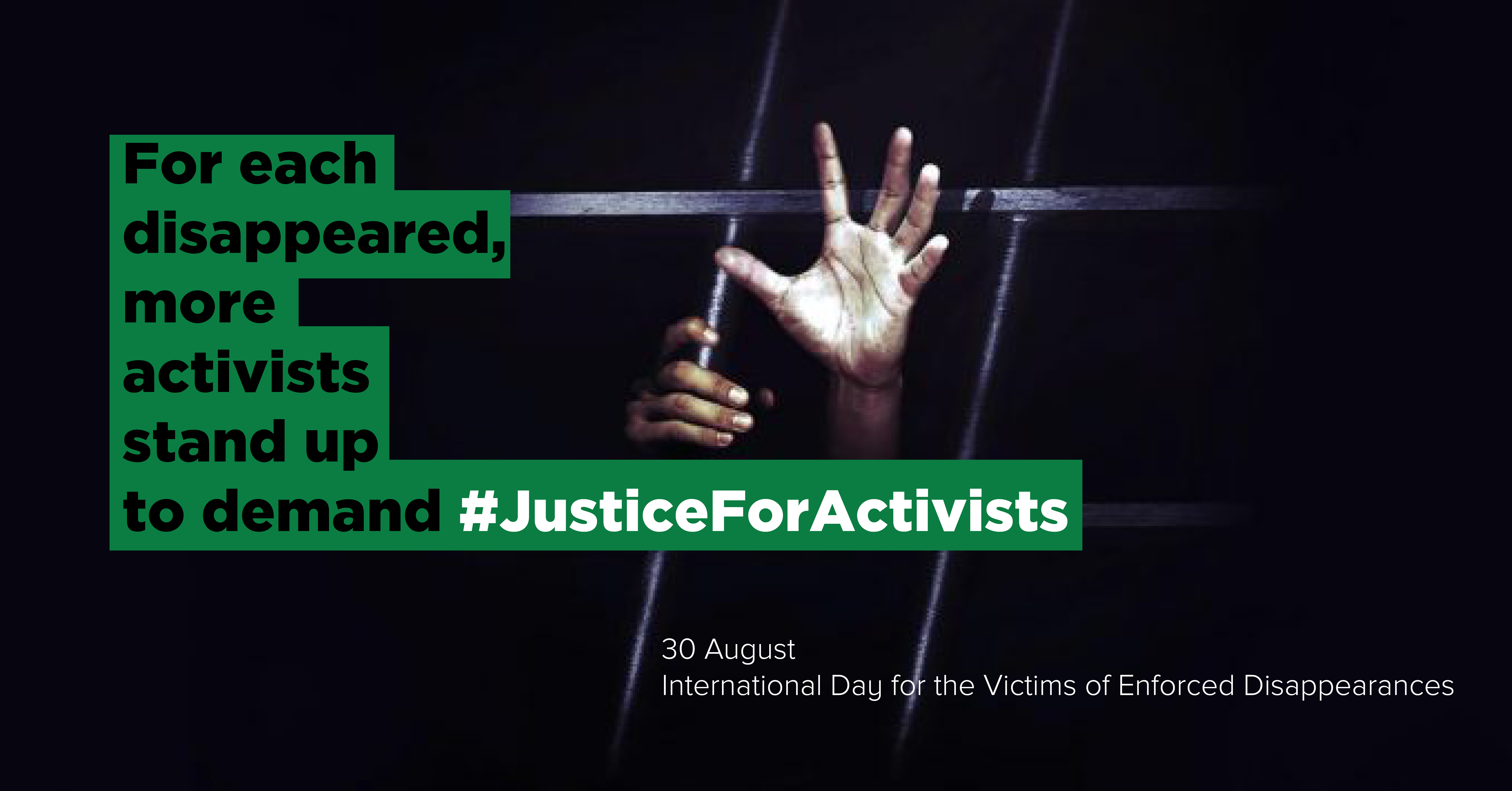
For each disappeared, more activists stand up! Stop enforced disappearances against human rights defenders

On 13 April 2015, Sandra Kodouda, a Sudanese human rights defender (HRD), was abducted in Khartoum, Sudan by a group of unidentified men. Three days later she returned home with a dislocated shoulder and clear signs of physical abuse. [see: https://humanrightsdefenders.blog/2015/04/17/update-sandra-kodouda-in-sudan-injured-but-back-from-illegal-detention-by-niss/]

Some months later, on 10 December 2015, Burundian HRD Marie Claudette Kwizera was abducted in Bujumbura, Burundi by individuals believed to be members of the Burundian National Intelligence Service (SNR). Marie is still missing.  

The cases of Sandra and Marie are not unique – it was just one of the few cases of enforced disappearance of African HRDs that made the headlines. Every year, African activists disappear without a trace, and without any media coverage. More importantly, no investigation is carried out, and no accountability is ensured. The alleged perpetrators continue to walk the streets, or, in most cases, rule the country, without any repercussions. Meanwhile, the victims are often tortured and many are killed, or live in constant fear of being killed, and the family and friends of the victim are left in the agony of not knowing the fate of their beloved. 

In international human rights law, an enforced disappearance occurs when a person is abducted or imprisoned by state agents or by a third party with the authorisation, support or acquiescence of the state, followed by a refusal to acknowledge the person’s fate and whereabouts, which place the victim outside the protection of the law. When used systematically, it constitutes a crime against humanity according to the International Convention on the Protection of All Persons Against Enforced Disappearances (ICPPED). 

Yet, it is a longstanding, systematic, and widespread tactic, often used by governments to silence HRDs, and as a strategy to spread terror within society. During the 1990s in Algeria, it is estimated that at least 7000 critical voices were abducted by government forces alone during the civil war. In Egypt, the Egyptian Commission for Rights and Freedoms’ campaign, “Stop Enforced Disappearances”, has documented more than 1000 cases of enforced disappearances of HRDs under Al-Sisi’s regime. During the current revolution in Sudan, hundreds of peaceful protests were abducted, disappeared, allegedly by the security forces. The fate and whereabouts of most of the victims remains unknown.

Despite threats and reprisals, the families and the communities of the victim continue to stand up and call for justice. For instance, every year,  Burkinabe students commemorate Dabo Boukary, a student activist who disappeared during student protests in 1990. In Burundi, the impactful campaign “Ndondeza” (where are they?) continues to put pressure on the government and to call for justice. For each person that disappears, more activists stand up.

On 30 August, we commemorate the International Day of the Victims of Enforced Disappearance. We call on states to investigate cases of enforced disappearance and to ensure accountability; to ratify and implement the International Convention for the Protection of all Persons from Enforced Disappearances; and to ensure adequate reparations to the survivors, and their families.

We continue to stand in solidarity with HRDs that have disappeared, been tortured, and/or killed. We continue to demand #JusticeForActivists.

For each disappeared, more activists stand up! Stop enforced disappearances against human rights defenders

Human rights defenders at Gymnich’ meeting in Helsinki

August 30, 2019

Sometimes small announcement are the most interesting: Foreign Ministers from 28 EU countries continue their ‘Gymnich’ meeting in Helsinki today, 30 Augsut 2019. On the agenda they’ll be discussing the situation in the Middle East, hybrid threats, the Arctic and the wildfires in the Amazon rainforest. Over lunch ministers will get the chance to meet with international human rights defenders to hear their stories. …..


https://newsnowfinland.fi/domestic/morning-headlines-friday-30th-august-2019

Hollywood celebrities and human rights: backlash from China

August 30, 2019

Jocelyn Neo in the Epoch Times of 17 August 2019 traces the backlash from China against some of Hollywood’s best-know names for standing up against China on human rights related matters. As most of this is some time ago it is mostly for the record as this blog likes to keep up with star power and human rights [see e.g.: https://humanrightsdefenders.blog/2014/02/10/star-power-and-human-rights-a-difficult-but-doable-mix/%5D.

Read the rest of this entry »

European Court rules on Sergei Magnitsky’s death

August 29, 2019

Ilham Tohti one of the finalists for the Vaclav Havel Human Rights Prize

August 29, 2019

Photo courtesy of Martin Ennals Award

Ilham Tohti, a Uyghur scholar who has been serving a life sentence in Chinese prison since 2014, has been chosen as a finalist for the Vaclav Havel Human Rights Prize.  [see: http://www.trueheroesfilms.org/thedigest/awards/vaclav-havel-prize-for-human-rights-pace].  The Germany-based Ilham Tohti Initiative e.V. (ITI) had nominated Prof. Tohti to the Prize on April 29, with support of four other human rights activists and NGOs. [see also: https://humanrightsdefenders.blog/2018/01/15/today-ilham-tohti-completes-his-fourth-year-in-chinese-detention/].

The decision as to the Prize winner will be made by the Selection Panel on 29 September 2019, and its name will be announced in the Chamber of the Parliamentary Assembly of the Council of Europe in Strasbourg, on 30 September 2019 at 12:30pm. The award ceremony for the Prize will subsequently take place in the presence of all three shortlisted candidates. Two other candidates, who have also been shortlisted are Mr Buzurgmehr Yorov (Tajikistan) and the Youth Initiative for Human Rights.

The UNPO is currently campaigning for Mr. Tohti to also be awarded the Sakharov Prize saying that such prizes are an excellent way in which the international community can continue to show support for the Uyghur people in the face of hostile oppression.

China’s predictable reaction came quickly: “Beijing slammed on Thursday the nomination of a jailed academic from China’s Uighur minority for one of Europe’s top human rights awards, saying it equated to “supporting terrorism”.

https://unpo.org/article/21639

https://www.straitstimes.com/asia/east-asia/china-says-uighur-award-nomination-is-supporting-terrorism