Author Archive

South Sudan’s President Salva Kiir has released two human rights activists

January 8, 2020

Garang Malak reports in the Kenyan newspaper the Nation that South Sudan’s President Salva Kiir has released two human rights activists who were jailed for criticising the government. The order, dated January 1, 2020, included a list of 30 inmates most of who had been imprisoned on minor offences and had shown good conduct while in detention. But it also included Peter Ajak Biar [see: https://humanrightsdefenders.blog/2019/03/30/seven-persons-charged-in-south-sudan-including-peter-biar-ajak/ ]and Keribino Agok Wol, critics of President Kiir’s regime. The two were detained in July 2018 before they were jailed in June 2019. Mr Biar, 35, a PhD student at Cambridge University, had called on top leaders in Juba to resign and give the younger generation a chance to lead the country.
https://www.nation.co.ke/news/africa/Salva-Kiir-pardons-key-critics-Peter-Biar–Keribino-Wol/1066-5405914-h4dloxz/index.html

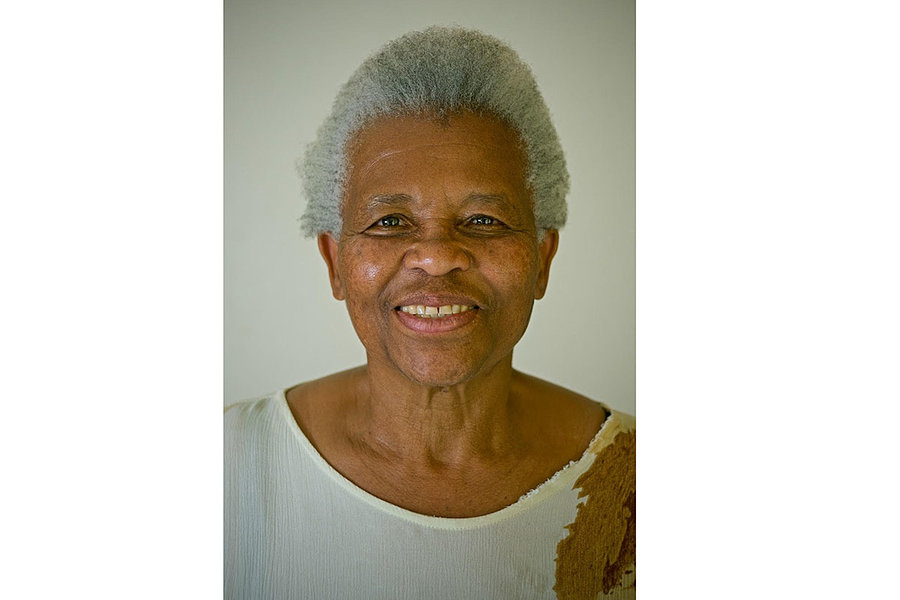
More about MEA finalist Sizani Ngubane from South Africa

January 7, 2020
staff writer on the Christian Science Monitor published on 6 January 2020 a Question and Answer piece with Sizani Ngubane, the South African land rights defender who became a finalist for the Martin Ennals Award [see: https://humanrightsdefenders.blog/2019/11/26/breaking-news-mea-has-3-women-hrds-as-finalists-for-2020/ ]
The first inkling Sizani Ngubane had that she might grow up to be an activist came when she was just 6 years old. It was the early 1950s, and while her father, a migrant worker, was away from the family home near the eastern city of Pietermaritzburg, his brother evicted her mother from their land. “You’re a woman,” she remembers her uncle telling her mother, “so you have no right to this property if your husband isn’t around. Those were the early years of apartheid, South Africa’s infamous system of white minority rule, and a woman like Ms. Ngubane’s mother had few places to turn. The white government wasn’t likely to be on her side, and neither were the men in charge in her own community. At 6, of course, Ms. Ngubane didn’t know exactly what was happening, but her mother’s humiliation told her all she needed to know. “From that experience I just said to myself, when I grow up I want to be part of the people who are going to correct these wrongs,” she says. 

In the 70 years since, indeed, she has become the voice for tens of thousands of women like her mother. In the late 1990s, Ms. Ngubane was a founding member of the Rural Women’s Movement, which today counts some 50,000 members. Among other work, the organization fights to make sure women have access to, and ownership over, the land on which they live and work. This has been a major challenge in many rural areas under the authority of semi-autonomous traditional chieftaincies that were originally set up by the apartheid and colonial governments. These leaders have often been reticent to give more rights to women. As South Africa’s government mulls over whether to expropriate some land from white owners and return it to the country’s black majority, her work has become all the more urgent – and complicated.

Ms. Ngubane spoke by phone with the Monitor’s Johannesburg bureau chief Ryan Lenora Brown about why land is so important in South Africa, and what keeps her going as an activist.

Since the start of democracy in South Africa, there’s been a program to provide land or money to people who were stripped of their land during the colonial or apartheid periods. But it’s moved slowly, and over the last few years, there’s been a lot of talk about expropriating land – that is to say, redistributing the land, whether current landowners want that or not. What do you think of that idea? And do you think it will really happen?

I support it. A large percentage of South African arable land is still in the hands of white people, even though they are a small minority in this country. How equal is that? How constitutional is that? But the problem now is that our government is not really doing anything about it. They promised us in the 1990s that by 2014 they would have redistributed 30% of land into hands of original users. I say users and not owners because in our culture land is not owned. Mother Nature was not a commodity that could be bought and sold. But only about 10% of that land has been returned to date. So I think those promises were politically motivated to get people to come out and vote in elections. I don’t see real transformation of the land situation happening anytime soon.  

Why is access to land so important for South African women in particular?

When you begin to give land to women, a lot of abuses in society are eliminated. They can feed their own families without fear of being evicted. They can inherit land when their male relatives die. And most importantly, they are not so controlled by the men in their lives. Because when land is the main value of a society and women cannot own land, we are nothing. We are not 100% human beings. It is easy to abuse and abandon us. So the land is the only way out for us.

What is the accomplishment you’re most proud of? 

The thing I’m most proud of isn’t necessarily any legal battle we’ve won. It’s the fact that before we started this movement women in many rural communities were not empowered to speak. Now we see our women speaking up for their rights, even at national and international levels. And no one tells them to shut up, because we have taught them that this is our constitutional right. [The men] know they must listen.

You’ve been an activist for nearly six decades. And there are still more battles to be fought. Right now, for instance, you’re preparing to go to court as part of a challenge against the Ingonyama Trust, an organization run by the Zulu king Goodwill Zwelithini that controls an area in eastern South Africa the size of Belgium. I’m wondering what keeps you going through battles like this one. 

It comes from my heart. From when I was 6 years old I knew exactly what I was going to do with my life. Don’t ask me how exactly I knew there was a world outside that rural community where I grew up. The only other place I had ever seen was the city of Pietermaritzburg [10 miles away], where I went once a year with my mother to buy school shoes. But somehow I knew even then I was going to grow up to see the world, and learn from it. And that’s exactly what I’ve done.

——

On 28 November 2019 Kim Harrisberg reports for the Thomson Reuters Foundation about the “Death-Defying South African Nominated for International Human Rights Award“. A South African women’s land rights activist who has been stabbed with a knife, slapped with a gun and hit by a speeding car and those are just a few of the murder attempts on Sizani Ngubane who is currently in hiding to prevent further attempts on her long life of activism.

“We cannot separate women’s land rights from gender based violence in South Africa,” said the 74-year-old activist who frequently champions women’s access to land in rural KwaZulu-Natal (KZN) province. “We are celebrating 25 years of democracy, but rural women are still treated like children. It is not in line with our constitution,” Ngubane, founder of the Rural Women’s Movement (RWM) land rights group, said in a phone interview.

Land is a hot topic in South Africa, where President Cyril Ramaphosa last year launched a process to change the constitution with a proposed redistribution of land aimed at addressing high levels of inequality. But in KZN, Zulu King Goodwill Zwelithini controls 2.8 million hectares of land, a fragmented sub-tropical area the size of Belgium, under an entity called the Ingonyama Trust established in 1994. The Zulu monarch wants President Cyril Ramaphosa to sign an agreement promising to exclude territories that the king controls from land reform.

Land rights activists are challenging the control wielded by such traditional authorities over rural communities, particularly on women who are often evicted once widowed. “The trust has turned communities into tenants by leasing ancestral land to them,” said Ngubane, adding that a compulsory rent, rising 10% every year, had to be paid by community members who otherwise face eviction.

Ngubane, along with rights groups, is challenging the Ingonyama Trust in Pietermaritzburg High Court in March 2020. The work of the Rural Women’s Movement includes finding housing for evicted women and children, helping grow food on communal land for the hungry and sick, campaigning for better legal protection of women’s land rights and more. “We are like one big family,” Ngubane said. “We have now begun to spread our wings into different parts of the country.” Launched in 1998, the Rural Women’s Movement has grown to 50,000 women, said Ngubane.

Ngubane said there was retaliation and danger involved in challenging the traditional authorities, citing burnings, kidnappings and beatings of outspoken women and men. “My dream is that one day KwaZulu-Natal will be like other provinces, where women’s rights are seen as human rights and women are given the same power over land that men are keeping for themselves,” Ngubane said.

https://www.csmonitor.com/World/Africa/2020/0106/A-woman-s-right-to-her-land-Q-A-with-Sizani-Ngubane

Death-Defying South African Nominated for International Human Rights Award

https://www.businesslive.co.za/bd/national/2019-11-28-human-rights-award-nominee-in-hiding-as-she-fights-for-womens-land-rights/

Mexico: in eight years 99.5% of crimes against media workers have gone unsolved – time for something better

January 4, 2020
Protesters call for justice for a Michoacán journalist who was victim of an assault last September and then harassed by police. Protesters call for justice for a Michoacán journalist who was victim of an assault last September and then harassed by police.

In that context, National Action Party Senator Marco Antonio Gama Basarte last month presented a proposal that seeks to create a new, completely autonomous special prosecutor’s office to investigate crimes against both journalists and human rights defenders. Mexico needs a strong and independent prosecutor’s office in order to “guarantee the institutional commitment we have with journalists and people who defend human rights,” he said while presenting his bill on December 12.

The senator also said that an average of 23 journalists per month requested government protection last year, adding that the funds to provide such protection were cut in the federal budgets for both 2019 and 2020. President López Obrador has come under fire for contributing to a culture of violence against journalists by launching scathing verbal attacks on reporters and news outlets that are critical of his government. The president often dismisses reports with which he doesn’t agree by declaring that they come from the prensa fifi (elitist press) and has called journalists and news outlets “puppets,” “hypocrites” and “two-faced,” among other disparaging terms.

After López Obrador criticized a story published by the Mexico City-based newspaper Reforma in April last year, the paper’s editor received death threats and was a victim of harassment.

Article 19, a press freedom organization, said at the time that the president’s “stigmatizing discourse [against the media] . . . has a direct impact in terms of the . . . risk it can generate for the work of the press because [his remarks] permeate in the discourse of the rest of society and can even generate attacks.” The organization demanded that López Obrador “abstain from generating any act that inhibits the exercise of freedom of expression,” adding “this includes maintaining a stigmatizing discourse” against the media.

Source: El Financiero (sp) 

https://mexiconewsdaily.com/news/prosecutor-for-crimes-against-journalists-has-closed-4-of-803-cases/

Dakar Rally starts on 5 January in Jeddah but HRDs in jail

January 4, 2020

Ross LaJeunesse and human rights policy at Google

January 3, 2020
The former Google Exec said it was driven out after trying to start a human rights program

An illuminated Google logo can be seen in an office building in Switzerland on December 5, 2018. (Arnd Wiegmann / Reuters)

Several newspapers (here the BBC) wrote on 2 January 2020 about ex-Google executive Ross LaJeunesse revelations concerning the firm’s human rights policy. This matters more than usual in view of Google’s self-professed commitment to human rights, e.g. in the context of the Global Network Initiative (GNI) which brings information technology companies together with NGOs, investors and academics. Founding companies are: Google, Microsoft, and Yahoo!. GNI’s principles and guidelines provide companies with a framework for responding to government requests in a manner that protects and advances freedom of expression and privacy. Companies that join GNI agree to independent assessments of their record in implementing these principles and guidelines [see https://humanrightsdefenders.blog/2013/05/23/facebook-joins-the-global-network-initiative-for-human-rights/. Or by providing funding [see e.g. https://humanrightsdefenders.blog/2019/05/08/excellent-news-huridocs-to-receive-1-million-from-google-for-ai-work/].

A former Google executive has raised concerns about the tech giant’s human rights policies as it eyes expansion in China and elsewhere. Ross LaJeunesse, the firm’s former head of global international relations (until May last year), said he was “sidelined” after he pushed the company to take a stronger stance. Google defended its record in a statement, saying it has an “unwavering commitment” to human rights.

Mr LaJeunesse is now campaigning for a seat in the US senate. He said his experience at Google convinced him of the need for tougher tech regulations. “No longer can massive tech companies like Google be permitted to operate relatively free from government oversight,he wrote in a post on Medium.

Google’s main search business quit China in 2010 in protest of the country’s censorship laws and alleged government hacks. But it has since explored ways to return to the country, a major market, stirring controversy.bLaJeunesse said Google rebuffed his efforts to formalise a company-wide programme for human rights review, even as it worked to expand in countries such as China and Saudi Arabia. “Each time I recommended a Human Rights Program, senior executives came up with an excuse to say no,” he wrote. “I then realized that the company had never intended to incorporate human rights principles into its business and product decisions. Just when Google needed to double down on a commitment to human rights, it decided to instead chase bigger profits and an even higher stock price.

Google said it conducts human rights assessments for its services and does not believe the more centralised approach recommended by Mr LeJeunesse was best, given its different products.

View at Medium.com

Alex Neve of AI Canada wants us to put human rights first in the new decade

January 3, 2020

..If ever there was a need for a resolution for a new decade, this is it: put human rights first.

…This decade has been a breathless time of mass mobilization, as staggering numbers of people have spilled out into public squares, streets and alleyways in communities large and small: The “Arab Spring” protests across the Middle East and North Africa, Idle No More, Black Lives Matter, FridaysForFuture climate strikes, the #MeToo movement and Women’s Marches and the March for Our Lives against gun violence in the United States. Protesters who refused to give up have toppled cruel leaders, stopped unjust laws and catalyzed struggles against deep inequities in Sudan, Hong Kong, Chile, Haiti, Algeria and Lebanon; and have been met with terrifying violence from security forces leading to hundreds of deaths in Iran and Iraq.

The decade has also been marked by the tension of technology’s wonders and threats. The digital world has opened up exciting new platforms of communication and means of accessing and sharing information, often to considerable benefit for human-rights movements. However, we have also witnessed an explosion of hate, racism and sexism on social media; growing awareness that the rise of artificial intelligence brings unimagined human-rights worries; and new tools of state surveillance and intrusion into our privacy that pose some of the most insidious and chilling threats to human rights that we have ever seen.

Above it all – as we move into the 2020s – the urgency of responding to the gravest human-rights challenge of our time, the global climate crisis, deepens daily. And the outright refusal of governments and businesses, including in Canada, to pursue climate action and deliver climate justice that is truly and ambitiously serious, stands out as perhaps the most unforgivable human-rights failing of the decade. The decade behind us reminds us that the threats to human-rights protection run deep and demand vigilance; the power of the people is, ultimately, unstoppable; there is great risk in embracing all that technology offers without addressing its many perils; and that if we do not safeguard our one and only shared global climate, all of our human-rights effort will ultimately be for naught.

And therefore with deep resolve it is imperative and it is incumbent upon us all to make the 2020s a very different decade.

  • A decade in which women’s equality, women’s leadership and women’s power is consistently at the fore.
  • A decade in which we at long last deliver the commitment – an empty one for far too long – of a world that will “never again” witness mass atrocities.
  • A decade in which we all live up to our shared, personal responsibility to say no to racism, bigotry and hate.
  • A decade that tackles the climate crisis; finally embracing the catastrophic reality that without a climate, all human-rights struggles inevitably mean nothing.
  • Quite simply, a decade that – no matter the cost, the inconvenience, the controversy or the opposing interests – puts human rights first.

See also: https://humanrightsdefenders.blog/2019/07/09/environmental-defenders-in-alberta-canada-be-warned-oil-will-get-you/

https://www.theglobeandmail.com/opinion/article-a-resolution-for-a-new-decade-put-human-rights-first/

Sri Lankan human rights defender barred from legal practice appeals to Supreme Court

January 2, 2020

Dr Kumaravadivel Guruparan filed a Fundamental Rights Petition in the Supreme Court of Sri Lanka last week, challenging the decision of the University Grants Commission and University of Jaffna to bar him from legal practice.

The senior lecturer of law at Jaffna University and prominent civil society representative was barred from engaging in private practice following pressure from the Sri Lankan military, after he took up a public interest habeas corpus case into the 1996 disappearance of more than two dozen Tamil youth.

The incident drew outrage from around the world, with hundreds signing a statement condemning the ‘threats, harassment and reprisals’ against the prominent human rights lawyer and the international human rights organisation Front Line Defenders has issued an urgent appeal. See: https://www.frontlinedefenders.org/en/profile/kumaravadivel-guruparan

https://www.tamilguardian.com/content/jaffna-university-senior-lecturer-appeals-legal-practice-ban-supreme-court

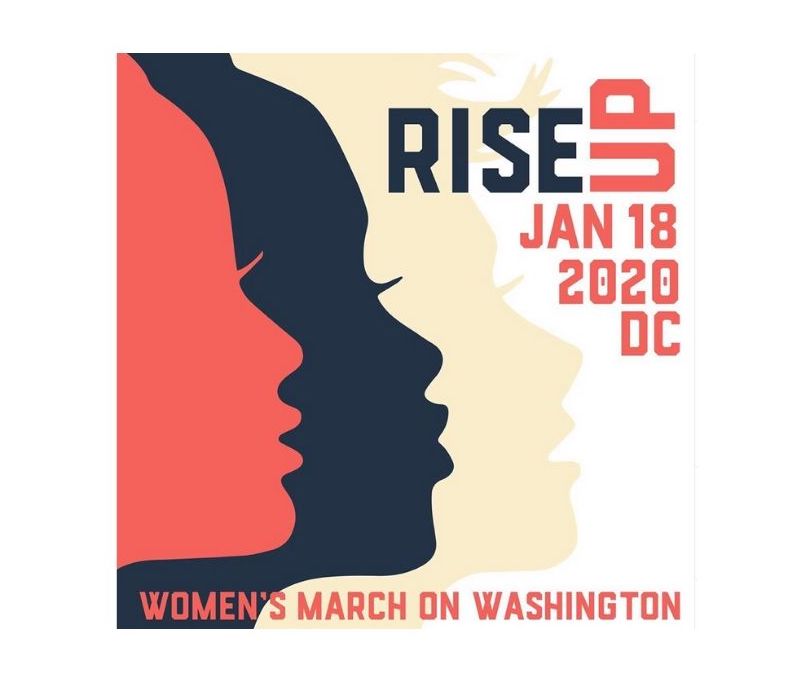
4th Annual Global Women’s March is on 18 January 2020

January 1, 2020
2020 women's march BELatina

On January 21st of 2017, millions of women and allies around the world took to the streets to make themselves seen and heard, demonstrating to advance women’s human rights. Now, nearly three years later, the Women’s March movement has announced that on 18 January, 2020, feminists and women’s human rights defenders will march yet again in the 4th Annual Global Women’s March.

Common Dreams also reported that women and men alike marched in France, Spain, Uganda, and other countries in November 2019 to demand that their elected officials work to end violence against women. In Spain, tens of thousands of people marched to recognize the day. But as the New York Times reported, the country’s far-right Vox Party—which, though still a minority party, doubled its representation in Parliament in recent elections—used the opportunity to affirm its opposition to a law aimed at protecting women from gender-based violence. Women gathered at City Hall in Madrid shouted, “This is shameful!” as Vox secretary-general Javier Ortega Smith spoke out against the law and called for national attention to men who are killed by their partners.

Women during a protest on the commemoration of the International Day for the Elimination of Violence Against Women, in Nantes, France, on November 25, 2019. (Photo: Estelle Ruiz/NurPhoto via Getty Images)

As part of the global effort, the International Labor Organization (ILO) called for ratification of its new Convention, adopted in June, to recognize the right of all people to be free from harassment and violence in their workplaces. “This commitment now needs to be turned into concrete, practical action,” the ILO wrote. “Violence and harassment in the world of work has enormous human, social and economic costs. Violence and harassment constitutes one of the greatest threats to decent work. No more excuses. Let’s work together and make the promise of Convention No. 190 a reality for all.”

It’s Official! The 4th Annual Global Women’s March is in January of 2020

Welcoming the New Year with civil society in Geneva

January 1, 2020

ISHR and  HRCnet are hosting a welcome reception for Ambassador Elisabeth Tichy-Fisslberger, the incoming President of the Human Rights Council. On Thursday 16 January 2020, 6:15pm – 7:30pm, Rue de Varembé 1, Geneva, Ground Floor Conference Room. This will be an opportunity for civil society colleagues, human rights experts and diplomats to meet and greet the incoming President and Vice-Presidents and wish farewell to the outgoing Bureau in a relaxed atmosphere. As space is limited, you need to register for this event.

Please click here to register before 12:00 noon on Monday 13 January. And for those who won’t be in Geneva that night: ISHR would love to hear your thoughts about what the Human Rights Council’s priorities for 2020 should be. Feel free to share them on Twitter using #HRC2020 and we’ll share a selection with the incoming HRC President. ISHR thanks the Permanent Mission of Australia for its contribution to the civil society welcome reception.

A HAPPY NEW YOUR TO YOU ALL

with hope for 2020

December 31, 2019

I wish you all a very good 2020 and can only hope – against a lot of evidence to the contrary – that next year will be better for human rights defenders. Let’s hope that the Malaysian cartoonist Zunar is too pessimistic with his:


https://www.zunar.my/toons/2020-is-coming/